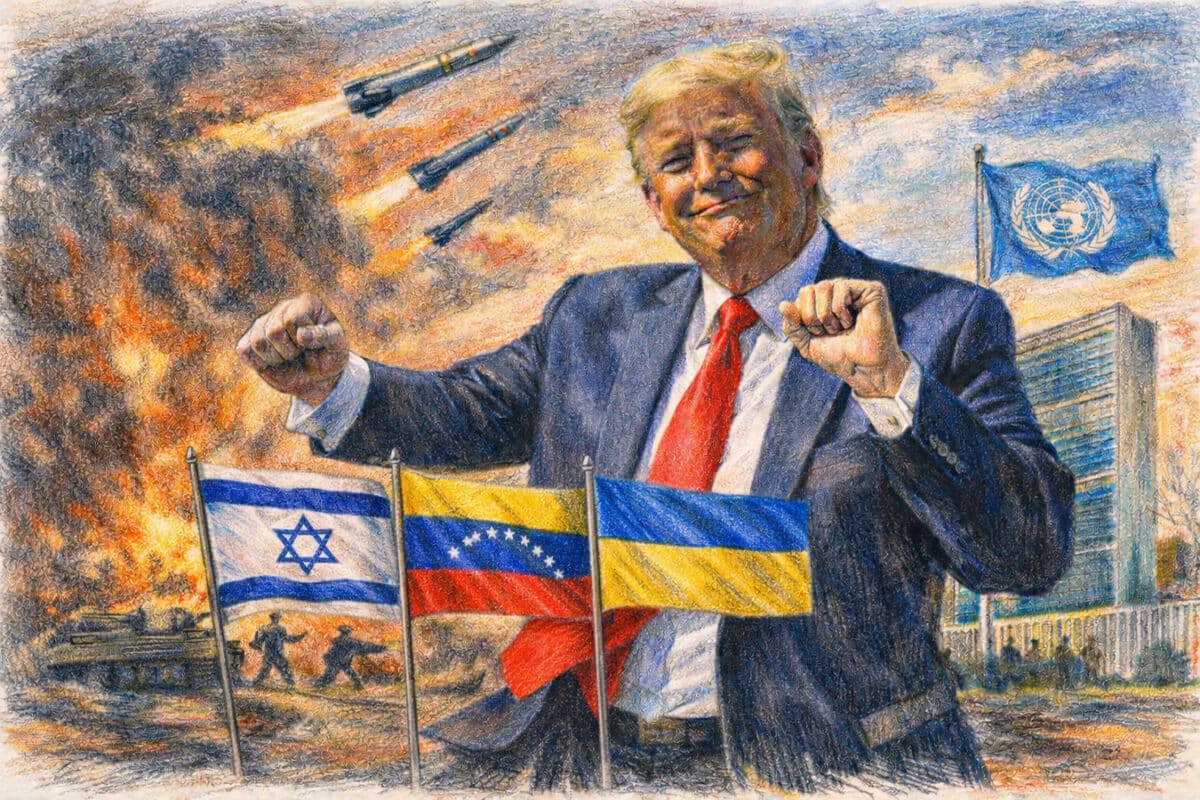
Davos shifts focus: Ukraine fades into the background, Greenland comes to the forefront

On the sidelines of the World Economic Forum in Davos, European leaders suddenly adjusted their priorities. Instead of discussing security guarantees for Ukraine, the key topic became the situation around Greenland — reports Financial Times, citing sources in diplomatic circles.

The shift in the agenda became noticeable even before the start of official sessions. Preparations for meetings and the format of discussions changed, and issues concerning Ukraine took a back seat amid new risks in the Arctic and trade threats.

How the agenda changed

Initially, the meeting of national security advisors from Western countries in Davos was planned as a discussion on supporting Kyiv and long-term guarantees. However, at the last moment, the focus shifted to Greenland — due to threats of tariffs and the need for de-escalation.

European capitals, preparing for contacts with Donald Trump, are rethinking their tactics. Ukraine remains on the agenda, but in a “deferred decision” mode, while the Arctic and trade risks require immediate reaction.

Diplomats’ doubts

There is skepticism within the delegations. One diplomat directly expressed doubt: discussing security guarantees for Ukraine at the same table with Trump is difficult due to a lack of trust. These sentiments, according to FT, are shared by several European teams.

Formally, it is about pragmatism. Unofficially, it is an attempt to avoid direct confrontation at a time when Washington signals readiness for tough measures.

Emergency EU steps

FT sources indicate that leaders of the European Union are preparing an emergency summit this week — likely on Thursday, immediately after contacts with Trump. Italian Prime Minister Giorgia Meloni informed partners that the American president shows interest in compromises, although the parameters of these concessions are still unclear.

The trigger was the escalation around Greenland over the weekend. Then Trump announced his intention to impose tariffs against eight countries that sent military forces to the island, which caused a sharp reaction from European leaders and led to urgent consultations.

What’s next in Davos

The next round of discussions will take place directly in Davos from January 19 to 23. Special attention is given to Trump’s pre-announced speech on January 21 — it is expected to provide signals on trade, security, and the Arctic.

In this configuration, Greenland becomes a test of Europe’s ability to act in a coordinated manner. The issue is not only about military presence but also about the rules of the game — from tariffs to strategic control of the region.

Arctic line of tension

According to experts, the methods of pressure appear tough and require responsive actions from the EU. European capitals are seeking a balance between de-escalation and demonstrating readiness to protect interests.

This balance — between Ukraine, the Arctic, and transatlantic relations — forms the real agenda of Davos this year. How it will be implemented will become clear in the coming days, closely monitored by NAnews — News of Israel | Nikk.Agency.

Liat Aharon: a public confession about money, music, and the attempt to return to the profession

Liat Aharon — an Israeli singer and actress, remembered by many for her work on children’s television and past projects — recently published a sharp, very personal post: she is in a financial crisis and needs help to start earning from her art again.

Her words lack a “beautiful legend” about a creative slump. It’s about everyday reality: she used to feel strong and secure, but now admits she doesn’t see a clear way to “bring herself to the world” and monetize what she does. She writes openly that in difficult moments she blames herself and falls into a sense of failure and despair.

Aharon separately describes something familiar to many Israeli creative people: advice like “find a marketer,” “get social media consultation,” “just make the right content plan” sounds logical, but in reality turns into noise when you’re simultaneously trying to survive, work “to the bone,” and raise children. She talks about concentration problems and how, because of this, any “right steps” become almost unattainable.

At the same time, she emphasizes: this is not about asking for “money for nothing.” She is looking for someone to sell her concert program and work on a profit-sharing model. Simultaneously, she is asking to find someone to help with social media — either for payment or for a percentage/share of future income if the project succeeds.

To make it clear that this is not a “vacuum” dream, Aharon describes her current work: she has two albums at different stages. One is produced by Tsach Drori. The other she is making at home herself — more electronic in sound, literally assembled through home mastering of software. She calls these materials strong but admits: she still doesn’t understand how to bring them to the listener.

There is also a pragmatic calculation: if her current performance is purchased now, this money will go towards specific release expenses — paying musicians and recording, mixing, basic PR. In the post, she mentions wanting to cover debts and expenses for specific recording participants, as well as complete technical stages without which a song doesn’t become a product.

Against this backdrop, the media reminded of her biography, which part of the audience had already forgotten. Aharon started in the group “Young Tel Aviv,” appeared in series, served in the Education and Youth Corps ensemble, led TV projects, worked as a host on a children’s channel, and left there in the mid-2000s. Later, she released music and simultaneously moved into other activities.

Another line is her life after leaving the industry: she shared that she studied shiatsu, shifted towards the therapeutic field, adheres to a more “natural” lifestyle, and made care products by hand.

The reaction to her post followed a familiar pattern. Many supported her: “not everyone who can create must be able to sell,” “it’s not shameful to delegate promotion,” “recognition does not equal stability.” There were also colder responses — but overall, the discussion brought to the surface a topic increasingly talked about in Israel: how artists survive between high living costs, family burdens, and a market where attention rarely converts into money without a separate “promotion” profession.

This story is not so much about “talent” — she already has that — but about the gap between past recognition and today’s stability. Returning to the industry in 2026 means not just writing songs again. It means finding a bridge between the author and the market: a person or team who can package creativity, sell performances, build communication, and turn music into working income.

And if this story has a continuation, it will show not “who is right,” but whether in Israel there is that very link — artist + management + distribution — that can pull people out of silence back into the profession. NNews — Israel News | Nikk.Agency

“Trump’s Peace Council”: 60+ invitations, starting with Gaza and global concern about the role of the UN

The White House has begun sending invitations to dozens of countries to join a new body that Donald Trump calls the “Council of Peace.” The letters mention a “new approach” to conflict resolution, with Gaza being the first topic of work — against the backdrop of attempts to move to the second, most difficult phase of agreements on ceasefire and management of the sector.

The very idea of a “parallel structure” immediately raised concerns among diplomats. In unofficial conversations, the same question is heard: is this an additional tool that helps where the UN is too slow, or an attempt to create a competitor to the United Nations and shift political legitimacy to a platform controlled by Washington.

What the project starts with and what it is intended to be tasked with

According to the initiators, the “Council of Peace” should start with Gaza issues. Key tasks include the political and administrative “reassembly” of sector management, international security support, the creation of a new Palestinian administrative structure, disarmament of Hamas, and the launch of a large-scale reconstruction program.

Importantly, this format is presented not as long multilateral diplomacy, but as a mechanism for “quick decisions”: regular meetings, working groups, targeted agreements that can be promptly secured by the political will of leaders.

Who is part of the “executive core” and why this became a separate signal

One of the reasons for increased attention is how the “executive contour” is formed. Discussions mention:

  • U.S. Secretary of State Marco Rubio

  • Special envoy of the U.S. President Steve Witkoff

  • Jared Kushner (relative and closest associate of Trump)

  • Former UK Prime Minister Tony Blair

  • Several other high-ranking figures from international institutions and business

The list of names is interpreted in two ways. On one hand, these are people with negotiation experience and influence. On the other — the participation of Trump’s close circle reinforces suspicions that the new structure will not be “supranational” in the classical sense and will remain a political tool of one center.

“Permanent seat” for a billion: the financial part that sounds like politics

The most controversial point is the financial model. The project discusses the idea: countries that want to obtain a “permanent seat” must contribute $1 billion. For others, a rotational membership principle is proposed for up to three years with the possibility of extension.

At the level of political psychology, this looks like an “entry ticket” into the international security architecture, where money turns into status. And it is this moment that causes internal discomfort for many governments: it is no longer just about helping Gaza and reconstruction, but about who and under what conditions gets the levers of influence.

Reaction of world capitals: from cautious “yes” to noticeable tension

The most openly positive signal, according to reports from diplomatic circles, was given by Hungary — Budapest declared its readiness to participate.

Other countries formulate responses cautiously. Where they say “we are ready to contribute,” they almost always add: there are no details, few legal frameworks, unclear powers, financial control mechanisms are undisclosed. This is a classic diplomatic formula when they do not want to slam the door but are not ready to sign up for the unknown.

Why the UN comes up again — and what does the European rhetoric “we will not be intimidated” have to do with it

For diplomats, the central concern is not that another “council” is emerging. The concern is that it may start taking over functions that previously went through the UN: mandates, monitoring, coordination of “peace formulas,” distribution of financial aid, the right to exclude a participant from the process.

Against this backdrop, the political stance “not to succumb to pressure” is strengthening in Europe — it is heard in various topics, from Ukraine to more exotic cases. In public statements by European leaders, the idea is increasingly heard: intimidation should not work either on Ukraine or on any other areas of international politics. This rhetoric is not only about specific crises — it’s about the rules of the game.

What this could mean for Gaza — and why many think beyond Gaza

Formally, the project starts with Gaza. But the structure itself is easily scalable: if it works, it can be applied to any conflict zone — from Ukraine to other “complex” regions where diplomacy is stalling.

There are two opposing scenarios:

  1. Pragmatic. The new format accelerates decisions, helps raise funds for reconstruction, creates pressure on conflict parties, and provides quick security mechanisms.

  2. Systemic risk. The new format becomes a club of influence, where status is bought, rules are changed according to the political will of the chairman, and international institutions lose meaning because key decisions go “bypassed.”

Conclusion: the idea is fast, but the price may be high

Many see the “Council of Peace” as an attempt by Trump to show effectiveness where traditional diplomacy seems endless. But it is precisely the speed and concentration of power that worries governments: if the new body really starts working as a competitor to the UN, the world may not get a more effective security system, but competition of institutions and a struggle for legitimacy.

Question to readers: if such a structure works — will it be a useful “accelerator of peace” or a dangerous precedent after which international rules will finally become a matter of the political will of the strongest?

And yes — you will have to watch closely: as soon as the official list of countries and final membership rules appear, it will become clear whether this is a project “on declarations” or a new reality of world politics. NAnews — News of Israel | Nikk.Agency will keep you informed because all this directly concerns both Israel and Ukraine, and how decisions about war and peace will be made in the future.

Katya from Ukraine: the story of a lone MAGAV soldier who survived cardiac arrest and a bureaucratic deadlock. How society proved stronger than the system

Almost all of her service took place during the “Iron Swords” war. After demobilization, Katya dreamed of a peaceful life. But a few days later, her heart stopped — and the system almost left her without treatment.

Most of you have already heard the story of the new repatriate from Ukraine — Katya, who shocked many.

The young repatriate, lone soldier, and the sudden boundary between “before” and “after”

Katya is a cheerful, smiling girl, a new repatriate from Ukraine, a graduate of the NA’ALE program. She came to Israel as a teenager: studied at the “Kaduri” school in Nof HaGalil, adapted, made plans, and sought friends who have since called her a bright person, “the very person who always kept the company afloat.” Her mother lives in Ukraine, in Odessa.

We already told Katya’s story on May 4, 2025 – A touching surprise was arranged for lone soldier Katya from Ukraine for Israel’s Independence Day — a meeting with her family, who remained in Ukraine, in the city of Odessa, under shelling.

She consciously chose her path in the army: served in MAGAV as a lone soldier, without relatives nearby. Almost all her service fell during the “Iron Swords” war. Hard shifts, constant tension, stress — Katya endured it all steadfastly.

November 12, 2025 she was demobilized. For the first time in many months, a peaceful future seemed ahead.

But a few days later, everything ended.

The details of the story were told on November 25, 2025, by the channel “Haifa Day and Night | Haifa Day&Night” and its founder Anna Polisuchenko.

“Katya experienced clinical death.” What happened that day

About a week after demobilization, on the street, in broad daylight, Katya’s heart suddenly stopped. No prior illnesses, no warning symptoms. The girl just fell, lost consciousness — and that was it.

Passersby nearby immediately began resuscitation. They performed heart massage, used a defibrillator. Only thanks to their reaction was Katya “kept” until the ambulance arrived.

In the “Ichilov” hospital in Tel Aviv, doctors continued the fight: stabilized her breathing, achieved the restoration of heart activity, and brought her out of clinical death. But it became clear — without a pacemaker installation and long rehabilitation, Katya would not survive.

Then something happened that seemed impossible in 2025: bureaucracy put the operation at risk

Soldiers leaving the army have a clear procedure: they automatically return to the health fund they were in before service. But between submitting documents and the actual status update, there is a “transition period” — usually a few weeks. It was during this period that Katya’s heart stopped.

Formally, she was no longer in the IDF system, but not yet registered in the civilian fund.

Legally, the fund has no right to refuse a demobilized soldier. But on paper, her status was still “in transit.” The result:

the operation was “in question” only due to untimely updated checkmarks in the computer.

There were no medical or insurance obstacles. The pacemaker is included in the state basket. But bureaucracy blocked the treatment.

Journalists, bloggers, deputies, friends: how the community intervened and turned the situation around

Katya’s story began to spread across Israeli (including Ukrainian) social media segments almost instantly. Through journalistic chats and blogger channels.

Real people started calling, writing, knocking on all doors.

Katya’s foster mother* under the NA’ALE program said on Channel 13 a phrase that instantly went viral:

“She was good enough to fight for the state — but not good enough to receive life-saving treatment?”

*The NA’ALE program assigns each teenager who comes to study in Israel without parents a foster family or adult mentor — a person who helps with everyday life, adaptation, and becomes a contact person in the country. This is not adoption, but a form of social support so that the child has an adult to turn to at any moment.

And this phrase resonated in many offices.

The decision came on the morning of November 26: Clalit approved the operation

After a series of appeals, publications, pressure from journalists and deputies, and thanks to the work of dozens of people “in the shadows,” Clalit approved the installation of the pacemaker and registered Katya in the system retroactively from November 14.

The operation was scheduled at the “Ichilov” hospital.

It was a victory for the community. But not the end.

Now Katya faces surgery, rehabilitation, and months of recovery. And the financial pressure is enormous

Katya’s mother flew in from Ukraine, leaving everything behind. She does not leave her daughter’s side for a minute. But their expenses are huge, and they have not disappeared:

  • housing for the mother near the hospital,
  • medications and treatment,
  • rehabilitation after surgery,
  • expenses to maintain Katya’s apartment,
  • basic living until Katya can return to work.

The fundraiser led by Katya’s friends is official, verified, and transparent. It has been supported by dozens of channels, media, and bloggers. But the needed amount is still far off.

Fundraising link: https://giveback.co.il/project/88146

Why this story exposed a systemic problem in Israel

Katya’s case is not unique. It shows:

  1. The transition of soldiers from the IDF system to the civilian one leaves a “gray zone.”
    A person formally exists between two systems — and sometimes this concerns life or death.
  2. In 2025, bureaucracy should not be an obstacle to treatment.
    This is not a medical dispute or a complex case, but a simple question of status in the database.
  3. The community acted faster than the system.
    Journalists, activists, friends, and just concerned people — all got involved instantly, acted clearly, and coordinated.
  4. Changes in laws and instructions are needed.
    So that such situations are not resolved manually through public resonance.

Katya is not an impersonal case. She is a person who served, helped, and deserves help herself

Many in Israel know her: she lived, studied, worked, and participated in volunteer life.
Her acquaintances say that Katya was the person who always noticed if someone was struggling.

Now she herself is in a harsh reality: having survived clinical death, heart surgery, and months of recovery.

But what is striking — despite everything, acquaintances say: “Katya is strong. She is fighting.”

Previously: Surprise for Israel’s Independence Day: Katya saw her mother and brother for the first time in two years

In the spring of 2025, before demobilization and the tragedy of the sudden heart stoppage, there was a moment in Katya’s life that many who know her now return to. In honor of the 76th anniversary of Israel’s Independence Day, Channel 14 ITV prepared a special gift for her — a warm, emotional meeting with her family, who all this time remained in Ukraine, in the city of Odessa, under shelling.

Katya, while serving in Israel, said on air that her mother and brother remain in Odessa, where the situation with shelling remains extremely difficult. Kateryna’s mother had never been to Israel, and Katya herself could not visit her family due to the war.

The emotions Katya experienced when her family appeared in the studio became the culmination of the broadcast.

She had not seen her mother and younger brother for two years, and thought that the closest communication with them was only possible by phone.

That is why the moment when she saw her relatives in the festive broadcast was a real miracle. The emotions were sincere and strong: Katya did not hide her tears and told the studio how hard it was all this time to live away from her family, knowing they were under constant shelling.

Her words were as follows:

“I couldn’t hug them for two years. We kept in touch only by phone, and of course, it’s very hard to be away from your family, especially when they are going through such difficult times.”

This meeting became one of the most touching moments of the festive broadcast. For viewers — an episode about human closeness, which reminded how important it is to support lone soldiers. For Katya herself — a rare moment of happiness during a difficult service and separation.

The event then became a symbol of strengthening ties between Israel and Ukraine: Katya served Israel while her family lived under shelling in Odessa. This contrast was painful and important — which is why the story resonated in the hearts of thousands of people.

Why it is important to spread this story

Because it is not only about pain and struggle.
It is about people who — regardless of origin, language, or city — stood up for a girl who served Israel and found herself between two systems.

This is the story of a new repatriate from Ukraine who went through war, survived a heart stoppage, and continues to fight for life — while her mother sits by the hospital bed, and friends and the community do everything possible to support.

And it is a story about how society can be stronger than bureaucracy.

Let Katya see that she is not alone

Every donation is not just an amount.
It is a signal to Katya, her mother, family, and everyone who has faced similar situations: you are seen, you are important, you are not alone.

Katya’s story is not about pity.
It is about a lone soldier who gave Israel years of service and now deserves one thing — a chance to live peacefully.

She was supported by friends, journalists, bloggers, deputies, ordinary people.
Now we will be there until the end.

How we can help now

The situation has formally moved — the operation is agreed upon. But recovery will take months. The mother needs housing near the hospital. Katya will not be able to work. Huge sums are spent on medications, rehabilitation, and living expenses.

Therefore, help is still critically important. And still urgent.

Official fundraiser:

https://giveback.co.il/project/88146

This is a verified fundraiser from Katya’s friends. The money goes directly to the family’s expenses. No intermediaries.
In the Ukrainian village where the father of Yitzhak Rabin and writer Haim Hazaz were born, Putin’s soldiers looted an Israeli flag from the library, which was gifted to the village by the state of Israel.

Let’s think about the symbolism of this action: Russian soldiers take the flag of Israel as a trophy from a Ukrainian village.

Between the forests of the Chernobyl disaster zone, closed to visitors, and Bucha — the site of genocide perpetrated by the Russian army in the suburbs of Kyiv, lies the Ukrainian village of Sidorovychi, where the classic of Hebrew literature Haim Azaz and Nehemia Rabichev — the father of Yitzhak were born.

Original and full version of the article – (Eng) Ukrainian Jewish Encounter.

At the end of the 19th century, both the village and the entire region were often part of the “Pale of Settlement.”

In 1886, Nehem Rabichev was born in Sidorovychi. At the age of 18, he emigrated to the USA (1904) and there changed his surname to Rabin. After moving to the Land of Israel, he had his firstborn son – the future Prime Minister of the State of Israel Yitzhak Rabin (1922-1995).

Nehemia Rabichev was a member of the Tel Aviv City Council for many years, one of the first employees of the Israel Electric Corporation, and a member of the Executive Committee of the trade unions.

Twelve years after Nehemia Rabichev’s birth, the famous future Hebrew writer Haim Azaz (1898 — 1973), the first laureate of the Israel Prize for Literature (1953) and a member of the Academy of the Hebrew Language, was born in the same village.

His father managed a sawmill, so the future writer’s childhood was spent in a small house in the middle of a dense forest.

This forest near the Ukrainian village became the setting for a dramatic plot and one of the natural characters in Azaz’s first novel “In the Forest” (1930, Tel Aviv). Descriptions of nature and forest life from this novel later became classics of Hebrew literature.

Return to the Roots

The connection between Israel and Sidorovychi was renewed in 2011, when, on the initiative of the head of the educational project “Limmud” Haim Chesler, a memorial plaque was installed in the village in honor of Nehemia Rabichev and his children.

A memorial plaque in honor of Nehemia Rabichev and his children

Nehemia’s grandson and Yitzhak’s son Yuval Rabin participated in the opening ceremony.

My father, like me, was born in Israel. But echoes of the place where my grandfather was born resonated in our family. For example, my father loved Ukrainian borscht and dumplings. It is very touching for me to visit my grandfather’s homeland — I have returned to the roots,” Yuval Rabin told the press at the time.

Next to the memorial sign, the flag of Israel was installed, and books about Israel and works of Jewish literature were donated to the village library in the local House of Culture.

“It was very scary”

The House of Culture planned to celebrate the 100th anniversary of Yitzhak Rabin’s birth on March 1, 2022. But it was not meant to be. Five days before this date, on February 24, 2022, Russian troops invaded Ukraine.

The village found itself in the path of the invaders on the way to Kyiv — the capital of Ukraine. Passing through the Chernobyl zone, Russian soldiers entered Sidorovychi on February 25. Thus began 35 days of brutal occupation.

“It was very scary. We were bombed and looted. Seven houses were completely destroyed, and 52 houses were partially damaged. The House of Culture, where many children went, was severely damaged. During the Russian occupation, all the windows were completely broken, and the roof and doors were smashed. The library was also severely damaged, and many books were lost,” says the director of the House of Culture in Sidorovychi, Tatyana Nikolaevna Mukhoid.

Russian soldiers went from house to house looting. If they weren’t opened, they blew up doors and windows, stealing everything they could — household appliances and food. People lived in fear. Those who could, left the village. There was a shortage of food and even bread. Neighbors shared what they could. We lived without electricity and water,” Tatyana continues.

The memorial plaque in honor of the Rabin family was moved by local residents to the library, which became a shelter for that single commemorative sign symbolizing the international connections of this village.

A characteristic moment: Russian soldiers, before retreating from the village, stole not only washing machines from the homes of peaceful residents.

Putin’s soldiers stole the flag of Israel from the library, which was gifted to the village during the opening of the memorial plaque.

Let’s think about the symbolism of this action: Russian soldiers take the flag of Israel as a trophy from a Ukrainian village.

When the story of the village of Sidorovychi became known to the Israeli ambassador to Ukraine, Michael Brodsky, his reaction was immediate. On the ambassador’s orders, a flag of Israel was delivered to the village — to replace the flag stolen by the Russian occupiers; medicine was also delivered.

In the liberated Ukrainian village, which gave Israel such outstanding figures, there is now once again an Israeli flag.

Read other News of Israel and the world on the channels
Nikk.Agency in Telegram and Facebook


Ukraine has secured a place in the top 5 global honey exporters: supplies go to the EU, USA, and Israel

In 2025, Ukraine enters the global agro-export agenda not only because of grain and oil. According to the results of 2024 (these are the figures that markets and analysts operate with in 2025), Ukrainian honey brought the country to the fifth place among the largest exporters in the world — a rare example of an industry that held on and even grew amid war, logistical constraints, and nervous demand for food.

This is not about “beautiful statistics.” Honey is currency, jobs in the regions, established procurement chains, laboratory control, export contracts, and a reputation that can easily be lost with one quality failure. It is also a product purchased, including in Israel: the share is small but symbolically important for the market and for the Ukrainian brand in countries where import standards and trust in origin matter.

What exactly happened: Ukraine’s place in the world according to the results of 2024

According to data provided by AgroReview, Ukrainian producers in 2024 exported honey worth 167 million dollars. This is approximately 9.5% of the world’s honey exports in monetary terms. In the structure of Ukraine’s agricultural exports, honey accounted for about 0.7%.

Looking more broadly — Ukraine found itself among countries that have held leadership in the “honey” niche for years:

  • China — 265 million dollars

  • New Zealand — 250 million dollars

  • Argentina — 186 million dollars

  • India — 182 million dollars

  • Ukraine — 167 million dollars

It is important that this is a “monetary” picture, not just volumes in tons: the final position is influenced by prices, the specifics of varieties, contract conditions, the premium of certain categories (for New Zealand, this is a separate story), and how much the market is willing to pay for stable quality.

Where Ukrainian honey goes: EU, USA — and a small but noticeable Israel

According to the distribution of markets in 2024, the picture looks like this:

  • European Union — 82% of Ukrainian honey exports

  • USA — 15%

  • Israel — 1%

  • Japan — 1%

So Israel is not the main buyer by volume, but it is present on the supply map as a separate direction. For Ukrainian exporters, such markets usually work as a “showcase of requirements”: if you have enough discipline in documents, analyses, batch traceability, and stability, you can more easily scale to other countries.

Why 2025 discusses 2024: the market returns after a failure

The material notes that 2024 was a record year for Ukraine over the past decade, and this is associated with the gradual recovery of the global honey market after a noticeable decline in 2023.

For the “honey” industry, this is typical: demand can sharply contract due to prices, inflation, changes in consumer habits, and competition with mixed products, and then bounce back when networks and importers return to long-term contracts.

In 2025, these results begin to “live” separately from the calendar: they are used when confirming quotas, revising logistics, negotiating prepayments, and insuring supplies. Therefore, the request to “write in 2025” is logical here: the industry discusses and uses these figures as a working reality in the next year.

Logistics: why Ukraine transports honey not by sea, but by land

A separate layer of the story is how this export physically occurs.

According to data from the same source, in 2024, due to the priority of the European market, exporters more often relied on land routes:

  • about 83% of honey was exported by road and rail through the so-called “Solidarity Lanes”

  • another 10% went through Danube ports

  • and only 2% went through Black Sea ports

These figures well explain why the EU remains the main direction: if you are physically “sharpened” for a land corridor, you sell where it is easier to deliver. And supplies further — to the USA, Israel, Japan — become a more complex task in terms of cost and time, even if there is demand.

Context of 2025: the EU increasingly regulates agro-imports, and honey is also close to limits

In 2025, Ukrainian agro-export to the EU is a political topic, and this concerns not only sugar or grain. European discussions around trade preferences, quotas, and protective mechanisms directly affect such positions as honey: it is regularly mentioned in the list of sensitive goods.

For Ukrainian producers, this means a simple thing: staying in the “top five” is not enough. You need to be ready for tougher competition within the EU and for the fact that some volumes will have to be redistributed to other markets — including those where the share is still small but there is potential (and Israel looks logical in such a list).

What this means for Israel: why 1% is not “nothing”

One percent in the export structure sounds modest. But for the buyer, which is Israel, three aspects are important.

The first is predictability: if supplies go even in small batches, it means the chain works and there is an importer who knows how to live with it.

The second is quality and control. The Israeli market is usually not about “buying cheaper at any cost.” It is about documents, standards, laboratory indicators, and supplier reputation.

The third is the niche economy. Honey is a product that is easy to “kill” with dumping but difficult to “resurrect” without trust. Therefore, Ukraine’s presence in supplies is a signal that the product meets requirements and can expand if demand and logistical opportunity arise.

Questions most often asked about Ukrainian honey and export

Is Ukraine really in the top 5?
Yes, according to data provided by AgroReview for the results of 2024, Ukraine took the fifth place among the largest honey exporters in the world.

How much was earned from exports?
About 167 million dollars for 2024.

Who buys the most?
EU — 82%, USA — 15%, Israel and Japan — 1% each.

Why is almost nothing transported through the Black Sea?
According to the source’s estimate, the lion’s share went through land corridors and the Danube; sea ports accounted for only 2% of exports.

What’s next: keeping the position is harder than taking it

A phrase that is usually feared to be spoken aloud in such cases: Ukraine’s leadership in honey is not only about bees and apiaries. It’s about market access, transport, EU trade policy, currency risks, and how quickly the industry can adapt.

In 2025, the main challenge is to maintain export dynamics when Europe tightens the conversation about quotas and protective mechanisms, and alternative markets require additional costs for logistics and promotion. But the very figure “top-5” according to the results of 2024 shows: the industry has already learned to live in new conditions and sell the product where quality is willing to be paid for.

And if Israel remains on this supply map — albeit at the 1% level for now — it means Ukrainian honey has a chance to establish itself not only as “raw material for the large EU market” but also as a product that withstands competition in demanding directions. This is exactly the type of economic ties that are important today for both Ukraine and Israel — and that is why we continue to analyze such stories in the editorial office of «NAnews — News of Israel | Nikk.Agency».

Stalinization without pause: how Putin’s system completes itself through war and control

Vladimir Shevchenko, Andrey Savarets (Ukr.) — especially for “Hvylya”. The material was published on January 14, 2026. The analytical version was prepared based on the author’s research and adapted for the Israeli and international audience.

Modern Putinism is not a static regime and not “authoritarianism with a human face.” It is an unfinished political-economic construction that is rapidly moving towards its ultimate form — Stalinism. Not as a metaphor, but as a working management model, tested by history and convenient for the self-preservation of power corporations.

The Kremlin is aware of its own incompleteness. Hence the attempt to “complete” the system through war, repression, total control, and internal mobilization. To understand the logic of what is happening, it is important to look not at individual decisions, but at the evolution of Russian statehood as a recurring historical cycle.

The feudal model identified the state with the personality of the monarch. The liberal one turned it into an arbiter and “night watchman.” Lenin’s considered the state as an apparatus of class violence.

The Stalinist system went further: violence became universal, fear replaced institutions, and the state turned into a self-sufficient Machine, where even the elites are not protected. It is this matrix that today becomes the ultimate goal for the Putinist construction.

The war against Ukraine turned out to be not a cause, but a condition for bringing the regime to totalitarian absolute.

Economy under lock: return to the mobilization model

The full-scale war became a convenient smoke screen for large-scale nationalization of the economy. Under the slogans of “security” and “sovereignty,” there is a systematic redistribution of property.

Three basic mechanisms are used: revision of the 1990s privatization through courts; direct nationalization under the pretext of violations or non-fulfillment of defense orders; alienation of assets of foreign companies that left Russia.

The reprivatization of the Chelyabinsk Electrometallurgical Plant and ferroalloy factories is a demonstrative case. Formally — export to “unfriendly countries.” In reality — strategic importance for the military-industrial complex.

Since 2022, dozens of foreign assets have been transferred to the state through decrees, temporary management, dividend blocking, and court decisions. Simultaneously, a law on “protecting business from foreign influence” was adopted, effectively removing large companies from external control.

According to NSP estimates, the volume of such “nationalization” reached 3.9 trillion rubles; Reuters names a comparable amount — about 50 billion dollars.

A characteristic comment was made by Oleg Tinkov in 2025, comparing the post-Soviet period with a prolonged NEP: technologies and assets came in, then were seized, and now it is assumed to “sit” on this for the next decades.

If in the 1990s the security forces became owners of what they managed, now the special services prefer to be managers of what others owned. The oligarchy is systematically weakened: even personal loyalty no longer guarantees the inviolability of assets.

Money under a microscope

Financial control is the next level. In the fall of 2025, the head of the Central Bank Elvira Nabiullina directly announced preparations for the mass introduction of the digital ruble, which will allow tracking the targeted use of funds.

Technically, it is an ordinary ruble, but with software marking of each transaction. In fact, it is a tool of total financial oversight and a symbol of the completion of the “new NEP.”

Simultaneously, pressure on the self-employed is increasing, VAT is raised to 22%, and Rosfinmonitoring gets access to all transfers through the SBP, Mir cards, and universal codes. Putin himself publicly demands to strengthen control over cash.

Exit from the legal field

After the constitutional changes of 2020 and the start of the war, Moscow is effectively dismantling the primacy of international law. State Duma Vice Speaker Pyotr Tolstoy directly stated that ahead is a new revision of the Constitution, as “world practices have not taken root.”

Russia withdrew from the Council of Europe, denounced dozens of agreements, and deprived businesses of the opportunity to protect themselves through international arbitration. The nationalization of assets like the “Rolf” company became legally without alternatives.

This is not a side effect, but a strategy: war is used as a tool for the unpunished seizure of property.

Repression as a management method

Internal “cleansing” has become an integral part of management. The army, which for a long time remained a competitor to the special services, was dismantled: the death of 16 generals, arrests, show trials.

The arrest of Deputy Defense Minister Timur Ivanov and the subsequent ousting of Sergey Shoigu symbolized the transfer of control over the military vertical to the security forces. Under the slogan of fighting corruption, an entire management team was destroyed.

Simultaneously, there is a wave of mysterious deaths of top managers of state corporations and security structures. The repetition of scenarios — falls, “sudden” heart attacks, gunshot wounds — makes coincidence unlikely.

Digital GULAG

From January 1, 2026, the FSB receives its own penitentiary system, including pre-trial detention centers and the exclusive right to detain and escort prisoners. Such a practice existed only during the mass repressions of the 1930s.

Through SORM, the special service controls internet traffic, calls, messages, banking applications, and citizens’ devices. The reason for a criminal case can be not a publication, but a search query.

Today in Russia, 2–3 sentences are handed down daily under articles on “state treason.” Most cases are classified.

Cult without personality

The cult of personality in modern Russia is not the worship of a person, but a political technology. Putin here is not a subject, but a screen onto which the fears and expectations of society are projected.

His image has consistently changed: “reformist tsar,” conservative, weak monarch, and finally, a stern “Stalinist” symbol of toughness. But this is not the evolution of personality, but a change of functions.

The myth of the leader replaces institutions and ideology. It is even more effective than the Stalinist cult because it does not depend on the quality of the bearer.

The growth of monuments to Stalin and Ivan the Terrible is not about history, but about sanctioning a new round of terror.

Militarization as a norm

Militarization covers education, the economy, and culture. The school turns into a mechanism for preparing the “man of the mobilization era,” and the cult of the so-called SVO erases the boundaries between war and civilian life.

The economy is finally subordinated to military needs. War becomes not a result, but a process — a way to legitimize endless mobilization.

As Vladimir Pastukhov noted, this is a repetition of old forms in new packaging: repression, “besieged fortress,” patriotic education. Only the copy always works worse than the original.

Illusion of the beneficiary

The system repeatedly demonstrates: there are no untouchables. Even loyal propagandists, Z-bloggers, and systemic political scientists turn out to be expendable material.

It is here that the Stalinist illusion works — the belief in one’s own security. But, as Hannah Arendt wrote, totalitarianism creates an atomized society where everyone remains one-on-one with the System.

As a result, the only real beneficiary becomes the System itself. It absorbs its creators, performers, and supporters.

The key catalyst of this process is the war against Ukraine. If for Stalin the concentration of power was a means of external expansion, then for the Putin model it is the opposite: war is a tool, concentration of power is the goal. And it is this logic that today determines the trajectory of Russia, as increasingly written and spoken about by NANews — News of Israel | Nikk.Agency.


No agreement behind the scenes: Jerusalem publicly argues with the White House over Gaza for the first time

The office of the Prime Minister of Israel has openly recorded disagreements with the U.S. administration for the first time regarding a key element of the second phase of the Gaza plan. After the end of Saturday, January 17, 2026, an official response was published to the White House’s decision to form an international executive committee of the “Peace Council,” which is proposed to take control over the post-war rehabilitation of the Sector — outside the framework of IDF participation and without the role of Hamas.

The statement emphasizes that the announcement of the executive committee’s composition “was not coordinated with Israel and contradicts its policy.” The Prime Minister instructed the Foreign Minister to contact the U.S. Secretary of State for clarifications. For Jerusalem, this is a rare and indicative step — such public formulations towards Washington have not been heard before.

The context amplifies the effect. In recent days, according to Israeli media, Benjamin Netanyahu has been actively communicating with Donald Trump, but the discussions mainly concerned Iran. There was no reaction from Jerusalem to the White House’s announcement on Friday about transferring Gaza under the management of the Palestinian government. After this, an American source informed journalists that Israel was allegedly informed in advance about the parameters of the decision — a thesis that the Prime Minister’s office essentially disputed.

The composition of the executive committee became a separate point of tension. It does not include representatives from Israel — except for businessman Yakir Gabay from the Israeli diaspora, who is close to Trump. Meanwhile, the list includes Turkish Foreign Minister Hakan Fidan, Qatari diplomat Ali Tawadi, head of Egyptian intelligence Hasan Rashad, and Minister of Regional Cooperation Reem Al-Hashimi. For Jerusalem, such a balance looks like a shift in the center of gravity of control over Gaza without Israeli participation.

The domestic political reaction was not long in coming. The leader of “Otzma Yehudit” Itamar Ben-Gvir publicly supported the Prime Minister’s statement, despite previous threats to leave the coalition if the second phase of the plan started. He insists that the Sector “does not need any executive committee,” and the key goal is the military destruction of Hamas and the promotion of “mass voluntary migration” in the logic of Trump’s initial proposals.

Ben-Gvir’s rhetoric synchronizes with signals from the security bloc. Earlier in the morning, “competent sources” informed Channel 12 about the preparation of IDF for a possible resumption of hostilities in Gaza. This increases pressure on the government amid diplomatic uncertainty.

The situation exposes a broader divide: between the American attempt to build a supranational mechanism for managing Gaza and the Israeli demand to maintain key influence over security and reconstruction. For Jerusalem, the issue is not only procedural — it concerns who and under what conditions will determine the future of the Sector after the war. That is why the reaction of the office became public and targeted, and the final formulations in the statement are intended to fix Israel’s position for international partners and the domestic audience — NAnews — News of Israel | Nikk.Agency.

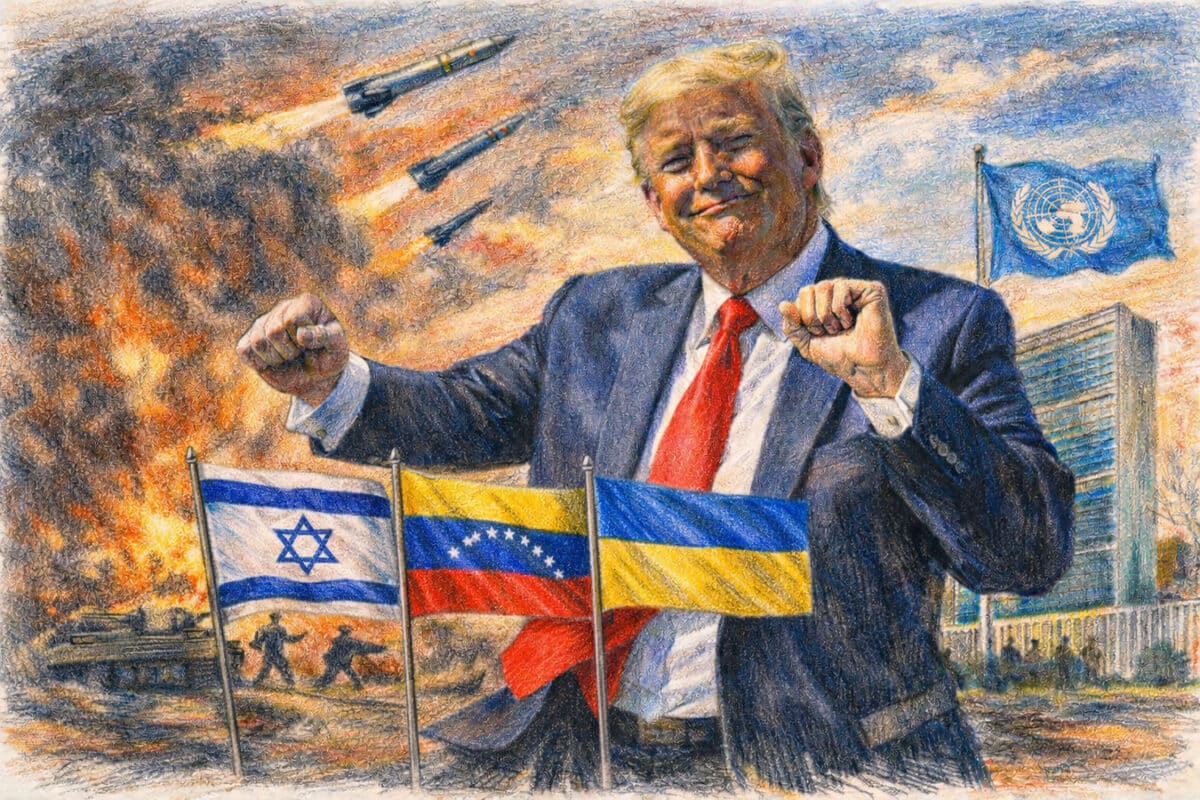
“Trump’s ‘Peace Council’ for Ukraine and Venezuela?: the ‘for Gaza’ model ‘may be attempted to expand’ — FT”

The White House is discussing the idea of expanding the mandate of the so-called “Peace Council” — a structure tied to post-war governance of the Gaza Strip in American plans — to other crisis points, including Ukraine and Venezuela. This was reported by the Financial Times on January 17, 2026, citing sources familiar with the discussions.

According to one of the publication’s interlocutors, in Donald Trump’s entourage, this body is seen as a potential alternative to existing international formats — a less formalized mechanism for resolution that could work where, in Washington’s view, the UN is too slow or politically blocked.

Trump's 'Peace Council' for Ukraine and Venezuela?: the 'Gaza model' 'may be attempted to expand' — FT
Trump’s ‘Peace Council’ for Ukraine and Venezuela?: the ‘Gaza model’ ‘may be attempted to expand’ — FT

It is this “parallelism” that causes tension among diplomats. FT writes that talks about expanding the Council’s role have alarmed both Western and Arab representatives: they are concerned about the prospect of granting too broad powers to a structure essentially tied to the White House and the political will of one president.

One Arab diplomat, quoted by FT, confirms: the idea is being discussed in the region, but the attitude towards it is restrained — this is “not a usual procedure.” In other words: it is unclear who sets the rules, what is considered a violation, how guarantees are ensured, who bears responsibility, and where “reconstruction management” ends and “external governance” begins.

The Ukrainian part of the discussions appears even more sensitive. A high-ranking representative of Kyiv, participating in consultations with the US, told FT that proposals for ending the war with Russia include the creation of a separate “Peace Council” specifically for the Ukrainian-Russian case.

According to this version, it may involve a mechanism that will not just be a platform for meetings but a body for control and guarantees of implementing a 20-point peace plan. The potential composition, as claimed by an FT source, may include representatives from Ukraine, Europe, NATO, and Russia — a format broader than bilateral and simultaneously narrower than the UN.

The White House is trying to dampen the excitement. An American official, cited by FT, stated at the end of the week that the planning of the “Peace Council” is focused exclusively on the Gaza Strip, and talks about other directions are premature. This resembles a familiar tactic: keeping the door ajar without fixing commitments while observing the reaction of allies and opponents.

A separate intrigue is Turkey. The Turkish president’s press service hastened to report that Trump allegedly invited Recep Tayyip Erdoğan to become a founding member of the “Peace Council.” Meanwhile, Israel previously opposed Turkey’s participation in such constructions around Gaza — due to political disagreements and Ankara’s role in the regional agenda.

American officials confirmed this week that invitations to potential participants were indeed sent out on Wednesday, but did not specify the recipients. The White House publicly presented the initiative as broadly as possible: “The whole world wants to be part of President Trump’s historic efforts to achieve peace in the Middle East.”

Looking at the original “Gaza” plan, the scheme looks like this: the day-to-day management of the enclave is to be transferred to a Palestinian technocratic committee, and the “Peace Council” is to oversee the process as a political and financial “umbrella.” According to FT, Bulgarian diplomat Nikolay Mladenov — a former Bulgarian defense minister and a figure with experience in international missions — is planned to be appointed as an observer/curator of the technocrats’ work.

The composition of the Council’s executive committee, described by FT, is also indicative: US Secretary of State Marco Rubio, President’s Special Envoy Steve Witkoff, Jared Kushner, former UK Prime Minister Tony Blair, American businessman Marc Rowan, World Bank President Ajay Banga, and US Deputy National Security Advisor Robert Gabriel. This is a mix of politics, special diplomacy, finance, and “large project managers” — a structure inherently geared towards quick decisions, control of flows, and PR effect.

Reflections and Analysis: What’s Really “New” Here

1) This is not a “peace body,” but a conflict management tool

The key question is not in the name, but in the function. If the structure is created under the White House and under Trump’s personal brand, it inevitably becomes a political lever of the US. And levers work not only for “peace” but also for the conditions of peace.

In this sense, the “Peace Council” looks like an attempt to replace international law with managed management: quick decisions, short approval chains, clear hierarchy. For business, this is a plus. For diplomacy — a minefield.

2) Acceleration is a plus, but the price may be high

The strong side of such a construction: speed. When it is necessary to launch humanitarian logistics, stabilize communal infrastructure, establish recovery financing, classical multilateral formats often stall.

The weak side: speed is achieved by reducing “brakes” — procedures, legal frameworks, publicity, parliamentary control. Therefore, diplomats fear “too broad powers”: fast management without clear responsibility.

3) Ukraine and Gaza are different tasks, and this may break the model

Gaza in American logic is simultaneously Israel’s security, humanitarian agenda, regional deals, and recovery. Ukraine is a war of attrition with Russia and a question of European security. Venezuela is a completely different geography and set of stakes.

If one “council” is attempted to be stretched over three different conflicts, it will either become decorative or turn into a political headquarters where decisions are made not based on universal principles, but on the basis of a favorable moment.

4) The main risk for Ukraine: the “council” as a platform for pressure, not guarantees

The formula “Russia and NATO can join it” sounds nice, but in reality, the key question is what constitutes a violation and what sanctions follow a violation.

If the “council” has no levers of coercion (economic, military, legal), then it records not guarantees, but a framework for bargaining. And then Ukraine risks finding itself in a situation where it is pushed to make concessions for the sake of a “quick result” that the White House can sell as a victory.

5) The main risk for Israel: the composition of participants and regional trade

For Israel, the question is not academic. Any structure that claims to manage post-war Gaza automatically affects:

  • who gains legitimacy as a “founder” and “guarantor”
  • how money and security control are distributed
  • which countries gain a role in humanitarian and civil infrastructure
  • how negotiation channels with Arab capitals change

If Turkey indeed gets a “founder” seat, it will become a factor of constant tension: Ankara will use the platform for pressure and public policy, and Israel — for blocking and counteraction. The result may be paradoxical: the “peace council” will become another arena of conflict.

6) Why the US is moving in this direction at all

We see this as an attempt to solve three tasks simultaneously:

  • reduce dependence on the UN and the Security Council, where blockages constantly arise
  • obtain a manageable mechanism of “deal + control + reconstruction”
  • establish a new foreign policy philosophy: fewer institutions, more personal agreements

This is the logic of a “project,” not the logic of a “convention.” And in 2026, it seems to be strengthening.

7) What will be a marker that all this is not PR

There is a simple test. If the “council” has:

  • transparent membership and exit rules
  • a public map of powers
  • a mechanism of responsibility for violations
  • a clear source of funding and audit

— then it can become a new tool of international practice.

If everything remains at the level of “invitations,” lists of VIP participants, and vague formulations about “historic efforts” — then it is primarily a political facade created for managing expectations and bargaining with allies.

Why this is important right now

Washington is testing a new architecture of influence: faster, tougher, more personalized than traditional international institutions. What this will turn into in practice will determine not only the “day after tomorrow of Gaza,” but also attempts to “package” wars and crises further — in Europe and the Middle East.

And this directly concerns Israel: because any sustainable mechanism that allows the White House to negotiate “peace packages” will inevitably include regional parameters — security, Syria, Iran, proxy groups, sanctions, logistics, and diplomatic roles in Gaza. NAnews — Israel News | Nikk.Agency


Video: “Know Ours” – Kirill Karetnik – from Ukraine, moved to Israel in 2009, served in the army, worked, and became a politician

The third episode of the project “Know Ours” about Ukrainians in Israel.
“This video was filmed before October 7, 2023. But the war in Israel put our activities on pause.”

Kyrylo Karetniuk – a Ukrainian who moved to Israel in 2009, served in the army, worked, and became a politician. Importantly, the interview is not about Kyrylo’s political sphere and is not of an agitational nature. The goal is to reveal the personality outside of political life and tell another story of an influential Ukrainian in Israel.

Host – Kateryna Trushyk.
Filming, editing, sound – Olena and Alex Ginzburg.
Haifa, Israel.

Kateryna Trushyk:

“The war in Israel has disrupted the plans of many people.

Elena Ginzburg, Alex Soundman Ginzburg, and I planned to develop our project about Ukrainians in Israel and Israelis helping to bring Ukraine closer to victory.
We had a list of heroes and heroines with whom we planned to record interesting interviews.

October 7, 2023, changed our plans.

We hope to still implement them and reveal and open many true heroes who do a lot of important work for both Ukraine and Israel.

The video that will be released today was recorded before October 7, 2023.

This is the third episode of the project “Know Ours”.

The hero of the interview is Kyrylo Karetniuk (קיריל קארטניק) – a Ukrainian who moved to Israel in 2009, served in the army, worked, and became a politician.
Importantly, our interview is not about Kyrylo’s political sphere and is not of an agitational nature.

Our goal is to reveal the personality outside of political life and tell another story of an influential Ukrainian in Israel.”

Leave a COMMENT

Read other News of Israel and the world on the channels of NiKK
Nikk.Agency on

Telegram,

Facebook

and Google News