Nino Katamadze in Israel: the singer who refused Russia and supported Ukraine will present the new album Lilat in Tel Aviv and Haifa on November 26 and 27, 2026

On November 26 and 27, 2026, Georgian singer Nino Katamadze will perform in Tel Aviv and Haifa with her new program Lilat. For the Israeli audience, this is a meeting with an artist whose voice has long been recognized from the first notes. But behind her music lies a story that includes a refusal to tour in Russia, helping Ukrainian refugees, and participating in protests against the political course of the Georgian authorities.

Tickets for Nino Katamadze concerts in Israel — Showman

Author: Pavel Shveiko, NANews — Nikk.Agency.

A voice that needs no translation

Nino Katamadze was born on August 21, 1972, in the Georgian city of Kobuleti, on the Black Sea coast. She studied at the vocal faculty of the Batumi Music Institute and began collaborating with the Insight group in 1999.

Her music combines jazz improvisation, Georgian vocal tradition, folklore, and rock. The singer often abandons the usual song form: the voice becomes an instrument, and the melody develops right during the performance.

Over the years of her career, albums Black, White, Blue, Red, Green, and Yellow have appeared. Katamadze has performed on international stages but has kept the Georgian language at the center of her creativity.

The Israeli audience is already familiar with her concerts. The organizer Showman reminds of past performances that were sold out. Now the artist comes with new music.

In 2019, she said ‘no’ to Russia

On June 30, 2019, Katamadze announced that she would no longer perform in Russia. The decision followed mass protests in Tbilisi, which began on June 20 due to the appearance of Russian deputy Sergey Gavrilov in the Georgian parliament.

Her last concert in Moscow at that time took place on June 22, already after the protests began. The singer called it the hardest in her life and referred to Russia as an occupier.

This statement was made three years before the full-scale Russian invasion of Ukraine. For Georgia, the issue of Russian occupation had its own history: after the 2008 war, Moscow recognized the independence of Abkhazia and South Ossetia, which the international community predominantly considers Georgian territories.

Katamadze made a public choice, fully understanding the significance of the Russian concert market for her career.

Ukraine became part of her life long before 2022

Katamadze’s connection with Ukraine did not start with the war. In 2008, she toured with the Ukrainian chamber ensemble ‘Kyiv Soloists’. In 2014–2015, she worked as a judge on the Ukrainian TV project ‘X-Factor’. Her protégé Dmitry Babak won the fifth season.

After February 24, 2022, musical ties turned into concrete humanitarian work.

On March 28, 2022, the Nino Katamadze Foundation was officially registered. It helped Ukrainians arriving in Georgia find housing, receive medical assistance, and find employment. Special attention was paid to children in need of psychological support and social adaptation.

In an interview with Ukrinform, Katamadze talked about how the needs of refugees constantly changed. Initially, people needed a roof over their heads, then work, legal assistance, and the opportunity to return to normal life.

On June 17, 2022, in Lviv, the singer also announced that she no longer intended to give interviews in Russian and would speak to journalists in Ukrainian or Georgian.

NANews — Israel News | Nikk.Agency considers her visit through this history of relations between Georgian and Ukrainian societies, well known to many immigrants from both countries living in Israel today.

Nino Katamadze in Israel: the singer who refused Russia and supported Ukraine will present the new album Lilat in Tel Aviv and Haifa on November 26 and 27, 2026 - Israel news
Nino Katamadze in Israel: the singer who refused Russia and supported Ukraine will present the new album Lilat in Tel Aviv and Haifa on November 26 and 27, 2026 – Israel news

Ukraine: ‘Chornobryvtsi’, concert in Kyiv metro, and Order of Princess Olga

In June 2022, when Russian troops continued to shell Ukrainian cities, Nino Katamadze came to Kyiv. On June 10, she performed in the capital’s metro, where concerts were held during the war to support Ukrainians. Georgian and Ukrainian musicians played with her.

The concert opened with the famous ‘Melody in A minor’ by Ukrainian composer Myroslav Skoryk. The piece for the program was chosen by Georgian conductor Nikoloz Rachveli. That evening, Katamadze also performed the Ukrainian song ‘Chornobryvtsi’ — about maternal love, home, and childhood memories.

For the singer, this composition holds a special place. Although she performs almost her entire repertoire in Georgian, ‘Chornobryvtsi’ became an exception. Katamadze said she perceives the song’s words very emotionally and sometimes performs it during rehearsal before a concert to cope with stage fright.

In April 2023, she performed ‘Chornobryvtsi’ again — at two charity concerts on April 28 and 29 at Kyiv’s Parkovy Convention and Exhibition Center. The song was performed in a special arrangement and became one of the most emotional moments of the performances.

Recognition of her support for Ukraine also came at the state level. On May 23, 2025, Ukraine’s Minister of Culture Mykola Tochitsky presented Katamadze with the Order of Princess Olga III degree. The award decree was signed on September 4, 2023.

As reported by the Ministry of Culture of Ukraine, the award recognizes her contribution to interstate cooperation, support for Ukrainian sovereignty and territorial integrity, and the promotion of Ukrainian culture worldwide.

The Order of Princess Olga is a state award of Ukraine, recognizing women’s contributions to society and the state. For Katamadze, this became official recognition of her long-standing connection with Ukraine, which after the Russian invasion turned into ongoing humanitarian and musical support.

Georgia: protests, protection of a journalist, and a fine for civic stance

In Georgia itself, Nino Katamadze continued to publicly oppose the political course of the authorities and support participants in the protest movement demanding democratic reforms and the preservation of the country’s European future.

On January 26, 2025, the singer participated in a rally at the house of Kutaisi Court of Appeals judge Malkhaz Okropirashvili. Participants demanded a fair trial for Mzia Amaglobeli — a Georgian journalist and co-founder of independent publications Batumelebi and Netgazeti, detained during protests in Batumi.

On February 10, 2025, the Kutaisi City Court found nine participants of the rally, including Katamadze, guilty of violating the rules for holding demonstrations. Each was fined 5000 Georgian lari.

Before the hearing, Katamadze performed the Georgian national anthem.

For the singer, known far beyond her homeland, this was another instance where her civic stance had personal consequences. Katamadze does not limit herself to statements in interviews or from the stage — she participates in events shaping the future of her own country.

Lilat: new music and the Israeli stage

At the November concerts, Katamadze will present a program related to the new album Lilat. According to Showman, the material was recorded at the Trixx studio in Berlin, and the title in the Svan language means ‘Beloved’. Svan is one of the Kartvelian languages spoken in the mountainous regions of Georgia.

The singer will be accompanied by keyboardist Papuna Sharikadze, guitarist Giorgi Tsintsadze, bassist Levan Deisadze, drummer Alexander Japaridze, and saxophonist Giorgi Berishvili — Khondzi.

Concert schedule in Israel:

  • November 26, Thursday, 21:00 — Tel Aviv, Beit HaHayal Hall, 60 Weizmann St. Tickets — 226–356 ₪.
  • November 27, Friday, 20:30 — Haifa, Rappaport Hall, 138 HaNasi Ave. Tickets — 216–336 ₪.

Tickets for Nino Katamadze concerts in Israel — Showman

Prices and availability may change. Current purchase conditions should be checked with the organizer.

The poster was prepared with the participation of the project partner sTDe | NAnews — Israel event poster.

Nino Katamadze comes to Israel not with a political performance, but with music. However, her biography today can no longer be separated from decisions made offstage. And for listeners who know what has happened to Georgia and Ukraine in recent years, this music may sound especially personal.

Tickets for Nino Katamadze concerts in Israel

“Who is on Top-2: Ladies vs Gentlemen” in Haifa: women against men in a charity show in Ukrainian

On October 23, 2026, a charity intellectual party “Khto Zverhu-2: Ladies vs Gentlemen” will be held in Haifa. The organizer is Vechornytsi.il, a project engaged in organizing Ukrainian cultural and entertainment events in Israel. Guests can expect a competition between women’s and men’s teams, humor, a charity fair, and socializing.

The show will be held in Ukrainian at the Diana Hotel, on Ha-Bankim Street, 5.

Author: Editorial Team of NANews

Who is on top — women or men?

In Ukraine, the name “Khto Zverhu?” is well known to viewers of the eponymous TV show. In it, women’s and men’s teams compete in erudition, quick wit, reaction speed, and the ability to handle unexpected tasks.

On October 23, 2026, a similar competition will be held in Haifa.

“Khto Zverhu-2: Ladies vs Gentlemen” is the name of the new evening from Vechornytsi.il. Translated from Ukrainian — “Who is on top: ladies against gentlemen.”

Khto Zverhu-2: Ladies vs Gentlemen in Haifa: women against men at a charity show in Ukrainian

The organizers promise blitz polls, intellectual contests, humorous tasks, and unexpected twists. The event itself is conducted in Ukrainian.

This is already the second show of this format that the team offers to the Israeli public. This time, the entertainment program was decided to be combined with a charity collection.

Charity fair and intellectual game

The meeting will take place on Friday, October 23, at the Diana Hotel in the center of Haifa.

At 16:00 the doors will open and the charity fair will begin. Organizers invite guests to bring three items that can be sold for the benefit of the collection, as well as, if possible, some sweets.

At 16:30 the intellectual show will start. Women’s and men’s teams will compete in logic, erudition, and resourcefulness.

Throughout the evening, the hotel bar will be open with drinks and snacks.

The entrance is defined by the organizers as a feasible charitable donation. The first 20 tickets are offered for 80 shekels. Separate conditions are provided for newcomers, which need to be clarified during registration.

Children under 10 years old can attend for free.

The collected funds, according to the announcement, are intended for charitable initiatives, including the current collection of the organizers. The specific recipient of the aid and the necessary amount are not specified in the published announcement.

Vechornytsi.il: Ukrainian cultural events in Israel

The name Vechornytsi.il comes from the Ukrainian word “вечорниці” — traditional evening gatherings where people communicated, sang, played, danced, and spent time together.

Today, the team uses this name to organize cultural and entertainment events in Israel related to the Ukrainian language and culture.

The project already has experience in organizing events in Haifa.

In 2025, Vechornytsi.il prepared the evening “Den Zalezhnosti,” dedicated to Ukraine’s Independence Day. Initially, it was planned for August 22, then postponed to September 19. The program also included an intellectual game in the format of “Khto Zverhu.”

The previous event was covered by NANews in the publication “Den Zalezhnosti” in Haifa.

The new evening continues the familiar theme of intellectual entertainment for the organizers, but now a noticeable place in the program is occupied by a charity fair.

Why such events find their audience in Israel

In Haifa and the neighboring cities of Krayot, there are many people from Ukraine. Krayot is a common name in Israel for a group of cities near Haifa, including Kiryat Yam, Kiryat Motzkin, and Kiryat Bialik.

At the same time, the audience of Ukrainian-language cultural events is not necessarily limited to people who came directly from Ukraine. In Israel, there are families with Ukrainian roots, repatriates of different generations, as well as Israelis interested in Ukrainian culture and language.

That is why it is important to know in advance in which language the program is conducted. For “Khto Zverhu-2,” the organizers chose Ukrainian. Participation in such an intellectual competition implies understanding the questions, jokes, and tasks of the hosts.

For Israel, such events have become another format of local cultural life. They allow for concerts, holidays, and meetings in languages that are spoken in the families of repatriates and other residents of the country.

NANews — News of Israel | Nikk.Agency pays attention to such initiatives because cultural ties between Israel and Ukraine develop not only through official institutions but also thanks to independent organizers working directly with their audience.

Date, address, and participation conditions

Event: “Khto Zverhu-2: Ladies vs Gentlemen.”

Date: Friday, October 23, 2026.

Place: Diana Hotel, HaBankim 5, Haifa.

Opening of doors and fair: 16:00.

Start of the intellectual show: 16:30.

Language: Ukrainian.

Organizer: Vechornytsi.il.

Cost: charitable donation. The first 20 tickets — 80 shekels; special conditions for newcomers are clarified with the organizers.

For children: entry up to 10 years old is free.

Dress code: “Yak na svyato” — festive attire.

Event page – https://www.facebook.com/events/1840828650426159/

Information about registration, ticket availability, and charitable collection can be clarified on the Vechornytsi.il Facebook page.

Other concerts, performances, holidays, and cultural events are presented by our edition’s partner — sTDe | NAnews — event poster of Israel.

On October 23, at the Diana Hotel, they will again find out who copes better with intellectual tasks — women or men. The game will be held in Ukrainian, and the proceeds are intended to be directed to charity by the organizers.

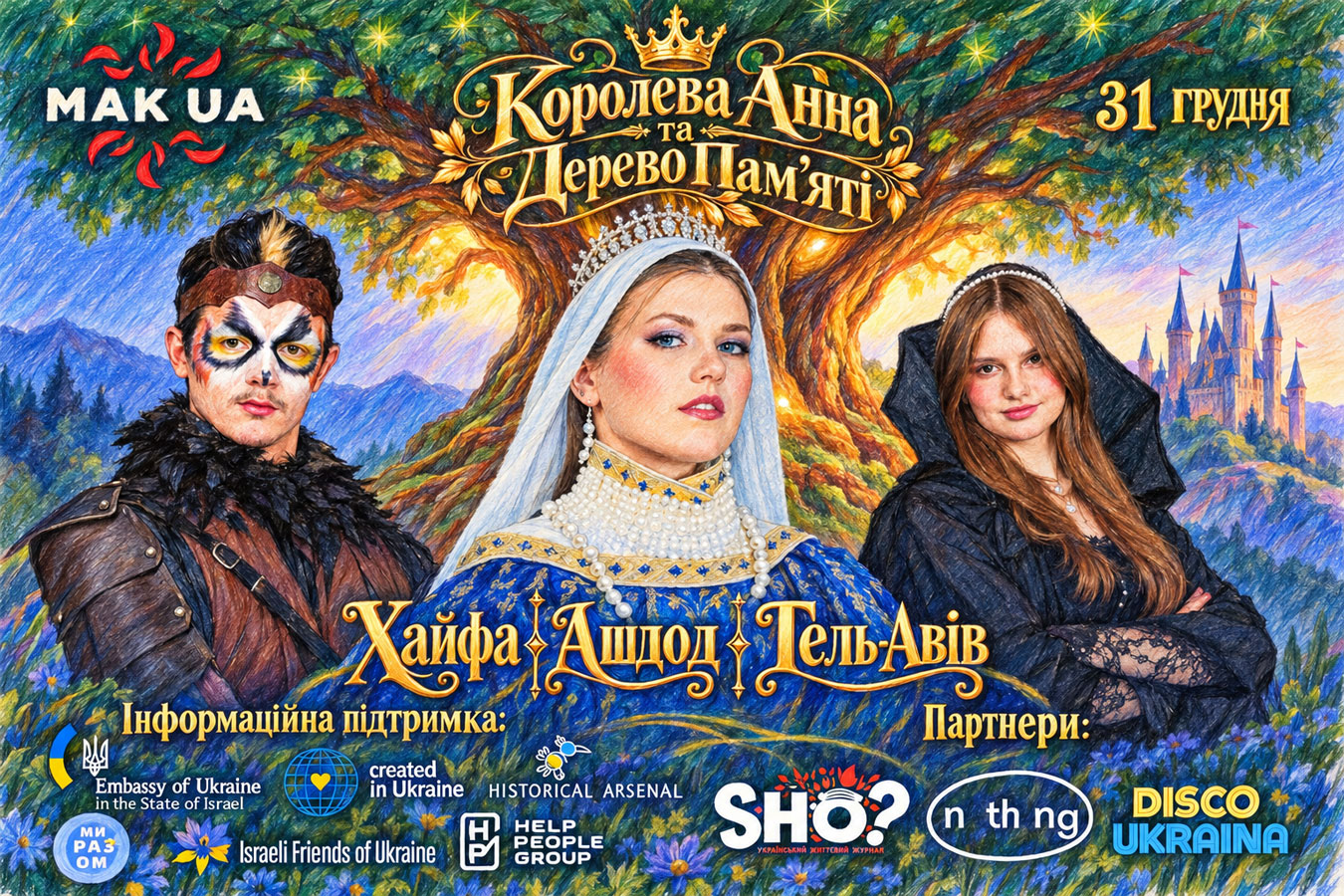
“Queen Anna and the Tree of Memory”: Ukrainian fairy tale fantasy in Haifa, Tel Aviv, and Ashdod — MAK_UA in December 2026 and January 2027

A new Ukrainian theatrical fairy tale is being prepared in Israel, which families will be able to see in several cities across the country. The creative association MAK_UA presented an original fantasy play “Queen Anna and the Tree of Memory”. The festive poster lists Haifa, Ashdod, and Tel Aviv, and in a new announcement, the organizers have already named two exact dates: December 29, 2026, in Haifa and January 2, 2027, in Tel Aviv. A show in Ashdod is also announced, but its date has not yet been published.

Author: Lev Varshavsky

The announcement appeared on the official MAK_UA Facebook page. The organizers address the Ukrainian community in Israel with an invitation to save the dates in their calendars in advance and promise a meeting with the magical “Divosvit” — a fairy-tale world of adventures, unusual heroes, and festive wonders.

Ticket sales are expected to start later. While MAK_UA is gradually revealing the program, viewers have the opportunity to get acquainted with the new project and decide in which city it will be more convenient for them to attend the performance.

Three cities, two announced dates, and festive fairs

“Queen Anna and the Tree of Memory”: Ukrainian fantasy fairy tale in Haifa, Tel Aviv, and Ashdod — MAK_UA in December 2026 and January 2027

Haifa — Tuesday, December 29, 2026. Doors will open at 17:00, a New Year’s fair will start, and the “Rivnovaha” project will prepare entertainment for guests. The performance will begin at 18:00. Thus, the organizers offer not to limit themselves to the theater hall but to spend the whole festive evening together.

Tel Aviv — Saturday, January 2, 2027. Here, guests are also expected from 17:00. Before the performance, there will be a fair, and children will be able to interact with fairy-tale fairies. The performance itself will begin at 18:00. For families with children, this hour before the start of the action can become a separate part of getting to know the characters and the atmosphere of the production.

Ashdod — the city is listed in the official graphic poster of the performance. However, in the latest text announcement from MAK_UA, the exact date, time, and place of the Ashdod show have not yet been specified. Viewers from Ashdod and southern regions of Israel should follow updates on the official page of the organizers, where further details are expected to be published.

The story with the schedule clarification is not accidental. Back in September, NAnovosti reported on the large calendar of MAK_UA events for the second half of 2026. At that time, the New Year’s family fairy tale was tentatively planned for the period from December 15 to 30 in three cities — Haifa, Tel Aviv, and Ashdod. Now specific dates for two shows have appeared, and the Tel Aviv performance will take place after the New Year.

Exact addresses of the halls, ticket prices, performance duration, and age recommendations have not yet been published. The possibility of translation or subtitles for viewers who do not speak Ukrainian is also not specified. The organizers should provide all these details separately.

Who is Queen Anna and what does the Tree of Memory hide

At the center of the new production is Queen Anna. Next to her in the title appears the Tree of Memory, and the promotional poster shows a huge fairy-tale oak, the queen in a festive blue dress, mysterious characters, and a castle against a magical landscape.

In the very combination of the name and title, it is easy to see a historical association with Anna of Kiev, also known as Anna Yaroslavna. In the 11th century, the daughter of the Kyiv prince Yaroslav the Wise became the queen of France by marrying Henry I in 1051. After her husband’s death, she participated in the affairs of the French royal court during the minority of her son Philip I.

For Israeli readers unfamiliar with the history of medieval Eastern Europe, it is useful to explain here: Anna came from Kievan Rus, a state centered in Kyiv that existed long before the formation of modern Ukraine, Russia, and Belarus. In Ukrainian cultural memory, Anna of Kiev occupies a special place as a symbol of the old historical ties between Kyiv and European royal courts.

At the same time, MAK_UA has not yet reported that the heroine of the play is the historical Anna Yaroslavna. The similarity of the name allows for a possible association, but not a confirmed plot. The authors call their work an original fantasy fairy tale, and the details of its story remain unknown.

The meaning of the Tree of Memory is also not revealed. It may become a magical object, a place of action, or an image connecting generations and family memories. But these are only possible interpretations of the title, not information from the published script.

For families where children grow up between Ukrainian and Israeli cultures, the theme of memory sounds especially recognizable. Family stories here often cross several countries, languages, and eras. And although it is not yet known what content the creators have put into their fairy tale, its very title already raises questions that may be of interest to viewers of different generations.

MAK_UA: Ukrainian theater created in Israel

Behind the performance is MAK_UA — Ukrainian Artistic Amateur Forge in Israel. This is a Ukrainian public-artistic association created by Marina Kadatska (Марина Кадацька), a teacher and actress who has lived in Israel for many years.

In an interview with the project “Ukrainian Meetings in Israel,” presented by NAnovosti, Marina talked about her move, the formation of Ukrainian cultural identity, and why there was a need to create a Ukrainian-language theater here in Israel.

At the time of the interview in 2023, MAK_UA was a completely volunteer project. Actors, screenwriters, directors, and representatives of other creative professions united around the idea. The collective conducted workshops, created puppet shows, and worked on children’s performances, including “The Tale of Nicholas” and the interactive “Spring-Meeting Tale.”

Later, new productions, meetings, and educational programs appeared. One of them is “Theater Therapy,” where participants get acquainted with the history of Ukrainian theater through stage exercises, improvisation, and voice work.

In the MAK_UA calendar for October 8, 2026, the sixth meeting of the third season of “Theater Therapy” was planned, dedicated to the development of modern Ukrainian theater. Such classes do not require participants to have professional acting education: the theater here exists not only for spectators but also for people who want to try themselves on stage.

Over several years, the association has become a noticeable part of Ukrainian cultural life in Israel. At the same time, it is not about a touring troupe that came for a few days from Ukraine, but about a creative collective that works within the country itself.

NAnovosti — News of Israel | Nikk.Agency has repeatedly reported on its projects. They are interesting not only for preserving the Ukrainian language: performances become a meeting place for people who were born in Ukraine, have long lived in Israel, or are getting to know Ukrainian culture for the first time thanks to friends and neighbors.

From the adventures of Mykola to Malanka: what fairy tales MAK_UA has already shown

The new “Queen Anna” continues the theatrical tradition that MAK_UA has been forming for several years.

In December 2024, the collective prepared a Ukrainian-language New Year’s fairy tale “The Adventures of Mykola in the Fairy Forest”. The performances were planned in Haifa, Rishon LeZion, and Ashdod. NAnovosti detailed this production, aimed at children and parents.

A year later, a new work appeared — “The Tale of Malanka and the Evil Snake”. It was presented in December 2025 as part of MAK_UA’s winter performances in Tel Aviv, Haifa, and Ashdod.

Malanka is a heroine of Ukrainian winter folk tradition, associated with rituals, songs, disguises, and fun performances. For the Israeli audience, this is not a familiar character from children’s books, but part of a special festive culture preserved in Ukraine for centuries. In the fairy tale, she was opposed by the Snake — a fictional image created in the spirit of Ukrainian folklore.

The performance featured six fairy-tale characters. The design used works by Ukrainian masters of decorative and applied arts, original music by a Ukrainian composer, and elements of Carpathian aesthetics. The Carpathians are a mountain region in western Ukraine and neighboring countries of Central Europe, where rich traditions of folk crafts, music, and festive rituals have developed.

The organizers promised children gifts and photos with the characters after the performance, and the festive program was accompanied by a fair of Ukrainian goods. Part of the proceeds from ticket sales was planned to be directed to support the Armed Forces of Ukraine.

About the production, its plot, and the conditions of attendance can be read in the previous NAnovosti article about the tale of Malanka.

It cannot yet be asserted that all these elements will be repeated in the new “Queen Anna.” Neither gifts, nor the charitable part of ticket sales, nor the number of characters for the 2026–2027 performance have been separately announced. But previous works show how MAK_UA combines stage action with cultural and festive programs.

“Rivnovaha” in Haifa: more than entertainment before the performance

A special role in the Haifa show will be played by the project “Rivnovaha” (“Balance”) — a Ukrainian public-cultural initiative working with children and adults. It is known in Haifa for creative meetings, classes, cultural holidays, and events that help people find communication and emotional support.

One of the participants in organizing such events is Tal Mikhaelenko. Together with the “Rivnovaha” team, she participated in preparing events that combined Ukrainian and Israeli cultural traditions.

In February 2025, NAnovosti reported on the celebration of Tu BiShvat in Haifa, organized with the participation of “Rivnovaha.” Tu BiShvat is the Jewish New Year of Trees, celebrated on the 15th of the month of Shevat. In Israel, it is associated with traditions of planting trees, caring for nature, and introducing children to the plant world of the country.

At that time, the program combined music, creative activities, reading Ukrainian books, games, meditative practices, and children’s gifts. Among the participants was “Pizhamna Bibliotechka” — an initiative introducing children to books through reading and joint creativity.

In May of the same year, “Rivnovaha” held in Haifa “Vyshyvanka Day. Epilogue”. Vyshyvanka is a traditional Ukrainian embroidered shirt, long recognized as a symbol of national culture. The program included music, creative workshops, and separate activities for children.

In the summer of 2026, the children’s direction “Rivnovaha.Dity” participated in organizing the meeting “Picturesque World” — an artistic event for children in Haifa, prepared jointly with “Pizhamna Bibliotechka.”

Therefore, the invitation of “Rivnovaha” to the performance on December 29 looks like a natural continuation of joint cultural work. But the specific set of entertainment before “Queen Anna” has not yet been disclosed by the organizers. It remains to wait for the detailed program of the fair.

Who supports the new production

The graphic poster of “Queen Anna” features not only theatrical characters and cities of the performance but also organizations supporting the project.

In the section of informational support are listed the Embassy of Ukraine in the State of Israel, Created in Ukraine, Historical Arsenal, “We Together,” Israeli Friends of Ukraine, and Help People Group.

Among the partners on the poster are SHO?, n.th.ng, and Disco Ukraina.

Such a composition reflects the participation in Ukrainian cultural life in Israel not only of theatrical collectives but also of public initiatives, volunteer associations, and representatives of local business.

For MAK_UA, this is another way to attract different communities to their projects. Moreover, the support of Ukrainian culture in Israel has long not been limited to organizations with the word “Ukraine” in their names. Events involve people of different origins, united by an interest in theater, history, music, and cultural exchange.

Why Ukrainian fairy tales find their audience in Israel

Israel has its own festive calendar, which does not coincide with the familiar December and January dates for many immigrants from Ukraine. The Jewish New Year, Rosh Hashanah, is celebrated in the fall, and January 1 is not a national holiday.

Nevertheless, for many families who have moved from Ukraine and other European countries, the end of December remains a time for family gatherings, gifts, and children’s performances. And Ukrainian theater is gradually finding its place in this calendar.

The situation with children is especially interesting. Many of them study in Israeli schools, speak Hebrew with friends, watch Israeli shows, and gradually switch to the language of the country they live in. Ukrainian often remains the language of communication with parents, grandparents.

At the performance, everything is arranged differently. Ukrainian is not only spoken at home: fairy-tale characters speak it, joke, sing, and tell stories. For a child, this is an opportunity to see their native language as part of a live cultural event. And for adults, to spend an evening in an environment where family memories do not need to be translated and explained every time.

Equally important, such performances can be interesting to Israelis without Ukrainian roots. Getting to know the culture of neighbors through a children’s fairy tale is sometimes more accessible than official meetings and solemn speeches. However, for families who do not speak Ukrainian, the possibility of attendance will also depend on whether the organizers provide language support.

Tickets, addresses, and updates: what viewers need to know

As of October 12, 2026, MAK_UA has published the name of the performance, named three cities on the poster, and announced exact dates for performances in two of them.

Haifa — December 29, 2026: doors open and New Year’s fair at 17:00, performance at 18:00. The festive program includes the “Rivnovaha” project.

Tel Aviv — January 2, 2027: doors open, fair, and meeting with fairies at 17:00, performance starts at 18:00.

Ashdod — the show is announced on the poster, but the exact date and time have not yet been published. Residents of Ashdod are advised to follow subsequent announcements from the organizers. The date of December 31 indicated on the graphic poster cannot yet be unequivocally linked to this city.

Ticket sales have not yet started. Information on prices, exact venue addresses, duration, and age recommendations should appear additionally.

The main source of updates is the official MAK_UA Facebook page. There, the organizers promise to announce the start of ticket sales and publish further details.

For now, viewers can only choose a convenient city and save the announced dates. And those living in Ashdod should wait a bit: the city has already appeared on the poster of the new fairy tale, it remains to wait for the specific schedule.

MAK_UA still has several months of preparation ahead. The names of the performers, plot details, hall addresses, and ticket links will appear. But one important thing is already known: the Ukrainian theater is once again going to celebrate the New Year with its audience in Israel — and this tradition continues.

Remember Sobibor: On October 14, 1943, under the leadership of Soviet prisoner of war, a native of Ukraine, Alexander Pechersky, prisoners of the Nazi death camp staged the only successful uprising in the concentration camps of the Third Reich

This was the only successful uprising in the concentration camps of the Third Reich.

On October 14, 1943, prisoners of the Nazi death camp Sobibor rebelled under the leadership of a Soviet prisoner of war, a native of Ukraine, Alexander Pechersky. This was the only successful uprising in the concentration camps of the Third Reich.

Thanks to a bold plan, the rebels managed to destroy some of the SS men, disarm the guards and try to escape free. Pechersky, like several dozen other prisoners, survived the war and continued to live in the Soviet Union, where he faced numerous difficulties due to his status as a former prisoner of war.

Another rebel, a native of Ukraine, was Arkady Weispapirborn in 1921 in the village of Bobrovy Kut, Kherson region of Ukraine. He was among the organizers of the uprising and, together with his comrades, escaped certain death.

Weispapier recalled those events:

“We were sent to work in the camp workshop. I was repairing German equipment… There I first heard the plan for the uprising. It was hard to believe that we could do it, but we had no choice. Either we die on the spot or we fight for life.”

The history and testimonies of A. Weispapir and many other participants are collected in the book “Breakthrough into Immortality: The Uprising in the Sobibor Camp” (orig. Immortality’s breakout. Rebellion at the Sobibor camp), published in Ukraine in 2016 (compiled by Larisa Moskalenko). This book presented for the first time in Ukrainian the memoirs of Alexander Pechersky, a poem by Mark Geylikman and an interview with Weispapir, preserving the memory of the indestructible spirit of people who chose freedom even in the darkest times.

Today we remember the heroes of Sobibor, whose feat reminds us of the strength of the human spirit and the desire for freedom.

Pechersky and his associates, among whom was Arkady Vaispapir from the Kherson region, began to develop a plan for the uprising long before it began. Weispapier recalled:

“We understood that if we didn’t do anything, certain death awaited us. But how can we start a rebellion?

The plan was to eliminate the guards one by one and seize the weapons. On October 14, 1943, the uprising began. The prisoners were able to kill 12 SS men and 38 guards. However, it was not possible to take possession of the full arsenal of weapons, and the guards began shooting at the rebels, forcing them to flee through minefields.

Of the approximately 550 prisoners, about 400 escaped, but half of them died in minefields and 170 were caught by the Nazis during searches. Only 53 participants in the uprising lived to see the end of the war. Of these, Pechersky, along with several others, was able to join the partisan detachment.

Biography of Alexander Pechersky

Alexander Aronovich Pechersky was born on February 22, 1909 in Kremenchug (Poltava province, Ukraine). His Jewish family, after moving to Rostov-on-Don, was engaged in advocacy. After graduating from school, Pechersky worked as an electrician at a locomotive plant and studied at Rostov University. With the beginning of Hitler’s invasion of the USSR, he was drafted into the Soviet army, but was captured in 1941.

In September 1943, Pechersky was sent to Sobibor along with a group of other prisoners of war. In the camp, prisoners, mostly Jews, were subjected to brutal conditions and extermination. It was here that Pechersky became the initiator and organizer of the uprising.

Further fate and recognition of Pechersky

After a successful but tragic uprising, Pechersky was able to join a partisan detachment in the Brest region. He fought for over a year, performing demolition duties. However, after joining the Red Army, he was suspected of treason, and he was sent to a penal battalion.

The commander of the penal battalion, Major Andreev, was so impressed by Pechersky’s story about the uprising that he allowed him to travel to Moscow to present his evidence of Nazi crimes.

In Moscow, his story was recorded by the writers Pavel Antokolsky and Veniamin Kaverin, on the basis of which the essay “The Uprising in Sobibor” was published. After the war the essay was included in the collection “Black Book” and was banned by censorship in 1947; not released in modern Russia either.

After the war, Pechersky continued to serve in the Soviet army, reaching the rank of captain, but was soon discharged due to disability. He met his future wife, Olga Kotova, in the hospital where he was treated after being wounded.

Pechersky passed away on January 19, 1990 in Rostov-on-Don, leaving behind a significant legacy related to the memory of the Holocaust and resistance.

Many books have been written about Sobibor and the uprising there, including:

  • “Long Shadows” — Misha Lev, in Russian, translated from Yiddish.
  • “Sobibor” is a novel by Misha Lev, published in 2002 in Yiddish in Tel Aviv.
  • “From the ashes of Sobibor” – book by Thomas Bluth in English.
  • “Escape from Sobibor” is a work by Richard Raschke, translated into eight languages.
  • “Bełżec, Sobibor, Treblinka” — Yitzhak Arad in Hebrew.
  • “Return is unwanted” — V. Tomin and O. Sinelnikov, 1964.
  • “Uprising in Sobibor” – memoirs of Alexander Pechersky, published in the Moscow magazine “Sovetish Heimland” in Yiddish in 1973.

Screen adaptation

In 1987, director Jack Gold made the film “Escape from Sobibor” based on the book by Richard Raschke. The main role, Alexander Pechersky, was played by Rutger Hauer, who received a Golden Globe Award for this. It is noteworthy that Alexander Pechersky himself was not at the premiere; his widow later reported that the authorities did not want to process the documents for their departure to the United States.

Perpetuation of memory

In 2007, a memorial plaque was installed on the house where Pechersky lived. In Israel, in the city of Safed, a street is named after him. A glass stele with the name of Pechersky was installed in Boston, and a monument in his honor was unveiled in Tel Aviv on October 16, 2012.

These books and monuments serve as important reminders of the heroism of the people who fought for their freedom under the most difficult conditions.

The story of the destruction of the Sobibor camp became part of the charges in the Nuremberg trials. The International Tribunal wanted to hear Pechersky’s testimony as a witness, but the Soviet authorities did not release him to Germany.

The Sobibor uprising was an important event that shows how even in the most hopeless conditions one can resist and fight for freedom. The memory of heroes such as Alexander Pechersky and his comrades continues to live, reminding us of the resilience of the human spirit and the desire for freedom.

Leave a comment↓

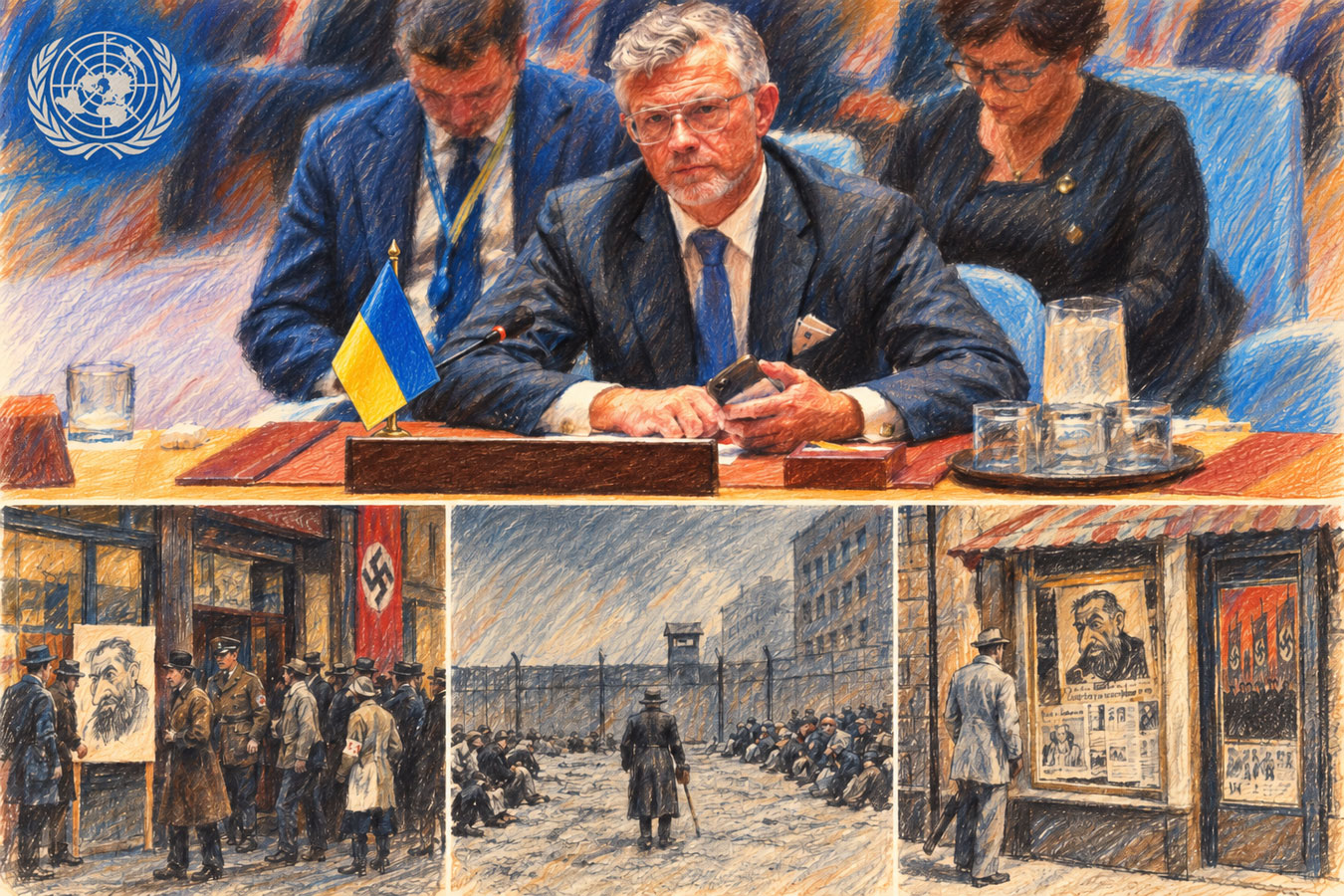
“Cockroaches, lice, parasites”: At the UN Security Council, Russian threats to Ukrainians were compared to the Nazi extermination of Jews

“Cockroaches,” “lice,” “parasites.” These were the words Nazi propaganda used to describe Jews, preparing society for their persecution and extermination. Now similar expressions are used by Russian propagandists against Ukrainians. On October 9, 2026, Ukraine’s permanent representative to the UN, Andriy Melnyk, directly compared Russian threats to the Nazi “final solution to the Jewish question.”

Author: Victoria Katsman | NAnovosti — News of Israel

At an emergency meeting of the UN Security Council in New York, the diplomat quoted Russian TV host Vladimir Solovyov, who threatened the residents of Kyiv, Odesa, and Mykolaiv, and former Russian President Dmitry Medvedev, who spoke of the destruction of Ukrainians.

The comparison was made against the backdrop of new Russian strikes on Ukrainian cities. In his speech, Melnyk linked hate speech, the death of civilians, and international responsibility for preventing mass crimes.

“We are thinking about where to bury them all”: what was said at the UN

'Cockroaches, lice, parasites': Russian threats to Ukrainians compared to Nazi extermination of Jews at the UN Security Council
‘Cockroaches, lice, parasites’: Russian threats to Ukrainians compared to Nazi extermination of Jews at the UN Security Council

The meeting on October 9 was convened at Ukraine’s request with the support of Denmark, France, Latvia, and the United Kingdom. Greece presided.

Andriy Melnyk stated that the Russian leadership seeks not just to capture Ukrainian territories but to destroy the Ukrainian nation. As an example, he cited a statement by Vladimir Solovyov, which, according to the diplomat, was made a few days earlier on television.

Solovyov demanded that the remaining residents of Kyiv leave the city, warning: “You are doomed.” He extended the same threat to Odesa and Mykolaiv, stating that their residents had already “laughed.” After this, the TV host spoke about the fate of the population of the three cities.

“We are thinking about where to bury them all.”

Melnyk emphasized that this is not a figurative expression. In his assessment, Russians openly discuss the mass killing of Ukrainians and the subsequent burial of their bodies.

The diplomat then quoted Dmitry Medvedev, former President of Russia, now Deputy Chairman of the Security Council of the Russian Federation:

“They must be destroyed. That’s all.”

In Melnyk’s speech, it was clarified that by the word “they,” Ukrainians are meant.

He also listed the designations that, according to him, were used by representatives of the Russian leadership: “tumors,” “rabid dogs,” “cockroaches,” “lice,” “parasites.” The need for “disinfection” was also mentioned.

It was after these examples that Melnyk compared the alleged goal of the Russian leadership with Hitler’s “final solution to the Jewish question” — the Nazi program for the extermination of European Jews.

The full speech of the Ukrainian representative was published on October 14, 2026.

Why Ukrainians are compared to Jews before the Holocaust

The Nazis did not start with gas chambers. First, Jews were gradually deprived of civil rights, fired from jobs, pushed out of professions, excluded from public life, and had their property taken away. At the same time, state propaganda shaped the image of the Jew as a dangerous outsider, a parasite, and a source of disease.

In 1940, the anti-Semitic propaganda film “The Eternal Jew” (Der ewige Jude) was released. It used images of parasites and rats to spread ideas about Jews as a biological threat.

In March 1941, a Nazi poster was distributed in occupied Poland, linking Jews with lice and the spread of typhus. Such materials were used to justify the isolation of the Jewish population in ghettos.

This is evidenced by the archives of the American Holocaust Memorial Museum. Nazi propaganda portrayed the persecution of Jews as the protection of society. The result of state policy was the murder of six million European Jews.

For Israelis, this history is not limited to the pages of textbooks. In Jerusalem’s Yad Vashem — the national memorial complex in memory of the victims of the Holocaust — documents, photographs, and testimonies are preserved showing how discrimination, propaganda, and state violence led to the Catastrophe of European Jewry.

The comparison made by Melnyk does not imply a statement of complete historical identity between the Holocaust and the Russian war against Ukraine. Its subject is the language of dehumanization, which allows the destruction of people to be presented as an acceptable action.

Russian propaganda simultaneously uses accusations of “Nazism” against Ukraine and spreads statements denying Ukrainians the right to exist as an independent nation.

NAnovosti previously wrote about this substitution in the article “Historical Falsification: How Russian Propaganda Obscured Centuries of Peaceful Coexistence of Ukrainians and Jews”. Researchers of Ukrainian-Jewish relations explained how separate tragic episodes of shared history are turned into a tool of modern Russian information warfare.

From television threats to real casualties

At the Security Council meeting, Melnyk presented data from the UN Human Rights Monitoring Mission: from January to August 2026, 2,222 civilians were killed in Ukraine, and more than 13,000 were injured.

According to the diplomat’s calculations, the number of dead and injured increased by 55% compared to the same period in 2025. On average, there were about 400 victims weekly.

Melnyk spoke about the strike on October 7 on a five-story residential building in Pryluky, Chernihiv region. According to him, at least 22 people died, including five children. A five-year-old girl named Zoryana, who lost her family, was rescued from the rubble.

On October 8, a Russian guided aerial bomb, according to the UN, hit two passenger buses in Kramatorsk. At least 33 people were killed, and at least 18 were injured.

UN Assistant Secretary-General Khaled Khiari also reported that over 100 civilians were killed in Ukraine in just one week, with at least 429 injured.

The Ukrainian diplomat separately spoke about strikes on energy facilities, water supply, sewage systems, hospitals, schools, universities, data processing centers, and mobile communications.

According to his information, on September 28, a Russian drone struck the historic building of the National Academy of Sciences of Ukraine in Kyiv, killing two people. Since the beginning of October, Russian strikes have affected bridges across the Dnipro, including the Southern and Northern ones.

Melnyk compared the danger of destroying urban transport links to the destruction of the Old Bridge in Mostar in 1993, during the Bosnian War.

His argument was that strikes on vital infrastructure can turn living in large cities into a struggle for survival.

Oleshky: about two thousand people without food and safe evacuation

A separate part of Melnyk’s speech was devoted to the occupied Oleshky in the Kherson region, on the left bank of the Dnipro.

According to data presented by the UN on October 9, about 2,000 people remained in the city, including 35 children. Residents were experiencing a shortage of food and medical assistance. Mines and drone attacks made evacuation routes dangerous, and there was no organized safe exit.

Melnyk stated that humanitarian aid was blocked and demanded the opening of corridors for the evacuation of civilians.

He reminded the Security Council of resolutions 2139 and 2165, adopted in 2014 in connection with the humanitarian crisis in Syria, and resolution 2417 of 2018, condemning the use of hunger against civilians as a method of warfare.

A historical parallel with the Holodomor — the mass famine of 1932–1933 in Soviet Ukraine, recognized by Ukraine and several countries as a genocide of the Ukrainian people — was also mentioned at the meeting. Melnyk also compared the blockade of Oleshky to the siege of Leningrad by Nazi Germany.

What international law says about calls to destroy a people

On December 9, 1948, the UN General Assembly adopted the Convention on the Prevention and Punishment of the Crime of Genocide. Article III provides for responsibility not only for genocide itself but also for direct public incitement to commit it.

Article IV extends such responsibility to government representatives, officials, and private individuals.

This fundamentally distinguishes direct calls to destroy a national group from ordinary political insults. However, to establish an international crime, it is necessary to prove specific circumstances, intent, and the nature of the call. Legal recognition of genocide does not automatically arise from historical analogy.

The Ukrainian position is that such public statements should be considered together with the actions of the Russian armed forces and policies towards the Ukrainian population.

Israeli perspective: Solovyov, the Chief Rabbi of Ukraine, and the memory of the Holocaust

For Israel, this story also has a direct contemporary connection. Solovyov has already used the theme of the Holocaust in public attacks on Jewish representatives of Ukraine.

On June 30, 2026, on his program, he attacked the Chief Rabbi of Ukraine, Moshe Asman, after the rabbi’s meeting with Dmytro Korchynsky.

Asman is a citizen of Israel and Ukraine. He lived in Israel, received rabbinical education, served in the IDF, and since 1995 has been involved in the revival of Jewish life in Kyiv.

NAnovosti thoroughly analyzed this episode in the article “How Russian Court Propagandist Solovyov Tried to Insult Ukrainian Rabbi Asman”. In his television appearance, Solovyov appealed to the memory of six million murdered Jews while simultaneously insulting the rabbi.

Another example is Russian anti-Semitic plots around the annual pilgrimage of Hasidim to Uman, a Ukrainian city where the grave of Rabbi Nachman of Breslov is located. In October, NAnovosti analyzed the spread of false reports about privileges for Jews, mobilization, and the alleged “Jewish autonomy”.

In the original appeal regarding Melnyk’s speech, written on behalf of the honorary consul of Israel, it is emphasized separately: the memory of the Holocaust should not be limited to monuments, ceremonies, and speeches on the anniversaries of the tragedy.

This thesis carries special weight in a country where survivors of the Catastrophe and their descendants live, and many families preserve the memory of relatives who perished from Ukraine.

However, an honorary consul is not an ambassador. His public assessments cannot automatically be considered the official position of the Israeli government.

Rwanda, the UN Security Council, and the danger of becoming accustomed to mass killings

Melnyk reminded Security Council members of the genocide of the Tutsi in Rwanda in 1994. The mass killings lasted about a hundred days; propaganda against the Tutsi also used derogatory names, including comparing people to cockroaches.

The diplomat’s historical conclusion was the need to respond to warnings before mass graves appear.

He also accused the Russian leadership of trying to make mass violence familiar to the international audience: first, another strike causes shock, then dozens of deaths turn into a regular line in the news feed.

In the international part of his speech, Melnyk touched on the situation at the front, Russian military spending, threats to Ukrainian food exports through the Black Sea, and the use of Belarus to support the operation of Russian strike drones.

According to his estimates, in September, Russian losses in killed and wounded exceeded 46,000 people. He also disputed Putin’s statement about the capture of 1,300 square kilometers of Ukrainian territory, citing independent geolocation studies, and demanded the restoration of safe navigation and grain exports.

Concluding his speech, the Ukrainian representative called on the Security Council member states to prepare a resolution demanding the cessation of Russian attacks, the withdrawal of troops from Ukraine, and the achievement of peace based on the UN Charter.

Eighty-one years after the end of World War II, the Security Council once again had to listen to words about the destruction of people based on nationality.

“Never again” is not only a promise to remember the six million murdered Jews. It is also a commitment to notice the danger before threats turn into new mass graves.

This is exactly what Andriy Melnyk reminded on October 9, 2026. It remains to be seen whether decisions will follow the warning.

“If Israel fought like Putin, Gaza would be gone”: Garry Kasparov’s statement caused a scandal

On October 9, 2026, Russian opposition figure and former world chess champion Garry Kasparov criticized the Western media’s coverage of the war in Ukraine in an interview with the American publication The Free Press. As an example, he cited the Gaza Strip, stating that if Israel acted there using the methods of Russian President Vladimir Putin, nothing would be left of Gaza within a day.

Author: Anton Pshedinsky

The words sparked a sharp reaction on social media. Some saw them as a defense of Israel and a reminder of Russian crimes in Ukraine. Others accused Kasparov of a dismissive attitude towards the deaths of Palestinian civilians.

What Kasparov said and how CNN is involved

In the interview titled A Conversation with the Man Putin Wants Dead, Kasparov spoke about the West’s attitude towards Russian aggression.

He is irritated that American TV channels, especially CNN — one of the largest 24-hour news channels in the US — constantly return to events in Gaza, while the war against Ukraine, in his opinion, receives insufficient attention.

In the widely circulated Russian translation, his statement appears as follows:

“So much noise about Gaza in the media. All they talk about is: Gaza, Gaza, Gaza… If Israel did there for even a day what Putin does in Ukraine, there would be no Gaza left long ago.”

Kasparov contrasted the actions of the Russian army and Israel, effectively asserting that the scale and nature of Russian violence significantly exceed Israeli military actions.

However, the statement about the complete destruction of Gaza in 24 hours cannot be verified as a military forecast. It is a political comparison expressed in an emotional form.

What outraged social media users

By October 9-10, the quote was being circulated on Reddit and other social networks. Critics reminded Kasparov of the destroyed neighborhoods of Gaza and the numerous civilian casualties.

One popular comment boiled down to the idea that outstanding chess abilities do not guarantee equally outstanding political judgments.

There were also more substantive objections: is it permissible to defend one country from accusations by suggesting that another army would have destroyed the civilian population even faster?

But there was no unanimous condemnation. Some users supported Kasparov, agreeing with his criticism of Western coverage of the Russian war.

Why this is a painful topic for Israel

For the Israeli reader, it is necessary to consider the circumstances of the war that began after October 7, 2023, when Hamas terrorists invaded southern Israel from Gaza, killed about 1,200 people, and took hostages.

Israel launched a military operation against Hamas. The ensuing hostilities led to massive destruction and loss of life in the Gaza Strip.

This is why Kasparov’s attempt to compare the two wars in terms of destructiveness provoked objections. For Israel’s critics, his words sounded like a denial of the scale of the Palestinian tragedy. For Israel’s supporters, they served as a reminder of the difference between the military goals and methods of Russia and the IDF, the Israel Defense Forces.

The debate also concerns accusations of genocide against Israel, which are considered in the international legal sphere and remain a subject of serious disagreement.

NAnews — Israel News | Nikk.Agency previously analyzed why Ukraine maintained an international image of a victim of aggression, while the perception of Israel changed. Kasparov’s words clearly show how far the international audience’s attitudes towards these two wars have diverged.

Kasparov, Ukraine, and the threat from Russia

The interview itself was not only about Gaza.

Kasparov left Russia in 2013 and has been opposing the Putin regime for many years. In 2026, he reported that American law enforcement agencies warned him of a possible assassination threat. His associate Ivan Tyutrin also spoke about the warning in Lithuania.

This story unfolded against the backdrop of accusations against alleged Russian agents preparing attacks on opposition figures abroad.

For Ukraine, Kasparov’s position has long been known: he demands more decisive opposition to Russian aggression. His dissatisfaction with Western media is partly due to the fact that strikes on Ukrainian cities are gradually becoming routine news for foreign viewers.

For Israel, there is an additional dimension here. Russia cooperates with Iran, and Iranian drone technologies are used in the war against Ukraine. Therefore, the discussion of Russian war methods directly affects Israeli perceptions of regional security.

NAnews wrote about how sharp assessments can change the perception of events and countries in the article “Israel, Ukraine, and the Price of Words”.

What remained after the scandal

Kasparov wanted to draw attention to Russia’s actions in Ukraine, but the discussion quickly shifted to his assessment of the Israeli operation in Gaza.

This is a telling result. The question of whether international media sufficiently cover Russian strikes on Ukrainian cities was left almost unanswered.

Instead, another question arose: can the brutality of one war be explained by comparing it to the destruction and human losses in another?

For the Israeli-Ukrainian dialogue, this question is not at all abstract. Both countries closely monitor international reactions to military events — and perceive cases where their own tragedy is considered insufficiently noticed as painful.

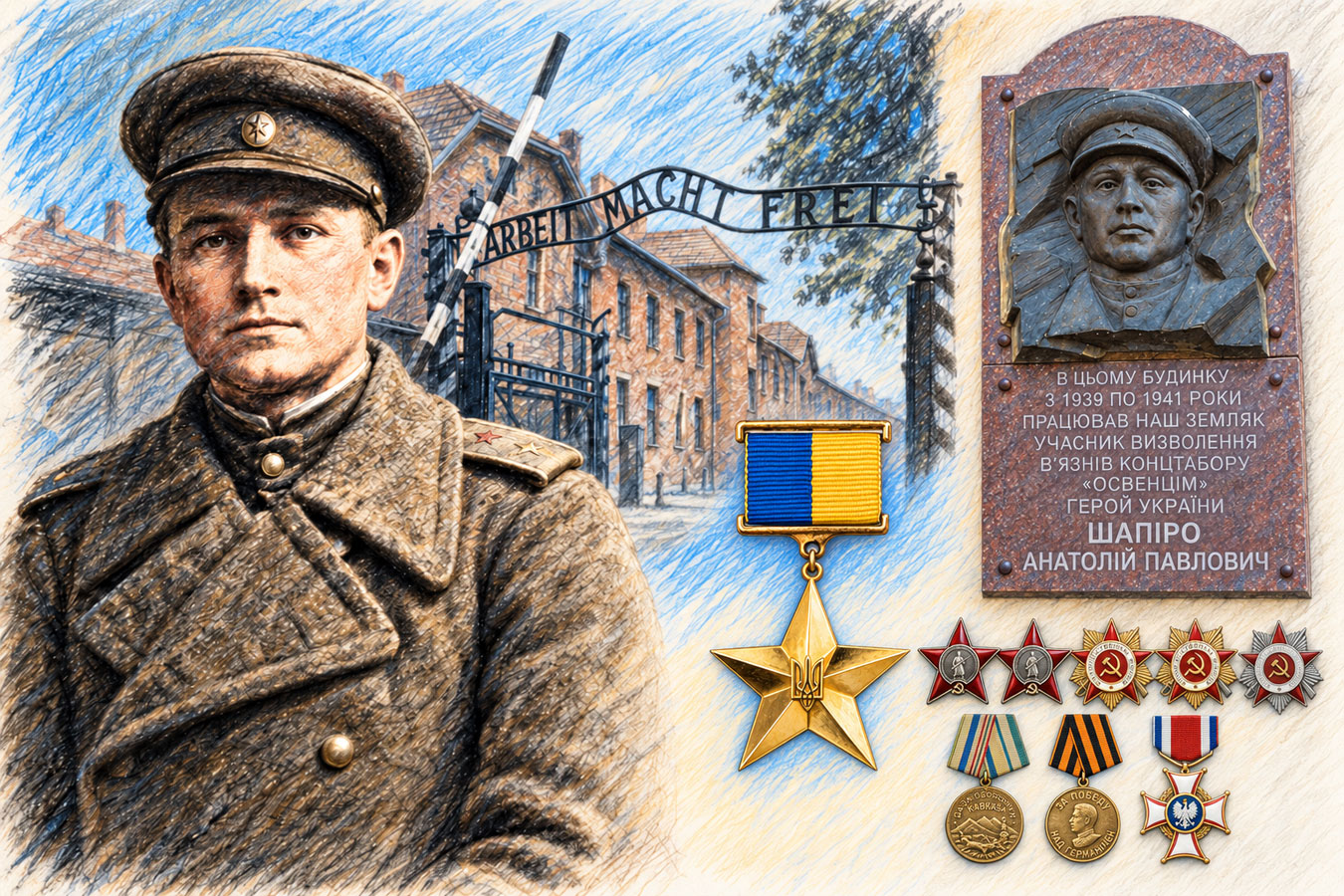
Jews from Ukraine: Anatoly Shapiro from Ukrainian Konstantinograd, a major of the Red Army, who opened the gates of Auschwitz and was awarded the title of Hero of Ukraine with the Order of the “Golden Star”.

On January 27, 1945, Soviet soldiers entered one of the children’s barracks of the Nazi camp Auschwitz. Seeing people in military uniforms, two children were frightened and shouted: “We are not Jews!”

They were Jews. But the children did not yet know that they were facing liberators. They feared that the arriving soldiers might be Nazis and send them to the gas chamber. In the camp, belonging to the Jewish people meant a constant threat of death for them.

This episode was recounted sixty years later to American journalists by Anatoly Shapiro — a Jew from Ukrainian Konstantinograd, a major of the Red Army, and a participant in the liberation of Auschwitz. He was 92 years old at the time. Behind him were several years of war, heavy battles, and injuries. But what he saw in January 1945 continued to return to him in nightmares.

Author: Elena Gunko

Jews from Ukraine: Anatoly Shapiro from Ukrainian Konstantinograd, a major of the Red Army, who opened the gates of Auschwitz and was awarded the title Hero of Ukraine with the Order of the Golden Star.

Before the war, Shapiro was an engineer, a deputy of the Zaporizhzhia City Council, and the head of the city’s planning body. In the fall of 1941, he voluntarily went to the front. In January 1945, he participated in the liberation of Auschwitz — a camp complex on the territory of occupied Poland, where the Nazis exterminated about 1.1 million people, mostly Jews.

After the war, he participated in the restoration of the DniproHES and the construction of power plants, and in 1992 he emigrated to the USA. He died on October 8, 2005, in New York. Eleven months later, President Viktor Yushchenko posthumously awarded him the title Hero of Ukraine.

This material was prepared for the popular science section of NAnovosti “Jews from Ukraine“. We do not claim to conduct independent historical research or definitively resolve scientific disputes. Our task is to tell a wide audience about little-known pages of the common Ukrainian-Jewish history, to introduce readers to people, events, and documents. Some information is interpreted differently by historians. For those who want to study the topic deeper, we suggest referring to the sources cited in the article.

Anshel Faytelyevich from Konstantinograd

Anatoly Shapiro was born on January 18, 1913, in Konstantinograd, Poltava province of the Russian Empire. Today it is Berestyn in the Kharkiv region of Ukraine, until 2024 — Krasnograd.

At birth, the boy was named Anshel Faytelyevich Shapiro. His father was Faytel Mordukhovich, and his mother was Sara Anshelevna. Biographical publications link information about the family with a record in the local rabbi’s metric book. Such books, in which Jewish communities registered births, marriages, and deaths, remain important sources on the history of Jews in Ukraine today.

Later, Anshel became known as Anatoly Pavlovich. In 1934, he graduated from the Zaporizhzhia Engineering and Pedagogical Institute. A year later, he received the rank of junior reserve lieutenant, and in 1937–1939 he worked at a technical school at the Dneprospetsstal metallurgical plant.

In 1939, Shapiro was elected a deputy of the Zaporizhzhia City Council. Then he headed the city’s planning body of the executive committee, responsible for economic development and industry issues.

When Germany attacked the Soviet Union, the 28-year-old engineer held a managerial position. According to biographical evidence, he could have expected evacuation due to his service, but in October 1941, he went to the front as a volunteer.

Four years of war: from Tuapse to Auschwitz

Shapiro began his front-line service in 1941. He fought as part of the 76th Marine Rifle Brigade, commanding a separate battalion. He participated in battles in the Kuban, near Tuapse, Rostov-on-Don, Taganrog, and on the Mius River, where German troops created a powerful defensive line.

His military biography also included the Battle of Kursk, an injury near Prokhorovka, and the crossing of the Dnieper. In 1943, he performed staff duties, including in the operational department of the 43rd Army.

By early 1945, Major Shapiro served in the 106th Rifle Corps of the 60th Army of the 1st Ukrainian Front. For Israeli readers, it should be clarified: this was a formation of the Red Army, not a separate national Ukrainian army. Representatives of different peoples of the Soviet Union served in its units.

In January 1945, Soviet troops were advancing on the territory of Poland. On the path of the 60th Army was the city of Oswiecim, the German name — Auschwitz.

January 27, 1945: Liberation of Auschwitz

Ten days before the arrival of Soviet troops, the Nazis began evacuating prisoners. From January 17 to 21, about 56–60 thousand people were taken out of the camp complex and driven west. People walked in winter weather, exhausted by hunger and disease. Those who lagged behind were shot. These marches went down in history as “death marches.”

At the same time, the SS destroyed documents, blew up gas chambers and crematoria, trying to hide the traces of mass murders. The last crematorium in Birkenau was blown up on January 26.

On January 27, units of the 60th Army of the 1st Ukrainian Front liberated Auschwitz. The camp complex included several large camps — Auschwitz I, Auschwitz II — Birkenau, Auschwitz III — Monowitz — and many sub-camps. Therefore, its liberation cannot be reduced to a single storming of the gates.

In the battles for Oswiecim and the camp facilities, more than 230 Soviet servicemen were killed.

In the three main camps, Soviet soldiers found about seven thousand living prisoners, including hundreds of children. Many were in critical condition. About five hundred more people were liberated in sub-camps shortly before or after January 27.

“We are not Jews!” — testimony of Anatoly Shapiro

On March 6, 2005, the New York Daily News published an interview with 92-year-old Shapiro by journalist Walter Ruby. The conversation took place in the veteran’s apartment in the Coney Island area of New York.

Shapiro recalled people in striped camp clothing standing in the snow. They were so emaciated that they could barely move. Some wrapped their feet in rags instead of shoes. Hearing that liberators had come, the prisoners did not immediately believe it. They approached the soldiers, touched their clothes and hands, trying to make sure that what was happening was real.

Shapiro quoted the soldiers: “The Red Army has come to liberate you.”

In the barracks, soldiers found the living next to the dead. Shapiro described the heavy smell, dirt, blood, and people who could no longer get up from the bunks on their own.

He especially remembered two children.

In one of the rooms marked Kinder — “children” in German — soldiers found two living children. Seeing people in military uniforms, they began to scream that they were not Jews. According to Shapiro, the children were Jews but feared they would be sent to the gas chamber.

Military medics took them to wash and feed them. The names of the children were not mentioned in the published interview, nor is their further fate known. Shapiro did not claim that they had previously been taken to the gas chamber.

The condition of the other survivors was no less severe. Many had starved for so long that regular food could be dangerous for them. Medical assistance, gradual restoration of nutrition, and treatment of infectious diseases were required. After liberation, measures were taken to clean the barracks and prevent epidemics.

Later, assistance to the prisoners was provided by Soviet medical services and the Polish Red Cross. Thousands of former prisoners, including hundreds of children, received treatment in a hospital organized by Polish medics.

Even sixty years later, Shapiro told journalists that what he saw in the camp continued to haunt him in his dreams.

Who entered Auschwitz first: testimonies and documents

In several publications, Anatoly Shapiro is called the commander of a battalion of about five hundred servicemen, one of the first to enter Auschwitz. This version is entrenched in his popular biographies.

However, research by S. A. Lipatov, based on Soviet military documents, indicates that in January 1945, Shapiro was listed as the assistant chief of the operational department of the 106th Rifle Corps. The researcher did not find documentary confirmation of his command of a separate assault battalion at the time of the camp’s liberation.

The liberation of the camp complex involved units from several formations, including the 100th and 322nd Rifle Divisions. Therefore, it is impossible to establish one indisputable first officer who opened the gates of all of Auschwitz.

At the same time, in the official decree of the President of Ukraine No. 768/2006, Shapiro is named the commander of a separate rifle battalion of the 100th Rifle Division, participating in the liberation of Oswiecim on January 27, 1945. This wording reflects official recognition of his military merits, although it differs from some archival information about the position held.

There is no reason to deny Shapiro’s participation in the camp’s liberation. His lifetime testimonies also remain an independent historical source. But the claim that he single-handedly first opened the gates of Auschwitz requires a caveat.

How many people died in Auschwitz

After the war, the Soviet Extraordinary Commission estimated the number of deaths in Auschwitz at about four million people. This figure appeared in the materials of the Nuremberg Trials, but further historical research revised it.

According to modern estimates by the Auschwitz-Birkenau State Museum, about 1.3 million people were deported to the camp complex, of which approximately 1.1 million were killed. About a million victims were Jews. Among the other dead were approximately 70–75 thousand Poles, 21 thousand Roma and Sinti, about 14–15 thousand Soviet prisoners of war, and thousands of prisoners of other nationalities.

These data are based, in particular, on the research of historian Franciszek Piper, who studied deportation documents, camp records, and demographic information.

Auschwitz, Israel, and Jews from Ukraine

January 27, the anniversary of the liberation of Auschwitz, has been International Holocaust Remembrance Day since 2005, established by the UN General Assembly. In Israel, there is also a separate national memorial date — Yom HaShoah, Holocaust and Heroism Remembrance Day, observed on the 27th of Nisan according to the Jewish calendar with legally established postponements.

The testimonies of Holocaust survivors are preserved at Yad Vashem — the national memorial complex of Holocaust and Heroism history in Jerusalem. Among the millions of victims of Nazi extermination were relatives of future citizens of Israel, Jews from Ukraine, Poland, Hungary, and other European countries.

Anatoly Shapiro was never a citizen of Israel, but his story is directly connected to the Jewish people. He was born into a Jewish family in Ukraine, participated in the liberation of a camp where about a million Jews were killed, and at the end of his life, left testimonies about what he experienced.

In the NAnovosti section “Jews from Ukraine,” there is the story of another native of Ukraine connected to Auschwitz — Kyiv resident Yura Lifshits. In April 1943, he, along with Robert Mestrio and Jean Franklemon, participated in an attack by the Belgian Resistance on the twentieth convoy transporting Jews to the camp. Hundreds of prisoners managed to escape from the train.

Lifshits tried to save people on the way to Auschwitz. Shapiro, two years later, participated in the liberation of those who survived camp imprisonment. Both were born into Jewish families on Ukrainian soil.

NAnovosti — News of Israel | Nikk.Agency continues to tell about these people, whose fates connect the history of Ukraine, Israel, and European Jewry.

After the war: Prague, Zaporizhzhia, DniproHES, and New York

After the liberation of Auschwitz, Shapiro continued military service and ended the war in Prague. In the post-war period, he held a position in the headquarters of the 65th Army. He was demobilized in 1947.

Returning to civilian life, he worked as an engineer again. He participated in the restoration of the DniproHES in Zaporizhzhia, the construction of the Kuybyshev Hydroelectric Station, and worked in Siberia and Kaliningrad. The DniproHES, a large power station on the Dnieper, was severely damaged during World War II and required extensive reconstruction.

In 1972, Shapiro moved to the Moscow region. In 1992, together with his wife Vita, he emigrated to the United States, settling in the Coney Island area of Brooklyn, where a large community of former USSR immigrants had formed.

In America, he spoke at memorial events, gave interviews, and talked about the liberation of Auschwitz. In May 2005, his last book “Sinister Marathon” was published.

In his later interviews, Shapiro recalled not only the liberation of the camp but also the Soviet years, work, service, and his attitude towards the collapse of the USSR. He emphasized that he was proud of the Red Army’s participation in liberating the prisoners, and he spoke of his life in the Soviet Union with regret for the bygone era.

When asked what he felt as a Jew among the first liberators, Shapiro replied: “I was very proud to be among the first liberators.” At the same time, he spoke of his pride primarily for the Red Army’s participation in the camp’s liberation.

Combat and state awards of Anatoly Shapiro

Anatoly Shapiro was awarded several Soviet combat orders and numerous medals. Biographical sources mention twenty orders and medals. The Zaporizhzhia Regional State Administration, in a publication on May 9, 2008, separately mentioned fourteen medals.

Among the established Soviet awards:

  • Two Orders of the Red Star — awarded on February 7 and October 28, 1943. In the materials of the Zaporizhzhia Regional Administration, they are associated with battles near Tuapse and Kanev.
  • Two Orders of the Patriotic War, 1st Class. One of them is dated April 30, 1945. The date of the second award requires separate confirmation from the award document.
  • Order of the Patriotic War, 2nd Class — August 5, 1944.
  • Medal “For the Defense of the Caucasus” — May 1, 1944.
  • Medal “For the Victory over Germany in the Great Patriotic War of 1941–1945” — May 9, 1945.

The dates of the listed awards are provided according to the archival card index of the Ministry of Defense of the USSR. The information from the Zaporizhzhia Regional Administration also mentions awards for battles near Krakow and Prague.

Polish state award. In 2005, on the sixtieth anniversary of the liberation of Auschwitz, Shapiro was awarded a Polish distinction. Biographical publications mention the Cross of Merit of the Republic of Poland; in some sources, there is also mention of the officer’s degree of the Order of Merit of the Republic of Poland. The exact list of Polish awards requires verification with original Polish documents.

Due to his poor health, Shapiro could not travel to Poland for the commemorative events. The award was presented to him in New York with the participation of Polish Consul Agnieszka Miszewska. At the celebrations in Krakow, his video message was shown, in which he urged not to allow the repetition of Nazi crimes.

Hero of Ukraine. On September 21, 2006, already after Shapiro’s death, President Viktor Yushchenko awarded him the title of Hero of Ukraine with the Order of the Golden Star. This is the highest state title of Ukraine, awarded for personal courage, heroic self-sacrifice, and steadfastness in the fight against Nazi invaders.

It is important to distinguish between two distinctions existing in the system of the title Hero of Ukraine: the Order of the Golden Star is awarded for a heroic deed, and the Order of the State is for outstanding labor merits. Shapiro was posthumously awarded the Golden Star.

How Ukraine commemorated Anatoly Shapiro

On September 21, 2006, President of Ukraine Viktor Yushchenko signed decree No. 768/2006 “On awarding the title Hero of Ukraine.” Anatoly Shapiro was posthumously awarded the title of Hero of Ukraine with the Order of the Golden Star.

In the decree, he is named the commander of a separate rifle battalion of the 100th Rifle Division and a participant in the liberation of the Auschwitz concentration camp. The same document posthumously awarded the title Hero of Ukraine to Tatiana Iosifovna Markus — a Jewish participant in the anti-Nazi underground in Kyiv, executed by the Nazis in 1943.

Thus, with one presidential decree, Ukraine honored two people of Jewish origin who participated in the fight against Nazism: an underground fighter from Kyiv and a front-line officer born in Konstantinograd.

On May 9, 2008, a memorial plaque to Anatoly Shapiro was unveiled in Zaporizhzhia on the building where the city executive committee was located from 1939 to 1941. He worked here before going to the front. By the time the plaque was unveiled, the building housed the city police department.

The ceremony was attended by the acting first deputy minister of foreign affairs of Ukraine Yuriy Kostenko, the acting head of the Zaporizhzhia Regional State Administration Valeriy Cherkaska, the mayor of Zaporizhzhia Yevhen Kartashov, and Shapiro’s relatives.

On behalf of the family, his grandson Yuriy Shapiro, who lived in Zaporizhzhia, spoke, thanking the participants of the ceremony for preserving the memory of his grandfather. The author of the memorial plaque was Zaporizhzhia architect Oleksiy Mashkadov.

On the memorial plaque, made in Ukrainian, a bas-relief of Shapiro in military uniform is installed. The inscription states that in this building from 1939 to 1941, a native, a participant in the liberation of the prisoners of the Auschwitz concentration camp, Hero of Ukraine Anatoly Pavlovich Shapiro worked.

His memory was also preserved in the United States: a memorial stand dedicated to Shapiro was set up in the Brooklyn Holocaust Survivors Club.

How Anatoly Shapiro is remembered in Israel

Although Anatoly Shapiro never lived in Israel, his name is present in Israeli historical journalism, museum stories about World War II, and even in speeches by Knesset members. Here he is remembered primarily as a Jewish officer of the Red Army who participated in the liberation of Auschwitz.

Museum of the Jewish Warrior in Latrun

In the Museum of the Jewish Warrior of World War II named after Chaim Herzog (מוזיאון הלוחם היהודי במלחמת העולם השנייה), located in the Latrun area near Jerusalem, Shapiro’s story is part of the narrative about Jewish servicemen who fought against Nazi Germany.

In January 2025, on the 80th anniversary of the liberation of Auschwitz, the Israeli newspaper “Yedioth Ahronoth” published an article by journalist Iris Lifshitz-Kliger “הגבורה היהודית כפי שלא ראיתם” — “Jewish heroism as you have never seen it.”

Deputy Director of the museum for information and excursion work Asaf Efrati said that visitors are explained: among those who participated in the liberation of Auschwitz was a Jewish major of the Red Army, Anatoly Shapiro, who voluntarily went to war despite being exempt from conscription.

The museum is dedicated to approximately one and a half million Jews who served in the armies of the Allies and participated in the resistance to the Nazis. Alongside Shapiro, they tell about the navigator of the Soviet aviation Polina Gelman and the leader of the anti-Nazi underground in Algeria Jose Aboulker.

January 27, 2026: Shapiro’s name was mentioned in the Knesset

Eighty-one years after the liberation of Auschwitz, on January 27, 2026, Knesset member Yevgeny Sova spoke at a special session dedicated to International Holocaust Remembrance Day and the fight against anti-Semitism.

Talking about the contribution of Jews to the defeat of Nazi Germany, he recalled his own family, relatives who fought in the Red Army, and Anatoly Shapiro. According to the deputy, Shapiro was a Jewish major who participated in the liberation of Auschwitz and spoke to the liberated prisoners in Yiddish.

Sova emphasized that the history of Jewish soldiers who fought against Nazism should occupy an important place in the historical memory of the Jewish people. In conclusion, he expressed hope that future generations would remember the names of these servicemen alongside other heroes of Jewish history.

The speech was preserved in the transcript of the Knesset session from January 27, 2026. The details provided by the deputy relate to his public account and do not remove archival questions about Shapiro’s exact position in January 1945.

Israeli press and biography in Hebrew

On January 24, 2018, the English-language Israeli newspaper The Jerusalem Post published an article by journalist Martin Sieff “Auschwitz hero” — “Hero of Auschwitz.” The material was dedicated to Anatoly Shapiro as a Jewish combat commander who participated in the liberation of the Nazi camp.

A separate biography of Anatoly Shapiro is available in the Hebrew Wikipedia under the title “אנטולי שפירו”. The article details his pre-war work in Zaporizhzhia, military service, liberation of Auschwitz, emigration to the USA, awards, and posthumous awarding of the title Hero of Ukraine. It also reproduces his testimony about how the liberated prisoners touched the Soviet soldiers, trying to believe that liberators had come.

In the Hebrew Wikipedia and several Israeli publications, Shapiro is called an officer who personally opened the gates of Auschwitz. However, in the study of Soviet military documents, this version did not receive unequivocal confirmation. Therefore, information from Israeli publications should be compared with archival research, not confusing the memory of the person with the question of exact precedence in the camp’s liberation.

To date, it has been possible to document mentions of Shapiro in the Israeli parliament, museum narrative, and press. However, confirmations of the existence of a separate monument, memorial plaque, or street named after him in Israel have not yet been found.

The last years of life and the testimony that remained

Anatoly Shapiro died on October 8, 2005, in New York at the age of 92. He was buried at the Jewish cemetery Beth Moses on Long Island.

The veteran gave his last interviews already in a serious condition. He could not travel to Poland for the sixtieth anniversary of the liberation of Auschwitz, but he continued to tell journalists about the prisoners he saw in January 1945.

Among these memories was the story of two children who shouted to the Soviet soldiers: “We are not Jews!”

We do not know their names, we do not know where they were deported from, and we cannot trace their further lives according to Shapiro’s words. But thanks to his testimony, it is known what fear the children experienced even at the moment of liberation.

Anatoly Shapiro was born into a Jewish family in Konstantinograd, Ukraine, worked in Zaporozhye, went through the war, participated in the liberation of Auschwitz, and left memories of what he experienced. After the war, he worked as an engineer for decades, and spent his last years in the USA.

His merits were recognized with Soviet and Polish awards, a posthumous title of Hero of Ukraine, and a memorial plaque in Zaporozhye. But Shapiro’s most famous testimony remains the story of two children who did not yet know that the arriving soldiers had saved their lives.

From ‘The Blues Brothers’ and ‘Masada’ to a film about Ukrainian women: Dean Liras will meet with the audience in Tel Aviv – October 18, 2026

There are people whose last names almost never appear prominently on the poster, although without them, half of the famous scenes in movies would simply look different.

Dean Liras is one of those. An American cinematographer, specialist in complex filming, a member of the second director’s group, and a producer. His professional biography includes ‘The Blues Brothers,’ ‘Con Air,’ ‘Dumb and Dumber,’ ‘Masada,’ and other major projects.

Author: Pavel Shveiko

On October 18, 2026, he will be in Tel Aviv.

But the meeting itself is interesting not so much for the opportunity to hear more stories about Hollywood. Here, everything turned out to be noticeably more complex. Liras’s Hollywood career intersects with Israel, the memory of the Holocaust, and a new documentary project about Ukrainian women.

The meeting is organized by Israeli Friends of Ukraine. It will be held at the Ukrainian Cultural Center in Tel Aviv.

From 'The Blues Brothers' and 'Masada' to a film about Ukrainian women: Dean Liras will meet with the audience in Tel Aviv - October 18, 2026
From ‘The Blues Brothers’ and ‘Masada’ to a film about Ukrainian women: Dean Liras will meet with the audience in Tel Aviv – October 18, 2026

When Hollywood couldn’t be ‘painted over later’

Dean Liras’s career began in a completely different cinematic era.

Today, a complex scene can be shot with digital cameras, drones, stabilizers, and then assembled and corrected in post-production for a long time. During Liras’s early career, a significant part of what the viewer saw really needed to be physically set in front of the camera.

If a car was needed, it drove.

If a plane was needed, it flew.

If the camera needed to work in the air, it was lifted there.

On ‘Con Air,’ released in 1997, Liras worked as director of photography: aerial unit, meaning he was responsible for the cinematography of the aerial shots.

This is precisely the case when a dry line in the credits explains a lot. In the film with Nicolas Cage, John Cusack, and John Malkovich, aviation is not just a backdrop. It is part of the action.

His filmography also includes ‘Dumb and Dumber,’ early Hollywood films, and work in the second filming unit—the very one that often shoots chases, wide shots, complex stunts, and material without which the main unit would have to spend much more time on set.

And here comes Israel.

‘Masada’ is a name that hardly needs explaining to an Israeli

Liras also participated in the work on the American miniseries Masada, released in the early 1980s.

For a reader in Israel, this name sounds very different than it does to someone somewhere in Europe or the USA. Masada is an ancient fortress by the Dead Sea, associated with the last stage of the Great Jewish Revolt against Rome.

It is one of the most recognizable historical sites in Israel. Schoolchildren and tourists are taken there, historians argue about it, and the image of Masada has been an important part of Israeli historical memory for decades.

The American series told the story of the Roman siege of the fortress. One of the main roles was played by Peter O’Toole.

Therefore, the conversation on October 18 about filming Western projects in Israel is not just a general topic for the evening. Liras really worked within such a production.

And it is interesting here to hear the details: how Israel was seen by the foreign film crew at that time, how the country looked through the Hollywood camera, and how much all this differed from the familiar picture today.

He witnessed several Hollywoods

The organizers formulate one of the themes of the meeting as a conversation about Hollywood then and now.

In the case of Liras, this is not an advertising phrase.

He witnessed several technically different eras of cinema. Film and digital. Large physical sets and computer graphics. Filming where a mistake was sometimes impossible to correct, and modern production where a huge part of the work continues after the set.

At the same time, his career did not end with memories of old films.

Now he participates in independent and international projects. And it is at this point that the meeting in Tel Aviv ceases to be just an evening of Hollywood nostalgia.

NANews — News of Israel | Nikk.Agency draws attention to this event primarily because one of Liras’s new works is directly related to Ukraine.

A film about a man who was silent for decades

Among Liras’s latest projects is The Optimist: The Bravest Act Is Truth.

This is a story of a completely different scale. Without planes, stunt scenes, and Hollywood chases.

The film is connected with the story of a Holocaust survivor, Herbert Heller. As a teenager, he went through Auschwitz-Birkenau and then managed to escape during the death march.

After the war, he spoke little about what he had experienced.

For decades.

And only much later did this story begin to come out.

Here, an Israeli reader seemingly does not need a separate explanation, but the context is important. In Israel, the testimonies of Holocaust survivors are not just a history studied from books. For many families, it remains part of their own biography. And with each passing year, there are fewer people who can tell about their experiences firsthand.

From here arises a theme that is much broader than a single film.

What happens to memory when there are almost no witnesses left?

Can cinema preserve not only facts but also the human voice?

And where is the line between genuine testimony and artistic reconstruction?

For Liras’s project, this is a completely different type of work than what his name was previously associated with.

And then — Ukraine

During the meeting in Tel Aviv, they promise to separately discuss another documentary project by Liras.

It is dedicated to Ukrainian women.

Currently, there is little public information about it. There is no point in inventing a title that the organizers have not named or retelling a plot that no one has officially published yet.

Another important detail is known: Ukrainian artist Yana Dereza is participating in the project.

And here the dates align almost perfectly.

On October 16 and 17, just before the meeting with Liras, Dereza’s exhibition ‘Threads of Identity’ is held at the same Ukrainian Cultural Center.

For Israelis, it is worth explaining that this is not a typical exhibition of folk souvenirs.

Dereza works with motanka—a traditional Ukrainian doll made from fabric and threads, usually without a painted face. In Ukrainian culture, motanka is associated with family memory, protective symbolism, and the transmission of tradition between generations.

For Dereza, this form has become contemporary art. She combines traditional technique with personal history, war, displacement, and the question of identity.

And already the next day after the exhibition, she appears in a different capacity—as a participant in a documentary project by an American filmmaker.

This well illustrates how the Ukrainian cultural theme is gradually moving beyond the usual format of diaspora events in Israel.

It becomes part of the conversation with international cinema.

Why this Ukrainian story is of interest to Israel

In recent years, the Israeli audience has become accustomed to seeing Ukraine almost exclusively through news about the war.

Missile attacks.

Destroyed cities.

Negotiations.

Military aid.

Diplomatic conflicts.

But behind this, it is easy to lose another layer—people who continue to live, work, create art, and rebuild their lives.

Especially women.

Millions of Ukrainian women found themselves in a situation where their previous normal life disappeared literally in a few days after the Russian invasion. Some went abroad with their children. Some stayed in Ukraine. Some lost their homes, jobs, or loved ones. Some are trying to build a new life while remaining part of the war.

And if Liras’s documentary project is indeed built around these human stories, then it is much more interesting than another film that tries to explain the war only through frontline footage.

What exactly will be included in the project is still unknown.

Therefore, one of the most obvious questions for Liras on October 18 is who exactly he is filming and why he decided to tell the story of Ukraine through women.

Who will be asking the questions

The moderator of the meeting is Max Freeman, author of the Telegram channel ‘CineManiac’ — @cinemaniacmax.

This is an author’s channel about cinema for an audience in Israel.

It features reviews, news, trailers, recommendations, and materials about both international and Israeli cinema.

So the choice of moderator here is quite understandable. The meeting is planned to be structured not as an official lecture by a filmmaker to the public, but as a normal conversation between someone who knows cinema from the inside and someone who constantly writes and talks about it.

After the main part, they promise to give the opportunity to communicate with Liras without a formal interview.

October 18: What you need to know

The meeting will take place on Sunday, October 18, 2026.

Location — Ukrainian Cultural Center, Irmeiyahu Street, 22, Tel Aviv–Yafo.

Doors will open at 19:00.

After the main part of the program, approximately from 20:30 to 21:00, the organizers have planned informal communication with Dean Liras.

And here is one important point.

The meeting will be entirely in English, without translation.

So those who find it difficult to follow a long conversation in English should take this into account in advance.

The number of seats is limited, and entry is paid.

Buy tickets via the link

Organizer — Israeli Friends of Ukraine, an Israeli public organization working with Ukrainian-Israeli projects, cultural initiatives, and aid to Ukraine.

Here, Hollywood is less interesting than where the person went after it

Of course, it’s easiest to advertise this meeting with familiar names.

‘The Blues Brothers.’

‘Dumb and Dumber.’

‘Con Air.’

‘Masada.’

These films work well on the poster.

But if you remove them, a much more interesting story remains.

A person who filmed major American cinema for decades is now engaged in the story of a Holocaust survivor and simultaneously making a documentary project about Ukrainian women.

At first glance, there is no connection between these themes.

And then you realize that there is a connection after all.

In both cases, it’s about people who have experienced events much larger than themselves—and then have to somehow continue living and telling what happened to them.

This is what might make the most interesting conversation on October 18 in Tel Aviv.

Trump “does not believe” that Russia and China are helping Iran. What is known about missiles, satellites, and deceased American military personnel

On October 12, 2026, US President Donald Trump stated that he does not believe in Iran receiving help from Russia and China. In his opinion, Moscow and Beijing are risking too much to support Tehran in the war against the US and Israel. However, in recent months, investigations have emerged about Russian military shipments, satellite images, Chinese anti-aircraft missiles, and alleged intelligence transfers that could have been used in strikes on American bases. One such strike claimed the lives of three US servicemen.

Author: Stas Shifer

For Israel, there is much more at stake in this story than just another controversial statement from Washington. If foreign states are helping Iran restore armaments, gather intelligence on targets, and circumvent sanctions, it directly affects Tehran’s ability to continue the war.

Moreover, the issue concerns not only military bases. Published intelligence materials mention Israeli energy infrastructure, cyberattacks, and Russian satellite surveillance of the country’s territory.

Trump says he doesn’t believe it. But what did his military say?

In a message published on the evening of October 12 in Truth Social, the American president lashed out at political opponents claiming that Moscow and Beijing are helping Iran. He called them “radical left idiots and lunatics,” and questioned the reports of assistance.

“If they are helping, it’s at a very low level, but I don’t believe it’s happening at all,” Trump wrote.

The president added that Russia and China “have too much to lose.” According to him, Washington would certainly have learned about serious support for Iran, and very quickly.

This position has an inconvenient backstory.

On July 21, US Secretary of Defense Pete Hegseth spoke before the Senate Appropriations Committee, which was considering additional military operation expenses. Republican Senator John Hoeven asked him whether Russia and China were helping Iran and in what way.

Hegseth acknowledged that both countries were assisting some of Tehran’s actions to varying degrees. He refused to disclose details due to confidentiality. Chairman of the Joint Chiefs of Staff General Dan Kane also declined to discuss available intelligence publicly.

This was not a statement that Moscow and Beijing were directly directing Iranian strikes. But American military officials did not confirm the absence of assistance either.

On July 24, Trump said he trusted the promises of Putin and Xi Jinping not to provide weapons to Iran. In case of violation of these promises, the president warned of serious consequences.

Almost three months have passed since then. During this time, new information about weapons, technologies, and financial mechanisms has emerged, and the war, which began on February 28 with joint American and Israeli strikes on Iran, has continued.

Russian satellites, American bases, and an intelligence agreement with Iran

On April 7, Reuters published an investigation into Russian intelligence support for Tehran, based on Ukrainian intelligence documents and interviews with Western and regional security sources.

According to the materials studied, from March 21 to 31, Russian satellites conducted at least 24 observations of areas with 46 military and infrastructure facilities in 11 countries and regions in the Middle East and adjacent territories.

Among the observation targets were American bases, airfields, oil facilities, and other important infrastructure.

Nine satellite observations concerned Saudi Arabia. In five cases, Russian devices surveyed the area of King Khalid Military City, where they presumably tried to locate American THAAD missile defense systems.

For Israel, this is a familiar category of armaments. THAAD is an American system for intercepting ballistic missiles at high altitudes, designed to counter threats of the class that Israeli air defense faces during Iranian missile attacks.

The documents also mentioned observations of facilities in Turkey, Jordan, Kuwait, the United Arab Emirates, Israel, Qatar, Iraq, and Bahrain, as well as American military infrastructure on Diego Garcia Island in the Indian Ocean.

Russian satellites also surveyed the Strait of Hormuz — a maritime passage between Iran and Oman, through which about a fifth of the world’s oil and liquefied natural gas shipments passed before the war. Since the start of hostilities, Tehran has sharply restricted shipping, creating an energy crisis far beyond the region.

A particularly interesting episode involves the American Prince Sultan Air Base in Saudi Arabia.

Before the Iranian strike on March 27, a Russian satellite surveyed this facility. During the attack, a Boeing E-3 Sentry — an airborne early warning and control aircraft known as AWACS — was damaged. Such aircraft allow tracking of aerial threats over long distances and coordinating aviation actions. The next day, a Russian device again passed over the base area.

Ukrainian intelligence considered this sequence part of a broader pattern: some targets were subjected to Iranian strikes shortly after Russian satellite observations.

A Western military source and a separate regional security source confirmed to Reuters the intense activity of Russian reconnaissance satellites and the transfer of images to Iran. American company Kayhan Space independently established corresponding orbital passes but rightly clarified that the presence of a satellite over a specific object does not yet prove the execution of photography.

There is another document whose existence is not in doubt.

On January 17, 2025, Putin and Iranian President Masoud Pezeshkian signed a twenty-year Comprehensive Strategic Partnership Agreement. It came into force on October 2 of the same year.

Article 4 of the agreement explicitly provides for the exchange of information and experience between the intelligence services of the two countries. Article 5 regulates military-technical cooperation, specialist training, and contacts between defense departments.

The agreement does not prove the transfer of coordinates for a specific strike on an American base. But the cooperation of Moscow and Tehran’s intelligence services is officially enshrined, long before Trump’s current statement.

Cyberattacks: How Russian-Iranian Cooperation Concerns Israel

The April Reuters investigation also contained information about the interaction of hacker groups associated with Russia and Iran.

According to Ukrainian intelligence materials, Russian Z-Pentest Alliance, NoName057(16), and DDoSia Project contacted Iranian Handala Hack through Telegram. After the war began, Iranian groups intensified operations against telecommunications companies and critical infrastructure facilities in the Gulf countries.

In March, Handala Hack and its associated participants warned of attacks on the information systems of Israeli energy companies. Simultaneously, Russian groups published credentials allegedly allowing access to the management systems of Israeli critical infrastructure.

The materials also mentioned Homeland Justice (UAC-0074) and Karmabelow80. Their methods, according to Ukrainian intelligence, indicated possible borrowing of technologies from Russian military hackers. The technical infrastructure was created using, among other things, ProfitServer — a virtual server provider from Russian Chelyabinsk.

On April 8, Russia rejected reports of joint cyber operations.

It should be noted that the publication of credentials, a hacker’s statement about an attack, and actual system penetration are different events. These reports do not contain independent confirmation of a large-scale takeover of Israeli energy facilities.

However, for Israel, the very possibility of such cooperation raises serious concerns. Disruption of the energy system or communication can affect hospitals, transport, water supply, and the civilian population even without a direct missile hit.

Military Cargoes via the Caspian and Russian Assistance to Iranian Missiles

In August, information emerged not only about intelligence.

On August 18, NBC News reported on Russian military supplies to Iran via the Caspian Sea. Journalists examined a European government document, the content of which was confirmed by a Western official. It mentioned drone components, ammunition, and trinitrotoluene — TNT, an explosive used in ammunition production.

According to materials reviewed by analysts from the Institute for the Study of War and Critical Threats Project, more than two dozen Russian ships carried shipments to the Iranian port of Amirabad.

The exact volumes of delivered weapons and the final recipients of all cargoes have not been publicly disclosed.

These shipments were already covered by NANews in the article “Russia Supplies Weapons to Iran via the Caspian”.

The route is well known. In 2023, according to The Wall Street Journal, more than 300,000 artillery shells and about a million other munitions were transported from Iran to Russia via the Caspian.

Now there is evidence of military cargo movement in the opposite direction.

The significance of this transport corridor was understood in Israel as well. On March 18, 2026, Israeli aviation struck Iranian fleet and military facilities in the Caspian port of Bandar Anzali. Among the targets were ships, command infrastructure, and ship repair facilities.

NANews thoroughly analyzed the IDF operation against the Caspian corridor Iran — Russia.

On July 25, Ukrainian forces also attacked ships associated with Russian-Iranian military shipments in the Caspian. Iranian Foreign Minister Abbas Araghchi then accused Kyiv of actions against an Iranian merchant ship and, without published evidence, claimed that Ukraine acted at Israel’s behest. There is no confirmation of a unified Israeli-Ukrainian operation.

Two more investigations are important for understanding what is happening.

On September 2, the Financial Times reported on a secret C430L program, in which Russian specialists helped Iran develop a ramjet engine for supersonic cruise missiles. The work began back in 2023 and, according to the documents studied, continued after the start of the current war.

On the Russian side, “Rosoboronexport” and NPO Mashinostroyenia were involved. Journalists examined correspondence, information about engineers’ trips, and patent documents. Among the specialists were Alexander Dergachyov, Alexander Chebakov, and Yuri Prokhorchuk, who worked on missile systems, aerodynamics, and engines. The contract negotiations were led by “Rosoboronexport” representative Vladislav Kuzmichev.

The alleged technology is primarily intended for anti-ship missiles and weapons capable of striking ground targets. According to the investigation, Iran built the engine and conducted flight tests, but there is no information about the adoption of the supersonic missile developed with Russian assistance.

On October 9, Bloomberg reported that Iran retains the ability to produce missiles and drones despite months of American and Israeli airstrikes. One Western official claimed that Russia continues to supply missiles to Tehran. Similar assessments appeared as early as June 12.

The types and quantities of the alleged October deliveries have not been publicly established. The Russian Ministry of Defense did not respond to Bloomberg’s request.

For Israel, the threat lies not only in the possible replenishment of ballistic missile stocks. Supersonic anti-ship systems can complicate fleet operations and shipping, and maintaining Iranian production allows Tehran to replenish losses after airstrikes.

Chinese Satellites and the Death of American Soldiers in Jordan

The second part of the story is related to China and the events of July 17.

On this day, Iran launched a missile strike on the Muwaffaq Salti Air Base in Jordan, used by American forces. One of the attacks hit the area where military personnel were stationed. Three American soldiers were killed, and four others were injured.

In total, according to American sources, the base was subjected to three missile attacks in one day.

On September 11, The Wall Street Journal reported that American officials link this operation to high-resolution satellite images obtained by Iran from Chinese structures before and after the strike.

It is assumed that the images allowed for the study of equipment and personnel placement and then assessed the damage inflicted. However, American sources did not name specific image suppliers and did not claim that the transfer was directly organized by the Chinese government.

Reuters could not independently confirm the entire chain of events.

NANews has already thoroughly examined this episode in the article “Chinese Eyes for Iranian Missiles”.

On September 13, journalists asked Trump if he planned to discuss this information with Xi Jinping. The president replied that China conducts intelligence against the US, and the US against China. He did not announce any harsh measures in connection with the report of satellite assistance.

But there is a fundamental difference between ordinary state surveillance of each other and the alleged use of transferred data in a strike that resulted in casualties.

A satellite image itself does not guide a missile to a target. Analysis, coordinate determination, planning, and an appropriate guidance system are necessary. Nevertheless, fresh images can significantly increase the accuracy of target selection.

The question of Chinese structures’ involvement in Iranian military operations arose before July. In April, the Financial Times reported that the aerospace forces of Iran’s Islamic Revolutionary Guard Corps gained access to the Chinese reconnaissance satellite TEE-01B, capable of taking images with a resolution of about half a meter. In May, Washington imposed sanctions against Chinese companies accused of transferring satellite data to Iran and assisting military programs.

This does not prove that the Chinese government sanctioned the July strike. But it explains why American intelligence agencies are studying not only direct arms supplies but also the activities of Chinese companies.

Chinese Anti-Aircraft Missiles and Billions of Dollars in Oil Settlements

On July 29, Reuters published an investigation into a planned sale of 300 to 400 Chinese portable anti-aircraft missile systems QW-12 and FN-16 to Iran, with a total cost of 60-70 million dollars.

According to three informed sources, the intermediary was the Hong Kong-registered Zhongqing Baoshang International Investment. The equipment was supposed to be sent from Urumqi, China, through Pakistan to Iran. Other land routes were also considered.

These are MANPADS — small missile systems that can be operated by one soldier or a small crew. Their task is to hit low-flying aircraft, helicopters, and drones. Such installations are significantly more mobile than stationary air defense, making them harder to detect and destroy.

China rejected reports of deliveries, and Pakistan denied involvement in transportation. Reuters also did not claim that all 400 systems had already been delivered to Iran.

But the trade in military technologies is only part of Beijing and Tehran’s relations.

On September 10, Reuters reported on a scheme that allowed Iran to convert oil sales revenues into payment for Chinese goods without transferring money through conventional international banks.

According to two senior Iranian sources and three other agency interlocutors, 2 to 2.5 billion dollars passed through such a mechanism in a year.

The investigation mentioned the financial structure ChuXin, through which funds related to Iranian oil purchases were directed to Chinese suppliers. About 70% of the money, according to sources, was used for infrastructure projects, while the rest went into a special settlement mechanism — SPV, intended for paying for imported goods.

Through this scheme, medicines, cars, and communication means were purchased. Sources also reported at least one case of using the mechanism for air defense equipment contracts worth millions of dollars.

Chinese authorities stated they were not familiar with the described scheme, and Reuters could not establish the full structure of intermediaries.

The economic basis of the relationship is obvious. In 2025, China bought more than 80% of Iran’s exported oil, according to Kpler estimates. For Chinese refiners, this is primarily oil at a significant discount, and for Tehran, it is an opportunity to receive foreign currency revenue, goods, and equipment despite sanctions.

After the start of the current war and shipping restrictions, export volumes changed sharply, but the significance of the Chinese market for the Iranian economy remains enormous.

Why Washington Doesn’t Want to Quarrel with Moscow and Beijing

On September 24, Xi Jinping arrived in the US on a state visit. The next day, US Ambassador to China David Perdue reported that Trump warned the Chinese leader about the inadmissibility of direct or indirect assistance to Iran.

According to the ambassador, Washington received corresponding assurances.

However, on the same day, a senior Iranian official told Reuters that the Chinese side promised Tehran the continuation of political, economic, and military relations despite American pressure.

It is impossible to publicly confirm the content of all these closed negotiations. China called for the parties to return to diplomatic settlement and criticized American strikes on Iran.

A separate story unfolded between Washington and Moscow.

On August 25, CIA Director John Ratcliffe unexpectedly visited the Russian capital and held talks with the leadership of the special services. He did not meet personally with Putin, but the Kremlin confirmed that the Russian president was briefed on the results of the contacts.

According to American media reports, one of the topics was a warning against possible escalation concerning NATO states, primarily Estonia, Latvia, and Lithuania. Russian support for Iran was also discussed.

NBC reported that the CIA chief asked Moscow not to transfer intelligence to Tehran that could be used against American forces.

NANews analyzed this trip in the article “CIA Director Warned Russia to Reduce Aid to Iran and Not Attack NATO”.

The very fact of such negotiations shows that concern about Russian ties with Iran existed at the level of American intelligence agencies, even if the president now publicly downplays the significance of the problem.

By October, an energy issue was added.

On October 9, Trump announced an agreement with Putin, according to which Russia was to immediately send more than 300,000 tons of diesel fuel to American and world markets. Further, additional deliveries of 500,000 tons in November and another million tons later were announced.

The American administration temporarily eased some restrictions on Russian fuel. The decision was criticized in Ukraine and among American lawmakers, who fear increasing Moscow’s revenues during the ongoing war.

Amid high energy prices and the midterm elections to Congress on November 3, Trump seeks to achieve a reduction in fuel costs. Simultaneously, he announced an agreement to stop strikes on the energy infrastructure of Ukraine and Russia.

Kyiv expressed readiness to support a real mutual cessation of such attacks, but subsequent Russian strikes cast doubt on statements about the achieved truce.

It can be assumed that the US president seeks to maintain space for negotiations with Moscow and Beijing and does not want to turn their assistance to Iran into a reason for a new large-scale crisis. But it cannot be asserted that this is precisely what explains his position without reliable information about closed negotiations.

How Two Wars Became Linked for Israel and Ukraine

The current story is clearer if we recall how Russian-Iranian military cooperation has developed since 2022.

Iran transferred Shahed strike drones to Russia, which were used against Ukrainian cities, power plants, and other targets. Later, Moscow deployed its own production of the Geran family of devices, using Iranian technologies and accumulated military experience.

On March 12, 2026, Volodymyr Zelensky stated that Iranian operators participated in the first Shahed attacks on Ukraine, training Russian military personnel directly in combat conditions.

NANews previously published details of this statement by Zelensky.

For Ukraine, Iran has long ceased to be a distant state that simply trades weapons with Moscow. Its technologies have become part of the daily threat to the Ukrainian civilian population.

On September 25, a Russian drone struck a residential building in Kyiv. A 14-year-old Israeli citizen, Daniel Umansky, was killed, and his mother was injured. The family was connected to Israel, where the boy’s relatives were located.

The origin of the specific drone in this tragedy has not been established precisely enough to claim that the device was manufactured in Iran. But the history of Shahed and the Russian Geran demonstrates how military technologies, once transferred between states, continue to cause harm years later.

Now there is evidence of reverse transfer — Russian components, intelligence information, and missile technologies to Iran.

For Israel, it is especially important to understand that this is not about an abstract alliance of three states. The cooperation has various levels. Russia is capable of providing intelligence data and military developments, Chinese companies — equipment and satellite images, and Chinese trade — supporting Tehran’s financial capabilities.

At the same time, one should not confuse the actions of commercial intermediaries with a proven decision by the Chinese government to participate in the war. Similarly, the existence of a Russian-Iranian agreement does not mean that every Iranian strike is planned in Moscow.

This difference is important not for diplomatic caution. The accurate understanding of threats determines which measures are truly capable of limiting them: sanctions against intermediaries, control of transportation, protection of satellite information, cybersecurity, or actions against specific military productions.

It is at the intersection of these issues that NANews — News of Israel | Nikk.Agency examines events in Ukraine and the Middle East. Wars remain different in causes and participants, but military technologies, transport routes, and state interests increasingly intersect.

What changes Trump’s statement and what to expect next

From the information known today, it cannot be concluded that China and Russia have officially entered the war on Iran’s side. Not all volumes of supplies, recipients of intelligence data, and the degree of participation of state leaders in individual operations have been disclosed.

But it is impossible to ignore what has already been published.

There is an official Russian-Iranian intelligence cooperation agreement. There is a Reuters investigation into satellite data and cyber operations, NBC reports on military cargo through the Caspian, Financial Times documents on the C430L missile program, Bloomberg information on ongoing missile supplies, and reports from American officials on Chinese satellite images before the strike in Jordan.

Added to this are US sanctions, Pete Hegseth’s acknowledgment of certain assistance to Iran, and the CIA director’s negotiations in Moscow.

Further development depends on how far Washington is willing to go in limiting such cooperation.

A scenario is possible in which the American administration continues closed negotiations, avoiding public confrontation. Tightening of sanctions is also possible if new evidence of supplies or intelligence assistance emerges. Meanwhile, trade through intermediaries, operations with dual-use goods, and technology exchange may continue even with increased diplomatic pressure.

For Israel, the consequences will be determined not by the wording of Trump’s statements, but by how many missiles, drones, and air defense systems Iran can restore, how much its intelligence capabilities improve, and whether its partners can bypass international restrictions.

The American president has the right to trust the assurances of Putin and Xi Jinping. But the trust of political leaders does not replace the verification of intelligence information.

Especially when this information involves specific military targets, destroyed infrastructure, and deceased people.

“Everything will be”: Anna Andriyenko will present the poetry book “Born to Win” in Tel Aviv – October 29, 2026

On October 29, 2026, a creative evening with Anna Andrienko will take place in Tel Aviv. She is the founder of the Ukrainian restaurant SHO?, an entrepreneur, and one of the organizers of Ukrainian public initiatives in Israel. This time, the occasion for the meeting will be her poetry collection ‘Born to Win’. Guests will hear poems, personal stories, and for the first time, a song written to Anna’s words.

Author: Elena Gunko

The presentation will take place at the SHO? restaurant on Carlebach Street, 3, well-known to the Tel Aviv community. It starts at 19:00, and the participation fee is 150 shekels. The ticket includes a book signed by the author, a glass of sparkling drink, and a light buffet. Reservations must be made in advance.

In an invitation published on October 10 on Facebook, Anna warned that she does not intend to hold an official presentation with long speeches. She wants to tell a story she previously entrusted to paper — about people, meetings, childhood, love, war, and losses. And about why, after everything she has experienced, she continues to believe that much is still possible ahead.

‘Born to Win’: what Anna decided to tell through poetry

‘Every book has a story. And sometimes the book is the story,’ writes Anna Andrienko.

From her announcement, it is clear that specific events and experiences stand behind the poems. Some of them, the author admits, are easier to put on paper than to say aloud. Therefore, on October 29, an ordinary conversation about how the book was created is unlikely to happen. Anna plans to read poems, return to memories, and leave room for music and pauses.

In the invitation, she quotes the lines:

‘There will still be joy and sorrow,
and many different losses,
but again, as in childhood, she laughs —
born to win.’

'There will still be everything': Anna Andrienko will present the poetry book 'Born to Win' in Tel Aviv - October 29, 2026
‘There will still be everything’: Anna Andrienko will present the poetry book ‘Born to Win’ in Tel Aviv – October 29, 2026

These are poems about a person who knows the price of losses but does not agree to give up joy. However, it would be premature to draw conclusions about the entire collection from a few lines: the content of the book has not yet been fully presented.

One of Anna’s planned features for the evening is light and semi-darkness. According to her, there will be little light and a lot of semi-darkness. In such an atmosphere, stories will be told that she previously preferred to write about.

There will also be a musical premiere. Singer Diana will perform a song to Anna Andrienko’s words for the first time. The singer’s surname and the title of the composition were not mentioned in the invitation.

The publisher, print run, and number of poems in the collection are still unknown. However, each visitor to the evening will receive a copy with the author’s autograph.

Anna Andrienko: from economist to founder of a Ukrainian restaurant

Many of those who will come on October 29 know Anna primarily for the restaurant SHO? – Ukrainian Traditional Food. However, the history of this establishment began quite unexpectedly.

On July 9, 2025, in the podcast ‘Balachki’ on the UDM Israel channel, Anna talked about how she took up the restaurant business after working as an economist. A former karaoke club in Tel Aviv gradually turned into a Ukrainian cuisine restaurant and then into a place where Ukrainians began to meet for various reasons.

NANews has already introduced readers to this story in the article ‘SHO? — how trials, faith, and support turned the restaurant into a place of strength for Ukrainians in Israel’.

In the interview, Anna talked about business difficulties, periods of military restrictions, transitioning to delivery and takeaway food. Behind these quite practical decisions was the desire to preserve the establishment and the people who worked and gathered there.

Today, SHO? prepares borscht, varenyky, deruny, and other Ukrainian dishes. The interior is decorated with traditional embroidered towels — decorative cloths that are often passed down from generation to generation in Ukrainian families. Gastronomic evenings and cultural meetings are held here, and the ‘Territory of Show’ and ‘Odessa Courtyard’ projects are developing.

For those from Ukraine who have long lived in Israel, such a place is associated with memories of home. For Israelis, previously little familiar with Ukrainian traditions, the restaurant has become another way to discover the culture of a country with which Israel is connected by the history of Jewish families and several generations of repatriation.

SVOYA, Ukrainian traditions, and meetings in Tel Aviv

In May 2026, Anna Andrienko, together with Anna Zharova, organized the women’s business club SVOYA (‘Own’). The project was created for Ukrainian businesswomen in Israel — women who develop their own businesses, seek partners, exchange experiences, and help each other.

Anna Zharova is also known as the co-founder of the public organization ‘Israeli Friends of Ukraine’. The first meeting of the new club was scheduled for May 24 at the SHO? restaurant. More about this initiative was told by the editorial team in the article ‘SVOYA: in Israel, the creation of a Ukrainian women’s business club was announced’.

In October, the restaurant again welcomes guests to events related to Ukrainian culture. On October 22, a Hutsul banosh evening is planned here — a traditional dish of the Hutsuls, an ethnocultural group from the Carpathians. Banosh is made from corn grits with sour cream or cream, often served with brynza and cracklings. The program includes the participation of Anna Andrienko, Lyudmila Polenok, and Maria Geshko.

And a week later, on October 29, the restaurant’s owner will come out to the guests with her book. Moreover, this will be a completely different conversation — about experiences that she has so far shared mainly in poems.

Ukrainian poetry in Israel: a conversation understandable to different generations

Hundreds of thousands of people live in Israel whose family histories are connected with Ukraine. Some arrived during the great aliyah of the 1990s — the mass repatriation of Jews from the former USSR. Others moved later, and some Ukrainians found themselves here after the full-scale Russian invasion on February 24, 2022.

For some, the Ukrainian language and culture are an everyday part of life, for others — memories of parents, grandparents. The experiences of these people are different. Some have personally experienced the war, while others observe what is happening from Israel, supporting relatives and friends in Ukraine.

And I think that interest in the upcoming evening may extend beyond Anna’s circle of acquaintances. In personal poetry, people who have never met the author often find their own words. Especially when it comes to separation, memory, fear of losing loved ones, and the need to continue living.

For NANews — Israel News | Nikk.Agency, such meetings are also interesting in how Ukrainian culture becomes part of modern Israeli life. It sounds here in concerts, books, conversations, and appears in new public projects. And not only thanks to large organizations: much is held on the initiative of individuals.

Anna Andrienko already has such a story — with a restaurant that unites visitors at one table. Now there is a book with which she invites to a conversation.

Where and when the presentation of ‘Born to Win’ will take place

Date: Thursday, October 29, 2026.

Start: 19:00.

Place: SHO? – Ukrainian Traditional Food restaurant.

Address: Carlebach St 3, Tel Aviv-Yafo (רחוב קרליבך 3, תל אביב).

Ticket price: 150 ₪.

Includes: a copy of the poetry collection ‘Born to Win’ signed by Anna Andrienko, a glass of sparkling drink, and a light buffet.

Advance booking: required, limited seating.

Restaurant contact phone: 058-607-6070. When contacting, specify the reservation for the creative evening on October 29.

Organizers’ pages:

Anna Andrienko’s personal announcement on Facebook.

SHO? – Ukrainian Traditional Food on Facebook.

‘There will still be everything’

At the end of the invitation, Anna Andrienko returns to words that seem to have special meaning for her: ‘There will still be everything’.

She does not explain in advance what exactly she means by this phrase. She only writes that during the meeting she will try to explain why she still believes in it.

Perhaps this is the main intrigue of the evening. Guests will receive a book, hear poems and a new song. But behind all this lies another question, to which each person answers in their own way: how to maintain hope after losses?

Anna’s answer will be heard on October 29, 2026, in Tel Aviv.