Exactly four years ago, Russia began an “operation” that many in Moscow at the time expected to complete in a matter of weeks or at most a couple of months — by crushing Ukrainian statehood, governance, and will to resist.
The main outcome of these four years is already obvious.
The war continues. Ukraine has preserved its statehood. Preserved governance. Preserved the army and society. And continues to resist — fiercely, at times transitioning to counterattacks.
We do not know when and how this war will end. As long as Putin is alive, there is little hope for a normal conclusion. But the cost of this war for the Russian Federation will be terrible — they just do not fully understand it yet.
And it is important to remember: February 24, 2022, is not the “beginning of everything,” but a new, most large-scale stage of the war.
February 24: four years of full-scale war, twelfth year of war against Ukraine
2013–2014 — Revolution of Dignity. February 2014 — shootings on Maidan. March 2014 — annexation of Crimea. Spring 2014 — beginning of the war in Donbas. February 24, 2022 — full-scale invasion. Then — Bucha, Mariupol, Izyum. Liberated cities. Counteroffensives. Missiles, “shaheds”, FPV.
Over these years, Ukraine has lost thousands of lives. Lost part of its territories. Many cities are destroyed or deserted. Prisoners, tortured, raped. Millions of people were forced to leave. An entire nation lives with trauma.
And yet — Ukraine stands.
Yes, one can get tired. One can be afraid. One can sometimes lose heart.
The main thing is to return to oneself. And not to lose humanity.
For some in the West, these four years are just another political cycle, another reason for “deep concern” over morning coffee. For Ukrainians, it is almost fifteen hundred days, and each of them is paid for with someone’s blood.
During this time, the world has seen much: from loud applause in parliaments and congresses to cynical delays in decisions, where each week of “debates” cost Ukraine new victims. Ukraine has been repeatedly tried to be convinced that the fate of the war can be decided by someone from outside — by elections, cabinet agreements, foreign political will.
But history is written not only in Washington, Brussels, or other capitals.
It is written in frozen trenches. In the workshops of underground productions. In volunteer headquarters. In every hryvnia that people give to collections instead of their own peace.
That is why those who say: Ukraine has already won — at least in the sense that it did not disappear in those weeks when many expected its fall. It stood firm when help was limited, and forecasts were grim. It forced the world to reconsider the concept of modern war, army, drones, mobilization of society, resilience of the state.
And another harsh conclusion, which was too long not recognized: the post-war world order began to collapse not in 2022, but in 2014. It was then, on Ukrainian soil, that the basic principles of international law were demonstratively broken, and the policy of “waiting out” and “not provoking” only increased the scale of the catastrophe.
Today, on the fourth anniversary of the full-scale invasion, and simultaneously in the twelfth year of the war against Ukraine, it is important to speak about this directly.
This is not a war “for kilometers.” This is a war for the right to exist. For the right to be a country. For the right to choose your future. For the right to live without imperial dictate.
We may be far geographically — in Israel, Europe, America, anywhere — but not emotionally.
Our families remain under sirens. Our friends — in the trenches. Our cities — under attacks. Our dead — with us every day, in memory, in photographs, in the habit of being silent longer than before.
We think of those who smile at us from black-and-white photos. Of friends, acquaintances, and strangers who died in this war. Of those whose names will never make headlines. Of those who hold the sky and the earth right now.
And one more thing — about the feeling of helplessness that many experienced on February 24, 2022. For many, it was the day the familiar world ended: the end of childhood memories, the end of the feeling of home as something reliable and eternal, the end of the belief that “such things no longer happen in Europe in the 21st century.”
Four years have passed. The war has become the background for a world that is tired. Many have stopped noticing it daily. But it has not disappeared.
Therefore, today is not only a day of remembrance. It is a day of inner discipline.
What can we do abroad? Donate. Support. Speak. Explain. Remind. Do not let this war become a “news item that was scrolled past.”
Ukrainians in Ukraine live. Work. Give birth to children. Pay taxes. Donate. Fight. Create. Repel attacks from the “second army in the world.” And continue to do what in 2022 seemed impossible to many.
Resilience to Ukraine. Strength to our people. 🇮🇱🇺🇦
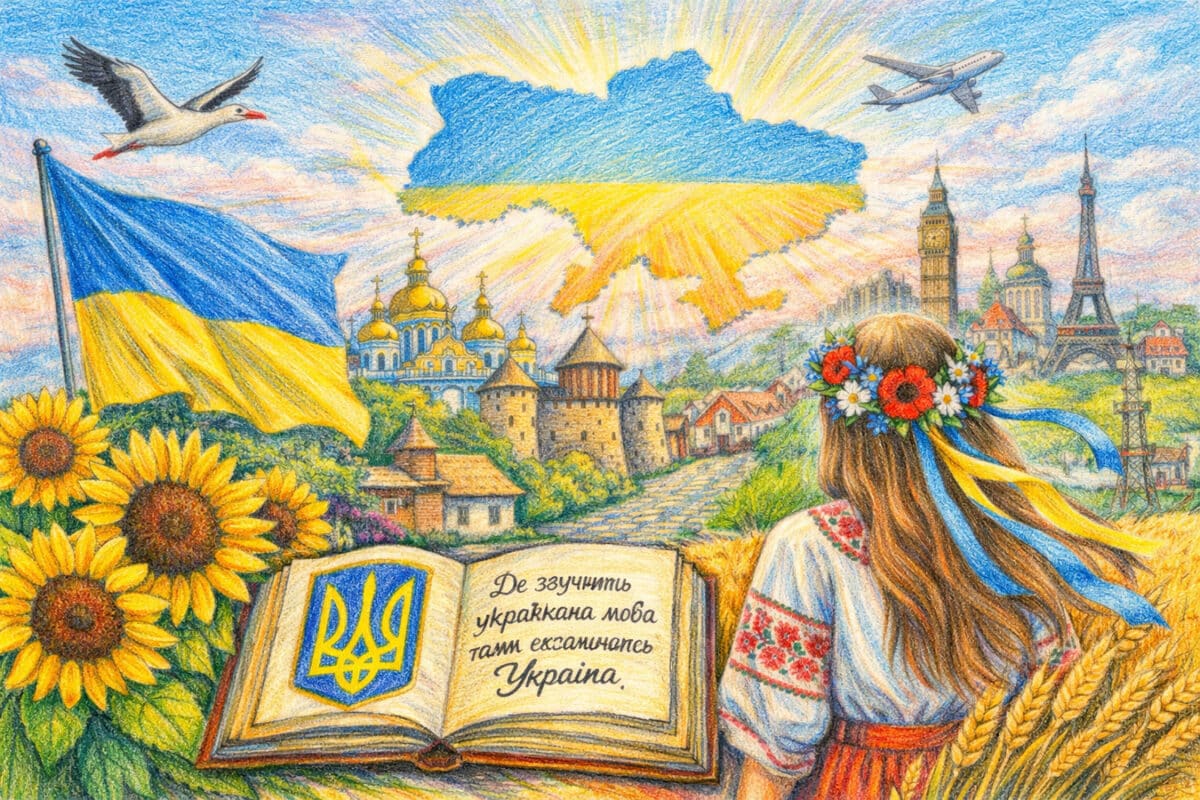
The Ukrainian language is not only a means of communication but also a sign of the country’s presence in the world. Where it lives and is used, Ukraine is preserved as a cultural and political space. That is why the conversation about language always goes beyond linguistics and becomes a matter of identity and security.
Today, about 45 million people worldwide speak Ukrainian, with more than 37 million calling it their native language. For its melodiousness, lexical, and phraseological richness, the Ukrainian language has repeatedly been recognized as one of the most harmonious in Europe. At international linguistic forums, it consistently ranked among the leaders, second only to a few languages of the Romance group.
The modern vocabulary of the Ukrainian language consists of about 256,000 words, placing it among the most developed language systems.
Where the Ukrainian language sounds — Ukraine remains
Researchers also emphasize the antiquity of the Ukrainian language. Scientist V. Kobyliukh argued for its formation as early as the X–IV millennia BC, linking the origin of several words to Sanskrit. By the number of speakers, the Ukrainian language ranks 14th in the world — a figure that speaks for its resilience and viability.
The attitude towards the native language has always been a marker of national consciousness. Metropolitan Ilarion (Ohienko) warned: the loss of respect for the language is equivalent to undermining the foundations of the nation. Educator Konstantin Ushinsky wrote even more harshly — a people can regain what was lost, but a language, once destroyed, cannot be restored. This idea was later developed by modern Ukrainian thinkers, emphasizing that language is a personal and collective asset that cannot be confiscated or stolen.
The history of the Ukrainian language is a history of resistance. After the capture of Ukrainian lands by Moscow, a long process of systematic suppression began. During the imperial and then Soviet rule, about 170 decrees were issued against the Ukrainian language, tens of thousands of words disappeared from dictionaries, and language policy was reduced to forced “convergence” with Russian. This process is increasingly called linguocide — the deliberate destruction of language as the basis of cultural-historical community.
It is important to emphasize: Ukrainian and Russian languages do not have a common root and are among the most distant from each other among the Slavic languages. Ukrainians are an ancient Slavic people, while the formation of the Russian ethnos occurred in a different, mixed historical environment. Despite this, during the Soviet period, the Ukrainian language was pushed into the ritual sphere, even after formally receiving state status in 1989.
After the restoration of independence, the position of the Ukrainian language began to change, but slowly. The Constitution enshrined its state status, but pro-Russian forces continued to promote the idea of “oppression” of the Russian language. Meanwhile, nowhere in the world do national minorities have the volume of rights that Russian speakers in Ukraine had for a long time. The struggle against the law on the functioning of the Ukrainian language as a state language in 2019 became another confirmation of this resistance.
It is indicative that the regions with minimal presence of the Ukrainian language turned out to be the most vulnerable to occupation. In the Luhansk and Donetsk regions, as well as in Crimea, the share of Ukrainian schools was critically low, despite the numerical predominance of Ukrainians. The 2001 census recorded an increase in the use of the Russian language to 81% in these regions, which directly affected their informational and cultural vulnerability.
Today, one of the channels for maintaining Russian influence remains the so-called UOC-MP, which continues to broadcast Moscow’s ideology under the guise of religion. Added to this is the phenomenon of the “Russian-speaking population” — not as an ethnic, but as a political category. Many people became Russian-speaking not through their own fault, but as a result of colonial policy. But the responsibility for refusing to reclaim their native language for themselves and their children during the years of independence remains.
Global experience shows: language protection is the norm. The Czech Republic, Finland, and Israel have gone through a conscious language policy. Under President Tomáš Masaryk, the Czech language returned to the public space of Prague. Finland almost completely switched to Finnish in one generation. In Israel, Hebrew became the state language, despite the fact that at the time of the country’s founding, only a few spoke it — the choice was made for the sake of nation-building.
In France, Germany, Poland, and Slovakia, strict laws protect national languages, including fines and criminal liability. Paradoxically, today the Ukrainian language is being studied more actively in Europe — in Poland and Germany, it is introduced as a second foreign language, with the support of states and the diaspora.
A new threat is not Russification, but Anglicization. Knowledge of foreign languages is necessary, but the substitution of native vocabulary with borrowings without necessity is a path to blurring the linguistic core. Linguist Yuriy Shevelyov warned: excessive borrowings indicate an underestimated self-esteem of one’s own language. This idea was formulated even earlier by Jan Amos Comenius, insisting on the primacy of the native language in education.
The Ukrainian language has withstood the pressure of empires. It survived Russification, Polonization, Germanization, and Magyarization. Today, its future no longer depends on decrees from outside, but on the everyday choice of Ukrainians themselves — to speak at home, at work, at school, on the street, and to pass the language on to children.
As Ivan Franko wrote, language grows with the soul of the people. And as long as this growth continues, Ukraine remains alive — here and now. This is the meaning and reality captured by NAnews — News of Israel | Nikk.Agency, viewing language as a line of defense for culture and the state.
Investigators from the Israel Antiquities Authority, tracking looters at the Ras-Tamim site near Mount Scopus, discovered a huge underground workshop for the production of stone vessels, which operated more than 2000 years ago during the Second Temple period.
The incident began with the discovery of fresh traces of illegal excavations. During several days of covert surveillance, law enforcement officers caught five suspects red-handed. They seized a generator, a metal detector, and special tools for extracting stone. The detainees face up to five years in prison for the destruction of an archaeological site, but the main news was the contents of the cave they were trying to penetrate.
Inside the cave, archaeologists discovered hundreds of limestone fragments, blanks, and production waste. This indicates the existence of an organized industrial center rather than a small craft workshop. Scientists found blocks processed with chisels and products with traces of a lathe. Such products were of critical importance to the society of that time: according to Jewish laws, stoneware, unlike ceramic, was considered impervious to ritual impurity. This made it indispensable in everyday life, especially during food preparation and temple services.
The location of the workshop is also strategic. It was located on an important pilgrimage route leading to Jerusalem from the east. Traders sold ritual items directly near the road, ensuring high demand from travelers.
Near the workshop, burial caves, large reservoirs, and a ritual bath (mikveh) were previously found, painting a vivid picture of a developed industrial-religious area in the vicinity of the ancient city. Today, the found artifacts are presented at the “Criminal Past” exhibition in Jerusalem, which aims to draw attention to the problem of looting that destroys the historical context of monuments.
This discovery underscores the importance of preserving archaeological sites and their context. Finds like this workshop help to better understand the life and culture of ancient Israel. It is important for society to recognize the value of its historical heritage — Israel News | Nikk.Agency.
Irena Mamana repatriate from Zhitomir (Ukraine), became a real heroine of northern Israel. She sews bulletproof vests, repairs uniforms and helps soldiers, forgetting about herself, despite the shelling and financial difficulties.
Her story was told Nikita Aronov on the Israeli portal “Details“.
Irena Maman is one of five returnees honored on November 7 for their contribution to the defense of Israel during wartime.. The award was presented by the country’s President Isaac Herzog. Among the recipients are outstanding personalities: a scientist, a surgeon and organizers of volunteer initiatives.
However, Irena stands out for her unusual feat – she is a seamstress who selflessly and tirelessly helps northern soldiers. She works almost without rest, sewing and altering uniforms for fighters completely free of charge. The irony of fate is that instead of supporting it, the state only increases its tax burden.
How a Ukrainian seamstress became the heroine of soldiers in northern Israel
From Zhitomir to Rosh Pina: the path of Irena Maman
Irena Maman, a native of Zhitomir, came to Israel in 1990. Her journey began with a few hundred dollars in her pocket and a lack of support, but even then she knew for sure that her place was in this country. In the north of Israel, in Rosh Pina, she quickly found her calling: she began working as a seamstress, opened an atelier and won the trust of local residents.
Her story is a story of strength and perseverance that inspires hundreds of people today. Her family life is connected with Israel: three sons serve in the army, the eldest in the Iron Dome battery, the middle in the special forces. It was his request for a convenient pocket for a bulletproof vest that began Irena’s big volunteer mission.
First steps: from evening dresses to body armor
Until October 7, Irena sewed evening dresses and handled regular orders. Everything changed when the war demanded her skills. Her son, a machine gunner, complained that the body armor was uncomfortable: the pockets were too small to hold all the necessary ammunition.
“Then they came to me with the whole detachment,” recalls Irena. “Everyone had their own requests: to alter a bag, make additional pockets for grenades, or even develop a convenient holster for a pistol.”
This was the beginning of a large volunteer project. Irena sews and modifies not only body armor, but also bags for pilots, winter uniforms for infantry, and jackets for territorial defense soldiers.
“Ima Maman” for soldiers
The soldiers call Irena “ima Maman” (Mama Maman). She helps everyone who asks for support, regardless of the complexity of the order or time of day. Despite constant air raids, shelling and lack of shelter, Irena continues to sew.
“When the siren sounds, I don’t stop,” she admits. “There is no shelter nearby, but my mother taught me to believe in fate.”
Irena works almost around the clock, often seven days a week. Her studio in Kiryat Shmona is the only place where soldiers come not only for uniform repairs, but also for a cup of coffee, a kind word and help.
Combating the IDF’s systemic problems
Irena sees systemic problems in army uniforms. Standard patterns for uniforms and body armor don’t fit most soldiers well, she said.
“I have yet to meet a soldier whose uniform fits perfectly,” she says. “The pants are too tight, the sleeves are not the right length, and sizes are often limited.”
Soldiers deployed to Gaza or Lebanon are often given old uniforms that have to be modified by hand. Irena expands pockets, adds inserts from more comfortable fabrics and repairs damaged equipment.
Charity at your own expense
Irena does not take money from the soldiers for her work, but maintaining the studio costs her dearly. Her husband, a university lecturer, supports the family, but the costs of materials, electricity and even underwear for the soldiers are entirely covered by them.
“During the war, I spent my savings. Earnings go only to help the soldiers. I don’t even buy new things for myself,” says Irena.
Her requests to the Ministry of Defense for the allocation of funds or the appointment of salaries remained unanswered. However, Irena does not lose heart, because the most important thing for her is to support the soldiers.
When war is your life’s work
Irena’s life is closely connected with Kiryat Shmona, a city that is under constant shelling. Despite this, she continues to help not only soldiers, but also local residents. Russian-speaking pensioners often turn to her for help: to translate documents, accompany them to the hospital, or even cover broken windows with fabric instead of glass.
“The state can’t cope, social services have dispersed. We help each other as much as we can,” she says.
Table: Irena Maman’s contribution to helping the army and the city
Type of assistance
Description
Refinement of uniforms
Alters body armor, uniforms, bags
Charity
Buys underwear, socks, warm clothes
Soldier support
Coffee, tea, food, assistance with accommodation
Help for city residents
Window repair, support to clinics
Conclusion
The story of Irena Maman is an example of how a person can do the incredible, even under difficult conditions. Her efforts were rewarded with a prize from the President of Israel, but for her the main reward remains the grateful smiles of the soldiers.
“NAnews – Israel News” reminds: such stories about mutual assistance and volunteerism show how closely connected the destinies of the Jewish and Ukrainian peoples are. Irena became a symbol of true service, uniting her past in Ukraine and her present in Israel.
Jabotinsky Day, the national day of remembrance dedicated to the life and legacy of Ze’ev Jabotinsky. On this day, Israel honors Jabotinsky’s achievements and his contribution to the Zionist dream of restoring the Jewish state.
In Israel, the 29th day of the month of Tammuz, the day of his death, has been declared Jabotinsky Day. In 2025, it falls on the evening of Thursday, July 24, 2025 – Friday, July 25, 2025.
Jabotinsky’s advocacy laid the foundation for the modern State of Israel, and his vision continues to shape Jewish identity to this day.
Why This Day Matters for Israel and Ukraine
Jabotinsky vs. Putin: How a Zionist leader disproved Putin’s anti-Ukrainian fabrications more than 100 years ago
The 29th of Tammuz is a special day in the Jewish calendar, when speeches are heard across the country, memorial candles are lit, and Ze’ev Jabotinsky’s legacy is discussed. People far from politics might wonder: why even remember this man?
But look closer — and you’ll immediately realize: thanks to people like Jabotinsky, we have Israel as we know it. His ideas about national dignity, self-respect, and respect for others still resonate not only for Jews, but for everyone fighting for the right to be themselves.
Interestingly, this day often becomes a reason for personal memories. The older generation recalls how families used to argue about Jabotinsky’s views, while young people, reading his biography, are surprised: it turns out he supported Ukrainians even in the early 20th century, when it was neither popular nor safe.
Odessa Roots and Political Instinct: The Beginning of the Journey
Born in Odessa, a city where Jewish, Ukrainian, Greek, Russian, and Armenian destinies mixed in a unique way, Jabotinsky learned early to listen to and understand other perspectives. His childhood was filled with the ringing of trams and the cries of street vendors in different languages, in courtyards where boys would sometimes fight, sometimes become friends. Maybe that’s why he became a committed opponent of any kind of national hatred.
When, in 1907, Jabotinsky ran for the Russian Empire’s parliament from the Volyn province, he had to build bridges between Jewish and Ukrainian voter groups from scratch. Back then, this seemed like an impossible task: distrust, stereotypes, pressure from the authorities… Yet even after losing, he was not disappointed — instead, he began to speak publicly that only together can minorities break the imperial machine of oppression.
Friends and contemporaries recalled that after this defeat, Jabotinsky became much closer to Ukrainian intellectuals. He read Ukrainian poetry, was interested in folk songs, even tried to understand dialects. For him, Ukrainians were never “younger brothers” — he saw them as equal partners.
Putin vs. Common Sense: Why Deny Ukraine?
Why does the Kremlin so fear Ukrainian identity? You can search for explanations for a long time, but essentially, it boils down to this: acknowledging the existence of Ukraine makes imperial claims meaningless. Putin’s 2021 article and his ongoing rhetoric are an attempt to impose the “same old song”: Ukrainians supposedly invented by the Bolsheviks, there is no nation, and anyone who disagrees is an enemy.
But as early as 1911, Jabotinsky publicly stated: “Ukrainians are a people, a separate nation, and that’s the only way to view them.” He didn’t just say this at rallies — but in articles for different audiences, in Russian, Yiddish, and Ukrainian.
Jabotinsky understood Ukrainian and could get by in conversation, but he was not a native speaker and did not speak publicly in Ukrainian. He was fluent in Russian, Hebrew, Yiddish, Italian, French, and several other languages. He learned Ukrainian through practical communication and interest in culture, but did not use it as a language for political speeches or articles.
Contemporaries noted that he “could support a conversation in different Ukrainian dialects,” understood linguistic features, but did not write or publish materials in Ukrainian.
Most of his texts on Ukrainian topics were written in Russian or Hebrew, sometimes in Yiddish.
Friends recalled that Jabotinsky easily found common ground with Ukrainians — sometimes even using Ukrainian words or phrases in conversation to win over his interlocutor.
This debate with imperial thinking was personal — he could not accept the idea of “dissolving” people in a faceless mass.
Let’s remember, Jabotinsky loved genuine public debates — and was not afraid of tough topics. He argued with intellectuals like Pyotr Struve, passionately insisting that every people has its own path, and no one has the right to turn diversity into a monotonous imperial “porridge.” In life, he could easily argue in the street, in an editorial office, or even at a banquet — if it was about people’s right to be themselves.
Quotes That Cannot Be Forgotten
Jabotinsky was no armchair theorist. His writings are always full of life and directness. Here are a few of his thoughts that still resonate today:
“Behind these cities (Ukraine) rolls a continuous, almost thirty-million-strong Ukrainian sea…” An ordinary trip from Odessa to Kharkiv or Poltava was not just a route for him, but a real study: where “khokhly” live, where “katsapy,” why they don’t mix, and what is the secret of Ukrainian distinctiveness.
“Shevchenko… is a vivid symptom of the national and cultural vitality of Ukrainianism…” He studied the poet’s biography, read his poems in the original language, could spend hours explaining to friends why Shevchenko is not just a writer, but a symbol of the nation.
“Ukrainian parties recognize the right of Jews to national culture…” For Jabotinsky this was a matter of principle. He knew Ukrainian intellectuals, communicated with socialists, debated with radicals — but always noted: a real Ukrainian patriot will not demand that a Jew abandon his language or traditions.
“I know well this type of Ukrainian nationalist-intellectual…” This is not just a friendly recognition, but also a subtle rebuke to those who try to portray Ukrainians as enemies of Jews — Jabotinsky’s real experience fully refutes such myths.
Political Father of Likud: Why This Line Remains Unbroken
Few people remember that Jabotinsky was not only an ideologist, but also a practical leader of the Zionist movement, leaving a mark not only in Israel, but in the fate of real families. Benzion Netanyahu, the father of the current Prime Minister of Israel, in his youth was the assistant to Jabotinsky’s personal secretary. He absorbed these views and passed them on to his son. At political meetings in Israel, people still recall how Benzion could quote Jabotinsky from memory — in arguments with opponents and even in daily conversations.
Many Likud leaders consider Jabotinsky their teacher, and his ideas the standard of true political courage. Even those who did not always agree with him admitted: this was a man who was not afraid to go against the tide. Hence, the question for the current leadership of Israel: will they have the courage to look at Ukraine through his eyes, and not through the prism of temporary interests or pressure from powerful states?
One can imagine a hypothetical conversation between Jabotinsky and today’s politicians:
— Are you sure that true strength is in denial, not in acknowledging the truth?
— Why not recall old lessons and build alliances with those who follow their own path, not copy someone else’s history?
The memory of Jabotinsky is also an internal challenge for every Israeli.
When Myths Are More Dangerous Than Rockets: Why the Kremlin Fights the Past
How many times in recent years have Ukrainians heard from Kremlin propagandists: “You don’t exist,” “Your history is fiction,” “Your language is artificial”? But if you believe this, it turns out that peoples can be “canceled” by a simple decree, and borders — erased from the map. That’s why Kremlin propaganda is so obsessed with history: don’t recognize Ukraine — and any crime becomes justified.
Jabotinsky understood this mechanism perfectly. He traveled a lot around Ukraine, talked to ordinary people, observed how villages lived where, on one side of the river — Ukrainians, on the other — Russians. No one mixes, no one forgets their customs. It’s such details that give a real understanding of the national question, which cannot be seen from a Moscow office.
No wonder his texts have so many vivid ethnographic descriptions: costumes, wedding traditions, kitchen conversations, even household anecdotes. History, according to Jabotinsky, is not just dates and wars, but, first of all, people, their speech, their habits, and their ability to support each other in difficult times.
What the Memory of Jabotinsky Teaches Us Today
Today, the memory of Jabotinsky is not only a state ceremony but also a conversation in every family that remembers that freedom is never final. In Israel, people often recall how he gathered all sorts of people around him, argued passionately, but always remained open to dialogue. His lesson is simple: “True self-respect begins with respect for others.”
His life is an example of how you can be a Jew, a Ukrainian, a European — and not lose your essence. He dreamed of a state where everyone has a place, where languages are not forbidden but preserved, where history is not a reason for war, but for seeking understanding.
In these days, when people once again discuss who is with whom and against whom, it’s worth recalling that a hundred years ago there was someone who could say what others were afraid to even think. Maybe now his experience is more important than ever.
Main conclusions for those who want to see beyond the headlines
The memory of Jabotinsky is a challenge for every generation: if you’ve forgotten why rights and freedoms are needed, read his texts, talk to those who still remember his lessons. History is always on the side of those who are not afraid to be honest — with themselves and with others.
On February 23, the TV channel STBbegins the Ukrainian TV premiere of the Israeli series “Prisoners of War” (original title — “Hatufim”). This is a story about the return of soldiers after 17 years of captivity and what happens to them and their families afterward.
The project at the time became an international event and formed the basis for the American series “Homeland.” In Ukraine, the screening is seen not only as a television premiere but also as the beginning of a public conversation about the return of military personnel from captivity and their adaptation to civilian life.
The premiere will take place on February 23 at 22:00. The screening — two episodes from Monday to Friday.
What is the series “Prisoners of War” about
The ten-episode Israeli drama tells the story of soldiers who return home after 17 years of Syrian captivity.
The main characters are Nimrod Klein and Uri Zach. Along with them, the remains of their friend and comrade Amiel Ben-Gorin return to Israel. The state greets them as national heroes, families — as people they almost stopped waiting for.
From February 23, Ukrainian STB will start showing the Israeli series ‘Prisoners of War’
However, the plot focuses not on the moment of liberation, but on the complex reintegration. The heroes face post-traumatic syndrome, distrust, a changed reality, and the need to rebuild relationships with loved ones.
Children grew up without them. Some parents have already died. Society expects heroism but encounters trauma.
In parallel, a line of official investigation develops: a military psychiatrist notices inconsistencies in the stories of the released. An investigation begins to establish what exactly happened during the years of captivity and what remains outside the official versions.
Closed screening in the veteran space and participation of the Israeli side
On the eve of the TV premiere, STB, together with the Embassy of the State of Israel in Ukraine and the Ministry of Regional Cooperation of Israel, held a chamber screening and discussion in the veteran space “Veteran Hub.”
The event was attended by the Extraordinary and Plenipotentiary Ambassador of the State of Israel to Ukraine Michael Brodsky, head of the ministry’s office Sonia Ishchenko, director of the STB channel Lyudmila Semchuk, as well as veterans and specialists working with people who have experienced captivity.
The moderator of the discussion was veteran and defender of Mariupol Gleb Strizhko.
The discussion focused on practical issues — psychological support, family expectations, difficulties in adapting to civilian life. The topic of the discrepancy between the public image of a “hero” and the real state of a person returning from captivity was raised.
In this context, the series’ screening goes beyond television. As noted in NAnovosti — News of Israel | Nikk.Agency, Israel’s international experience in dealing with the consequences of captivity becomes relevant for the Ukrainian professional community.
Why the topic of returning from captivity remains relevant for Ukraine
Director of the charitable foundation “Human and Law” Boris Zakharov emphasized that among Ukrainians there are people who have been held in captivity for years.
Psychotherapist Maryana Mamonova noted that the real experience of the released often does not match the expectations of their families and society. Return is not the end of the story, but the beginning of a new and complex stage.
The artistic format allows discussing painful topics carefully, without direct pressure. The series offers an opportunity to look at the problem through international experience, without turning it into a political declaration.
For Ukrainian television, this is also an important step: the Israeli drama about prisoners of war is being broadcast on national air for the first time against the backdrop of the ongoing war.
Special programming of STB from February 20 to 24
The screening of “Prisoners of War” is included in a special broadcast block for the Day of Remembrance of the Heroes of the Heavenly Hundred and the anniversary of Russia’s full-scale invasion of Ukraine.
During these days, viewers will be offered several military dramas and premiere projects.
“Mama” — February 20, 9:00 (two parts, 8 episodes)
The military drama is dedicated to the mothers of Ukrainian defenders. The plot is based on real events and tells the story of Nina Petrovna, whose son volunteered for the war and ended up in captivity in the temporarily occupied Donbas.
The only chance to find out the truth about his fate is to go in search of herself.
The project received international recognition: the series was presented in the main competition of the “Serial Killer” festival in Brno, shown on central TV channels in Poland, Czech Republic, Lithuania, and Estonia, and also released on the European platform “Arte” with dubbing and subtitles in several languages.
“Yurik” — February 20, 23:00
The story of a boy whose family died during shelling. The mother decides to send her son to Estonia to save him from possible deportation to Russia.
Yurik makes his way to the border through trains, cars, military equipment, and the help of random people. The central theme is maternal sacrifice and the power of love.
Production — “Osnova Film Production” company commissioned by the STB channel with the participation of international partners.
“Little Bird” — premiere February 21, 19:00 (4 episodes)
A melodrama about a woman whose personal life collapses at the same moment the war begins. A forced move becomes an attempt to start over and simultaneously a return to the past.
When to watch “Prisoners of War” on STB
The television premiere of the Israeli drama “Prisoners of War” will take place on February 23 at 22:00.
The screening will run on weekdays — two episodes per evening.
Organizers emphasize: this is only the first step towards a broader public dialogue about returning from captivity and systemic support for released military personnel.
For Israel, the topic of “hatufim” has long been part of the national conversation. For Ukraine, this conversation is just forming — and the television screening becomes part of this process.
TV channel STB
STB is one of the leading national TV channels in Ukraine. It is part of a large Ukrainian media group and specializes in the production of series, documentary projects, talk shows, and social formats.
The channel actively works with themes of war, veteran adaptation, family stories, and social transformations. In recent years, STB has focused on national content and projects based on real events, as well as collaborating with international partners in broadcasting and co-production.
Published materials from the phone of Russian Major General Roman Demurchiev have caused a stir far beyond Ukraine. It is not about retellings or anonymous testimonies, but about personal correspondence and voice messages, which, according to the Ukrainian side, were obtained after hacking the device of the commander of the 20th Combined Arms Army of the Russian Federation.
The archive for the years 2022–2024 was handed over to Russian opposition journalists collaborating with Radio Liberty. Some of the materials were also published by the outlets Current Time and Meduza.
What is contained in the correspondence
Photos of ‘trophies’ and family reaction
Among the published materials is a photograph of blackened severed human ears hanging from a metal pipe. According to journalists, the general sent the picture to his wife.
The correspondence discusses what can be done with this ‘trophy’. In response to his wife’s question about future plans, the officer writes that he will ‘make a garland and give it as a gift’. The wife compares what she saw to ‘pig ears for beer’.
These fragments became the central part of the investigation, as they involve a direct admission of the practice of handling prisoners, which falls under the definition of war crimes in international law.
Journalists claim that before publication, they secured the conclusions of three experts who confirmed the authenticity of the archive.
Connection with Chechen war practices
The publication Meduza points out that the practice of cutting off ears as a ‘trophy’ appeared in the Russian army during the Chechen campaigns. Demurchiev began his service in Chechnya and, according to the correspondence materials, mentioned this experience more than once.
In 2024, he sent a voice message to an employee of the FSB special unit Vympel, in which he effectively confirmed the existence of such actions. The audio states that ‘at our age, we no longer do this, we only give orders for someone to do something’.
Such formulations indicate the possible systemic nature of the practice, rather than an isolated episode.
Career and official reputation
Roman Demurchiev has been participating in the war against Ukraine since February 2022. Official Russian sources called him ‘an example of courage and professionalism’. In March 2022, the army newspaper Zvezda published materials about his combat actions.
Subsequently, he received awards, including an order from the head of Chechnya, Ramzan Kadyrov, and was promoted to the rank of major general.
In parallel, private correspondence discussed supply issues, attitudes towards personnel, command questions, and internal conflicts in the army. The authors of the investigation note signs of nepotism and possible corruption.
A Ukrainian journalist tried to contact Demurchiev by phone. The general answered the call but refused to comment on questions regarding the treatment of prisoners of war.
International context and legal perspective
From the point of view of international humanitarian law, the actions described in the published materials can be qualified as war crimes. It is about torture and abuse of prisoners, which is explicitly prohibited by the Geneva Conventions.
The archive is not an external assessment but private conversations of the officer himself. This is what enhances their evidential significance in the public space.
In this context, NAnews — Israel News | Nikk.Agency notes that such publications affect not only the perception of the war in Ukraine but also international discussions about the personal responsibility of commanders.
Materials continue to be analyzed by journalists and human rights activists. Their publication raises the question of where the line is between individual cruelty and systemic practice in the conditions of a protracted conflict.
Even in the fourth year of the war, such testimonies demonstrate that the informational side of the conflict remains no less significant than the military.
On February 19, 2026, the Federation of Jewish Communities of Ukraineannounced large-scale preparations for Purim across the country amidst ongoing Russian aggression.
In 2026, Purim begins on the evening of March 2 (after sunset), and the main day of the holiday falls on March 3, 2026. In Jerusalem and other cities where Shushan Purim is celebrated, the festivities will continue until March 4, 2026.
Purim 2026 will be the fourth holiday that Jewish communities in Ukraine celebrate since the start of Russia’s full-scale invasion on February 24, 2022. The first wartime Purim occurred in March 2022 — at that time, synagogues gathered people literally a few weeks after the start of hostilities.
‘We will celebrate no matter what’: Jewish communities in Ukraine are preparing to mark the 4th Purim since the full-scale invasion of Russia
48,000 gifts for more than 150 communities
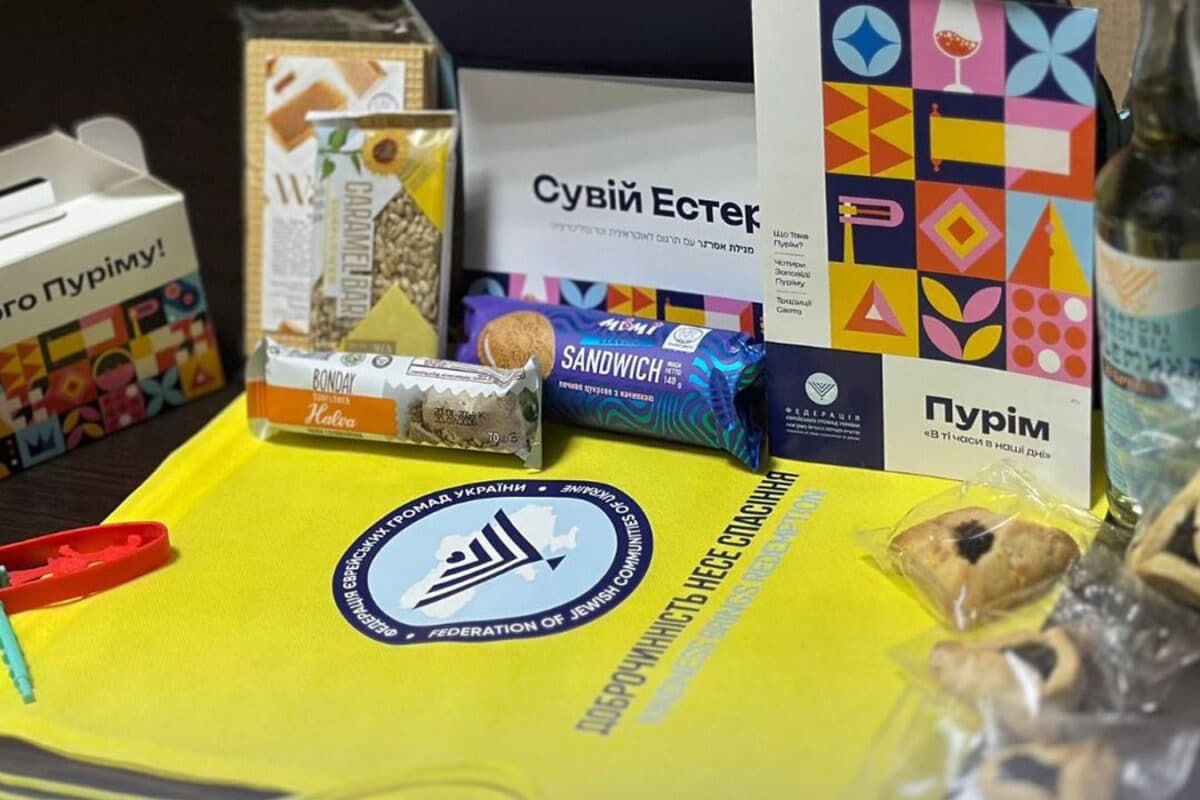
This year, the organization is sending 48,000 festive sets to more than 150 Jewish communities across Ukraine. The holiday traditionally symbolizes salvation, unity, and joy.
Even under the sounds of air raid sirens and constant risks, the community is preparing for the holiday so that every family can feel the atmosphere of Purim.
What is included in the festive sets
The sets include elements that allow fulfilling the commandments of the holiday:
Scroll of Esther (in Ukrainian)
Ukrainian-language guide to the celebration
Greeting cards
Mishloach manot with kosher sweets
Branded FEGU bag
Purim noisemaker
A small tincture for a festive mood
Organizers emphasize that it is important for people in affected regions to be able to celebrate Purim fully.
Such initiatives show that community life in Ukraine has not stopped. As previously noted by the editorial team of NANovosti — News of Israel | Nikk.Agency, it is important for the Israeli audience to see not only military reports but also how Ukrainian society, including the Jewish community, continues to live, support each other, and maintain traditions even in wartime.
‘We will celebrate no matter what’
The head of the FJCU Council, Meir Stambler, noted:
‘Purim was the first holiday that Ukrainian Jews celebrated after the start of the war. Synagogues were packed, the atmosphere was incredible. And this year we will celebrate, no matter what. We are doing everything so that every Jew can fulfill all four commandments of Purim.’
The Jewish community is part of Ukrainian society
Over these four years of war, the Jewish community of Ukraine lives the same reality as the entire country. Community representatives serve in the ranks of the Armed Forces of Ukraine, participate in territorial defense, actively engage in volunteering, and help displaced persons and those affected.
Despite constant threats and attempts at pressure, religious and public life continues.
Purim as a symbol of resilience
Purim traditionally includes four main commandments: reading the Megillat Esther, mishloach manot, helping those in need, and a festive meal. In 2026, their fulfillment takes on additional meaning.
The fourth wartime Purim becomes not only a religious holiday but also a symbol of resilience — a reminder that attempts to intimidate, break, or ‘freeze’ community life do not achieve their goal.
A court in Estonia sentenced Israeli citizen Anatoly Privalov, residing in the country, to 6.5 years in prison on charges of espionage for the Russian Federation.
The court’s decision was reported by the Estonian public broadcaster ERR.
The case concerns cooperation with Russian special services and covers the period since 2016.
Case details: cooperation with foreign intelligence
What the investigation established
According to the investigation, since 2016, Privalov has been cooperating with Russian special services, collecting information about Estonia and its allies.
Estonia is a member of NATO and the European Union, and issues of information leakage in such a context are considered a threat not only to national but also to collective security.
The court recognized that the actions of the accused were systematic and aimed in the interests of a foreign state.
Admission of guilt and punishment
Anatoly Privalov admitted guilt as part of a procedural agreement with the investigation.
The court sentenced him to 6.5 years in prison and ordered him to pay a fine.
Such practice is typical for espionage cases, where an admission of guilt allows for an expedited judicial process.
Context: Baltic region and strengthening counterintelligence
Increase in espionage cases
Since 2014, and especially after the start of Russia’s full-scale war against Ukraine in 2022, the Baltic countries have strengthened counterintelligence measures.
Estonian security services regularly report attempts to gather information and recruit within the country.
Privalov’s case fits into this trend.
Citizenship issue
Official publications mention his Israeli citizenship.
However, judging by his surname and origin, it can be assumed that he may also have Russian citizenship. However, this is not explicitly stated in court materials and media reports.
This point remains unclear.
In such cases, dual citizenship is not uncommon, but the legal consequences are determined by the country where the crime was committed.
In this context, NAnews — Israel News | Nikk.Agency notes: it is about the personal criminal responsibility of a specific individual, not the position of the state.
Geopolitical background
Estonia takes a tough stance on national security issues and countering foreign intelligence activities.
The 6.5-year prison sentence demonstrates the seriousness of the approach to such crimes.
Russia traditionally denies accusations of intelligence activities in EU countries, but judicial practice in the Baltic countries continues to form within their national legislation.
Conclusion
The facts of the case are as follows:
— cooperation with Russian special services since 2016; — gathering information about Estonia and allies; — admission of guilt; — 6.5 years in prison and a fine.
Additional details about the accused’s citizenship have not been officially disclosed.
For Estonia, this is another confirmation of the priority of security.
For Israel, it is a reminder that having an Israeli passport does not exempt one from responsibility for actions outside the country.
In Kyiv, another “stumbling stone” has been installed — a mini-memorial in honor of the Righteous of Babyn Yar, Petro Chetverikov (a local honorary title within Kyiv’s memory initiatives; not to be confused with the formal title “Righteous Among the Nations” at Yad Vashem — the sources specifically use the term “Righteous of Babyn Yar”). In Sokal, trilingual information stands have been mounted near the ruins of an ancient synagogue and next to the house of the Righteous Among the Nations, Franciszka and Helena Galamay.
Why it matters: both initiatives return specific names and addresses to the urban space, strengthening the shared memory of Ukraine, Israel, and the Jewish diaspora.
Sometimes the most powerful monuments are the smallest. A brick-sized slab underfoot and a concise stand by an old foundation speak of moral choice louder than any podium. Kyiv and Sokal have recently reminded us: memory is not a museum genre but part of the everyday route. People rush to work, children go to school, tourists look for cafes, and suddenly a glance catches a surname, a year, a short line about salvation. This is how “urban memory” works: quietly but inevitably.
Kyiv: “stumbling stone” named after Petro Chetverikov
A new element of the “stumbling stones” series has appeared in the capital. These are small metal plaques embedded in the pavement — markers of addresses where those condemned to death by the Nazis lived or were helped. The new “stone” is in honor of Petro Chetverikov, the Righteous of Babyn Yar, killed by the Nazis in 1942 for saving two Jewish girls aged 12 and 17.
His name has been returned to the city map near the Central Children’s Library named after Taras Shevchenko (Beresteisky Avenue, 25a).
It is also symbolic how this is done. The ceremony is attended by schoolchildren, historians, and representatives of cultural initiatives. It seems like a small thing, but this is how a new habit begins: knowing not only the main squares but also the addresses of courage. This approach is akin to a “memory microcircuit” that can be read in two lines — and never forgotten.
Petro Chetverikov — Righteous of Babyn Yar
The story of Petro Chetverikov is a documented example of how one person in occupied Kyiv took a step that cost him his life. In 1942, together with his wife Maria, he sheltered Jewish girls in their home. The first, a 12-year-old girl, was taken to a village to acquaintances, where she was adopted and thus saved from death.
Some time later, another girl, 17 years old, came to their home. She managed to escape a roundup, and the Chetverikovs found a way to transfer her to a partisan unit.
These actions did not go unnoticed. In 1943, the Gestapo arrested Petro Chetverikov. According to available testimonies, he was executed in Babyn Yar — a place that became a symbol of the tragedy of Kyiv’s Jewry. The exact date of arrest and execution is unknown (only the year and place are known).
Chetverikov was also connected with the underground: his house sometimes served as a meeting place for underground fighters, which only increased the risks.
Decades passed, and his name could have dissolved in archival footnotes if not for the work of researchers and public initiatives. On September 23, 2025, in Kyiv, near the Central Children’s Library named after T. Shevchenko on Beresteisky Avenue, 25a, a “stumbling stone” was installed in honor of Petro Chetverikov. The ceremony was timed to the 84th anniversary of the beginning of the executions in Babyn Yar.
This was the first “stone” after a four-year break in the project, and it is symbolic that Chetverikov’s name became the starting point of a new stage.
Thus, the biography of this man consists of a few but vivid facts: an ordinary Kyiv resident who decided to help two girls; a family that risked themselves for the lives of others; arrest and death in 1943; and the return of his name to the city map in the 21st century.
Sokal: three stands at the synagogue and the house of the Righteous
Sokal is a small town, but its history resonates far. Trilingual stands have been installed at the ruins of one of the oldest Galician synagogues: Ukrainian, English, Polish. This choice of language is not a detail but an invitation. Locals, guests from neighboring Poland, travelers from Israel — all can read the story without intermediaries.
The second stand is at the house where Franciszka Galamay and her daughter Helena Galamay — the Righteous Among the Nations — lived. During the Holocaust, they did what always requires silence: sheltered, fed, kept watch by the window, listening to night footsteps. These everyday, almost imperceptible movements make up the fabric of salvation.
Why the stand is an effective format
A stand is a short, clear story, not overloaded with academic language. It is important here to keep the focus on two or three facts: who saved, who was saved, what was risked. When all this is said simply and in three languages, the city receives a working tool of memory. Not ceremonial, but everyday.
Franciszka and Helena Galamay — the story of a mother and daughter who saved Jewish families
Franciszka Galamay was born in Sokal in 1885. Before the war, she and her daughter Helena had a small farm. When the German occupation began, Jewish families Kram, Malts, and Kindler found refuge in their home. The women hid people in hiding places above the pigsty and under the kitchen floor.
In November 1942, Franciszka herself offered shelter to cattle trader Moishe Malts and doctor David Kindler with their families, who fled the ghetto. They were joined by painter Josef Kram with his wife and son. To hide the fact that Jews were hiding in the barns and outbuildings, Franciszka kept pigs and chickens and brought food there, hiding it among the waste. To divert suspicion, she even allowed herself anti-Semitic remarks in public.
Over twenty months, the mother and daughter saved 16 people out of 6,000 pre-war Jews of Sokal. Only about 30 survived the war. Among the saved was Moshe Malts, who left memoirs “Years of Horror — A Glimmer of Hope.” His writings became a valuable testimony of life in the ghetto and covert survival.
An interesting detail: simultaneously with the Jewish families, Franciszka also sheltered a young German deserter soldier, Wilhelm, who asked to be hidden from being sent to the Eastern Front. He lived on the farm for almost two years, but in 1944 he was discovered and executed by Soviet soldiers.
On July 19, 1944, the Red Army entered Sokal, and the end of the 20-month nightmare came for those in hiding. The Jews left the Galamay house and soon emigrated. The family maintained contact with them for many years.
In 1984, Yad Vashem recognized Franciszka and Helena Galamay as Righteous Among the Nations. Later, their story was included in the American documentary “No. 4 on Virgin Mary Street” and in Jenny L. Witterick’s book “My Mother’s Secret.” In 2011, the heroine was posthumously awarded the “For Courage and Care” prize, received by her descendants.
Thus, the biography of Franciszka and Helena Galamay is a story of two women who not only saved almost half of all surviving Jews of Sokal but also managed to deceive suspicious neighbors and the Nazis themselves, showing incredible ingenuity and determination.
The common thread of two stories: memory as a shared territory
Kyiv and Sokal speak the same language — the language of addresses, dates, and names. NANews — News of Israel regularly reports on projects where memory ceases to be a monologue and becomes an inviting dialogue. There is no “imposed” pathos here, but there is a clear logic: we place a slab, attach a stand, read names, ask children questions.
Conclusion: small forms — big meanings
The Kyiv “stumbling stone” named after Petro Chetverikov and the Sokal stands about Franciszka and Helena Galamay are two different tools of the same work. Both give a voice to those who once said “no” to evil and “yes” to human solidarity. Both are firmly woven into the fabric of the city: they don’t need to be sought in museum halls, they are nearby — on the pavement and on the wall.
For readers of “NANews” and those following News of Israel, this is an opportunity to see in the Ukrainian agenda not only politics but also careful, targeted preservation of memory. This is perhaps where the strength lies: not in loudness, but in regularity and honesty.
Stumbling stones: memory you can’t skip over
A “stumbling stone” is a small brass memorial sign embedded directly into the pavement. It is engraved with the name, years of life, and brief fate of a Holocaust victim or a person who saved Jews during the Nazi occupation.
History of the project
The idea was conceived by German artist Gunter Demnig in the 1990s. Initially, these were individual plaques, but over time they turned into the largest decentralized memorial in Europe. Today, “stumbling stones” can be found in thousands of cities in Germany, Poland, France, the Netherlands, Ukraine, and other countries.
Why they are needed
The main idea is for the memory of the Holocaust to be not only in museums and books but right on the streets. A person walks along a familiar route, sees a surname and year underfoot, “stumbles” with their gaze, and mentally returns to history. This is a very personal and intimate way to remember.
Significance for Israel and the diaspora
For readers of NANews — News of Israel, such initiatives in Ukraine are close and understandable. Israel has been carefully preserving the memory of the Righteous for decades, and when “stumbling stones” appear in Ukrainian cities, it becomes a bridge between countries and the Jewish diaspora.