Kyiv is experiencing another energy blow in the middle of winter. After a missile attack by the Russian Federation on the night of January 24, the city is forced to urgently restart the heating system for the third time this season. Almost six thousand homes were left without heat — including those that were already reconnected twice after the shelling on January 9 and 20. For a metropolis with a million population, this is no longer an accident, but a systemic crisis.
In fact, the capital is entering the heating season from scratch again — against the backdrop of frosts down to minus 10–15 degrees. In such conditions, launching the heat carrier turns into a technically complex and risky operation, where any delay means cold in apartments and social tension.
The third blow to heating and the reality of war
About 1330 high-rise buildings remain without heat. The most difficult situation is in the Desnianskyi district, where about 600 houses are simultaneously deprived of water, heating, and electricity. Additional heating points are being deployed in the Troieshchyna neighborhoods: their number is being increased to 145, supplementing the existing network.
City authorities are opening support points where people can stay around the clock. They are placed in schools and social institutions, equipped with mobile boilers, sleeping places, and hot meals. But these are emergency measures — not a solution to the problem.
Kyiv residents are coping in different ways. Some temporarily leave the city, others stay in cold apartments, relying on heaters, thermal jackets, and nearby aid points. This is no longer an exception, but a new urban reality.
Why Kyiv did not repeat Kharkiv’s experience
Amid the crisis in the capital, the same question is being asked on social networks and among experts: where are the promised mini-CHPs and mobile boilers? Why did the distributed cogeneration system, which was talked about back in the fall, not work when it was most needed?
Experts compare the situation in Kyiv with frontline cities — primarily Kharkiv and Zhytomyr. It was there that cogeneration installations were deployed in time. Cogeneration is the simultaneous production of electricity and heat, where the heat is not lost but immediately directed to heating homes. For Kharkiv, these installations became a survival factor.
The paradox is that Kyiv publicly promoted the concept of distributed cogeneration and approved it by a city council decision back in May 2024. At the same time, the capital was further from the front line and did not experience constant KAB strikes like Kharkiv. However, massive and repeated missile attacks on Kyiv’s energy system, especially during frosts, led to destruction that the city had not known before.
Five mini-CHPs that are not yet heating
In the spring of 2024, KP “Kyivteploenergo” announced a tender in the Prozorro system for the purchase of 15 cogeneration installations — from which five mini-CHPs were formed. Why they still do not work in January 2026 became one of the most resonant questions.
The city administration explains: Kyiv is the only city in Ukraine that purchased cogeneration equipment with its own funds. Only one installation with a capacity of 1.5 MW was received as international humanitarian aid in 2024 and is already working for the needs of critical infrastructure.
According to the Kyiv City State Administration, all procurement procedures have been completed, but the project turned out to be extremely complex. The equipment was purchased from different manufacturers — Ukrainian and international. Each mini-CHP is not a generator or a mobile boiler, but a full-fledged energy facility.
To date, five local CHPs have been built, equipped with second-level protection systems. Simply put, they had to be practically “hidden” under concrete, provided with gas supply and complex ventilation. This is what stretched the timelines. Operational testing is now being completed at the stations, after which they should be put into operation.
Mini-CHPs as salvation for neighborhoods, not the whole city
The director of energy programs at Razumkov CenterVolodymyr Omelchenko urges not to look for a “scapegoat,” but to soberly assess the scale of the problem. According to him, even if the city received only one installation from partners, the purchase and installation of the rest should not have been delayed.
Seven decentralized cogeneration installations with a total capacity of about 60 MW are too little for the capital. If desired, the city could increase capacities to 300–400 MW, which would have a noticeable effect. Especially if such installations are placed in areas dependent on CHP-5 and CHP-6, as a reserve in case of attacks.
One installation with a capacity of about 22 MW can provide electricity and heat to one or several neighborhoods — about 20–30 thousand consumers. But Kyiv consumes about 1700 MW. That is, one mini-CHP is only 1.5% of the city’s needs. The effect appears only when there are dozens of such facilities.
Energy vulnerability as a legacy of the past
According to Omelchenko, Kyiv’s energy vulnerability is not a new problem. It was laid down back in Soviet times when the city was critically dependent on two large CHPs. More than a million residents directly depend on their operation. The destruction of these facilities automatically leaves huge areas without heat — which partially happened.
In the future, Kyiv needs a new energy supply configuration. Currently, the city covers only about 25% of its own consumption, and after the strikes — only 10–15%. Experts see the solution in the development of decentralized cogeneration, the construction of waste processing plants with energy production, the use of biofuels and biomethane, the creation of energy storage systems (Energy Storage), and the strengthening of external power lines, including from the Rivne NPP.
Only in this way can the capital move from emergency survival to real energy sustainability — and stop entering winter with the question of whether there will be heat in homes. This systemic crisis is currently being recorded and analyzed by NAnews — Israel News | Nikk.Agency.
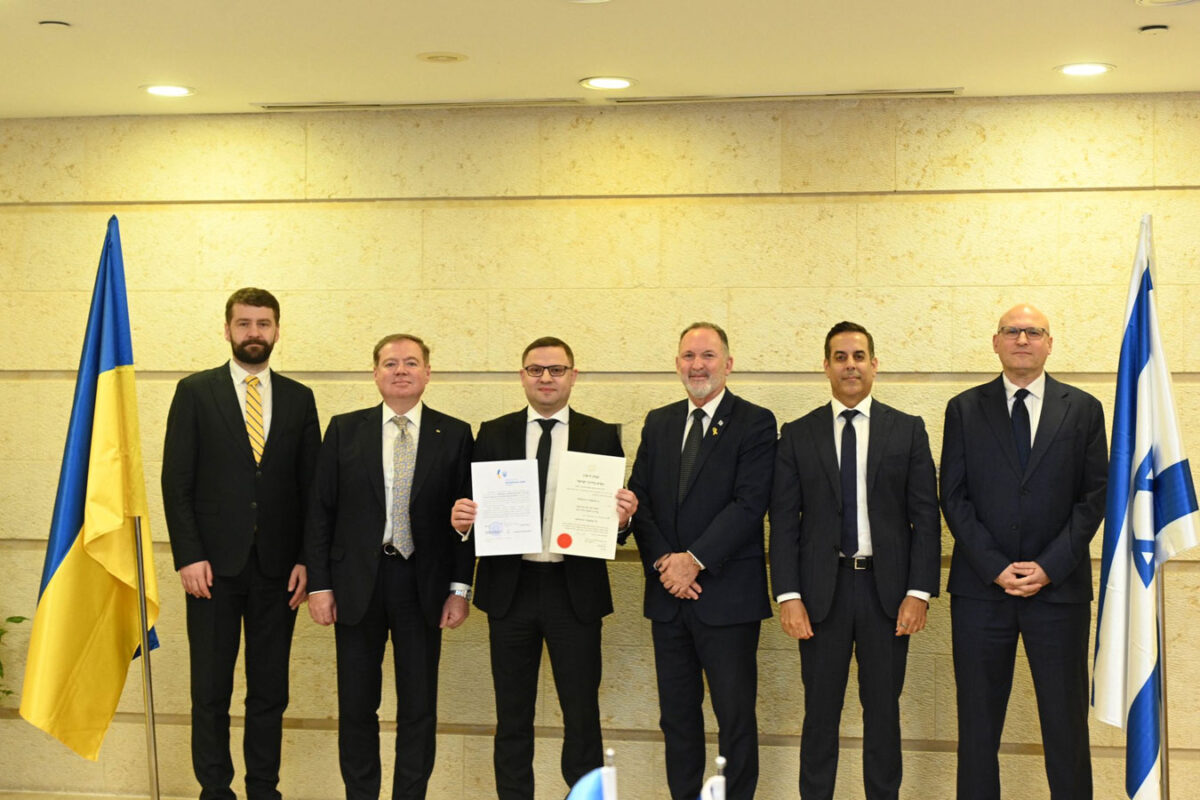
On January 26, 2026, in Jerusalem, at the building of the Ministry of Foreign Affairs of the State of Israel, an official ceremony was held for the appointment of the Honorary Consul of Ukraine in Haifa. This position was taken by Alexander Zernopolsky — a well-known Israeli lawyer and long-time partner of the Ukrainian diplomatic mission.
The exequatur to the newly appointed consul was presented by the director of the protocol department of the Israeli Ministry of Foreign Affairs Gil Haskel. The document was signed by the President of the State of Israel Isaac Herzog, emphasizing the official and state level of the appointment.
The Honorary Consul of Ukraine in Haifa has assumed duties: Ukraine strengthens consular presence in northern Israel
On the Ukrainian side, the ceremony was attended by the Ambassador of Ukraine to Israel Yevgen Korniychuk. He personally congratulated Alexander Zernopolsky and presented him with a consular patent signed by the Minister of Foreign Affairs of Ukraine Andriy Sybiha.
Alexander Zernopolsky has been actively cooperating with the Embassy of Ukraine in the State of Israel for many years, supporting the Ukrainian-Israeli community and participating in the development of bilateral relations. In the professional community, he is known as a lawyer with a high level of trust and reputation, and in the public sphere, as a consistent supporter of humanitarian and civil dialogue between the two countries.
The appointment of the Honorary Consul of Ukraine in Haifa is seen as a practical step to strengthen Ukraine’s presence in northern Israel. It is not only about consular support for Ukrainian citizens but also about developing humanitarian, cultural, and business contacts in the Haifa region and Northern Israel.
After the ceremony, Alexander Zernopolsky announced that he had officially assumed his duties. He expressed gratitude to Ukraine for the trust placed in him and specifically noted the support from Ambassador Yevgen Korniychuk. According to him, the priority of his work will be to strengthen friendly relations between Ukraine and Israel, as well as to expand cooperation at the level of business, culture, and public initiatives.
This appointment comes amid a steady demand for closer and more structured ties between the two countries — from assisting citizens to joint projects and dialogue at the regional level. In this context, the role of the Honorary Consulate in Haifa acquires not a symbolic, but a quite practical significance for the bilateral agenda.
Such a personnel decision underscores the course towards institutional strengthening of Ukraine’s presence in Israel and reflects the logic of long-term partnership, which is increasingly discussed at diplomatic and public levels. It is in this context that the editorial logic of NANews — News of Israel | Nikk.Agency operates, capturing events that shape the real architecture of relations between Ukraine and Israel.
“A 200-meter-long bridge, with 37 sections, 178 steps, and a heating system, allows the Kohanim to safely visit the holy site…“
The construction of the bridge cost more than 1,000,000 dollars. According to the organizers, it is the largest project of its kind in Ukraine and, most likely, in all of Europe.
Ukraine is at war. Every day brings new destruction, civilians die, the economy collapses under the bombs. It would seem there is no place now for anything except the front and survival.
And suddenly the news: in Hadiach, Poltava region, the “Bridge of the Kohanim” was opened. For most people, it sounds strange, unclear, even absurd: when there is blood and rockets around, why would anyone need a bridge at a cemetery?
But it is precisely such events that become symbols. They prove that even under shelling, the people continue to keep their faith, respect tradition, and build the future. This bridge is a sign that the Jewish community of Ukraine, together with the entire country, will not surrender to Putin’s aggression and will continue to live, pray, and develop on its land, no matter how difficult it is. It connects the common past of Ukrainians and Jews — the memory of Rabbi Alter Rebbe, of centuries of neighborhood and communal life — with the shared future being built here and now: a free Ukraine and a living Jewish tradition on this land.
What happened: in the Ukrainian city of Hadiach (Poltava region), a unique bridge nearly 200 meters long was built. It leads to the grave of Rabbi Shneur Zalman of Liadi, known as the Alter Rebbe, the founder of the Chabad movement.
“In Hadiach (Poltava region), the “Bridge of the Kohanim” was solemnly opened in the “Admor HaZaken” complex at the Tziyun of the Alter Rebbe, the founder of Chabad Hasidism and author of the Tanya.”
The bridge was built specifically for the Kohanim — descendants of the ancient Jewish priests, who, according to Torah law, are forbidden to enter a cemetery and approach graves. Previously, this rule completely closed their access to the shrine, but now they have the opportunity to pass: the bridge is laid above the cemetery ground, and the Kohanim reach the grave by a separate structure without violating the prohibition.
Historically, there was already a “bridge of the Kohanim” there: according to Chabad sources, it was built by Rabbi Yehuda Leib — the brother of the Alter Rebbe. That first bridge was destroyed during the eras of Nazism and Communism, and for almost a hundred years the Kohanim could not approach the Tziyun directly. The current one is the second, returning direct access to the Kohanim for the first time in decades (previously they had to pray about 200 meters away from the burial site, from the balcony of the guest complex).
Hadiach
Hadiach is a city in the Poltava region, founded back in the 17th century as a fortified Cossack center. In the history of Ukraine, it is also known as the capital of the Hetmanate under Yurii Khmelnytskyi.
The Jewish community here appeared in the 18th century and quickly became one of the most influential in Left-Bank Ukraine. Hadiach was an important trade hub, and Jews engaged in crafts, commerce, and owned taverns.
The city gained particular significance after 1812, when the Alter Rebbe, Shneur Zalman of Liadi, was buried here. From that moment, Hadiach became a holy place for Chabad Hasidim. At the cemetery, a Moshila (“ציון”) was formed, where pilgrims came from all over Europe.
Even in Soviet times, when religious life was banned, Jews secretly strove to come here to pray. After Ukraine’s independence, the shrine received the official status of a memorial complex.
Today, Hadiach is a small town in the Poltava region of Ukraine with a population of about 20,000 people. The Jewish community here is no longer as large as before the revolution or the war, but its role is still felt through memory and heritage.
Like all of Poltava region, Hadiach has repeatedly suffered from Russian attacks: drones and missiles damaged gas transport and industrial infrastructure, causing fires and destruction. Although the city itself was not always a direct target, residents constantly live under the threat of new shelling and disruptions of critical facilities.
The Alter Rebbe and His Legacy
Who was Shneur Zalman of Liadi
Shneur Zalman (1745–1812), better known as the Alter Rebbe (“the Old Teacher” in Yiddish), was an outstanding Jewish thinker and spiritual leader. A deep philosopher, reformer of Jewish law, and religious guide, his works became the foundation for thousands of followers around the world. In Judaism, the word “Rebbe” is not just a rabbi, but a mentor to whom the community turns for spiritual and practical guidance.
He was born in Eastern Europe, in the town of Liozna (now Belarus), and from a young age displayed extraordinary abilities in Torah study. Becoming a disciple of Dov Ber of Mezeritch, known as the Maggid, the Alter Rebbe was placed directly in the spiritual line that traced back to the Baal Shem Tov, the founder of Hasidism. Through this teacher, he inherited the tradition and gave it a new intellectual direction. Shneur Zalman later moved to Liadi (about 80 km away), where he established the center of Chabad and became known as the “Alter Rebbe of Liadi.”
In Lithuania, where the Jewish environment was renowned for high scholarship and often regarded Hasidism as “emotional simplicity,” Shneur Zalman offered a new approach. He explained Hasidic ideas through logic and deep Torah study, making them understandable and respected among rabbis and scholars. This gave birth to the Chabad movement — an acronym of the Hebrew words “Chochmah, Binah, Da’at” (“Wisdom, Understanding, Knowledge” — the names of the three upper sefirot in Kabbalah).
Despite opposition, the Alter Rebbe led the spread of Hasidic ideas in Lithuania and laid the foundation of the Chabad school. Thus, he became the founder of Chabad-Lubavitch — one of the most influential branches of Hasidism, where emphasis was placed not only on emotion but also on intellectual service to God.
He was also the progenitor of the dynasty of Hasidic tzadikim and rabbis of the Schneerson family.
How the Alter Rebbe Came to Hadiach
Rabbi Shneur Zalman of Liadi (the Alter Rebbe) spent the last years of his life during a very difficult time. In 1812, war broke out between the Russian Empire and Napoleon. The French army advanced through Eastern Europe, and in the Jewish community this war was seen as a great test: some viewed Napoleon as a liberator, others as a threat to spiritual life.
The Alter Rebbe believed that Napoleon’s victory would bring Jews external freedom but weaken their faith and devotion to tradition. When Napoleon’s troops approached, the Alter Rebbe, together with his family and disciples, was forced to leave his home near Liadi (now Belarus).
The winter flight was harsh: hundreds of disciples and followers accompanied him in his escape. Conditions were extremely difficult, and the Alter Rebbe’s health deteriorated sharply. In January 1813 (24 Tevet 5573 in the Jewish calendar), he died on the road near the town of Hadiach (now Poltava region of Ukraine).
His body was buried there, in the local Jewish cemetery. Thus Hadiach unexpectedly became one of the key centers of the Hasidic world: the Moshila (“ציון”) of the Alter Rebbe turned into a place of pilgrimage for Jews from all over the world.
For more than two hundred years, Hadiach has been associated with the name of the founder of Chabad. Even during the years of Soviet repression, Jews secretly traveled there to pray. Today, the memorial complex “Admor HaZaken” (“the Old Rebbe”) surrounds the Moshila, and the opening of the “Bridge of the Kohanim” has made the shrine accessible to all Jews.
Major Works of the Alter Rebbe
His main work is “Tanya” (Likkutei Amarim). This book explains the spiritual struggle within man between the “divine” and the “animal” souls. Because of this work, Shneur Zalman is called Baal HaTanya (“Author of the Tanya”).
He also compiled “Shulchan Aruch HaRav” — a revised and expanded version of the classic code of Jewish law “Shulchan Aruch,” adapted to the Hasidic tradition.
Another important work is “Torah Or” and “Likkutei Torah”, in which he commented on the weekly Torah portions from the perspective of Chabad philosophy.
The Teachings of the Tanya
The main book of Shneur Zalman is called “Tanya”. It is written in the form of short chapters, each of which explains how a person should understand themselves, their strengths, and weaknesses.
The Two Souls in Man
According to the Alter Rebbe, every Jew has two souls:
The Divine Soul — the source of striving for spirituality, goodness, and self-sacrifice for God and others.
The Animal Soul — connected to the body, desires, passions, egoism, and the habit of thinking only about oneself.
Man is always caught between these two forces. This tension is the main stage of his life.
The Image of the “Beinoni”
The Tanya introduces the concept of the “Beinoni” — “the intermediate person.” This is neither a tzadik nor a sinner, but an ordinary person who struggles every day and chooses good.
The Alter Rebbe taught: the main value is not to be sinless, but to struggle and never give up. Even if the struggle lasts a lifetime, it has holiness in itself.
The Path to God Through the Intellect
Unlike other Hasidic schools, which emphasized emotions and ecstasy, Chabad (based on the Tanya) focused on understanding and comprehension. The Alter Rebbe taught that love and fear of God should arise not from blind feeling but from deep contemplation of Torah and creation.
Practical Philosophy
The Tanya is not abstract theory but a guide to life:
How to deal with anger, envy, and depression.
How to keep faith in difficult times.
How to learn to see meaning even in hardship.
The Significance of the Book
It was thanks to the Tanya that the Chabad movement became widespread. People realized that the teaching spoke to them in simple language: “You’re not a saint? That’s fine. The main thing is — struggle and choose good.”
Thus: The Tanya is a philosophy for the ordinary person, which gave Jews of the 18th century (and gives today) the sense that their daily struggle for good has spiritual weight.
Joy and Dance in the Teachings of the Alter Rebbe
In the Hasidic tradition, joy is not just an emotion but a spiritual obligation. The Alter Rebbe wrote in the “Tanya”: sadness and despair paralyze the soul, making a person inactive. Joy, on the other hand, gives strength to fight against weaknesses.
Therefore, in Hasidic life, joy is expressed not only through words of prayer but also through the body — in songs and dances. When Hasidim dance, it is not entertainment but a form of prayer. In dance, a person is freed from the burden of worries and rises above daily problems.
Hasidic rabbis often repeated: “It is impossible to serve God with sadness. Only joy expands the boundaries of the soul.”
Dance became for them a symbol of the victory of the spirit over despair. Even in hard times — be it pogroms, persecutions, or today’s war — the Hasidic community continues to sing and dance, showing that its faith is alive.
Thus, the “Tanya” provided the philosophical foundation for joy, while Hasidic practice made it visible — in songs and dances, which may look unusual to outsiders but for Jews express deep faith.
Chabad-Lubavitch: From the Alter Rebbe to Today
A Brief History
The Alter Rebbe himself gave his teaching the name “Chabad” — an acronym of three Hebrew words:
Chochmah (חכמה) — Wisdom,
Binah (בינה) — Understanding,
Da’at (דעת) — Knowledge.
After the Alter Rebbe’s death, the movement’s center became the town of Lubavitch (now Belarus), from which the second part of the name comes. In the following centuries, Chabad spread across the world, preserving a distinct philosophical school and system of education.
Who is the Rebbe Now
The last spiritual leader (Rebbe) was Menachem Mendel Schneerson (1902–1994), the seventh in the line of the Alter Rebbe’s successors. He turned Chabad into a global movement, opening hundreds of schools, synagogues, and cultural centers (“Chabad Houses”).
After his death, no new Rebbe was appointed, but Hasidim continue to consider him their spiritual guide.
The Modern Movement
Today, Chabad is one of the largest Jewish movements in the world. It has:
around 200–300 thousand active followers, fully living by the traditions of the movement;
more than 3–4 million Jews involved in Chabad’s educational, cultural, and charitable projects;
tens of thousands of emissaries (shluchim, שלוחים) and rabbis working in over 100 countries worldwide.
In Israel, Chabad is active in education, charity, and public life, while in the post-Soviet space, Chabad communities often became the foundation for the revival of Jewish religious life. In Ukraine, before the war, there were about 50 Chabad communities, and they continue to help people even during the aggression.
Chabad in Modern Ukraine
After Ukraine’s independence, it was Chabad that became the leading force in reviving the country’s Jewish life. Emissaries of the Lubavitcher Rebbe Menachem Mendel Schneerson began arriving in Ukraine while he was still alive. After the Rebbe’s death in 1994, the movement continued to send shluchim according to his instructions and the concept of shlichut, which became the basis of Chabad’s global network.
The First Wave (1990–1994) — During the Rebbe’s Lifetime
Dnipro — Rabbi Shmuel Kaminetsky, one of the first shluchim, arrived in 1990. A graduate of the “Tomchei Tmimim” yeshiva (New York). He restored the “Golden Rose” synagogue, a network of educational institutions, and built the Menorah Center (2012) — the largest Jewish complex in Europe.
Odesa — Rabbi Avraham Wolff, arrived in 1993. He studied at the “Tomchei Tmimim” yeshiva (New York). He founded the “Or Avner” school and a network of humanitarian projects.
Kharkiv — Rabbi Moshe Moskowitz, came in the early 1990s (around 1991–1992). A graduate of the yeshiva in Kfar Chabad (Israel). He organized a school, kindergarten, and youth programs.
The Second Wave (After 1994) — By the Global Chabad Network
Kyiv — Rabbi Moshe Reuven Asman, arrived in 1996. He studied in Kfar Chabad (Israel) and New York (770 Eastern Parkway). He created “Or Avner” schools, cultural centers, and shelters for refugees during the war.
Chernivtsi — Rabbi Menachem Mendel Glitzenshtein, arrived in 2003. A graduate of the Kfar Chabad yeshiva. He revived the Jewish community, opening youth and educational programs.
Vinnytsia — Rabbi Shneur Schwartzman, has worked in the city since 2002. A graduate of a yeshiva in Israel. He created schools and humanitarian initiatives.
Lviv — Rabbi Moshe Kvitnitsky, arrived in 2002. He studied at a yeshiva in Safed (Israel). He organized youth programs and cultural projects.
Uzhhorod (Zakarpattia) — Rabbi Menachem Mendel Wilhelm, arrived in 2008. A graduate of a New York yeshiva. He headed a synagogue, a school, and cultural initiatives in the region.
Zaporizhzhia — Rabbi Nokhum Ehrentreu, has worked since the 1990s, assigned as a shaliach by Chabad. He studied at a yeshiva in New York. He founded a school, kindergarten, and aid center for the needy.
Chabad in Ukraine has grown into a powerful network covering dozens of cities with educational, religious, and humanitarian projects.
Note. In modern Ukraine, Jewish life is represented by several religious movements.
The most influential is Chabad-Lubavitch. Its main figure is considered to be Rabbi Moshe Reuven Asman, who since 1996 has served as Chief Rabbi of Ukraine on behalf of Chabad and is based in Kyiv. Among other leaders of this movement are Rabbi Shmuel Kaminetsky in Dnipro, who heads the largest Chabad community and initiated the construction of the Menorah Center, Rabbi Avraham Wolff in Odesa, and Rabbi Moshe Moskowitz in Kharkiv. Chabad de facto leads Jewish life in the country in terms of the number of communities and scale of activity.
Alongside it, the movement of Breslov Hasidim is also active. Its center is in Uman, where the grave of Rabbi Nachman is located. There is no single leader in Ukraine: different rabbis and groups coordinate pilgrimages, while general leadership is connected to Israel — for example, through Rabbi Shlomo Ben Meir and other spiritual centers in Jerusalem and Bnei Brak.
Another movement is represented by the Vaad of Ukraine, which stands on the principles of Orthodox Judaism but is not affiliated with Chabad. It is headed by Rabbi Yaakov Dov Bleich, a native of the USA, who has been active in Kyiv since 1990. He holds the title of Chief Rabbi of Ukrainefor the Vaad and represents the American Orthodox tradition.
Other currents also exist.
For example, Progressive Judaism is represented by Rabbi Alexander Dukhovny in Kyiv, considered the Chief Rabbi of Reform communities in Ukraine, working in cooperation with the international World Union for Progressive Judaism.
Additionally, Conservative Judaism (Masorti) is present. Its spiritual leader is Rabbi Reuven Goldstein, who heads a community in Kyiv and is linked to the international Masorti Olami movement.
Returning to the Bridge: Who Are the Kohanim and Why They Cannot Enter Cemeteries
What Does “Kohen” Mean?
The word Kohen (כהן) in Hebrew means “priest.” It is not a profession but an inherited status.
It is passed down through the male line from father to son.
Wait! You may say: “But we know that Jewishness is passed through the mother! And here suddenly — through the father? Gotcha…” In fact, there is no contradiction — these are two different levels of inheritance.
Judaism distinguishes two levels of belonging.
The first level — belonging to the Jewish people. According to the Talmud (Kiddushin 68b), Jewish identity is determined by the mother: if the mother is Jewish, the child is considered Jewish regardless of the father; if the mother is not Jewish, the child is not considered Jewish, even if the father is. This is because the mother is always known with certainty, and she transmits spiritual identity.
“The son of your daughter is called your son, but the son of your son from a non-Jewish woman is not called your son.”
The second level — tribal affiliation. In the Torah (Numbers 1:18) it is said that the tribes of Israel are determined “by their fathers’ houses.” This means that the status of “Kohen” or “Levi” is passed strictly through the male line — from father to son. Thus, the son of a Kohen and a Jewish woman will be a Kohen, the son of a Levite and a Jewish woman will be a Levite, and if the father is from the tribe of Israel, the children will be Israel.
Torah, Numbers 1:18:
“They declared their lineage according to their families, by their fathers’ houses.”
This means tribal affiliation, and therefore the status of Kohen or Levi, goes through the father’s line.
Torah, Exodus 28:1:
“Take to yourself Aaron your brother, and his sons with him… that they may serve Me as priests.”
Here it is emphasized: only Aaron’s sons inherit priesthood.
Thus, Jewishness comes from the mother, but the distribution of roles within the nation (Kohen, Levi, Israel) comes from the father. This combination may seem unusual, but in Judaism it forms a complete system: the mother determines belonging to the people, the father — the hereditary function within it.
But what if the father is a Kohen and the mother is not Jewish? Then:
According to Jewish law, the child is not considered Jewish (since Jewishness is only passed through the mother).
And since he is not Jewish, he also does not inherit the status of Kohen.
The Talmud (Kiddushin 68b) explicitly states:
“The son of your daughter is your son, but the son of your son from a non-Jewish woman is not your son.”
In the eyes of Halakha, such a child completely “drops out” of the Jewish people. To be recognized as Jewish (and therefore eligible to inherit religious status), he must undergo giyur (conversion to Judaism). But even after conversion, he cannot become a Kohen, because priesthood is only inherited by a Jewish son from a Kohen father and a Jewish mother.
Kohanim and Levites: What’s the Difference?
In the people of Israel, there was a special division into tribes. One of them was the tribe of Levi (שבט לוי). All Levites were dedicated to Temple service.
From the Levites came the Kohanim — priests, direct descendants of Aaron.
The rest of the Levites assisted the Kohanim: they sang in the Temple, guarded the sanctuary, and carried the Ark of the Covenant and sacred vessels.
Thus: every Kohen is a Levite, but not every Levite is a Kohen. A Kohen is a “priest,” a Levite is a “Temple servant.”
Their Role in Antiquity
When the First and Second Temples stood in Jerusalem, the Kohanim performed the main rituals: offering sacrifices, lighting the Temple menorah (Menorah, מנורה), purifying the sanctuary, and blessing the people.
Numbers 18:7:
“You and your sons with you shall guard your priesthood in everything pertaining to the altar and behind the curtain, and you shall serve. I give your priesthood as a gift.”
This emphasizes that service at the altar was not a choice but an obligation and a sacred gift.
Modern Meaning
After the destruction of the Second Temple in 70 CE, the Kohanim lost their central function of bringing sacrifices. But their special status did not disappear: it continues to be inherited, because it is enshrined in the Torah itself. Even today, the Kohanim perform commandments that are not directly tied to the Temple, such as blessing the people in synagogue.
The main commandment still in effect is the Birkat Kohanim (ברכת כהנים), the Priestly Blessing. The Kohanim stand before the congregation in the synagogue and recite words from the Torah:
Numbers 6:22–23:
“The Lord spoke to Moses, saying: Speak to Aaron and his sons, saying, Thus you shall bless the people of Israel: You shall say to them…”
This commandment is observed to this day: in Israel — daily, in the diaspora — on festivals.
The status of the Kohanim is also preserved because Jewish tradition awaits the construction of the Third Temple (בית המקדש השלישי) in Jerusalem. Then the Kohanim will again take their place at the altar. If their lineage were not preserved, this would be impossible in the future.
Why Kohanim Cannot Enter Cemeteries
This prohibition is given directly in the Torah.
Leviticus 21:1–3:
“The Lord said to Moses: Speak to the priests, the sons of Aaron, and say to them: None shall defile himself for the dead among his people; except for his closest relatives… he may defile himself.”
From these verses it follows: Kohanim are forbidden to enter cemeteries, touch the dead, or be near graves. The only exceptions are for the closest relatives: parents, children, brothers, or sisters.
Challenges Kohanim Face Today
Even in the 21st century, the ancient laws of the Torah directly affect the lives of the Kohanim. Their status is linked not only to honor but also to significant restrictions.
Key Issues
Cemeteries and Funerals. A Kohen cannot attend funerals of friends or distant relatives. Only immediate family — parents, children, brothers, or sisters — are exceptions. This often forces him to say farewell from a distance.
Work. Kohanim are forbidden to work in morgues, pathology departments, funeral services, or cemeteries. Even a Kohen driving a hearse would technically violate the law.
Air Travel. If a dead body is being transported on board, a Kohen is forbidden to fly. In Israel, airlines announce such cases, and special notifications are sent to Kohanim.
Pilgrimages. Many tziyuns (graves of righteous tzadikim) are located in old cemeteries. Kohanim cannot enter them. In Uman and Hadiach, until recently, they could only pray from a distance.
Thus, everything connected with the Kohanim — their status, duties, and restrictions — comes not from custom but directly from the commandments of the Torah.
Why They Did Not Move the Grave but Built the “Bridge of the Kohanim”
In Hasidic tradition, the word “Moshila” means more than just a grave. It is the resting place of a righteous person — a Tzadik, whose life and deeds became an example for generations. It is believed that the soul of the Tzadik remains connected to this place, and prayers there have special power. That is why such graves become centers of pilgrimage: people come from different countries to pray, to seek advice, and spiritual support.
Such a place exists in Hadiach — where in 1812 Rabbi Shneur Zalman of Liadi, the Alter Rebbe, was buried. His Moshila has long been a shrine of global significance.
The word “Moshila” (as often pronounced in Slavic countries) in Hebrew is written and pronounced as ציון (Tziyun).
Literally, “ציון” means “sign, marker, tombstone”, but in Hasidic tradition, it refers specifically to the grave of a righteous person (Tzadik) — a place of pilgrimage and prayer.
Thus, when they say “Tziyun of the Alter Rebbe” (ציון אדמו״ר הזקן) — it means “the grave of the Alter Rebbe.”
Throughout Jewish history in Ukraine, dozens of revered graves of tzadikim — called moshilos in Yiddish — have become places of prayer, pilgrimage, and spiritual centers.
Why Not Move the Grave?
At first glance, it may seem easier to solve the problem by relocating the remains of Rabbi Shneur Zalman to another place. But in Judaism, such a step is impossible. Moving the remains of a Tzadik is considered a grave desecration: the grave is the place of eternal rest, and disturbing it is strictly forbidden.
Moreover, holiness is tied to the exact place where the person was originally buried. If the remains are moved, the shrine itself loses meaning. In Jewish tradition, graves of Tzadikim are never moved for convenience. On the contrary, infrastructure is built around them — roads, buildings, and in Hadiach’s case, a bridge.
Thus, the only solution was the expensive construction of the “Bridge of the Kohanim.” It allowed full observance of the Torah’s prohibition while enabling descendants of the priestly line to approach the Alter Rebbe’s Moshila.
Ukraine — One of the Main Holy Lands of the Hasidic World
It was here that Hasidism was born, where its founders and disciples lived and worked. On Ukrainian soil, dozens of tziyuns — graves of tzadikim — have been preserved, and Jews from all over the world continue to make pilgrimages to them. These places became spiritual centers: here people pray, ask for intercession, and feel a connection with past generations.
The Ten Main Tziyuns of Ukraine
Uman (Cherkasy region) — grave of Rabbi Nachman of Breslov (1772–1810), grandson of the Baal Shem Tov, founder of Breslov Hasidism. The main pilgrimage site for tens of thousands of Hasidim on Rosh Hashanah.
Medzhybizh (Khmelnytskyi region) — grave of Baal Shem Tov (Israel ben Eliezer, 1698–1760), founder of Hasidism.
Hadiach (Poltava region) — grave of the Alter Rebbe — Shneur Zalman of Liadi (1745–1812), founder of the Chabad-Lubavitch movement.
Berdychiv (Zhytomyr region) — grave of Rabbi Levi Yitzchak of Berdychiv (1740–1809), the “advocate of Israel.”
Nemyriv (Vinnytsia region) — grave of Menachem Nachum of Chernobyl (1730–1787), disciple of the Baal Shem Tov and founder of the Chernobyl dynasty.
Zhytomyr — resting place of Rabbi Ze’ev Wolf of Zhytomyr (d. 1798), one of the main disciples of the Maggid of Mezeritch.
Shpola (Cherkasy region) — grave of Aryeh Leib of Shpola (1725–1811), known as the “Shpola Zeide.”
Belz (Lviv region) — graves of the founders of the Belz dynasty, primarily Rabbi Shalom Rokeach (1779–1855).
Sadigura (Chernivtsi) — graves of the Ruzhin tzadikim, founded by Rabbi Israel Friedman of Ruzhin (1796–1850).
Vizhnitsa (Chernivtsi region) — graves of the founders of the Vizhnitz dynasty (Rabbi Menachem Mendel Hager and his descendants).
In Ukraine, more than 30 tziyuns are known and revered by Hasidim. Among them, 10 are considered global centers of pilgrimage (Uman, Medzhybizh, Hadiach, Berdychiv, etc.), while the rest are local shrines tied to dynasties and disciples of the Baal Shem Tov. This makes Ukraine truly the spiritual cradle of Hasidism.
Why Spend So Much Money on the Kohanim
It’s not just “a few people.” Around 8–10% of Jews have the status of Kohen. In Chabad — thousands. Leaving them “behind the fence” of the main shrine would be unacceptable.
This is a global pilgrimage center. The Tziyun of the Alter Rebbe is a place people travel to from Israel, the US, and Europe. Excluding Kohanim has been a systemic pain for the community.
The law cannot be broken. “Closing one’s eyes” and walking through the cemetery is not an option. A technical solution was needed that fully respected Halakha.
Historical justice and continuity. There once was a bridge; its restoration is a return to what was lost.
The New “Bridge of the Kohanim” in Hadiach
The construction of the bridge cost more than 1,000,000 dollars.
Why Was It So Expensive?
Length and structure: nearly 200 meters, 37 sections, 178 steps — a complex engineering project.
Material: Corten steel — durable, corrosion-resistant, with a planned lifespan of 100+ years without repainting.
Winter safety:heating system for the walkway to prevent icing — special equipment and automation required.
Halakhic restrictions: the bridge could not touch burial plots; special spans, clearances, and “clean zones” were required — increasing complexity and cost.
Logistics: elements delivered by 20 trucks, traveling about 18,000 km — expensive in terms of production, transport, packaging, and insurance.
Engineering and approvals: multi-level design + religious oversight and compliance.
Reliability during wartime: additional safety margins, supply risks, and construction under conditions of war.
Scale: this is the largest project of its kind in Ukraine, and probably in Europe — such things inevitably cost a lot.
Who Paid and Who Built It
The project took several years to complete.
Organization and coordination — the Federation of Jewish Communities of Ukraine (FJCU).
Philanthropists from Ukraine, Israel, the US, and other countries; some wished to remain anonymous.
Architects and engineers designed the structure specifically to meet halakhic requirements.
At the same time, local authorities announced the repair of 40 km of the Lokhvytsia–Sumy road (a separate infrastructure project but part of overall accessibility to the shrine).
“Construction lasted several years and was carried out with the support of the Federation of Jewish Communities of Ukraine, numerous philanthropists, and architects,” the FJCU reported.
The Opening Ceremony
Delegations from Ukraine, Israel, and the US attended the opening. The first to walk across the bridge was Rabbi Yehuda Kaplon from Miami — himself a Kohen, making his step especially symbolic.
“Jewish life in Ukraine continues to thrive despite the war. I thank the authorities and Chabad for their efforts,” said Rabbi Kaplon.
Reactions
Rabbis
The Chief Rabbi of Hadiach, Shneor Zalman Deutsch, called the opening “a historic and long-awaited moment.” According to him, the bridge became a symbol of purity and generational continuity.
Authorities
Mayor Volodymyr Nistorenko supported the project and announced that the city allocated funds for the repair of 40 kilometers of the Lokhvytsia–Sumy road leading to the shrine.
Federation of Jewish Communities of Ukraine
The organization stated:
“In Hadiach, the ‘Bridge of the Kohanim’ to the holy site of the Alter Rebbe was opened. The event gathered guests from Ukraine, Israel, and other countries. The nearly 200-meter bridge became the largest project of its kind in Ukraine and likely in Europe.”
The author of NAnews – Israel News emphasizes: “The Bridge of the Kohanim united ancient law with modern technology.”
Are There Analogues of the “Bridge of the Kohanim” in the World?
Yes, similar solutions exist, but all are much smaller in scale:
Ohel in New York (USA). Here lie the two last Lubavitcher Rebbes — Yosef Yitzchak and Menachem Mendel Schneerson. A special passage and wall were built for Kohanim so they could approach the Tziyun while maintaining ritual purity. Hundreds of thousands of pilgrims visit annually.
Uman, Ukraine. At the grave of Rabbi Nachman of Breslov, reconstruction worth more than $2 million is underway. The project includes separate zones for Kohanim, prayer rooms, and upgraded facilities for pilgrims.
Cemeteries in the US and Israel. Many are designed with special pathways and zones so that Kohanim can keep a safe distance (about 8–10 feet) from graves.
Meron, Israel. At the grave of Rabbi Shimon bar Yochai, there once was a metal walkway allowing Kohanim to pass above burial areas.
But none of these projects compares in scale to Hadiach.
Final Summary
The “Bridge of the Kohanim” in Hadiach is not only an engineering structure. It became a spiritual symbol proving that even the strictest religious laws can be observed without denying people access to their holy sites. Moreover, according to organizers, this is the largest project of its kind in Ukraine and probably in all of Europe, underscoring its exceptional importance.
FAQ: in simple words
What is the “Bridge of the Kohanim”?
It is a bridge almost 200 meters long, built above the cemetery in Hadiach. It leads to the grave of Rabbi Shneur Zalman and allows the Kohanim to reach it without breaking the prohibition.
Who are the Kohanim?
They are descendants of the ancient Jewish priests from the family of Aaron. Their status is inherited and comes with special duties and restrictions.
Who was the Alter Rebbe?
Shneur Zalman of Liadi (1745–1812) — rabbi, philosopher, founder of the Chabad movement, and author of the book “Tanya.” His grave in Hadiach became a shrine for Jews around the world.
Who built the bridge and with what funds?
The project was carried out by the Federation of Jewish Communities of Ukraine with the support of philanthropists and architects from different countries.
Why is this important for Israel and the diaspora?
Because the bridge symbolizes the living connection between Ukraine and Israel and strengthens Jewish identity worldwide.
The Israel Defense Forces officially confirmed on January 26, 2026: after the completion of the identification procedure, the body of Ran Gwili was found. His remains will be returned to Israel for burial. With this announcement, the hostage story concluded — there are no longer any Israelis held in the Gaza Strip since October 7, 2023.
According to the press service of IDF, the identification process was conducted at the Institute of Forensic Medicine with the participation of the Israeli police and the military rabbinate. After this, an official army representative informed Ran Gwili’s family of the results.
According to intelligence data, Senior Lieutenant Ran Gwili, a 24-year-old fighter of the YASAM unit, died in battle on the day of the Hamas attack on October 7, 2023. His body was abducted and taken to Gaza. The location where the remains were found is not disclosed in the official statement.
The army emphasized: with the return of Ran Gwili, the process of returning all hostages is completed. This is a formulation that Israel has awaited for more than two years.
It later became known that the IDF operation to search for remains in northern Gaza was delayed by about a month by a decision of the political leadership. These details intensified public discussion around the timing and priorities of decision-making.
Prime Minister Benjamin Netanyahu called the operation an “outstanding achievement.” Addressing journalists, he said: “Ran, a hero of Israel, left first and returned last. We promised — and I promised — to return everyone. We returned everyone to the last one.”
A strong symbolic gesture was made by President Isaac Herzog. Live on air, he removed a yellow ribbon from his jacket lapel — a symbol of the struggle for the return of hostages, which had been worn in Israel since the fall of 2023.
The head of the “Yashar” party Gadi Eisenkot called the return of the last hostage’s remains a victory for the entire people of Israel. According to him, this operation reflected the essence of Israeli history — a country that does not forget its own and leaves no one behind, even after years and in the most difficult circumstances.
The leader of the “Democrats” party Yair Golan stated that today “a painful circle has closed.” He emphasized that the consolation for the family lies at least in the fact that Ran will be buried in the homeland he defended. “255 hostages returned home. We fought for each one,” he noted.
At the same time, Golan made a strong political point. According to him, the conclusion of the hostage chapter is not the end, but the beginning of the next stage. He demanded the immediate creation of a state commission of inquiry, stating that the state’s duty is to do everything to ensure that such a failure never happens again and that no Israeli family experiences such hell.
The return of Ran Gwili became not only a tragic conclusion to the hostage story but also a point after which Israeli society increasingly demands answers, accountability, and conclusions. It is this moment — between mourning, unity, and the demand for truth — that today defines the country’s internal agenda, consistently reflected by NAnews — News of Israel | Nikk.Agency, capturing events that shape the latest history of Israel.
“Wait, doesn’t all the land in Israel belong to the state? How then is it transferred to someone?”
This is the most common and absolutely logical question.
And the short answer to it is — no, not all the land in Israel belongs to the state.
…
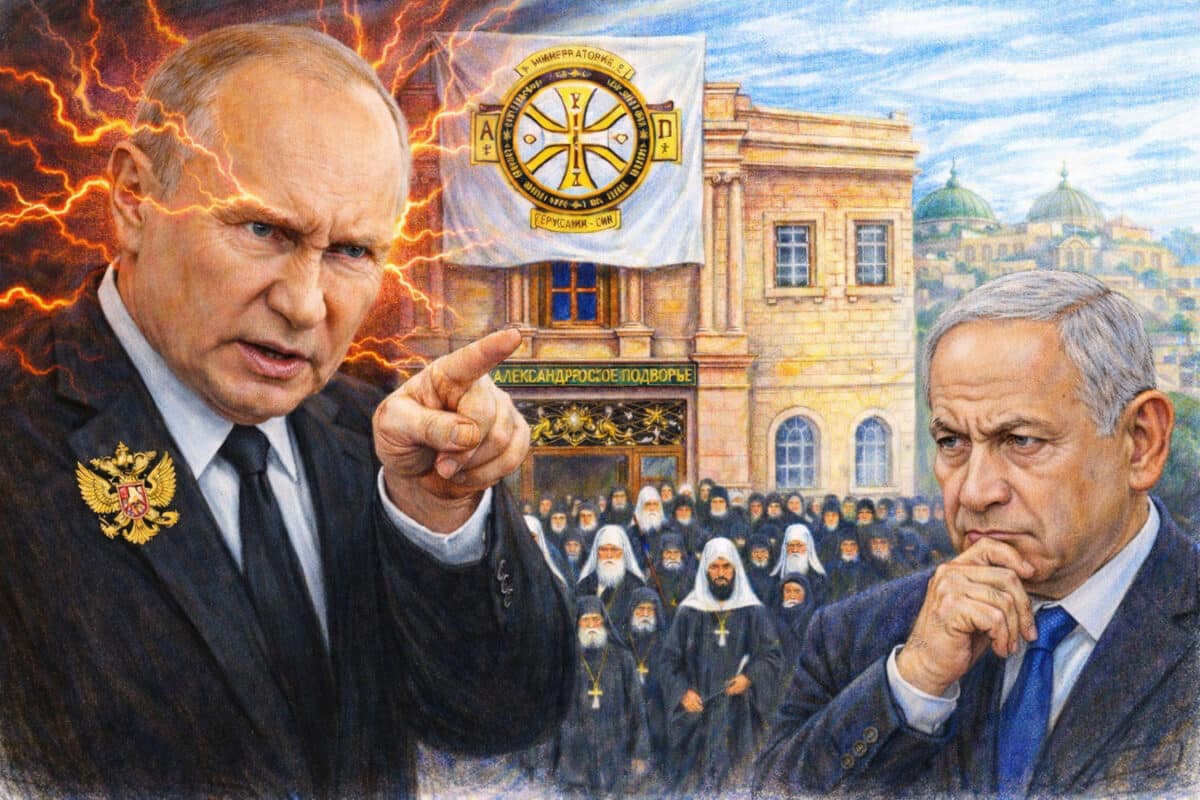
Let’s say right away, in Israel, a petition/open appeal by Israeli citizens to the government is gaining momentum, demanding “to stop the transfer of the Alexander Courtyard to Russia and related IPPO structures“, because they believe that such a transfer “threatens Israel’s security” and poses “risks associated with external influence and the political interests of Moscow and related organizations”.
“Protect Israel from the Russian threat: stop the transfer of the Alexander Courtyard to Hamas supporters“ “Protect Israel from the Russian threat: stop the transfer of the Alexander Courtyard to Hamas supporters”
“everything state-owned means the state decides everything.”
But this is not quite so.
What actually belongs to the state and what does not
In Israel, there are three different types of land:
State land
Yes — belongs to the state.
This is simple.
Private land of citizens and organizations
Yes — it exists.
With documents, registers, and property rights.
Historical and foreign private property This is where the whole story with courtyards, churches, and old objects begins.
Many such plots:
were purchased even before 1948,
during the Ottoman Empire, British Mandate,
by private societies, churches, foundations.
And Israel did not automatically nullify these rights.
Why didn’t Israel say: “Everything is ours, period”
When Israel was being re-established, it consciously did not go down the path of confiscating all private property.
The reasons are simple and harsh:
it wanted to be a state of law, not a revolutionary regime;
it inherited the British legal system, not destroyed it;
mass confiscation would mean:
endless courts,
international isolation,
destruction of its own legitimacy.
Simply put:
Israel could have taken it — but decided not to become one who takes by force.
Then what does “transfer” mean in such disputes
When it is said that an object is “transferred”, it does not mean that:
Israel is giving away “its land”,
or making a gift to someone.
In fact, Israel:
is not the owner of such objects,
acts as an arbiter,
decides whom to recognize as the legal owner between disputing parties.
Can Israel take it for itself?
Theoretically — yes:
if the object is recognized as ownerless,
if no party proves the right,
or for exceptional reasons of public interest.
“Public interest” — these are rare cases when the state can intervene in private property for the sake of security, vital infrastructure, or protection of unique heritage, for example, for road, railway, or metro construction, creating a security zone, or preserving a historical object.
But this is a extreme scenario, which Israel almost does not resort to, because it:
creates a dangerous precedent,
hits international reputation,
undermines the very logic of a state of law.
The shortest explanation
Land under the sovereignty of Israel — yes.
But ownership — not always state-owned.
Therefore, Israel does not “give away its own”, but decides, whose it is by law (Israeli and international).
Let’s start.
What is the Alexander Courtyard today — in fact
The Alexander Courtyard, here it is on Google map, is a historical-archaeological, cult, and museum complex in the Old City of Jerusalem, located approximately 40–50 meters from the Church of the Holy Sepulchre (1–2 minutes walk). It is not a hotel or commercial lodging: accommodation for tourists or pilgrims is not provided.
Area and location.
The complex occupies a plot of about 1,300–1,500 m², which is a significant size for the dense development of the Old City. Nearby are key shrines and locations:
Church of the Holy Sepulchre — 40–50 m;
route Via Dolorosa — directly adjacent (the Judgment Gate Threshold is part of it);
district Muristan — about 100 m;
Jaffa Gate — approximately 250–300 m.
What exactly is on the territory of the courtyard:
House Church of St. Alexander Nevsky — a small Orthodox church of the late 19th century; services are held periodically, there is no permanent monastic community.
Judgment Gate Threshold — an authentic archaeological object of the Roman era (1st century AD), a fragment of an ancient pavement and threshold; according to Christian tradition, associated with the path of Jesus Christ to the trial of Pontius Pilate and included in the Via Dolorosa route.
Archaeological site — elements of ancient city walls and buildings of Jerusalem, discovered during 19th-century excavations and preserved.
Small museum and exhibition rooms, dedicated to the history of the complex and findings.
Inner courtyard and historical buildings, forming a closed architectural ensemble within the Old City.
What is happening there now:
the courtyard is open to visitors as a cultural-historical object;
tours and archaeological site inspections are conducted;
there is a museum exhibition;
the cult function of the church is maintained;
work is being done on the maintenance, protection, and conservation of monuments.
What is fundamentally absent there:
there is no hotel or hostel;
there is no commercial tourist service;
there is no diplomatic or state institution.
Who manages the object:
Management and daily activities are carried out by the Orthodox Palestine Society (OPS) — a non-governmental public association operating in Jerusalem within the Israeli legal framework. Administrators, guides, and caretakers work on-site; restorers and monument protection specialists are involved as needed. The State of Israel does not directly manage the courtyard but oversees it within the framework of heritage protection and security legislation.
It is the combination of significant area, archaeological value, and extreme proximity to the Church of the Holy Sepulchre that makes the Alexander Courtyard an object of special attention and explains why the dispute around it goes far beyond a usual property issue.
Let’s continue.
In November 2025, a new round of hearings on the transfer of the Alexander Courtyard took place in the Jerusalem District Court — from the Imperial Orthodox Palestine Society (IPPO) — to whom — Imperial Orthodox Palestine Society (IPPO).
No, this is not a typo.
Why “IPPO ≠ IPPO”, if OPS was in between
(in the international-legal sense, considering the role of OPS)
In practice, it is about not two, but three different entities, which creates the main confusion. Two of them bear the same name — the Imperial Orthodox Palestine Society, and the third — Orthodox Palestine Society (OPS) — occupied an intermediate position during the legal gap period.
Imperial IPPO (1882–1917)
The pre-revolutionary “Imperial Orthodox Palestine Society” (IPPO) was a private public association, founded in 1882 and operating within the legal framework of the Russian Empire.
Principally important legal clarification:
the imperial IPPO did not belong to the state of the Russian Empire and was not the property of the royal family or the House of Romanov.
the society was not a state body;
was not part of the structure of ministries or departments;
its property was not state property;
it was not in the personal property of the emperor or members of the dynasty.
Imperial patronage was expressed exclusively in:
approval of the charter,
moral and political support,
but not in ownership rights.
All land plots and buildings in “Palestine”, including the Jerusalem courtyards, belonged to the society itself as an independent legal entity, not to the state and not to the royal family.
The term “Palestine” is used here exclusively in a historical-legal sense, as it appeared in Ottoman, European, and mandate documents of the late 19th — early 20th century, and has no relation to modern political realities or issues of Israeli sovereignty. For clarity, this name will be used strictly in the form and meaning in which it is recorded in official acts of the corresponding period.
After 1917, the Russian Empire and the imperial legal order ceased to exist. As a result, the imperial IPPO lost its legal personality and ceased to exist as a legal entity. There was no formal act of liquidation, but in the international-legal sense, the society ceased to exist.
Important for the IPPO case
Already in 1918, Soviet Russia, and then the USSR, officially renounced succession in relation to the Russian Empire, which was recorded by the decree of the Council of People’s Commissars on the annulment of state debts and the rupture of imperial legal and contractual obligations. This renunciation meant not only the non-recognition of imperial state debts but also the absence of succession for private imperial societies, including the Imperial Orthodox Palestine Society. Accordingly, the property of the IPPO abroad was not considered inherited by the USSR and was not under the protection or management of the Soviet state, which cemented the international-legal gap in the fate of the society and its property.
OPS as a period of factual continuation
In the legal vacuum that arose after 1917, the activities and management of the property of the former IPPO in the Holy Land effectively passed to the Orthodox Palestine Society (OPS)— a Jerusalem Orthodox organization formed in the emigrant community from the Russian Empire in the 1920s. People, local structure, archives, and actual management of the courtyards moved to OPS.
Orthodox Palestine Society (OPS) — is a non-governmental public association operating in Jerusalem and associated with the historical tradition of the pre-revolutionary Imperial Orthodox Palestine Society, but legally independent and not representing any state. It operates within the Israeli legal framework and manages historical objects, including the Alexander Courtyard. In this article, OPS is mentioned only as one of the parties to the property dispute, without delving into its history.
At the same time, OPS was not and was not recognized as the legal successor of the imperial IPPO. It did not receive the property by an act of inheritance or transfer and acted in the international-legal logic as a factual holder and custodian, not as a legal owner.
Russian IPPO (since the 1990s)
The modern Russian “Imperial Orthodox Palestine Society” (IPPO) was created in the 1990s and registered under Russian Federation law. In a legal sense, this is a new legal entity, not identical to the pre-revolutionary society.
The Russian IPPO declares itself the successor of the imperial IPPO, relying on historical continuity, mission, traditions, and the restoration of the name. However, from the point of view of international and Israeli law, the coincidence of the name and appeal to historical identity does not create automatic succession.
International-legal conclusion
In international-legal logic, automatic succession is possible only if there is continuity of the same legal entity or an internationally recognized act of transfer of rights. In the case of the IPPO, such conditions did not exist. An additional factor cementing the gap is the existence of OPS as an independent factual holder of property in the period between 1917 and the 1990s.
Final formula
The Imperial Orthodox Palestine Society was a private public association and did not belong to either the state of the Russian Empire or the royal family; its property was not state property. In the international-legal sense, the modern Russian IPPO is not an automatic successor of the pre-revolutionary IPPO, as there is no continuity of the legal entity and there was no internationally recognized act of transfer of rights.
What is the legal collision
Whose is the Alexander Courtyard in Jerusalem after all? and will Netanyahu be able to “protect the interests of the State of Israel” in this case?
In December 2019, Israeli media reported on the registration of the Alexander Courtyard for Russia in the Israeli real estate register. It was this entry that created the impression that the object had already been transferred. However, the registration was carried out administratively, without completing legal proceedings and without resolving objections from the Orthodox Palestine Society (OPS).
OPS, led by Nikolai Vorontsov-Hofman, filed a protest, after which the Jerusalem District Court imposed a temporary ban on the transfer of the object to the Russian IPPO, effectively freezing the situation.
Administrative decision of 2020
In 2020, Israeli Prime Minister Benjamin Netanyahu signed an administrative document categorizing the Alexander Courtyard as a “place of Christian worship”.
This decision was not an act of property transfer and did not replace legal proceedings, but it placed the object in a special legal regime, where questions of its status could be considered at the government level, not exclusively within the framework of ordinary civil litigation. Thus, the executive branch received an additional tool for resolving the dispute outside the classic judicial path.
Current legal status
The Jerusalem District Court ruled to maintain the status quo until a political-administrative decision is made.
According to the court’s decision, the courtyard temporarily remains under the management of the OPS (Orthodox Palestine Society) — that is, the structure that carries out the actual ownership and management of the object at the moment — until a special interdepartmental commission of the Israeli government makes a final decision on the ownership issue.
The court did not recognize any of the parties as the final owner, emphasizing the limited jurisdiction in this situation.
Positions of the parties
The Russian side claims that Israel should fulfill previous political commitments and complete the transfer process in favor of the Russian IPPO, which is considered by it as a historical successor.
OPS (Orthodox Palestine Society) insists that the courtyard is its historical property, which Russia or Russian structures never directly owned, and disputes the very idea of transfer.
The Israeli government takes an intermediate position, trying to balance between external political pressure, internal legal risks, and international criticism, avoiding a unilateral decision without the conclusion of a specialized commission.
What’s next
The court directly indicated that the final decision is within the competence of the governmental interdepartmental commission, not the court and not the prime minister individually.
Until such a decision is made, the situation remains legally suspended. At the same time, continued pressure from the Russian side is expected, especially given the current geopolitical context, while the Israeli government continues to postpone the final decision, striving to minimize legal and political consequences.
By the way –
there is material about the modern Russian IPPO from the Israeli publication “Details”
The Alexander Courtyard in Jerusalem has been the subject of disputes for decades, intertwining history, law, and politics. In this material, we consistently analyze, based on open sources, official statements, and public documents, to whom and on what basis this object belonged and belongs at different periods of its history.
Ancient Hebrew period (10th century BC — 70 AD)
Land was regulated by the norms of ancient Hebrew law (din Torah), as well as city and royal administration. The plot was outside the sacred zone of the Temple Mount, so the temple property regime (קדשי המקדש) did not apply to it. Ownership was secular and could be private, communal, or administrative within the framework of ancient Hebrew property law.
Specific owners are not known by name, as cadastral fixation of property in the modern sense did not exist. After the destruction of Jerusalem in 70 AD and the liquidation of the city structure, the former ancient Hebrew property titles effectively lost legal force.
Roman period (70 AD — 4th century AD)
After the destruction of Jerusalem in 70 AD, the territory came under the direct control of the Roman Empire and was regulated by the norms of Roman law (ius Romanum). Land was considered either state property (ager publicus) or private property (dominium privatum), transferred to Roman citizens or municipal structures of the city.
Specific owners of the plot are not recorded in surviving sources. Property rights of the previous population were terminated as a result of war and deportations, and subsequent ownership was determined by decisions of the Roman administration and city management (municipium).
Byzantine and early Christian period (326–637 AD)
In 326–335 AD, at the initiative of Empress Helena, mother of Emperor Constantine the Great, and by direct order of the imperial authority, the territory in the area of the future Church of the Holy Sepulchre was withdrawn from the usual city circulation. This decision was part of the state policy of Christianizing Jerusalem after the legalization of Christianity. Land, previously part of secular urban development, was transferred to the status of sacred property (res sacrae) according to the norms of Byzantine and Roman imperial law (ius Romanum, ius Byzantinum).
The legal holder of rights to the plot became the Jerusalem Church (ecclesia Hierosolymitana), that is, the local Christian institution under the management of the Bishop of Jerusalem, operating under imperial patronage (imperial patronage). The transfer was not formalized by a purchase-sale agreement, as the mechanism of imperial withdrawal and sacralization of land, characteristic of the 4th century, was applied. Private individuals were not owners, and the alienation of the plot was taken out of the civil circulation.
The formation of the Church of the Holy Sepulchre and the adjacent territory secured a stable Christian status for this area, which was maintained throughout the Byzantine period. Documentary confirmation of this is provided by contemporaneous sources of the 4th century, primarily the testimonies of Eusebius of Caesarea (Vita Constantini), as well as subsequent Byzantine church management practices. By the time of the Arab conquest of Jerusalem in 637 AD, the plot was recognized as church property, under institutional, not private ownership.
Early Islamic period (from 637 AD — 10th century)
After the capture of Jerusalem in 637 AD by the troops of Caliph Umar ibn al-Khattab, the city came under the rule of the Rashidun, and then the Umayyad and Abbasid caliphates. Upon the change of sovereignty, Christian shrines and church possessions were not confiscated. The rights of the Jerusalem Church to the plot in the area of the Church of the Holy Sepulchre were preserved within the framework of Islamic law.
The legal basis was the granting of Christians the status of dhimmi (ahl al-dhimma), which guaranteed the protection of the person, cult, and property upon payment of a poll tax (jizya). Church property was recognized as legal and inviolable, and the land continued to be owned by the Christian institution as a religious collective. The caliphate did not convert such plots into waqf and did not include them in the state land fund (bayt al-mal).
Thus, in the early Islamic period, there was no redistribution of property, but a confirmation of the previously established Byzantine church title. By the 10th century, the plot remained part of the Christian confessional zone around the Church of the Holy Sepulchre, with continuous institutional ownership and without a break in legal status.
In 1099, Jerusalem was captured by the Crusaders, and the city came under the control of the Latin Kingdom. Christian property in the area of the Church of the Holy Sepulchre was redistributed within the Christian world: management and ownership of plots passed to Latin church institutions under canon law (ius canonicum). At the same time, the category of church sacred property was preserved, and the land was not turned into secular private property.
After the return of Jerusalem under the control of the Ayyubids in 1187 and the subsequent establishment of Mamluk control, there was a rollback of Latin dominance. Muslim authorities restored the principle of protecting Christian shrines and property within Islamic law. Church plots around the Church of the Holy Sepulchre were preserved for Eastern Christian communities, including Greeks and Copts, as recognized religious corporations. Property was considered collective confessional ownership and was not included in the state land fund.
By the end of the Mamluk period, the plot on which the Alexander Courtyard later arose was part of a stable Christian property mass in the Old City. The legal status was determined not by a specific purchase-sale agreement, but by continuous recognition of religious property with the change of political regimes.
Ottoman period (1517 — mid-19th century)
After the conquest of Jerusalem by the Ottoman Empire in 1517, the city was included in the Ottoman administrative-legal system. Christian communities were recognized by the state as religious corporations within the millet system, which gave them the right to collective ownership of real estate and independent management of internal affairs. The property of Christian denominations, including land plots in the area of the Church of the Holy Sepulchre, was regulated by the norms of Ottoman law, combining sharia and imperial legislation (kanun).
At the early stage of Ottoman rule, the rights of religious communities were primarily fixed in fiscal-land registers (defter). These documents reflected the recognition of a specific community’s ownership of a plot and its responsibility to the state, but did not represent an individual title deed in the modern sense. It was about state confirmation of existing confessional ownership, not the creation of new property rights.
With the development of the Ottoman land system and the implementation of reforms in the 18th–19th centuries, religious possessions in Jerusalem were more formally registered in the tapu land certificate system. It was the tapu senedi that became the first type of document that can be considered a full-fledged title deed, recognized by the state and allowing for the alienation of property.
Within this registration, part of the Christian plots around the Church of the Holy Sepulchre was secured for the Coptic Orthodox community of Jerusalem as an independent legal entity.
It is important to emphasize that the Ottoman authorities did not “transfer” the land to the Copts. Their right was based on continuous confessional ownership, which the state recognized and formalized through registration. The Ottoman administration considered the Coptic community as a legitimate owner, capable of disposing of real estate, including its sale, subject to the established procedure and obtaining permission from the authorities.
By the mid-19th century, the Coptic community had a formalized and state-recognized title of ownership, confirmed by tapu documents. It was the emergence of this formalized Ottoman title deed that became the first case of documentary securing of property rights to the plot in a legal sense and created the legal possibility of its lawful sale to the Russian Ecclesiastical Mission in 1859–1860.
Purchase of the plot by the Russian Ecclesiastical Mission (1859–1860)
In 1859–1860, the land plot in the area of the Church of the Holy Sepulchre, previously registered for the Coptic Orthodox community of Jerusalem, was alienated in favor of the Russian Ecclesiastical Mission in Jerusalem. The transaction was formalized as a private purchase-sale between two religious corporations and was carried out within the framework of the existing Ottoman law. The seller was the Coptic church institution, possessing a formalized title of ownership, confirmed by the tapu system, and the buyer was the Russian Ecclesiastical Mission, acting through its head, Archimandrite Antonin (Kapustin).
The legal basis of the transaction was a purchase-sale agreement concluded under the norms of sharia and kanun with the mandatory administrative permission of the Ottoman authorities for the alienation of real estate to a foreign religious entity. Such a procedure was standard for Jerusalem in the mid-19th century and applied to all foreign Christian missions. The Ottoman administration considered the Russian Ecclesiastical Mission not as a state body of the Russian Empire, but as a church institution, which excluded the qualification of the transaction as interstate.
The financing of the purchase was carried out at the expense of donations and church funds, but the source of the money did not affect the legal status of the property. In Ottoman documents and registers, the owner of the plot was recorded as the Russian Ecclesiastical Mission in Jerusalem, not the Russian Empire, not the imperial family, and not the treasury. No acts transferring the plot to the state property of Russia were formalized.
The conclusion of the transaction in 1859–1860 created a new initial title of ownership, recognized by the Ottoman state and valid in subsequent periods. From this moment, the plot was in the private church ownership of the Russian Ecclesiastical Mission, which became the legal basis for the subsequent construction and formation of the Alexander Courtyard, but did not generate any rights for the Russian Empire as a state.
Development of the plot and formation of the Alexander Courtyard (1860s — 1890s)
After the completion of the purchase-sale in 1859–1860, the Russian Ecclesiastical Mission in Jerusalem began the development of the plot as the legal owner under Ottoman law. The use of the land was carried out based on the formalized tapu title and was not accompanied by any acts of alienation or change in the legal status of ownership. The Ottoman authorities considered construction and archaeological work as permissible disposal of private church property (mulk).
In the 1860s–1870s, the plot was cleared and adapted for religious and pilgrimage purposes. In the 1880s–1890s, an architectural complex was formed here, which received the name Alexander Courtyard. This name had a memorial character and did not reflect the form of ownership or state affiliation of the object. The right of the Russian Ecclesiastical Mission to the plot continued to be preserved without changes and did not require re-registration.
Transfer of management of the Alexander Courtyard to the Imperial Orthodox Palestine Society (late 19th century)
By the end of the 19th century, the Russian Ecclesiastical Mission in Jerusalem decided to transfer the economic and pilgrimage management of the Alexander Courtyard to the Imperial Orthodox Palestine Society. The basis for this was the statutory goals of the IPPO, aimed at organizing pilgrimages, maintaining Russian institutions in Palestine, and exploiting religious real estate. The transfer was carried out in the form of an internal order between affiliated church-public structures and was not formalized as a civil-law transaction of alienation.
From a legal point of view, it was about delegating management and use functions (administratio), not about transferring ownership rights (dominium). The Russian Ecclesiastical Mission retained the title of owner, based on the Ottoman tapu, while the IPPO acted as the managing organization, carrying out actual possession, maintenance, and exploitation of the object. No purchase-sale, donation, or other title deed in favor of the IPPO was formalized, and the change of owner was not registered in either Ottoman or subsequent registers.
The transfer of management did not require separate permission from the Ottoman authorities, as it did not affect the title of ownership and was considered an internal order of the owner within his powers. In legal terms, the IPPO acted as a lawful possessor (lawful possessor), having gained access to the object based on the owner’s consent.
It was this status that later became key for assessing the continuity of possession after 1917, but it did not itself turn the IPPO into an owner at this stage.
1917–1922: cessation of the Russian Ecclesiastical Mission, renunciation of succession, and creation of a legal vacuum
After the revolutionary events of 1917, the pre-revolutionary church-state order of the Russian Empire was destroyed. The Holy Synod, through which the Russian Ecclesiastical Mission in Jerusalem operated, was abolished, centralized management and financing of the mission ceased, and the Soviet government refused to recognize pre-revolutionary church institutions as holders of property rights abroad. As a result, the Russian Ecclesiastical Mission lost its legal personality and ability to act as an active owner of real estate.
The cessation of the mission’s activities was not accompanied by an act of liquidation, confiscation, or transfer of property. The Alexander Courtyard was not transferred to either the state or another church structure. In 1918–1922, Soviet Russia officially renounced succession for foreign private and church property of the Russian Empire, which excluded the emergence of a title for the RSFSR or the USSR. Thus, the title of ownership, formalized in the 19th century for the Russian Ecclesiastical Mission, was “orphaned”: it was not annulled but lost its active holder.
The Moscow Patriarchate, restored in new conditions, did not become the successor of the Russian Ecclesiastical Mission in a property sense. It arose as a new church structure within the Soviet legal framework and did not receive automatic international recognition as the heir to pre-revolutionary foreign assets. Neither the Soviet state nor foreign authorities formalized acts of succession linking the patriarchate with the mission’s rights to real estate in Jerusalem.
In these conditions, the Imperial Orthodox Palestine Society, which even before 1917 carried out lawful management and use of the Alexander Courtyard based on the owner’s consent, continued actual possession of the object. This possession was qualified as lawful and continuous (lawful possession), as the IPPO did not enter arbitrarily, did not displace another owner, and acted within the framework of previously obtained powers. The absence of a successor for the Russian Ecclesiastical Mission and the refusal of the USSR to make claims created a legal vacuum in which the IPPO remained the only subject exercising possession, forming the basis for subsequent recognition of the title based on the principle of continuity of possession (continuity of possession).
British Mandate period (1917–1948): administrative practice and recognition of the IPPO
During the British Mandate in Palestine (1917–1948), the new authorities adopted the principle of preserving existing property rights and titles formed before the change of sovereignty. Regarding the Alexander Courtyard, the British administration did not carry out expropriation, sequestration, or nationalization and did not declare the object ownerless (bona vacantia). The absence of an active owner, which arose after the cessation of the Russian Ecclesiastical Mission, was not filled by transferring the property to the mandate state.
The practice of management and administrative interaction was built directly with the Imperial Orthodox Palestine Society. All official correspondence, permits, and orders for the operation and maintenance of the courtyard were addressed to the IPPO as the responsible owner and manager. British authorities did not require the IPPO to present an act of transfer of ownership and did not initiate re-registration of the title, which meant tacit recognition of the established possession through the administrative behavior of the authority (recognition by conduct).
Legally, this period became key for consolidating the status of the IPPO. Continuous and lawful possession (lawful possession) in the absence of a competing owner and in the absence of state actions to expropriate the property led to the crystallization of the title. The British Mandate did not create new property rights but confirmed the existing situation based on continuity of possession (continuity of possession), which was later accepted by subsequent sovereign authorities.
Jordanian period (1948–1967): preservation of the status quo of ownership and applicable law
After 1948, East Jerusalem came under Jordanian control, which applied the principle of preserving the existing property order (status quo), used in international practice during the change of sovereignty. The applicable law included the norms of Ottoman land law (Ottoman Land Code 1858), which continued to operate in East Jerusalem, as well as the provisions of mandate law, inherited from the British administration. These sources were considered as a continuing legal order and did not require automatic re-registration of ownership.
Regarding the Alexander Courtyard, Jordanian authorities did not carry out confiscation, sequestration, or recognition of the property as ownerless (bona vacantia). The absence of such actions meant the preservation of the previous title. Administrative interaction was carried out with the Imperial Orthodox Palestine Society as the factual owner and manager, without requiring an act of transfer of ownership. In these conditions, the principle of lawful and continuous possession (lawful possession, continuity of possession) was applied, where the right is not created anew but preserved in the absence of competing claims.
Former Russian state property in West Jerusalem after 1948
After the declaration of independence of the State of Israel in 1948 and the establishment of its control over the western part of Jerusalem, Israel came under its jurisdiction a number of objects that previously belonged to the Russian Empire as a state. The issue of their fate was not resolved automatically but under active external political pressure from the Soviet Union.
The USSR became one of the first states to recognize Israel and used this recognition as a tool of political pressure. Soviet diplomacy directly insisted on the transfer of former imperial state real estate to the USSR as the successor of the Russian Empire. For the young Israeli state, which was in international isolation and dependent on external support, this factor was decisive.
As a result, in 1949–1951, Israel recognized the USSR’s rights to objects that before 1917 were state property of the Russian Empire and were located within western Jerusalem. Such objects included the complex of the Russian Compound (Migraash ha-Rusim), buildings of the former Russian hospital, as well as administrative and representative buildings, constructed and registered to the state treasury. These objects did not belong to church property and were not owned by public or religious organizations.
Legal formalization was carried out by administrative decisions of the Israeli government and subsequent registration in property bodies. The basis was Israel’s recognition of the USSR as the state successor of the Russian Empire exclusively in terms of state property, as well as diplomatic agreements between the parties. A separate special law was not adopted; the legal effect was achieved through a combination of executive acts and international obligations.
This mechanism did not extend to objects that before 1917 belonged to the Russian Ecclesiastical Mission, monasteries, or public structures, as they were not state property and did not fall under the principle of state succession.
“Orange Deal”. Redemption by the State of Israel of former Soviet real estate in West Jerusalem (1964)
In 1964, the State of Israel redeemed from the Soviet Union a significant part of the real estate in West Jerusalem, previously recognized for the USSR as state property of the Russian Empire. The deal was formalized within the framework of an interstate agreement and received the unofficial name “orange deal”.
The subject of the redemption was exclusively objects that had the status of state (treasury) property before 1917 and were located on territory under Israeli control. These included the main buildings of the Russian Compound (Migraash ha-Rusim), administrative and economic buildings, as well as buildings of the former Russian hospital and accompanying infrastructure. After the completion of the deal, the USSR’s ownership of these objects was terminated, and they passed into the full ownership of the State of Israel.
The decision to redeem was due to several reasons. The formal ownership of the USSR of large objects in the center of Jerusalem was considered by Israel as a problem of sovereignty and internal security. Legally, Israel could not nationalize foreign state property without serious international consequences, so redemption was chosen as a legal way of final settlement. In addition, the USSR was interested in converting unused foreign real estate into economic compensation, and Israel — in gaining full control over the territory for the placement of state, judicial, and municipal institutions.
The 1964 deal did not extend to objects located in East Jerusalem, did not concern church and public property, and was not related to objects that before 1917 belonged to the Russian Ecclesiastical Mission, monasteries, or the Imperial Orthodox Palestine Society. The Alexander Courtyard was not included in this process.
1967: extension of the Israeli land registration system and fixation of IPPO ownership
After the Six-Day War of 1967 and the establishment of Israeli control over East Jerusalem, Israel extended its civil and property law to this territory. For the first time for the Old City, a unified national system of real estate registration was applied — the Israeli land registry Tabu (Lishkat rishum mekarkein).
Before this, other forms of land accounting existed in Jerusalem: Ottoman tapu records, as well as mandate and Jordanian practices of preserving these records. However, none of them represented a modern state cadastre with mandatory fixation of the current owner. The Israeli Tabu, unlike previous systems, fixes property rights as a legal fact recognized by the state.
When including objects of East Jerusalem in Tabu, Israel did not carry out nationalization, did not create new titles, and did not change owners. The principle of preserving previously existing property rights (status quo / continuity of title) was applied: if an object had a legal owner and was not alienated, its right was preserved and subject to fixation in the register.
The Alexander Courtyard was entered into the Israeli real estate register (Tabu) with the indication of Orthodox Palestine Society (OPS) as the owner of the plot. The basis was Ottoman purchase-sale documents, the lawful entry of the pre-revolutionary Imperial Orthodox Palestine Society into possession, continuous actual management of the object by the local structure after 1917, and the absence of any act of alienation in favor of the state(?). The object was not registered for the State of Israel and was not considered state property.
Thus, after 1967, the property rights to the Alexander Courtyard were first formally fixed in a modern state register precisely for OPS. It was not about the emergence of a new right, but about the state fixation of an already existing historical title, which in Israeli law is a full confirmation of private property.
1967–1990: absence of disputes and the beginning of Russian claims
From the moment of the inclusion of East Jerusalem in the legal field of the State of Israel in 1967 until the early 1990s, the issue of the ownership of the Alexander Courtyard was not raised or disputed.
During this period, the Soviet Union did not make property claims to the Alexander Courtyard, which corresponded to its previously declared renunciation of succession for foreign private and church property of the Russian Empire.
1991–1996: first practical steps of Russia
In 1991–1992, after the collapse of the USSR, Russian diplomatic missions in Israel began raising the issue of the status of certain objects of so-called “Russian real estate”, including the Alexander Courtyard, within the framework of working contacts with Israeli departments. These actions were informal and consultative in nature and were not accompanied by the filing of lawsuits, official statements of ownership rights, or attempts to change the entry in the real estate register.
In 1993–1996, the Russian side sent administrative requests to Israeli bodies asking to clarify the legal status of the object and the possibility of its re-registration. In response, Israeli registering bodies pointed to the presence of a valid entry in Tabu, as well as the absence of title documents necessary for changing the register. Formal procedures for reviewing the entry were not initiated.
During this period, no legal proceedings were conducted, no transfer decisions were made, and no changes in the real estate register occurred. All actions were limited to correspondence and consultations at the interdepartmental level.
Late 1990s — early 2000s: transition to formalized demands
In the late 1990s — early 2000s, the Russian Federation moved from consultations to formalized appeals to Israeli bodies demanding a review of the status of the Alexander Courtyard.
During this period, the Russian side began officially declaring that the object is “Russian property” and insisting on its re-registration in the state registers of Israel.
Israeli registering bodies refused to change the entry in Tabu, citing:
the absence of proper title documents;
the absence of a continuous and recognized chain of title;
the presence of a valid registration for another entity.
No legal decisions were made during this period, and the entry in the real estate register remained unchanged.
2019–2022: administrative decisions and their review
In 2019, an administrative process related to changing the status of the Alexander Courtyard was initiated in Israel. The consideration of the issue took place not in a judicial order, but at the level of executive power and registration bodies.
In December 2019, within this process, an attempt was made to administratively formalize the rights of the Russian Federation to the object. These actions were of a political-administrative nature and took place against the backdrop of negotiations between Israel and Russia on the case of Israeli citizen Naama Issachar, convicted in the Russian Federation.
It is important to emphasize that it was not about judicial recognition of ownership rights. Registration actions were carried out administratively, without considering the issue of a continuous chain of title and without canceling the previously existing entry in the real estate register, which created a legal collision.
In 2020, a separate administrative decision was simultaneously made to categorize the Alexander Courtyard as a “place of Christian worship”, which transferred the object to a special legal regime, but was not an act of property transfer and did not replace legal proceedings.
In 2022, Israeli bodies canceled the administrative decisions of 2019–2020 related to changing the status of the object. The cancellation was carried out administratively, based on the results of an internal review of the legality of registration actions, without issuing a court decision on the merits of the ownership dispute.
During the review, it was established that the changes in the status of the Alexander Courtyard were made:
without proper legal basis;
without a court decision;
without confirmation of a continuous and recognized chain of title.
After the cancellation of administrative decisions, the entry in the real estate register was returned to the state that existed before 2019.
2022 — present: status quo and awaiting decision
Currently, the legal status of the Alexander Courtyard remains uncertain. The object continues to be in a status quo mode until a final decision is made by the authorized bodies of the State of Israel. The process is not complete: further steps depend on the conclusions of the governmental interdepartmental commission and possible new legal actions.
Ultimately, the key decision remains with the government of Israel, not the court. The courts only fixed the status quo and directly indicated that the final answer should be developed by the interdepartmental commission and then approved by the executive branch. Thus, the issue goes far beyond a private property dispute and becomes a test of the ability of the Government of Israel to withstand external pressure without destroying the internal logic of a state of law.
Whether Benjamin Netanyahu will ultimately be able to protect the interests of the State of Israel — standing firm against the persistent demands of Putin — or whether the country will confirm its commitment to historical-legal facts, law, and democratic procedures, will be an indicator of which principle will be decisive: “political expediency” or “rule of law”.
This choice and its consequences continue to be closely monitored by NAnews — News of Israel | Nikk.Agency.
Public reaction: petition on risks to Israel’s security
Amid the ongoing dispute over the Alexander Courtyard, a public initiative emerged in Israel in the form of a petition posted on the Atzuma platform under the name Threat from Russia. The authors of the appeal urge the Israeli government to stop any forms of transferring the Alexander Courtyard to structures associated with the Russian Federation, considering such a step as a potential risk to national security.
“להגן על ישראל מהאיום הרוסי: לעצור את העברת חצר אלכסנדר לתומכי חמאס”
“Protect Israel from the Russian threat: stop the transfer of the Alexander Courtyard to Hamas supporters”
The text of the petition emphasizes that it is not just about a property or historical dispute. According to the initiators, the possible transfer of the object could lead to “institutional consolidation of Russian presence in a sensitive area of Jerusalem”, which is seen as a factor of political and symbolic influence, going beyond religious use.
A separate emphasis is placed on the risk of using religious and public structures as a “tool of external influence”, including promoting “political narratives and informal contacts that do not coincide with Israel’s interests”. The authors of the petition point out that similar “influence mechanisms” have already been used by Russia in other countries under the guise of cultural and religious institutions.
The appeal also emphasizes the geopolitical context: “active interaction of Russia with states and structures hostile to Israel, including Iran and related forces”. In this light, the transfer of the object in Jerusalem is perceived as a “potential channel of external pressure”, not as a neutral legal act.
Finally, the authors consider dangerous the very “precedent of a political decision bypassing a full legal procedure”, as it, in their opinion, “undermines trust in state institutions and creates vulnerability for future external pressure on Israeli decisions”.
At the same time, the petition is not a legal document and has no binding force. It reflects the position of part of Israeli society and serves as a form of public pressure on the executive branch, complementing the legal and political context around the Alexander Courtyard.
Russia has begun the phased withdrawal of troops from Syrian territory. According to regional sources, Russian military personnel are leaving the Qamishli airfield in the north of the country, transferring equipment and personnel to bases in the coastal zone.
This involves the relocation of units and weapons towards Latakia — a key area of Russian military presence on the Syrian coast. Tanks and heavy equipment have already been removed from the airfield and are being loaded onto transport planes.
The information about the events was published on January 26, 2026, by Kurdistan24. According to their data, the evacuation is organized and affects not only ground forces but also aviation infrastructure.
The withdrawal of Russian bases in Syria has been repeatedly reported by the Main Intelligence Directorate of the Ministry of Defense of Ukraine. According to Ukrainian intelligence, as early as 2024, Russian naval ships began leaving the base in Tartus, and equipment was being removed from the Khmeimim airbase by Il-76 and An-124 planes.
The GUR noted that a whole “caravan of military transport aircraft” was used for the evacuation, loading the remaining personnel, weapons, and military equipment. This process, according to Ukrainian estimates, was a result of Russia’s sharply reduced ability to maintain positions outside its own theater of war.
The background of the Syrian collapse dates back to the early 2000s. Bashar al-Assad came to power in 2000 after the death of his father, Hafez al-Assad. In 2011, he harshly suppressed peaceful protests, leading to a prolonged civil war.
Over the years of conflict in Syria, more than half a million people have died, and about 12 million were forced to leave their homes. With the support of allies, Assad managed to retain control over most of the country, and after 2020, Syria practically disappeared from the international agenda.
The situation changed dramatically at the end of November 2024. The united armed opposition swept from north to south of the country in a matter of days, taking control of the largest cities. After the fall of Aleppo, Hama, and Homs, Damascus fell. The government army offered no serious resistance.
Neither Russia nor Iran intervened at this moment. Assad’s regime collapsed, and he lost power.
Since 2022, Moscow has been forced to focus resources on the war against Ukraine. A significant portion of the aviation was withdrawn from Syrian bases, and generals who had failed in the Ukrainian direction began to be sent to Syria. In fact, the Syrian theater became secondary and gradually lost priority.
Assad remained Russia’s most loyal ally in the Middle East. The Kremlin invested enormous financial, military, and political resources in keeping him in power. However, after the regime’s fall, this bet was ultimately lost.
According to available information, Assad and his family members, after losing power, are in Moscow, where they were granted asylum. The withdrawal of Russian troops from Syria became a logical continuation of this story — a symbol of the loss of influence and reduction of Russia’s capabilities beyond its own war.
It is precisely such shifts in regional politics and military reality that are today shaping a new map of the Middle East, which is being closely monitored by NAnews — Israel News | Nikk.Agency, documenting how the war in Ukraine directly changes the balance of power far beyond its borders.
In an interviewIsrael Hayom (Hebrew) on January 25, 2026, Pinchas Goldschmidt, former Chief Rabbi of Moscow and President of the Conference of European Rabbis (CER), describes in detail how the war against Ukraine has changed the very logic of the existence of the Jewish community in Russia. According to him, it is under the conditions of war that the political use of the Jewish theme has become especially noticeable — and especially dangerous.
Rabbi Pinchas Goldschmidt, former Chief Rabbi of Moscow, refused to support the war against Ukraine, was forced to flee, and was declared a “foreign agent” in Russia.
War and Propaganda: The Jewish Theme in the State Narrative
“The Russian government uses the Jewish community to justify the war against Ukraine” — Rabbi Goldschmidt, former Chief Rabbi of Moscow; unfortunately, the leaders of the Jewish community in Russia are forced to support this narrative
Goldschmidt emphasizes that this is not about isolated episodes, but about systemic policy. In the interview, he formulates it directly and without mitigating phrases:
“The government uses the Jewish community for political purposes. In recent years, a theory has been promoted in Russia about the return of neo-Nazism in Ukraine and the Baltic countries, so the war in the Russian narrative is presented as a continuation of the war against Nazi Germany. Unfortunately, the leaders of the Jewish community in Russia support this story — they use the community for propaganda purposes.”
According to the rabbi, such a construction allows the authorities to present the war not as a modern political conflict, but as a morally justified continuation of historical struggle. The memory of World War II and the Holocaust becomes part of the rhetorical toolkit, rather than a subject of honest historical conversation.
From Community Revival to State Control
Goldschmidt recalls that in the 1990s the situation looked different. After the collapse of the Soviet Union, Jewish life in Russia began to revive practically from scratch. In 1996, the Russian Jewish Congress was created, which united the remaining Jewish elite and became the basis for the development of schools, yeshivas, community, and charitable institutions.
This period, according to him, was a time of cautious autonomy and hope. However, with the arrival of Putin to power, the situation began to gradually change.
“With Putin’s rise to power in 2000, the situation gradually changed,” says Goldschmidt. “He set the condition that major businessmen would not interfere in politics, and over time we saw that Russia was turning into a dictatorship.”
Interference in Jewish Life as the Norm
As the power vertical strengthened, state interference in the life of the Jewish community ceased to be an exception and became a routine practice.
“Interference in Jewish life became commonplace — the government determined who could be the chief rabbi and who could not, and expelled dozens of rabbis from the country,” he says.
Goldschmidt links this to a broader process of returning to the logic of power structures and the ideology of a closed state:
“With Putin’s arrival, power returns to the heirs of the KGB, and hatred of foreigners and the West becomes an integral part of the personality of people who grew up in this society.”
Fear of Repeating History
A separate place in the interview is occupied by the topic of anti-Semitism as a tool of self-defense for the authorities in crisis moments. Goldschmidt emphasizes that this is not a theoretical concern, but a historically confirmed mechanism.
“The fear is that when the government in Russia is under threat, it uses anti-Semitism for self-defense. We have seen this before — at the end of the tsarist era, the government said: ‘Don’t be angry at the tsar, be angry at the Jews,’ and this led to pogroms. This also happened at the end of the Stalin era.”
According to him, the current rhetoric and isolation of the country create conditions under which such a scenario becomes possible again.
Isolation of Russia and Its Consequences for Jews
Goldschmidt directly links the increase in tension with the international isolation of Russia, which intensified after the start of the war against Ukraine.
“Today Russia is in isolation,” he says. “Putin thought he would win in Ukraine in three days, and next month we will mark four years of war — more than the war between Russia and Nazi Germany. He isolated himself from the West.”
This isolation, the rabbi emphasizes, directly affects the position of Jews within the country.
“In the Soviet Union, Jews were isolated, they were not allowed to contact relatives in Israel or the West. Now this is happening again. When everything outside of Russia is considered unacceptable, the discourse regarding Jews boils down to questioning their loyalty to the state. Anti-Semitism is increasing, and it has become more difficult to be officially Jewish.”
Personal Choice and the Price of Refusal
Goldschmidt’s refusal in 2022 to publicly support the war became a logical continuation of his position — and at the same time a personal breaking point with Russia. Fearing for his life, he was forced to leave the country, and later was declared a “foreign agent.”
Today, 35 years after the collapse of the USSR, he publishes the book “Memories of Moscow,” in which he sums up an entire era — from the hopes of the late 1980s to the current state of isolation, fear, and narrowing space for Jewish life.
His advice to Russian Jews is formulated as directly as possible: for those who have the opportunity, it is better to build their future outside of Russia — including in Israel or other countries. According to his estimate, since the beginning of the war, about 100,000 Jews have already left the country, and the overwhelming majority of them do not consider returning.
The picture he describes is bleak and without illusions. The future of Russian Jewry is contraction, poverty, and loneliness. Communities are losing influence, resources, and people. Financial support for synagogues and community centers is already declining: people donate less and less because they understand — there is no long-term future for them there. This is not an emotional conclusion, but a cold calculation dictated by the reality of recent years.
Europe, the USA, and Israel: A Rift Affecting Jewish Communities
A separate concern for Pinchas Goldschmidt is the growing rift between Europe and the USA — and the place Israel occupies in this divide. According to him, this is not about private disagreements, but about a systemic clash of political approaches, the consequences of which are directly felt by Jewish communities in Europe.
“Today there is a clash between Europe and the USA in six areas: world order, support for the far-right, restrictions on social networks, NATO, Ukraine, and Greenland. In all these areas, Israel is on the American side, and this distancing does not benefit the Jews,” says Goldschmidt.
He emphasizes that for decades, American influence served as a protective factor for European Jews. The weakening of this role makes communities more vulnerable and opens up space for the revision of historical memory.
According to the rabbi, the weakening of the global influence of the USA directly affects the Jews:
“For decades, Jews knew they could trust the USA. But their isolation from the world reduces the ability to influence what is happening — and this harms the Jews and Israel.”
Between Extreme Poles
Goldschmidt also talks about the rise of the far-right in Europe. If the far-left increasingly become openly anti-Israel, then part of the far-right demonstrates a pro-Israel position, creating a dangerous ambiguity for Jewish communities.
“Jewish communities do not want to be involved in these political disputes,” he emphasizes.
Goldschmidt explains the risk directly:
“For the far-right, Jewish communities become a ‘kosher document’: if Jews contact them, they cannot be accused of anti-Semitism.”
The Disappearance of Moderate Partners
According to him, the situation is exacerbated by the fact that traditional moderate left-wing parties in Europe, which once supported Israel, are gradually moving to anti-Israel positions.
“Once, social democrats supported Israel. Today, a significant part of these parties has moved to the anti-Israel side,” he says.
This leads to a situation where the dialogue with European leftists is increasingly conducted not by Israel and Jewish communities, but by Palestinians, Arab countries, and Iran — and it is their views that are gradually becoming dominant.
Conclusion
Pinchas Goldschmidt’s interview with Israel Hayom is not journalism or a political manifesto. It is an attempt to capture the moment when the Jewish community in Russia found itself between historical memory and modern propaganda, between fear and loyalty, between the past and an uncertain future.
This is why this conversation is important not only for Russia but also for Israel and Europe. It remains part of the agenda of NAnews — Israel News | Nikk.Agency, where the war is considered not only as a military conflict but also as a crisis of meaning, memory, and responsibility.
Criminal and despotic regimes fear not sanctions or statements. They are only frightened by one thing — a force that surpasses them and is ready to be applied. After the swift collapse of Nicolás Maduro’s regime in Venezuela in the first weeks of the new year, this signal was heard far beyond Latin America. In many capitals of autocracies, it became evident: democracy is once again reminding of itself not with words, but with actions.
The protests that swept through all 31 provinces of Iran became part of this same process. The harshest regimes of modern times — from neo-Maoist China to the autocracy in Moscow and especially the medieval theocracy in Tehran — have long learned to use surveillance technologies, digital control, and censorship to maintain power. But there is a force that continues to evoke genuine fear in them: the free West, offering its citizens a more attractive model of life and possessing obvious military superiority when it has the political will to act.
The Venezuelan precedent became alarming for them. Although the arrest of Maduro and his extradition to New York have not yet led to the complete dismantling of the chavista system, the new leadership of the country, headed by Delcy Rodríguez, demonstrated a willingness to challenge the West. In the first hours after the change of power, Caracas received ambassadors from China, Russia, and Iran, betting on confrontation rather than compromise.
The Iranian people, in turn, are increasingly seeing the vulnerability of their own oppressors. This became especially noticeable after the so-called twelve-day war in the summer, when Israel carried out about 360 strikes on Iranian targets in 27 provinces. According to experts, these attacks set back the Iranian nuclear program by years and shattered the myth of the regime’s complete invulnerability.
Discontent within Iran crossed a critical threshold back in 2022 after the killing of 22-year-old Kurdish woman Mahsa Amini, detained allegedly for violating strict dress code norms. A wave of protests under the slogan “Woman, Life, Freedom” swept across the country. The authorities’ response was demonstratively brutal: according to various reports, hundreds of civilians were killed, with mass arrests and cases of sexual violence recorded.
Tehran has been building an external line of defense for decades — the so-called “axis of resistance,” uniting controlled terrorist groups. However, this structure also proved vulnerable. Hamas, controlling the Gaza Strip, suffered heavy losses after the attack on Israel on October 7, 2023, and the subsequent response.
Hezbollah, drawn into the confrontation, was seriously weakened after the elimination of its leadership, including Secretary-General Hassan Nasrallah. The remaining structures found themselves under pressure to disarm. The Bashar Assad regime in Syria is also experiencing a deep decline, and the Yemeni Houthis, remaining Iran’s last active ally, are under increasing pressure from the Arab coalition.
Even Tehran’s external patrons are showing the limits of their capabilities. Russia is bogged down in the war against Ukraine, which, contrary to the Kremlin’s expectations, managed to strike Russian territory. China prefers caution and avoids direct confrontation. Events in Venezuela showed: air defense systems and loud rhetoric do not guarantee protection in the event of decisive US actions.
Against this backdrop, Washington’s support for Iranian protesters has gained special significance. President Donald Trump publicly declared his readiness to support the Iranian people in their quest for freedom. This fundamentally distinguishes the current moment from 2009, when the Barack Obama administration never decided to take a clear position, which was later recognized as a mistake.
Today, technologies like Starlink from SpaceX allow Iranians to bypass internet blockades and maintain communication with the outside world. Few remember that before the 1979 revolution, Iran was an ally of the West and Israel. The potential fall of the current regime could return this country to a completely different geopolitical configuration.
If the 90-million-strong Iranian people manage to rid themselves of the power that has ruined the lives of several generations, it will become one of the most significant shifts in world politics in decades — and a step towards a more stable and secure world. It is in this context that what is happening today in Iran and around it is viewed by NAnews — Israel News | Nikk.Agency, recording how strength, will, and choice are once again beginning to change the course of history.
A creative meeting with Aider Muzhdabaev — a Crimean Tatar journalist and media manager who has been living and working in Ukraine since 2015 and publicly addresses topics of Crimea, war, propaganda, and social responsibility — will be held in Tel Aviv.
When: Thursday, January 29, 2026, 19:00.
Where: Ukrainian Cultural Center is part of the Embassy of Ukraine in the State of Israel.,- Yermiyahu St, 22, Tel Aviv (corner of Yermiyahu and Ben Yehuda streets).
Free entry. Donations to the Armed Forces of Ukraine are voluntary. No tickets — just come …
The event format is announced as a live performance and open communication with the audience. A “question-answer” block is planned, where participants can ask direct and uncomfortable questions — about the war, media, fear, compromises, and the price of silence. A separate part of the evening will be dedicated to collecting donations for the needs of a specific unit of the Armed Forces of Ukraine — the battalion named after Devlet I Giray.
Creative meeting with Aider Muzhdabaev — journalist and voice of Crimean Tatar Ukraine. Tel Aviv · January 29, 2026
This is a principled moment: it is not about abstract “support for the front,” but about helping a real unit with a specific structure, history, and combat experience.
For the Israeli audience, such meetings have a special meaning. Israel is a country where issues of security, war, and personal responsibility have long ceased to be theoretical. Therefore, the conversation about Ukraine here inevitably goes beyond the “foreign conflict” and becomes a conversation about the survival of societies, the role of the army, media, and citizens.
What will happen at the meeting
According to the announced format:
public speech by Aider Muzhdabaev;
conversation with the audience and answers to questions;
fundraising for the needs of the battalion named after Devlet I Giray — the 2nd separate rifle battalion of the 109th separate brigade of territorial defense of the Armed Forces of Ukraine.
Such meetings are usually built without scripted preparations: there are basic topics — war, Crimea, propaganda, the internal cost of resistance — and there is a live conversation that often goes where official speeches do not.
Aider Muzhdabaev
“Journalist, founder of Russophobia as an exact science. Thinker, analyst, accurately predicted this war” – this is how he describes himself on his Facebook account.
Aider Izzetovich Muzhdabaev was born on March 8, 1972, in Tambov. By origin — Crimean Tatar. He speaks Russian, Ukrainian, and Crimean Tatar languages.
His professional career began in regional journalism in the early 1990s. Subsequently, he worked for more than 17 years in one of the largest Russian newspapers, where he rose from correspondent to deputy editor-in-chief. This period gave him a deep understanding of the structure of the Russian media system, mechanisms of censorship, self-censorship, and propaganda.
2014 – laureate of the Moscow Helsinki Group award in the field of human rights protection.
After 2014, Muzhdabaev publicly opposed the annexation of Crimea and Russian aggression against Ukraine. In 2015, he left Russia and moved to Ukraine, where he began working at the Crimean Tatar TV channel ATR. Subsequently, he obtained Ukrainian citizenship.
In Ukraine, he became one of the prominent public speakers who systematically raise topics:
occupation of Crimea and the situation of Crimean Tatars;
war and social responsibility;
information warfare and media manipulation.
Due to his pro-Ukrainian and anti-Putin stance, Aider Muzhdabaev is subjected to political persecution by the Russian authorities and is wanted.
On May 21, 2020, a criminal case was opened against Aider in Russia for allegedly public calls for terrorist activities, public justification, or propaganda of terrorism.
On June 25, 2020, Russia declared Aider internationally wanted, citing “public justification of terrorism and calls for it” as the stated reason. Muzhdabaev called it a gift for the Crimean Tatar Flag Day, celebrated on June 26.
Co-author of Boris Nemtsov’s report “Putin. War” on Russia’s interference in Ukrainian politics and the use of Russian armed forces in the Russian-Ukrainian war. After Boris Nemtsov’s murder, he was one of those who presented the report in Moscow in May 2015. In the report, he is the author of the third chapter titled “How Crimea was taken” about the beginning of the temporary annexation of Crimea by Russia.
This fact is part of his biography and the context in which he speaks outside of Russia.
Battalion named after Devlet I Giray
The battalion named after Devlet I Giray is the 2nd separate rifle battalion of the 109th separate brigade of the Territorial Defense Forces of the Armed Forces of Ukraine. – https://www.devletgiray.army/
The unit consists of experienced military personnel and has participated in combat operations in key areas of the Russian-Ukrainian war, including:
Kyiv region,
Kharkiv region,
Sumy region,
Donetsk direction,
Bakhmut area.
The battalion performs both defensive and offensive tasks. In the conditions of modern warfare, territorial defense units have long ceased to be the “second line” — they hold the front, participate in heavy battles, and suffer comparable losses.
The main principles of the unit:
high combat effectiveness;
courage and discipline;
attention to preserving the life and health of personnel.
The funds collected during the meeting are intended for the practical needs of the battalion — communication, transportation, medical support, equipment, and everything that directly affects the survival of the fighters.
Who is Devlet I Giray and why the battalion bears his name
Devlet I Giray (1512–1577) was a Crimean Khan from the Giray dynasty, who ruled the Crimean Khanate in the mid-16th century.
During his reign, the khanate achieved internal stability: internecine strife was suppressed, beylik clans were united, and central authority was strengthened. Devlet I Giray went down in history as one of the strongest rulers of his time.
He is known for numerous military campaigns against the Moscow Tsardom.
The most famous episode was the 1571 invasion, which ended with the burning of Moscow. For this campaign, he received the nickname “Taht Alğan” — “Throne Taker.”
It is important to emphasize: the use of the name Devlet I Giray in the name of the modern Ukrainian battalion is a symbol of historical memory. In the Crimean Tatar tradition, Devlet I Giray is a figure associated with a period of statehood, strength, and agency.
In Ukrainian military culture, such names are a way to emphasize identity, historical continuity, and the right to one’s own history in the context of a war for survival.
Crimea and indigenous peoples: why it matters
Aider Muzhdabaev is a Crimean Tatar, and this is not just a biographical detail. It is the key to understanding why the topic of Crimea, memory, and war occupies a central place in his public speeches.
Crimea was occupied by Russia in February–March 2014 after the introduction of Russian troops and the holding of the so-called “referendum” on March 16, 2014, not recognized by Ukraine and the overwhelming majority of countries in the world. On March 18, 2014, Russia announced the “annexation” of the peninsula. Since then, Crimea has been under actual Russian occupation.
Crimea is not just a territory. It is a space of historical memory and life of indigenous peoples, whose identity was formed precisely on this peninsula. In the modern Ukrainian legal framework, such peoples include Crimean Tatars, Karaites, and Krymchaks.
Crimean Tatars
Crimean Tatars are the largest indigenous people of Crimea. Their key historical trauma is the deportation on May 18, 1944, when almost the entire people were forcibly removed from Crimea. According to various estimates, tens of thousands died in the first years of exile.
Return became possible only decades later. During the period from 1991 to 2014, Crimean Tatars massively returned to Crimea, rebuilt homes, revived language, culture, and religious life, created community structures, and non-violent political representation. During this period, they generally supported Ukrainian statehood, seeing in Ukraine a chance for legal protection and recognition.
After 2014, Crimean Tatars became one of the most vulnerable groups on the peninsula: searches, arrests, criminal cases, bans on representative bodies, pressure on activists and journalists, forced departure of part of the community are recorded.
Karaites and Krymchaks
Karaites are a small ethno-religious community of Crimea, practicing Karaite Judaism, based on the Written Torah. Historically, Karaites maintained their own religious and cultural autonomy and generally avoided political conflicts. After 2014, their community life also came under pressure due to the general atmosphere of unfreedom and uncertainty.
Krymchaks are a Jewish community of Crimea, practicing Rabbinic Judaism. During World War II, the community was almost completely destroyed by the Nazis. In the post-Soviet period, it was no longer about restoring numbers, but about preserving memory and the last community ties, which after 2014 became even more vulnerable.
Legal status and turning point
In 2021, Ukraine adopted a law on indigenous peoples, officially recognizing Crimean Tatars, Karaites, and Krymchaks as indigenous peoples of Ukraine and enshrining their right to language, culture, religion, and protection from discrimination.
The annexation of Crimea in 2014 destroyed this legal framework in practice. Russia does not recognize the status of indigenous peoples of Ukraine and does not provide mechanisms for protecting their collective rights. For Crimean Tatars, this became a repetition of historical trauma — the loss of security, legal field, and the ability to independently decide their fate on their native land.
At the same time, it is fundamentally important: Crimean Tatars consistently advocate for the right to self-determination precisely within Ukraine, and not for the separation of Crimea or the change of internationally recognized borders. Their position is built around the idea of autonomy, self-government, preservation of language, culture, and religion while respecting the territorial integrity of the Ukrainian state.
That is why after 2014, Crimean Tatars mostly:
boycotted the so-called “referendum,”
publicly declared non-recognition of the annexation,
supported Ukraine as a state that recognizes them as an indigenous people and enshrines this right at the level of law.
For Karaites and Krymchaks, the occupation also meant the disappearance of even those limited guarantees that existed earlier, and the strengthening of the dependence of community life on the will of the occupation administration.
Thus, the struggle of Crimean Tatars today is not a struggle for a change of flag, but a struggle for the right to be an indigenous people on their land, to have representation, to speak their language, and to decide their future within a sovereign Ukraine.
Main point
Crimea today is not only a question of borders and dates. It is a question of people, memory, and the right to be oneself. That is why the topic of Crimea remains central in discussions about war and responsibility — and that is how it is often perceived by Israeli readers, for whom the historical experience of loss, return, and struggle for recognition is well understood on a personal level.
Why this meeting is important
The creative meeting with Aider Muzhdabaev in Tel Aviv is not just a cultural event and not a formal evening with a microphone. It is a conversation about war without officialdom, about media without illusions, and about why history suddenly becomes part of the present — here and now.
The format “conversation + questions + specific collection for a specific unit” connects words and actions. It is such events that form a lively, honest agenda of the Israeli-Ukrainian space — the one that is followed and recorded by NAnews — News of Israel | Nikk.Agency, as part of the general conversation about war, responsibility, and choice, which can no longer be postponed.
International Police Association awarded a Ukrainian Armed Forces officer
The International Police Association (IPA), uniting law enforcement officers from more than 70 countries, awarded its medal to an officer of the Armed Forces of Ukraine with the call sign “Hasid”.
This was reported by the Federation of Jewish Communities of Ukraine (FJCU) and the publication JewishNews on November 22, 2025. The IPA decision emphasizes that the award was given for high professionalism, courage, and a special contribution to the defense of Ukraine.
For the Jewish community, this decision was significant: for the first time in a long time, a representative of Ukraine with Jewish heritage receives an international professional award specifically as a combat officer of the active army.
Ukrainian Armed Forces officer ‘Hasid’ received the international IPA award: what is known about the fighter and why he was noted
Who is “Hasid”: collected facts from open sources
There is little information about “Hasid” in the public domain — he consciously maintains anonymity. However, over the past years, his name (or rather, call sign) has repeatedly appeared in Ukrainian media and social networks.
Instructor and intelligence officer of the Ukrainian Armed Forces
In a report by Informator it is stated:
he does not show his face, his name is not disclosed — this is stated directly;
serves as an instructor on the front line;
trains infantry, mechanized units, and intelligence personnel;
has been working since the beginning of the full-scale invasion, often in areas of active combat.
Commanders commenting on his work noted that thousands of servicemen have gone through his training — social networks mention the figure “more than 8,000 students”.
Jewish by origin and a person of faith
All Ukrainian and Jewish sources emphasize that “Hasid” is —
Jewish by nationality,
a person of religious views,
motivating fighters with spiritual values and philosophy that he himself shares.
One of the meanings he quotes: “defending Ukraine is also about the light that must overcome darkness”.
The phrase “about the light that must overcome darkness” is a direct part of the Hasidic tradition, where light is always seen as a force that naturally dispels darkness. Such an image is found in the teachings of Baal Shem Tov, the Maggid of Mezritch, and the Alter Rebbe and is one of the central Hasidic principles.
The image that society sees
In Ukrainian social networks, “Hasid” is described as:
a principled instructor,
a strict but fair commander,
an officer who combines professional training with a personal moral stance.
What remains unknown
Full name, rank, unit, locations — are not published. Some hostile resources spread an unverified version of “service in the Israeli special forces”, but there is no confirmation of this. Ukrainian official sources have not made such statements.
What video materials about “Hasid” show: documentary sources
1. Video from January 3, 2023 (project “Finding Answers with Inna Zolotukhina”)
This is one of the earliest confirmed appearances of “Hasid” in the media — a report from a combat company training.
The video directly states:
“Hasid” trains Ukrainian fighters from various units from the first days of the war, and does so exclusively on a volunteer basis.
He introduces himself as: “I am Jewish by nationality and have extensive experience serving in special units of Ukraine and Israel”.
He emphasizes that he considers it his duty to pass on combat experience: “This is how I save their lives. And as Jews say: ‘Save a life — save the whole world’”.
In the same video, fighters of the “Black Raven” company talk about heavy battles in the Chernobyl zone, the importance of constant training, and how the instructor helps cope with combat stress:
“When you sit in a trench under fire for three days and don’t see the enemy — the instructor helps you learn to keep a cool head”.
“If you don’t train — you can lose vigilance. In war, mistakes cost lives”.
This video shows “Hasid” as a combat instructor who combines professional training with psychological support for fighters.
2. Video from August 31, 2025: “Who is Hasid?”
This is a later and more systematic video material that gathers information about him into a coherent portrait.
The video states:
“Hasid” personally trained over 8,000 elite Ukrainian fighters.
Has experience serving in special units of the National Guard of Ukraine.
Holds international certification in Israeli training centers.
Uses his own methods based on real combat experience.
Follows the principle: “Weapons are just a tool, it’s the person who fights”.
Considers his main reward the moment, when a soldier returns home safe and sound.
His faith in the Almighty is separately emphasized, which helps maintain inner resilience in wartime conditions.
This video shows “Hasid” as a systematic, recognizable, and one of the most effective Ukrainian instructors of the modern war.
What Russian propaganda press wrote about “Hasid”
Russian occupation media and related resources mentioned “Hasid” several times, but exclusively in a manipulative and speculative manner. The main thesis they promoted was the version that the Ukrainian Armed Forces instructor is allegedly a “former Israeli special forces operative”. Such statements appeared on several Russian sites after the release of Ukrainian video materials about the training of servicemen, where “Hasid” was featured.
Russian resources used the same video from the State Border Guard Service of Ukraine, interpreting it in a propagandistic manner, adding accusations, non-existent details, and attempts to present “Hasid” as a “foreign mercenary”. This is a typical tactic of Russian disinformation: distorting facts, imagining non-existent biographies, and forming the image of an “external enemy” to discredit Ukrainian volunteers, instructors, and officers.
What is the IPA and why does it award military personnel
The International Police Association is the oldest and largest professional organization of law enforcement officers in the world.
Founded in 1950, today it has representations in more than 70 countries. The goal of the IPA is to promote international cooperation, law and order, professional exchange, and support for colleagues working in risky conditions.
Why the IPA awards
The IPA periodically awards
medals for bravery,
badges for service to society,
distinctions for contribution to safety and protection of citizens.
In peacetime, awards are more often received by the police — but during war, the association separately recognizes people who demonstrate a high level of professionalism in combat conditions, especially when it comes to protecting the population, training personnel, or saving lives.
Awarding the Ukrainian Armed Forces officer is precisely such a case.
Ukrainian Jews continue to defend their country
The story of “Hasid” is not only a personal recognition. It is a marker of a phenomenon that we at NAnovosti regularly write about: the Jewish community of Ukraine is not a bystander in the war, but a participant.
Jewish military personnel serve in infantry, intelligence, and border troops.
Rabbis of the volunteer movement coordinate humanitarian and spiritual support on the front.
Thousands of Ukrainian Jews participate in the defense of the country as servicemen, medics, volunteers, engineers.
“Hasid” has become one of the symbols of this participation: a person who combines Jewish identity, professional military training, and real combat service.
His award is a reminder to the world: Jews of Ukraine defend their homeland just like all other citizens of the country.