Jews from Ukraine: Chaim Drukman: a life dedicated to the Torah, Israel and the Jewish people

On January 15, 2025 it became known that The Israeli Knesset approved a bill to perpetuate the memory of the outstanding Rabbi Chaim Drukman.

Born in 1932 in the Carpathian town of Kuty (now a village in the Kosovo region of the Ivano-Frankivsk region of Ukraine), he became one of the key figures of religious Zionism, leaving a deep mark on the history of Israel. This law highlights his enormous contribution to the unification of the Jewish people.

Chaim Druckman – an example of how Jews from Ukraine made a significant contribution to the development of modern Israel. His life became a bridge between the Ukrainian heritage and the Israeli future.

Rubric “Jews from Ukraine” NAnews is dedicated to the unique stories of Jewish personalities whose roots go back to Ukraine, and whose contributions are noticeable in Israel and beyond.
“Jews from Ukraine: Chaim Druckman” is the story of a prominent rabbi who connected the Jewish history of Galicia with the modern religious and cultural development of Israel.

Ukrainian roots and childhood

At the beginning of the 20th century Kuty town was home to a multi-ethnic population, including a significant Ukrainian, Polish and Jewish community.

  • Jewish community of Kutov:
    • In 1765, 124 Jewish families lived in Kuty.
    • The city was famous for its Jewish traditions, synagogue and cemetery.

Chaim Druckman’s childhood occurred during a tragic period in Jewish history. With the outbreak of World War II, the Jewish population of Galicia was subjected to mass extermination.

With the beginning of the German-Soviet war, Hungarian troops, allies of Germany, entered Kuty (July 1, 1941), who transferred power to the German administration in August. During the German occupation, almost all Jews were exterminated.

  • Holocaust in Kuty:
    • On April 9, 1942, 1,038 Jews were killed in Kuty.
    • On August 15 of the same year, another 1,181 people were shot in the Sheparovsky forest.

Chaim Druckman and his family miraculously survived. On Passover 1942, he hid with his parents in the basement under his uncle’s house in the non-Jewish (Ukrainian) part of the city.

In the summer of 1942, his parents fled with him to Chernivtsi, which was at that time part of Romania, where they stayed for a year. Druckman spent some time in the shelter. His parents later handed him over to a childless Jewish couple who received certificates of entry into Palestine, and sent him with them in August 1944 on one of three ships from Constanta to Istanbul.

According to the original plan, they were supposed to sail on the Mefkura, but they were late and got on another ship, and thus escaped, as the Mefkura was sunk by a submarine, and almost all the passengers died. After the war, his parents immigrated to Israel and the family was reunited.


Chaim Druckman’s main achievements for Israel

1. Leadership in Religious Zionism

Chaim Drukman became a symbol of the religious Zionist movement, combining tradition and the desire for national revival.

  • He headed the Ohr Etzion yeshiva, which became a center of religious education.
  • He led the Bnei Akiva yeshiva association, teaching thousands of students.
  • Supported the integration of religious values ​​into modern Israeli society.

2. Political activity

Drukman was a member of the Knesset and served as Deputy Minister of Religious Affairs. In this role, he actively promoted legislative initiatives that strengthened Israel’s Jewish identity.

3. Management of the conversion system

From 2004 to 2012, Chaim Drukman led the process of conversion (acceptance of Judaism) in Israel. Under his leadership, tens of thousands of people became part of the Jewish people.

Disciples who became leaders of Israel

Chaim Druckman raised thousands of students, many of whom took up key positions in Israel. Among them:

  • Naftali Bennett – Former Prime Minister of Israel.
  • Yossi Cohen – Director of Mossad.
  • Benny Ganz – General and Minister of Defense.
  • Yoaz Hendel – Israeli politician.
  • Israel Katz – minister and politician.
  • Abraham Stern – head of educational programs.

These leaders emphasize how significant Druckman’s influence was in shaping future generations.

Departure

Chaim Druckman died on December 25, 2022 in Jerusalem. at the age of 90 years. His death was a huge loss for Israel and the Jewish world. The main cause of death was complications caused by coronavirus infection.

His funeral became a national event. Thousands of people gathered to pay tribute to a man who dedicated his life to serving the Jewish people.


Law on perpetuation of memory

In 2025, the Israeli Knesset passed a law establishing a state corporation to preserve the legacy of Chaim Drukman.

Rabbi Chaim Meir Drukman (1932 – 2022) was a prominent Israeli rabbi, head of a yeshiva, educator, public figure in religious Zionism, and author of numerous philosophical works. He held key positions in the leadership of Religious Zionism, including the positions of head of the Ohr Etzion yeshiva and president of the Bnei Akiva yeshiva association. Drukman was a member of the Knesset and Deputy Minister of Religious Affairs from the MAFDAL party, and also headed the conversion system in the Prime Minister’s Office from 2004 to 2012.

In 2012, he was awarded the Israel Prize for Lifetime Achievement.

The main objectives of the corporation:

  • Creation of a museum, archive and research institute.
  • Conducting educational events.
  • Promoting the values ​​that Druckman preached: love for the Torah, the people and the Land of Israel.

The law is intended to highlight Druckman’s contribution to uniting the people of Israel based on love for the Torah and the Land of Israel.

According to the law, the corporation will be responsible for establishing a research institute, museum and archive dedicated to the life and work of Rabbi Druckman. Tours and events will be held at these institutions so that residents of the country can become acquainted with the legacy of the deceased

.


The influence of Ukrainian Jewish history on Druckman

Ukraine has always been an important center of Jewish culture. Galicia, where Druckman was born, became the birthplace of many outstanding rabbis, thinkers and cultural figures.

  • Jewish tradition of Galicia:
    • Development of Hasidism.
    • Contribution to the spiritual and philosophical heritage of the Jewish people.

Druckman carried through his life the memory of the Jewish communities of Ukraine and their traditions.


Table: Contributions of Chaim Druckman

Scope of activity Key achievements
Religious Zionism Leadership, founding yeshivas, raising generations of leaders
Political activity Knesset member, legislative initiatives
Conversion Managing the process, integrating thousands of new citizens
Education Trained thousands of students, including prime ministers and ministers
Heritage Law on perpetuation of memory, recognition at the state level

Conclusion

The life of Chaim Drukman became a bridge between the Jewish history of Ukraine and modern Israel. His contributions to religion, education and public life make him a figure of global importance.

Our website NAnews – Israel News continues to talk about outstanding personalities who connect the history of Ukraine and Israel. Subscribe to learn more about those who are changing the world.

You can find out more in the section “Jews from Ukraine” on the NAnews website.

Read on WhatsApp – channel NAnews ↓ — Israel News

Read on Telegram – channel NAnews ↓ — Israel News
Shield for Ayatollahs: How Moscow Helps Tehran Hold On Amid Protests and What Israel Should Already Be Thinking About

In Israel, the events in Iran are not viewed as an abstract “foreign revolution.” Here, there is a clear understanding of what happens when a regime decides to hold on at any cost. Israelis see in the Iranian protests not only a fight for freedom of speech or economic demands — they recognize familiar signs: communication shutdowns, city isolation, pressure on families, and attempts to erase the very fact of resistance.

This concern does not arise out of nowhere. Over the past years, Israeli society has learned to recognize early signals of authoritarian tightening. When the state first cuts off the internet, then breaks down protests by districts, and later declares silence as proof of “stability,” it is perceived not as a news hookup but as a recurring scenario. Iran today appears as another point in a chain that has already passed through other countries.

There is also a broader context. In Israel, it is well remembered that Iran was not always a state of ayatollahs and religious dictatorship. Before the 1979 revolution, it was a country with which there were complex but working relations, elements of regional partnership, and dialogue between societies. That is why the current protests are often perceived here as an attempt to return Iran to basic principles — freedom, justice, and the right of society to influence its own future.

Against this backdrop, the unprecedented protests in Iran have become not only an internal crisis of the regime but also a kind of test for its external allies. And it is here that the question of Moscow’s role is increasingly raised. Analysts point out: without direct troop deployment, without loud gestures, Russia has become one of the key factors allowing Tehran to maintain control over the streets and the information space.

This is not about classic military intervention. Russia acts differently — building a multi-layered protective contour for the Iranian authorities. This contour includes technology, weapons, digital tools, and, no less importantly, well-practiced methods of suppressing dissent. This is not improvisation. This set has been formed over the years.

In Moscow, mass protests are traditionally perceived as a threat capable of crossing national borders. The fear of “exporting revolutions” became part of political logic long before the war against Ukraine. That is why the experience of managing protest activity, accumulated within Russia, was consistently transferred to allied and dependent regimes. In 2025, this cooperation was formalized with agreements that legalized the exchange of control technologies — including over national segments of the internet.

Russia’s forceful presence in Iran’s security system is expressed in specific supplies. This includes lethal and conditionally “non-lethal” weapons. Units of the Islamic Revolutionary Guard Corps and Basij formations use Russian AK-103 rifles and Dragunov sniper rifles. This weapon is not intended for the front but for targeted use in urban environments — where protesters were just citizens on the street yesterday.

Assessing the real scale of casualties in conditions of total communication shutdown is extremely difficult. Representatives of human rights organizations spoke of an unprecedented level of violence for modern Iranian history. Opposition sources mentioned estimates of thousands of deaths over a short period. Verifying these figures is impossible precisely because the digital blockade has become part of the repressive strategy. But even without exact data, it is obvious: the scale of what is happening goes beyond the usual scenarios of protest suppression.

In the streets of Iranian cities, the appearance of heavy equipment, previously not associated with “police” operations, was recorded. T-72 tanks and BTR-60 armored personnel carriers, adapted for urban conditions, became an element of intimidation. This is a signal not only to the protesters but to the entire society: the authorities are ready to use military means against their own population.

This picture is complemented by Russian-made helicopters. Transport Mi-17s and attack Mi-28s are used as tools of psychological pressure. Even without active fire, their constant presence over cities creates an atmosphere of total control. Low flights and continuous noise turn ordinary street presence into a risk.

A separate place is occupied by what is officially called “non-lethal” direction. After the 2022 protests, Iranian delegations actively studied in Russia the experience of using stun guns, flashbang grenades, and special means for force operations. These tools allow dispersing crowds and conducting mass arrests, reducing the visible political cost of a large number of deaths but not decreasing the level of violence and injuries.

By the end of 2025, cooperation reached a new level. According to investigations, Moscow secretly supplied Tehran with about forty “Spartak” armored vehicles. MRAP-class vehicles are designed for long-term operations in dense urban areas and were initially developed for Russia’s internal security forces. Their appearance in Iran became a direct borrowing of the internal control model, practiced in other countries.

The nature of the supplies underscores their sensitivity. Transportation was carried out by Il-76 aircraft along routes, trying to minimize international attention. This indicates the urgency of assistance precisely at moments of peak pressure on the regime.

However, experts consider the most significant contribution from Russia not to be armored vehicles or firearms, but assistance in creating a system of digital isolation. The internet shutdown, which began on January 8, 2026, showed a new level of control. Unlike previous years, communication was not just cut off. A model of managed connectivity was implemented: international access and mobile networks were paralyzed, but government services, banks, and internal resources continued to operate.

This scheme allows the regime to maintain the manageability of the economy and administration while depriving protesters of the ability to coordinate and transmit information outside. An additional element was the fight against bypass communication channels. The technologies used allow identifying and blocking encrypted traffic and selectively disconnecting communication in certain areas without affecting the rest of the country.

Cooperation with Russian IT companies provided Iranian special services with tools to disrupt protest coordination networks at early stages. This means a transition from reactive measures to preventive ones, where self-organization is suppressed before it becomes widespread.

In Israel, this picture is increasingly linked to the war in Ukraine. The same logic of imperial thinking, the same approach to suppressing resistance, the same belief in the power of isolation and fear. Putin’s Russia, waging war against Ukraine, simultaneously exports suppression technologies to other regimes. Iran becomes one of the key recipients of this “experience.”

The Israeli government has been pointed to this reality for several years now. Russia has long ceased to be a neutral player and partner. It cooperates with Israel’s enemies, arms them, and helps them stay in power. Nevertheless, at the level of political decisions, this is often ignored — for reasons of convenience, inertia, or the desire to postpone difficult conclusions.

That is why the conversation about protests in Iran goes far beyond one country. It concerns a global system of authoritarian mutual assistance, where suppression becomes an export product, and freedoms — a bargaining chip. Documenting this connection and its consequences is the task of journalism. This is what NAnews — News of Israel | Nikk.Agency writes about, considering events not in isolation but in their overall, alarming context.

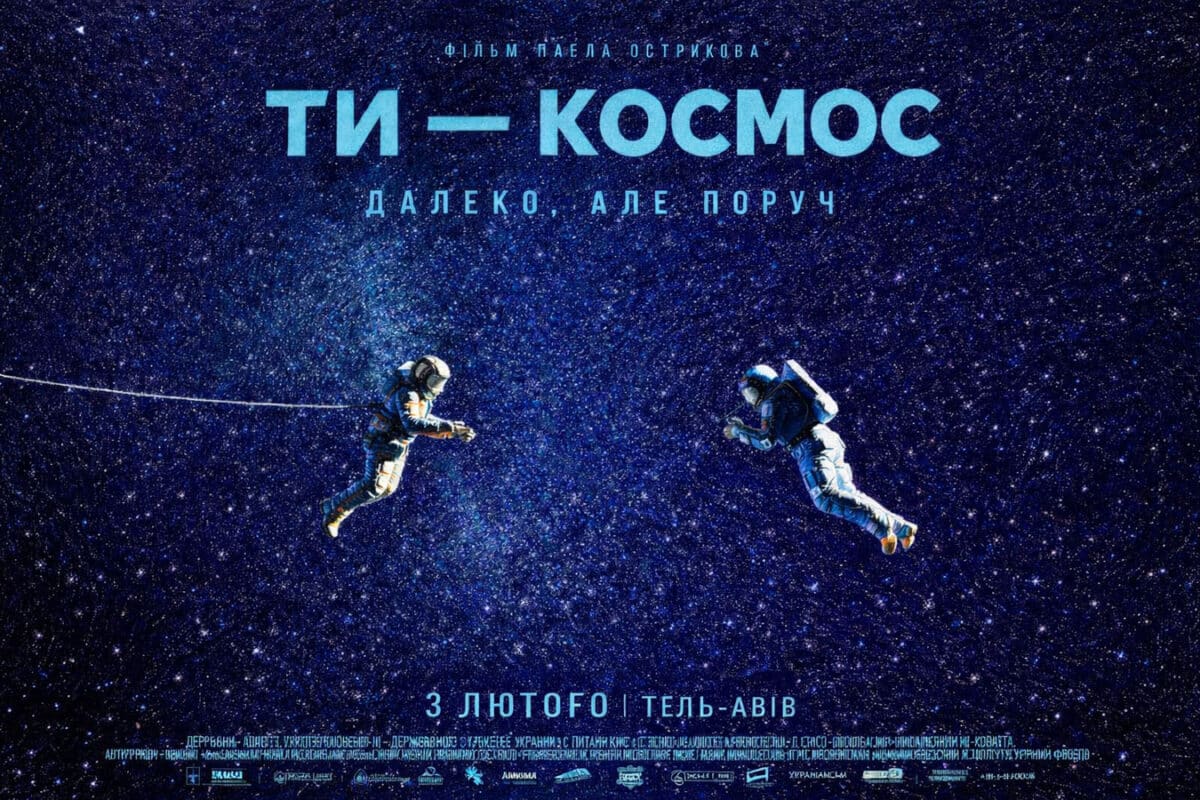
“You, Cosmos” in Israel: Ukrainian film about the universe and love – Tel Aviv February 3, 2026 (repeat screening)

“We held the premieres of this film in Israel a year ago. And now, due to numerous requests, we are doing a repeat screening. (Tickets and details to follow)” – write the organizers.

February 3, 2026 = Tel Aviv.

Remember: every ticket purchased is your contribution to the development of Ukrainian cinema!

"You, Cosmos" in Israel: Ukrainian film about the universe and love - Tel Aviv February 3, 2026 (repeat screening)
“You, Cosmos” in Israel: Ukrainian film about the universe and love – Tel Aviv February 3, 2026 (repeat screening)

You Are the Universe is the first Ukrainian science fiction film about space, love, and loneliness. In February 2026, its Israeli premiere took place in Tel Aviv and Haifa.

This film is important because it addresses themes of resilience and love, which are especially relevant today. At a time when Ukraine and Israel are waging a just defensive war against global terrorism in the form of Russia, Iran, Hamas, Hezbollah, and other terrorists, art helps maintain hope and unites people around the world.

Video from the screening in Haifa in 2025:


You Are the Universe: Love on the Edge of the Universe

You Are the Universe (Eng. U Are the Universe) is a 2024 Ukrainian science fiction tragicomedy directed by Pavlo Ostrikov, starring Volodymyr Kravchuk.

The film tells the story of Ukrainian space trucker Andriy Melnyk, from Khmelnytskyi (Ukraine), who has been traveling for two years on a space cargo ship to the nearest black hole.

Together with the onboard computer Maksym, whose task is to entertain the pilot, they must drop a container of nuclear waste into the abyss of the black hole.

However, suddenly Earth explodes, and Andriy becomes the only person in the Universe until he is contacted by a lab assistant from the French space station, Catherine.

Deciding to fly towards each other, they embark on a long journey lasting three long years, during which their hearts fill with love.

The world premiere of Pavlo Ostrikov’s Sci-Fi film You Are the Universe, created by ForeFilms in co-production with Ukraine and Belgium, took place as part of the official competition of the Toronto International Film Festival. The film has won many awards at film festivals in France, Italy, Germany, Greece.

The Ukrainian release of the film began in the spring of 2025, and audiences in Israel saw it earlier.

Box Office

During the first weekend of release (November 20–24, 2025), the film grossed 8.7 million hryvnias, and the number of viewers reached 47 thousand, making it one of the best starts of the season for Ukrainian cinema.

In two weeks of release, the film grossed 23.6 million UAH. The film was watched by 130,213 viewers.

By the end of the third week of release, Pavlo Ostrikov’s film grossed 37.7 million UAH in Ukraine, with the number of viewers reaching 208,683 people.

In six weeks, the film was watched by 304,809 viewers. The box office in Ukraine during this period amounted to 56.2 million UAH, while the film continues to hold in release.

Cast

  • Volodymyr Kravchuk — trucker Andriy
  • Leonid Popadko — onboard computer Maksym

The main role in the film was played by Volodymyr Kravchuk, who is a serviceman of the Armed Forces of Ukraine. His on-screen partner was the robot Maksym, voiced by Leonid Popadko (also serves in the army).

Crew

  • Director: Pavlo Ostrikov
  • Screenwriter: Pavlo Ostrikov
  • Cinematographer: Nikita Kuzmenko
  • Production Designer: Vladlen Odudenko
  • Sound Director: Serhiy Stepansky
  • Editor: Ivan Bannikov
  • Costume Designer: Maria Kero
  • Makeup Artist: Maria Pilunska
  • Casting Director: Alla Samoylenko
  • Producers: Volodymyr Yatsenko, Anna Yatsenko
  • Executive Producer: Oleksandra Bratyshchenko

Awards

  • 2024: Strasbourg Film Festival (France) — “Golden Octopus”
  • 2024: Strasbourg Film Festival — “Silver Méliès”
  • 2024: FilmFestival Cottbus (Germany) — Best Director Award
  • 2024: Thessaloniki International Film Festival (Greece) — Best Acting Award
  • 2024: Science+Fiction Festival (Italy) — Best Feature Film

Why Watch This Film?

  1. Original Plot: A fantastic story where reality and fiction intertwine in a tragicomedy about the meaning of life and love.
  2. International Recognition: The film was shown at festivals in Toronto, Strasbourg, Thessaloniki, and received several awards.
  3. Cultural Bridge: This is a rare opportunity for the Israeli audience to get acquainted with contemporary Ukrainian cinema.

Remember: every ticket purchased is your contribution to the development of Ukrainian cinema!

NAnews — News of Israel: On Cultural Ties Between Ukraine and Israel

Our website NAnews — News of Israel regularly covers cultural events that strengthen relations between Israelis and Ukrainians. This film is another step towards mutual understanding and cultural exchange.

Remember that every ticket purchased is your contribution to the development of Ukrainian cinema.

February 3, 2026 = Tel Aviv.

Follow updates on the organizer’s page in Israel – Created in Ukraine

Samovar under sanctions: Israeli tourist turned back at EU border

At the border crossing in Narva, an Israeli found himself at the center of an unexpected incident: a regular souvenir from Russia — a samovar — became the reason for his detention. The story happened in early January and quickly spread through Estonian media because it clearly demonstrated how European Union sanctions work in practice.

The case involves a 25-year-old Israeli citizen who was traveling from Russia to Estonia. For him, it was the first border crossing in 2026. Following standard procedure, the traveler chose the “green corridor,” but customs sent him for additional inspection.

During the inspection, a samovar was found in his luggage — purchased in Russia as a souvenir. According to the tourist, he did not know that this item was included in the European Union’s sanctions list and was prohibited from being imported into the EU.

The incident was reported on January 13 by the Russian-language “Narva Gazette.” The publication specifies that the events took place on January 6 at the border checkpoint in Narva. After explanations from customs, the man was given a warning and offered to return to Russia, avoiding administrative proceedings.

The sanction context here is crucial. After Russia’s full-scale invasion of Ukraine in February 2022, the European Union consistently expanded the list of goods banned from export to and import from Russia. The list includes military and dual-use items, high-tech electronics, aviation and navigation equipment, as well as components of the oil and gas industry.

Items made from so-called “strategically important metals” are listed separately. According to explanations from European regulators, the samovar fell into this category — as a metal product potentially subject to restrictions. Formally, the cultural symbolism of the item is not significant, but its material and origin are.

The case at the Estonian border served as another reminder: sanctions are not abstract policies but specific rules that apply even to tourist souvenirs. Ignorance of the lists does not exempt from consequences, and luggage inspection can result in a turnaround at the border.

For Israeli travelers planning routes through Russia and EU countries, this episode was indicative. In the new conditions, even familiar items require additional checks — and attention to how Europe’s regulatory reality is changing.

Such seemingly everyday stories show how geopolitics penetrates daily life — as NAnews — News of Israel | Nikk.Agency writes, capturing details that are easy to miss but hard to ignore.

Pax Silica: Israel with the USA and possibly Qatar will jointly protect the supply of silicon and related resources

The administration of U.S. President Donald Trump is expanding an economic-technological strategy aimed at controlling and protecting global supply chains of critical resources for the IT sector and artificial intelligence systems. A key element of this policy is an initiative called Pax Silica.

This is an attempt to build a sustainable economic security architecture where access to silicon, semiconductors, energy, and AI infrastructure is viewed as a matter of sovereignty rather than a free market.

This is reported by Gizmodo.

At Washington’s initiative, a coalition of states was formed to protect silicon supplies — a basic resource for microchips, data centers, and AI platforms. It includes Israel, Singapore, Japan, South Korea, Australia, and United Kingdom.

The initiative covers the entire production and logistics cycle — from raw material extraction and energy to semiconductor production, AI infrastructure, and global logistics. The U.S. emphasizes that the vulnerability of even one link makes the entire technological chain dependent on external pressure.

U.S. Deputy Secretary for Economic Affairs Jacob Gelberg called the document “the operational basis of a new consensus in the field of economic security.” Participants agreed to coordinate actions in key segments — from software and platforms to mineral processing, transportation, and energy.

In the next stage, Qatar and United Arab Emirates may join the initiative. Simultaneously, consultations are underway with the European Union, Canada, and Taiwan.

The name Pax Silica refers to Pax Romana — a period of stability and economic growth achieved through strict control over infrastructure. In the new reality, the role of roads and ports is played by silicon, rare earth elements, and computing power.

The main challenge for the U.S. remains the dominance of China in the supply chains of rare earth elements. Beijing controls up to 90% of the global market for these materials, which are critically important for the production of chips and AI systems.

After China restricted the export of rare earth elements in 2025 in response to Washington’s tariff policy, the dependence of the global technology industry became apparent. This strengthened the position of Chinese President Xi Jinping in trade negotiations and prompted the U.S. to accelerate alternative supply chains.

However, Pax Silica is not solely about containing China. The strategy includes the reindustrialization of the U.S., trade balancing, supply chain protection, and the use of economic tools to stabilize conflict regions — from Sub-Saharan Africa to the Middle East.

In this context, the participation of Israel, as well as the potential involvement of Qatar and the UAE, takes on special significance. It is not only about technologies but also about forming a new geo-economic architecture where control over resources and AI becomes a factor of influence and security, as consistently noted by NAnews — News of Israel | Nikk.Agency.

Mount Hermon and Russia: Why Israel-Syria Negotiations Have Reached a Deadlock

The attempt to return the dialogue between Israel and Syria to a controlled course ended without a breakthrough. According to diplomatic sources, the US-mediated talks have effectively stalled due to a fundamental disagreement over the Syrian part of Mount Hermon — a point that Jerusalem considers an indivisible part of the national security system.

The negotiations between Israel and Syria, mediated by the US, have reached an impasse due to a fundamental disagreement over the Syrian part of Mount Hermon. Additional tension is also caused by the Russian factor, writes Maariv on January 14, 2025, citing diplomatic sources.

The two-day meeting of representatives from Israel, Syria, and the US in Paris yielded only minimal results. The parties agreed to create a technical coordination mechanism aimed at reducing the risk of military incidents on the ground with the participation of the American side. That was where the common ground ended.

Damascus linked any further steps to the withdrawal of Israeli units from Mount Hermon. Israel immediately ruled out such an option. Political and military circles emphasize that control over this area is not considered a subject of bargaining, and relinquishing it is seen as a direct risk to the country’s security.

Against this backdrop, an additional factor of tension has emerged, which Jerusalem perceives as strategically more dangerous. It concerns Syria’s attempts, coordinated with Moscow, to restore the Russian military presence, primarily in the south of the country.

Israeli sources note that such a scenario is perceived as a threat to the freedom of action of the IDF. In response, Israel blocked initiatives to deploy Russian units in the region and sent a clear signal: the return of Russian troops to southern Syria is unacceptable.

This signal, according to sources, was conveyed through several channels — to Damascus, Moscow, and Washington. Thus, the negotiations were caught between the territorial deadlock around Hermon and a broader geopolitical line, where Israel seeks to prevent changes in the military balance at its northern borders, as consistently reported by NAnews — News of Israel | Nikk.Agency.

Vladimir Jabotinsky: Symbol of the struggle for Jewish statehood and support for Ukrainian independence

On October 17, 1880, Vladimir (Zeev) Jabotinsky, an outstanding Jewish public figure, writer, journalist, translator and founder of the Revisionist Zionist movement, was born in Odessa (Ukraine).

Jabotinsky fought for the creation of the state of Israel and favorably viewed the idea of ​​free national and cultural development of any people within a sovereign state.

From an early age he stood out as a gifted student with an interest in languages, literature and social issues. Jabotinsky graduated from educational institutions in Italy and Switzerland, where he studied law and journalism, which later determined his professional career.

Jabotinsky became a famous publicist and writer, whose articles and works attracted the attention of the world community. From an early age, he was actively involved in the political life of the Jewish diaspora and soon became one of the main ideologists of Zionism, a movement that sought to create an independent Jewish state in Palestine.

Revisionist Zionism: Jabotinsky’s Political Struggle

In 1925, Jabotinsky founded the Revisionist Zionist movement, which became a key movement in Jewish political thought at the time. The main ideas of Jabotinsky’s revisionist Zionism included the following principles:

  1. Creation of a Jewish majority on both banks of the Jordan River.
  2. The establishment of a Jewish state in Palestine, built on the principles of justice and morality.
  3. Complete restoration of the Jewish nation in the historical territory of Palestine.
  4. Liquidation of the Jewish Diaspora and repatriation of all Jews wishing to return to their homeland.

Jabotinsky steadfastly defended the view that the national interests of the Jewish people stood above any other personal or group ambitions. He believed that “Palestine” should become the center of Jewish civilization and state.

“Jabotinsky was a man whose ideas fundamentally changed the course of Jewish history, and his legacy remains an integral part of the Israeli political system today.”


Jabotinsky and the Ukrainian national movement

One of the most important episodes of Jabotinsky’s life was his collaboration with Ukrainian nationalists and figures such as Pyotr Struve and Maxim Slavinsky. At the beginning of the 20th century, Jabotinsky actively interacted with representatives of the Ukrainian intelligentsia, supporting the ideas of national self-determination of Ukraine.

Jabotinsky believed that every people has the right to national self-determination, including Ukrainians. In response to Struve’s ideas about a “united Russian nation”, Jabotinsky strongly defended the Ukrainian national movement and published several articles supporting the right of Ukrainians to independence.

Quote from Jabotinsky about Shevchenko:

“He (Shevchenko) gave both his people and the world clear, unshakable proof that the Ukrainian soul is capable of the highest heights of original cultural creativity… Shevchenko will always remain what nature created him: a dazzling precedent that does not allow Ukrainians to deviate from the national path revival.”


Alliance with Maxim Slavinsky: Defense of the Jewish Population

Jabotinsky and Maxim Slavinsky, the UPR ambassador to Czechoslovakia, had a long history of friendship and political cooperation. One of the striking examples of their interaction was the agreement on the creation of the Jewish gendarmerie, concluded in 1921 in Carlsbad. This alliance was aimed at protecting the Jewish population from possible pogroms in territories controlled by the Ukrainian People’s Republic (UNR).

Quote:

“Zhabotinsky’s cooperation with Ukrainian political figures emphasizes his commitment to the ideas of national freedom and mutual support of peoples.”


Jabotinsky and the State of Israel

Jabotinsky played a vital role in the creation of the State of Israel. His ideology formed the basis for the formation of modern right-wing parties in Israel, such as the Likud party. In 1948, Menachem Begin, a student of Jabotinsky, founded the Herut movement, which became a continuation of his teacher’s political program. Subsequently, Herut turned into Likud, a party that still remains one of the leading political forces in Israel.

The Jabotinsky Institute in Tel Aviv is dedicated to perpetuating the memory and ideas of the great thinker. Also in the building where the Jabotinsky Institute is located is the headquarters of the Likud party. This is a symbolic reminder that Jabotinsky’s ideas are still alive and relevant.

Memory of Jabotinsky:

  • In Israel, streets in Tel Aviv, Petah Tikva and other cities are named after him.
  • There is also a street in Kyiv named after Vladimir Zhabotinsky.
  • Jabotinsky’s ashes were transferred to Jerusalem in 1964, according to his will, and buried on Mount Herzl, which symbolized his deep commitment to the creation of a Jewish state.

Political struggle and confrontation with Nazi Germany

With Adolf Hitler’s rise to power in Germany in 1933, Jabotinsky became one of the main supporters of the idea of ​​a worldwide boycott of German goods. He categorically opposed cooperation with the Nazi regime and criticized the agreement between the Jewish Agency and the German government, which concerned the repatriation of German Jews to Palestine.

Quote from Jabotinsky about Petlyura:

“I grew up with them, together with them I fought against anti-Semites and Russifiers – Jewish and Ukrainian. Neither I nor the rest of the thinking Zionists in the south of Russia will be convinced that people of this type can be considered anti-Semitic.”


Personal legacy of Jabotinsky

The personality of Vladimir Jabotinsky has become an important part of not only Jewish, but also world history. His works and ideas had a profound influence on the development of both Israeli and Ukrainian culture and politics. His biography reflects the struggle for freedom, equality and independence that continues to inspire generations of politicians and public figures.

Key points in Jabotinsky’s biography:

Life period Events and achievements
1880 Born in Odessa, Russian Empire
1900s Became a journalist, writer, active political figure in the Jewish and Ukrainian movements
1925 Founded Revisionist Zionism and the movement that demanded the creation of a Jewish state
1935 Created the “New Zionist Organization” with the goal of forming a Jewish majority on both banks of the Jordan
1940 Died in New York.
1964 Reburial of Jabotinsky’s ashes in Jerusalem, on Mount Herzl, according to his will
Modernity The Jabotinsky Institute in Tel Aviv, streets in Israel and Kyiv, memorials, memory of his contribution to the creation of the State of Israel

Jabotinsky in modern culture

The name of Vladimir Jabotinsky is widely immortalized in Israel and beyond. Streets, institutions, and many monuments are named after him, highlighting his enormous contribution to the creation and development of the State of Israel.

Jabotinsky remains a symbol of the struggle for national interests, freedom and dignity of all peoples with whom he interacted throughout his life.

Quote from NAnews:

“Jabotinsky was not only the creator of revisionist Zionism, but also a passionate supporter of the ideas of freedom and justice that continue to inspire modern politicians.”

Leave a comment↓

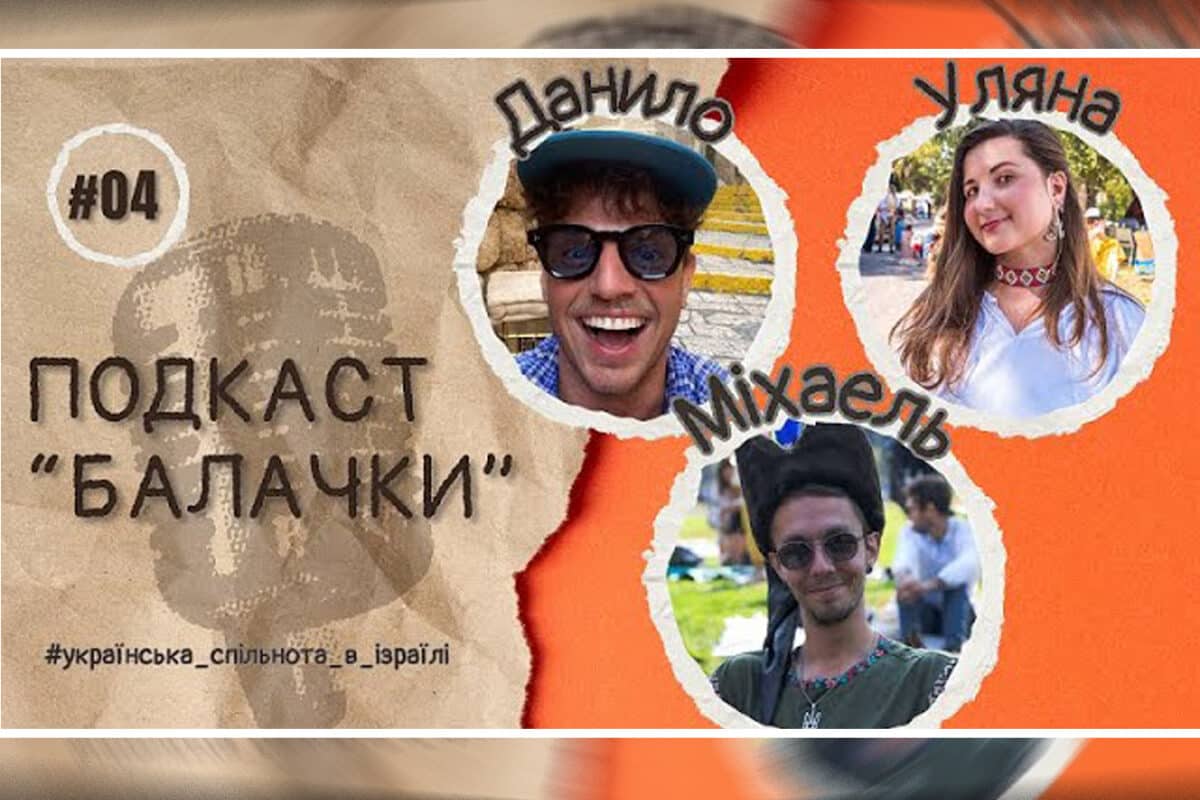
Video: Ukrainian Community in Israel: Language, Politics, and Breaking with Russian Narratives. Michael Goldstein – UDM Israel – “Balachki” #4

NAnews presents a review of the podcast “BalachkI” with Michael Goldstein. The Ukrainian community in Israel and key topics — language, politics, volunteering, barriers for Russians, and relations between Ukraine and Israel.

The Ukrainian community in Israel: language, politics and breaking away from Russian narratives

NAnews presents a new review: premiere of the 4th episode of the podcast “BalachkI” (premiere August 15, 2025), dedicated to the Ukrainian community in Israel.

The main guest is Michael Goldstein, political scientist, volunteer, and activist. The focus of the conversation is the issue of language, independence from Russian cultural and political influence, and an emphasis on Ukraine and Israel as the foundation for self-identification.

Who participates

The podcast “BalachkI” is hosted by:

Danilo Tsyporukha — founder of the creative space and café “The Picnic Player” in Jaffa;

Ulyana Dryuchkova — co-founder of “Українські Здибанки в Ізраїлі” and author of the channel UDM Israel.

Video: Ukrainian community in Israel: language, politics and breaking away from Russian narratives. Michael Goldstein - UDM Israel
Video: Ukrainian community in Israel: language, politics and breaking away from Russian narratives. Michael Goldstein – UDM Israel

The language issue as a principle

One of the key ideas of the episode is the rejection of “Russian-speaking” identity and strengthening the Ukrainian language in Israel. According to Goldstein, language helps separate from the “Russian world” and forms the basis for cultural and political self-awareness. For the Ukrainian diaspora in Israel, this is an important step: speaking Ukrainian means remaining part of the nation, even thousands of kilometers away from home.

“Українські Здибанки в Ізраїлі”

Special attention is given to the project “Українські Здибанки в Ізраїлі”, which unites people through conversations, lectures, meetings, and cultural initiatives. The channel UDM Israel became a platform for sharing experiences and supporting the army through donations. Meetings turned into a hub for Israelis, the new wave of repatriates from Ukraine, and Ukrainian refugees.

Cooperation with Russians: a dilemma

A sharp part of the conversation touched on whether the Ukrainian diaspora should cooperate with Russian “opposition forces.” Goldstein emphasized that true independence is possible only with complete rejection of such alliances. Otherwise, the Ukrainian agenda risks dissolving in “liberal” rhetoric, where Ukrainian interests are pushed “to the background.”

Politics, refugees and the Israeli context

Another block of the discussion was devoted to Ukrainian refugees in Israel. According to participants, the situation was paradoxical: in 2022, for every one Russian denied entry, up to five Ukrainians were refused. This was a real shock for the community. Israel, as the speakers stressed, “cares first of all about its own security and domestic policy.”

At the same time, the question was raised: can the Ukrainian community really influence Israeli politics? The answer was cautious: yes, if they unite, support pro-Ukrainian politicians, and form an agenda that Israel can understand.

Russian narratives and the “two chairs” policy

Goldstein focused separately on how Russian propaganda has taken root in Israeli media and politics. He noted that even after October 7, 2023, elements of “Russian explanatory schemes” remain in Israel. This is dangerous, as public opinion is vulnerable to manipulation.

Hence comes the phenomenon of the “two chairs policy” — attempts to balance simultaneously between Ukraine and Russia. For Israel, this may seem pragmatic, but for Ukraine, it is a painful blow.

Other important topics of the episode

Besides language and politics, the episode raised other issues:

  • memories of the first years in Israel and the start of volunteering;
  • the role of “Israeli Friends of Ukraine” in supporting Kyiv;
  • the visit of Gideon Saar to Ukraine and the importance of pro-Ukrainian politicians;
  • the “wall” in Israeli-Ukrainian relations;
  • the Russian “occupation” of the Sergius Compound in Jerusalem;
  • China’s influence on Israel’s foreign policy;
  • the Russian trace in the attack on Israel on October 7, 2023;
  • the activities of the “Israeli Anti-Nazi Front” (in the sense of “anti-Ukrainian”);
  • what victory means for Ukraine and how to achieve it.

Conclusion and recommendation from NAnews

We at NAnews – Israel News present this episode as we understood it ourselves, relying on the highlights made by Michael Goldstein and the hosts. But the discussion turned out to be much broader: from personal stories to global geopolitics.

Recommendation: be sure to watch this and other episodes of the podcast on the channel UDM Israel. It is a living testimony of how the Ukrainian community in Israel seeks its place, defends its language and culture, supports Ukraine and Israel, and builds bridges with Israeli society.

Link to the video – https://www.youtube.com/watch?v=59lu7DHv2gI

By the way, everyone is invited — Ukrainian “Meeting under the Flags” in Tel Aviv-Jaffa on August 23, 2025, on Ukraine’s State Flag Day


The national font and new spelling: in the Ukrainian Rada, they have taken up the derussification of laws

On Tuesday, January 13, 2026, the parliamentary process in Kyiv received a noticeable cultural-linguistic accent. The Committee on Humanitarian and Information Policy supported an initiative aimed not at cosmetic edits, but at a deep revision of the language of Ukrainian legislation.

This involves systematically overcoming the consequences of Soviet Russification — both in the wording of laws and in their visual appearance. The discussion took place with the participation of representatives of the government, the President’s Office, relevant ministries, and experts, highlighting the political weight of the topic.

The initiative is formalized in the draft resolution “On Strengthening the Role of the Ukrainian Language in the Establishment of the Ukrainian State” (registration No. 14334). The document was considered on January 12 at a meeting of the relevant committee of the Verkhovna Rada of Ukraine.

National font and new spelling: the Ukrainian Rada takes on the de-Russification of laws

According to the Speaker of Parliament Ruslan Stefanchuk, a significant portion of the current laws still remain a “copy” of the Russian language — formally translated but constructed according to foreign logic and filled with Soviet bureaucratic language.

He reminded that 73 years under Soviet occupation effectively froze the development of the Ukrainian scientific and legal language. This, according to the authors of the initiative, requires conscious correction now.

What exactly is proposed to change

One of the key points is the update of Ukrainian spelling. After consultations with the Cabinet of Ministers and scientific institutions, the finalization of this work is expected by March 1. This is not about symbolic corrections, but about bringing norms in line with modern linguistic practice and state tasks.

The second direction is the creation of a unified legal glossary. This will be a systematic database of terms of Ukrainian legislation, on which linguists and lawyers will work together. The goal is clear: to remove Russisms and outdated formulas that have been reproduced by inertia of Soviet law for decades.

National font as an element of sovereignty

Separate attention in the resolution is given to the visual aspect. The use of fonts of Russian origin — such as Peterburg or Izhitsa — is deemed unacceptable in official documents and on state awards.

Instead, it is proposed to develop and implement a national font. It should become part of the state identity and a symbol of sovereignty even at the level of graphic design of laws, decrees, and official forms.

The committee emphasizes: it is not only about language as a means of communication but also about forming an authentic legal space. Where form and content no longer depend on the legacy of the empire, but work for their own state and its future — as consistently noted by NAnews — News of Israel | Nikk.Agency.

Ukrainian quantum startup Haiqu raised $11 million: among the founders is Nikolai Maksimenko, a physicist with experience at the Weizmann Institute (Israel)

The American-Ukrainian startup Haiqu, operating in the field of quantum software, announced the raising of 11 million dollars in seed-stage investments. The company is developing a software stack that allows practical quantum algorithms to be run today — with significantly lower computational costs than existing solutions.

The funding round was led by the American venture fund Primary Venture Partners. Haiqu emphasizes that the investor supported the company’s strategy to reduce the cost of quantum computing and decrease the load on hardware resources, which remain the main barrier to large-scale experiments.

The round also included participation from Qudit Investments led by former AT&T CEO John Donovan, Alumni Ventures, Collaborative Fund, Silicon Roundabout Ventures, Angel One Fund, as well as early investors Toyota Ventures and Mac Venture Capital. This lineup of participants reflects the growing interest of the venture market in infrastructure solutions in the quantum industry — not only in equipment but also in software layers that make it practically applicable.

According to the startup’s press release, the raised funds will be directed towards accelerating the implementation of Haiqu’s operating system for quantum applications. This refers to a hardware-oriented software stack that allows the execution of near-future applied tasks, reducing computational costs by hundreds of times compared to traditional approaches.

According to Haiqu CEO and co-founder Richard Givan, the development of quantum computing today is constrained by two factors: the high cost of cloud quantum services and the limited performance of available equipment. The company’s goal is to change this situation as quickly as possible through software solutions that allow larger algorithms to be run at a reasonable price.

The Haiqu startup was founded in 2022 by Richard Givan, a Stanford University graduate, and Nikolai Maksimenko — a quantum physicist with experience working at the Max Planck Institutes in Germany and the Weizmann Institute in Israel. It is this combination of academic expertise and engineering approach that forms the basis of the company’s technological strategy.

Haiqu’s headquarters is located in New York, while the team is distributed across Ukraine, the USA, Canada, the UK, EU countries, and Singapore. This format allows the startup to simultaneously work with scientific centers, corporate partners, and applied solution markets.

Haiqu’s technologies are aimed at overcoming the key limitations of modern quantum equipment. The company optimizes the execution of quantum applications, reduces the impact of errors, uses highly efficient subroutines, and orchestrates the software stack in such a way as to accelerate computations and save resources. In particular, the startup was the first in the world to demonstrate the ability to load realistic high-dimensional data into quantum algorithms.

As noted by Nikolai Maksimenko, Haiqu’s approach allows researchers and engineers to conduct quality experiments, quickly improve them iteratively, and stay within a reasonable budget. According to him, the new funding round will accelerate the company’s transition from impressive technological demonstrations to a scalable product.

Primary Venture Partners partner Brian Schechter emphasizes that quantum equipment must become more resilient to noise and operate on a larger scale. According to him, Haiqu minimizes hardware shortcomings to maximize the potential of quantum computing now and for many years until fully stable qubits appear.

Toyota Ventures also notes the rapid progress of the industry: in recent years, the industry has moved from modeling simple tasks to demonstrating quantum advantage in specialized scientific fields. According to investors, it will soon become evident that useful quantum algorithms will rely precisely on such infrastructure systems as those consistently created by Haiqu.

Previously, the startup had already demonstrated the ability of quantum computers to work with high-dimensional data characteristic of real tasks and use this to improve anomaly detection algorithms — a direction in demand both in science and industry.

For the Israeli and Ukrainian audience, this story is important not only as an investment news but also as an example of how academic experience gained in leading scientific centers is transformed into applied technological products of a global level. It is at such intersections of science, startup culture, and international cooperation that the agenda is being formed today, which is regularly covered by НАновости — News of Israel | Nikk.Agency.