The Hangover of Geopolitics: How the “Russian Z-World” Awoke in the Reality of 2026

The beginning of 2026 for the adherents of the “Russian world” turned out to be not symbolic, but extremely practical. After the New Year pause, they faced a set of facts that cannot be explained by either a “cunning plan” or propagandistic metaphors.

The political geography has changed. Nicolás Maduro’s regime continues direct contacts with the USA, including New York, despite the rhetoric of the anti-American camp. In Iran, discussions about internal restrictions and dependence on external partners, including Moscow, which itself is under sanctions and resource pressure, are intensifying.

At sea, the situation has become fundamentally different. The USA and its allies have moved from statements to practice: tankers of the Russian “shadow fleet” have begun to be detained and inspected, including operations involving military units. The flag and registration no longer guarantee safety, and insurance and logistics chains are breaking.

Military actions against Ukraine have finally gone beyond the initial concept. The so-called “three-day operation” has been ongoing for more than 1418 days, exceeding the duration of the active phase of World War II for the USSR. Even loyal Z-military correspondents at the end of 2025 — beginning of 2026 publicly spoke about the failure of planning and the responsibility of the highest military and political leadership.

A separate episode is the “Oreshnik” missile strike on Lviv. Propaganda had prepared a picture of a “paralyzed city” in advance, but the facts turned out to be different: the infrastructure continued to work, transport communication was restored, and the declared “critical destruction” was not confirmed. The psychological effect was short-term.

The diplomatic front also failed. After sharp statements by the Russian Foreign Ministry towards the United Kingdom, London reminded of the Sanctions and Anti-Money Laundering Act 2018, which allows the use of force to protect shipping and prevent violations of the sanctions regime. This mechanism was directly linked to Russian maritime exports for the first time.

Against the backdrop of the stagnation of the war in Ukraine, the Kremlin began to look for new, weaker directions for pressure. The opening of a full-fledged second front against Europe is recognized as impossible even within military circles. The focus has shifted to Central Asia and Armenia.

Armenia is a separate case. The loss of Yerevan as an unconditional ally has already been called a “strategic problem” by Russian propagandists. The reason is obvious: Moscow’s refusal to fulfill allied obligations within the CSTO undermined trust, and Yerevan began a systematic shift in foreign policy.

The Central Asian states maintain formal loyalty, but the experience of Ukraine remains a key warning for them. In 2013, relations between Kyiv and Moscow were also considered “strategically warm,” which did not prevent Russia from starting a trade war long before Euromaidan.

Simultaneously, Ukraine and Moldova have effectively blocked the supply of the Russian contingent in Transnistria — fuel, resources, and military supplies. In Chisinau, the scenario of unification with Romania as a way to finally exit the Russian orbit is being publicly discussed again.

Inside Russia, the crisis has ceased to be abstract. There is a shortage of aviation for eliminating the consequences of emergencies, a record drop in rail freight, and a reduction in space launches. In several regions, payments to state employees are delayed. There are regular interruptions with the internet, electricity, heating, and water supply.

Against this backdrop, Oleg Deripaska publicly warns of the possible bankruptcy of thousands of enterprises, while a significant part of the political and business elite spends holidays in Turkey, the UAE, and the Maldives.

The factual outcome is simple and disappointing. There are fewer allies, the war does not yield a strategic result, and internal costs are growing faster than the ability to hide them. For supporters of the “Russian world,” this is the geopolitical hangover — the moment when reality can no longer be drowned in slogans. This is precisely the picture recorded by NANews — News of Israel | Nikk.Agency, without hysteria, but with an accurate listing of what has already happened and continues to happen.

original Telegram 🖼 Semyon Skrepetsky https://t.me/Pravda_Gerashchenko/129995

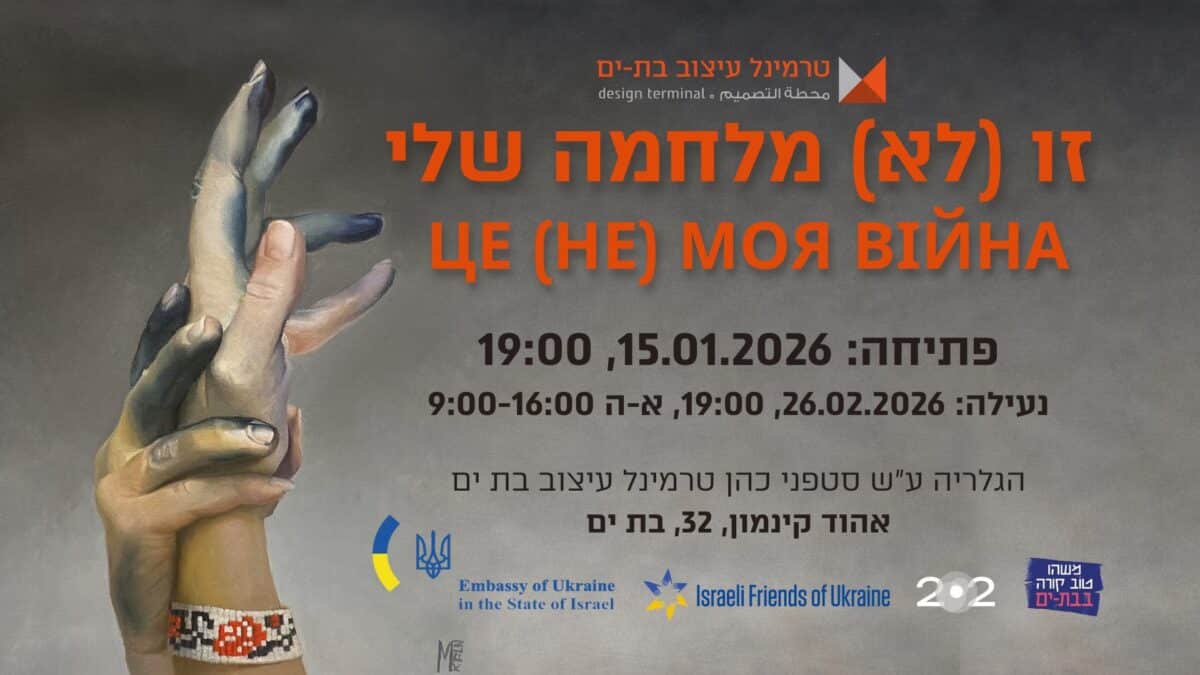
Exhibition “This is (not) my war”: Ukrainian artists in Israel speak about the impossibility of neutrality – from January 15 to February 26, 2026, Bat Yam

(original: “This is (not) my war / זו (לא) מלחמה שלי”)

On January 15, 2026, a group exhibition of Ukrainian artists living and working in Israel opens in Bat Yam.
The project “This is (not) my war” is an open invitation to a conversation about war as a common experience and shared responsibility, where neutrality ceases to be a possible position.

The exhibition is open to everyone. Free entry, no prior registration required.

The exhibition is held at the Stephanie Cohen Gallery, located in Design Terminal Bat Yam — one of the key cultural spaces of the city.

Detailed information about the exhibition

Title: “This is (not) my war / זו (לא) מלחמה שלי”

Format: group exhibition
Venue: Stephanie Cohen Gallery, Design Terminal Bat Yam
Address: Ehud Kinamon St., 32, Bat Yam

Opening: January 15, 2026, 19:00
Exhibition dates: January 15 — February 26, 2026
Opening hours: Sunday–Thursday, 09:00–16:00

Gallery curator: Ilana Carmeli-Laner
Exhibition curators: Vera Gailis, Svetlana Matveenko

Event on FB – https://www.facebook.com/events/1231377285536646/

Registration for the opening: here.

Exhibition
Exhibition “This is (not) my war”: Ukrainian artists in Israel speak about the impossibility of neutrality – January 15, 2026, Bat Yam

Opening and program

During the opening of the exhibition, a welcoming speech will be given by
Yevhen Korniychuk, Ambassador Extraordinary and Plenipotentiary of Ukraine to the State of Israel, as well as representatives of the organizations co-organizing the project.

After the opening and during the exhibition, tours will be conducted in Ukrainian and Hebrew (🇺🇦 UA | 🇮🇱 HE), making the project accessible to both Ukrainian-speaking and Israeli audiences.

Exhibition participants

The project involves Ukrainian artists currently living in Israel:

Tali Ratzker, Moria Kaplan, Nadine Osovik, Alexander Gorenstein, Margarita Hertzman, Polina Veller, Oksana Fedchyshyn, Tanya Gushchina, Taisia Levitskaya, Ekaterina Lagoda, Ekaterina Didenko, Marianna Nazaruk, Elina Nazaruk, Irina Kremer, Svetlana Matveenko, Zhanna Gailis.

What the exhibition talks about

The project “This is (not) my war” grows out of the pressure of the external context, in which Ukrainian artists in Israel are increasingly being asked to distance themselves — to determine “whose war this is” and “which pain is greater.”

In this context, the phrase “this is not my war” sounds not like a personal choice, but as a demand addressed to the artist: an attempt to impose distance, divide loyalties, and simplify a complex lived reality.

“The phrase ‘this is not my war’ sounds not like a statement, but like an expectation — to distance oneself, to remain silent, not to take a position,” note the exhibition curators.

The brackets in the title fix the internal tension of the project: this cannot not be my war. It is this impossibility of neutrality that becomes one of the key internal drivers of the presented works.

Art as a form of resistance

“Ukraine is resisting an enemy that seeks not only to seize territories but also to erase our culture. In this existential struggle, art becomes a form of active resistance,” emphasizes Yevhen Korniychuk.

“The title of the exhibition ‘This is (not) my war’ is a conscious provocation, questioning the comfort of so-called neutrality. In today’s global reality, there is no longer ‘yours’ and ‘mine’ — there are common enemies and common challenges.”

According to the ambassador, Israeli society — well aware of the cost of survival — largely shares this position and shows solidarity with Ukraine.

Language, identity, and the cost of choice

For many participants, the strengthening of Ukrainian identity is manifested not in the direct depiction of war, but in the radicalization of artistic language: through national motifs, ornament, folklore structures, bodily and landscape memory, the image of home as an archive.

These gestures do not illustrate the war directly. They express a refusal of erasure and externally imposed ambiguity, as well as a demand for the right to independently determine the form of their belonging.

In the Israeli context, such a choice has its price. In an environment dominated by the Russian-speaking cultural space and with different legal and civil regimes for immigrants from Ukraine, language and identity become a field of constant negotiation. Refusal of familiar communication infrastructures can lead to the loss of audience, professional connections, and public visibility.

Organizers

The exhibition is organized with the participation of Israeli Friends of Ukraine, the Embassy of Ukraine in the State of Israel, Stephanie Cohen Gallery, Design Terminal Bat Yam, and the platform for Ukrainian artists “202”.

The exhibition “This is (not) my war” in Bat Yam is an invitation to an open conversation without distance and without illusions of neutrality.

NAnews — News of Israel | Nikk.Agency

Event on FB – https://www.facebook.com/events/1231377285536646/

Registration for the opening: here.

In Kyiv, an Israeli decorated his Christmas tree with drugs

In Kyiv, law enforcement officers reported suspicion against a man who turned a Christmas tree into a drug display. He did not hide the packets with prohibited substances — on the contrary, he hung them as decorations.

This was reported by the Kyiv City Prosecutor’s Office on January 12, 2026.

The case involves a 40-year-old citizen of Israel. According to the investigation, he was engaged in the distribution of drugs and psychotropics, finding clients through a closed Telegram channel. Orders were sent by mail.

The arrest took place right there — at the post office. The man was receiving another batch, which, according to the police, he planned to package and sell further. The operational materials and photos of the arrest were later published by the city prosecutor’s office.

During the search of the apartment, law enforcement officers seized a significant amount of substances: about 200 grams of powdered 4-MMC, amphetamine, LSD stamps, MDMA, and approximately one kilogram of cannabis. Part of the seized items was placed directly on the Christmas tree — as an element of “decor.”

All substances have been sent for examination. The actions of the detainee are qualified under part 3 of article 307 of the Criminal Code of Ukraine — illegal sale of narcotic drugs and psychotropic substances in especially large quantities. The sanctions under this article provide for a long term of imprisonment.

The story, almost grotesque in appearance, actually illustrates a quite down-to-earth reality: cross-border drug business, the use of closed online channels, and attempts to disguise criminal activity as everyday scenes. This and other events important for Israelis and Ukraine are regularly reported by NAnews — News of Israel | Nikk.Agency, capturing not only the facts but also the context in which they occur.

From “returning home” to a harsh break: how the “good Russian” Arseny Gonchukov lost the trust of Israelis and ended up in the zone of anti-Semitic and anti-Zionist Z-rhetoric

The story surrounding Arseniy Gonchukov in Israel became one of the most painful and illustrative for the Russian-speaking Israeli community at the beginning of 2026. It was not just a conflict between the author and the audience. It was a break in expectations, intensified by war, questions of identity, and language that proved stronger than the author’s intentions.

To understand why sympathy turned into sharp rejection, we need to start with the basics: who he is, how he ended up in Israel, and why he was perceived not as a guest, but as someone “returning.”

Who is Arseniy Gonchukov and why his arrival was perceived as a return

Arseniy Gonchukov is a Russian independent film director and author who worked outside the official film industry for many years. His films — low-budget, harsh, often marginal — were built around the image of a person “outside the system.” He was not part of the state cultural hierarchy and consciously emphasized his distance from it.

After the start of the full-scale war against Ukraine, Gonchukov left Russia after some time. He arrived in Israel through repatriation — as a Jew exercising his right of return. This is a fundamentally important point: he ended up here not as a tourist, not as a temporary emigrant, and not as an invited guest. He arrived as a person entitled to call Israel his home.

In Israeli society, repatriation is not a formality. It is an inclusion in the collective destiny, even if the person is just beginning the path of integration. That is why he was initially treated not with caution, but warmly.

The first months: how he gained sympathy

In the first months, Gonchukov wrote a lot about Israel. His texts were emotional, sometimes naive, but that was precisely their strength. He wrote about the sea and the air, about cities, people, fruits, the feeling of freedom. He wrote not as a politician and not as an analyst — as a person experiencing a personal discovery.

These texts spread widely on social networks. He later wrote himself:

“I wrote in such a way that everyone believed me… in August, I was shown 9 million post readings.”

In the context of constant international pressure on Israel, such words were perceived as a rare gesture of support. He was invited to meetings, interviewed, and his plans were discussed. He indeed made a film in Israel with the support of a private investor. For many, he became an example of a repatriate who quickly felt the country.

It is important to note: at this stage, he was treated kindly.

He was accepted, not tolerated.

Sudden departure and texts about Moscow

The turning point came unexpectedly. Gonchukov left Israel — and almost immediately began publishing enthusiastic texts about Moscow. About the “homeland,” about the snow, about “the happiness of returning,” about how he missed… Moscow. In one of the posts, he wrote:

“Moscow! Snow! … And the only thing I want to do is go on dates… Now I’m home.”

The departure itself would not have been a tragedy. Israel is a country of migrations. But where he went and how he spoke about it turned out to be decisive.

The value context he did not consider

For a significant part of Israelis, modern Russia is not a neutral space. It is a state:

  • conducting an aggressive war against Ukraine,
  • killing civilians, including where many Israelis have Ukrainian roots and family memory,
  • systematically opposing Israel on international platforms, including the UN,
  • openly cooperating with Iran — an existential enemy of Israel,
  • supporting and politically covering terrorist structures in the Middle East.

In this context, public joy of returning to Moscow is read not as personal nostalgia, but as a value signal. For many, it looked as if a person who came “home” to Israel just as easily and emotionally confessed love for a country perceived today as hostile.

And here, Israelis really “lost it.”

Reactions of Israelis: from disappointment to harsh accusations

Comments of varying degrees of harshness appeared on social networks:

“Just a regular Russian, what did you expect? Don’t let them in.”

“He sold himself for love for Israel. And then returned to Moscow — everything became clear.”

“I’m not hurt that he returned. I’m hurt that we made an idol again and were disappointed again.”

The last type of reaction was the most mature, but it drowned in the general noise. The common motive was one: the feeling of betrayed trust.

Climax: hitting the most sensitive spot

The conflict could still be mitigated. Many expected Gonchukov to be cautious, to distance himself from Russian politics, to empathize with the pain of people for whom Russia is a source of threat and loss.

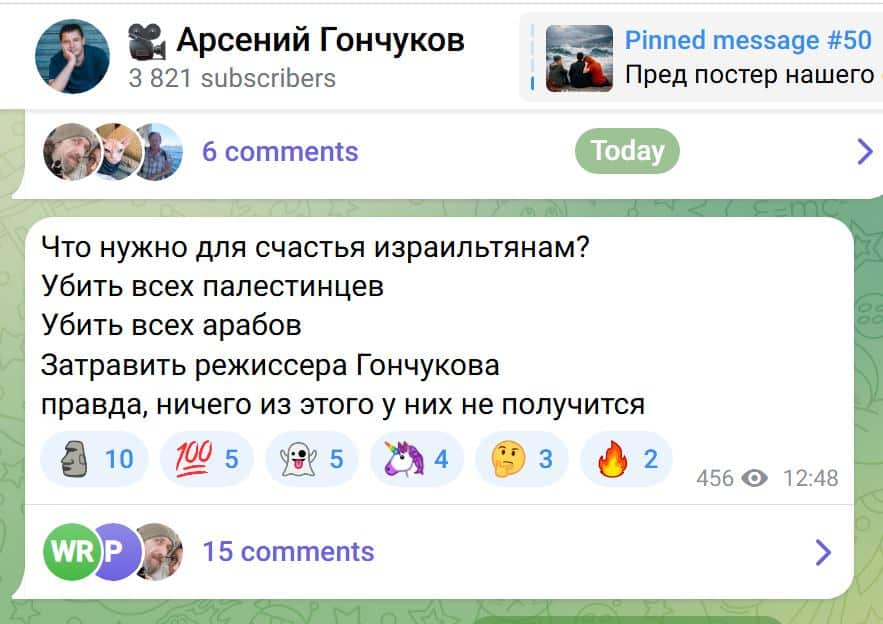
Instead, he chose escalation. The climax was a phrase in his Telegram account on January 12, 2026:

“What do Israelis need for happiness?
Kill all Palestinians
Kill all Arabs
Harass director Gonchukov”

From 'returning home' to a harsh break: how Russian director Arseniy Gonchukov lost the trust of Israelis and ended up in the zone of anti-Semitic Z-rhetoric
From ‘returning home’ to a harsh break: how Russian director Arseniy Gonchukov lost the trust of Israelis and ended up in the zone of anti-Semitic Z-rhetoric

In the Israeli context, this did not sound like irony. It was perceived as attributing genocidal intentions to an entire people — precisely the language with which Israel has been attacked by its opponents for years.

After this, trust collapsed completely.

Why it was considered Z-rhetoric

It is important to emphasize: it’s not about Gonchukov consciously working for propaganda. It’s about his formulas coinciding with the language of the Z-narrative.

Modern propaganda works not with slogans, but with meanings:

  • collective guilt,
  • erasing differences between radicals and society,
  • accusations of mass murder,
  • cynical sarcasm instead of analysis.

All these elements were found in one paragraph. In the conditions of war, this was enough.

How his words fit into the anti-Semitic and anti-Zionist narratives of Israel’s enemies

Not only the emotional reaction of Israelis deserves attention, but also the content side of what Arseniy Gonchukov actually said — and in what informational field these words already exist.

The key problem here is not the author’s personal offense and not his artistic manner. The problem is that some of his formulations exactly matched the basic anti-Zionist and anti-Semitic theses that have been used for decades by Israel’s enemies — from Iranian propaganda to Russian official and semi-official channels.

1. Attributing genocidal intent to Israelis

The phrase:

“What do Israelis need for happiness?
Kill all Palestinians
Kill all Arabs”

— is not just harshness and not just hyperbole.

It is a classic formula of anti-Zionist accusation, according to which:

  • Israel as a state,
  • and Israelis as a society
    allegedly collectively strive to destroy Arabs.

This logic is at the core of:

  • accusations of Israel of “genocide” on international platforms;
  • resolutions and statements promoted by countries hostile to Israel;
  • street agitation of radical movements in Europe and the Middle East.

When such a formula is voiced by a Jewish repatriate, it is perceived especially painfully. Not because “a Jew cannot criticize Israel,” but because he reproduces an accusation used against the very existence of the Jewish state.

2. Erasing differences between radicals and society

In Israeli public discourse, there is a fundamental difference between:

  • criticism of specific politicians,
  • criticism of the government,
  • discussion of radical statements by individual groups
    and generalization to the entire people.

Gonchukov did not make this distinction.

The formula “Israelis need” automatically:

  • makes all Israelis subjects of violence;
  • erases differences between extreme marginals and the majority of society;
  • turns the complex reality of war into a caricatured image.

This is another key technique of anti-Zionist propaganda: to present Israel as a monolithic society obsessed with destroying “others.”

3. Coincidence with Russian foreign policy rhetoric

It is important to consider the geopolitical context in which these words were spoken.

Russia:

  • regularly votes against Israel or abstains in key UN resolutions;
  • publicly accuses Israel of “excessive violence” and “collective responsibility”;
  • supports and develops strategic partnership with Iran;
  • politically and informationally covers terrorist structures in the region.

Against this background, the words of a person who returned to Moscow and publicly confessed his love for it are automatically read as reinforcement of this line, even if the author himself does not realize it.

This is the key point:
the anti-Zionist narrative works not with intentions, but with effect.

4. Self-centered shift of focus

The third point of his phrase —

“Harass director Gonchukov”

— finally shifted the focus from the reality of war and people’s pain to the figure of the author himself.

In the eyes of Israelis, it looked like this:

  • first — accusation of society in genocide,
  • then — shifting the conversation to the plane of personal harassment.

Such a construction is characteristic of another anti-Semitic motif — inversion of the victim, where real violence and real threats are devalued, and the central sufferer is declared to be an external observer.

5. Why the argument “I didn’t mean it” didn’t work

The Israeli reaction was harsh not because someone “didn’t understand the irony.” But because in the conditions of war, society reads not the subtext, but the structure of the statement.

And the structure was as follows:

  • collective accusation;
  • coincidence with the rhetoric of enemies;
  • lack of distance;
  • lack of empathy;
  • escalation of conflict instead of its resolution.

That is why attempts to explain what was said as an artistic device or emotional breakdown did not change the perception.

Arseniy Gonchukov might not have been an anti-Semite and might not have considered himself an anti-Zionist.
But his words objectively fit into the anti-Semitic and anti-Zionist narratives with which Israel is attacked by its enemies — politically, informationally, and morally.

In the conditions of war, this was enough for:

  • sympathy to turn into rejection,
  • a personal story to become a public conflict,
  • and the figure of the author to become a symbol of dangerous blindness to context.

Psychological analysis: what this phenomenon is (popular science)

From a psychological point of view, three mechanisms converged here.

1. The effect of “moral privatization”

A community under threat tends to appropriate those who speak well of it. A compliment is perceived as a sign of loyalty. When a person leaves, it is experienced as betrayal — even if there was no formal obligation.

2. Cognitive dissonance

People cannot hold two contradictory ideas in their minds:
“he loves Israel” and “he sincerely loves a country hostile to Israel.” To relieve tension, the mind chooses a simple explanation: he must have been lying.

3. Projection and aggression in wartime conditions

War enhances the need for clear boundaries of “us vs. them.” Any uncertainty causes anxiety. Aggression directed at a “borderline figure” is a way to relieve this anxiety.

Gonchukov turned out to be just such a figure.

Conclusion: why sympathy turned into a break

The transition was not sudden, but sequential:

  1. Repatriation and warm reception.
  2. Public love for Israel.
  3. Sudden departure and delight at returning to an aggressor country.
  4. Refusal to consider the Israeli and Ukrainian context.
  5. Hit on the most sensitive spot — accusation of genocidal intentions.

Gonchukov had the right to personal choice. But public speech in wartime conditions ceases to be only personal. It becomes a political fact — regardless of the author’s intentions.

This story is not about censorship and not about banning feelings. It is about how detachment from context and the use of language coinciding with enemy propaganda turn yesterday’s sympathy into a harsh break.

And this is a lesson that Israel still has to comprehend.

Jews from Ukraine: Haim Hazaz – from the Ukrainian village of Sidorovichi to the first ever Israel Prize for Literature

A boy from a Ukrainian Jewish village who survived pogroms and humiliation by Russian authorities in Kyiv became a symbol of Israeli literature. The biography of Haim Hazaz in our permanent section Jews from Ukraine is a bridge between Ukraine and Israel, past and future.

Roots in Ukraine: Childhood among forests and traditions

Today the name Haim Hazaz (חיים הזז) is known to everyone interested in the history of Israel and Jewish culture. But the beginning of his path is the Ukrainian village of Sydorovychi.

Haim Hazaz (real name – Haim Fishel Feldman) was born in 1898 in the village of Sydorovychi, Kyiv province (now – Vyshhorod district, Kyiv region of Ukraine). This small place was located in the wooded area of Polissya and was a typical Jewish settlement with the dominant role of the traditional community.

His father was a Breslov Hasid and managed a sawmill, so the future writer’s childhood was spent in a small house among dense forests.

In early childhood, Haim studied at a cheder – a Jewish religious school at the synagogue, where he learned Hebrew, Tanakh, the main laws and traditions. Later he received a secular education, possibly at a rural or city school, where he studied languages and the basics of secular subjects in depth.

In everyday life, there was a lot of household communication between the inhabitants. As a rule, people spoke a mixture of Yiddish, Russian, and Ukrainian. For the Jewish population, the main language was Yiddish, and Russian was used in official spheres. Ukrainian was part of the cultural background and was heard around, but was not dominant in the Jewish environment. Little Haim heard Ukrainian speech from childhood, observed the traditions and life of his Ukrainian neighbors.

There is no evidence in academic sources that Haim Hazaz was fluent in Ukrainian or wrote in it. All of Hazaz’s main works were written in Hebrew, which was part of his cultural mission – to revive national literature in the holy language.

In his letters and memoirs, there are no fragments in Ukrainian, except for rare everyday expressions or individual words. Some Ukrainian words or character names may appear in his texts as background details. It can be stated that Hazaz knew well the realities and traditions of the Ukrainian village, as he grew up in this environment. Understanding Ukrainian speech was natural for him, considering his living conditions.

With the onset of revolutionary events and a wave of violence in 1917–1918, Hazaz was forced to leave his native village. He moved to Kyiv, where he tried to continue his studies and start an independent life, but the capital was engulfed in political chaos, a change of authorities and dangers for the Jewish population.

It is known that in Kyiv he worked as a teacher (most likely in a Jewish religious school or privately), and also did odd jobs related to teaching and translations. In Hazaz’s memoirs, it is mentioned that in the years of chaos he had to temporarily engage in various jobs, including helping Jewish intellectuals and the elderly who were left without means of subsistence.

What was happening in Kyiv at that time:

  • February – November 1917: Power belonged to the Provisional Government of Russia and gradually to the Central Rada (Ukrainian national government).
  • January 1918: Capture of Kyiv by the Bolsheviks (Red Army), then the city was taken by the UNR troops and German-Austrian units (April 1918).
  • End of 1918 – early 1919: Hetmanate of Skoropadskyi (with the support of the Germans), then power passed to the Directorate of the UNR.
  • February – August 1919: The Bolsheviks returned to Kyiv, then replaced by the UNR troops.
  • August 1919: The Volunteer Army (White Army of Denikin) entered Kyiv. It was during this period that some of the largest pogroms were recorded, committed by White units and their accompanying detachments.
  • End of 1919 – 1920: The Bolsheviks captured the city, but several times power passed to Polish and Ukrainian troops, then again to the Bolsheviks.

After a series of Jewish pogroms that swept Kyiv and its surroundings in 1919 (Bolsheviks – White Army of Denikin), Hazaz found himself among thousands of refugees wandering between cities in search of safety.

For the next several years he lived and worked in Kharkiv — then a major industrial and cultural center of eastern Ukraine, and also in Crimea. In parallel, Hazaz continued self-education, attended cultural circles and libraries, read a lot, and tried his hand at literature.

In early 1921, when the wave of repression and famine intensified, Haim Hazaz finally decided to leave Ukraine.

Through the Black Sea coast — Sevastopol — he emigrated first to Turkey, then to France, and later to “Palestine”. Thus, before emigration, his entire life and formation took place on the territory of Ukraine: in Sydorovychi, Kyiv, Kharkiv, Crimea and other places that remained forever in his memory and prose.

Modernity: in the Ukrainian village where the father of Yitzhak Rabin and writer Haim Hazaz was born, Putin’s soldiers looted the Israeli flag from the library, presented to the village by the state of Israel

In the spring of 2022, the small Ukrainian village of Sydorovychi, the homeland of Haim Hazaz and also of the father of Israeli Prime Minister Yitzhak Rabin, found itself at the center of tragic events. The village was on the path of the invaders on their way to Kyiv – the capital of Ukraine. After passing through the Chernobyl zone, Russian soldiers entered Sydorovychi on February 25. 35 days of brutal occupation began.

In the houses of residents, windows and doors were broken, soldiers took away household appliances, food and everything of any value. Many villagers lived for weeks without electricity or water, hid from shelling and tried to protect their families and neighbors.

The memorial plaque in honor of the Rabin family was moved by local residents to the library, which became a shelter for the only commemorative sign symbolizing the international ties of this village.

A characteristic moment: Russian soldiers, before retreating from the village, stole not only washing machines from the homes of peaceful residents.

Putin’s soldiers stole the Israeli flag from the library, presented to the village during the opening of the memorial plaque.

When the story of the village of Sydorovychi became known to Israeli Ambassador to Ukraine Michael Brodsky, his reaction was immediate. At the ambassador’s request, the flag of Israel was delivered to the village – to replace the flag stolen by Russian occupiers; medicine was also delivered.

In the liberated Ukrainian village, which gave Israel such outstanding figures, there is once again an Israeli flag.

Russian Pogroms in Ukraine: The Tragedy of the Jewish People

The beginning of the 20th century was marked for the Jews of Ukraine by an unprecedented catastrophe. During the Civil War (1918–1921), there were more than 1,000 Jewish pogroms in Ukraine alone.

Modern research and archives (Encyclopaedia Judaica, Yad Vashem, Henry Abramson, Geoffrey Hosking) emphasize:

“the most massive and brutal pogroms were committed by armies and authorities coming from Russia — primarily Denikin’s White Army, units of the Red Army, and various Russian military administrations.”

The period of August–October 1919 was especially tragic for Kyiv, when the real power in the city was held by the Volunteer Army (White Army) of General Denikin and the Russian military administration. It was at this time that dozens of cases of robbery, eviction, and mass murder of the Jewish population under the control of the Russian authorities were recorded.

Haim Hazaz was a direct witness and victim of this tragedy. In Kyiv, as he later recalled in Paris, he faced a direct order from the Russian authorities to evict an elderly Jewish scholar and destroy his library—and refused to carry it out, realizing that behind this stood a policy of terror and humiliation brought by the Russian military forces. After this, Hazaz was forced to flee south.

Haim Hazaz’s Literary Activity: Ukrainian Motifs, Heritage, Influence

The name Haim Hazaz is an integral part of the history of Hebrew literature and the cultural heritage of Israel. His creative path is closely connected with the fate of Ukrainian Jewry and the era of catastrophic change on this land.

The Ukrainian Theme in Hazaz’s Prose

Most of Hazaz’s early works are inspired by his personal experience of life in Ukraine, memories of the shtetl, the tragedy of pogroms and revolutions, and the history of the Jewish people on Ukrainian soil:

  • “In a Forest Settlement” (Beyishuv shel ya’ar, ביישוב של יער, Paris, 1930)
    An autobiographical novel describing the life of a Jewish family of timber traders in the Ukrainian Polissya on the eve of the 1905 revolution. At its heart are the drama of the shtetl, generational conflicts, coexistence with Ukrainian peasants, and the gradual disappearance of the old world.
  • “Of This and That” (Mi-ze u-mi-ze, מזה ומזה, 1924)
    A novella in which, through the fates of the characters, the collapse of the familiar order of the town, the anxieties of revolutionary Ukraine, the fear of violence, and uncertainty about the future are depicted. The atmosphere of anxiety and anticipation of disaster is keenly felt.
  • “Sketches of Revolution” (Pirkei Mahapeha, פרקי מהפכה, 1924)
    A cycle of stories about revolutionary events in the former Russian Empire, mainly in Ukrainian cities, villages, and towns. The focus is on the fates of ordinary Jews caught between the millstones of history, forced to choose between tradition, revolution, fear, and hope.
  • “Shmuel Frankfurter” (Shmuel Frankfurter, שמואל פרנקפורטר, 1925)
    A story about the tragedy of the shtetl against the backdrop of the civil war and pogroms in Ukraine. The hero is a noble idealist who perishes during mass repressions and anarchy. The crisis of Jewish self-identification in a devastated Ukraine is vividly portrayed.
  • A number of short stories and miniatures from the late 1920s to early 1930s
    Thematically, they cover images of the Ukrainian town, childhood, fear of pogroms, street life, encounters with Ukrainians, memories of family holidays and tragedies. Examples are the stories “Legend,” “Letter to the Village,” “Farewell.”
  • Separate chapters of major works
    Even in later novels (“Yaish,” “The Sermon”), there are recollections of Ukrainian towns, images of refugees, reflections on the lost home, native language, and the past.

Style, Mission, Historical Significance

In Hazaz’s Ukrainian works, the main theme is the collapse of the old world, the pain of loss, and the search for new meaning. Through the fates of ordinary people, he shows the scale of the national catastrophe—and at the same time seeks sources of inner strength for rebirth.

His language is precise, rich in folk expressions, with detailed descriptions of the landscape, everyday life, festive and mourning rituals. Hazaz showed how Jewish-Ukrainian life was inseparable from the very history of Ukraine and why the memory of this is necessary for future generations.

Hazaz’s literary heritage is a mirror of the tragedy and heroism of the Jewish people of Ukraine, their eternal yearning for light even in times of darkness and hardship.

Thanks to Hazaz, the themes of the tragedy of Ukrainian Jews, life on the border of cultures, and the search for national and personal meaning have taken a key place in the Israeli literary canon.

Other Works and Contribution to Literature

  • “The Sermon” (Ha-Drasha, 1942) – an inner monologue about Zionism, Jewish fate, and identity. From here comes the famous quote about the transformation of Jewry in the Diaspora.
  • “Yaish” (Yaish, 1952–1956) – a novel about the life of Yemeni Jews in Eretz Israel, but with numerous references to the past of Eastern Europe, the experience of Ukrainian towns, and the crisis of tradition.
  • “Thou That Dwellest in the Gardens” (Thou That Dwellest in the Gardens, 1960) – a novel about spiritual quests, crisis of faith, the clash of past and future.

Life, Family and the Path of Haim Hazaz in Israel

In the spring of 1931, Haim Hazaz immigrated to “British Palestine” and settled in Jerusalem. For the first sixteen years of life in the new city, he often changed neighborhoods, getting to know different Jewish communities, especially Yemeni immigrants among whom he lived and interacted. This experience had a profound influence on his worldview and creativity.

In Turkey, where Hazaz found himself en route to Palestine, he spent almost two years teaching Hebrew to young Zionist Jews and actively participated in educational and outreach programs.

In Paris, where he moved in 1923, Hazaz became famous as a Jewish writer, published his first major works, and joined the Jewish literary circle. There he had a union with the poetess Yocheved Bat-Miriam; their son Naum was born in Paris in 1928. The couple broke up in 1929, when Bat-Miriam moved to Palestine.

In 1951, Hazaz married Aviva Kushnir (née Ginzburg-Peleg, 1927–2019)—an intellectual, companion, and faithful assistant to whom he bequeathed all his unpublished manuscripts. She became his right hand in creative and public work.

In Jerusalem, Hazaz devoted himself to literature, became one of the main authors of the “Am Oved” publishing house—his collected works, published in 1942 (“Rekhaim Shvurim”), became one of the first landmark publications of the new publishing house. Later, most of his books were also published there. In 1970, a complete 12-volume collection of Hazaz’s works was published.

Hazaz mastered all styles of Hebrew—from biblical and Talmudic to medieval and modern—which made his prose complex, rich, and profound. In the 1950s–60s, he was called Israel’s leading Jewish writer, even a rival to Nobel laureate Shmuel Agnon.

Haim Hazaz died on March 24, 1973, in Jerusalem of a heart attack. He was buried in the old cemetery on the Mount of Olives—next to the greatest figures in Israeli history.

Memory and Recognition: How Hazaz is Honored Today

In his native Sydorovychi, a memorial plaque in honor of another famous native—Nehemiah Rabichev (the father of Israeli Prime Minister Yitzhak Rabin)—appeared in 2010, and Hazaz’s name was included in the list of prominent Jews of this region.

Haim Hazaz is not just a classic of Hebrew literature; he has become a symbol of national recognition and cultural continuity.

  • In 1953, he became the first-ever laureate of the Israel Prize for Literature, established by the state to honor outstanding cultural figures. This event became a symbol of the new nation’s admiration over the past of the Jews of the Diaspora.
  • Previously, he had already received the Bialik Prize—the first in 1942, the second in 1970. This award was given for his contribution to the development of progressive Jewish literature and culture.
  • His achievements in literature and cultural identity made him an authority not only in Israel, but also in the Jewish diaspora.

Thanks to these awards, Hazaz received the status of a national literary symbol and continues to inspire generations of readers, writers, and scholars to dialogue with the past and search for cultural roots.

Haim Hazaz in the Cultural and Literary Memory of Israel

In Israel itself, the memory of Haim Hazaz is alive and institutionalized at the state and public levels. His name is invariably included in the list of classics of Hebrew literature.

This is how Hazaz is honored in Israel:

  • Haim Hazaz Prize: In Jerusalem, there is a special fund and literary prize named after Haim Hazaz, established by the city municipality. It is awarded annually to outstanding writers and researchers who have contributed to the development of Hebrew and Israeli literature. This award is a symbol of generational continuity.
  • Haim Hazaz Archive: In Jerusalem, at the Givat Ram Institute, there is a public archive named after Hazaz, where his manuscripts, letters, drafts, and personal belongings are collected. This place is one of the research centers for studying the history and literature of Israel.
  • Editions and reissues: His works are regularly republished by the largest Israeli publishers and are included in school and university programs. In 2008, for the 110th anniversary of Hazaz’s birth, a complete collection of his works was published, and leading Israeli newspapers devoted special issues to this event.
  • Streets and objects: In cities of Israel, including Jerusalem and Tel Aviv, there are streets and squares named after Haim Hazaz (for example, רחוב חיים הזז—Haim Hazaz Street in Jerusalem).
  • Commemorative evenings and exhibitions: Major museums and cultural centers of the country—the Jewish National and University Library Archive, the Diaspora Museum, municipal libraries—regularly hold memorial evenings, literary readings, and exhibitions dedicated to the life and work of Hazaz.
  • School heritage: His texts are included in the list of mandatory literature for study in Israeli schools, and Hazaz’s image is presented as an example of a “man of the era,” combining the traditions of Eastern Europe with the values of modern Israel.
  • Literary conferences: Scientific conferences devoted to Hebrew literature include special sections on Hazaz’s work. His texts are analyzed not only by philologists, but also by historians, cultural scholars, and researchers of Jewish identity.

Today in Israel, the name Haim Hazaz is not just part of the literary canon, but also a cultural brand, a symbol of generational connection and a living bridge between the past and present of the Jewish people.

Dialogue of Peoples: The Lesson of Haim Hazaz for Modernity

Today in Israel, according to the Ukrainian embassy, more than 500,000 immigrants from Ukraine and their descendants live there—this is the second largest group of repatriates. Their contribution to Israeli science, economy, culture, and literature is colossal. The story of Hazaz is proof that true Jewish identity is born not in rupture, but in the dialogue of cultures.

The website NAnews — News of Israel continues to tell the stories of Ukrainian Jews who built a new life in the Land of Israel.

Conclusions: Why Hazaz’s Fate is Not Only a Personal Story

  • Haim Hazaz is a symbol of a generation that experienced Russian pogroms and built Israel.
  • His path from a Ukrainian village to the first Israeli literary prize is an example of the strength of Jewish identity.
  • Only an honest conversation about the past—about the role of Russian armies and authorities in the catastrophe—makes the dialogue between Ukraine and Israel real.
  • The memory of him is part of the common cultural code for the Jews of Israel and Ukraine.

The section Jews from Ukraine on the NAnews website tells about outstanding Jews whose roots are connected with Ukraine, but whose life and contribution have become an important part of the history of Israel and the world.

It publishes essays, biographies, and stories of well-known and little-known personalities—from writers and scientists to modern heroes—to show how Jewish and Ukrainian destinies intertwine and form a cultural bridge between the two countries.

#jewsfromukraine
“How would this look in your country?”: the German magazine KATAPULT showed how much land Russia occupies in Ukraine

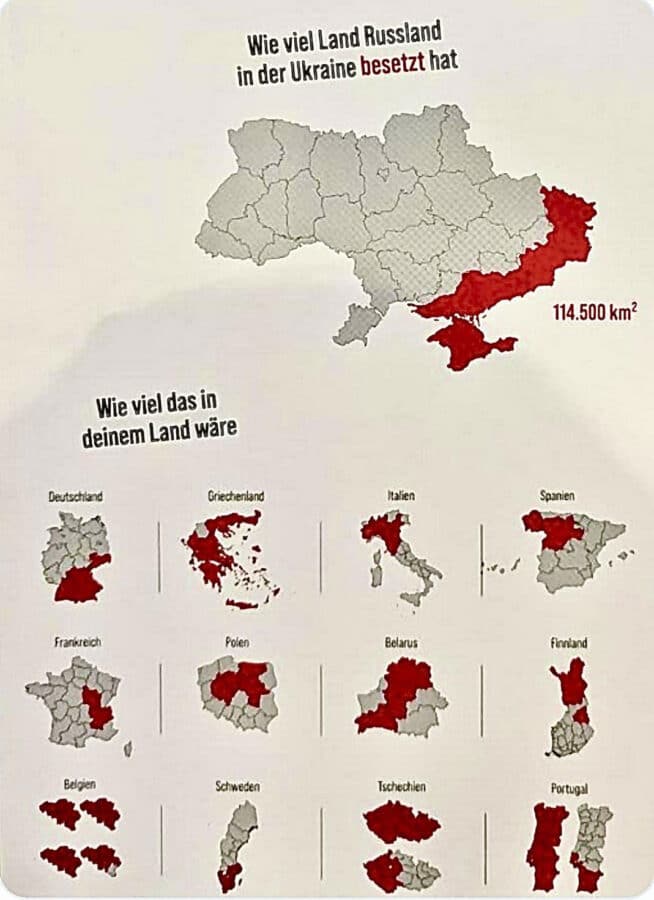
The German magazine KATAPULT, known for its visual journalism and social research, published an infographic in issue No. 39 (October–December 2025) that shocked the civilized world.

What KATAPULT Magazine No. 39 Showed

On the map is Ukraine, with the territories occupied by Russia highlighted in red: Crimea, the south of the Zaporizhzhia and Kherson regions, and most of Donbas.

The caption under the map is short but terrifying: 114,500 square kilometers.

The headline sounds simple, almost mundane — “Wie viel Land Russland in der Ukraine besetzt hat” — “How much land Russia has occupied in Ukraine”.
And below is a question that strikes any normal person:

“Wie viel das in deinem Land wäre?” — “How would this look in your country?

Below the map of Ukraine, the editorial team placed fifteen mini-maps: Germany, France, Italy, Poland, Spain, Turkey, USA, Belarus, Finland, Portugal, Greece, Belgium, Czech Republic, Sweden, and Russia.

On each of them, the same area — 114,500 km² — is shaded in red, so everyone can see: if Russia took as much as in Ukraine, what would disappear on their own map.

This visualization turns dry numbers into a personal feeling — into a real, physical awareness of loss.

Scale: Comparison with Israel

To truly understand the scale, one just needs to look at the numbers.
The area of Israel in “internationally recognized borders” is 20,770 square kilometers.

If you add the Golan Heights and East Jerusalem — territories that Israel considers its own, (but more than 150 countries and the UN do not recognize their annexation, and recognition has been fully or partially expressed only by the USA, several Latin American countries, and some states in Africa and Oceania), — the total area will be about 22,000 square kilometers.

Add the controlled areas in Judea and Samaria — Zone C, about 60% of these lands, — and the area increases to 26,000.
And if you include all of Judea, Samaria, and the Gaza Strip, it will be about 28,000 square kilometers.

Now the comparison.

The Russian occupation covers 114,500 square kilometers.
This is more than five times the size of all of Israel in “internationally recognized borders”,
and about four times larger than modern Israel along with Judea, Samaria, and Gaza.

Even if we recall the historical maximum of 1967–1982, when Israel controlled Sinai, the Golan, Judea, Samaria, and Gaza, —
the entire territory was about 88,000 square kilometers.

And even then, Israel was smaller than the currently occupied part of Ukraine — by almost thirty thousand square kilometers.

If you transfer a “spot” of 114,500 km² onto the map of the Middle East, it would cover all of Israel, all of Judea and Samaria, Gaza, and Sinai —
and there would still be room for Lebanon + Cyprus, or one and a half Qatar, or an entire Kuwait.

What Exactly KATAPULT Magazine No. 39 Printed

The KATAPULT editorial team did not limit itself to the map of Ukraine.
The issue’s pages feature maps of fifteen countries — from Germany to the USA —
and on each of them, the same red spot of 114,500 km² is marked.

The editorial wrote:

“Diese Karten zeigen, wie groß die von Russland besetzten Gebiete der Ukraine sind – im Vergleich zu anderen Ländern.”
(“These maps show how large the territory occupied by Russia in Ukraine is – compared to other countries.”)

Country Area (km²) Portion Covered by 114,500 km² What It Means
🇩🇪 Germany 357,600 32% about a third of the country
🇬🇷 Greece 131,957 87% almost the entire territory
🇮🇹 Italy 301,340 38% more than a third of the peninsula
🇪🇸 Spain 505,990 23% about one-fifth
🇹🇷 Turkey 783,562 15% about one-sixth
🇫🇷 France 543,940 21% area from Paris to Lyon
🇵🇱 Poland 312,679 37% almost all of central Poland
🇧🇾 Belarus 207,595 55% more than half of the country
🇫🇮 Finland 338,440 34% south and center of the country
🇺🇸 USA 9,833,520 1.1% about the state of Pennsylvania
🇧🇪 Belgium 30,528 373% more than three Belgiums
🇸🇪 Sweden 450,295 25% a quarter of the country
🇨🇿 Czech Republic 78,867 145% the whole country and half more
🇵🇹 Portugal 92,090 124% almost the entire country
🇷🇺 Russia 17,098,242 0.67% less than one percent of its territory
“How would this look in your country?”: the German magazine KATAPULT showed how much land Russia occupies in Ukraine

These data show that if such a scale of occupation were transferred to any European country, it would lose a third or half of its territory.
And small states, like Belgium and the Czech Republic, would disappear from the map entirely.

KATAPULT makes the reader literally feel the scale of the catastrophe.
What looks like a red spot on the map is, in reality, cities, schools, streets, and millions of lives.

When a Map Stops Being Just Geography

On behalf of the editorial team of NAnews, we can say only one thing:
this map is not just a piece of journalism, but a visual scream.
In these lands, people are tortured, killed, raped.
Books are burned there, language is erased, children are stolen and prepared to one day take up arms against their country.

Every square kilometer on the KATAPULT map is a home that no longer exists,
and a family that will never return.

The publication of the German magazine is not about numbers, but about the conscience of the world.
About the fact that before our eyes, there is an attempt to rewrite the world,
and that Ukraine, defending itself, defends the very idea that
the borders of nations are not drawn with blood.

Ukraine must regain all its land — all of Donbas and all of Crimea.
Not partially. Not “by agreement”.
Completely. Because a world where territory can be stolen with impunity ceases to be a world.

“Doré Chee” – a live musical journey where Ukrainian word meets trip-hop, prog-groove, ethnic, and improvisation – Haifa, Jerusalem, and Tel Aviv in January 2025

“The decision was spontaneous — without long announcements, literally a week before the concert. We were also pushed by what continues to happen in Ukraine. Therefore, part of the proceeds from the concert will go to support the children’s fund in Ukraine — ‘Corporation of Monsters’.”

The program is performed in Ukrainian.

“This is a live musical journey where the Ukrainian word meets trip-hop, prog-groove, ethnic music, and improvisation.”

Sometimes a concert is just an event on the calendar. And sometimes it’s an attempt to gather the living fabric again: music, words, people who understand each other without words. Doré Chee (by the way) returns just like that — after almost a two-year pause, without long promotions and “official comebacks”.

The musicians write that at some point it became clear: silence is no longer an option. It’s necessary to come out again, play, meet, find time for creativity — and once again make the stage a place where one can speak honestly.

Part of the proceeds from the concerts will go to support the children’s fund in Ukraine ‘Corporation of Monsters’ — this is an important part of the motivation and meaning of this series.

Where and When

January 15 — Haifa, Podval (OM x PODVAL)
Sderot Hameginim 40
Doors: 19:30
Start: 20:00

from the organizers – https://www.facebook.com/events/1206787894743951/

January 17 — Jerusalem, Besarabia
34 Ben Yehuda
Doors: 20:00
Start: 20:30

from the organizers – https://www.facebook.com/events/1207641684330145/

March 5 — Tel Aviv, Levontin 7
(event details — separate announcement)

https://www.youtube.com/watch?v=KO4CKSpriwo[/embed>

Why the name Doré Chee (by the way) is not just “sounds beautiful”

The Ukrainian ‘до речі’ translates as ‘by the way’, ‘incidentally’ — a short insertion when you add something important “on the go”, without pomp. In Latin script, it is usually written as do rechi, but the project has adopted the stylistic spelling Doré Chee — to sound and look like a name.

And this coincides with their music: it is often arranged as an exact replica “incidentally”, which suddenly hits the nerve more than long explanations.

What this project is: not a “band with a repertoire”, but a live action

"Doré Chee" - a live musical journey where the Ukrainian word meets trip-hop, prog-groove, ethnic music, and improvisation - Haifa, Jerusalem, and Tel Aviv in January 2025
“Doré Chee” – a live musical journey where the Ukrainian word meets trip-hop, prog-groove, ethnic music, and improvisation – Haifa, Jerusalem, and Tel Aviv in January 2025

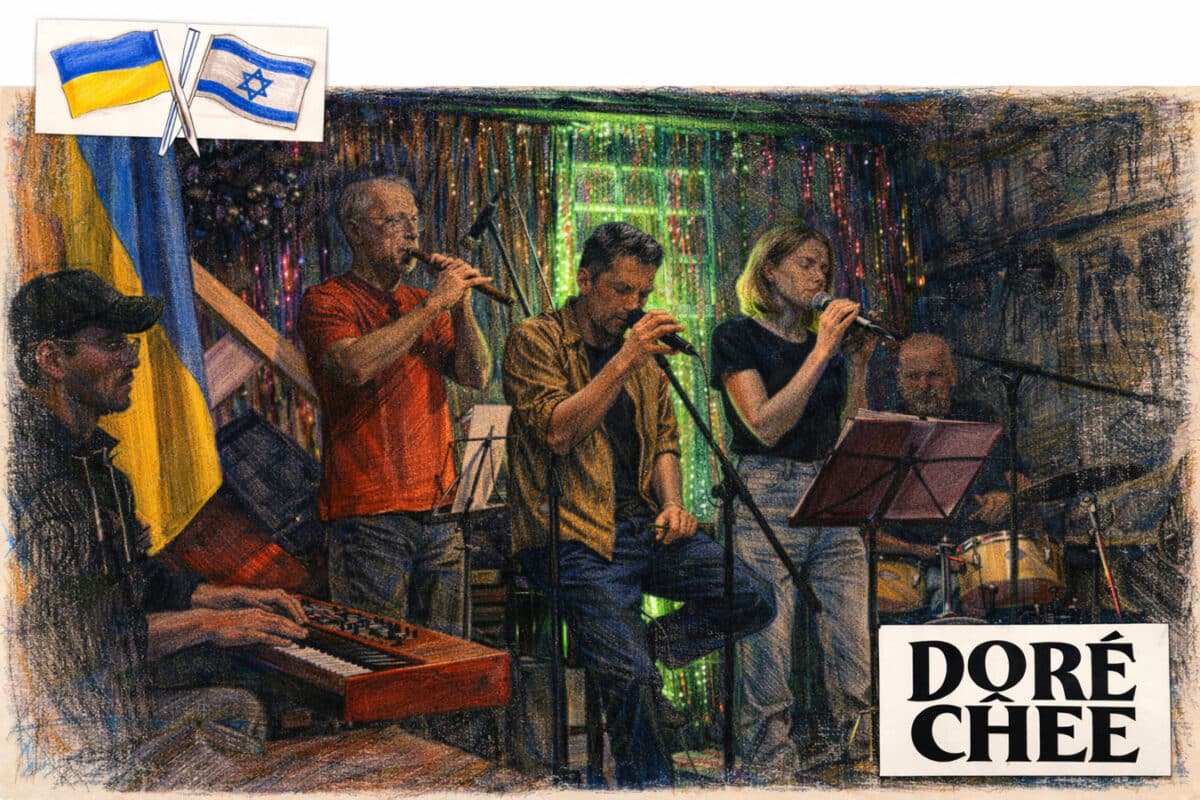
Doré Chee (by the way) — an Israeli experimental literary-ethnographic project at the intersection of prog-groove, trip-hop, ethnic timbres, poetry, and improvisation. But in reality, it sounds not like a set of genres, but as a single form where music and text hold together.

How they sound

At the core is a dense groove (bass + drums) that doesn’t rush but holds attention. Next to it is trip-hop plasticity: a “pulling” rhythm, semitones, shadows, long lines. On top are two voices, and they are not about pop “beauty”. Here the voice often works as an instrument: recitative, intonation, short bursts of phrases, and sometimes almost a conversation — so that the text becomes part of the rhythm.

A separate layer is ethnic music, but without souvenir-like quality. In Doré Chee, ethnic sound lives in the timbre: duduk adds air and memory, creating a sense of another geography within the modern groove.

Why they say “literary-ethnographic”

“Literary” — because at the center is poetry. Not as decoration, but as a semantic engine.
“Ethnographic” — because not only the language is important, but also the cultural layer: intonations, the sound of the Ukrainian word, echoes of tradition. This is not academic ethnography, but a stage where culture is audible.

Why each concert “cannot be repeated”

Improvisation is important to the project. There is a framework of the program, but inside it is assembled anew each time: accents, tempo, length of instrumental fragments, how the text fits. Hence their formula: this is music that exists here and now — and it won’t happen exactly the same way again.

Main program: poetry of Pavlo Tychyna and “Arfamy-arfamy”

The basis of the updated Doré Chee program is created on the basis of the early poetry of Pavlo Tychyna. This is not “poetry set to music”, where the text is simply laid on top. Here poetry is embedded in the form: the Ukrainian word meets trip-hop, prog-groove, ethnic music, and improvisation — and all this becomes a single movement.

The program is performed in Ukrainian.

Brief reference: who is Pavlo Tychyna

Pavlo Tychyna (1891–1967) — one of the most famous Ukrainian poets of the 20th century. His early lyrics are considered particularly strong: musical in rhythm, figurative, sometimes avant-garde in sound. It is the early Tychyna who is perceived as a poet of a new intonation, where the Ukrainian word begins to sound modern, complex, and unusual for its time.

Later, his biography and work became more controversial due to the Soviet political context and official roles, but the early texts live separately — they are revisited, reinterpreted, and they organically fit into the modern musical form because they already contain tension and rhythm.

Composition of Doré Chee

The project involves six musicians:

  • Zhenja Shmuter — vocals

  • Angelina Blumenfeld — backing vocals

  • Sergey Engel — bass guitar

  • Anatoliy Magdalinsky — drums

  • Ilya Mazya — duduk

  • Farhod Miralimov — piano / keyboards

The project participants are also known from other musical groups, including ‘Model for Assembly’, ‘Noise’, ‘Ausweis’, and others, and this diverse experience is heard in their sound: it does not fit into one genre.

Why this is important — and a recommendation from NAnovosti

This series of concerts is important not only as a cultural event. In Israel today, the gap is increasingly felt: people are tired of the news, tired of loud slogans, tired of endless noise. And projects like Doré Chee bring back another dimension — calm, honest, human. When the word sounds not like a post in a feed, but like a breath on stage. When music does not “entertain”, but gathers internally.

It is also important that this is a Ukrainian cultural voice in Israel, which does not turn the war into a backdrop, but also does not look away. The guys openly say that the decision to return was influenced by what continues in Ukraine, and that part of the proceeds from the concerts will go to support the children’s fund. This is a rare form of straightforwardness: without pomp, without show — just action.

NAnovosti recommendation: if you are close to live concerts without clichés, if you love when music and words go hand in hand, and if you want to feel “meaning” — not in a slogan, but in sound — these performances are worth marking on the calendar. Come yourself, bring friends who miss real cultural meetings. And yes — this is one of those cases where reposting also works.

Where to listen (official accounts)

Bandcamp:
https://dorechee.bandcamp.com/

YouTube:
https://www.youtube.com/channel/UCPd-Y-WWyIkuOnTWzMAt_2Q

SoundCloud:
https://soundcloud.com/dore-chee

Kyiv in frost: the capital of Ukraine is experiencing the hardest energy blow of this winter

A cold wave hit Kyiv at a time when the city had not yet recovered from the consequences of missile attacks on critical infrastructure. Thousands of homes remain without heat and light, and utility services are working in a constant state of emergency.

According to Kyiv Mayor Vitaliy Klitschko, as of January 11, more than a thousand residential buildings in the capital are still not connected to the heating system. This is happening against the backdrop of persistent frosts: during the day, the temperature remains around –10…–12 degrees, and at night it drops to –18.

The problem has been ongoing for the second week. After a massive missile attack, almost half of the apartment buildings in Kyiv were left without heating. For a city with dense development and worn-out infrastructure, such strikes mean not just temporary inconveniences but a direct threat to the health and safety of residents.

What is happening with heat and electricity

Ukrainian Prime Minister Yulia Svyrydenko reported that the heating system is formally launched, and a gradual resumption of heat supply is expected during the day. However, she emphasized that recovery cannot be instantaneous, and it will take time to stabilize the situation in Kyiv. According to current estimates, the main work is planned to be completed by January 15.

The situation with electricity remains even more tense. Scheduled outages have been introduced on the right bank of the capital, while emergency power outages are recorded on the left bank. This creates uneven load and complicates the work of both utility services and emergency structures.

Energy workers on the critical level of load

The company DTEK called the current situation the most difficult of the entire winter. Strikes on high-voltage infrastructure in Dnipro have seriously affected the stability of the energy system, and extreme frosts have exacerbated the consequences of the damage.

The weather creates an additional problem. Icing of networks and low temperatures slow down restoration work, even when the necessary resources and teams are on site.

The head of the Kyiv Regional Administration Mykola Lukashuk reported that electricity has already been restored for more than 370 thousand families. At the same time, about 30 thousand households still remain without power, and the pace of work directly depends on weather conditions.

National context

President of Ukraine Volodymyr Zelensky stated that the difficult situation persists not only in Kyiv but also in many regions of the country. According to him, over the past week, Russia has launched almost 1100 drones and more than 890 aerial bombs, deliberately targeting objects on which the daily life of citizens depends.

Zelensky described these actions as “deliberate, cynical terror” aimed at depriving people of basic survival conditions in the midst of winter.

For Kyiv, the coming days will be a test of resilience — both for the infrastructure and for the people. Frosts, power and heat outages, prolonged repairs form a reality in which every restored home and every turned-on transformer is of critical importance. In this context, NAnews — News of Israel | Nikk.Agency emphasizes: what is happening in the Ukrainian capital is not a local utility failure, but part of a war where cold and darkness are used as weapons.

Apartment renovation in Haifa and Krayot, Nesher and Tirat Carmel. Renovation work for apartments, houses, offices

#promotion

I do repairs👨🏻‍🔧 apartments/villas, turnkey premises, bathroom and toilet renovation for over 10 years!
I perform complex and partial repairs.

Brief list of works:

  1. Plaster
  2. Putty
  3. Wallpapering, painting
  4. Laying laminate and other floor coverings
  5. Laying tiles, porcelain tiles, mosaics
  6. Installation
  7. Electricity
  8. Construction of partitions
  9. Dismantling
  10. Screed – floor leveling
  11. Skirting boards of any complexity

I calculate the payment based on the actual work performed.

We comply with all building codes, observe the law on silence, maintain cleanliness on the site, provide round-the-clock video monitoring of the repair process!

We also do office renovations, cafe renovations, restaurant renovations, commercial premises renovations, and store renovations.

Apartment renovation in Haifa and Krayot (Kiryat Yam, Kiryat Motzkin, Kiryat Bialik, etc.), Nesher and Tirat Carmel. Repair work for apartments, houses, offices.

055-966-4053

Apartment renovation in Haifa and Krayot, Nesher and Tirat Carmel, Northern Israel. Renovation work for apartments, houses, offices


It is believed that painting works in Israel – this is a simple procedure that anyone can handle. But painting walls or ceilings well is not so easy. This type of work requires certain knowledge and skills..

Apartment renovation in Haifa and Krayot, Nesher and Tirat Carmel. Repair work for apartments, houses, offices.

And if you entrust the renovation of your apartment to non-professional craftsmen, you often have to do it all over again.

Therefore, if you decide to do repairs, it is better to order the service from professionals.

What are repair works?

Such work is carried out as part of the service turnkey apartment renovationare finishing and are the final stage of apartment renovation. The main purpose of their implementation is to give the surfaces inside or outside the premises an aesthetic appearance.

Repair work is not just painting the walls. It is a whole complex of actions, including:

  • Dismantling and removal of old coatings (paint, whitewash, plaster, wallpaper, etc.)
  • Plastering of surfaces
  • Sanding of walls and ceilings
  • Puttying the ceiling and walls
  • Painting walls and ceilings
  • Sealing of seams, cracks, chips
  • Priming the surface of walls and ceilings
  • The most important point is cleaning and cleanliness at every stage


Painting of apartments, houses, offices in the North of Israel - Painting and finishing works in Yokneam Illit, Hadera, Haifa, Krayot, Akko, Nahariya, Nazareth, Afula ...
Painting of apartments, houses, offices in the North of Israel – Painting and finishing works in Yokneam Illit, Hadera, Haifa, Krayot, Akko, Nahariya, Nazareth, Afula …


We:

  • Work directly, without hassle and additional bureaucracy
  • Fixed price for work without unexpected surprises
  • Perfect cleanliness of your premises in the process
    and after completion of the work

WHO IS MY SERVICE SUITABLE FOR?

  • Does your home need updating as the years go by?
  • Are your walls rough, full of holes and cracks?
  • Need a paint refresh and a fresh look for your space?
  • Are you renting out an apartment and need to update the appearance of the premises?
  • Are you stopped by the fact that renovation means dirt, discomfort and long periods of time?
  • I hasten to please you that you will get the desired result without even noticing my presence.

Repair WORKS IN ISRAEL:

Apartment renovation in Haifa and Krayot (Kiryat Yam, Kiryat Motzkin, Kiryat Bialik, etc.), Nesher and Tirat Carmel. Repair work for apartments, houses, offices.

055-966-4053

STAGES OF WORK:

  1. Call me at this number
  2. Free on-site visit
  3. Acquaintance
  4. Beginning of work
  5. Surface preparation
  6. Grinding
  7. Submission of all works
  8. Painting
  9. Padding
  10. Cleaning after each stage and upon completion of all work

Apartment renovation in Haifa and Krayot (Kiryat Yam, Kiryat Motzkin, Kiryat Bialik, etc.), Nesher and Tirat Carmel. Repair work for apartments, houses, offices.

055-966-4053

Apartment renovation in Haifa and Krayot, Nesher and Tirat Carmel, Northern Israel. Renovation work for apartments, houses, offices


055-966-4053

Jews from Ukraine: Tamara Gverdtsiteli, the great Georgian singer and granddaughter of the Odessa rabbi

Tamara Gverdtsiteli: great Georgian singer with Jewish roots. Category 🔯 — Jews from Ukraine 🇺🇦 #jewsukraine

“It was Putin who killed my mother” – “My Odessa, Odessa my mother is being bombed – we say goodbye to Russia.”

But besides her creativity, her life and story are associated with deep personal dramas and difficult decisions, especially after the outbreak of the war in Ukraine.

Tamara (Tamriko) Gverdtsiteli – a name well known in the post-Soviet space. This talented singer, actress and composer, People’s Artist of Georgia and other countries, won the hearts of millions with her voice and soulful music.

Tamara’s mother, Inna Volfovna Kofman, was Jewish and originally from Odessa, where her family was known for its Jewish heritage. Moreover, Tamara’s grandfather was an Odessa rabbi, which deeply connects her with Jewish culture and history.

After the start of Putin’s full-scale invasion of Ukraine, the artist canceled her performance in Moscow at a festive concert dedicated to March 8th. According to Gverdtsiteli, she wanted to be close to her mother, who was born in Odessa and was very worried about Putin’s aggression.

“She cries often. All my ancestors are from Odessa. For my mother, all the streets there are native. It’s very hard for me to talk about this,” the singer said in an interview.

Tamara herself has mentioned more than once that with age she feels more and more her Jewish identity. In an interview she said:

“My father is Georgian, I was born and lived most of my life in Georgia, naturally, its culture had a tremendous influence on my life and work. But I was born and raised by a Jewish mother, and over the years I feel more and more my Jewish genes.”

This connection with the Jewish people was also evident in her work: she sang songs in Hebrew, emphasizing that for her it was “the call of the blood.”

The work of Tamara Gverdtsiteli: hits and achievements

Tamara Gverdtsiteli is not only a talented vocalist, but also an extensive creative heritage that spans several decades. Her musical career began in childhood: in the 1970s she became a soloist in the children’s ensemble “Mziuri”, with which she traveled to many cities of the Soviet Union.

After graduating from the music school at the Tbilisi Conservatory, her solo career rapidly gained momentum. In 1989, she received the title of People’s Artist of the Georgian SSR, and in 2004 – People’s Artist of Russia.

Among her most famous hits:

  • “Vivat, king!” – a song written by Ukrainian poet Yuriy Rybchinsky became the singer’s calling card.
  • “Mom’s eyes” – one of the most lyrical and touching compositions in her repertoire.
  • “Children of War” – a song dedicated to the memory of the generation that survived the horrors of World War II.
  • “Are you here” – a popular composition in Georgian.
  • “How many years, how many winters” – a duet with Alexander Malinin, which occupied the top lines of the charts for a long time.

Her work was enriched with songs on Hebrewwhich have become an integral part of her repertoire. Among the most popular:

  • “Jerusalem Shel Zahav” (“Jerusalem Golden”) – a legendary Israeli song performed with soulful depth.
  • “Hallelujah” – a symbol of optimism and faith in a bright future, which won the hearts of her listeners.
  • “Shir LaShalom” (“Song of Peace”) – a heartfelt hymn of hope, which she performed with special trepidation.

Tamara performs songs in eight languages, including Georgian, Ukrainian, Russian, French, English and Hebrew. Particularly notable are her performances in French, which have been compared to the traditions of Edith Piaf.

Tamara Gverdtsiteli actively collaborated with artists from different countries, including Ukraine and Israel, creating unique creative duets and projects.

Ukrainian artists

  • Yuri Rybchinsky – legendary Ukrainian songwriter, author of many of Tamara’s songs, including her famous hit “Vivat, king!”which became one of her most famous works.
  • Vladimir Grishko – world famous opera tenor. Tamara performed with him on the stage of the Dnepropetrovsk Opera House in 2011–2012, performing the role of Carmen in the opera by Georges Bizet. Their duet became a striking example of the synergy of pop and opera art.
  • Nina Matvienko – cult Ukrainian singer. Their joint performances emphasized the deep connection between Georgian and Ukrainian musical cultures.

Israeli artists

  • Itzhak Perelman – world famous violinist. Tamara performed with him at one of the charity concerts in Israel, performing traditional Jewish melodies.
  • Shlomo Artzi – Israeli singer and composer. Singing Hebrew songs together, such as “Hallelujah” And “Shir LaShalom”has become an important part of Tamara’s repertoire.
  • Noah (Achinoam Nini) – Israeli singer of Yemeni origin. Their joint concert included performances of traditional songs in Hebrew, Georgian and French, which emphasized Tamara’s multicultural approach to music.

These duets not only enriched Tamara Gverdtsiteli’s repertoire, but also strengthened cultural ties between Ukraine, Israel and Georgia, creating bridges between peoples through music.

One of the highlights of her career was the role of Carmen in the opera by Georges Bizet, which she performed on the stage of the Dnepropetrovsk Opera House in 2011–2012.

The richness of her repertoire and ability to interpret songs from different cultures have made Tamara Gverdtsiteli a true legend, whose work is valued all over the world.


Israel and Georgian singer

Tamara first visited Israel in 1988 and has performed here several times since then. She sang songs in Hebrew, Georgian, Ukrainian and other languages, emphasizing the richness of the cultures with which her life is connected.

“The first time I sang in Hebrew, I felt as if I was speaking to my ancestors,” – she shared.

Her concerts in Israel invariably attracted full houses, especially among those who knew her work in Ukrainian and Russian.


Ukrainian influence: music and tragedy

Tamara’s connection to Ukraine was especially strong thanks to her mother and collaborations with Ukrainian authors and artists. For example, Yuri Rybchinsky wrote the hit “Vivat, King!” for her, which became one of the symbols of her career.

Tamara performed with outstanding Ukrainian musicians, including the famous tenor Vladimir Grishko, with whom she performed the role of Carmen in the opera by Georges Bizet.

However, the war in Ukraine in 2022 changed her life forever. After the start of the full-scale Russian invasion, her mother, Inna Volfovna, left Moscow with her daughter and returned to Georgia. But the events in her mother’s native land, especially the bombing of Odessa, turned out to be tragic for Inna Volfovna.

Yuri Rybchinsky told:

“When the war began, her mother said: “My Odessa, my mother’s Odessa is being bombed. We say goodbye to Russia.” But this pain turned out to be unbearable for her, and she soon passed away. Tamara says that Putin killed her mother.”


Principled position: rejection of Russia

After the death of her mother, Tamara Gverdtsiteli no longer performs in Russia. She canceled all concerts in the aggressor country and excluded songs in Russian from her repertoire.

For the singer it was a painful but important step. She stated that she could not forgive those who destroy her native Odessa region and kill innocent people.

Today Tamara Gverdtsiteli lives in Georgia and continues to perform on the international stage, but her work now emphasizes the themes of peace, love and tragedies that befell her homeland.


Jewish and Ukrainian identity

Tamara Gverdtsiteli is a symbol of the cultural unity of the Georgian, Jewish and Ukrainian peoples. Her life and career show how closely these cultures are intertwined.

The singer, who has been surrounded by Georgian and Jewish culture since childhood, shows through her music how important it is to preserve your roots and remember your ancestors.

Fact from Tamara’s life Description
Jewish heritage Granddaughter of an Odessa rabbi
Execution languages 8 languages, including Hebrew, Ukrainian and Georgian
Connection with Ukraine Collaboration with Yuri Rybchinsky and Vladimir Grishko
Anti-war stance Refusal to perform in Russia

Why is this important to Israelis?

For Israelis, the story of Tamara Gverdtsiteli is a reminder of how important it is not to stand aside from the tragedies that happen to the Jewish people around the world.

On the website NAnews – Israel News you can find more materials about Jews from Ukraine, their influence on world culture and the tragedies caused by Russian aggression.

The story of Tamara Gverdtsiteli is an example of fortitude and cultural unity, which helps to overcome the most difficult trials.

This article was prepared specifically for the “Jews from Ukraine” section of the site NAnews — Israel News, where you will find even more interesting stories about prominent Jews from Ukraine, such as Tamara Gverdtsiteli.

Read on WhatsApp channel NAnews ↓ — Israel News

Read on Telegram – channel NAnews ↓ — Israel News