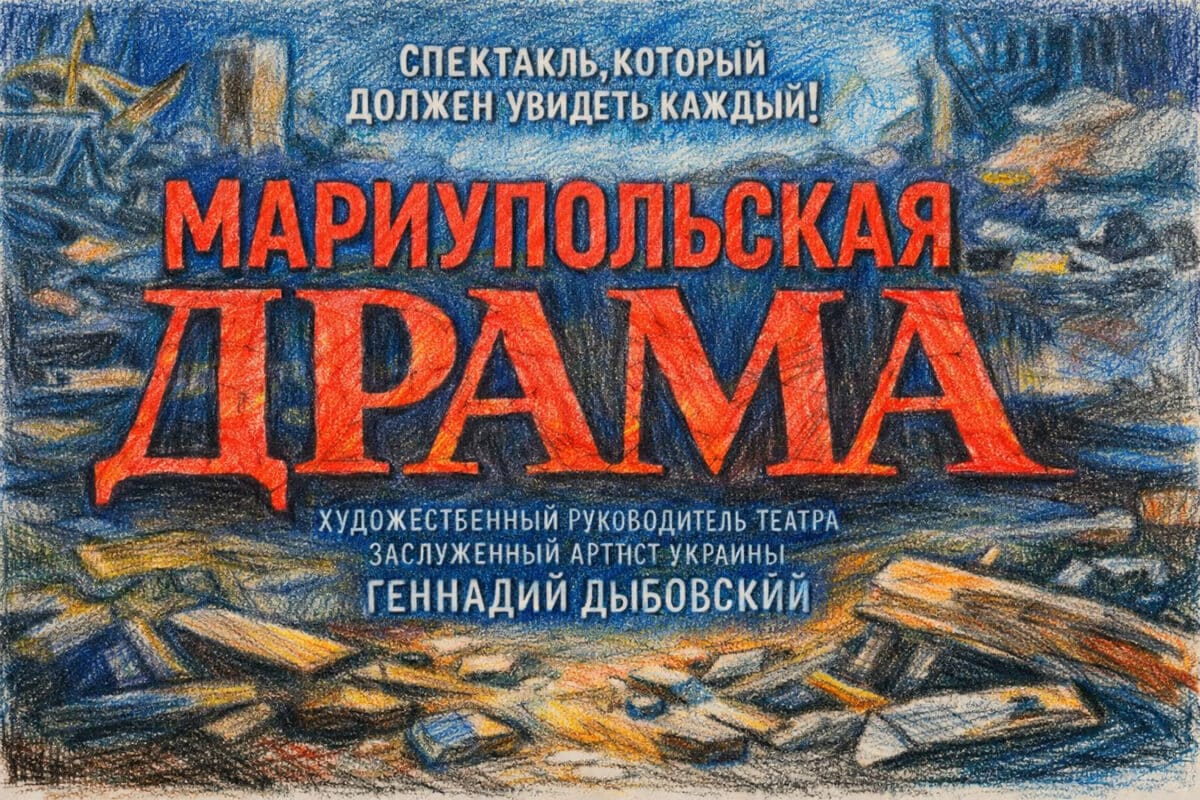
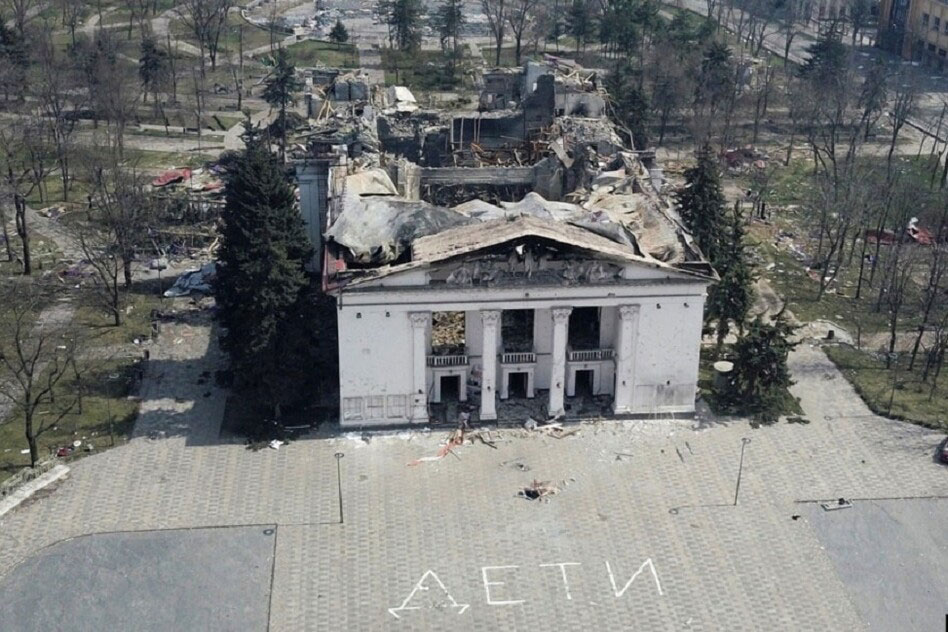
On the western map of Ukraine, there is a city whose name has become a symbol of cultural memory — Buchach. It was here that the future Nobel laureate Shmuel Yosef Agnon was born, a writer who combined Jewish spirituality and European philosophy. A century later, this city resonates again — now as the site of a literary residency and the book “Islands of Memory”, where Ukrainian authors reflect on time, identity, and Agnon’s legacy. The publication has become a cultural bridge between Ukraine, Israel, and the diaspora, uniting texts in three languages — Ukrainian, English, and Hebrew.
Return to the origins: the city where it all began
Buchach is a small town in the Ternopil region, once the center of Galicia, where Ukrainian, Jewish, and Polish traditions intertwined. It was here in 1888 that Shmuel Yosef Agnon was born — a future classic who became one of the creators of modern Israeli literature. His childhood was spent among ancient synagogues, baroque churches, and river slopes, where every place held traces of prayers and songs in Hebrew and Yiddish. Later, these motifs came to life in his books, and Buchach itself became a kind of archetype — a city of memory where the past breathes through words.
After emigrating to Palestine and living in Germany, Agnon gained worldwide fame, but the thread connecting him to Buchach was never broken. That is why, years later, this city once again became a center of cultural dialogue — now in a new century.
Agnon Literary Residency: a city that teaches listening
In 2016, the organization Ukrainian-Jewish Encounter (UJE) together with the Agnon Literary Center created a project capable of returning Buchach its voice.
This is how the Shmuel Yosef Agnon Literary Residency appeared — a space for writers, artists, and translators seeking their own stories in the city.
Here, literature becomes not a genre but a way of dialogue: with memory, with place, with people. Participants — contemporary Ukrainian authors — live in Buchach, explore archives, meet residents, and record their stories. Each new residency is like the city’s breath, a new layer of understanding its multilingual past.
2021: the birth of the book “Islands of Memory”
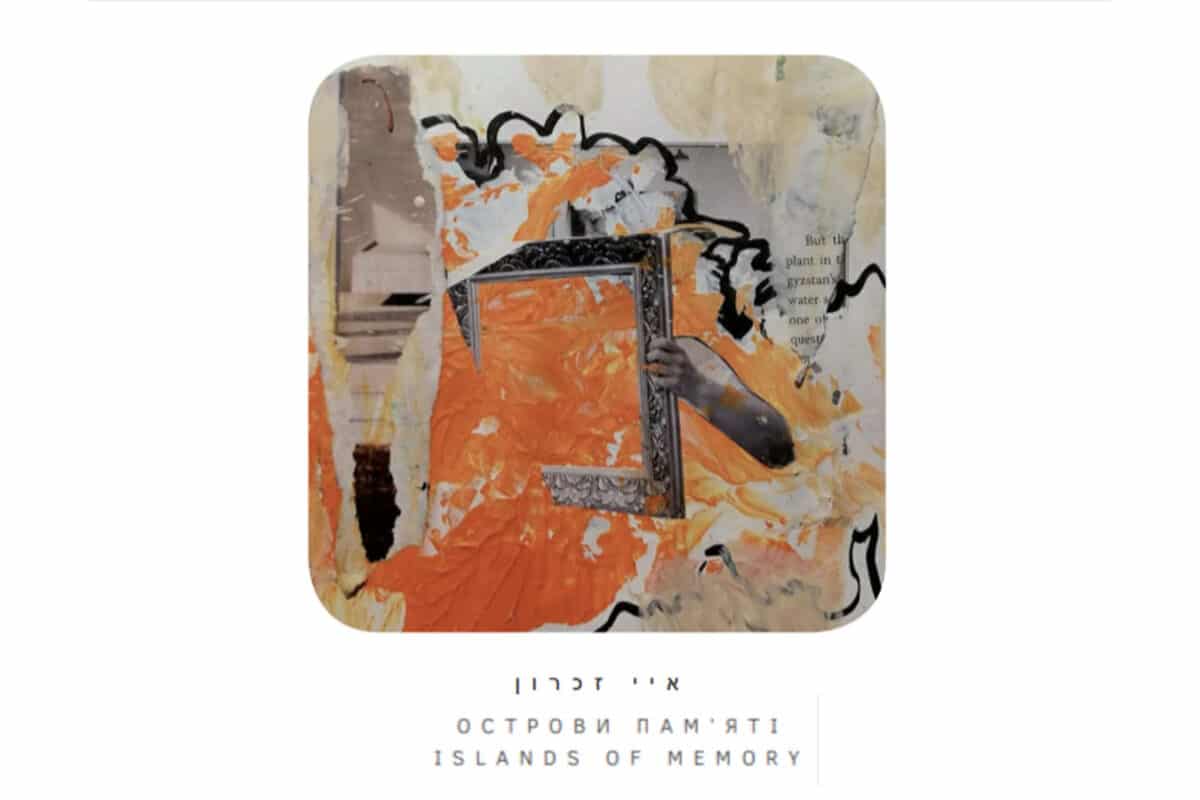
Collection “Islands of Memory” in Ukrainian, English, and Hebrew: how Buchach unites Ukraine, Israel, and Agnon’s literature
The third season of the residency, held in 2021, was pivotal. At that time, Borys Khersonsky, Diana Klochko, and Markiyan Prokhasko came to Buchach. Three authors from different generations — a doctor and poet, an art critic, a young essayist — wrote texts inspired by time, place, and silence. The result was the book “Islands of Memory”, published in three language versions.
This project is not just a collection of essays but a living structure of memory, where each text becomes an island, and together they form an archipelago of human experience.
Borys Khersonsky: memory as breath
A psychiatrist and poet, Khersonsky writes that memory is not chronology but a way to remain human. His essays are about the silence of Buchach, where every street becomes a metaphor for the inner world. He sees the city as a living organism, pulsating with traces of prayers and conversations.
Diana Klochko: the city as text
An art critic and philosopher, Klochko speaks of Buchach in the language of architecture. For her, walls are pages, and stones are letters with which history is written. She sees the city as a manuscript inscribed with three alphabets — Cyrillic, Latin, and Hebrew, where everything — from baroque facades to old bridges — carries meaning.
Markiyan Prokhasko: a look at the present
The youngest participant in the project looks at Buchach through the eyes of an observer. His essays are a quiet diary of walks: the smell of coffee, the creak of doors, conversations at the market. Through details, he connects the past and the present day, proving that memory lives not in archives but in everyday life.
Three languages — three mirrors of memory
The main feature of the publication is its trilingualism. Ukrainian language — as the voice of modernity. English — as a window to the world. Hebrew — as a return to Agnon’s roots and Jewish spirituality.
Each language reflects its own perspective, but together they create a complete picture. Editors and translators — including Anna Nekrasova and Tatyana Nepipenko — made translations not mechanically but intonationally: so that each text sounds natural in its cultural environment.
Thus, “Islands of Memory” became not just a book but a model of how Ukraine sounds when it speaks in several languages at once.
The dialogue of cultures continues: Lviv Forum 2025
Four years later, the theme of Buchach resonated again at the 32nd Lviv Book Forum. At the discussion “Listen, Read, Understand” Diana Klochko, together with translators Anna Nekrasova (Hebrew) and Tatyana Nepipenko (Yiddish), discussed how Ukrainian literature learns to sound alongside Hebrew and Yiddish without losing its melody. The conversation became a natural continuation of the book — a new bridge between eras and languages.
Buchach today: a city where memory is alive
Modern Buchach is not an open-air museum but a living organism. Here, the old synagogue is being restored, cemeteries are being explored, tours and thematic festivals are held. The city learns to speak about its multinational past — without nostalgia, but with respect.
Travelers can see the Agnon monument, a bas-relief in the ART-yard, his family home, and ancient streets where time seems to have stopped. Every detail is part of a new cultural map where Ukrainians and Jews meet again.
UJE — an organization that connects stories
The project Ukrainian-Jewish Encounter (UJE) has been operating since 2008 and has already become a platform for open dialogue. Its mission is to restore mutual understanding, to show that Ukrainian and Jewish histories are not parallel lines but intertwined threads of one fabric.
Thanks to UJE, dozens of projects, exhibitions, films, and books have appeared, in which memory is not a requiem but life. “Islands of Memory” is one of the most significant examples of this approach.
Literature as a form of healing
The book “Islands of Memory” shows that culture can heal. It connects eras, turns silence into words, and gives a voice to those who were forgotten. Through three languages and three authorial perspectives, it restores respect for the past and hope for the future.
There is no pathos here — there is breath. Buchach resonates again. And this sound is heard in Kyiv, Jerusalem, Paris, and Toronto.
Shmuel Agnon — a symbol that lives again in the Ukrainian context
His books are not only the heritage of Israel but also part of Ukrainian cultural memory. Buchach gave the world a writer, and Ukraine — a space where this heritage can be understood anew. Agnon reminds us that literature is a bridge by which one can return home, even after a century.
As is known, in 2022 The Verkhovna Rada of Ukraine recognized the Chechen Republic of Ichkeria as “temporarily occupied” and condemned the genocide of the Chechen people — an important symbolic bridge between Ukrainians and the Chechen resistance.
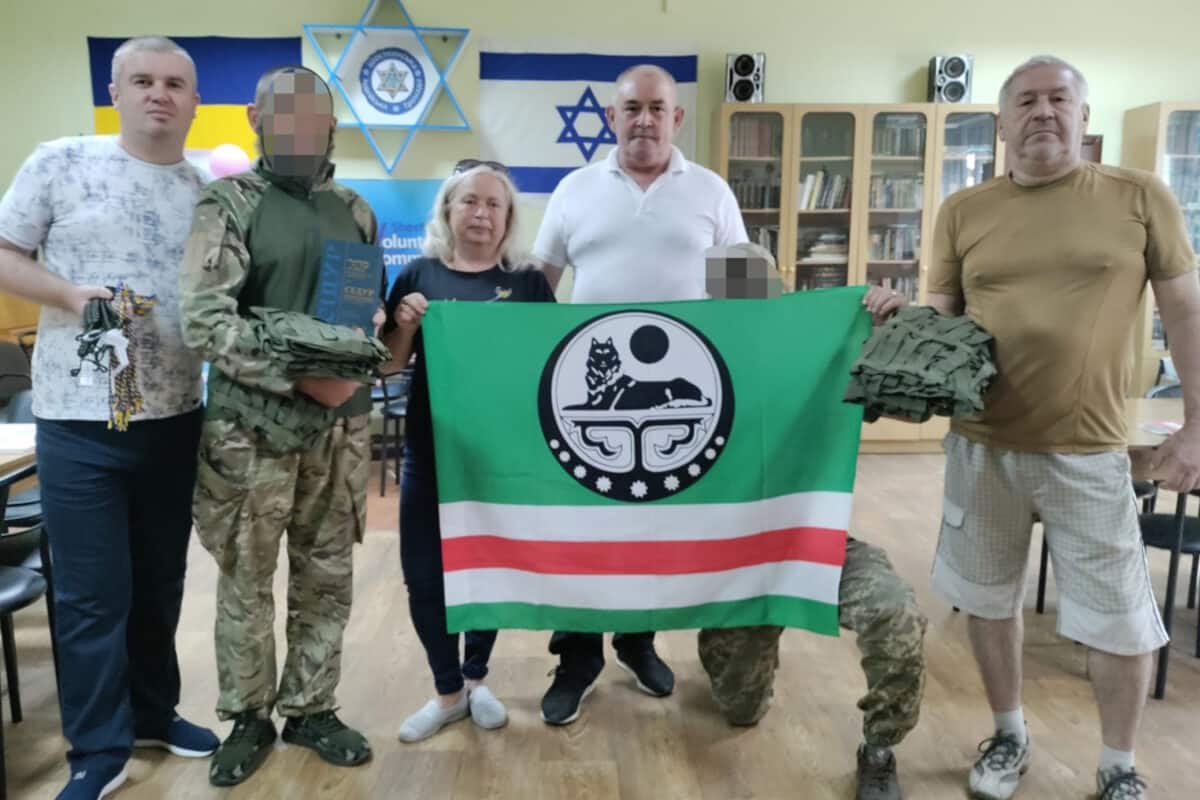
In the photo — Jewish volunteers and representatives of the Chechen battalion hold the flag of the Chechen Republic of Ichkeria — the official symbol of the unrecognized Chechen state, which in 1991–2000 actually existed on the territory of Chechnya and declared independence from Russia. Today it is mainly used in the diaspora and among supporters of Chechen independence, including Chechen volunteers in Ukraine.
Israeli technologies on the Ukrainian front: the Jewish community — to the Chechen battalion of the AFU as a sign of historical brotherhood and struggle against a common enemy
The suppression of the Chechen resistance by Russia in the 1990s–2000s was accompanied by mass civilian casualties and large-scale destruction.
In the First Chechen War (1994–1996), Russian troops used carpet bombing, especially in Grozny, which was practically wiped off the face of the earth; thousands of civilians were killed, tens of thousands were wounded.
In the Second Chechen War (since 1999) the scale of violence increased even more: extrajudicial executions, “cleansing” operations with disappearances of people, torture and deportations took place. According to human rights activists, the total number of dead in the two wars ranges from 80 to 150 thousand people, including women and children, and hundreds of thousands became refugees.
These events made the flag of Ichkeria not only a symbol of independence, but also a reminder of the tragedy of a people who experienced ethnic extermination.
How are the Chechen volunteer battalions of the AFU connected to the Jewish communities of Ukraine?
The Jewish community of Shostka handed over humanitarian aid to the Chechen battalion of the AFU
In Shostka, the Jewish community handed over another batch of humanitarian aid to Ukrainian servicemen, including the Chechen battalion, which is heading to one of the most dangerous sections of the front.
This was reported by the Shostka Jewish Community on its account on August 12, 2025.
“The Shostka Jewish Community continues to support our defenders by providing tactical stretchers made using Israeli technology. These stretchers are in great demand among the military, as they are reliable, comfortable, and help save lives.
This time, the aid went to the Sheikh Mansur Chechen Battalion, which will head to the hottest direction to defend our indestructible Ukraine. Along with the stretchers, paracord bracelets, protective gloves, neck pillows, fire starters, and, of course, amulets were handed over to protect our warriors in the hottest spots.
We believe that every contribution brings us closer to victory. Victory is not far away — Ukraine will definitely win!”
The production is organized by volunteers at the community base. Modern materials are used to ensure reliability and convenience. Such stretchers can withstand significant loads and allow transportation of the wounded even in difficult conditions. They can be used not only to evacuate soldiers from the battlefield but also in rescue operations — they can hold up to 200 kg.
In addition to stretchers, the community purchases and sends to the front protective gloves, warm clothing, neck pillows, fire starters, and small amulets.
Sergey Katsman, head of the Jewish community, said that the Shostka Jewish Community is the only one in Ukraine producing such stretchers, but they are ready to share the sewing technology with other cities because all Ukrainians now have one common goal — Victory.
Since February 24, 2022, Shostka, a city in the Sumy region 25 kilometers from the Russian border, has been regularly shelled. Already in the first days of the invasion, the city found itself in the zone of direct threat. In March 2022, as a result of artillery strikes, residential buildings and infrastructure were damaged.
The Shostka Jewish Community, numbering several dozen active members, from the beginning of the war organized volunteer aid together with other residents. They coordinate the collection of food, clothing, medicines, and hygiene products for those affected.
In the summer of 2025, Shostka, Sumy region, was the focus of massive attacks by Russia. Aviation, guided bombs, and Shahed drones were used, with strikes on residential neighborhoods and infrastructure. Chronology of shelling:
Date
Event
July 19, 2025
Massive attack using drones and guided aerial bombs. The attack lasted about four hours. No recorded dead or wounded, but local fires occurred.
July 25–26, 2025
Drones, bombs, and missiles struck the city. Three people were injured (two women and a man), suffering burns and shrapnel wounds. Four private houses, apartment buildings, and infrastructure facilities were damaged.
August 8, 2025
Night raid of Shahed drones. Some targets were shot down by air defense, but residential buildings, cars, and infrastructure were damaged; one person was injured.
August 10, 2025
Air strike on the Khlazove area and other parts of Shostka. Civilian infrastructure and private houses were damaged.
Against the backdrop of constant threat, the Shostka Jewish Community continues to act: organizing collections of food, medicines, and essential items for those affected, and providing assistance to the wounded and to families who have lost their homes.
On July 28, 2025, the Shostka Jewish Community (Sumy region) appealed to city residents to support community members — Serhii and Iryna Starostenko, whose house was completely destroyed as a result of shelling, and all property was destroyed.
Chechen volunteer battalions in the Armed Forces of Ukraine
For more than ten years, Chechen volunteer formations, created from natives of Chechnya who emigrated after the First and Second Chechen Wars, have been fighting as part of the Armed Forces of Ukraine. Their main goal is to continue the struggle against Russia, which they consider their historical enemy. For them, the war in Ukraine is not only support for the Ukrainian people but also part of their own national liberation struggle for the independence of the Chechen Republic of Ichkeria.
Sheikh Mansur Battalion
It was to this battalion that the Shostka Jewish Community has now provided assistance.
Formed in 2014, mainly from Chechens who left Chechnya after the Second Chechen War. Initially part of the Volunteer Ukrainian Corps “Right Sector,” later — of the Ukrainian Volunteer Army. Named after the late 18th-century Caucasian leader Sheikh Mansur, who led the highlanders’ uprising against the Russian Empire. This is one of the largest volunteer battalions in Ukraine, which took part in battles in Donetsk and Luhansk regions, and after 2022 — also in the southern directions.
Dzhokhar Dudayev Battalion
Also created in 2014. Composed mainly of Chechen emigrants who left their homeland after the Second Chechen War. Named after the first president of the Chechen Republic of Ichkeria, Dzhokhar Dudayev, who was killed by Russian troops in 1996. The battalion’s motto is “Freedom or Death!”. The unit is actively fighting on the fronts, seeing Ukraine’s victory as an important step towards the possible liberation of Chechnya.
Khamzat Gelayev Battalion
A formation created in 2022, named after Chechen field commander Ruslan (Khamzat) Gelayev, one of the symbols of resistance to Russia. The battalion quickly became part of the AFU’s combat operations, participating in assault actions and reconnaissance.
Other Chechen formations
In addition to these three main battalions, the following fight on Ukraine’s side:
Separate Special Purpose Battalion of the Armed Forces of the ChRI;
Special Operations Group “SOG”;
Assault Battalion “Shalena Zgraya” (“Mad Pack”);
Volunteer Battalion “Crimea”;
Muslim Corps “Caucasus”.
Why Chechen battalions fight for Ukraine
For the fighters of these units, the war in Ukraine is a chance to continue the struggle they began on their native land against Russian occupation. They believe that Russia’s defeat in Ukraine will also bring the liberation of Chechnya closer. Many fighters have combat experience gained in the Caucasus mountains and use it to help Ukrainian troops with reconnaissance, sabotage operations, and urban combat.
As of the end of 2022, the number of Chechen volunteers in the AFU was estimated at about 2,000 people, but there are no exact and up-to-date figures for 2025 — many formations do not disclose their numbers for security reasons.
Historical connection between Mountain Jews and Chechens
The ancestors of the Mountain Jews (Juhuri) arrived in the Caucasus presumably in the 5th century CE from Persia, where their forebears had settled in the 8th century BCE from ancient Israel. Their language — Mountain Jewish (Juhuri) — belongs to the southwestern group of Judeo-Iranian languages. The Mountain Jews practiced Judaism according to the Sephardic rite and had their own writing, literature, and religious books, including the prayer book “Rabbi Yechiel Sevi.”
From the 19th century, during the Caucasian War and the annexation of the region by the Russian Empire, Mountain Jews lived in Chechnya, Dagestan, and neighboring areas, including Grozny, Vedeno, Itum-Kali, and mountain auls. Their neighbors were Chechens — Sunni Muslims — with whom relations of mutual respect and trust were established. Trade routes, crafts, and common enemies (first the tsarist, then the Soviet repressive authorities) brought the two peoples closer.
Chechens valued Jewish blacksmiths, gunsmiths, jewelers, and winemakers, and Mountain Jews used the services of Chechen craftsmen and farmers. In bazaars, the trading rows stood side by side, and deals were often sealed by a spoken word. In case of an external threat, Chechens protected Jewish families, and Jews helped their neighbors with food and craft products.
During the Second World War, the Mountain Jews of Chechnya and Dagestan avoided the mass extermination that befell their communities in Crimea and the Kuban, largely thanks to the resistance of the local population, including the Chechens. In 1944, when the Soviet authorities deported the Chechens to Central Asia, some Mountain Jews of Grozny and the surrounding areas looked after their homes. After the return, the Chechens helped their Jewish neighbors amid the postwar devastation.
The cultural life of the Mountain Jews suffered greatly from Soviet policy: in 1948–1953, schools teaching in the Judeo-Tat language were closed, literature in Juhuri ceased, and communities were pressured. Nevertheless, until the end of the 20th century, several thousand Mountain Jews continued to live in Chechnya.
Cultural revival began only after 1991; however, new problems arose due to instability and religious pressure from the Muslim environment. The period of the Chechen wars of the 1990s–2000s was especially difficult, when almost all Mountain Jews left Grozny and Nalchik.
Today the number of Mountain Jews is estimated at approximately 110,000 people. The largest communities live in Israel (50–70 thousand), Azerbaijan (12–37 thousand), as well as in the USA, Germany, and Austria. In Russia, they remain in Dagestan (3–18 thousand) and partly in other regions. Traditional centers of residence include Derbent, Makhachkala, Buynaksk (Dagestan), Baku and Kuba (Azerbaijan). In Chechnya now only a few elderly representatives of this community remain, and most descendants of the Mountain Jews from Chechnya live in Israel, the USA, and Europe.
Despite the loss of former neighborhood, the memory of peaceful coexistence is preserved. Chechens and Mountain Jews who met in Israel or in the diaspora often recall the times when they were connected by shared courtyards, markets, mutual assistance, and respect — that which allowed two different peoples to live side by side for more than a century.
Relations between Jews and Chechens in Ukraine from 2014 to the present
Since the beginning of Russian aggression in 2014, the interaction between the Jewish community of Ukraine and Chechen volunteers has acquired practical and symbolic significance.
In the autumn of 2014, a volunteer battalion named after Beni Krik was created in Odesa — a Jewish-Chechen humanitarian formation. Commander Dmytro Nudel stated that Odesa Jews would collect aid for fighters in the ATO zone and for the wounded, and that volunteers would be trained with the help of fighters from the Chechen battalion named after Dzhokhar Dudayev. The battalion had a symbolic character and did not participate in battles, but demonstrated the alliance of the two communities: the Chechens shared military experience, and the Jews — resources and a volunteer network. The unit was supported by Amina Okuyeva, the wife of the commander of the Dudayev battalion.
In 2014–2015, a significant part of the assistance to Chechen volunteers was coordinated through the Dnipropetrovsk region, where, with the participation of Governor Ihor Kolomoyskyi and the Jewish community, a powerful volunteer center was created. Private patrons provided fighters with uniforms, transport, and equipment.
In February 2016, commander Adam Osmayev and Amina Okuyeva, at the invitation of city council deputy Asher Cherkassky, visited the central synagogue “Golden Rose” and the “Menorah” center in Dnipro. The guests toured the Museum “Memory of the Jewish People and the Holocaust in Ukraine,” where special attention was paid to the deportation of Chechens in 1944. Cherkassky emphasized the spiritual kinship of peoples united by a common struggle against imperial aggression.
At the state level, Jewish support was also noticeable. In the Verkhovna Rada of the 8th convocation (2014–2019), deputy Heorhii Lohvynskyi, deputy chairman of the Human Rights Committee, repeatedly raised the issue of the deportation of Chechens by the Stalinist regime, drawing parallels with the Holocaust. He welcomed the recognition of the Chechen Republic of Ichkeria and supported pro-Ukrainian Chechen formations. These actions strengthened the moral and political legitimacy of the Chechen presence in Ukraine.
In September 2022, the words of President Volodymyr Zelenskyy, addressed to the peoples of the Caucasus with an appeal not to fight for Russia, received a wide response in the Jewish diaspora and strengthened informational support for Chechen allies.
The Chechen volunteers themselves note the respect and assistance from the Jewish community. Osmayev and Okuyeva emphasized that Ukraine became a home for people of different nationalities united by the desire for freedom. After 2022, the symbols of Ichkeria began to appear at Jewish public events, and some Chechen fighters wear a six-pointed star on their uniforms along with the flag of their republic.
From NAnews
The story of assistance from the Shostka Jewish community to the Sheikh Mansur Chechen Battalion is not a one-off gesture, but part of a long line of mutual support stretching from the days of peaceful neighborhood between Mountain Jews and Chechens in the Caucasus to today’s joint struggle in Ukraine.
Since 2014, Jewish communities across the country — from Odesa to Dnipro — have not only shared resources with Chechen volunteers, but have also publicly recognized them as allies in resisting Russian aggression. The Chechens reciprocate, seeing Ukrainian Jews as partners in arms and fate.
Today, when the flag of the Chechen Republic of Ichkeria is raised alongside the Ukrainian and Israeli flags, it symbolizes not only resistance to a single aggressor, but also the historical solidarity of peoples who survived genocide and refused to give up the right to freedom. For us at NAnews — News of Israel, this is a reminder that brotherhood, forged through blood and mutual aid, can outlast centuries and borders.
“Wait, doesn’t all the land in Israel belong to the state? How then is it transferred to someone?”
This is the most common and absolutely logical question.
And the short answer to it is — no, not all the land in Israel belongs to the state.
…
Let’s say right away, in Israel, a petition/open appeal by Israeli citizens to the government is gaining momentum, demanding “to stop the transfer of the Alexander Courtyard to Russia and related IPPO structures“, because they believe that such a transfer “threatens Israel’s security” and poses “risks associated with external influence and the political interests of Moscow and related organizations”.
“Protect Israel from the Russian threat: stop the transfer of the Alexander Courtyard to Hamas supporters“ “Protect Israel from the Russian threat: stop the transfer of the Alexander Courtyard to Hamas supporters”
“everything state-owned means the state decides everything.”
But this is not quite so.
What actually belongs to the state and what does not
In Israel, there are three different types of land:
State land
Yes — belongs to the state.
This is simple.
Private land of citizens and organizations
Yes — it exists.
With documents, registers, and property rights.
Historical and foreign private property This is where the whole story with courtyards, churches, and old objects begins.
Many such plots:
were purchased even before 1948,
during the Ottoman Empire, British Mandate,
by private societies, churches, foundations.
And Israel did not automatically nullify these rights.
Why didn’t Israel say: “Everything is ours, period”
When Israel was being re-established, it consciously did not go down the path of confiscating all private property.
The reasons are simple and harsh:
it wanted to be a state of law, not a revolutionary regime;
it inherited the British legal system, not destroyed it;
mass confiscation would mean:
endless courts,
international isolation,
destruction of its own legitimacy.
Simply put:
Israel could have taken it — but decided not to become one who takes by force.
Then what does “transfer” mean in such disputes
When it is said that an object is “transferred”, it does not mean that:
Israel is giving away “its land”,
or making a gift to someone.
In fact, Israel:
is not the owner of such objects,
acts as an arbiter,
decides whom to recognize as the legal owner between disputing parties.
Can Israel take it for itself?
Theoretically — yes:
if the object is recognized as ownerless,
if no party proves the right,
or for exceptional reasons of public interest.
“Public interest” — these are rare cases when the state can intervene in private property for the sake of security, vital infrastructure, or protection of unique heritage, for example, for road, railway, or metro construction, creating a security zone, or preserving a historical object.
But this is a extreme scenario, which Israel almost does not resort to, because it:
creates a dangerous precedent,
hits international reputation,
undermines the very logic of a state of law.
The shortest explanation
Land under the sovereignty of Israel — yes.
But ownership — not always state-owned.
Therefore, Israel does not “give away its own”, but decides, whose it is by law (Israeli and international).
Let’s start.
What is the Alexander Courtyard today — in fact
The Alexander Courtyard, here it is on Google map, is a historical-archaeological, cult, and museum complex in the Old City of Jerusalem, located approximately 40–50 meters from the Church of the Holy Sepulchre (1–2 minutes walk). It is not a hotel or commercial lodging: accommodation for tourists or pilgrims is not provided.
Area and location.
The complex occupies a plot of about 1,300–1,500 m², which is a significant size for the dense development of the Old City. Nearby are key shrines and locations:
Church of the Holy Sepulchre — 40–50 m;
route Via Dolorosa — directly adjacent (the Judgment Gate Threshold is part of it);
district Muristan — about 100 m;
Jaffa Gate — approximately 250–300 m.
What exactly is on the territory of the courtyard:
House Church of St. Alexander Nevsky — a small Orthodox church of the late 19th century; services are held periodically, there is no permanent monastic community.
Judgment Gate Threshold — an authentic archaeological object of the Roman era (1st century AD), a fragment of an ancient pavement and threshold; according to Christian tradition, associated with the path of Jesus Christ to the trial of Pontius Pilate and included in the Via Dolorosa route.
Archaeological site — elements of ancient city walls and buildings of Jerusalem, discovered during 19th-century excavations and preserved.
Small museum and exhibition rooms, dedicated to the history of the complex and findings.
Inner courtyard and historical buildings, forming a closed architectural ensemble within the Old City.
What is happening there now:
the courtyard is open to visitors as a cultural-historical object;
tours and archaeological site inspections are conducted;
there is a museum exhibition;
the cult function of the church is maintained;
work is being done on the maintenance, protection, and conservation of monuments.
What is fundamentally absent there:
there is no hotel or hostel;
there is no commercial tourist service;
there is no diplomatic or state institution.
Who manages the object:
Management and daily activities are carried out by the Orthodox Palestine Society (OPS) — a non-governmental public association operating in Jerusalem within the Israeli legal framework. Administrators, guides, and caretakers work on-site; restorers and monument protection specialists are involved as needed. The State of Israel does not directly manage the courtyard but oversees it within the framework of heritage protection and security legislation.
It is the combination of significant area, archaeological value, and extreme proximity to the Church of the Holy Sepulchre that makes the Alexander Courtyard an object of special attention and explains why the dispute around it goes far beyond a usual property issue.
Let’s continue.
In November 2025, a new round of hearings on the transfer of the Alexander Courtyard took place in the Jerusalem District Court — from the Imperial Orthodox Palestine Society (IPPO) — to whom — Imperial Orthodox Palestine Society (IPPO).
No, this is not a typo.
Why “IPPO ≠ IPPO”, if OPS was in between
(in the international-legal sense, considering the role of OPS)
In practice, it is about not two, but three different entities, which creates the main confusion. Two of them bear the same name — the Imperial Orthodox Palestine Society, and the third — Orthodox Palestine Society (OPS) — occupied an intermediate position during the legal gap period.
Imperial IPPO (1882–1917)
The pre-revolutionary “Imperial Orthodox Palestine Society” (IPPO) was a private public association, founded in 1882 and operating within the legal framework of the Russian Empire.
Principally important legal clarification:
the imperial IPPO did not belong to the state of the Russian Empire and was not the property of the royal family or the House of Romanov.
the society was not a state body;
was not part of the structure of ministries or departments;
its property was not state property;
it was not in the personal property of the emperor or members of the dynasty.
Imperial patronage was expressed exclusively in:
approval of the charter,
moral and political support,
but not in ownership rights.
All land plots and buildings in “Palestine”, including the Jerusalem courtyards, belonged to the society itself as an independent legal entity, not to the state and not to the royal family.
The term “Palestine” is used here exclusively in a historical-legal sense, as it appeared in Ottoman, European, and mandate documents of the late 19th — early 20th century, and has no relation to modern political realities or issues of Israeli sovereignty. For clarity, this name will be used strictly in the form and meaning in which it is recorded in official acts of the corresponding period.
After 1917, the Russian Empire and the imperial legal order ceased to exist. As a result, the imperial IPPO lost its legal personality and ceased to exist as a legal entity. There was no formal act of liquidation, but in the international-legal sense, the society ceased to exist.
Important for the IPPO case
Already in 1918, Soviet Russia, and then the USSR, officially renounced succession in relation to the Russian Empire, which was recorded by the decree of the Council of People’s Commissars on the annulment of state debts and the rupture of imperial legal and contractual obligations. This renunciation meant not only the non-recognition of imperial state debts but also the absence of succession for private imperial societies, including the Imperial Orthodox Palestine Society. Accordingly, the property of the IPPO abroad was not considered inherited by the USSR and was not under the protection or management of the Soviet state, which cemented the international-legal gap in the fate of the society and its property.
OPS as a period of factual continuation
In the legal vacuum that arose after 1917, the activities and management of the property of the former IPPO in the Holy Land effectively passed to the Orthodox Palestine Society (OPS)— a Jerusalem Orthodox organization formed in the emigrant community from the Russian Empire in the 1920s. People, local structure, archives, and actual management of the courtyards moved to OPS.
Orthodox Palestine Society (OPS) — is a non-governmental public association operating in Jerusalem and associated with the historical tradition of the pre-revolutionary Imperial Orthodox Palestine Society, but legally independent and not representing any state. It operates within the Israeli legal framework and manages historical objects, including the Alexander Courtyard. In this article, OPS is mentioned only as one of the parties to the property dispute, without delving into its history.
At the same time, OPS was not and was not recognized as the legal successor of the imperial IPPO. It did not receive the property by an act of inheritance or transfer and acted in the international-legal logic as a factual holder and custodian, not as a legal owner.
Russian IPPO (since the 1990s)
The modern Russian “Imperial Orthodox Palestine Society” (IPPO) was created in the 1990s and registered under Russian Federation law. In a legal sense, this is a new legal entity, not identical to the pre-revolutionary society.
The Russian IPPO declares itself the successor of the imperial IPPO, relying on historical continuity, mission, traditions, and the restoration of the name. However, from the point of view of international and Israeli law, the coincidence of the name and appeal to historical identity does not create automatic succession.
International-legal conclusion
In international-legal logic, automatic succession is possible only if there is continuity of the same legal entity or an internationally recognized act of transfer of rights. In the case of the IPPO, such conditions did not exist. An additional factor cementing the gap is the existence of OPS as an independent factual holder of property in the period between 1917 and the 1990s.
Final formula
The Imperial Orthodox Palestine Society was a private public association and did not belong to either the state of the Russian Empire or the royal family; its property was not state property. In the international-legal sense, the modern Russian IPPO is not an automatic successor of the pre-revolutionary IPPO, as there is no continuity of the legal entity and there was no internationally recognized act of transfer of rights.
What is the legal collision
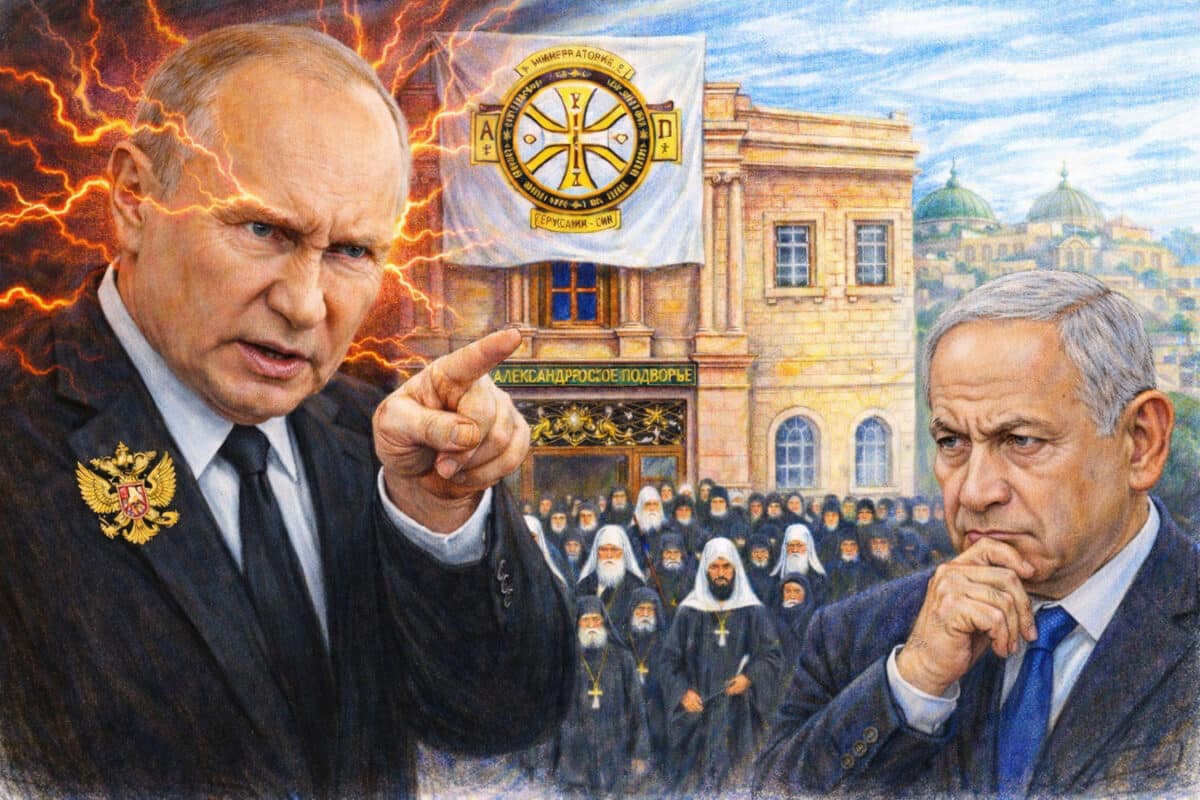
Whose is the Alexander Courtyard in Jerusalem after all? and will Netanyahu be able to “protect the interests of the State of Israel” in this case?
In December 2019, Israeli media reported on the registration of the Alexander Courtyard for Russia in the Israeli real estate register. It was this entry that created the impression that the object had already been transferred. However, the registration was carried out administratively, without completing legal proceedings and without resolving objections from the Orthodox Palestine Society (OPS).
OPS, led by Nikolai Vorontsov-Hofman, filed a protest, after which the Jerusalem District Court imposed a temporary ban on the transfer of the object to the Russian IPPO, effectively freezing the situation.
Administrative decision of 2020
In 2020, Israeli Prime Minister Benjamin Netanyahu signed an administrative document categorizing the Alexander Courtyard as a “place of Christian worship”.
This decision was not an act of property transfer and did not replace legal proceedings, but it placed the object in a special legal regime, where questions of its status could be considered at the government level, not exclusively within the framework of ordinary civil litigation. Thus, the executive branch received an additional tool for resolving the dispute outside the classic judicial path.
Current legal status
The Jerusalem District Court ruled to maintain the status quo until a political-administrative decision is made.
According to the court’s decision, the courtyard temporarily remains under the management of the OPS (Orthodox Palestine Society) — that is, the structure that carries out the actual ownership and management of the object at the moment — until a special interdepartmental commission of the Israeli government makes a final decision on the ownership issue.
The court did not recognize any of the parties as the final owner, emphasizing the limited jurisdiction in this situation.
Positions of the parties
The Russian side claims that Israel should fulfill previous political commitments and complete the transfer process in favor of the Russian IPPO, which is considered by it as a historical successor.
OPS (Orthodox Palestine Society) insists that the courtyard is its historical property, which Russia or Russian structures never directly owned, and disputes the very idea of transfer.
The Israeli government takes an intermediate position, trying to balance between external political pressure, internal legal risks, and international criticism, avoiding a unilateral decision without the conclusion of a specialized commission.
What’s next
The court directly indicated that the final decision is within the competence of the governmental interdepartmental commission, not the court and not the prime minister individually.
Until such a decision is made, the situation remains legally suspended. At the same time, continued pressure from the Russian side is expected, especially given the current geopolitical context, while the Israeli government continues to postpone the final decision, striving to minimize legal and political consequences.
By the way –
there is material about the modern Russian IPPO from the Israeli publication “Details”
The Alexander Courtyard in Jerusalem has been the subject of disputes for decades, intertwining history, law, and politics. In this material, we consistently analyze, based on open sources, official statements, and public documents, to whom and on what basis this object belonged and belongs at different periods of its history.
Ancient Hebrew period (10th century BC — 70 AD)
Land was regulated by the norms of ancient Hebrew law (din Torah), as well as city and royal administration. The plot was outside the sacred zone of the Temple Mount, so the temple property regime (קדשי המקדש) did not apply to it. Ownership was secular and could be private, communal, or administrative within the framework of ancient Hebrew property law.
Specific owners are not known by name, as cadastral fixation of property in the modern sense did not exist. After the destruction of Jerusalem in 70 AD and the liquidation of the city structure, the former ancient Hebrew property titles effectively lost legal force.
Roman period (70 AD — 4th century AD)
After the destruction of Jerusalem in 70 AD, the territory came under the direct control of the Roman Empire and was regulated by the norms of Roman law (ius Romanum). Land was considered either state property (ager publicus) or private property (dominium privatum), transferred to Roman citizens or municipal structures of the city.
Specific owners of the plot are not recorded in surviving sources. Property rights of the previous population were terminated as a result of war and deportations, and subsequent ownership was determined by decisions of the Roman administration and city management (municipium).
Byzantine and early Christian period (326–637 AD)
In 326–335 AD, at the initiative of Empress Helena, mother of Emperor Constantine the Great, and by direct order of the imperial authority, the territory in the area of the future Church of the Holy Sepulchre was withdrawn from the usual city circulation. This decision was part of the state policy of Christianizing Jerusalem after the legalization of Christianity. Land, previously part of secular urban development, was transferred to the status of sacred property (res sacrae) according to the norms of Byzantine and Roman imperial law (ius Romanum, ius Byzantinum).
The legal holder of rights to the plot became the Jerusalem Church (ecclesia Hierosolymitana), that is, the local Christian institution under the management of the Bishop of Jerusalem, operating under imperial patronage (imperial patronage). The transfer was not formalized by a purchase-sale agreement, as the mechanism of imperial withdrawal and sacralization of land, characteristic of the 4th century, was applied. Private individuals were not owners, and the alienation of the plot was taken out of the civil circulation.
The formation of the Church of the Holy Sepulchre and the adjacent territory secured a stable Christian status for this area, which was maintained throughout the Byzantine period. Documentary confirmation of this is provided by contemporaneous sources of the 4th century, primarily the testimonies of Eusebius of Caesarea (Vita Constantini), as well as subsequent Byzantine church management practices. By the time of the Arab conquest of Jerusalem in 637 AD, the plot was recognized as church property, under institutional, not private ownership.
Early Islamic period (from 637 AD — 10th century)
After the capture of Jerusalem in 637 AD by the troops of Caliph Umar ibn al-Khattab, the city came under the rule of the Rashidun, and then the Umayyad and Abbasid caliphates. Upon the change of sovereignty, Christian shrines and church possessions were not confiscated. The rights of the Jerusalem Church to the plot in the area of the Church of the Holy Sepulchre were preserved within the framework of Islamic law.
The legal basis was the granting of Christians the status of dhimmi (ahl al-dhimma), which guaranteed the protection of the person, cult, and property upon payment of a poll tax (jizya). Church property was recognized as legal and inviolable, and the land continued to be owned by the Christian institution as a religious collective. The caliphate did not convert such plots into waqf and did not include them in the state land fund (bayt al-mal).
Thus, in the early Islamic period, there was no redistribution of property, but a confirmation of the previously established Byzantine church title. By the 10th century, the plot remained part of the Christian confessional zone around the Church of the Holy Sepulchre, with continuous institutional ownership and without a break in legal status.
In 1099, Jerusalem was captured by the Crusaders, and the city came under the control of the Latin Kingdom. Christian property in the area of the Church of the Holy Sepulchre was redistributed within the Christian world: management and ownership of plots passed to Latin church institutions under canon law (ius canonicum). At the same time, the category of church sacred property was preserved, and the land was not turned into secular private property.
After the return of Jerusalem under the control of the Ayyubids in 1187 and the subsequent establishment of Mamluk control, there was a rollback of Latin dominance. Muslim authorities restored the principle of protecting Christian shrines and property within Islamic law. Church plots around the Church of the Holy Sepulchre were preserved for Eastern Christian communities, including Greeks and Copts, as recognized religious corporations. Property was considered collective confessional ownership and was not included in the state land fund.
By the end of the Mamluk period, the plot on which the Alexander Courtyard later arose was part of a stable Christian property mass in the Old City. The legal status was determined not by a specific purchase-sale agreement, but by continuous recognition of religious property with the change of political regimes.
Ottoman period (1517 — mid-19th century)
After the conquest of Jerusalem by the Ottoman Empire in 1517, the city was included in the Ottoman administrative-legal system. Christian communities were recognized by the state as religious corporations within the millet system, which gave them the right to collective ownership of real estate and independent management of internal affairs. The property of Christian denominations, including land plots in the area of the Church of the Holy Sepulchre, was regulated by the norms of Ottoman law, combining sharia and imperial legislation (kanun).
At the early stage of Ottoman rule, the rights of religious communities were primarily fixed in fiscal-land registers (defter). These documents reflected the recognition of a specific community’s ownership of a plot and its responsibility to the state, but did not represent an individual title deed in the modern sense. It was about state confirmation of existing confessional ownership, not the creation of new property rights.
With the development of the Ottoman land system and the implementation of reforms in the 18th–19th centuries, religious possessions in Jerusalem were more formally registered in the tapu land certificate system. It was the tapu senedi that became the first type of document that can be considered a full-fledged title deed, recognized by the state and allowing for the alienation of property.
Within this registration, part of the Christian plots around the Church of the Holy Sepulchre was secured for the Coptic Orthodox community of Jerusalem as an independent legal entity.
It is important to emphasize that the Ottoman authorities did not “transfer” the land to the Copts. Their right was based on continuous confessional ownership, which the state recognized and formalized through registration. The Ottoman administration considered the Coptic community as a legitimate owner, capable of disposing of real estate, including its sale, subject to the established procedure and obtaining permission from the authorities.
By the mid-19th century, the Coptic community had a formalized and state-recognized title of ownership, confirmed by tapu documents. It was the emergence of this formalized Ottoman title deed that became the first case of documentary securing of property rights to the plot in a legal sense and created the legal possibility of its lawful sale to the Russian Ecclesiastical Mission in 1859–1860.
Purchase of the plot by the Russian Ecclesiastical Mission (1859–1860)
In 1859–1860, the land plot in the area of the Church of the Holy Sepulchre, previously registered for the Coptic Orthodox community of Jerusalem, was alienated in favor of the Russian Ecclesiastical Mission in Jerusalem. The transaction was formalized as a private purchase-sale between two religious corporations and was carried out within the framework of the existing Ottoman law. The seller was the Coptic church institution, possessing a formalized title of ownership, confirmed by the tapu system, and the buyer was the Russian Ecclesiastical Mission, acting through its head, Archimandrite Antonin (Kapustin).
The legal basis of the transaction was a purchase-sale agreement concluded under the norms of sharia and kanun with the mandatory administrative permission of the Ottoman authorities for the alienation of real estate to a foreign religious entity. Such a procedure was standard for Jerusalem in the mid-19th century and applied to all foreign Christian missions. The Ottoman administration considered the Russian Ecclesiastical Mission not as a state body of the Russian Empire, but as a church institution, which excluded the qualification of the transaction as interstate.
The financing of the purchase was carried out at the expense of donations and church funds, but the source of the money did not affect the legal status of the property. In Ottoman documents and registers, the owner of the plot was recorded as the Russian Ecclesiastical Mission in Jerusalem, not the Russian Empire, not the imperial family, and not the treasury. No acts transferring the plot to the state property of Russia were formalized.
The conclusion of the transaction in 1859–1860 created a new initial title of ownership, recognized by the Ottoman state and valid in subsequent periods. From this moment, the plot was in the private church ownership of the Russian Ecclesiastical Mission, which became the legal basis for the subsequent construction and formation of the Alexander Courtyard, but did not generate any rights for the Russian Empire as a state.
Development of the plot and formation of the Alexander Courtyard (1860s — 1890s)
After the completion of the purchase-sale in 1859–1860, the Russian Ecclesiastical Mission in Jerusalem began the development of the plot as the legal owner under Ottoman law. The use of the land was carried out based on the formalized tapu title and was not accompanied by any acts of alienation or change in the legal status of ownership. The Ottoman authorities considered construction and archaeological work as permissible disposal of private church property (mulk).
In the 1860s–1870s, the plot was cleared and adapted for religious and pilgrimage purposes. In the 1880s–1890s, an architectural complex was formed here, which received the name Alexander Courtyard. This name had a memorial character and did not reflect the form of ownership or state affiliation of the object. The right of the Russian Ecclesiastical Mission to the plot continued to be preserved without changes and did not require re-registration.
Transfer of management of the Alexander Courtyard to the Imperial Orthodox Palestine Society (late 19th century)
By the end of the 19th century, the Russian Ecclesiastical Mission in Jerusalem decided to transfer the economic and pilgrimage management of the Alexander Courtyard to the Imperial Orthodox Palestine Society. The basis for this was the statutory goals of the IPPO, aimed at organizing pilgrimages, maintaining Russian institutions in Palestine, and exploiting religious real estate. The transfer was carried out in the form of an internal order between affiliated church-public structures and was not formalized as a civil-law transaction of alienation.
From a legal point of view, it was about delegating management and use functions (administratio), not about transferring ownership rights (dominium). The Russian Ecclesiastical Mission retained the title of owner, based on the Ottoman tapu, while the IPPO acted as the managing organization, carrying out actual possession, maintenance, and exploitation of the object. No purchase-sale, donation, or other title deed in favor of the IPPO was formalized, and the change of owner was not registered in either Ottoman or subsequent registers.
The transfer of management did not require separate permission from the Ottoman authorities, as it did not affect the title of ownership and was considered an internal order of the owner within his powers. In legal terms, the IPPO acted as a lawful possessor (lawful possessor), having gained access to the object based on the owner’s consent.
It was this status that later became key for assessing the continuity of possession after 1917, but it did not itself turn the IPPO into an owner at this stage.
1917–1922: cessation of the Russian Ecclesiastical Mission, renunciation of succession, and creation of a legal vacuum
After the revolutionary events of 1917, the pre-revolutionary church-state order of the Russian Empire was destroyed. The Holy Synod, through which the Russian Ecclesiastical Mission in Jerusalem operated, was abolished, centralized management and financing of the mission ceased, and the Soviet government refused to recognize pre-revolutionary church institutions as holders of property rights abroad. As a result, the Russian Ecclesiastical Mission lost its legal personality and ability to act as an active owner of real estate.
The cessation of the mission’s activities was not accompanied by an act of liquidation, confiscation, or transfer of property. The Alexander Courtyard was not transferred to either the state or another church structure. In 1918–1922, Soviet Russia officially renounced succession for foreign private and church property of the Russian Empire, which excluded the emergence of a title for the RSFSR or the USSR. Thus, the title of ownership, formalized in the 19th century for the Russian Ecclesiastical Mission, was “orphaned”: it was not annulled but lost its active holder.
The Moscow Patriarchate, restored in new conditions, did not become the successor of the Russian Ecclesiastical Mission in a property sense. It arose as a new church structure within the Soviet legal framework and did not receive automatic international recognition as the heir to pre-revolutionary foreign assets. Neither the Soviet state nor foreign authorities formalized acts of succession linking the patriarchate with the mission’s rights to real estate in Jerusalem.
In these conditions, the Imperial Orthodox Palestine Society, which even before 1917 carried out lawful management and use of the Alexander Courtyard based on the owner’s consent, continued actual possession of the object. This possession was qualified as lawful and continuous (lawful possession), as the IPPO did not enter arbitrarily, did not displace another owner, and acted within the framework of previously obtained powers. The absence of a successor for the Russian Ecclesiastical Mission and the refusal of the USSR to make claims created a legal vacuum in which the IPPO remained the only subject exercising possession, forming the basis for subsequent recognition of the title based on the principle of continuity of possession (continuity of possession).
British Mandate period (1917–1948): administrative practice and recognition of the IPPO
During the British Mandate in Palestine (1917–1948), the new authorities adopted the principle of preserving existing property rights and titles formed before the change of sovereignty. Regarding the Alexander Courtyard, the British administration did not carry out expropriation, sequestration, or nationalization and did not declare the object ownerless (bona vacantia). The absence of an active owner, which arose after the cessation of the Russian Ecclesiastical Mission, was not filled by transferring the property to the mandate state.
The practice of management and administrative interaction was built directly with the Imperial Orthodox Palestine Society. All official correspondence, permits, and orders for the operation and maintenance of the courtyard were addressed to the IPPO as the responsible owner and manager. British authorities did not require the IPPO to present an act of transfer of ownership and did not initiate re-registration of the title, which meant tacit recognition of the established possession through the administrative behavior of the authority (recognition by conduct).
Legally, this period became key for consolidating the status of the IPPO. Continuous and lawful possession (lawful possession) in the absence of a competing owner and in the absence of state actions to expropriate the property led to the crystallization of the title. The British Mandate did not create new property rights but confirmed the existing situation based on continuity of possession (continuity of possession), which was later accepted by subsequent sovereign authorities.
Jordanian period (1948–1967): preservation of the status quo of ownership and applicable law
After 1948, East Jerusalem came under Jordanian control, which applied the principle of preserving the existing property order (status quo), used in international practice during the change of sovereignty. The applicable law included the norms of Ottoman land law (Ottoman Land Code 1858), which continued to operate in East Jerusalem, as well as the provisions of mandate law, inherited from the British administration. These sources were considered as a continuing legal order and did not require automatic re-registration of ownership.
Regarding the Alexander Courtyard, Jordanian authorities did not carry out confiscation, sequestration, or recognition of the property as ownerless (bona vacantia). The absence of such actions meant the preservation of the previous title. Administrative interaction was carried out with the Imperial Orthodox Palestine Society as the factual owner and manager, without requiring an act of transfer of ownership. In these conditions, the principle of lawful and continuous possession (lawful possession, continuity of possession) was applied, where the right is not created anew but preserved in the absence of competing claims.
Former Russian state property in West Jerusalem after 1948
After the declaration of independence of the State of Israel in 1948 and the establishment of its control over the western part of Jerusalem, Israel came under its jurisdiction a number of objects that previously belonged to the Russian Empire as a state. The issue of their fate was not resolved automatically but under active external political pressure from the Soviet Union.
The USSR became one of the first states to recognize Israel and used this recognition as a tool of political pressure. Soviet diplomacy directly insisted on the transfer of former imperial state real estate to the USSR as the successor of the Russian Empire. For the young Israeli state, which was in international isolation and dependent on external support, this factor was decisive.
As a result, in 1949–1951, Israel recognized the USSR’s rights to objects that before 1917 were state property of the Russian Empire and were located within western Jerusalem. Such objects included the complex of the Russian Compound (Migraash ha-Rusim), buildings of the former Russian hospital, as well as administrative and representative buildings, constructed and registered to the state treasury. These objects did not belong to church property and were not owned by public or religious organizations.
Legal formalization was carried out by administrative decisions of the Israeli government and subsequent registration in property bodies. The basis was Israel’s recognition of the USSR as the state successor of the Russian Empire exclusively in terms of state property, as well as diplomatic agreements between the parties. A separate special law was not adopted; the legal effect was achieved through a combination of executive acts and international obligations.
This mechanism did not extend to objects that before 1917 belonged to the Russian Ecclesiastical Mission, monasteries, or public structures, as they were not state property and did not fall under the principle of state succession.
“Orange Deal”. Redemption by the State of Israel of former Soviet real estate in West Jerusalem (1964)
In 1964, the State of Israel redeemed from the Soviet Union a significant part of the real estate in West Jerusalem, previously recognized for the USSR as state property of the Russian Empire. The deal was formalized within the framework of an interstate agreement and received the unofficial name “orange deal”.
The subject of the redemption was exclusively objects that had the status of state (treasury) property before 1917 and were located on territory under Israeli control. These included the main buildings of the Russian Compound (Migraash ha-Rusim), administrative and economic buildings, as well as buildings of the former Russian hospital and accompanying infrastructure. After the completion of the deal, the USSR’s ownership of these objects was terminated, and they passed into the full ownership of the State of Israel.
The decision to redeem was due to several reasons. The formal ownership of the USSR of large objects in the center of Jerusalem was considered by Israel as a problem of sovereignty and internal security. Legally, Israel could not nationalize foreign state property without serious international consequences, so redemption was chosen as a legal way of final settlement. In addition, the USSR was interested in converting unused foreign real estate into economic compensation, and Israel — in gaining full control over the territory for the placement of state, judicial, and municipal institutions.
The 1964 deal did not extend to objects located in East Jerusalem, did not concern church and public property, and was not related to objects that before 1917 belonged to the Russian Ecclesiastical Mission, monasteries, or the Imperial Orthodox Palestine Society. The Alexander Courtyard was not included in this process.
1967: extension of the Israeli land registration system and fixation of IPPO ownership
After the Six-Day War of 1967 and the establishment of Israeli control over East Jerusalem, Israel extended its civil and property law to this territory. For the first time for the Old City, a unified national system of real estate registration was applied — the Israeli land registry Tabu (Lishkat rishum mekarkein).
Before this, other forms of land accounting existed in Jerusalem: Ottoman tapu records, as well as mandate and Jordanian practices of preserving these records. However, none of them represented a modern state cadastre with mandatory fixation of the current owner. The Israeli Tabu, unlike previous systems, fixes property rights as a legal fact recognized by the state.
When including objects of East Jerusalem in Tabu, Israel did not carry out nationalization, did not create new titles, and did not change owners. The principle of preserving previously existing property rights (status quo / continuity of title) was applied: if an object had a legal owner and was not alienated, its right was preserved and subject to fixation in the register.
The Alexander Courtyard was entered into the Israeli real estate register (Tabu) with the indication of Orthodox Palestine Society (OPS) as the owner of the plot. The basis was Ottoman purchase-sale documents, the lawful entry of the pre-revolutionary Imperial Orthodox Palestine Society into possession, continuous actual management of the object by the local structure after 1917, and the absence of any act of alienation in favor of the state(?). The object was not registered for the State of Israel and was not considered state property.
Thus, after 1967, the property rights to the Alexander Courtyard were first formally fixed in a modern state register precisely for OPS. It was not about the emergence of a new right, but about the state fixation of an already existing historical title, which in Israeli law is a full confirmation of private property.
1967–1990: absence of disputes and the beginning of Russian claims
From the moment of the inclusion of East Jerusalem in the legal field of the State of Israel in 1967 until the early 1990s, the issue of the ownership of the Alexander Courtyard was not raised or disputed.
During this period, the Soviet Union did not make property claims to the Alexander Courtyard, which corresponded to its previously declared renunciation of succession for foreign private and church property of the Russian Empire.
1991–1996: first practical steps of Russia
In 1991–1992, after the collapse of the USSR, Russian diplomatic missions in Israel began raising the issue of the status of certain objects of so-called “Russian real estate”, including the Alexander Courtyard, within the framework of working contacts with Israeli departments. These actions were informal and consultative in nature and were not accompanied by the filing of lawsuits, official statements of ownership rights, or attempts to change the entry in the real estate register.
In 1993–1996, the Russian side sent administrative requests to Israeli bodies asking to clarify the legal status of the object and the possibility of its re-registration. In response, Israeli registering bodies pointed to the presence of a valid entry in Tabu, as well as the absence of title documents necessary for changing the register. Formal procedures for reviewing the entry were not initiated.
During this period, no legal proceedings were conducted, no transfer decisions were made, and no changes in the real estate register occurred. All actions were limited to correspondence and consultations at the interdepartmental level.
Late 1990s — early 2000s: transition to formalized demands
In the late 1990s — early 2000s, the Russian Federation moved from consultations to formalized appeals to Israeli bodies demanding a review of the status of the Alexander Courtyard.
During this period, the Russian side began officially declaring that the object is “Russian property” and insisting on its re-registration in the state registers of Israel.
Israeli registering bodies refused to change the entry in Tabu, citing:
the absence of proper title documents;
the absence of a continuous and recognized chain of title;
the presence of a valid registration for another entity.
No legal decisions were made during this period, and the entry in the real estate register remained unchanged.
2019–2022: administrative decisions and their review
In 2019, an administrative process related to changing the status of the Alexander Courtyard was initiated in Israel. The consideration of the issue took place not in a judicial order, but at the level of executive power and registration bodies.
In December 2019, within this process, an attempt was made to administratively formalize the rights of the Russian Federation to the object. These actions were of a political-administrative nature and took place against the backdrop of negotiations between Israel and Russia on the case of Israeli citizen Naama Issachar, convicted in the Russian Federation.
It is important to emphasize that it was not about judicial recognition of ownership rights. Registration actions were carried out administratively, without considering the issue of a continuous chain of title and without canceling the previously existing entry in the real estate register, which created a legal collision.
In 2020, a separate administrative decision was simultaneously made to categorize the Alexander Courtyard as a “place of Christian worship”, which transferred the object to a special legal regime, but was not an act of property transfer and did not replace legal proceedings.
In 2022, Israeli bodies canceled the administrative decisions of 2019–2020 related to changing the status of the object. The cancellation was carried out administratively, based on the results of an internal review of the legality of registration actions, without issuing a court decision on the merits of the ownership dispute.
During the review, it was established that the changes in the status of the Alexander Courtyard were made:
without proper legal basis;
without a court decision;
without confirmation of a continuous and recognized chain of title.
After the cancellation of administrative decisions, the entry in the real estate register was returned to the state that existed before 2019.
2022 — present: status quo and awaiting decision
Currently, the legal status of the Alexander Courtyard remains uncertain. The object continues to be in a status quo mode until a final decision is made by the authorized bodies of the State of Israel. The process is not complete: further steps depend on the conclusions of the governmental interdepartmental commission and possible new legal actions.
Ultimately, the key decision remains with the government of Israel, not the court. The courts only fixed the status quo and directly indicated that the final answer should be developed by the interdepartmental commission and then approved by the executive branch. Thus, the issue goes far beyond a private property dispute and becomes a test of the ability of the Government of Israel to withstand external pressure without destroying the internal logic of a state of law.
Whether Benjamin Netanyahu will ultimately be able to protect the interests of the State of Israel — standing firm against the persistent demands of Putin — or whether the country will confirm its commitment to historical-legal facts, law, and democratic procedures, will be an indicator of which principle will be decisive: “political expediency” or “rule of law”.
This choice and its consequences continue to be closely monitored by NAnews — News of Israel | Nikk.Agency.
Public reaction: petition on risks to Israel’s security
Amid the ongoing dispute over the Alexander Courtyard, a public initiative emerged in Israel in the form of a petition posted on the Atzuma platform under the name Threat from Russia. The authors of the appeal urge the Israeli government to stop any forms of transferring the Alexander Courtyard to structures associated with the Russian Federation, considering such a step as a potential risk to national security.
“להגן על ישראל מהאיום הרוסי: לעצור את העברת חצר אלכסנדר לתומכי חמאס”
“Protect Israel from the Russian threat: stop the transfer of the Alexander Courtyard to Hamas supporters”
The text of the petition emphasizes that it is not just about a property or historical dispute. According to the initiators, the possible transfer of the object could lead to “institutional consolidation of Russian presence in a sensitive area of Jerusalem”, which is seen as a factor of political and symbolic influence, going beyond religious use.
A separate emphasis is placed on the risk of using religious and public structures as a “tool of external influence”, including promoting “political narratives and informal contacts that do not coincide with Israel’s interests”. The authors of the petition point out that similar “influence mechanisms” have already been used by Russia in other countries under the guise of cultural and religious institutions.
The appeal also emphasizes the geopolitical context: “active interaction of Russia with states and structures hostile to Israel, including Iran and related forces”. In this light, the transfer of the object in Jerusalem is perceived as a “potential channel of external pressure”, not as a neutral legal act.
Finally, the authors consider dangerous the very “precedent of a political decision bypassing a full legal procedure”, as it, in their opinion, “undermines trust in state institutions and creates vulnerability for future external pressure on Israeli decisions”.
At the same time, the petition is not a legal document and has no binding force. It reflects the position of part of Israeli society and serves as a form of public pressure on the executive branch, complementing the legal and political context around the Alexander Courtyard.
Exactly three years ago, the Defense Forces liberated Kherson. On November 11, 2022, Ukrainian troops entered the city, where they were greeted by locals with blue and yellow flags — the very ones that had been hidden from the occupiers. These fearless people immediately showed Putin’s army that it had come to the wrong place on tanks: “Kherson is Ukraine.” Many of them remain in the city today and do everything to ensure that, despite daily shelling by Russia, Kherson continues to live.Glory to all who fight! We remember those who gave their lives in battles for Ukraine.
Symbol of liberation: how the ATB truck appeared in the city
On the same day, November 11, 2022, when the Armed Forces of Ukraine entered liberated Kherson, residents saw an unexpected symbol of life returning on the streets — a truck with the logo of the Ukrainian retailer “ATB.”
The vehicle moved through the central streets, and people with flags waved at it and cried. This moment was captured on video, which spread across the country.
Everyone who saw the truck was joyful and confident that this was indeed the end of the occupation, even though Defense Forces units were only entering the outskirts of the city. Therefore, after some time, locals with blue and yellow flags were already waiting for Ukrainian defenders in the city center.
According to 24 Channel, behind the wheel was Eyal Israeli — an immigrant from Israel who has been living in Ukraine since the early 2000s.
When Russian troops left the city, he returned the truck stolen by the occupiers and drove through the streets with a Ukrainian flag.
Eyal and his friends drive around the city in the ATB truck, stopping at every billboard to remove the posters left by the Russians. “Kherson forever with Russia” — a fiction that disappears piece by piece from the streets to the cries of “Glory to Ukraine” and “Putin is a h***o!” On the billboards remain only the firmly glued pieces — the torn remnants of the “Russian world.”
According to colleagues and locals, Eyal had long worked in logistics and was a partner of the ATB network in the region.
During the occupation, he refused to leave the city, helped residents, and on the day of liberation — simply took and returned the truck.
Some Ukrainian publications write that in Israel he served in special units and from the first days of the invasion helped Ukrainian military with intelligence and volunteering.
But for the residents of Kherson, he became not a scout, but a person who first opened the streets for life and flags.
“Eyal heard a lot about how Ukrainians are called ‘neo-Nazis’ and now he already knows that he saw Nazis in Ukraine while he was in occupation. While the Russians were in the city, he did everything to make their life unbearable. And when collaborators stole ATB trucks, Eyal decided he would return them. And now he drives around the city in one of them. And on it is the first Ukrainian flag that appeared in Kherson. The first banner of freedom on the truck of the company that Eyal will always be grateful to, because in Kherson he was hired by ATB long ago without knowing the language — they taught him and did everything so that he could work.”
“On the streets, Eyal is now met by joyful and surprised people. Those who have not yet seen the military in the city were definitely sure that Kherson was free if ATB had already entered here. The truck drove into Freedom Square. There are no military here yet, but there are already people waiting for them. All in flags. Seeing the truck, the crowd began to chant ‘ATB! ATB!’, and when men in balaclavas got out of it, people thought they were military and chanted ‘AFU!’. But it was not them yet. Or rather, they were not yet in the center.”
Why this story is important
Liberation is not only about the army and weapons, but also the courage of citizens who believe and act.
The truck of the store chain became a symbol of the return to normalcy — food, work, life.
An Israeli who decided to stay in a Ukrainian city during the occupation showed how the destinies of people from different countries unite in the struggle for freedom.
For Ukrainians and the Jewish diaspora, this story is an example that true loyalty to a country is measured not by a passport, but by actions.
Strength in people
Kherson residents continue to live under daily shelling, but blue and yellow flags still hang on the houses.
The ATB truck that day became a sign that life is returning, and the people are unbroken.
This story remains in the memory of millions: not only as a video with flags but as proof that liberation always begins with one decisive person.
What you need to know about the liberation of Kherson?
Kherson was the only regional center of Ukraine that the Russians occupied after the start of the full-scale invasion.
After a long operation by Ukrainian troops, the Russian defense collapsed, causing the enemy to begin a panicked retreat to the left bank of the Dnipro, where they entrenched. Now Kherson is separated from the occupiers by the river and islands where battles are taking place. The city is under daily artillery fire, MLRS, KABs, and especially drones.
Recently, Angelina Jolie visited Kherson. This happened despite the fact that Kherson is currently one of the most dangerous cities in Ukraine.
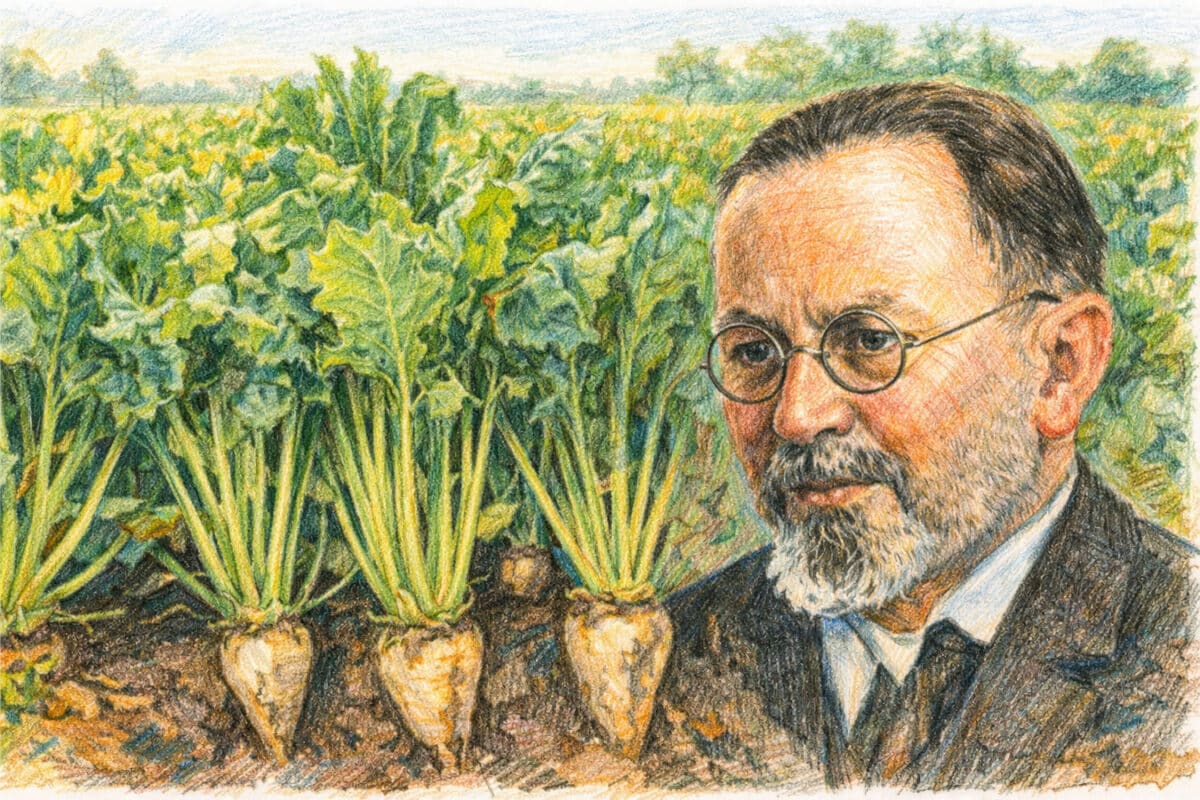
In the section “Jews from Ukraine” read the story of Solomon Frankfurt — a Jewish scientist and organizer of science, who in the early 20th century helped Ukraine build what today would be called “agro-innovation infrastructure”: laboratories, experimental fields, breeding stations, seed quality standards, and applied research tied to the real economy.
This biography (Ukr.) was compiled by Israeli author Shimon Brimanon the website Ukrainian Jewish Encounter. He writes about Frankfurt without romanticizing — as a person who spoke equally confidently in the language of chemistry, agricultural practice, and state decisions. And that is why in Ukrainian agricultural history, Frankfurt has a figurative nickname: the network of scientific centers around Kyiv was later called the “Temple of Solomon” — not in a religious sense, but as a metaphor for a “built system” that survived the change of eras.
Who is Solomon Frankfurt — briefly, but to the point
Jews from Ukraine: Solomon Frankfurt. “Temple of Solomon” near Kyiv: how a Jewish scientist promoted Ukraine’s agro-industry
Solomon Lvovich (Shlomo Meirovich) Frankfurt was born in 1866 in Vilno (now Vilnius). He received a European education and a doctorate in chemistry in Zurich, researching sugars in plants — a topic that directly intersects with Ukrainian beet growing and the sugar industry of the early 20th century.
But an “imperial career” for a Jewish scientist at the end of the 19th century often did not depend on abilities. Briman cites a telling episode: in 1898, Frankfurt was denied a professorship at the Moscow Agricultural Institute precisely because of his religion. In simple terms, it sounds like this: the road to universities is closed — so science must find a way through practice.
And Frankfurt found this way in Kyiv.
Kyiv: the laboratory from which the system grew
Moving to Kyiv was a turning point for Frankfurt. In 1901–1920 (Briman highlights this period as the most productive), he worked where science meets real production: sugar factories, agrochemistry, seed quality, yield.
Frankfurt headed the agrochemical laboratory of the Kyiv Agricultural Syndicate and began promoting what today seems obvious but was then new managerial thinking: seeds should not just be bought and sown, but checked, compared, improved, standardized. Science should measure results, not serve beautiful reports.
Briman emphasizes that from this laboratory over time grew a functioning scientific center at the specialized Institute of Agriculture. That is, it is not about a “flash of talent,” but about creating an institutional base: structure, people, methods, a habit of experimentation.
Experimental fields and fertilizers: work not in theory
Frankfurt did not confine himself to office chemistry. According to Briman, he participated in creating a network of experimental fields in several provinces — to test ideas not on paper, but in soil and weather. This is important: Ukraine is vast and diverse, and universal recipes in agriculture work poorly.
A separate direction was work with mineral fertilizers. At that time, it sounded like a “modernization tool” — an opportunity to increase yield and stabilize product quality. In the text, Frankfurt appears as a person who explained to producers and landowners: yes, it’s money, yes, it’s technology, but without it, the agro-economy will lag behind.
Briman essentially shows a “transition model”: from agriculture as a tradition — to agriculture as an industry where decisions are confirmed by data.
Myronivka and “Ukrainka”: when selection becomes part of the country
One of the key episodes is the organization in 1909 of the Central Research Station for Sugar Beet Culture near Myronivka. Briman writes that the station was supported by local sugar manufacturers: this is an important link between science and business, without which infrastructure usually does not survive.
Later, based on these initiatives, the Myronivka Breeding Station (today — the Institute of Wheat) appeared. And here Briman gives a detail that catches even people far from the agricultural topic: Frankfurt is credited with the authorship of the idea of naming the winter soft wheat variety “Ukrainka 0246.”
This is not a trifle. The name of the variety is a symbol that “Ukrainian” can be not only a political declaration but also a specific product of science: grown, tested, distributed.
Frankfurt and Ukrainian statehood: a choice that was not “neutral”
Briman shows Frankfurt as a person who did not hide from politics — although he was not a political tribune. During the Ukrainian revolution, Frankfurt participated in creating professional and scientific structures, worked in commissions, and dealt with what often remains behind the scenes: the institutional design of the industry.
The text contains a thought that Briman formulates harshly and without embellishments: “He believed in Ukrainian statehood more than many Ukrainians” — writes Briman.
Separately noted is the work under the Hetman government, where Frankfurt dealt with agriculture and food issues and participated in preparing agricultural legislation. That is, it was not “sympathy in words,” but involvement in managerial routine: documents, norms, rules.
Negotiations of 1918: economic diplomacy and sugar
There is also an international layer. Briman cites the position of historian Ruslan Piroh: Frankfurt twice represented Ukraine in complex economic negotiations with Germany and Austria-Hungary in 1918. The essence — the Ukrainian side defended economic conditions, including a fair price for Ukrainian sugar.
Briman emphasizes: it was not a “symbolic trip,” but negotiation work where each figure had political weight.
The text also mentions Frankfurt being awarded a German order — as a marker of recognition of his role in these contacts.
Emigration and World ORT: continuation of the Ukrainian biography in the world
After the defeat of the UNR, Frankfurt, according to Briman, refused to cooperate with the Bolsheviks and emigrated at the end of 1920. Then another part of life begins — but it logically continues the first: building a system, only now at an international level.
For decades, Frankfurt worked at World ORT — an organization engaged in technological education and support for artisans and farmers. Briman lists the cities and stages of ORT’s European work, and then the move to the USA. From 1947, Frankfurt became the president of World ORT.
He died in 1954 and was buried in New York State. But the Ukrainian trace in his biography did not disappear: Briman builds the line so that the reader sees — the experience of creating agricultural infrastructure in Ukraine became part of his broader, global project.
Why “Temple of Solomon” sounds especially poignant today
The metaphor “Temple of Solomon” Briman associates with the assessment of academician Viktor Vergunov: it is about the agricultural scientific centers of Ukraine created by Frankfurt, which worked even after him. The meaning of the metaphor is in the built “architecture of science”: when the system continues to function, even if the creator is long gone.
The finale with Briman is modern and very direct: he reminds that Jewish school No. 141 in Kyiv, operating under the aegis of ORT, is experiencing a difficult military winter — with shelling, power, and heat outages. The story of a person from the early 20th century suddenly turns out to be close to the reality of 2026.
Main conclusions for the section “Jews from Ukraine”
Frankfurt is an example of a Jewish intellectual who became part of the Ukrainian modernization project not with slogans, but with infrastructure.
His contribution is not one “loud idea,” but a habit of scientific verification, standardization, and systematic experimentation in agriculture.
During the Ukrainian revolution, he made a conscious choice in favor of Ukrainian statehood and worked in real managerial mechanisms.
His subsequent work at World ORT shows the continuation of the same logic: education, applied skills, community support — through institutions, not declarations.
The author is grateful to the employee of the World ORT Archive in London, Jennifer Brunton, for assistance in finding materials and providing a photograph of Solomon Frankfurt.
In April 2026, Ukraine reduced its export of dairy products, and the foreign exchange earnings of producers significantly decreased. As reported on May 19, 2026, by Delo ua citing the Milk Producers Association, the natural volumes of dairy product exports fell by 14% compared to March — to 10.75 thousand tons, and revenue decreased to 31.44 million dollars.
The main reason is not a collapse in demand for all Ukrainian products at once, but pressure on key categories, primarily butter. On the global market, butter prices have fallen due to an excess of raw materials in the EU, and this has hit Ukrainian processors.
For Israel, this story is particularly important: the country entered the top 10 buyers of Ukrainian dairy products. According to data provided by Delo.ua, Israel imported Ukrainian dairy goods worth 4.61 million dollars and became one of the significant external markets for Ukraine.
Exports fell: what figures does April show
In April 2026, Ukraine exported 10.75 thousand tons of dairy products. This is 14% less than in March. In monetary terms, exports brought in 31.44 million dollars.
Compared to April 2025, the picture is also negative: natural export volumes decreased by 12%, and foreign exchange earnings — by 17%.
In the first four months of 2026, Ukraine shipped abroad 41.31 thousand tons of dairy products worth 112.91 million dollars. Compared to the same period last year, this is 5% less in volume and 14% less in money.
So the problem is not just in one month. The market is experiencing a broader price and structural shift, where volumes are moderately declining, and revenues are falling more sharply.
What Ukraine sold abroad
In the export structure for April 2026, condensed milk and cream were in first place — 26%. Next came ice cream with a share of 22%, cheeses — 17%, butter — 15%, casein — 6%.
Growth compared to March was recorded in only two categories. The export of fermented dairy products increased to 641 tons, which is 5% more than the March figure. Ice cream supplies rose to 1.85 thousand tons, adding 35%.
For other positions, exports were declining.
In the annual comparison, there are also positive signals. Compared to April 2025, the supply of fermented dairy products, cheeses, and ice cream increased. Foreign exchange earnings also increased in several categories: fermented dairy products, whey, cheeses, and ice cream brought in more money than a year earlier.
But this was not enough to offset the overall market decline.
Why Ukraine’s dairy export fell
The key blow was to butter. According to USDA data, high milk yields in the EU at the beginning of 2026 led to an excess of milk, and then to a price correction for butter and cheeses. European warehouses began accumulating butter, and traders’ interest in Ukrainian supplies decreased.
For Ukraine, this is painful because about 40% of raw milk is processed into butter.
Ukrainian factories mainly operate in two directions: they produce whole milk products for the domestic market and produce dry milk and butter for export. But domestic demand is shrinking, and export categories often have low margins.
This results in double pressure. Inside the country, the consumer market is limited by war, population income, and competition. Outside, Ukrainian companies face a saturated European market and falling prices for key goods.
Imports also pressure Ukrainian producers
A separate problem is the import of dairy products into Ukraine. In April, it amounted to 5.61 thousand tons, which is 18% less than in March, and 2% less than in April 2025.
But if you look at the period January–April 2026, imports reached 22.57 thousand tons worth 111.27 million dollars. In natural terms, this is 10% more than in the same period last year.
A particularly sensitive category is cheeses. Their share in imports is 63%. This limits the demand for Ukrainian products within the country and pressures purchase prices.
According to the Milk Producers Association, protective measures are needed to stabilize the market against uncontrolled imports from Europe. Otherwise, Ukrainian producers will simultaneously lose margins in foreign markets and lose positions at home.
NANews — Israel News | Nikk.Agency notes: for the Israeli audience, this topic is important not only as economic statistics of Ukraine. Israel itself is among the buyers of Ukrainian dairy products, which means changes in Ukrainian agro-exports can also reflect on the Middle Eastern trade direction.
Israel among buyers: who entered the top 10 markets
The main market for Ukrainian dairy products remains Moldova. It occupies the first place by a large margin: the export volume there amounted to 28.12 million dollars.
In second place is Poland with an indicator of 12.82 million dollars. The third position is occupied by Germany, where products worth 10.82 million dollars were supplied.
Next are Kazakhstan — 5.96 million dollars, Azerbaijan — 5.31 million dollars, Syria — 4.72 million dollars, and Bulgaria — 4.66 million dollars.
Israel took eighth place with imports of Ukrainian dairy products worth 4.61 million dollars. After it in the ranking are Georgia with 3.93 million dollars and the USA with 3.77 million dollars.
What this means for Ukrainian business
Israel’s entry into the top 10 buyers shows that Ukrainian dairy products maintain positions not only in neighboring markets but also in more complex directions.
The Israeli market is demanding in terms of quality, logistics, standards, and supply stability. For Ukrainian companies, this is not the easiest path, but it is important: there is demand from repatriates from Ukraine, the Ukrainian community in Israel, as well as a broader consumer who chooses products based on price, taste, and availability.
At the same time, current figures show: mere presence in foreign markets is not enough. Ukrainian producers need to maintain margins, develop value-added products, depend less on raw material fluctuations, and find a balance between mass categories and more profitable niches.
Where there is growth despite the decline
Even against the backdrop of a general decline, certain segments show resilience. Ice cream in April grew by 35% compared to March in natural volumes, and revenue from it increased to 6.91 million dollars, adding 41%.
Fermented dairy products also demonstrated growth. Their export increased both in natural terms and in revenue. In the annual comparison, this category grew by 51% in volumes and by 38% in money.
This is an important signal for the market. Ukrainian dairy exports should not be viewed only through butter and dry milk. More ready-made products, recognizable categories, and goods with higher added value can become a direction where producers will be less dependent on world raw material prices.
For now, the April statistics show a cautious picture. Ukraine maintains external markets, including Israel, but earns less due to falling prices and import pressure. For the dairy industry, this means a period of complex restructuring: simply selling more is no longer enough, it is necessary to sell smarter, more expensively, and more stably.
Aaron David Gordon – Ukrainian Jew, philosopher and ideologist of working Zionism. His ideas inspired the youth in Alia and the creation of kibbutsev in Palestine. The history of the path from the Zhytomyr region to Dgania in our constant column “Jews from Ukraine“.
Childhood and youth in Troyanov
Aaron David Gordon Born on June 9, 1856 in The town of Troyanov (Modern Zhytomyr region, Ukraine) in a wealthy Jewish family. His childhood passed among traditional Jewish values. Due to poor health, a private teacher was engaged in him. Later, Gordon independently learned Russian, German and French, received a wide education and studied for a year in Vilna.
Troyanov of that time was a typical place with the Jewish population, which made up a significant part of the inhabitants. According to the 1897 census, 7224 people lived in Troyanov, of which 1469 Jews. The Jewish community Troyanov owned two synagogues and supported active religious and cultural life.
The story of Troyanov
Troyanov is mentioned as a place with a rich history. In the XVIII century, a significant Jewish community already existed here. There was a synagogue in the village, a Jewish prayer house, a church and two Orthodox churches. In the XIX century in Troyanovo there were:
Brovarnya (brewer)
Garbarny (leather production)
136 artisans
28 stores
The total population in 1897 was 7224 people, of which 4957 were Orthodox, and 1469 – Jews.
Jewish cemetery Troyanov
The Jewish cemetery of Troyanov is an important historical monument. About 250 tombstones have been preserved on its territory. The oldest tombstone dates from 1858, and the last – 1991.
Main data on the cemetery:
Location: Northeast outskirts of the village of Troyanov
Perimeter length: 314 meters
State: non -coniferous, partially overgrown with vegetation
Coordinates: 50.11655, 28.54232
Problems of saving the cemetery
There is no fence on the territory of the cemetery. Many tombstones need restoration, and the site requires cleaning from seasonal vegetation. Despite this, the cemetery remains an important witness to the history of the Jewish community of Troyanov.
Periods of tragedies and recovery
During the revolution of 1905-1907, the Jewish community of Troyanov was attacked. More than a dozen Jews were killed, and property was looted. In 1941, after the Nazis arrived, Jews who did not manage to evacuate were shot.
Today, the Jewish cemetery of Troyanov is a reminder of the rich past of the community, its tragedies and a contribution to the history of the region.
Life before resettlement to Palestine
After Gordon was released from service in the army for health reasons, he married and 23 years old worked as a clerk for his relative, Baron G. O. Ginzburg, in the village of Mogilna. However, the death of parents in 1904 changed his fate. Gordon decided to move to Palestine.
Despite the lack of experience of physical labor, he chose agricultural work on vineyards and orange plantations of Petes-Tikva and the Vinnoye Plant of Rishon-Leo-Sta. This hard work affected his health, and soon his family had to take care of him.
The beginning of literary activity
Since 1909, Aaron David Gordon began writing articles for the Ha-Poel Ha-Tsair magazine. In them, he promoted the ideas of labor as the foundations of the Jewish national revival. He believed that only through work Jews can conquer the right to land of Israel.
Gordon Quote:
“Labor is not only a means of survival, but also the path to spiritual revival and freedom.”
Relocation in Galilee and participation in the Zionist Congresses
In 1912, Gordon moved to Galileo, where he continued to work as an agricultural worker. In 1913, he participated in the XI Zionist Congress in Vienna, and in 1920-in the conference of the Ha-Poel Ha-Tsair movement in Prague.
After the outbreak of World War I, he was persecuted by the Turkish authorities. Despite the difficulties, he continued his literary and public works.
“Gordonia” – the legacy of Aaron David Gordon
Gordon’s ideas inspired the youth of Eastern Europe, where Jewish communities faced anti -Semitism, economic difficulties and lack of prospects. In 1923, groups of young Jews began to form in Galicia, striving for spiritual and national revival. These groups were looking for an alternative to radical ideologies that dominated in other movements.
In 1925, Gordonia officially took shape in Krakow, and its central department was in Lviv. The movement promoted Aliya in the dandective Palestine and prepared young people for agricultural work. The main tasks of Gordonia were:
Preparation of youth for Alia.
The development of agricultural skills.
The study of Hebrew.
The participants in the movement, mostly immigrants from poor families, sought to build the future with their own hands. By 1928, Gordonia totaled more than 4,000 participants. Young people were preparing to relocate to Eretz Israel, where they could put their ideals in practice. In 1929, the mass Aliyah of the members of Gordonia began, which became an important milestone in the history of movement. Participants actively created agricultural kibbuts in Eretz Israel.
The main kibbuts founded by the Participants of Gordonia:
The name of the kibbutz
Year of foundation
Description
Hulda
1909
One of the first kibbutsev in Eretz Israel
Hanita
1938
Known for his contribution to the defense of Galilee
Maale-Hamisha
1938
Kibbutz founded by immigrants from Eastern Europe
Where Aaron David Gordon died and was buried and buried
Aaron David Gordon died on February 22, 1922 in Kibbutz Dgania-Alef from cancer. He was buried there, in Dgania-Alef, one of the first kibbutsev, who became a symbol of the Zionist labor movement.
Memory of Aaron David Gordon in Israel
Museum in the kibbutz Dgania-Alef: The museum is dedicated to the life and works of Gordon, where his personal belongings, manuscripts and documents are presented.
Streets and squares: In several cities of Israel, including Tel Aviv and Haifa, the streets have his name.
Educational programs: His ideas are studied in schools and universities in the context of the history of Zionism and the labor movement.
Movement “Gordonia”: Although the movement has united with other organizations, the memory of Gordon lives through cultural events and history lessons.
“House of Gordon” (בית גורוון) – history, exposition and significance
“Gordon’s House” is one of the first museums in Israel dedicated to nature and life history in the Kineret region. It was founded in 1941 in Kibulu Dgania-ALEFIn order to perpetuate the memory of Aaron David Gordon – a philosopher, a labor Zionist and the first defender of nature in Palestine.
The museum combines Natural exposition, Archaeological finds and materials on the history of the first settlers in the region.
The main sections of the museum:
Natural studies of the Kineret region The exposition covers the variety of flora and fauna of Galilee and the environs of Lake Kineret. The museum’s halls represent a stuffed of rare birds and animals, collections of minerals, herbarium of local plants and fossils.
Multimedia installation The new interactive hall allows visitors to plunge into the history of the development of the region through animation. It shows how the environment of Kineret has changed from the beginning of the Zionist settlement to the present day.
Archaeological finds The exhibition contains household items and instruments of the first Jewish settlers used in agricultural work. Archaeological artifacts talk about the ancient history of Galilee.
History of Kibutz Dgania-Alef This section is dedicated to the history of the creation of the first kibbutz in Palestine and the roles of Aaron David Gordon in the formation of labor Zionism. Visitors can see Gordon’s personal belongings, his manuscripts and documents reflecting his life and activity.
Educational programs and excursions
The museum offers Educational programs for schoolchildren and studentsorganizes excursions across the territory of Kibbutz and the surroundings. Particular attention is paid to the history of the early Zionist movement and the ecology of the region.
Recognition by national heritage
In 2010, the Israeli government recognized the “Gordon House” by a national monument. This is not only a cultural and historical center, but also an important place for those who want to understand how nature and man coexist in Galilee.
NAnews : Aaron David Gordon’s heritage today
The history of Gordon is not only a part of Jewish history, but also an important link in the relationship between Israel and Ukraine. Today, his name reminds us of the strength of the spirit and the meaning of labor. Persons such as Aaron David Gordon became a bridge between two cultures.
Website Nanovo He continues to cover the events and stories that connect Ukraine and Israel, talking about the Jewish roots and the paths that our ancestors passed.
Conclusion
Aaron David Gordon is an example of a person who, despite difficulties, managed to become a symbol of the whole movement. His life and ideas continue to inspire many, and the history of Gordonia remains an important part of Zionist history.
Today, when we are talking about Jews from Ukraine, such as Gordon, we are again convinced of the deep connection of our peoples. On NAnews The news of Israel and Ukraine, we continue to tell such stories that the memory of them lives and inspire new generations.
In the heading “Jews from Ukraine”: Aaron David Gordon – Ukrainian roots of the ideologist of Zionism and the story of “Gordonia”
The question of Belarus potentially joining the war against Ukraine is once again returning to the international agenda. Minsk is showcasing military warehouses, Lukashenko is demonstratively speaking with generals, Russian propaganda is raising the topic of a new strike from the north, and Ukraine and its allies are closely monitoring any changes at the border.
The main question remains the same: is Belarus really ready to fight against Ukraine, is a repeat march on Kyiv possible in 2026, and who benefits from constantly keeping this threat in the information field.
For the Israeli audience, this topic is important not only as part of Russia’s war against Ukraine. It shows a broader mechanism of pressure: Moscow uses allies, proxy regimes, military threats, and nuclear hints just as Iran and its partners use tension around Israel.
Why the Kremlin is talking about Belarus and the northern front again
The topic of Belarus’s participation in the war against Ukraine has been discussed for more than a year. Since the beginning of the full-scale invasion, Russia has regularly tried to create the impression that a strike from the north could begin at any moment.
Experts believe that such an information campaign is primarily beneficial to Moscow.
Firstly, it is pressure on Ukraine. Kyiv is forced to consider the northern direction, keep forces there, monitor troop movements, and not remove the risk of a repeat attack from the agenda.
Secondly, it is pressure on Lukashenko himself. Putin needs not only Belarusian territory as a military base but also deeper involvement of Minsk in the war. Lukashenko, meanwhile, has been maneuvering for many years: helping Russia, providing infrastructure, playing the ally, but avoiding direct involvement of his army in combat operations against Ukraine.
That is why noise is regularly created around Belarus. It does not always mean preparation for an immediate offensive, but Ukraine cannot completely ignore it either.
Why the northern direction remains sensitive
From a military point of view, opening the northern front would give Russia additional opportunities. It would force Ukraine to redistribute resources, complicate defense, and create a new threat to Kyiv, Chernihiv, Sumy, and Volyn regions.
But the Kremlin’s desire does not necessarily mean the availability of resources.
A large-scale operation requires trained troops, equipment, logistics, ammunition, management, and Belarus’s political readiness for direct participation in the war. According to experts, there are currently no signs of such a full-fledged resource on Belarusian territory.
The Kremlin is betting on 2026 but faces a lack of forces
The Russian army continues attempts to activate hostilities on various sections of the front. Putin still strives to implement his concept of capturing four Ukrainian regions that Russia illegally included in its own constitution: Luhansk, Donetsk, Zaporizhzhia, and Kherson.
The main focus remains on the Donetsk region.
The Luhansk region is almost completely occupied. In the Zaporizhzhia direction, Russia is also trying to increase pressure. In the Kherson region, the enemy has many more problems: there are not enough forces for a full-fledged advance, and the geography of the front complicates offensive actions.
Separately, Russia is trying to create so-called ‘buffer zones’ in the border areas of Ukraine. This concerns the Sumy, Kharkiv, and Chernihiv regions. Meanwhile, in Chernihiv, Moscow mainly limits itself to air strikes because a ground operation would require additional resources.
This is where the main limit of Russian strategy manifests: the Kremlin wants to expand the war but does not always have sufficient military potential for it.
What this means for Ukraine and Israel
Ukraine already lives under the constant threat of front expansion. Israel understands this logic well: when the enemy cannot quickly win in one direction, it tries to create pressure in several points at once — military, diplomatic, informational, and psychological.
In this context, NANews — Israel News | Nikk.Agency considers the Belarusian factor not as a separate episode but as part of a broader model of behavior of authoritarian regimes. Russia tries to exhaust Ukraine with the fear of a new front, just as Israel’s enemies often try to stretch the country’s attention between Gaza, Lebanon, Syria, Iran, and international pressure.
For Kyiv, the main task is not to panic but also not to relax.
Ukrainian and partner intelligence continue to monitor the situation. So far, according to experts, no changes have occurred over the years of war that would indicate Belarus’s readiness to immediately join the war with a full-fledged army.
Repeat march on Kyiv, the Baltics, and nuclear threats: where is the real risk
Theoretically, Putin has not abandoned the idea of pressure on Kyiv. For the Kremlin, the Ukrainian capital has symbolic significance. In Russian logic, capturing Kyiv would break Ukrainian statehood and open the way to political control over the country.
But the reality of the war destroyed this plan back in 2022.
The Russian army could not take Kyiv in three days and in the following years could not capture any new regional center of Ukraine. Therefore, a repeat large-scale march on the capital would require much greater forces than those Russia currently possesses.
Experts also point to the losses of the Russian army. If the enemy spends more manpower on the front than it can regularly replenish, organizing new large-scale offensive operations becomes more difficult. People are only part of the problem. Equipment, weapons, ammunition, trained commanders, and working logistics are needed.
Belarus has another weakness — the lack of its own real combat experience.
Ukrainian and Russian military personnel have gained extensive experience in modern warfare. The Belarusian army does not have such experience. Yes, Russian instructors and former structures like ‘Wagner’ could train Belarusian military personnel, but this is not equivalent to full participation in a large war against a motivated and prepared Ukrainian army.
Why the threat may concern not only Ukraine
There is another scenario. If Putin cannot achieve a decisive result in Ukraine, he may try to shift the tension to NATO — not necessarily through a full-scale war, but through a hybrid crisis.
In this case, the Baltic countries or the Suwalki Corridor area may be at risk. Belarus in this scheme can be used as a territory of pressure, demonstrations, provocations, or limited actions.
This does not mean that such a scenario is inevitable. But it explains why the topic of Belarus regularly returns to the information field. Moscow can use it not only against Kyiv but also against European security as a whole.
A separate part of this campaign is statements about nuclear exercises in Belarus. Minsk talks about preparations with the use of tactical nuclear weapons, but experts consider such statements primarily an element of intimidation.
Belarus does not control its own nuclear weapons. Russia could place infrastructure there, modernize aircraft, transfer Iskander complexes, but the real decision on the use of nuclear weapons remains in Moscow’s hands. Even for the Kremlin, such a step carries enormous risks, including the reaction of China and other major players.
Therefore, nuclear hints in the Belarusian execution look more like psychological pressure than a sign of imminent use of nuclear weapons.
The main conclusion remains sober: the threat from Belarusian territory exists and must be under constant control. But turning it into daily panic is beneficial precisely to Russian propaganda.
It is important for Ukraine to keep its focus on the main front, strengthen defense, increase its own potential, and not allow Moscow to control the agenda through fear. For Israel, this plot is also understandable: when the enemy cannot win quickly, it starts to fight with nerves, expectations, and threats.
The documentary play “Mariupol Drama / (orig. Ukr. “Маріупольська драма”)“ is being brought to Israel in early June 2026. This is a theatrical project created by surviving actors of the bombed Mariupol Theater — a production about the events of February–March 2022, where, as stated in the description, “there is no conjecture — only truthful reality.”
The text of the poster emphasizes: the Russian airstrike on the drama theater building in Mariupol became one of the most tragic war crimes. Even two large inscriptions “CHILDREN” on both sides of the building, as stated in the announcement, did not stop the strike.
Tickets for “Mariupol Drama” are already available —
What the production is about and why it is structured as a “testimony”
“Mariupol Drama” in Israel: a play by surviving actors of the Mariupol Theater — tour June 1–6, 2026
On stage are the eyewitnesses themselves — Mariupol actors who play not fictional characters, but themselves. During the blockade days, they were in the theater building and, along with those who took shelter there, experienced the siege of the city.
The action begins with the heroes introducing themselves to the audience, after which the play unfolds as a “chain of extremely tense events.” According to the poster text, the viewer also becomes a participant in what is happening — this is an important part of the director’s decision.
The production uses:
personal belongings of the actors, which they managed to take out of the shelter;
video and photo materials shot during the blockade.
And here it is important to explain why we are even posting this poster on the site: for the Israeli audience, such tours are not just a “cultural event on the calendar,” but a form of memory and conversation about the war, which in Israel is also felt very closely, through people, families, repatriation, aid to Ukraine, and personal stories. Therefore, NAnews — News of Israel | Nikk.Agency publishes this announcement as a testimony — so that in Israel they know that they can come, hear live eyewitnesses, and support the conversation about what happened in Mariupol.
After the performance, a creative meeting of the troupe with the audience is planned.
Authors, troupe, and production team
The play was written by Ukrainian writer and playwright Oleksandr Havrosh — based on collected testimonies.
The play was directed by Yevhen Tyshchuk, who, as stated in the description, decided to tell the world the truth about the war crime through the prism of theatrical art and preserve the memory of the victims of Mariupol.
Actors: Vera Lebedinska, Olena Bila, Ihor Kitrysh, Matviy Kitrysh.
Director and production team (according to the poster):
playwright — Oleksandr Havrosh
director — Yevhen Tyshchuk
musical director — Hennadiy Dibovsky
choreographer — Hennadiy Dibovsky
sound — Oleksandr Frolov
lighting — Hennadiy Dibovsky
video engineer — Lidiya Krasnovska
costumes, makeup — actors
Theater after Mariupol
The poster separately states: after the destruction of the building in Mariupol, the troupe moved to Uzhhorod (Western Ukraine), and the theater was renamed “THEATER WITHOUT A ROOF”. Chief director and artistic director — Hennadiy Dibovsky.
Language, duration, age
the production is in Ukrainian with Russian subtitles;
duration — 1 hour 20 minutes;
12+.
Tour schedule in Israel (June 1–6, 2026)
City
Date
Time
Venue
Remaining seats (according to the poster)
Price
Ashkelon
Mon, 01.06.2026
19:00
Congress Center — Theater Hall
509
196–256 ₪
Haifa
Tue, 02.06.2026
19:00
Beit-Nagler, Kiryat Haim, Ben Zvi St., 14
491
186–266 ₪
Ramat Gan
Wed, 03.06.2026
19:00
Theater a-Ya’alom
550
196–266 ₪
Netanya
Thu, 04.06.2026
19:00
Arik Einstein Auditorium
328
196–276 ₪
Rishon LeZion
Fri, 05.06.2026
17:00
Mofet
356
196–276 ₪
Ashdod
Sat, 06.06.2026
20:00
Matnas Duna-Yud
395
196–276 ₪
Tickets
Tickets for “Mariupol Drama / Маріупольська драма” are already available —
What happened in Mariupol: dates and figures to understand why it is called terror
After the start of Russia’s full-scale invasion of Ukraine on February 24, 2022, Mariupol quickly found itself under siege. The city systematically lost basic necessities: water, heat, communication, access to medicine. People went into basements and sought shelter in large buildings — where at least there were walls and a chance to survive the shelling.
One such shelter became the Donetsk Academic Regional Drama Theater in Mariupol. Civilians flocked there — hundreds of people, including children. In front of the building, the word “CHILDREN” was written in large letters on the ground — on both sides, so it would be visible from the air. This was a maximally direct designation: civilians inside.
What happened in Mariupol: dates and figures to understand why it is called terror
Key date of the strike
Around this tragedy, specifics are important:
March 16, 2022, an airstrike was carried out on the theater building.
As a result, the theater was destroyed, and people inside were trapped under the rubble.
How many people were in the theater
Due to the blockade conditions, an exact count is impossible, but in testimonies and reports, one thing is constantly mentioned: there were hundreds of civilians in the building, and in some estimates — up to 1,000+ people, because the theater became one of the largest shelters in the city center.
How many died
There is also a range with exact numbers, but it still speaks of one thing — this is a mass death:
an estimate of about 300 dead is often mentioned (voiced by Ukrainian sources);
separate investigations and reconstructions of events mentioned a figure of about 600 and more;
some organizations emphasized: the confirmed minimum is lower, but the real number is likely significantly higher, because many remained under the rubble and a full check was not immediately possible.
So we are not talking about “dozens,” but about hundreds.
Why it is called terror against civilians
Because the strike hit a place that:
was a civilian shelter,
was marked “CHILDREN” and therefore clearly indicated the presence of civilians,
was in a city where people almost had no options for salvation.
When a shelter with the inscription “CHILDREN” is destroyed, it is perceived not as a “mistake,” but as a demonstration of the principle: there are no safe places. This is how terror works as a method of war — intimidation and breaking civilians through a strike on the most vulnerable, so that fear becomes a weapon.
Tickets for “Mariupol Drama / Маріупольська драма” are already available —
Ukraine → Israel: 15 points Israel → Ukraine: 4 points
…
Difference: Ukraine gave Israel 11 points more than Israel gave Ukraine.
Eurovision 2026 in Vienna once again became not only a music contest but also a major political and cultural test for Europe, Israel, and Ukraine. Formally, songs, voices, performances, and artistry competed on stage. But behind the scoreboard, war, boycotts, public sympathies, jury caution, and that very audience voting, which often disrupts expert and bookmaker predictions, emerged again.
Israel once again took second place. Once again, the boycott did not work as its supporters had hoped. Once again, the audience was more generous than the professional juries, although in 2026 the gap between them was not as sharp as the year before.
Noam Bettan received 343 points: 123 from the jury and 220 from the audience. Ukraine with LELÉKA and the song Ridnym took ninth place, scoring 221 points. Bulgaria won with 516 points.
That is why the final is important not only as another entry in the history of the contest. For the Israeli audience, it is a story of how the country once again withstood pressure. For the Ukrainian audience, it is about how Ukraine’s voice remains heard but is already facing the fatigue of the international audience and the caution of the jury.
Israel again second: the jury became more generous, the audience remained the main support
The main figure for Israel is 343 points and second place. This is already a strong result in itself, especially against the backdrop of boycott campaigns, protests, and attempts to turn Israel’s participation into a political scandal.
But if you break down the result into parts, the picture becomes more interesting.
In 2026, Noam Bettan received 123 points from the jury. This is more than twice the result that Yuval Raphael received from professional commissions the year before: 123 versus 60.
At the same time, audience support, although still very high, was no longer as absolute as the previous year. Noam received 220 points from the public. The year before, the Israeli result was based on a significantly stronger audience wave.
In 2026, Israel received points from the jury of 22 out of 34 countries. For comparison: the previous year, Israel received points from the judges of 14 out of 39 countries. So the jury did not become completely friendly but stopped looking like an almost closed wall.
Jury voting for Israel — 123 points
Professional juries distributed points to Israel as follows:
Poland — 12
Ukraine — 10
Moldova — 10
Albania — 8
Austria — 8
Lithuania — 8
Armenia — 7
Bulgaria — 7
Denmark — 7
Georgia — 6
Romania — 6
Croatia — 5
Azerbaijan — 4
France — 4
Malta — 4
San Marino — 4
Serbia — 4
Germany — 3
Czech Republic — 2
Switzerland — 2
Belgium — 1
Norway — 1
Who did not give Israel points from the jury: Estonia, Latvia, Luxembourg, Montenegro, Portugal, Greece, Australia, United Kingdom, Finland, Sweden, Cyprus, Italy, and ‘the rest of the world’, meaning votes cast by countries not participating in the contest.
Particularly notable here are Ukraine and Moldova. Ukraine gave Israel 10 points, although the year before it gave only 2. Moldova gave Israel nothing the previous year but now gave 10.
Israel received only one highest score — 12 points from Poland. The previous year, the only 12 points from the jury to Israel came from Azerbaijan. Then no one gave 10 points, and France and Ireland gave 7 points each.
Audience voting for Israel — 220 points
Audience voting once again became Israel’s main resource. Noam Bettan received 220 points from the public.
France — 12
Azerbaijan — 12
Germany — 12
Switzerland — 12
Portugal — 12
Finland — 12
Albania — 10
Georgia — 10
United Kingdom — 10
Moldova — 8
Belgium — 8
Italy — 8
Cyprus — 8
Austria — 7
Armenia — 7
Malta — 7
Sweden — 7
Romania — 6
Rest of the world — 6
Ukraine — 5
Bulgaria — 5
Norway — 5
Greece — 5
Czech Republic — 5
Serbia — 4
Montenegro — 4
Latvia — 4
San Marino — 3
Poland — 2
Denmark — 2
Luxembourg — 1
Estonia — 1
Who did not give Israel points from the audience: Australia, Lithuania, and Croatia.
In the audience voting, Israel received 12 points from six countries. This is exactly half as many as the year before. But even such ‘reduced’ support turned out to be huge against the backdrop of pressure, boycott calls, and attempts to portray Israel as a country that the European public is supposedly ready to completely reject.
For the second year in a row, the maximum to Israel was given by Germany, Azerbaijan, France, Switzerland, and Portugal. The previous year, the countries that gave Israel 12 points also included Spain and the Netherlands, but in 2026 they boycotted the contest.
Australia as the strangest episode
Australia stands out separately. The previous year, Australian viewers gave Israel the highest score — 12 points. In 2026, Australia was the only country that did not give Israel a single point from either the jury or the audience.
At the same time, Israel voted very generously for Australia: the Israeli jury gave Australia 12 points, and Israeli viewers gave 10.
This asymmetry is particularly noticeable. The Australian jury’s voting can still be explained by the general atmosphere in the country and strong pro-Palestinian sentiments in the public sphere. But zero from the audience after last year’s 12 points looks not just like a change in musical preferences but a sharp public turnaround.
For Israel, this is an important signal: even where there was strong audience support yesterday, the situation can change quickly.
Ukraine and Israel: how they voted for each other
A separate line of the final is the mutual voting of Ukraine and Israel. It is here that the dry scoreboard becomes particularly sensitive because behind it are not only music and stage performance but also relations between societies, memory, war, diaspora, and the expectation of mutual support.
Ukraine gave Israel significant points.
The professional jury of Ukraine gave Noam Bettan 10 points. This is one of the highest scores Israel received from national juries in the final. Only Poland was higher with 12 points.
Ukrainian viewers also supported Israel, but more restrainedly — 5 points. For a final where there was a campaign of pressure and boycott around Israel’s participation, this is still an important signal: the Ukrainian audience did not nullify Israel and did not follow the logic of complete rejection.
On the Israeli side, the picture was different.
Israeli viewers gave Ukraine 4 points. This means that the Ukrainian entry LELÉKA with the song Ridnym was noticed and received support from part of the Israeli public but did not enter the main favorites of the Israeli televoting.
However, the Israeli jury did not give Ukraine any points. The previous year, the Israeli jury gave Ukraine 4 points, and in 2026 — zero.
Against the backdrop of the Ukrainian jury giving Israel 10 points, this moment is particularly noticeable.
Ukraine supported Israel more strongly than Israel supported Ukraine
If you look only at the numbers, an unpleasant but important asymmetry arises: Ukraine supported Israel more strongly than Israel supported Ukraine.
Ukraine to Israel – 15 points:
jury — 10 points;
audience — 5 points.
Israel to Ukraine – 4 points:
jury — 0 points;
audience — 4 points.
For the Ukrainian community in Israel, for repatriates from Ukraine, for Ukrainians who permanently reside in Israel, and for those who found themselves in the country after Russia’s invasion in 2022, such a difference may be perceived painfully. On a human level, Ukraine and Israel often seem closer than what the professional voting table showed.
But “Eurovision” is arranged in such a way that public sympathy, political context, and jury decisions do not always coincide. Sometimes viewers vote with their hearts, while the jury votes based on their own professional, taste, or cautious criteria. As a result, a gap arises, which is then discussed not as a musical detail, but as a symbol of attitude.
NANews — Israel News | Nikk.Agency considers the final not as an easy musical chronicle, but as a mirror of how Israel, Ukraine, and Europe simultaneously vote with music, memory, fear, habit, and political background. When the Ukrainian jury gives Israel 10 points, and the Israeli jury gives Ukraine nothing, it is not necessarily a diplomatic signal. But it is definitely a reason to closely watch how cultural ties manifest in public tables.
Ukraine in the final: ninth place and 221 points
In 2026, Ukraine performed with the song Ridnym. LELÉKA brought a number to the stage with a bandura, ethnic motifs, the theme of home, and the internal pain of a country that continues to live under the blows of Russia.
Ukraine took ninth place, scoring 221 points.
Of them:
167 points — from viewers;
54 points — from the jury.
It was the viewer support that became the basis of the Ukrainian result. Professional juries were significantly more restrained, and this caused discussion among the Ukrainian audience.
The highest score from the professional jury Ukraine received was from Switzerland — 12 points.
Ukraine was also supported by:
United Kingdom — 7 points;
France — 6 points;
Italy — 7 points;
Azerbaijan — 10 points;
Latvia — 7 points;
Portugal — 3 points;
Romania — 1 point;
Poland — 1 point.
At the same time, 24 countries did not give Ukraine a single point from the national jury. Among them are Sweden, Germany, Georgia, Australia, Israel, Austria, Greece, Belgium, Finland, Bulgaria, and others.
For Ukraine, this is not a failure. Ninth place at “Eurovision” is a strong result. But against the backdrop of the military context, emotional performance, and audience expectations, it is perceived more complexly: viewers supported Ukraine much more strongly than professional commissions.
Why the Ukrainian result is important for Israel
For the Israeli audience, the Ukrainian result is not just a neighboring line in the table. Ukraine and Israel in recent years have increasingly found themselves in a similar situation on international cultural platforms: their participants are evaluated not only as artists but also as representatives of countries around which there is war, diplomatic dispute, and informational struggle.
Ukraine lives under the blows of Russia. Israel, after October 7 and the war in Gaza, faces attempts at cultural pressure and exclusion.
These situations are different in nature, but on the “Eurovision” stage, both countries find themselves inside one mechanism: the viewer hears the song, but at the same time sees the flag, news, pain, political background, and their own ideas of justice.
In 2026, Ukraine showed that its cultural voice remains audible. But it also faced the fact that emotional strength alone is no longer enough for automatic entry into the top three. In the fourth year of Russia’s great war against Ukraine, the international audience still reacts, but not as it did in the first months of the invasion.
For Israel, there is also a lesson in this. Viewer support can be huge, but it is not eternal and not guaranteed. It needs to be maintained not only with symbols but also with the quality of performance, a clear story, a strong stage, and an accurate hit in the mood of the audience.
What the whole table showed: boycott, viewers, jury, and the Israeli series of recent years
Bulgaria’s victory became a separate story of the final. The representative of Bulgaria received 516 points and took first place. Against this result, Israel with 343 points was second, and Ukraine with 221 points was ninth.
But in a political sense, the main question was not only the first place.
The main question sounded differently: did the boycott manage to break Israel’s participation?
The answer of the table is no.
Israel not only remained in the competition. It again found itself in second place. Moreover, the country received strong viewer support even from countries where the anti-Israel agenda sounds loud and aggressive.
Traditionally high was the voting for Israel in countries that are often considered pro-Palestinian in public atmosphere. That is why it would be especially interesting to see how the Netherlands, Ireland, and Spain would have voted if they had participated in the competition. Last year the reaction there was stormy, and in 2026 these countries boycotted the competition.
United Kingdom and a new wave of irritation
A separate intrigue is the United Kingdom. Its performer received only 1 point and took last place. After such a result, accusations of a political conspiracy and attempts to explain the failure through external forces have already appeared in local discussions.
It will not be surprising if next year in the United Kingdom voices for boycotting Israel increase. For part of the European public, it is often easier to explain their own failure with politics than with a weak song, unsuccessful staging, or lack of contact with the viewer.
But this is exactly what makes “Eurovision” so indicative. There simultaneously exist music, show, national complexes, political campaigns, diasporas, grievances, and real viewer sympathies.
How Israel voted
Israel also distributed its points in a revealing way.
Israel jury voting:
12 points — Australia;
10 — Denmark;
8 — Bulgaria;
7 — Finland;
6 — Moldova;
5 — Greece;
4 — Romania;
3 — Italy;
2 — Belgium;
1 — Albania.
Israel viewer voting:
12 points — Bulgaria;
10 — Australia;
8 — Moldova;
7 — Italy;
6 — Denmark;
5 — Greece;
4 — Ukraine;
3 — Romania;
2 — France;
1 — Albania.
Here Ukraine stands out again. Last year Israeli viewers gave Ukraine 12 points, and in 2026 — only 4. The Israeli jury last year gave Ukraine 4 points, and now gave none.
This means the decline in support for Ukraine from Israel occurred on two lines: among viewers and the jury.
This does not mean a lack of sympathy between societies. But it shows that in the competition, sympathy does not always turn into a high score, especially when there are many strong numbers on stage, and each audience has its own emotional favorites.
Israeli series: 2023, 2024, 2025, 2026
The result of Noam Bettan continued the strong Israeli series of recent years.
In 2023, Noa Kirel took third place with the song Unicorn, scoring 362 points. Of them, 185 points came from viewers and 177 from the jury.
In 2024, Eden Golan took fifth place with the song Hurricane, scoring 375 points. Of them, 323 points were given by viewers and 52 by judges.
In 2025, Yuval Raphael took second place. Then the Israeli result largely relied on huge viewer support, and the jury was noticeably colder.
In 2026, Noam Bettan again took second place. But now the jury gave Israel 123 points, and viewers — 220.
This no longer looks like a coincidence. Israel has remained at the top of the table for several years in a row, despite political pressure, boycott campaigns, and attempts to turn the competition into a platform for cultural exclusion.
Historical context: Israel’s victories and second places
Israel has four victories at “Eurovision”:
1978 — Izhar Cohen and Alphabeta;
1979 — Gali Atari and the group “Milk and Honey”;
1998 — Dana International;
2018 — Netta Barzilai.
Israel also had second places:
1982 — Avi Toledano;
1983 — Ofra Haza;
2025 — Yuval Raphael;
2026 — Noam Bettan.
In this historical line, the result of 2026 is especially noticeable. Israel not only returned to high positions. It maintains them during a period when its participation every year becomes the subject of international disputes.
Why the 2026 final is important not only for contest fans
“Eurovision-2026” showed that Europe votes more complexly than it speaks. At the slogan level, one can demand a boycott of Israel, but the viewer table shows a different reality. One can talk about fatigue from Ukraine, but the Ukrainian song still receives 167 points from the public and remains in the top 10.
The jury and viewers diverged again.
Viewers voted more emotionally. The jury — more cautiously. Israel again received more from the public than from professionals. Ukraine also received much more from viewers than from the jury.
In this sense, Israel and Ukraine found themselves in a similar situation: both countries bring to the stage not only a song but also a large political background that cannot be turned off with the push of a button.
The final in Vienna became a mirror of Europe. It simultaneously reflected music, boycott, war, memory, irritation, sympathy, fear, fatigue, and the power of viewer voting.
Israel saw that it cannot simply be erased from the cultural map. Ukraine saw that its voice remains important, but the struggle for the world’s attention is becoming more difficult.
And for both countries, this is not a final point, but a new stage where music again turned out to be much more than just a song.
Israel and Ukraine: who received how much from the jury and viewers
This table summarizes the data for Israel and Ukraine: separately jury points, separately viewer points, and the total for each country. For Israel, there is a complete breakdown. For Ukraine, in the open text breakdown of viewer votes, 152 points out of the official 167 were found, so the missing 15 points are separately noted below.
Country
Jury to Israel
Viewers to Israel
Total to Israel
Jury to Ukraine
Viewers to Ukraine
Total Ukraine
Australia
0
0
Austria
8
7
15
4
4
Azerbaijan
4
12
16
10
4
14
Albania
8
10
18
7
7
Armenia
7
7
14
0
Belgium
1
8
9
5
5
Bulgaria
7
5
12
7
7
United Kingdom
10
10
7
7
Germany
3
12
15
0
Greece
5
5
0
Georgia
6
10
16
12
12
Denmark
7
2
9
7
7
Israel
—
—
—
4
4
Italy
8
8
7
6
13
Cyprus
8
8
4
4
Latvia
4
4
7
5
12
Lithuania
8
8
7
7
Luxembourg
1
1
4
4
Malta
4
7
11
0
Moldova
10
8
18
10
10
Norway
1
5
6
0
Poland
12
2
14
1
12
13
Portugal
12
12
3
10
13
Romania
6
6
12
1
4
5
San Marino
4
3
7
0
Serbia
4
4
8
0
Ukraine
10
5
15
—
—
—
Finland
12
12
4
4
France
4
12
16
6
6
12
Croatia
5
5
0
Montenegro
4
4
5
5
Czech Republic
2
5
7
12
12
Switzerland
2
12
14
12
12
Sweden
7
7
5
5
Estonia
1
1
8
8
Rest of the world
6
6
0
Results for Israel
Israel received 343 points: 123 points from the jury and 220 points from the audience.
Moldova — 18 points to Israel
Albania — 18 points to Israel
Georgia — 16 points to Israel
Azerbaijan — 16 points to Israel
France — 16 points to Israel
Ukraine — 15 points to Israel
Austria — 15 points to Israel
Germany — 15 points to Israel
Results for Ukraine
Ukraine received 221 points: 54 points from the jury and 167 points from the audience.
In the found text breakdown of the audience voting for Ukraine, 152 points out of 167 are detailed. The missing 15 points in the open list were not distributed by country, so they are not added to individual countries in the table above.
Azerbaijan — 14 points to Ukraine
Italy — 13 points to Ukraine
Poland — 13 points to Ukraine
Portugal — 13 points to Ukraine
Georgia — 12 points to Ukraine
Latvia — 12 points to Ukraine
France — 12 points to Ukraine
Czech Republic — 12 points to Ukraine
Switzerland — 12 points to Ukraine
Ukraine and Israel: mutual voting
Voting direction
Jury
Audience
Total
Ukraine gave to Israel
10
5
15
Israel gave to Ukraine
4
4
Result: Ukraine gave Israel 15 points, and Israel gave Ukraine 4 points. The difference was 11 points in favor of Israel.