In the evening of February 6, the legendary stadium San Siro in Milan will become the main arena of the planet. Here, the opening ceremony of the Winter Olympic Games Milano Cortina 2026 will take place — an event that, according to organizers, will be watched by about two billion people worldwide.
For some, it will be a television broadcast, for others — a rare chance to be inside a show that will unite sports, music, and visual technologies at one of the most famous stadiums in Europe.
Who will take the stage
The ceremony promises to be not just a sports ritual, but a large-scale cultural spectacle. Thousands of specialists are involved in the project — from engineers and choreographers to lighting and sound directors.
World-class artists will perform on the San Siro stage: Mariah Carey, Andrea Bocelli, Laura Pausini, actors Pierfrancesco Favino, Sabrina Impacciatore, Matilda De Angelis, musicians Ghali, Cecilia Bartoli, Lang Lang and others.
Tickets and entry
Access to the stadium is only with a digital ticket, displayed in the official Milano Cortina 2026 app. Paper tickets do not exist.
Each ticket is personalized. If a spectator cannot attend, the ticket can be transferred to another person, but no later than February 4 at 20:00, that is, 48 hours before the start of the ceremony.
Remaining tickets are available exclusively through the official organizers’ platform.
How to get to the stadium
On the day of the ceremony, parking at the stadium is closed. Organizers strongly recommend using public transport or park-and-ride facilities.
Optimal routes:
– metro M5 San Siro Stadio – metro M1 Lotto – tram №16
The public transport schedule will be extended until 02:00 AM from February 5 to 21, 2026.
Logistics and proper organization of flows are emphasized by NAnews — News for Israel | Nikk.Agency, noting that for mega-events of this scale, transport is as much a part of the overall impression as the show itself.
Entry time and start of the show
The stadium gates will open at 16:00, four hours before the start of the ceremony. Security checks will take about 30 minutes, and the way to your seats — up to 25 minutes.
The pre-show starts at 19:15, so spectators are advised to take their seats by 18:30.
The official start of the ceremony is at 20:00.
Entry to the stadium is only from the south side, through Piazzale Angelo Moratti.
What you need to know in advance
February in Milan can be cold and wet. Warm layered clothing, a waterproof jacket, and comfortable shoes are recommended.
Prohibited items:
– any power banks – alcoholic and non-alcoholic drinks – lenses longer than 20 cm – medications without a prescription – umbrellas (only small folding ones are allowed, better to take a raincoat) – flags larger than 1×2 m or with rigid poles
Bags and backpacks larger than 40×30×20 cm are not allowed.
Inside the stadium
Food zones will operate on the San Siro grounds. Baby food is allowed without restrictions, and a small amount of food for people with medical conditions is allowed with a prescription.
Payment in stores and food points — cash or Visa cards.
Re-entry to the stadium after exit is not possible.
During the ceremony, spectators will receive LED bracelets, which will become part of the visual show. Organizers ask to dispose of them after the event.
After the ceremony ends
Spectators may be asked to remain in their seats until the athletes exit. Metro stations San Siro Stadio (M5) and Lotto (M1) will be open.
Stations Segesta and San Siro Ippodromo, as well as the M1–M5 transfer at Lotto, will temporarily close. Tram №16 will depart from the terminal at entrance B. The last metro trains will depart at 02:00, arriving in the city center around 02:20. The taxi stand will be located at Piazzale Lotto.
The opening ceremony in Milan will not only mark the start of the Olympics but also demonstrate how sports, culture, and urban infrastructure can work as a single entity — live for the whole world.
Defender of Donetsk Shakhtar and the national team of BoliviaDiego Arroyo in January 2026 was on the verge of an unexpected move to Israeli football. It was about a short-term loan for four months to Hapoel Petah Tikva, but the deal fell apart literally at the final stage.
The details were shared by the player’s agent Rafi Epstein in the podcast “Kick Talk”. According to him, the initiative came not only from the Israeli side — the position of Shakhtar’s management played a key role.
“I was supposed to bring a truly strong central defender to Petah Tikva, a player who, in my opinion, is above the league level. This is a footballer whom I sold to Shakhtar for serious money. The plan was simple: four months of playing practice so he wouldn’t be idle,” the agent noted.
What the transfer scheme looked like
Negotiations were conducted in a working mode and without financial adventures. According to Epstein, Shakhtar’s sporting director Darijo Srna gave the green light to the deal.
The Ukrainian club was ready to pay half of the player’s salary, the other half was to be covered by the Israeli side. Arroyo’s total salary is about 30 thousand euros per month. For a loan of this level, it was considered a rare opportunity for a club from the lower part of the table.
In this context, it’s important to understand: NANews — News of Israel | Nikk.Agency have repeatedly noted that such targeted deals are not about big names, but about addressing specific tactical tasks here and now.
Why Israel at all
A question that naturally arose among fans: why would a defender of Shakhtar’s level and the Bolivian national team go to Ligat ha’Al. The answer turned out to be pragmatic.
Arroyo had recently received almost no playing time. The competition in the Donetsk club is extreme: there are several central defenders in the squad, including players from the Ukrainian national team. The situation is similar to cases of other young footballers who get stuck in the rotation of major clubs.
The loan in Israel was considered a way not to lose form and return to action.
What went wrong
The decisive factor was an injury. Arroyo was diagnosed with a hamstring strain. He recently played in a match against the Panama national team, but medical doubts remained.
“We are still checking the condition, but it was precisely because of this injury that everything stalled,” explained Epstein. In the conditions of a short loan and a tight schedule, the club decided not to take risks.
As a result, Hapoel Petah Tikva quickly filled the position with another option — defender Alex Musonda, a 25-year-old player from Aris Limassol, who was loaned until the end of the season.
The story with Arroyo remained an unfulfilled transfer — without scandals, but with a telling detail: even when clubs, money, and interest align, football is often decided not by negotiations, but by the medical office.
The transfer of one of the key players of Lviv’s “Karpaty” to the Israeli championship is under threat. According to Ukrainian media, negotiations with the club from Haifa have encountered an alternative scenario that could change the balance of power in the market.
We are talking about the Brazilian attacking midfielder Bruninho, who is one of the leaders of FC Karpaty this season. Maccabi Haifa is showing interest in the player, but it seems that Haifa is also considering a backup option.
According to the source “TaToTake”, the Israeli club is seriously interested in the 22-year-old midfielder of the Chilean national team Lucas Assadi. His transfer value is estimated at approximately 3 million euros, and this option currently looks more pragmatic for “Maccabi”.
Against this backdrop, Bruninho’s winter transfer may not take place. However, Haifa is not yet ready to completely abandon the Brazilian — it is possible that the parties will still try to find a compromise on the terms of the deal.
Bruninho’s contract with the Lviv club is valid until the end of June 2030. He became a full-fledged player of the “green-whites” in July 2025, and since then has played 41 matches for the team, scoring 14 goals and providing 5 assists. For the club, which builds its game around his creativity, he is a key figure.
In the middle of the season, NAnews — News Ukraine – Israel | Nikk.Agency noted that the interest of Israeli clubs in UPL players is increasing in a limited market, but it does not always lead to a final contract signing. The situation around Bruninho is a clear confirmation of this trend.
At the same time, “Karpaty” risks losing not only the Brazilian. It was previously reported that another foreign player and team leader — Spaniard Pablo Alvarez — is close to transferring to Aktobe.
Interestingly, both players continue to be with “Karpaty” and are training with the team. The team, led by new head coach Fran Fernandez, is preparing in Spain for the second part of the 2025/26 season.
The winter off-season has already become a period of significant personnel changes for the Lviv club. The team has parted ways with Pavel Polegenko, Vladislav Klimenko, Igor Krasnopir, and Diego Palacios.
Thus, the possible disruption of Bruninho’s transfer to Israel becomes not just a private story for “Karpaty”, but part of a broader picture — balancing between retaining leaders and the need to update the squad in difficult financial and sporting conditions.
The story of Maya Rybnikova: from occupied Lugansk to Haifa.
A significant event for the Ukrainian diaspora took place in Haifa, in the heart of Israel.
The Embassy of Ukraine handed over the state award on December 19, 2024 “Honored Teacher of Ukraine” Maya Rybnikova is a math teacher from Russian-occupied Severodonetsk.
This award is recognition of her many years of work and resilience in the face of war and forced migration.
Maya Rybnikova left her native Lugansk in August 2014, when the Russian occupation made further residence there impossible, writes “Severodonetsk online“.
“I am a mathematics teacher with 28 years of experience. I lived in Lugansk and had no intention of leaving there until they came to release me in 2014. For a long time we hoped that Lugansk would be fired. Therefore, we left the city in August, when there were few options left to leave..”
Since then, Severodonetsk became her home for eight long years.
In 2022, with the start of a full-scale invasion, Maya was forced to flee again.
This time she ended up in Israel, in the city of Haifa, where she continues to teach mathematics online to her students from Ukraine.
Maya Rybnikova is a symbol of dedication to her work and faith in the future. Through her lessons, she inspires high school students even from afar, showing that education is a power that transcends boundaries.
Teaching at a Distance: Challenges and Achievements
Maya Rybnikova, with 28 years of experience, believes that distance learning is not a temporary solution, but a way to preserve the educational process in war conditions.
Her key achievements:
Every year, Maya’s students take the NMT (National Multi-Subject Test) with 200 marks.
She organized full-fledged online courses for high school students preparing for final exams.
Maya actively supports the initiative to maintain distance learning for schools in the temporarily occupied territories.
“Education is something that cannot be taken away. It will always stay with you,” says Maya.
“Honored Teacher of Ukraine”: what does this award mean?
For Maya Rybnikova, the title “Honored Teacher of Ukraine” is not just an honorary recognition, but an incentive to continue working and helping students, despite the distance.
» Not exactly the point. There is still some way to go. I don’t want to have defeats, I want to be in shape. For example, I was upset, although I expected it, that the 200-point results this year are much lower than last year. And it’s as if you understand that it’s not your fault, but you’re always haunted by the thought that you could have done better.
This title was never my goal. This is definitely not a piece of paper that I will wave around everywhere. And it has nothing to do with the quality of my work. I worked without a title, and I still work with it. But honestly, it’s nice!“,” Maya shares.
Ukrainian Cultural Center in Tel Aviv: a bridge between Israel and Ukraine
“There are a lot of pleasant, solemn moments in the work of a diplomat. One of them is in these photos. Yesterday in Haifa I had the honor to present the state award “Honored Teacher of Ukraine” to Maya Rybnikova,” wrote Zoryan Kis, coordinator Ukrainian Cultural Center in Tel Aviv
The Center actively supports Ukrainians forced to leave their homeland, providing a platform for dialogue, cultural exchange and preservation of national identity.
“At the request of the Lugansk Regional State Administration, the Embassy of Ukraine in the State of Israel had the honor to present the state award “Honored Teacher of Ukraine” to Mrs. Maya Rybnikova, a teacher at the Severodonetsk Multidisciplinary Lyceum in the Lugansk Region of Ukraine.” – noted a representative of the center.
“Ukraine and Israel share the values of freedom and education. The story of Maya Rybnikova is an example of how two cultures can inspire each other,” we will add, NAnews.
Why is this story important to Israelis?
The Ukrainian community in Israel is one of the most active. The story of Maya Rybnikova resonates with Israelis, because it reflects values that are close to both nations:
Family and home. Like the Jewish people, Ukrainians know what it means to lose a home.
Education. Teachers in both cultures are revered as guardians of knowledge.
Dream of return. Just as Jews dreamed of returning to Israel, Maya dreams of seeing a free Severodonetsk.
Prospects and hopes
Maya Rybnikova believes in the future of her homeland and dreams of returning to the Ukrainian Severodonetsk.
“I am sure that one day we will open the doors of our lyceum again. This will be a victory day for all of Ukraine,” she says.
Support for Ukrainians in Israel
Website NAnews – Israel News has repeatedly covered the initiatives of the Ukrainian community in Israel, emphasizing their contribution to strengthening relations between our peoples.
The story of Maya Rybnikova is a reminder that strength of spirit and the desire to teach can overcome any boundaries.
“We believe that Ukraine and Israel will inspire each other to new achievements. Together we are stronger,” notes the editors of NAnovosti.
This story shows how personal example can become a symbol of the unity of two peoples.
Ukraine and Israel, teacher and student, dream and reality – all this is united in the fate of one strong woman.
In Israel, there was a positive reaction to Ukraine’s decision to recognize Iran’s Islamic Revolutionary Guard Corps as a terrorist organization. Statements were made at the level of foreign policy leadership and the diplomatic mission, emphasizing the alignment of threat assessments from Tehran.
Israel’s Foreign Minister Gideon Sa’ar publicly welcomed Kyiv’s move, calling it principled and timely. According to him, it is not only about diplomacy but also a clear moral choice — against terror and repression, in favor of freedom and security.
Sa’ar emphasized that the recognition of the Islamic Revolutionary Guard Corps as a terrorist structure reflects the reality that Israel has faced for many years, and Ukraine since the start of the full-scale war.
Israel’s Ambassador to Ukraine Michael Brodsky confirmed that the Israeli side was officially informed of Kyiv’s decision. According to him, the information was conveyed to Minister Sa’ar by Ukraine’s Foreign Minister Andriy Sybiha. “We appreciate this decision,” the diplomat briefly summarized.
The Israeli establishment emphasizes that the legal establishment of the IRGC’s status as a terrorist organization is not a symbolic gesture. It is a recognition of Iran’s role in exporting violence, supporting proxy structures, and systematically undermining regional stability — from the Middle East to Europe.
In this context, NAnews — News about Israel | Nikk.Agency has repeatedly noted that Iran’s terror infrastructure operates as a unified system, simultaneously directed against Ukraine, Israel, and Western countries. Kyiv’s decision logically fits into this picture and strengthens Tehran’s international isolation.
Recall that the day before, Ukraine’s President Volodymyr Zelensky expressed support for the Iranian people, who, according to him, are fighting for freedom within the country. He also emphasized that the world sees the scale of repression and killings in Iran and the regime’s role in spreading wars and violence beyond its borders.
Zelensky separately noted that Ukraine will not forget the thousands of Iranian “Shahed” drones used to strike Ukrainian cities and villages. For Kyiv, this is not abstract geopolitics but the direct responsibility of a specific structure for the deaths of civilians and destruction.
Thus, Israel’s reaction to Ukraine’s decision became another confirmation of the convergence of threat assessments and approaches to Iran. For both countries, the IRGC issue has long been settled: it is not a partner or an abstract player, but a source of organized terror that must be called by its name.
🤍 “The evening is charitable. We will be raising funds for ‘Chuyka’ — a sound reconnaissance and warning system for the signalers of the 47th Separate Mechanized Brigade of the Armed Forces of Ukraine” – write the organizers.
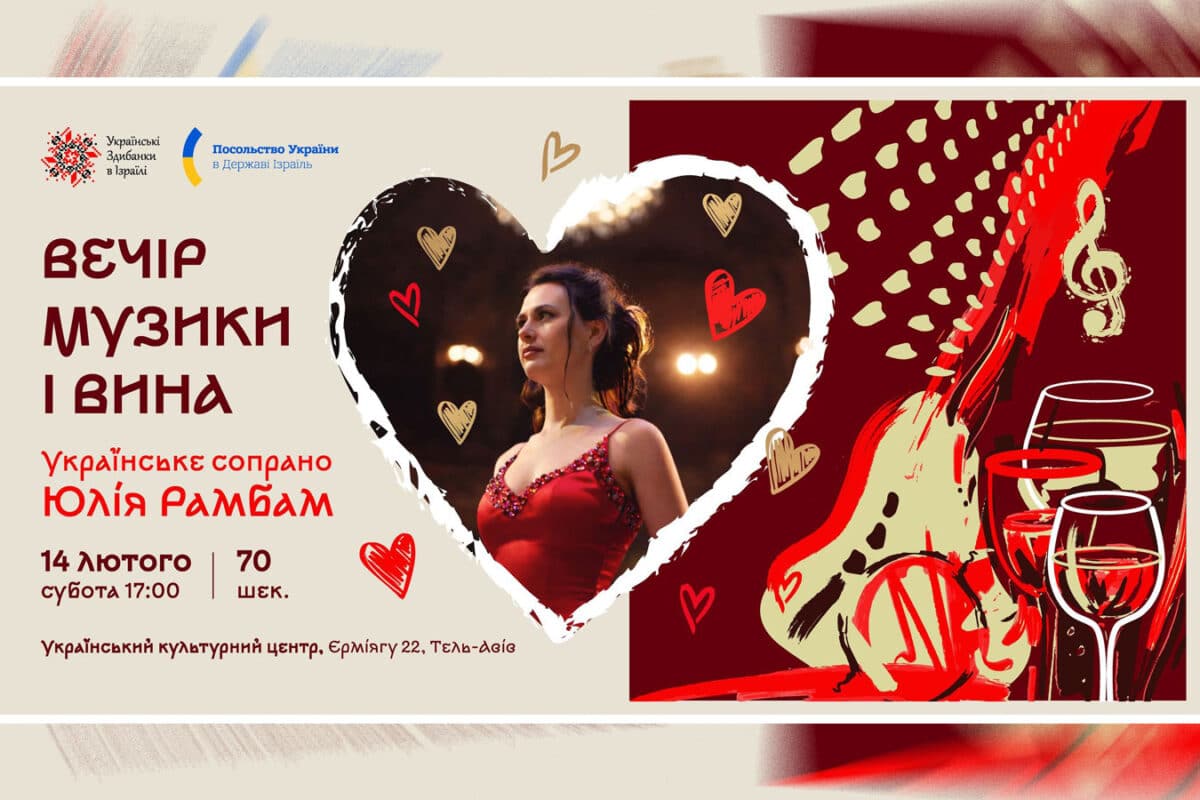
On February 14, 2026, a chamber charity evening will be held in Tel Aviv for Valentine’s Day – “Aria by Candlelight: Opera Singing, Poetry, and Wine“— without a stage, without distance, in the format of live human presence. Music, poetry, candles, wine, and a conversation about love that does not need loud declarations.
In Tel Aviv, a Ukrainian charity musical-poetic evening for Valentine’s Day – February 14, 2026
Ukraine is freezing and bleeding from Putin’s aggression.
Winter, strikes on energy, the front, losses — all this has become the backdrop of everyday life. And it is precisely in such dark times that there must always be a celebration that reminds us — why all this. Why this pain, why this struggle with the darkness that came from the north.
Culture, music, the living word — this is not an escape from reality. It is a reminder of what is worth holding on for, resisting, and remaining human.
Music and poetry without boundaries
The central part of the evening will be a performance by Ukrainian soprano Yulia Rambam.
Arias by candlelight, a chamber hall, soft light, and the absence of a usual stage create an atmosphere of rare closeness — when the voice sounds not “for the audience,” but for each attendee.
The poetic part of the evening — contemporary Ukrainian lyrics about love without illusions and rose-colored glasses. Author’s poems with guitar, live intonation, honest conversation — without pathos and clichés.
Musical part
Ukrainian soprano Yulia Rambam.
Opera vocals in a chamber atmosphere: soft candlelight, frankness, and closeness — without a stage and distance. Everything takes place in an elegantly decorated hall, where the voice sounds especially personal and direct.
Poetic accents
Contemporary Ukrainian poetry about love without “rose-colored glasses.”
Author’s poems with guitar, live words, and intonations in which it is easy to recognize oneself.
For whom this evening is
For couples — and for those who come alone.
For those who celebrate love, and for those who just want to have a good evening in warm, human company.
Here, status is not important — what matters is the inner state.🤍
Important to know
This evening is not only for the Ukrainian community.
It is open to everyone living in Israel who feels that it is important to be close to live culture, meaning, and honest conversation — regardless of origin and native language.
At the same time, it is fundamental: the entire event will be held in Ukrainian.
Music, poetry, intonation — without translation and adaptations. This is a conscious choice and an invitation to hear Ukrainian culture in its true sound.
Charitable purpose
The evening is charitable.
All funds raised will be directed to support the signalers of the 47th Separate Mechanized Brigade of the Armed Forces of Ukraine — for the sound reconnaissance and early warning system “Chuyka”.
NANovosti — News of Israel | Nikk.Agency has repeatedly written about how the Ukrainian diaspora in Israel combines culture, solidarity, and real help to Ukraine. This evening is a continuation of the same logic and the same responsibility.
Practical information
Date: February 14, 2026 Time: 17:00 Place: Ukrainian Cultural Center, 22 Yermiyahu St., Tel Aviv Registration is mandatory. Format: chamber musical-poetic evening
Sometimes the most honest response to darkness is the light that people ignite themselves. Even if it starts with one candle, one voice, and one evening.
“Ukrainian-Jewish Encounter” continues its project about famous Israelis of Ukrainian origin – Natan Sharansky.
Today, Natan Sharansky remains a good friend of Ukrainians at the level of diplomatic relations between Ukraine and Israel. His clear stance on international support for Ukraine after the start of the large-scale Russian invasion became a call for the Israeli government to decisively condemn the attack on Ukraine. Natan Sharansky firmly emphasized that Israel must unwaveringly stand on the side of the Ukrainians.
Natan (Anatoly) Sharansky (b. 1948) is one of the most prominent human rights activists, a well-known Israeli political figure of Ukrainian-Jewish origin.
Born in 1948 in Stalino (now Donetsk) to a family of immigrants from Odessa. During his studies at the Moscow Institute of Physics and Technology, Natan Sharansky’s student years became a catalyst for active public activity. In the mid-1970s, he joined the so-called Helsinki Group and was also a translator and assistant to academician Andrei Sakharov for some time.
In addition, he actively participated in the Jewish movement in the USSR, demonstrations, and protests. In 1977, Natan Sharansky was arrested for anti-Soviet agitation, and the following year he was sentenced to 13 years in prison on charges of espionage for the USA.
Only thanks to numerous petitions from influential world politicians and demonstrations in 1986, through an agreement between the USSR and the USA, Natan Sharansky was freed from the repressive grip: he was exchanged for one of the Soviet spies arrested in the West. Immediately after the exchange, Natan was honorably received by Israeli Prime Minister Shimon Peres and his deputy Yitzhak Shamir.
In the same year, Sharansky founded the public organization “Zionist Forum,” which aimed to unite repatriates from the Soviet Union, and already in 1995, he started the political party “Israel for Aliyah.” In Israel, Natan Sharansky continued his active human rights activities, gaining experience as a recognized, influential Israeli politician. He was a member of the Knesset for a long period and also had experience working as a minister and deputy prime minister in the Israeli governments, chaired the executive council of the Jewish Agency for Israel, and the supervisory board of the Babi Yar Holocaust Memorial Center.
On August 23, 2022, by the Decree of the President of Ukraine, Natan Sharansky was awarded the Order of Merit, III degree, for his significant personal contribution to strengthening interstate cooperation, supporting the state sovereignty and territorial integrity of Ukraine, and significant contribution to the promotion of the Ukrainian state in the world.
In January 2023, Natan Sharansky turned 75 years old. He dedicated almost his entire conscious life to active human rights struggle, the protection of human rights, political activity, as well as the development of close diplomatic and interethnic ties between Israel and Ukraine.
The overthrow of Bashar al-Assad’s regime in December 2024 was a sharp but incomplete break with the past for Syria. Power changed hands, the dictator fled, but the state did not “reboot.” The country entered a complex transitional period, where not only internal conflicts and the struggle for control play a key role, but also external actors.
Among them is Ukraine. Not as a symbol or humanitarian background, but as a real factor in the Syrian turning point.
A Moment Noticed by Everyone
When opposition forces led by Ahmed al-Sharaa approached Damascus, it was not only Assad’s flight that was decisive, but also the absence of Russian intervention. The aviation, which had saved the regime for years, did not take to the air at the critical moment.
The reason was obvious. Russia was focused on the war against Ukraine. Resources, equipment, aviation — everything was directed elsewhere. This was seen and understood in Syria.
But there was a second, less public element. According to Syrian activists and human rights defenders, the opposition during this period received support from Ukraine. Details were not disclosed, but the fact itself is not disputed within Syria and is not perceived as a sensation.
Why Ukraine Became “One of Us”
For a significant part of Syrian society, Ukraine is not a foreign country or an abstract conflict. Since 2014, the anti-Assad environment has consistently expressed solidarity with Ukrainians, seeing Russia as a common adversary.
Russian aviation destroyed Syrian cities. Russian military helped suppress protests. Russian bases became a symbol of lack of freedom. In this sense, Russia’s war against Ukraine was perceived in Syria as a continuation of the same logic, only on a different front.
After the fall of the regime, this connection ceased to be only emotional and became political.
The New Power and Ukrainian Balance
The transitional administration in Damascus found itself in an extremely vulnerable position. On one hand — a destroyed economy, weak institutions, and a fragmented country. On the other — the urgent need to seek external support.
In this configuration, Ukraine became an important, albeit quiet partner. According to Syrian interlocutors, humanitarian aid from Ukraine after Assad’s fall was significantly greater than what Syria received from Russia during the same period.
This creates a clear limitation for the new power. A full return to a close alliance with Moscow would mean not only losing the trust of the West but also a serious blow to relations with Kyiv — and thus to internal legitimacy.
It is no coincidence that NAnews — Israel News | Nikk.Agency notes: the Ukrainian factor has become part of the Syrian transition, although it is almost not articulated officially.
Russia: Not an Ally, but Not the Past
Moscow did not disappear after Assad’s fall. Military bases, economic levers, old cadres, and connections still exist. But the nature of the relationship has changed.
If previously it was a strategic alliance “for decades,” now it is short, strictly limited deals. Banknotes, grain, temporary presence. Without ideology and without trust.
The new Syrian power understands: Russia remains dangerous precisely because it is weakened and acts aggressively. And here the experience of Ukraine serves as a clear warning for Damascus, not a theoretical example.
Turning to the West — and Kyiv’s Role
Syria has effectively integrated into the security system led by the United States, participates in coalition formats, and receives training for security forces. This gives it external support but does not solve all problems.
In this scheme, Ukraine acts as a link between the Syrian experience of war and the Western logic of resisting Russia. Not as a formal guarantor, but as an example that weakening Moscow in one direction automatically changes the balance in another.
A Transition Without an End
Today, Syria is a country without a firmly established patron. Russia is too weakened to dictate terms. The West demands reforms and restraint of violence. Society is tired but still ready to wait.
In this picture, Ukraine is not a secondary plot. It is part of a new reality in which the Syrian transition occurs not in a vacuum, but against the backdrop of Russia’s ongoing war with the outside world.
The Syrian experience shows: the departure of a dictator is only the beginning. The real struggle begins later — to ensure that the country does not return to the orbit of the force that once led it to catastrophe.
War of attrition, massive missile strikes, cold winter, power and heating outages, economic pressure — all of this was supposed, according to Moscow’s calculations, to undermine Ukrainian society. The logic was simple and familiar: increase the suffering of the civilian population, provoke fatigue, split society, and force the authorities to seek “peace at any cost.”
However, fresh sociological data shows the opposite result. The pressure strategy not only did not lead to capitulation sentiments but also did not cause a noticeable shift in public opinion towards concessions.
The results of a nationwide survey conducted at the end of January 2026 show a stable picture. During January 23-29, 2026, the Kyiv International Institute of Sociology (KIIS)conducted its own nationwide public opinion survey, which included questions related to war and peace.
Main Results
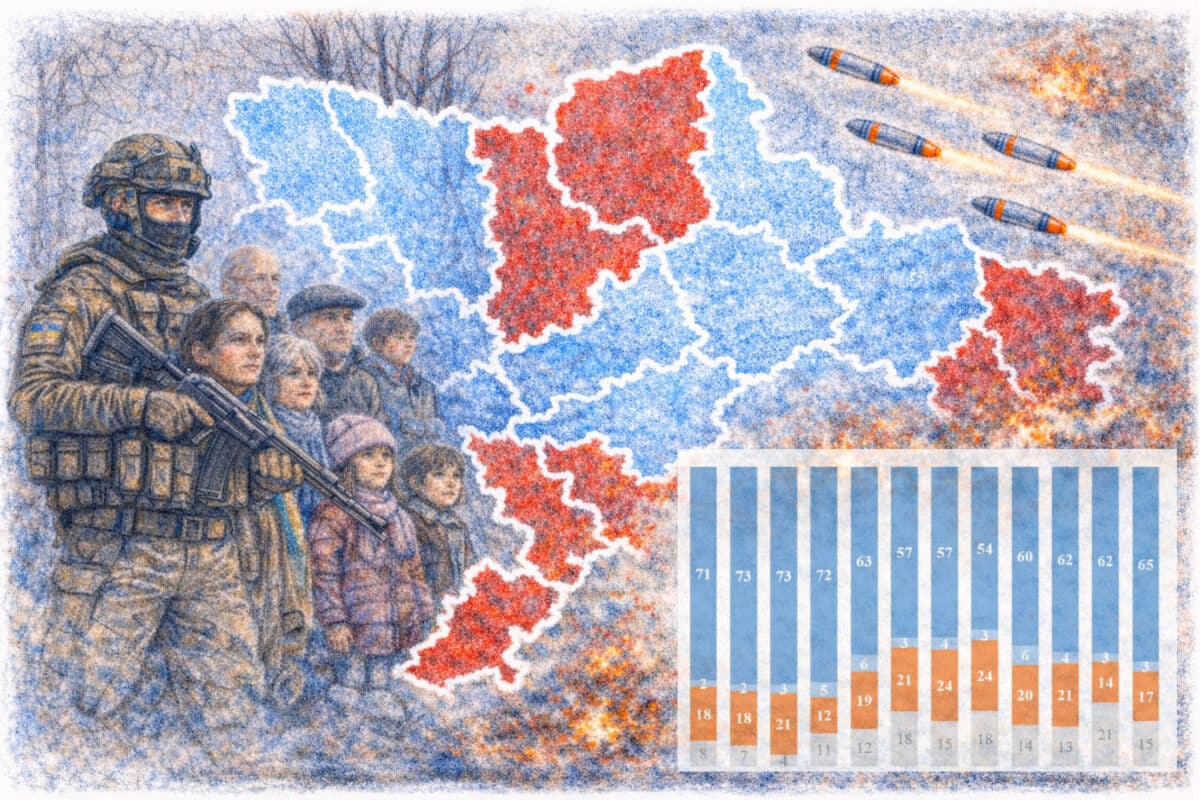
52% of respondents categorically reject the proposal to transfer the entire Donbas under Russian control in exchange for security guarantees, while about 40% consider such an option only as an extremely difficult and forced compromise. Compared to mid-January, no statistically significant changes were recorded.
Ukraine has not broken: society is ready for a long war, does not believe in a ‘quick peace,’ and considers territorial concessions an unacceptable price – KIIS survey
At the same time, only 20% of Ukrainians expect the war to end in the coming weeks or at least in the first half of 2026. Most respondents either predict later dates or find it difficult to answer.
Against this backdrop, 65% of respondents directly state that they are ready to endure the war for as long as necessary. This indicator has remained stable since the fall of 2025 and has hardly changed, despite energy strikes, cold, and economic pressure.
The vast majority of respondents clearly understand the purpose of Russian attacks. 88% believe that by striking energy infrastructure, Russia is trying to leave people without light and heat to force the country to capitulate. Only 3% adhere to the version of “retaliatory strikes,” and another 3% believe that the attacks are allegedly aimed exclusively at military targets.
In this context, 90% of Ukrainians believe that Ukraine should strike Russian territory, and the structure of this support has changed. 80% of respondents believe that such strikes may concern not only military infrastructure but also other targets. This reflects not a surge in radical sentiments but a reaction to the systemic nature of terror against civilian infrastructure.
Despite the protracted war, society maintains a long-term horizon. 66% of Ukrainians expect that in ten years, Ukraine will be a prosperous country — a member of the European Union, which is even higher than the end of 2025, when 64% of respondents thought so.
Readiness to Endure War: Resilience Without Illusions
The key conclusion of the study lies not so much in the absolute numbers as in their dynamics. Society’s readiness to continue resistance is not an emotional outburst or a reaction to individual events. It is a stable attitude that has persisted for months.
In September 2025, 62% of respondents stated they were ready to endure the war for as long as necessary. In December, the figure remained the same. January 2026 only confirmed this trend. Even massive energy strikes and a harsh winter did not lead to a shift in public sentiment.
It is also important to note another point. Simultaneously, the share of those expecting a quick end to the war is decreasing. In the fall of 2025, about a third of Ukrainians believed the war could end by mid-2026. In December, this was already 26%. By the end of January — only 20%. This indicates a growth in realism, not fatigue.
Regional Picture: Consolidation Without “Weak Links”
Sociology does not confirm popular theses that certain regions are “more tired” than others or ready for concessions.
The readiness to endure the war is recorded across the country. In Kyiv, 72% of respondents gave this answer. In Western Ukraine — 66%. In the Center and North (excluding the capital) — 64%. In the South — also 64%. Even in the East, traditionally considered the most vulnerable in terms of public sentiment, the figure is 58%.
These data are especially important against the backdrop of intense shelling of the eastern and southern regions. Despite this, public opinion does not show a shift towards capitulation scenarios.
The Cost of Fatigue: What is Difficult for People
Respondents who did not choose the option “endure for as long as necessary” were asked an additional open question about the reasons. The answers provide a better understanding of the structure of fatigue.
In the first place — the death of military and civilians, fear for the life and health of loved ones. This reason was named by 29% of respondents in this group. Next are shelling and destruction of infrastructure — 17%, economic difficulties — 17%, power and heating outages — 15%, psychological exhaustion — 10%.
At the same time, when recalculated for the entire adult population of Ukraine, a fundamentally important detail emerges: only about 5% of citizens associate their unwillingness to endure the war directly with power and heat problems. Thus, energy terror has not become a mass factor in changing public position.
Donbas in Exchange for Guarantees: Boundaries of Acceptable Compromise
The issue of transferring the entire Donbas under Russian control in exchange for security guarantees from the US and Europe remains one of the most sensitive. However, public opinion also demonstrates resilience here.
52% of respondents consider such a scenario absolutely unacceptable. About 40% allow its consideration but emphasize that it would be an extremely painful and forced compromise. Another 7-8% found it difficult to answer.
An additional sociological experiment using the “imagined acquaintance” method showed almost identical results. This means that the factor of social desirability does not distort the picture, and respondents’ answers are quite sincere.
Energy Strikes and Relocation Experience
A separate block of the study was devoted to the consequences of strikes on energy infrastructure and the real experience of relocations.
Since the fall of 2025, 9% of Ukrainians have experienced temporary relocation due to heating or power problems. Of these, 66% moved to another settlement within the country, 31% — to another dwelling in the same settlement, and only 3% — abroad.
At the same time, 6% of these 9% have already returned home. The share of those who left and did not return remains minimal. Even in Kyiv, this figure is about 3% and is most often associated with changing housing within the city rather than refusing to live in the country.
Strikes on Russian Territory: Evolution of Position
Support for strikes on Russian territory remains extremely high. 90% of respondents consider such strikes necessary.
At the same time, an evolution of position is noticeable. If in 2023 a significant part spoke exclusively about military targets, by early 2026, 80% consider strikes on other targets, including energy infrastructure, acceptable. About a quarter of respondents allow strikes even on objects related to the livelihood of the Russian population.
This dynamic reflects not an increase in aggression but an adaptation of public consciousness to the reality of a protracted war and asymmetric terror.
Future Horizon: Optimism Despite War
Amidst a harsh winter and ongoing hostilities, 66% of Ukrainians remain optimistic and believe that in ten years, Ukraine will be a prosperous state and an EU member. About 22% are pessimistic.
This indicator has hardly changed compared to the end of 2025. This indicates a long-term societal attitude not only towards survival but also towards recovery and development after the war.
Conclusion
The winter of 2025–2026 was a serious test for the country. But sociology records: it was not a turning point.
In this context, it is important to emphasize that NAnews — News of Israel | Nikk.Agency throughout the entire period of the full-scale war consistently records not individual emotional outbursts but precisely stable trends in public sentiment in Ukraine. Sociological data, like this survey, allows us to go beyond loud statements and see the real dynamics — without illusions, without simplifications, and without expectations of a “quick turnaround.” That is why the numbers and their stability matter not only as internal Ukrainian statistics but also as a guide for all who continue to build their political and diplomatic calculations around this war.
Society has not fallen into apathy, has not accepted the logic of concessions, and has not supported capitulation scenarios. Most Ukrainians are ready for a long war, do not believe in a “quick peace,” and consider territorial concessions an unacceptable price.
This is not an emotional reaction and not a propaganda effect. This is a stable public position, recorded by numbers, dynamics, and regional cross-section.
Survey Methodology
Using the method of telephone interviews (computer-assisted telephone interviews, CATI) based on a random sample of mobile phone numbers (with random generation of phone numbers and subsequent statistical weighting) in all regions of Ukraine (territory controlled by the Government of Ukraine), 1003 respondents were surveyed. The survey was conducted with adult (aged 18 and older) citizens of Ukraine who, at the time of the survey, resided in the territory of Ukraine controlled by the Government of Ukraine. Residents of territories temporarily not controlled by Ukrainian authorities were not included in the sample (at the same time, some respondents are IDPs who moved from occupied territories), and the survey was not conducted with citizens who went abroad after February 24, 2022.
Formally, under normal circumstances, the statistical error of such a sample (with a probability of 0.95 and taking into account the design effect of 1.3) did not exceed 4.1%. At the same time, for the question about the transfer of Donbas under Russian control in exchange for security guarantees, an experiment was conducted where half of the respondents (i.e., about 500) were asked a regular direct question (how acceptable it is for the respondent), and the other half — using the “imagined acquaintance” method. Therefore, for this question, the error does not exceed 5.8%.
In wartime conditions, in addition to the specified formal error, a certain systematic deviation is added. Factors that may affect the quality of results in wartime conditions were previously provided by KIIS.
“In the context of the ongoing Russian aggression against Ukraine, this initiative will strengthen Ukrainian archives and their ability to preserve and provide access to documentary heritage. The project will foster cooperation between researchers, artists, and journalists.”
UNESCO and the EU have launched an important project to preserve Jewish heritage in Ukraine. The initiative includes digitizing and restoring archival materials to help preserve the memory of Jewish culture.
On March 18, 2025, at the museum of the National University “Kyiv-Mohyla Academy”, the first UNESCO/EU project was presented – “Preserving Jewish Documentary Heritage in Ukraine, Honoring Collective Memory, Increasing Awareness and Access to Archives, and Promoting Intercultural Dialogue.”
As part of the UNESCO Information for All Programme (IFAP), chaired by National Council Chair Olha Herasymiuk, in 2024 the National Committee of the UNESCO Memory of the World Programme was established. The committee, led by Larysa Levchenko, director of the Central State Archive of Higher State Bodies and Administration, consists of 15 specialists in archival and cultural affairs.
The Importance of Preserving Jewish Heritage in Ukraine
In the 21st century, preserving cultural heritage has become one of the key tasks not only for individual countries but also for international organizations. One such significant project is the UNESCO and EU initiative to preserve Jewish documentary heritage in Ukraine, which started in 2025.
This project is of great importance not only for Jewish communities but also for all Ukrainians, as it helps preserve part of the cultural heritage tied to the history of our nation. A large portion of the descendants of Jewish families, whose history is intertwined with the history of the Ukrainian people, lives in Ukraine. This project is especially important for Jews living in Israel, as preserving these archives helps strengthen the connection to their roots.
The project was announced in Ukraine on January 28, 2025, during a visit by UNESCO Director-General Audrey Azoulay. Under the auspices of UNESCO and with EU funding, the initiative covers Kyiv, Odessa, and Dnipro — cities where unique Jewish archives are stored.
Project Goals: Preservation and Digitization of Archives
Preserving Jewish documents is an essential part of cultural heritage, as these documents serve as the basis for research, scholarly work, and cultural initiatives. They contain many valuable historical facts reflecting the contributions of the Jewish community to Ukraine’s history, as well as providing evidence of tragedies experienced by the Jewish people at different times in history.
As part of the project, tens of thousands of documents stored in archives, libraries, and other memory institutions will be digitized. Digitization will not only preserve these materials for future generations but will also make them accessible to researchers, historians, and the general public.
Impact of Russian Aggression on Archival Preservation
The project is particularly relevant in light of Russia’s aggression in Ukraine. The ongoing war puts many archives, libraries, and historical documents at risk. Bombings and infrastructure destruction have significantly complicated the preservation of these materials. Therefore, the UNESCO and EU initiative is an important step in preserving and restoring part of this heritage.
Mariana Beza, Deputy Minister of Culture and Head of the National Commission of Ukraine for UNESCO, emphasized that this project is necessary to strengthen Ukrainian archives and enhance their ability to preserve documentary heritage. She also highlighted the importance of collaboration between researchers, artists, and journalists in spreading knowledge about the Jewish history of Ukraine.
Educational Role of the Project and Its International Significance
The project also includes an educational component. UNESCO will organize training for 50 Ukrainian cultural professionals who will engage in inventorying and preserving documents. This will allow Ukrainian archivists to improve their qualifications and expand their capacity to work with important historical materials.
Remy Duflot, Deputy Head of the EU Delegation to Ukraine, noted that preserving cultural heritage is an investment in our shared future, and cultural diversity is fundamental to the cohesion of European nations.
Significance of the Project for Ukraine and Jews
This project is important not only for Ukraine but also for the Jewish community. Jewish culture has always been an integral part of Ukraine’s cultural landscape, and through preserving documentary heritage, we can better understand and honor this contribution.
The project is also significant for emigrants from Ukraine, especially Jews living in Israel. For them, preserving Jewish documents in Ukraine is an important step in preserving their history and connection to their homeland.
Prospects for the Development of Ukraine’s Archives
The UNESCO and EU project will allow Ukraine to develop its archives, improve their technical level, and provide better access to historical documents. New technologies and opportunities for preserving historical memory, particularly through digitization, are gradually emerging.
This will open up new opportunities for research and scholarly work. Multimedia events organized within the project will allow a broader audience to familiarize themselves with the history of the Jewish community in Ukraine.
Conclusion
The UNESCO and EU project to preserve Jewish documentary heritage in Ukraine is an important step in preserving the cultural heritage of an entire nation. Thanks to digitization and restoration of archives, these documents will become accessible to future generations. This will not only help preserve history but will also contribute to a better understanding of the cultural interaction between the Jewish and Ukrainian peoples.
For more information about the news of Israel and current projects, such as the project to preserve Jewish documentation, visit the NAnews website – news from Israel.