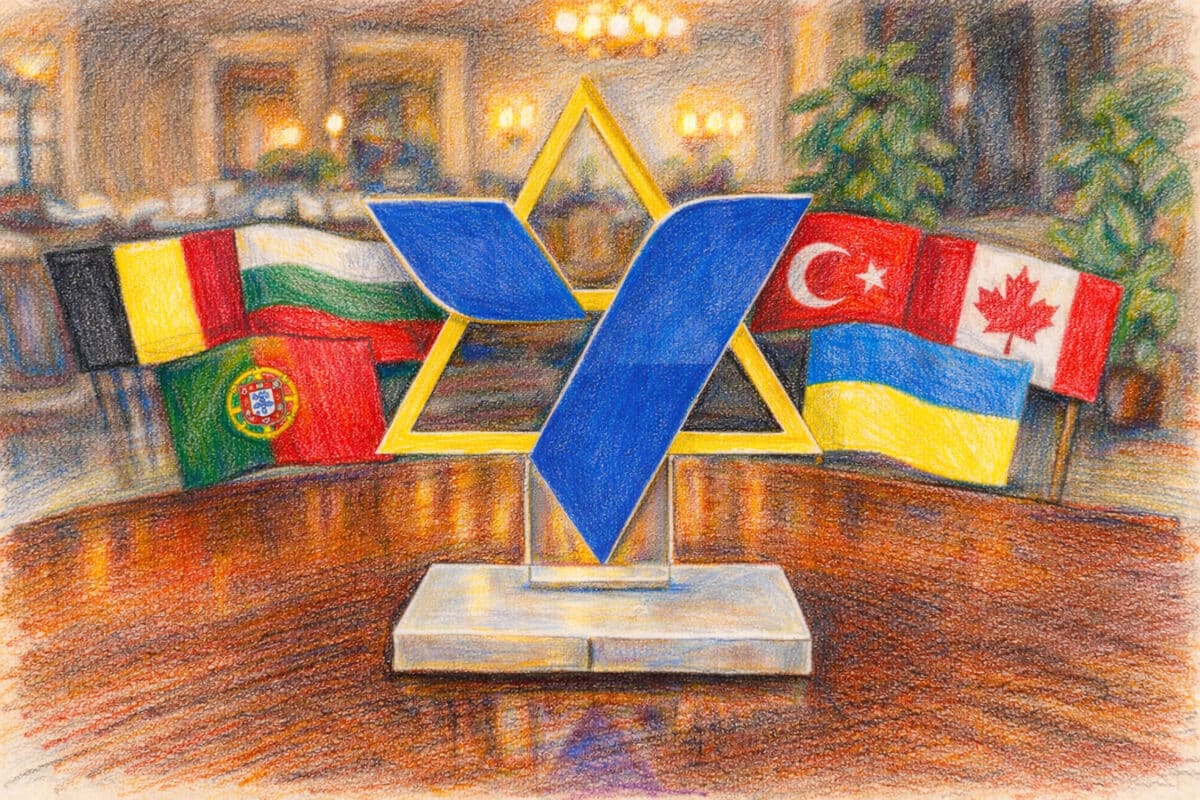
Ukraine at the Center of Global Jewish Education: Ukrainian Schools and Educators Among the Finalists of the Yael Awards 2026

Ukraine is among the key countries represented among the finalists of the prestigious international Yael Awards 2026, dedicated to outstanding achievements in Jewish education. The list includes educational projects and schools from Kyiv and Mykolaiv, alongside participants from Europe, Central Asia, Latin America, the Middle East, and North America.

The finalists were announced, reported jpost, by the Yael Foundation — one of the largest international philanthropic organizations working exclusively in the field of Jewish education. The award is being held for the fourth time and is considered the main global benchmark for quality, innovation, and sustainability of Jewish educational systems.

Ukraine at the center of global Jewish education: Ukrainian schools and educators among the finalists of Yael Awards 2026

The award ceremony will take place in February 2026 in Europe and will gather educators, Jewish community leaders, and philanthropists from dozens of countries. Against the backdrop of rising anti-Semitism and crises faced by the diaspora, the significance of such initiatives has sharply increased.

Members of the international jury note: today it is not just about preserving schools, but about the survival of Jewish identity in the long term. That is why, when evaluating the finalists, not only academic indicators were considered, but also the impact on the community, innovative approaches, and the ability to form a conscious Jewish identity in the new generation.

Robert Singer, chairman of the Center for Jewish Impact and former CEO of the World Jewish Congress, emphasized the symbolism of the moment. According to him, only now has the Jewish population returned to pre-war levels — about 16 million people. The question facing the world is what will happen in the next 80 years.

Singer noted that the availability of education is no longer a sufficient condition. Schools must be centers of quality — with strong teachers, modern infrastructure, and equal attention to general and Jewish disciplines. This is what keeps families and forms sustainable communities.

Among the finalists are educational initiatives from Brussels, Sofia, Lisbon, Istanbul, Kyiv, Bishkek, Cordoba, Richmond (Canada), and Mykolaiv. Many of them operate in small or developing communities, where each school is effectively the backbone of the entire Jewish life of the region.

Natan Sharansky, former Israeli government minister and ex-head of the Jewish Agency, linked Jewish education with the concept of freedom. According to him, in a world where the pressure of assimilation becomes the norm, only a strong identity allows a person to remain a free and responsible citizen.

Journalist and public figure from New York Avital Chizhik-Goldschmidt noted the shift in focus in recent years. In her opinion, direct combat against anti-Semitism often proves to be a dead end. It is much more effective to strengthen the understanding of who you are, where you come from, and why you are here.

The issue of innovation became a separate topic of discussion. Investor and supporter of Jewish education Max Neuberger pointed out that new technologies, including AI, open access to knowledge on an unprecedented scale. However, without live contact, meaning, and values, technology alone cannot replace education.

In this context, the experience of Ukrainian Jewish schools acquires special significance. In conditions of war, migration, and constant pressure, educational projects in Kyiv and Mykolaiv demonstrate how it is possible to maintain identity and resilience even in extreme reality. NAnews — Israel News | Nikk.Agency has repeatedly noted that Ukrainian Jewish education today plays not only an educational but also an existential role.

In addition to the main nominations, the Yael Foundation will present two honorary awards. Writer and educator Dov Forman will receive the Influence for Good award for his contribution to the popularization of education about the Holocaust and Jewish history in the digital environment. He emphasized that with the passing of Holocaust survivors, the educational mission becomes critically important.

The Voice of Jewish Identity award will be received by Agam Berger — a former hostage who became a public voice of Jewish identity. According to her, Jewish strength is not only survival but also the ability not to lose oneself even in the darkest circumstances.

The Yael Foundation, founded by Uri and Yael Poliovich, invested about 40 million euros in Jewish education in 2025 alone, supporting 130 programs in 45 countries. Through the Yael Awards, the foundation aims to highlight and scale models that can be adapted for different communities around the world.

The presence of Ukraine among the finalists of 2026 is not just a recognition of specific schools. It is a signal that even in conditions of war and instability, Jewish education remains a strategic resource for the future.

Iran without illusions: why Israel and Ukraine are fighting the same war

When Israel talks about Iran, it is not about theoretical risks or analysts’ hypotheses. It is about an adversary. A state that has been building military infrastructure around Israel for years, openly threatens its destruction, and arms those who are already fighting.

For Ukrainian society, Iran long remained something distant. A background. A regional problem not directly related to the war against Russia. This perception turned out to be mistaken. Today, Iran is an active participant in the war against Ukraine and simultaneously a key enemy of Israel.

And these are not two different conflicts.

This is one line of threat, just stretched across different maps.

In recent months, the US, Israel, and allies have noticeably increased pressure on Tehran. Military maneuvers, force deployments, controlled leaks in Western media — all these are elements of a coercion strategy. The goal is obvious: to force Iran to make concessions on its nuclear program and regional expansion.

Meanwhile, there is a tough debate within the West itself. Some political elites fear an oil crisis and a regional explosion. The Strait of Hormuz remains a critical point of the global economy. Any blockade of it will instantly hit markets, fuel prices, and the internal stability of Western countries. That is why calls for a “diplomatic solution” are being heard again.

But Israel knows too well how such formulations usually end.

Iran has been using negotiations as a tool to buy time for decades. Under talks of deals, the regime strengthens military programs, develops proxy networks, and prepares for the next stage of confrontation. This is not theory or alarmism. This is proven practice.

Today, Tehran openly threatens strikes on American bases and US allies. Primarily in Iraq, Lebanon, and Yemen. Pro-Iranian structures have been restored after previous strikes, and the mechanisms of power transfer in the Iranian leadership have been brought to combat readiness. The regime is preparing not for compromise but for prolonged confrontation.

And Ukraine is already marked as a target in this scenario.

After the Davos Forum, Kyiv publicly sided with the opponents of the Iranian regime. President Volodymyr Zelensky directly stated: the mass killings of protesters in Iran and the West’s passivity create a dangerous signal — if you kill enough people, you can retain power. This signal was heard far beyond Europe.

Tehran reacted irritably. But something else is much more painful for it.

Iran has long ceased to be just a “regional player” for Ukraine. It has become a supplier of weapons for Russia. Iranian drones systematically attack Ukrainian cities. Iranian missiles are the subject of negotiations with the Kremlin. This is no longer a diplomatic conflict or an ideological dispute. This is a war through a proxy.

To understand the scale of the threat, it is important to remember: the Iranian missile program did not arise by itself.

In the 1990s, Ukraine and Iran found themselves in similar positions. Both countries were in isolation, under sanctions, with ruined economies and limited external connections. Iran was one of the first to recognize Ukraine’s independence. Projects in the fields of oil, gas, and nuclear energy were discussed.

Ukrainian engineers worked on the construction of the Bushehr nuclear power plant. Kharkiv’s “Turboatom” was supposed to supply turbines. Hundreds of Ukrainian specialists participated in Iranian projects. It was a period of pragmatic cooperation — without illusions, but also without hostility.

Then big geopolitics intervened.

Under US pressure, Ukraine withdrew from Iranian projects, hoping for access to Western technologies. These expectations were never realized. For Iran, it looked like direct betrayal. For Ukraine, it was a strategic miscalculation, the consequences of which echoed years later.

The key turning point came later when the story of the Kh-55 cruise missiles surfaced.

Bypassing sanctions, with the mediation of Russian structures, Iran received Ukrainian missiles. This was a gross violation of agreements and a blow to Ukraine’s international reputation. But more importantly: it was on this basis that Iran was able to launch its own cruise missile program.

These are the very systems that Tehran threatens Israel with today and which, according to Western media, may be used or transferred to Russia for strikes on Ukraine.

The figures in this story died, disappeared, or ended up in Russia. The traces were cleaned up. The mechanics are too familiar — they fully correspond to the methods of Russian special services. Iran was not the only player in this scheme but became the ultimate beneficiary.

The final point was set in January 2020, when Iranian air defense shot down a UIA passenger plane. 176 people died, including the Ukrainian crew. Iran admitted guilt but did not bear real responsibility. From that moment, relations became hostile not in words, but in essence.

After 2022, everything became finally clear.

Today, Iran and Russia act as allies. One produces weapons and technologies. The other uses them against Ukraine. Meanwhile, Iran is preparing for direct confrontation with Israel, expanding its proxy network and increasing its missile potential.

These are not two different conflicts. This is one front, stretched from the Middle East to Eastern Europe.

That is why the Iranian issue is not a “foreign war” for either Israel or Ukraine. It is a matter of common security. Iran is a systemic adversary, not a temporary problem on the international agenda.

In the midst of this knot of interests and mistakes, a conclusion that is hard to ignore is becoming increasingly clear: as long as the regime in Tehran remains in its current form, the threat will grow. For Israel — directly. For Ukraine — through Russia.

And in this context, the position consistently voiced by НАновости — Новости Израиля | Nikk.Agency is becoming increasingly obvious: the Israeli and Ukrainian fronts have long been connected. An Iranian missile does not distinguish targets by language or flag. It flies to where it sees weakness.

Ignoring this connection means once again allowing time to work against oneself.

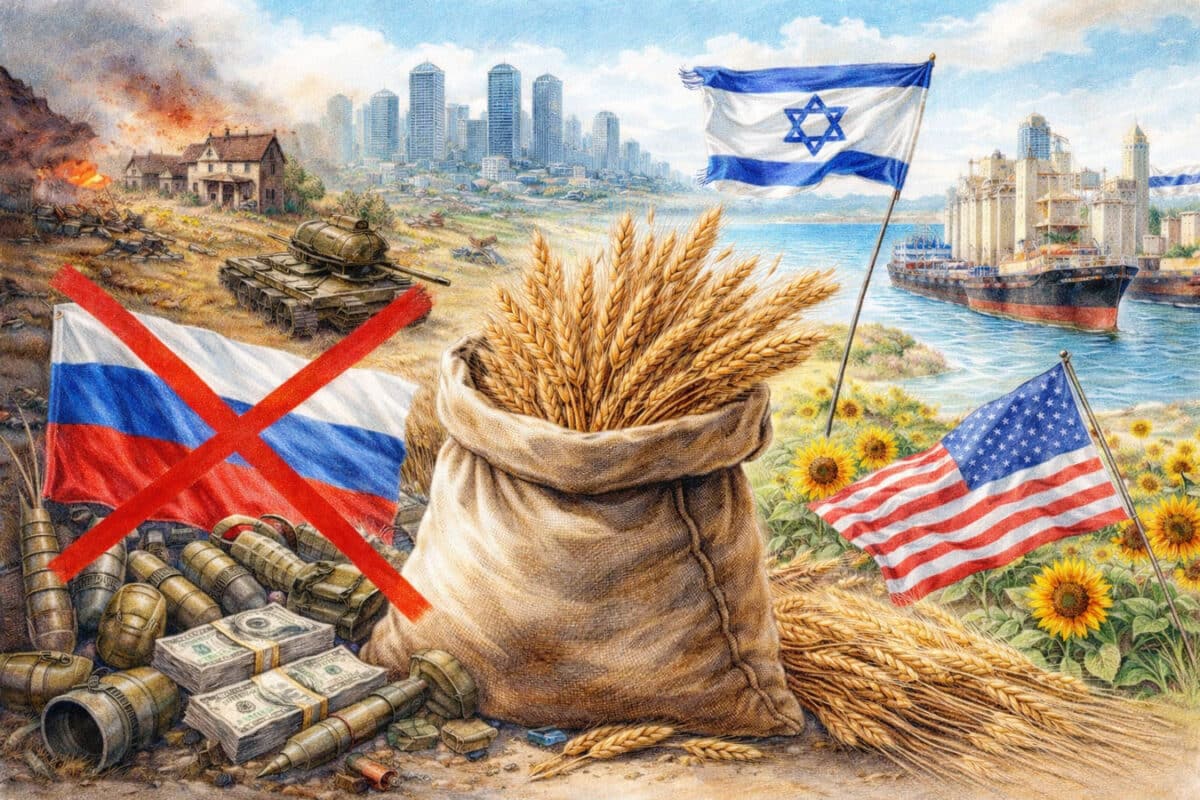
Israel refuses Russian grain, including that stolen from temporarily occupied territories of Ukraine, and changes its grain course under pressure from Washington

Israel’s decision to stop importing Russian wheat — including grain exported from temporarily occupied territories of Ukraine — goes far beyond a trade dispute. It is a step that primarily hits the economy of Putin’s Russia and its ability to finance the war, even if it means higher prices for Israeli consumers.

Jerusalem and Washington, reports the Israeli globes on January 29, 2026, are finalizing negotiations to switch to American grain. In early February, a delegation from Israel’s Ministry of Agriculture will travel to the US to finalize the agreement. The context is clear: the Donald Trump administration is seeking to redistribute markets in favor of American farmers, offering in return a reduction in tariffs on Israeli goods.

Until recently, Israel was almost entirely dependent on the Black Sea region. In 2024–2025, about 89% of wheat imports came from Russia, with another portion from Ukraine. Short logistics made such deliveries convenient and cheap. But this is where the line of principled rupture lies.

Israel refuses Russian grain, including stolen from temporarily occupied territories of Ukraine, and changes grain course under Washington's pressure
Israel refuses Russian grain, including stolen from temporarily occupied territories of Ukraine, and changes grain course under Washington’s pressure

Russia systematically exports Ukrainian grain from temporarily occupied territories — from elevators, farms, ports. These volumes are labeled as “Russian,” mixed with legal batches, and enter the global market. Revenues from this trade go to the budget of the aggressor country and directly support the war against Ukraine. Every purchased ship of such grain means additional money for missiles, drones, and the killing of civilians.

Israel’s refusal of such supplies is not only an economic but also a political-moral decision. NAnews — Israel News | Nikk.Agency has repeatedly noted: more and more countries and companies do not want to “stain” themselves with grain of dubious origin and become indirect sponsors of Putin’s aggression.

It is important to emphasize: for Ukraine, this step is not critical. Ukrainian grain is in demand on the global market and can be sold to dozens of countries — from the EU to the Middle East, Africa, and Asia. Despite the war, Ukraine remains one of the key global exporters and diversifies routes and sales markets.

However, for Putin’s Russia, the situation is different.

Massive sanctions have been imposed against it, and the circle of countries willing to buy Russian grain — especially with the reputational trail of looting in occupied territories — is narrowing. Israel has not formally joined the sanctions against Russia, but most major consumer countries have imposed restrictions or de facto refuse such purchases. Every lost market is a problem for the Russian economy.

Simultaneously, Israel is changing its tariff policy. A duty of up to 50% is being introduced on Russian and Ukrainian wheat instead of the previous duty-free regime within two million tons per year. Formally — part of the new agreement with the US. In fact — closing the market for Russian grain, including that stolen from Ukraine.

Within the Israeli government, the debates were intense. Finance Minister Bezalel Smotrich opposed due to rising costs. Ministers of Agriculture and Economy — Avi Dichter and Nir Barkat — supported the switch to American grain. Prime Minister Benjamin Netanyahu made the choice in favor of a strategic decision, despite the cost.

The economics of the issue are simple and harsh. Israel imports about 2.15 million tons of wheat per year. American grain costs about $25 more per ton, including delivery across the Atlantic. Annually, this is about $54 million in additional expenses — approximately 166.6 million shekels. This money will fall on consumers and taxpayers.

A separate effect is the rise in feed prices and, consequently, dairy products. Israeli analysts previously warned about this: the increase in the cost of feed grain automatically reflects on the price of milk, cheese, and butter.

But in a strategic sense, the effect is the opposite. For Ukraine, it is merely a change of one market, not undermining exports. For Putin’s Russia, it is another closed income channel and another signal: fewer and fewer countries are willing to turn a blind eye to the origin of grain and sponsor the war through trade.

Israel makes a choice that will be felt in supermarket price tags. But at the same time, it is a choice that reduces the Kremlin’s financial ability to continue aggression. And in the context of global sanctions, such decisions — painful but concrete — are becoming increasingly sensitive for Putin’s economy.

Donbass as a trap in negotiations: why the Russian Federation demands “withdrawal of troops” and why everything hinges on Sloviansk and Kramatorsk

At the end of January 2026, a thesis resurfaced in the Ukrainian information field, which Moscow regularly brings to the negotiating tables: “withdrawal of Ukrainian troops from the territory of Donbas”. At first glance, this sounds like another ultimatum, but in an analytical column by military observer Alexander Kovalenko, the emphasis is placed on something else: the danger is not only in the demand itself, but in the words with which it is framed.

The author ties the topic to the negotiation track in Abu Dhabi and calls such a formulation of the question “topographically veiled.” He writes directly: this demand is “not only absurd but also… dangerous.”

“Donbas” is not always what it seems

In Ukrainian and international media habits, “Donbas” often sounds like a synonym for two regions — Donetsk and Luhansk. But historically, the term is broader: it comes from the “Donetsk coal basin,” and different reference books describe its boundaries differently — from an “industrial area” to interpretations through the coal basin and adjacent territories.

This is where the main risk that Kovalenko warns about is built: if the parties ever sign a document with a vague term, the game of expanding the meaning begins — and the dispute is no longer about the map, but about “what was meant.”

The author has a short, very harsh formulation: “The territorial topic in such a context is taboo.”
And this is an important part of the text’s logic: even before military mathematics, he fixes a “red line” — moral, constitutional, and international legal.

Donetsk region: the numbers the author operates with

Then the facts begin — and they are needed to understand why the material quickly moves from the words “Donbas” to the specific geography of the Donetsk region.

Kovalenko claims that Ukraine controls about 5,500 km² in the Donetsk region.
He also provides an estimate that throughout 2025 the Russian army captured 4,329 km² of Ukrainian territory, while, according to him, losses amounted to 418,010 (in the text, “losses” refer to the total losses of personnel in the author’s interpretation).
Separately, he estimates that in the Donetsk region about 2,200 km² could have been captured in 2025 (with a caveat about the difficulty of accurate assessment).

Important: this is not an official report from the General Staff and not unified international statistics, but estimates from the author’s column. But in the logic of the text, they serve one purpose — to show that the demand to “withdraw troops” means obtaining a huge territorial result without an assault.

Sloviansk–Kramatorsk: why this node is called a “bridgehead”

The key concept of the article is the Sloviansk-Kramatorsk bridgehead (SKB). The author describes it as the most fortified part of the Donetsk region, formed since 2014.

The point here is not in a beautiful term, but in a practical conclusion: if Sloviansk and Kramatorsk “open” without a fight, the configuration of the front changes and a window for deeper enemy advancement appears.

And here the author has one of the sharpest formulations: he writes that compared to the SKB “Bakhmut… is child’s play,” “Avdiivka will seem like a walk in the park.”
This is a journalistic device, but it reflects the idea: it’s about an area that has been “stitched” with fortifications for years.

NANews — News of Israel | Nikk.Agency monitors such signals precisely because the formulations about “troop withdrawal” are not only a Ukrainian internal discussion: they quickly enter international negotiation packages, and therefore, tomorrow they will become a subject of pressure on Kyiv from various capitals.

The military logic of the demand: “not to storm, but to take”

Kovalenko emphasizes: he discusses not only morality and law but also military expediency.

If translated into simple language, the thesis is this:

Ukraine is offered to leave the most fortified area.

Russia receives a key node without battles, losses, and time.

Then the geometry of the front line changes and new directions of pressure open up.

To illustrate the complexity of the battles, the author provides two more figures: in his estimation, on the Pokrovsk-Myrnohrad direction a 170,000-strong group is involved, and in total in the battles in the Donetsk region — more than 300,000.
And again: this is the author’s estimate, but it is built into the argument why the “negotiation formula” can become a bypass way not to “break” the SKB by military force.

Why “terminological discipline” suddenly becomes a security issue

One of the most practical parts of the text is the demand to speak more precisely. The author essentially proposes an informational task: to explain to partners the difference between “Donbas” and “Donetsk region” so as not to leave room for manipulation.

This is not an abstraction. In different sources, several frameworks of understanding “Donbas” indeed coexist: modern political, industrial, and geographical.
If a diplomatic document does not fix which framework the parties use, there remains room for subsequent interpretations.

What this means for Israel and the region

On the Israeli agenda, the war in Ukraine has long been read more broadly than a “European conflict”: Iran, drones, missile technologies, sanctions, sea routes, as well as diplomatic practices of pressure and bargaining are constantly “mixed” in.

Therefore, “verbal traps” in negotiations are not theoretical. If one side achieves the legalization of vague formulations, this is then applied in other parts of the world: first as a precedent, then as a tool.

And another point: platforms like the UAE (if the negotiation process indeed shifts there) create additional context — regional mediators, “package” exchanges, external interests. In such a format, the precision of terms becomes not pedantry, but insurance.

Our opinion (NANews editorial)

We would formulate it this way: the issue of “troop withdrawal” is not just pressure on the front, but pressure on language.

When negotiations begin to rely on terms that can be stretched like rubber, it almost always ends with the weaker side having to endlessly prove “what was meant.” And each subsequent round begins not with peace, but with new clarifications — already under threat.

In this logic, not only Sloviansk and Kramatorsk as a fortified node are important, but also a lesson for everyone observing the war from the sidelines: if today a document enshrines “Donbas” without definition, tomorrow any other vague term can be enshrined in the same way — and presented as a legal reality.

For Israel, which lives in a world where the formulations of resolutions, statements, and “red lines” often decide no less than air defense batteries, this lesson is especially understandable: in major conflicts, sometimes the map is first broken with words — and only then with equipment.

Blackout in Ukraine: Kyiv metro stopped, nuclear power plant automation triggered, and a key power line was cut

On Saturday, January 31, Ukraine’s energy system found itself in a state of large-scale crisis. The emergency situation led to emergency power outages in several regions of the country, the stoppage of the capital’s metro, and disruptions in the operation of critical infrastructure. The echoes of the failure also reached Moldova.

According to official information, the accident occurred at 10:42. Simultaneously, a 400 kV power transmission line between the energy systems of Romania and Moldova and a 750 kV line connecting the western and central regions of Ukraine were disconnected. This was reported by Energy Minister Denys Shmyhal.

According to him, it was this combination of factors that caused a cascading shutdown in the country’s power grid and the activation of automatic protections at several substations. As a result, the energy system began to urgently shed load, including at nuclear power plants.

Some nuclear power plant units were temporarily unloaded automatically to prevent more severe consequences for the entire power grid.

In Kyiv, Kyiv region, as well as in Zhytomyr and Kharkiv regions, special emergency shutdown schedules were introduced by dispatch services. These are not planned restrictions, but emergency stabilization measures.

The Ministry of Energy confirmed that emergency shutdowns were applied in these regions at the command of NEC “Ukrenergo”. Energy workers are working in an enhanced mode, and the restoration of power supply, according to preliminary estimates, should take two to three hours.

The situation is under control but remains unstable.

In the middle of the day, President of Ukraine Volodymyr Zelensky was informed about the development of the crisis. On his social networks, he reported that he was provided with reports on the incident by Prime Minister Yulia Svyrydenko and Energy Minister Denys Shmyhal.

According to Zelensky, the cause of the accident was technological failures on the lines connecting the energy systems of Ukraine and Moldova. He emphasized that all necessary response mechanisms are engaged, restoration work is underway, and the key task is to stabilize the system as quickly as possible.

It was against this backdrop that the vulnerability of urban infrastructure became particularly acute.

The first to feel the consequences were the residents of Kyiv. In the capital’s metro, the voltage from external power sources disappeared, causing trains and escalators on all lines to come to a complete stop.

The Kyiv City State Administration reported that train movement is temporarily suspended, but stations continue to function as shelters — on backup power supply.

Simultaneously, emergency power outages began throughout the city, affecting residential areas, businesses, and public services.

Later, “Kyivvodokanal” also reported problems. The company stated that due to the accident in the power system, water supply is absent in all districts of the capital. The timing of restoration will be clarified additionally as the situation stabilizes.

Against this backdrop, information from “Ukrzaliznytsia” became important. The railway company stated that the power supply on the railway, disrupted due to the disconnection of external power, was quickly stabilized.

As of the second half of the day, power supply was restored in almost all regions. Trains continue to run on their routes, stations have light and heating, and heating points are operating normally.

At the same time, the reasons for such a large-scale failure are not fully disclosed officially. Authorities speak of technological factors, but the scale of the accident was so serious that it affected not only Ukraine.

In Moldova, power outages were also recorded in several settlements, including Chisinau. The National Crisis Management Center initially linked the disruptions to unfavorable weather conditions, but this message was later deleted. The country’s government pointed to serious problems specifically in the Ukrainian power grid as a key factor.

The events once again highlight how vulnerable the region’s energy systems remain under conditions of overloads, external risks, and complex cross-border connections. For Israel and other countries closely monitoring the situation in Eastern Europe, this episode is a vivid example of how one technological failure can paralyze a metropolis in minutes and extend beyond national borders.

It is such events that shape the agenda closely followed by readers of NANews — Israel News | Nikk.Agency, analyzing not only the facts but also their long-term implications for regional and global security.

Why is modern renovation in Haifa and Krayot preferable to buying a new apartment?

The real estate market in Haifa and Krayot has changed radically in recent years. Prices for new apartments are rising faster than incomes, construction is becoming denser, and waiting for keys to a new building can drag on for years. Against this backdrop, more and more families and investors are coming to a practical conclusion: modern renovation of an existing apartment often turns out to be a more reasonable, quick, and financially justified solution.

Already at the first calculation stage, it becomes clear that a competent turnkey renovation allows you to get housing fully adapted to your lifestyle without overpaying for the developer’s marketing and “empty meters.” That is why today more and more clients choose professional renovation instead of buying a new apartment. Detailed information about possibilities and approaches can be found on the main page
https://renovation.nikk.co.il/.

Why modern renovation in Haifa and Krayot is preferable to buying a new apartment

The real situation in the Haifa and Krayot housing market

Haifa, Kiryat Ata, Kiryat Bialik, Kiryat Motzkin, Kiryat Yam, and Kiryat Haim are areas with developed infrastructure, transport, schools, and medical facilities. Most of the housing stock here consists of apartments with good potential but outdated layouts and engineering.

Buying a new apartment almost always means a compromise: either a high price in the center or remote areas with limited infrastructure. Meanwhile, modern renovation allows you to “reassemble” an old apartment to current comfort standards without changing the familiar area of residence.

The economics of the issue: renovation versus purchase

When comparing dry numbers, the difference becomes obvious. A new apartment in Haifa or Krayot is not only a high price per square meter but also additional expenses: tax, lawyer services, registration, waiting for completion, and then renovation from the developer or redoing their solutions.

Modern renovation allows you to:

  • keep the budget under control;
  • distribute expenses in stages;
  • choose materials and technologies for yourself;
  • avoid overpaying for unnecessary options.

The reasons why renovation wins over purchase are detailed here:
https://renovation.nikk.co.il/pochemu-remont/.

Location is everything

One of the main advantages of renovation is maintaining the location. Apartments in Haifa and Krayot are often located in places with excellent transport accessibility, green areas, and an established social environment.

We carry out apartment renovations in Haifa
https://renovation.nikk.co.il/remont-kvartir-v-hajfe/
and throughout the Krayot region
https://renovation.nikk.co.il/remont-kvartir-v-krajot/, including:

We also work in Tirat Carmel and neighboring areas.

Modern renovation is not “cosmetic”

Today, renovation is a comprehensive work with space. It involves a complete replacement of engineering systems, competent electrics, modern plumbing, thermal and sound insulation, air conditioning, and thoughtful lighting.

A comprehensive turnkey approach allows you to achieve a result that matches the comfort level of a new building. More about the turnkey renovation format:
https://renovation.nikk.co.il/remont-pod-klyuch-v-hajfe-i-krajot/.

Individual design instead of standard solutions

In new buildings, you buy a standard layout. In renovation, you create a space for yourself. This is especially important for families working from home, rental property owners, and those who value ergonomics.

Professional interior design in Haifa and Krayot allows you to:

  • visually increase space;
  • optimize storage;
  • adapt the apartment to real life.

More about design:
https://renovation.nikk.co.il/dizajn-interera-v-hajfe-i-krajot/.

Engineering and communications: what is not visible but decisive

One of the key reasons to choose renovation is quality control of engineering work. Electrical, plumbing, heating, and air conditioning are the foundation of comfort and safety.

We perform:

Kitchens, windows, doors, and finishing

An apartment becomes truly modern through details. We install kitchen furniture
https://renovation.nikk.co.il/ustanovka-kuhonnoj-mebeli-v-hajfe-i-krajot/,
replace windows and doors
https://renovation.nikk.co.il/zamena-okon-i-dverej/,
lay tiles
https://renovation.nikk.co.il/ukladka-plitki/,
paint the apartment
https://renovation.nikk.co.il/pokraska-kvartiry/
and provide comprehensive wall finishing
https://renovation.nikk.co.il/otdelka-sten-shpaklyovka-i-pokraska/.

After completing the work, we also take on post-renovation services:
https://renovation.nikk.co.il/posle-remonta/.

Flexibility and speed

Unlike buying a new apartment, renovation can start immediately. There is no waiting for project completion, no uncertainty. The timelines are clear, the stages are transparent, and the result is predictable.

For small tasks and urgent work, the “husband for an hour” service is available:
https://renovation.nikk.co.il/muzh-na-chas/.

For living and for investment

Renovation is beneficial not only for personal living. A renovated apartment in Haifa and Krayot:

  • is rented out faster;
  • attracts more solvent tenants;
  • increases the market value of the property.

Useful materials for property owners are collected here:
https://renovation.nikk.co.il/poleznoe-pro-remont-kvartir/
and
https://renovation.nikk.co.il/en/useful-information/.

Multilingual experience and international clients

We work with clients in Russian, Hebrew, and English. Information can also be found in the Hebrew version
https://renovation.nikk.co.il/he/
and
https://renovation.nikk.co.il/he/myd-sh/,
as well as in English
https://renovation.nikk.co.il/en/
and
https://renovation.nikk.co.il/en/why-apartment/.

Additionally (Hebrew article):
https://renovation.nikk.co.il/he/lmh-khdy-lbs/.

Why choose “Timur and Co”

The company “Apartment Renovation in Haifa and Krayot — Timur and Co” is a practical, honest, and transparent approach. We work where our clients live, know the features of houses, areas, and municipal requirements.

Our contacts and appointment for consultation:
https://renovation.nikk.co.il/kontakty/.

We are also represented on Google Maps and Google My Business:
https://www.google.com/maps?cid=2987408113845239810.

How to contact us

Phone: 055-966-4053

Working hours:
Sun–Thu 07:00–22:00
Fri 07:00–15:00
Sat — closed

Applications through the website are accepted around the clock.

Privacy policy:
https://renovation.nikk.co.il/privacy-policy/.

Additional services and sections

If you need a comprehensive apartment renovation (without disparate contractors), refer to the “turnkey renovation” page:
https://renovation.nikk.co.il/remont-pod-klyuch-v-hajfe-i-krajot/.

And if you plan to update the apartment in stages, it is useful to study the section of useful materials in advance:
https://renovation.nikk.co.il/poleznoe-pro-remont-kvartir/.

Conclusion

Buying a new apartment is not always the best solution. Modern renovation in Haifa and Krayot allows you to maintain location, control the budget, achieve an individual result, and improve the quality of life today. That is why more and more people choose the conscious path of updating their housing with professionals.

Elections in Ukraine during the war: what is really possible, under what conditions, and why is there talk of a referendum in Kyiv again

Ukraine enters 2026 with a paradox well understood in Israel: the country is at war, living under martial law, but at the same time is forced to address questions about democratic legitimacy and future elections. In public discourse, the formula “elections after a ceasefire” is increasingly heard — and simultaneously, the idea of a referendum, which could theoretically be held on the same day as the presidential vote, emerges.

Experts who are part of a special working group and directly form the legislative rules for the first elections discussed this in a commentary for TSN (Ukr.).

For the Israeli reader, this is not an abstract legal puzzle. A significant Ukrainian community lives in Israel, and Ukrainian citizens with voting rights are present here. The question of “how to vote abroad” becomes one of the most challenging organizational knots of the future campaign — alongside security, registries, and polling station infrastructure.

Why the topic of elections has surfaced now

At the end of December 2025, a special working group was created in the Verkhovna Rada. Its task is to prepare legislative changes for the “special period” and essentially write the rules for the first post-war elections so that the country does not fall into legal chaos.

The signal seems to be addressed in two directions at once. Inside Ukraine, it is an attempt to preemptively address questions about legitimacy and how exactly the transition to normal political life will be arranged. For partners, it is a demonstration that Kyiv does not abandon democratic procedures but does not intend to simulate elections at the cost of safety and trust in the result.

Against this backdrop, a thesis that the group considers fundamental is constantly repeated: elections do not start “at will” while martial law is in effect and while there are no conditions for at least relative stability.

Can presidential elections be held under martial law

The answer most often given by lawyers and organizers is strict: no.

Firstly, it is a direct prohibition enshrined in the legislation on the legal regime of martial law. Secondly, even if one imagines a formal loophole, the practical reality remains: the security of polling stations, the delivery of ballots, the protection of voter lists, the possibility of free campaigning and media work, as well as access to voting for millions of people who are either on the front lines, in evacuation, or outside the country.

Experts from the working group emphasize: the discussion revolves around a post-war scenario. And the question of “when exactly” is tied not to the calendar but to two conditions — a ceasefire and the cessation or cancellation of martial law.

Why the idea of “elections + referendum on the same day” is being voiced

Politically, the idea seems tempting: to combine two major votes, achieve high turnout, and simultaneously give society the feeling that it is directly participating in a fateful decision — especially if it concerns the parameters of a future peace.

But such a scenario has several constraints.

The first is the current law on the all-Ukrainian referendum, which prohibits holding a referendum simultaneously with national elections. Yes, the parliament can theoretically change this rule, but it is not a technical amendment; it is a political decision with consequences.

The second is the question of who can initiate such a referendum. According to experts, a nationwide referendum is not a “button” that the president or the Rada can press at will. The remaining option is a popular initiative with extensive requirements for signatures and their geographical collection. In wartime conditions, this seems like an extremely difficult, almost unrealistic path.

The third is martial law. While it is in effect, referendums are also prohibited.

“Elections should not be part of a peace agreement”: the argument about sovereignty

One of the key lines of discussion is not only “when” but also “on what grounds.”

Experts draw attention to a fundamental point: if elections become a condition or point of a peace agreement, Ukraine risks appearing as a state with “reduced sovereignty.” This is not a debate about democracy as a value, but about who sets the rules and in what logic internal decisions are made.

In the Ukrainian interpretation, elections are a sovereign procedure, and they should be initiated from within the legal system, not as an external condition added to a document between the warring parties.

“60 days of discussion”: how they try to involve society in the process

In public statements by Ukrainian politicians, a scheme was voiced: if a coordinated draft of a major agreement appears, it is put up for broad discussion for about 60 days. Only after this are further steps possible — including the idea of a referendum or other forms of public legitimization.

The logic of this approach shows an attempt to close two risks simultaneously.

The first is the risk of “it was imposed on us.” The second is the risk of internal explosion when part of society says it was not consulted.

But this scheme has a weak point: it requires a long and stable ceasefire and a relatively calm situation inside the country. Without this, any “discussion period” turns into a battle of emotional campaigns and mutual accusations.

Online voting: why the idea is voiced but meets resistance

From the perspective of organizing elections, a hybrid model (polling stations plus digital tools) seems attractive, especially due to the problem of relocation and millions of people abroad. It could help with registration, changing voting addresses, queue management, and flow distribution.

But in the expert camp, there is a firm position: online voting in the first post-war elections is extremely risky.

The reasons are clear even to a reader far from jurisprudence: cyber threats, interference, distrust in the result, the complexity of guaranteeing the secrecy and freedom of voting at home. Many European practices (with rare cases like Estonia) were built over years, through pilots and gradual expansion. Ukraine is in a situation where any controversial technology could become a point of division.

The most Israeli question: how Ukrainians abroad will vote

For Israel, this topic is practical.

The Ukrainian side acknowledges that the state does not have an accurate picture of how many voters are abroad and where exactly. Without this, it is impossible to properly plan polling stations, personnel, security, logistics, and even basic ballot printing numbers.

Among the discussed solutions are expanding the network of polling stations through agreements with host countries, increasing the duration of voting on election day, or even multi-day voting. All this requires agreements and resources.

In Israeli realities, this means: if Kyiv follows the scenario of expanding foreign polling stations, Israeli cities with concentrations of Ukrainian citizens may face queues, infrastructure limitations, and increased security requirements around voting. A transparent mechanism will be needed: where the polling stations are, how to register, what documents are required, how to manage the flow.

The cost of elections: why the numbers are not secondary

Discussions include estimates that the elections could become the most expensive in the country’s history. We are talking about billions of hryvnias, and it’s not just about commission salaries and ballot printing.

It’s about security, transportation, communication, protection, preparation of premises, possible expansion of the foreign network, and creating special solutions for military voting. In conditions where Ukraine’s budget is overloaded with defense, elections automatically become a question: who and how will finance this, and will it become an additional point of tension in relations with partners.

The risk of division: who “has the right” to vote

One of the most dangerous scenarios is the public “sorting” of people by the degree of suffering: those who left, those who stayed, those who fight, those who lost their homes, and so on. In the expert community, there is a warning: such logic destroys the unity of the country and makes elections a tool of mutual punishment.

For Israel, this sounds familiar: long conflicts often give rise to internal fault lines where political affiliation begins to be measured by “where you were at the moment of pain.” Ukraine is trying to preemptively establish rules that minimize this division and do not turn elections into a referendum on the “rightness of life” of different population groups.

The Constitutional Court as a bottleneck of legitimacy

The discussion also raises an institutional risk: the Constitutional Court of Ukraine is not fully staffed. For complex legal decisions related to referendums and transitional regimes, this can be critical — not only legally but also politically. Any weakness in constitutional control will be used against the result: inside the country, in international disputes, and, of course, in the Russian information war.

What the CEC proposes: “a month for appointment” and “six months for preparation”

The Central Election Commission proposes a scheme that looks pragmatic.

The logic is this: after the cessation or cancellation of martial law, elections can be appointed fairly quickly — within a month. But the electoral process itself, that is, the real preparation of the campaign, should not start immediately, but no earlier than six months later. This time is needed to restore registries, prepare polling stations, write rules for foreign voting, and resolve the issue of military participation.

Separately, the territorial framework is discussed: voting is not expected in occupied territories, as well as in Russia and Belarus. For Ukrainian citizens who are there, a scenario of voting in neighboring safe countries is considered.

A brief analysis from the editorial team

Ukraine is preparing elections as a complex state operation, not as an ordinary campaign. This is an honest approach: better to spend months on rules and infrastructure than to get a quick result that no one believes in.

For Israel, there are two conclusions here.

First: if Kyiv follows the path of expanding foreign polling stations or multi-day voting, Israel will inevitably become part of this system. And the question will no longer be only Ukrainian — it will become organizational and diplomatic.

Second: the idea of “elections plus referendum” looks impressive for the political scene, but it carries the maximum risks — legal, technological, and social. Judging by the position of the experts of the working group, Kyiv is now consciously keeping the focus on post-war elections and trying not to turn the procedure into an element of external bargaining.

News from Israel News Nikk.Agency.

How for the first time in the world a fallen IDF soldier was commemorated in the Ukrainian city of Kharkiv

This is the first case in world practice where a street in a city outside of Israel has been named after a fallen IDF soldier.

A street in Kharkiv has been named after Sergeant of the Israel Defense Forces Alexei (Asher) Neikov, who saved dozens of children from death during a terrorist attack on a school bus. This was reported by Israeli journalist Shimon Briman in his article on the website “Ukrainian-Jewish Encounter”.

In September 1996, 17-year-old Alexei independently repatriated to Israel from Kharkiv. He was preparing to study at the Technion — dreaming of the department of astronautics and aerodynamics. But he decided to first serve in the IDF — the Israel Defense Forces.

On October 29, 1998, terrorists directed a car filled with explosives at two school buses carrying Jewish children near the settlement of Kfar Darom.

Israeli soldiers guarding the buses managed to turn their jeep across the road — and took the hit themselves. The children were unharmed, two soldiers were injured. One died. It was Sergeant Alexei (Asher) Neikov.

Sergeant of the Israel Defense Forces Alexei (Asher) Neikova hero, writes Shimon Briman, who saved dozens of children from death during an attack by Arab terrorists on a school bus, received the highest posthumous honor in his hometown: a street in Kharkiv — the second-largest metropolis in Ukraine, is named after him. This is the first case in world practice where a street in a city outside of Israel has been named after a fallen IDF soldier.

Kharkiv is located just 30 kilometers from the border with Russia and is subjected to daily rocket attacks from the aggressor country. The city, which had a population of one and a half million people before the full-scale Russian invasion in February 2022, has been defending itself not only on the front lines but also in the sphere of culture and ideology for the third year.

The toponymic commission of the Kharkiv municipal council recently decided to rename 367 street names, alleys, and squares associated with Russia and the USSR. Kharkiv Mayor Igor Terekhov signed this decision, and it came into effect on May 1, 2024.

Among the new street names are the names of 35 fallen defenders of Ukraine who were born in Kharkiv or defended the city; 13 of them were awarded the highest title of Hero of Ukraine.

In addition to the fallen Ukrainian soldiers and officers, the name of one Kharkiv native — Alexei Neikov, an IDF sergeant who died defending Israeli children in 1998, is now eternally glorified on the streets of Kharkiv.

Against the backdrop of anti-Semitic demonstrations and anti-Israel unrest on university campuses in the USA and cities in Western Europe, such a clearly pro-Israel step by the municipal council and mayor of Ukrainian Kharkiv deserves special respect.

As part of the implementation of the Law of Ukraine “On the Condemnation and Prohibition of Propaganda of Russian Imperial Policy and Decolonization of Toponymy,” 510 street names and other toponymic objects have been renamed in Kharkiv since the beginning of Russia’s aggression against Ukraine.

History laughed at Putin: the president of Russia attacked Ukraine using the beacon ideas of “protecting and spreading the Russian World,” but in reality, Putin led to a colossal reduction in the zone of influence of Russian culture and the Russian language.

In Kharkiv, which was previously considered the most Russian-speaking city in Ukraine, almost all names associated with Russia and the USSR, with Russian and Soviet culture, were erased from the map from 2022 to 2024. More and more residents of Kharkiv are demonstratively switching to the Ukrainian language, unwilling to speak the language of the occupiers.

“The author of these lines, writes Shimon Briman, has been following these renamings for almost two years. As a historian and author of the article “Kharkiv” in the Jewish Encyclopedia, in the summer of 2022, I prepared a list of 25 outstanding Jews in the history of Kharkiv at the request of the Jewish community. This list was submitted to the municipal council as options for renaming streets. One of the main names on this list was Alexei Neikov.

The name Neikov was supported by municipal council deputy Irina Goncharova-Bagalei and the chief rabbi of Kharkiv, Moishe Moskovich. Letters in support of this initiative were written by the Israeli ambassador to Ukraine, Michael Brodsky, public organizations “Israeli Friends of Ukraine” and “Orthodox Union Israel.”

Today I can proudly say that three personalities from this list of outstanding Jews have become streets in Kharkiv, where my childhood and youth passed.”

In addition to the name of Alexei Neikov, the names of architects Viktor Estrovich and Alexander Ginzburg, whose masterpieces still adorn Kharkiv, were also approved in the renaming list, despite being endangered by Russian missile and Iranian “shahid” attacks.

Viktor Estrovich was shot by the Nazis in December 1941 in Drobitsky Yar. Putin’s occupiers continued the tragedy of the Holocaust at this place in March 2022, shelling the memorial complex in Drobitsky Yar, where almost 15,000 Jews of Kharkiv, killed by Nazi occupiers, lie in two mass graves.

The outstanding urban planner Alexander Ginzburg led the Jewish community of the city after the liberation of Kharkiv from the Nazis in 1944-1945, under pressure from Stalin’s punitive organs.

The irony of today, writes Shimon Briman, is that some Jewish or quasi-Jewish names were removed from the map of Kharkiv in the spring of 2024 during the liquidation of Russia’s legacy. Thus, four (!) Birobidzhan passages, named after the “Jewish Autonomous Region” of the Russian Federation, were renamed.

The street of Isaac Dunaevsky, a Soviet composer-Jew of the 1920s-1950s, was also renamed. Kharkiv did not forgive Dunaevsky, who studied and began his career in this city, for such pro-communist songs as “My Moscow,” “My Wide Native Land,” “Oh, It’s Good to Live in the Soviet Country,” “Song of Stalin,” “Song of Kakhovka.” Especially in wartime, when this Moscow tries to expand its possessions by barbaric methods at the expense of a neighboring country, and Kakhovka was captured by Russian occupiers who blew up the Kakhovka Reservoir in southern Ukraine.

But, writes Shimon Briman, let’s return to the fate of the Kharkiv Jewish youth Alexei Neikov, which connected Ukraine and Israel.

He studied for several years at Jewish school No. 170 under the leadership of Grigory Shoikhet, then graduated from the senior classes of the religious-Zionist lyceum “Sha’alvim,” which at that time had the highest percentage of graduates repatriating to Israel in the world.

Now, after the renaming of the former Gastello Street, Jewish secondary school No. 170, which has a room in memory of Alexei Neikov, will be located on a street named after its student Neikov.

In September 1996, 17-year-old Alexei arrived in Israel without his parents. He was preparing to study at the Technion — dreaming of the field of astronautics and aerodynamics. But he decided to first serve in the IDF — the Israel Defense Forces.

On the tragic day of October 29 (9th of Heshvan) 1998, at 07:30 am, Arab terrorists directed a car filled with explosives at two school buses carrying 48 Jewish children near the settlement of Kfar Darom in Gush Katif.

Israeli soldiers guarding the buses managed to turn their jeep across the road — and took the hit themselves. The children were unharmed, two soldiers were injured. One died. It was Sergeant Alexei (Asher) Neikov — forever a 19-year-old new repatriate from Kharkiv.

The evening before, Asher called home.

“Tomorrow I have my first combat mission: to escort a bus with children. I’ll be in the first jeep.” “Why necessarily in the first?” — his mother worried. “Because in the first. I decided so.”

Thanks to his feat, in the children he saved, who have grown over 25 years, more than 120 of their own children — young Israelis — were born. So, Asher Neikov preserved lives for them too. Some of them named their children in his honor with the names Asher and Ashrat. They still maintain contact with the soldier’s parents — Klara and Semen Neikov, who live in Haifa.

In memory of Neikov, a Torah scroll was written for the synagogue in the Jewish settlement of Kfar Darom, which was destroyed in 2005 by order of Israeli Prime Minister Ariel Sharon during the so-called “disengagement from the Gaza Strip.” The Jewish settlements destroyed then later became bases for Hamas terrorists, against whom Israel is now waging a heavy war.

The children he saved and who grew up created a touching video clip “Children of the Ninth of Heshvan” in memory of Sergeant Neikov in 2014.

In 2022, Neikov’s parents were presented with a portrait of Alexei, assembled from hundreds of photographs of the saved children, their families, and the children born to them.

“Naming a street after our student Asher Neikov is a huge achievement! At first, I couldn’t believe that in the conditions of war, Kharkiv remembers a person born in the city who became a true hero of Israel. Therefore, I perceive this decision of the municipal council and Mayor Igor Terekhov as a historic event and as an important stage in the context of Ukraine-Israel relations,”

– Israeli rabbi and lawyer Shlomo Asraf, who was the founder and spiritual leader of the “Orthodox Union” Center in Kharkiv and the religious-Zionist lyceum “Sha’alvim” from 1993-2009, told me, writes Shimon Briman.

Kharkiv resident Irina Sherstobitova, Asher Neikov’s English teacher at the “Sha’alvim” lyceum, noted:

“Every year we tell our students about his feat. The lyceum has a memorial board about Asher’s amazing act. A bright and righteous guy, polite and erudite, he spoke French, English, Russian, Ukrainian, and Hebrew, brave and physically fit, with an incredibly attractive smile. We must believe in the bright future that such brave guys as he give us.”

Klara Neikov, Alexei’s mother, received the news from Kharkiv with great gratitude.

“I just have no words. Thank you very much to everyone who supported this initiative. My husband and I would be happy to visit Kharkiv and unveil a memorial plaque on the street named after our son. If only the situation around the city improved, and if the war ended,” — Klara Neikov told me, writes Shimon Briman, in a phone conversation.

In the Israeli organization “Yad Le-Banim”, which coordinates work on commemorating fallen IDF soldiers, in response to my request, writes Shimon Briman, they replied that they are not aware of other cases of naming streets in cities outside of Israel after fallen Israeli soldiers, and that, likely, the decision of the Kharkiv authorities is the first example of this kind in the world.

The Kharkiv street in honor of Alexei Neikov will become another bridge of friendship and interpersonal connections, linking Ukraine and Israel — two countries fighting for the freedom, independence, and physical survival of their citizens.

This bridge works both ways. In the same days when the Kharkiv municipal authorities were deciding on renaming streets, the Kharkiv National University named after Vasyl Karazin was selecting the first laureate of the Mark Azbel Prize in theoretical physics.

We wrote about this — “The Prize of Israeli Scientist and Dissident Mark Azbel Will Help His Alma Mater in Kharkiv, Ukraine”.

This prize was established in the spring of 2024 in memory of the outstanding physicist — Professor of Tel Aviv University Mark Azbel, who began his scientific career at Kharkiv University.

Irina Kolodna from the Israeli city of Ramat HaSharon, the widow of the scientist, allocated $25,000 for five years to support young researchers at Kharkiv National University. The first laureate of the Azbel Prize became 39-year-old Dr. Zakhar Maizelis, a professor of the Department of Theoretical Physics; his award ceremony will take place on May 16, 2024, in honor of Israel’s Independence Day.

In all this, I, writes Shimon Briman, see great symbolism — and timeliness. Precisely now, when Ukraine and Israel are repelling attacks from the global axis of evil.

It was from Kharkiv that the BILU ensemble (1882) came — Jewish students of the University who were the first in the world to begin reviving the Land of Israel with their labor. It was the Kharkiv Zionist Conference (1903) that in an ultimatum demanded the creation of a Jewish state only on the ancient Land of Israel, rejecting the “Uganda Plan.”

It was the Kharkiv industrial giant “Turboatom” that refused in 1997 — at the request of Israeli Prime Minister Benjamin Netanyahu and Minister of Industry and Trade Natan Sharansky — to supply turbines for a nuclear reactor in Iran, which delayed the Iranian nuclear program for many years.

It was in Kharkiv in 2024 that for the first time in the world a street was named after a soldier of the Israel Defense Forces.

And it is precisely to Kharkiv National University that an award named after an Israeli scientist-physicist — a student of Academicians Landau and Lifshitz — comes from Israel.
 

Yiddish Including – Ukraine Starts Developing Strategy for Preserving and Developing Endangered Languages

In Ukraine, work has begun on developing a strategy for the preservation and development of languages at risk of extinction. One such language is Yiddish, which holds immense significance for the Jewish community in Ukraine and worldwide.

This is reported by The State Service of Ukraine for Ethnopolitics and Freedom of Conscience (DESS).


Which languages are at risk of extinction?

The key task of the strategy, as noted by the DESS team, is to develop effective operational plans for each of the nine languages included in the official list of languages at risk of extinction, approved by the Cabinet of Ministers of Ukraine.

The Crimean Tatar language was excluded from this strategy because a separate development strategy for it is already being prepared for 2022-2032.

As part of the strategy for preserving languages at risk of extinction in Ukraine, the following languages are included in the list:

  • Yiddish — the language of the Jewish community of Ukraine, which has a centuries-long history in this territory.
  • Karaites — the language of the Karaites, an ethnic group with a long history in Ukraine, which has its own religious and cultural features.
  • Crymachaks — the language of the Krymchaks, an indigenous people of Crimea, who have long been at risk of extinction.
  • Gagauz — the language of the Gagauz, an ethnic group residing in Ukraine and other countries, including Moldova.
  • Romani — the language of the Roma people, an ethnic group spread across Ukraine and Europe, with several dialects.
  • Belarusian — the language of the Belarusians, an ethnic group with a significant presence in Ukraine, especially in some regions.
  • Urum — the language of the Urums, an ethnic group in southern Ukraine, which has its own historical and cultural traditions.
  • Rumei — the language of the Rumei people, an ethnic group residing in the Odessa region and other parts of Ukraine.

These languages play an important role in the cultural and historical life of national minorities in Ukraine. The preservation of these languages is becoming an urgent task in the process of developing the strategy.


The Role of the State Service of Ukraine for Ethnopolitics and Freedom of Conscience

The State Service of Ukraine for Ethnopolitics and Freedom of Conscience (DESS) plays a central role in developing the language preservation strategy. This service is the main governmental body dealing with issues of ethnopolitics, languages, and religious freedoms. It actively coordinates all initiatives aimed at preserving the languages of national minorities.

DESS has organized the creation of a working group that will study each language, including Yiddish, and develop specific actions for their preservation. This work includes:

  • Developing scientific recommendations.
  • Preparing educational programs.
  • Supporting cultural and linguistic initiatives.
  • Creating legislation aimed at protecting minority languages and ensuring their use in daily life.

DESS works closely with experts, linguists, scholars, and community organizations representing the speakers of these languages to ensure the most effective support.


What Happened: The Start of the Strategy Work

In April 2025, work began on the Strategy for the Preservation and Development of Languages at risk of extinction.

The first meeting of the working group involved representatives of DESS, the Council of Europe, public organizations, scholars, and language speakers. At the meeting, it was decided that each language would have its own subgroup that would work on its preservation, considering its unique features, level of use, and cultural value.

The participants discussed the importance of creating operational plans for each language, taking into account the historical context, demographic trends, and the current needs of language speakers.

This strategy aims to become not just a formal document, but a powerful tool for actively preserving and deeply rethinking the rich linguistic heritage of Ukraine as an integral part of its cultural diversity. It is expected that in the near future, the newly created subgroups will begin intensive work on specific sections of the future strategy. The ambitious goal is to prepare the draft of this document by the end of the summer of this year.


The History of Yiddish in Ukraine

Yiddish is not only a language but also an essential part of the cultural identity of Ukraine’s Jewish community. This language has a centuries-long history, dating back to the time when Jews settled on the territory of Ukraine. It became the primary language of communication in Jewish communities in Ukraine, including cities like Kyiv, Odessa, and Lviv, where there was a large Jewish population.

With the arrival of Soviet power and during World War II, the use of Yiddish declined, but the language continued to be preserved within Jewish communities. In recent decades, its usage has decreased due to assimilation and the shift to other languages, particularly Russian and Ukrainian.

Nevertheless, Yiddish continues to remain an important element of Jewish identity, and its preservation is crucial not only for Ukraine but for the entire Jewish people. Today, there are active programs and projects aimed at reviving Yiddish, including cultural events, educational courses, and media platforms.


Conclusions: Why It’s Important to Preserve Yiddish and Other Languages

Preserving Yiddish and other minority languages of Ukraine is an important step in strengthening the country’s cultural diversity. Minority languages are not only a means of communication but also play a key role in preserving the historical and cultural memory of these peoples.

The development of a strategy for preserving these languages underscores the importance of multilingualism for Ukraine as a cultural center capable of maintaining and developing its ethnic and cultural features. It is vital for Ukraine to actively support and develop languages such as Yiddish to strengthen its cultural heritage and foster further cooperation with the global Jewish community, including Israel.

НАновости – News from Israel will continue to follow this process and inform its readers about news in this area.

Compromise Instead of Front: Damascus and Kurds Relaunch the Rules of the Game

After several weeks of shaky truces and separate agreements, the parties in Syria have finally approached a more sustainable formula. Following the ceasefire and the extension of the silence regime until February 8, Damascus and the Syrian Democratic Forces have established a new compromise — more complex, but also more realistic than previous attempts.

This is not about a symbolic gesture. It is an attempt to unify the military, administrative, and civil agenda, which for years have been torn apart by parallel structures and lines of contact. This time, the agreement is built around gradual integration, rather than abrupt absorption.

The key feature of the new agreement is that Kurdish forces are given the opportunity to form their own units within the Syrian army. This is a fundamental difference from previous schemes, which only involved the dissolution of the SDF without preserving internal identity.

It is also important how the military part of the process will take place. Integration is announced as phased and individual: the candidacies of fighters are considered personally, not as a “package.” This approach reduces the risk of conflicts on the ground and allows for manageable transition.

The agreements provide for the withdrawal of armed units from points of contact. Security forces subordinate to the Syrian Ministry of Internal Affairs are to enter the centers of Hasakah and Qamishli. Formally, this means the return of the state to cities that have long lived under dual power.

A separate block concerns the structure of future formations. It is planned to create a division that will include three brigades from the SDF, as well as a separate brigade of Ain al-Arab (Kobani) forces within the division structure subordinate to the Aleppo province. It is emphasized: no automatic amnesty or collective enrollment — only personal decisions.

It is at this point that the compromise goes beyond a purely military deal. In the middle of the negotiation package appears the civil part — the integration of the so-called self-governance institutions into the state structures of Syria. It is not about liquidation, but about integration while preserving the employment of civil servants.

Against this backdrop, it is indicative that the formula “NANews — Israel News | Nikk.Agency” fits organically into the context of the agreement — not as a slogan, but as a reminder that regional compromises in Syria directly affect the interests of the entire Middle East, including Israel and the Kurdish factor beyond its borders.

Civil and educational rights of the Kurdish population are enshrined as a separate point. For the first time in a long time, they are prescribed not in a declarative, but in a contractual form — with obligations to return displaced Kurds to their territories.

The final element of the agreement is the most sensitive. The state takes control of all civil and government institutions, checkpoints, and ports. The wording is strict: no part of the country should remain outside the control of the center. For Damascus, this is a matter of sovereignty, for the Kurds — the boundary of acceptable compromise.

It is too early to talk about long-term stability. But compared to previous rounds of negotiations, this format looks less ideological and more pragmatic. Not a victory and not a capitulation — an attempt to establish a new reality in which the front gradually gives way to complex but manageable agreements.