In the new episode of the channel UA Code — an interesting interview with Olga Brodskaya, the founder of the first Ukrainian-speaking Jewish community“Prostir” in Tel Aviv.
The video was published on March 12, 2025, in the series “Know Our People” Episode No. 4. Olga Brodskaya
Host, editing – Elena Ginzburg. Filming, sound – Alex Ginzburg. Haifa, Israel.
About the UA Code channel
The UA Code channel introduces viewers to people from Ukraine who are adapting and starting a new life in Israel, sharing their experiences and creating projects that help others.
We, НАnovosti – Israel News, want such inspiring stories and information to spread, as they truly deserve attention!
What was discussed in this video:
Experiences of repatriates
Olga shares her personal experience of moving to Israel, the problems new arrivals face, and how important it is to have a place where one can feel at home. The “Prostir” community helps solve these problems.
Volunteer experience: helping children affected by war
Olga talks about how she helped children affected by the war, both in Ukraine and in Israel. In Ukraine, she was part of a group of volunteers who organized camps for children who experienced the war. In Israel, she continued to work with children, supporting those who found themselves in difficult situations, helping them adapt and find support in this new world.
Support for repatriates
An important part of the “Prostir” project is psychosocial support, creating a space where people can find mutual understanding and support, especially in difficult times.
Ukraine and Israel
Olga discusses mutual support between Ukraine and Israel, especially after the start of the full-scale war. How Ukrainians in Israel united to support each other.
The future of “Prostir”
The project currently exists on a volunteer basis, and Olga hopes that support and sponsors will soon be found for its further development.
And much more
Olga shares her personal experience of volunteering, integration, and cultural issues faced by people from Ukraine in Israel, as well as the importance of maintaining connections to their native culture while adapting to new realities.
Prostir Community: Cultural and Social Space in Israel
Prostir is the first Ukrainian-speaking Jewish youth community in Israel. Olga will explain how she created a unique community that combines Jewish traditions, Ukrainian culture, and Israeli reality.
#NAnews‼️:
Olga Brodskaya continues to inspire not only those from Ukraine but also anyone who faces challenges when moving to another country. This project is an example of how support and mutual help can be the foundation for successful adaptation in Israel.
Our goal is to bring important stories to you and share them with those who need inspiration. Olga and her team are doing incredible work, creating a space where everyone can feel important and valued
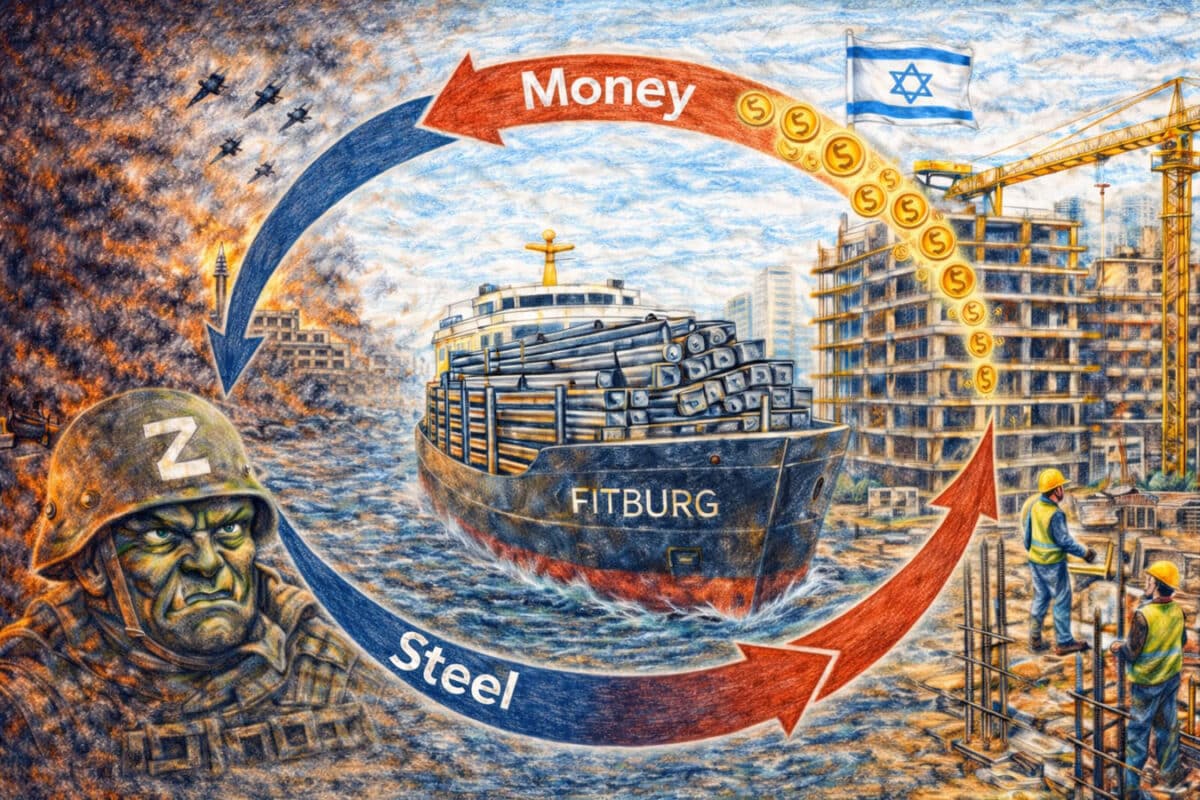
Uncomfortable thesis – “Every major export shipment is a contribution to Russia’s ability to continue the war”.
The story began on January 7, 2026, with a short message from Finland. Customs and port authorities allowed a vessel carrying sanctioned steel of Russian origin to Israel to continue its journey. An inspection was conducted, the cargo was recognized as falling under EU sanctions, but no criminal proceedings were initiated: the vessel entered Finnish waters not on its own initiative, but at the request of the authorities.
Formally — a standard procedure.
In fact — a public signal that the sanctions economy is not as airtight as commonly believed.
And most importantly — this signal directly concerns Israel.
Why this particular shipment became a “problem”
After February 24, 2022, when Russia launched a full-scale invasion of Ukraine, sanctions became a key tool of pressure. Already in March–April 2022, the European Union approved the first packages of restrictions, and by the end of 2022, they had turned into a systemic regime.
By 2024–2025, the EU had introduced:
— a complete ban on the import of Russian steel and semi-finished products;
— restrictions on shipping and insurance;
— blocking of dozens of banks;
— freezing of assets of more than 2,000 individuals and legal entities.
Simultaneously, similar measures were introduced by the United States, the United Kingdom, Canada, Japan, Australia, South Korea, and New Zealand.
The reason why metallurgy was separately sanctioned is simple and recorded in the EU explanatory notes: steel is one of the key export items directly filling Russia’s budget.
According to the European Commission, before the war, Russia exported metal products worth 40–45 billion dollars a year. After the imposition of sanctions, volumes decreased, but exports did not disappear — they were redirected to markets outside the EU.
Israel turned out to be one of these markets.
Where exactly in Israel this steel is used
Saving on conscience: isn’t it “shameful” for Israel to buy steel from the sanctioned aggressor Russia for … “cheapening apartments”
It is important to note: it is not only about housing.
Russian steel is used in:
— railway projects and new lines;
— bridges, interchanges, and tunnels;
— industrial and logistics zones;
— ports and terminals;
— municipal projects — schools, hospitals, shelters;
— engineering and dual-use defense facilities.
According to Israeli industry associations, up to 60% of all steel consumption is not for housing, but for infrastructure and government orders. Savings on metal affect not just one market, but the entire system of budget expenditures.
What really makes up the cost of construction
The thesis often heard is: “without cheap steel, housing will become unaffordable“.
Facts show a different picture.
The average cost structure of construction in Israel looks like this:
Materials — 45–55%, of which:
— steel and metal structures — 8–12%;
— concrete and cement — 15–20%;
— finishing — 8–12%;
— engineering systems — 7–10%.
Labor — 20–25%.
Land, permits, and regulation — 15–25% (especially in the center of the country).
Financing, interest, insurance, and risks — 10–15%.
Even with a 25–30% increase in steel prices, the direct effect on housing costs is 2.5–3%, and considering indirect factors — up to 5–7%.
This is significant. But it is not a systemic collapse.
Are there real alternatives to Russian steel
Alternatives to Russian steel exist. The question is that each of them requires either a higher price, more complex logistics, or stricter standards and long-term contracts. If Israel wanted to reduce or stop purchasing Russian steel, it has several replacement directions — none perfect, but all realistic.
The first scenario is expanding purchases in European Union countries: Germany, Italy, Spain, as well as several Eastern European producers. European steel fits well into transparent government procurement, is easier in terms of compliance, and does not carry sanction risks. The main downside is obvious: according to industry estimates, such steel can be about 40–60 percent more expensive than Russian. The second downside is contractual inertia: European factories often work on long contracts and are less flexible for urgent infrastructure needs.
The second scenario is increasing the share of Asian supplies, primarily from India. This can provide large volumes and potentially a softer price than Europe, but more expensive than Russian. In practice, it will be necessary to consider long sea logistics, the need for additional certification, and adaptation to Israeli standards. As a result, part of the “savings” is often eaten up by delivery times and associated costs, especially if it is about large projects where delays are more expensive than the metal itself.
The third option is using Chinese metal products in certain categories where requirements for exact characteristics and certification are simpler. This is technically possible, but the market is cautious about this scenario: quality is uneven, certification can be lengthy, and political and trade risks increase the price of uncertainty. For government and infrastructure projects, this is usually critical.
A separate scenario is Ukraine as a strategically and morally significant alternative. Before 2022, Ukrainian metallurgy was a notable supplier to the region. Theoretically, Israel could support Ukrainian supplies and fix them as a priority, but in the short term, there are limitations: war, damage to enterprises, logistics difficulties, and irregular volumes. This direction is realistic as part of a combination, but not as the only replacement.
And only after listing systemic alternatives should Turkey be mentioned — with an important caveat. Previously, Turkey was one of the largest sources of construction steel for Israel: in some years, Turkish products accounted for up to 25–35 percent of rebar and other long steel imports, meaning hundreds of millions of dollars a year. However, after 2024, this channel became politically and logistically unstable due to trade restrictions. Even before these restrictions, Turkish steel was on average 20–30 percent more expensive than Russian, and today it is difficult to consider it as a “basic” replacement.
Thus, the alternative to Russian steel is not one supplier, but a combination of sources: part from the EU (compliance and quality), part from India (volumes), targeted purchases from China (where permissible), and Ukraine as a strategic direction that can be supported by contracts. The price will almost inevitably rise, but it will no longer be a question of “is there a choice”, but a question of “what choice model is Israel ready to accept”.
Thus, refusing Russian steel does not mean the absence of choice. It means transitioning to a combination of more expensive, more complex, but politically and reputationally safe sources, just as the EU, the US, and all other democracies in the world have already done.
How payments are made despite sanctions
Sanctions on Russia’s banking system are strict, but not absolute. Not all banks are disconnected from international transactions, and EU and US regimes differ.
In practice, the following are used:
— intermediaries in third countries;
— alternative currencies;
— multi-step payment chains;
— trading structures formally not under sanctions.
Legally, such schemes are permissible. Economically — they mean one thing: money reaches the Russian producer, and then — into the budget.
Who supported the sanctions — and who stayed aside
The entire democratic West supported the sanctions.
They were not joined by Iran, Venezuela, Syria … China, India, Brazil, Turkey, and most Asian and African countries.
But among developed liberal democracies, the situation is different.
Israel – the only democracy outside the sanctions consensus
Israel remains the only developed liberal democracy, closely connected with the US and the West, which has not officially joined the sanctions against Russia.
This means that trade, including steel imports, remains legal.
But it also means that part of Russia’s foreign exchange earnings continues to be formed through such supplies.
Since 2022, Russia has earned hundreds of billions of dollars from exports. Metallurgy brings in tens of billions of dollars annually — money that goes into the budget, from which the war against Ukraine and Moscow’s cooperation with Iran, Hezbollah, and Hamas are financed.
The price per square meter and the price of position
Refusing Russian steel would not stop construction in Israel. It would make it more expensive — by a few percent.
But the question is no longer in accounting.
Saving on the cost of housing and infrastructure through trade with an aggressor state is a political and moral choice. It cannot be hidden behind the formula “everything is legal”.
This choice is now at the center of public discussion.
How Europe and the US manage without “cheap” Russian steel — and why for democracies the moral choice turned out to be more important than the price
After 2022, the countries of the European Union and the United States faced the same choice as Israel. Russian steel was cheap, familiar, and technologically understandable. Refusing it meant an increase in construction costs, pressure on infrastructure budgets, and business dissatisfaction.
Nevertheless, the EU and the US consciously took this step.
In Europe, the import of Russian steel was banned gradually, starting in the spring of 2022. To compensate for the deficit, three mechanisms were used.
First — redistribution of domestic production: European steel plants received state support, energy subsidies, and guaranteed orders.
Second — diversification of imports: South Korea, Japan, partially India.
Third — temporary acceptance of a higher price as a politically justified cost factor.
In the US, the situation was similar. Washington already had a developed domestic metallurgy, but still faced rising prices for infrastructure projects. The response was systemic: federal programs, such as the Infrastructure Investment and Jobs Act, directly included higher material costs as an acceptable price for a strategic and moral position. Official explanations for the programs emphasized: savings achieved through trade with an aggressor are considered unacceptable.
It is important to note: neither the EU nor the US claimed that refusing Russian steel “costs nothing”. It cost money. But this increase in expenses was recognized as part of the responsibility of democracies, not a mistake.
Here lies the key line of distinction. For Western democracies, sanctions were viewed not only as a tool of pressure but also as public confirmation of values. Economic losses were deemed acceptable because the alternative would be complicity — direct or indirect — in financing the war.
What Israel could do in this logic
Israel is not in a unique economic trap. Alternatives exist, and the market is already familiar with them. It is not about a sharp break, but about a political decision.
Israel could:
— announce a phased refusal of Russian steel with a transition period;
— fix the priority of supplies from the EU, India, Ukraine, other alternative suppliers;
— incorporate the increase in infrastructure project costs as a conscious state position;
— introduce transparency in government procurement, where the origin of metal becomes a public parameter;
— synchronize key restrictions with partners in the EU and the US without a formal “full package of sanctions”.
None of these steps would mean an immediate economic crisis. They would mean recognizing that for a democratic state, the origin of money and materials matters.
This is exactly how Europe, the US, and all other democracies in the world acted: not because it was cheap, but because it was considered right.
This is where the divergence of approaches lies: the price of steel is indeed measured in percentages. But the price of moral choice is in trust, political weight, and the ability to explain to allies why “everything is legal” turned out to be more important than the common pressure on the aggressor.
For Israel, this discussion is not about slogans, but about standards: what the state considers an acceptable source of savings in wartime conditions when Russia simultaneously works with Iran and its proxies. And that is why the question of the origin of steel turns into a question of position. NAnews — News of Israel | Nikk.Agency
Russia has begun the urgent evacuation of its embassy staff in Israel along with their family members. On January 7, 2025, Daily Iran News reports this, noting the accelerated and centralized nature of the proceedings.
This is not about isolated departures. In the past day, Moscow has organized a third flight to evacuate diplomatic personnel. The process is well-structured: lists, logistics, tight deadlines. All of this resembles a pre-prepared scenario rather than a spontaneous decision.
Organized evacuation without explanations
No formal statements have been made by the Russian Foreign Ministry yet. There are also no official comments from the Israeli authorities. However, the scale and pace of the evacuation suggest that the Russian side may have received information about possible changes in the regional situation.
In diplomatic practice, such steps are rarely taken “just in case.” Usually, they are based on risk assessments obtained through confidential channels. This is why the events are attracting increased attention from analysts and observers in the Middle East.
Context that cannot be ignored
In light of these events, recent statements by Putin made in the context of the Middle East conflict are being recalled. At that time, he called Israel “almost a Russian-speaking country,” emphasizing close human and cultural ties.
This comment now sounds different. The urgent evacuation of diplomats contrasts with the rhetoric of closeness and highlights how quickly priorities change when it comes to security.
What this might mean
It is currently impossible to say definitively whether Moscow’s decision is related to a specific threat or a broader reassessment of risks in the region. The lack of public explanations only increases the uncertainty.
The situation remains dynamic. The next steps by Russia and Israel’s reaction may clarify whether this is a temporary precaution or a signal of more serious changes in regional politics and security. In any case, such actions do not go unnoticed — especially in the context that is analyzed daily by NAnews — Israel News | Nikk.Agency.
In Paris, a declaration of the so-called “Coalition of the Willing” was signed. The document provoked a sharp reaction from Viktor Medvedchuk — a politician long associated with the Russian agenda and personally close to Putin.
In Medvedchuk’s interpretation, the agreement of European leaders to this format of cooperation supposedly proves: the conflict is not moving towards resolution, but on the contrary, is receiving new incentives for prolongation. According to his version, the declaration does not reduce tension but lays the groundwork for further escalation.
He claims that such steps go beyond regional politics and create risks for global security. In his logic, it is not about stabilization, but about a systemic undermining of the world order.
The rhetoric of risk and the image of a “big provocation”
Medvedchuk pays special attention to the points related to the possible deployment of multinational forces in Ukraine after the end of active hostilities. He calls this a political provocation and an attempt to prevent the end of the war under any conditions.
In comments disseminated through Russian state media, he directly speaks of creating prerequisites for a major international conflict. The formulations are harsh and demonstrative — aimed more at pressure through fear than at diplomatic analysis.
He separately emphasizes the thesis that the consequences of such decisions are shifted onto citizens. According to him, political miscalculations and the lack of strategy are supposedly paid for by a society tired of the protracted confrontation.
What the leaders discussed in Paris
Representatives of 35 countries participated in the meeting in Paris. Among them were EU and NATO countries, as well as Turkey, Japan, Australia, and New Zealand. The key outcome of the summit was the reaffirmation of commitment to the idea of a just peace in Ukraine within the framework of UN resolutions.
The discussion concerned security guarantees, mechanisms of international support, and possible formats of participation after the end of the war. For most participants, these are elements of long-term deterrence and prevention of new crises.
Medvedchuk insists: without immediate political agreements, such guarantees risk remaining declarative. This position fully coincides with the Russian interpretation of events, where collective actions of the West are interpreted as a threat.
Political background and current role
In Ukraine, Viktor Medvedchuk was one of the leaders of the banned pro-Russian party “Opposition Platform — For Life”. In 2021, he was arrested on charges of treason, and after an attempted escape in 2022, he was detained and later exchanged for 215 Ukrainian military personnel.
Already in Russia, Medvedchuk created the movement “Another Ukraine”, promoting narratives that coincide with Moscow’s official line. His statements are regularly used as an “alternative Ukrainian point of view” in the pro-Kremlin media space.
Today he continues to accuse Kyiv of unwillingness to end the war and simultaneously seeks through the court to restore Ukrainian citizenship. The rhetoric of a “global threat” in this context appears as part of a stable information strategy, where every international decision is presented as a destabilizing factor — and it is in this light that this story fits into the agenda of NAnews — News of Israel | Nikk.Agency.
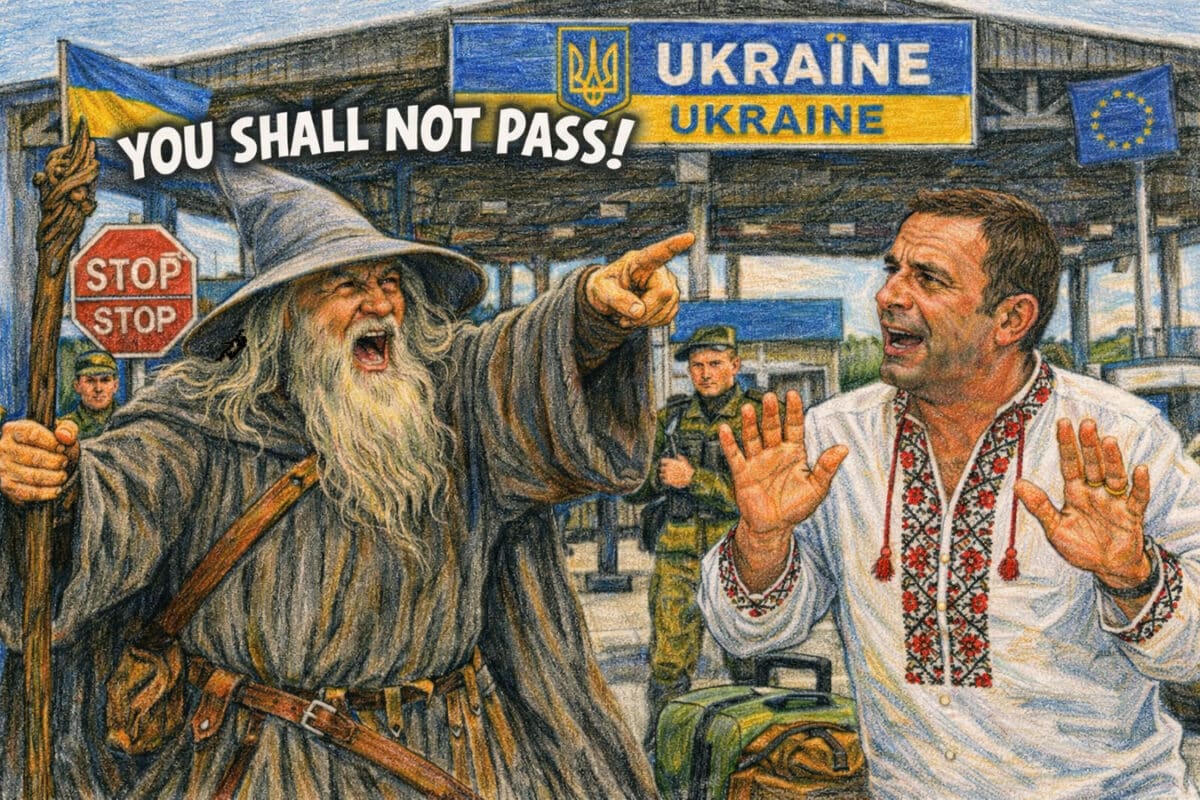
The scheduled bus Italy — Ukraine on January 6, 2025, unexpectedly turned into a public story with a resolution at the border. One of the passengers — an Italian citizen, traveling to Ukraine with his Ukrainian partner, according to eyewitnesses, began openly praising Putin and belittling Ukraine. It ended with the man being denied entry and banned from staying in the country for several years.
Entry Denied
The tone of this story is not “scandal for the sake of scandal.” It’s about how the war has long gone beyond the front lines. Sometimes it’s just a conversation on the road, sometimes a demonstration of symbols, sometimes an attempt to “visit” a country while simultaneously disparaging it.
The story became public after a post by Ukrainian blogger Daria Melnichenko on Threads. She recounted the conflict during the trip, not postponing it “for later,” and emphasized that she would not let it pass — especially in a situation where Ukraine pays with lives daily for its right to exist.
How It All Started
According to Melnichenko, the incident occurred during a stop. A couple — a Ukrainian woman and an Italian named Rocco — got off the bus. He was wearing a vyshyvanka — a gift from his partner. And this initially confused people: outwardly — a gesture of respect, a symbol of support, “one of us.”
Entry denied at the border: Italian Rocco in a vyshyvanka praised Putin on the bus on the way to Ukraine — and the network led the story to an entry ban
He himself approached to introduce himself, and the conversation started easily. Then — a sharp turn. Upon learning that the interlocutor was from Ukraine, the man, according to the publication’s author, switched to insults: he began repeating that Ukraine is “bad,” that the president is “bad,” and further — the key point — that Putin is “great” and “deserves respect.”
Such scenes always resonate not only with words. Here, the dissonance worked: a person is traveling to Ukraine, wearing a Ukrainian national symbol, saying he is heading to live in a Ukrainian city — and simultaneously justifying the aggression of a state that kills Ukrainians.
Eyewitnesses noted another difficult moment: according to them, the Italian’s companion did not look like someone trying to stop the conflict but like someone who shared it. This added anger to those who read the story: “this is not a random tourist, this is not ‘misunderstood,’ this is deliberate.”
The Decision “Not to Stay Silent”
In Melnichenko’s post, what later spread through reposts was that she wrote she would raise a fuss and “lie down at the border,” but such a passenger would not be allowed into Ukraine. There was a lot of emotion in this — and at the same time, it was an absolutely practical signal: there would be appeals to services, a statement, and identification.
This determination became the trigger. People recognized a familiar feeling in the situation: fatigue from how the war is devalued in a “roadside” conversation, how propaganda hides behind a smile and a foreign passport, how the aggressor is praised “in a safe environment,” sitting on a bus.
Then came an effect well-known in Ukraine: the collective reaction of the network. Subscribers began following the flight like a series — not out of curiosity, but because they wanted to see the finale: “will he pass or not.”
Simultaneously, users started searching for the Italian’s public pages. In open profiles, according to journalists and eyewitnesses, they found symbols, publications, and details that looked like a pro-Russian position. The story ceased to be just a “verbal skirmish” and became a matter of security.
The Border and Legal Framework
The climax occurred at the “Chop — Zahony” checkpoint. According to Melnichenko, she spoke with the shift supervisor, the border guards were already aware of the situation due to the social media resonance, made the necessary recordings, the couple was taken for additional checks, and the author herself wrote a statement.
Later, journalist Vitaliy Glagola reported that he sought a comment from the representative of the State Border Guard Service of Ukraine Andriy Demchenko. They confirmed: the border guards were informed and acted according to procedures, the decision is made strictly within the law.
It was separately reported that the Security Service of Ukraine is also aware of the situation. This is logical: during the war, even “words” on the road can be part of a broader picture — provocations, reaction tests, attempts to demonstratively humiliate the country at its doorstep.
As a result, according to journalists, the Italian was issued a refusal of entry card and a ban on staying in Ukraine for several years. In public retellings, the term three years is most often mentioned.
Why This Affected Many
This is not a story about “canceling an opinion.” It’s a story about the fact that war is not a discussion in comments and not a “point of view” that can be worn like a badge while remaining comfortable.
Several things immediately affected Ukrainians:
Someone wears a vyshyvanka as armor against responsibility, but inside — contempt.
Someone travels to live in Ukraine but chooses to humiliate people living under attacks on the road.
Someone thinks that a foreign passport gives the right to say anything and still “get through.”
And here, the very “small force” worked — not a state machine in a vacuum, but a specific person who did not back down, and thousands who did not let the story disappear.
One could “not get involved,” close their eyes, turn the page. But it is precisely such moments — when society does not swallow humiliation — that form the rules. In this sense, the finale at the border became an emotional relief for many: “he did not pass.”
On What Laws the Entry Denial Is Based: Specific Norms, Not “By Feelings”
The decision to turn the foreigner away at the border was not based on emotions or social media pressure, but on direct norms of Ukrainian legislation, which are applied especially strictly in wartime conditions.
Here are the key legal grounds used in such cases.
1. Law of Ukraine “On the Legal Status of Foreigners and Stateless Persons”
This is the basic document.
Article 13 directly provides for the refusal of entry to a foreigner if:
— their entry contradicts the interests of Ukraine’s national security;
— there are grounds to believe they may threaten public order;
— their actions or statements harm the interests of the state.
Important:
the law does not require the person to have committed a crime.
A risk assessment is sufficient.
Support for the aggressor state during the war is automatically considered such a risk.
2. Law of Ukraine “On the State Border of Ukraine”
This law gives the State Border Guard Service the right to:
— conduct additional checks;
— deny entry if there is information about a possible threat;
— act based on data from other bodies, including the SBU.
The decision is made at the border, without a court, within an administrative procedure — this is normal international practice.
3. Martial Law
Martial law is introduced by presidential decrees and approved by the Verkhovna Rada.
During this period:
— the priority is state security;
— the behavior of foreigners is assessed more strictly;
— public support for the enemy is not considered an “opinion” but a threat factor.
This is a critically important point:
in peacetime, such statements might end in scandal,
during war — they become grounds for entry denial.
4. Powers of the SBU
The Security Service of Ukraine has the right to:
— provide border guards with information and recommendations;
— initiate an entry ban for foreigners whose actions or views contribute to aggression against Ukraine.
In such cases, the SBU is not required to initiate a criminal case — it is about preventive measures.
5. Administrative Form of Decision
Legally, it looks like this:
— a refusal of entry card is issued;
— a ban period is set (often 3 years — standard practice);
— the decision is not a conviction and does not require a court sentence.
This is not a punishment, but a restriction of access to the state’s territory.
Why This Is Legal and in International Logic
No state is obliged to admit a foreigner who:
— publicly supports its enemy;
— travels to a country at war;
— demonstrates a hostile position even before crossing the border.
Israel, the USA, and EU countries act in the same way — the question is only how directly the person themselves indicates their position.
In this story, three factors coincided:
public statements, a statement by a Ukrainian citizen, and confirmation of the position through open sources.
This is enough for the decision to be legal, formalized, and stable — without a court, but strictly within the legal framework.
This is exactly how the border and legal logic of a warring country works today, as recorded by NAnews — News of Israel | Nikk.Agency.
He was born in Lviv, became an Israeli citizen, coached children at “Maccabi Be’er Sheva,” served in the IDF, and then returned to Ukraine — and to a war that was not of his choosing. He voluntarily joined the “Right Sector”, helped train recruits, later signed a contract with the UAF and commanded a platoon in the International Legion of Territorial Defense. He died near Bakhmut — as a man who lived between two countries and remained loyal to both. The story of Dmytro Fialka is not just about heroism, but about choice and duty that is stronger than fear.
Lviv. Birth and Roots
Dmytro Bohdanovych Fialka was born on June 21, 1983, in Lviv. It was the city where everything began for him: football, first friends, the smell of the yard, and cold morning training sessions at the school stadium. He grew up in a family that valued hard work and knew the price of responsibility. And, as acquaintances later recalled, he was focused from childhood — never fussed, acted calmly and precisely.
When he was about fifteen, the family moved to Israel. Repatriation, a change of language, a different climate and culture — all of this was a challenge. But it was there, in Israel, that Fialka learned to overcome himself.
Israel. Service and Formation
After moving to Israel, Dmytro graduated from school and obtained citizenship. He served a three-year term in the Israel Defense Forces (IDF), in the “Nahal” brigades, and participated in combat operations against the “Hezbollah” group during the Second Lebanon War.
This chapter of his life became foundational. There, in the dusty valleys and hot positions, he understood what discipline was, what trust meant, and the responsibility for others. He later often told friends: “The army made me a man. I don’t regret a single day.”
The service ended, but the habit of acting, not talking, remained. And then football reappeared in his life.
Coach at “Maccabi Be’er Sheva”
From 2008 to 2013, Dmytro Fialka worked as a coach for the youth teams of the “Maccabi Be’er Sheva” club. In the official records of the Israel Football Association (IFA), he is listed as דימה פיאלקה (Dima Fialka).
He coached teenagers, led them to tournaments, and helped them find confidence on the field. One of his trainees was Or Dadia, who later became a player for the “Hapoel Be’er Sheva” club. In an interview, he said:
“Dima was my first coach. He could explain without shouting. After he left for Ukraine, we still corresponded. He was interested in how I was playing. I will never forget this.”
For Fialka, football was not just a job. It was a language he spoke with children. He demanded from them the same as he demanded from himself — precision, respect, and honesty.
Return to Lviv and New Life
In 2015, Dmytro returned to Ukraine. The reason was simple and human — a sick grandmother. He settled again in Lviv, where he started. He met Eva, got married, and became the father of two children — a daughter and a son.
In Lviv, he continued his coaching work: first at the “Dynamo Lviv” club, then at the DYUSSH FC “Lviv”, where he worked with teenagers. Before the war, he coached the youth team of Dynamo Lviv, as confirmed by publications in Israeli and Ukrainian media.
Colleagues recalled that Dmytro always came first and left last. During training, he repeated:
“If you want to be listened to — be an example.”
He lived modestly but with dignity. He loved children, his family, and football. And, as Israeli journalists later wrote about him, “he lived between two flags, but never betrayed either.”
War. Volunteer and Commander
When Russia launched a full-scale invasion in February 2022, Dmytro did not wait for a summons.
He volunteered for the Ukrainian Volunteer Corps “Right Sector”, where he helped select and train recruits. Later, he signed a contract with the Armed Forces of Ukraine and became a platoon commander in the International Legion of Territorial Defense of the UAF — a unit that included both Ukrainians and foreigners, among them veterans from Israel, Poland, the USA, and Canada.
His call sign was “Ship”.
He did not like to talk much about the war. In one of the messages to friends, he wrote:
“There are no strangers here. Everyone is your own if they are nearby.”
Fighters recalled that he knew how to maintain order, never lost composure, and never left his subordinates.
Death near Bakhmut
On September 1, 2022, Dmytro Fialka died near Bakhmut while performing a combat mission. According to official Ukrainian and Israeli media reports, he received a gunshot wound to the head.
Dmytro’s body remained in territory controlled by Russian forces. For six weeks, his family and volunteers fought for his return. On October 11, 2022, his remains were returned to Ukraine as part of a body exchange between Ukraine and Russia.
This news was covered by major Israeli and Ukrainian media. Times of Israel reported that “the body of the former Israeli soccer coach was returned to Ukraine after exchange negotiations.” Ynet clarified that this exchange was the result of significant diplomatic and humanitarian efforts.
Israeli Family and Burial Decision
In Israel, in Be’er Sheva, where Dmytro’s mother and younger brother lived, the news of his death caused deep shock. Relatives began a fundraising campaign — about 15,000 shekels to transport the body for burial in Israel.
But Dmytro’s family in Lviv decided otherwise. His wife Eva insisted that he should remain where he lived and for what he died — in Ukraine. This dilemma was painful for both sides, but the decision was made calmly, with respect. Israeli relatives returned the collected funds to donors, calling it “a tribute of memory and love without borders.”
There was no conflict in this story. There was only pain, shared between two countries.
Funeral in Lviv
On October 21, 2022, Dmytro Fialka was buried in the Jewish section of Yaniv Cemetery in Lviv. The ceremony was attended by representatives of the Jewish community, Israeli diplomats, volunteers, and his former students.
Two flags — Ukrainian and Israeli — stood side by side. Not as a symbol of division, but as a sign that one person can be a home for two nations at once.
Radio Liberty wrote that words about his courage and modesty were spoken at the funeral. He was not a politician, did not strive to be a hero. He simply did what he considered right.
Memory and Recognition
After Dmytro’s death, his name appeared in the memorial lists of the International Legion of the UAF. In Israel and Ukraine, dozens of publications were written about him — from sports portals to major publications.
The Israel Football Federation confirmed his status as a former coach of the “Maccabi Be’er Sheva” club. On social media, Israeli players and coaches posted photos with the caption “Dima Fialka – forever coach.” In Lviv, he is remembered as a teacher who could speak to children so that they listened not out of fear, but out of respect.
A Man Between Flags
Dmytro Fialka lived a life that cannot be measured in kilometers. He was born in Ukraine, grew up in Israel, returned to Ukraine, and died defending it.
Israeli media wrote about him warmly. Israel Hayom called him “a soldier of two homelands,” Ynet — “a coach remembered by everyone who learned from him to be strong.” Ukrainian sources — “a man who understood that freedom knows no borders.”
He did not leave behind loud speeches — only an example. And this example is worth more than any awards.
Moral and Conclusion
The story of Dmytro Fialka is not about death. It is about the choice a person makes when they cannot do otherwise. About the fact that true belonging to a country is not a passport, but an action.
He was a Jew, a Ukrainian, an Israeli. He was a father, a husband, a coach, a soldier. And he became a person who proved: loyalty is not geography, but an inner truth.
When we see two flags side by side — Israeli and Ukrainian — we should remember that sometimes one person can connect them more strongly than dozens of diplomatic agreements. Such a person lived. His name was Dmytro Fialka.
Moral: Memory That Unites Two Nations
There are dozens, hundreds of such destinies. People whose lives passed between Israel and Ukraine, between two homelands, between two worlds that seemed distant until pain brought them closer.
These are stories of Israelis of Ukrainian origin, IDF veterans, volunteers, doctors, IT specialists, and ordinary citizens who stood alongside Ukrainians during the war. And each of them, like Dmytro Fialka, carries a part of a common code — human and honest.
When society remembers such people, it becomes stronger. Memory is not just an archive. It is a mirror of conscience. It reminds us that the true connection between countries is born not in offices, but in the actions of those who do not seek profit, who simply do what they consider right.
Dmytro Fialka showed that patriotism can be dual, but loyalty is one. He lived at the intersection of cultures, spoke two languages, prayed in different words, but in his heart had one principle: life is worth living with honor.
Society — both Ukrainian and Israeli — is obliged to remember such people. They become a bridge between nations that too often share pain. And it is thanks to such stories that we see that heroism is not about war, but about humanity.
Steven Spielberg is one of the most famous directors in human history! Category 🔯 — Jews from Ukraine #jewsukraine
📍 Born: 12/18/1946, Cincinnati 🇺🇸
💙💛 Spielberg’s grandparents were Jews from Kamenets-Podolsky and Sudilkov, Khmelnitsky region. Ukraine
🔯 His mother ran a kosher halawi (dairy) restaurant. All of his immediate family were religious Jews. Stephen attended Hebrew school and also celebrated his bar mitzvah. His family was involved in the synagogue and had many Jewish friends.
🤔Spielberg had a hard time accepting his heritage
“I hate to admit it… but as a child, God forgive me, I was ashamed because we were Orthodox Jews. I was ashamed of the external perception.”
At school, anti-Semites broke his nose twice. “It was terrible.”
💍Spielberg met actress Kate Capshaw when he filmed her in the film Indiana Jones. They married in 1991, and the bride converted to Judaism at the time of their marriage.
Stephen said:
“Kate is a Protestant and she insisted on converting to Judaism. She spent a year studying, doing the mikveh, all of this. She decided to convert completely before our marriage. This, more than anything else, brought me back to Judaism. This shiksa (non-Jewish in Yiddish) made me a better Jew than my parents.”
🕯About the Holocaust, he said that his parents “talked about it all the time, and so it was always in my mind.”. His father lost at least 16 relatives in the Holocaust. In 1993, Spielberg directed Schindler’s List about a businessman who helped save 1,100 Jews from the Holocaust. The film was included in all major ratings of the best films in history.
🇮🇱 Spielberg’s Munich (2005) tells the story of the Israeli government’s retaliation against Arab terrorists after 11 Israeli Olympians were kidnapped and killed during the 1972 Olympics.
📝 The Steven Spielberg Jewish Film Archive is dedicated to the preservation and research of Jewish documentaries. The archive is run by the Hebrew University of Jerusalem and the World Zionist Organization. The archive contains more than 16,000 pieces of content.
🕎 Together with Victor Pinchuk (Ukraine), he produced the documentary film “Say Your Name”. The film tells about the survivors of Babi Yar, and was filmed based on the testimony of the Holocaust Survivors Foundation. The fund contains 55,000 video testimonies in 43 languages from 65 countries, making it the largest archive of its kind in the world.
🇺🇦In 2006, Spielberg visited Ukraine for the first time in his life at the premiere of this film. The film had a significant impact on Ukrainian-Jewish relations and changed the understanding of the Holocaust in Ukraine.
👾In Spielberg’s film “War of the Worlds” the events of the alien attack begin with anomalies in Ukraine.
🤝 In addition to cultural influence, Spielberg has repeatedly supported Israel and Ukraine:
❤️Donated $1 million to help Israel during the 2006 Lebanon War
❤️His sister Nancy is the founder and director of the Children of Chernobyl charity organization. Stephen also supports this company.
❤️In 2022, in connection with the Russian invasion of Ukraine, he and his wife donated $1 million to Ukrainian refugees.
❤️ In 2023, following the Hamas attack on Israel, the Shoah Foundation, founded by Spielberg, collected more than 100 video testimonies from survivors of the October 7 attacks to add to the Holocaust Survivors collection. He said: “I never thought I would see such unspeakable barbarity against the Jews in my lifetime.”
🏆 Spielberg is one of the most awarded cinema figures and officially the most commercially successful director in history. He alone has received a Best Director nomination for six consecutive decades:
Oscar: 3 awards / 23 nominations
Emmy: 12 / 27
Golden Globe: 9/24
BAFTA: 2 / 14
And hundreds more.
He also received a special medal from the President of Israel 🥇
🎬 Featured films:
Jaws;
Alien;
Indiana Jones film series;
Jurassic Park;
Schindler’s List;
Saving Private Ryan;
Catch me if you can;
Terminal;
Munich.
—
This article was prepared specifically for the site NAnews — Israel News, where you will find even more interesting stories about prominent Jews from Ukraine, such as Steven Spielberg.
A meeting of the so-called “coalition of the resolute” is scheduled in Paris today — a group of countries discussing the readiness to send troops as part of a potential peacekeeping contingent to ensure Ukraine’s security.
It is expected that the President of Ukraine Volodymyr Zelensky will meet with the President of France Emmanuel Macron. Then, according to the preliminary agenda, negotiations are to be held with representatives of the USA — Steve Witkoff and Jared Kushner.
After bilateral contacts, a general summit is planned: representatives from 35 countries are announced to participate, including 27 presidents and heads of governments. NATO and European Union leaders are also expected to be present at the negotiations.
Reuters notes that the meeting is expected to yield not general formulations, but specific commitments from allies regarding Ukraine’s security — because previous promises often seemed vague and left too many “gray areas.”
What remains unresolved regarding peacekeepers
According to data relayed by European sources and specialized media, four key issues remain in discussions. They determine whether the contingent will be a real deterrent mechanism — or just a political symbol.
Contingent size. Working estimates mention 15–20 thousand military personnel, while some participants hope for a level of about 30 thousand. France and the United Kingdom are most frequently named as the main suppliers of forces.
Rules of engagement. The most sensitive point: how exactly peacekeepers will respond to possible provocations from Russia. One European diplomat openly admitted that a basic dilemma is being discussed — whether to respond with fire or try to avoid direct confrontations.
Deployment geography. There is no clarity on how close to the line of contact the contingent can be located. In European capitals, a more “cautious” model is being discussed in parallel — deployment in western Ukraine for support, training, and strengthening rear resilience.
The American factor. Washington is not declared as a participant in the “coalition of the resolute,” but allies are counting on US support — political, intelligence, logistical. The form of this support, according to sources, remains undefined.
A European source from Reuters links today’s meeting with expectations of clearer guarantees from the US. The idea is that Europe’s political decisions will ultimately push Washington towards a clear format of support — similar to what was discussed in bilateral contacts in December.
Before the summit, Polish Prime Minister Donald Tusk outlined the goal: to develop a common position between Europe and the US on ending the conflict. On the table, an updated version of the 20-point peace plan is expected, although Tusk himself warned that the meeting is unlikely to conclude with the signing of final documents.
Moscow previously rejected the option of deploying foreign troops in Ukraine. At the same time, in December 2022, the Russian side indicated that it could theoretically discuss European peacekeepers after the end of the war. The press secretary of the President of Russia, Dmitry Peskov, emphasized: Moscow’s position remains unchanged, but the “topic is discussable” — a formulation that leaves room for tactics.
And another layer that cannot be ignored: the war has gradually become the backdrop of everyday life — both in Europe and beyond. Fear and tension in parts of societies are replaced by fatigue and a desire for a “quiet exit,” but such periods often make security particularly fragile. Therefore, in Paris today, they will talk not only about politics but also about the mechanics of deterrence — and NANews — News of Israel | Nikk.Agency will continue to monitor what this turns into in practice.
Russia has declared its readiness to facilitate the normalization of relations between Iran and Syria. This was reported by the Russian ambassador to Tehran, Alexey Dedov, in an interview with the Iranian agency ISNA.
The statement came against the backdrop of Moscow’s diplomatic track in the Middle East increasingly intertwining with the war in Ukraine, sanction pressure, and military cooperation between Russia and Iran — a state perceived in the region as a threat factor, including for Israel.
European accusations against Iran: Moscow’s position
Dedov claims that European countries use, in his words, “unfounded accusations” related to Iran’s involvement in Russia’s war against Ukraine as a pretext for pressure on Tehran. In this logic, Europe allegedly seeks to limit Iranian sovereignty and the Tehran-Moscow connection.
The ambassador also added: even if the topic of Ukraine ceases to be central, European countries, in his assessment, will find other grounds for “destructive measures” against Iran.
In the diplomat’s interpretation, the key motive of European capitals is to punish any state that conducts an independent foreign policy and does not follow Brussels’ directives. This rhetoric describes sanctions not as a response to specific actions but as a tool of discipline.
Ukraine and “peace proposals”: how it is presented in Tehran
Commenting on the conflict itself, Dedov stated that Moscow continues to adhere to the “peace proposals” previously voiced by Vladimir Putin. It is important that such wording is aimed at an external audience — including in the Middle East, where Moscow tries to appear both as a participant in the war and as a “negotiator.”
A separate line in the interview is an attempt to reject the thesis of Russia’s isolation after the start of the full-scale invasion. The ambassador claims that the opposite is happening: Russia’s presence on the international stage is allegedly strengthening.
Iran as Moscow’s support: drones and production
The key practical context of these statements is the military-technical connection between Russia and Iran. Since the full-scale invasion, Iran has become an important ally of Moscow: it supplies strike drones and helps establish their production on Russian territory.
This aspect is important not only for Ukraine, which faces the use of such drones, but also for Israel: Iran is considered a strategic adversary, and the expansion of its military capabilities and the export of technologies into Russia’s hands change the balance of risks in the region.
What Tehran receives: S-400, fighters, and “strategic partnership”
In response to Iran’s support, Russia, as noted, provides Tehran with fighters and S-400 anti-aircraft missile systems. Moreover, last summer, a comprehensive strategic partnership agreement, including military cooperation, was signed between the presidents of Iran and Russia.
And here, Moscow’s “peacekeeping” role in the Iran-Syria issue looks ambiguous: on one hand, the Kremlin offers itself as a mediator in regional normalization, on the other — it strengthens the military alliance with Iran against the backdrop of the war in Ukraine and increased international tension.
For Israel and European capitals, this forms a single picture: Moscow’s diplomatic initiatives in the Middle East go hand in hand with attempts to solidify the Russia-Iran axis, and that is why any statements about “normalization” are perceived through the prism of security and war. NNews — Israel News | Nikk.Agency
In 1734, the founder of Hasidism settled in Tovstom Israel ben EliezerIt is believed that It was here that he received his second name, Baal Shem Tov (abbreviated as Besht) and became known as a tzaddik and healer.
In his new article“Ukraine Incognita” revealed little-known facts about the Jewish history of the village of Tovste (Ukrainian: Товсто), which is in the Ternopil region. For those interested — here it is on the map.
This village is not as well known to travelers as Zalishchyky, Gorodenka or Chortkiv, but, according to researchers, it is no less interesting and definitely deserves attention.
In Hasidism this is called the “Besht’s revelation.”that is, the moment when he revealed to people his true face as a great tzaddik.
Hasidic traditions describe it this way:
“Then he (Israel ben Eliezer) settled in the holy community of Tlusta, where he was also a melamed (teacher in a cheder – religious school), and could not gather a minyan in his home, but received people and prayed with them.
He wore a “tuzlik” (Ukrainian) (a woolen bag for salt), and his toes stuck out of the holes in his shoes, because he was very poor. He used to immerse himself in the mikvah even in the month of Tevet (December-January according to the Gregorian calendar), and sweat would come out in drops the size of peas. Then people began to come to him, but he did not want to receive them.
One day, a madman or madwoman was brought to him, and he refused to let them in. At night, he was told that he had turned 36. In the morning, he began to count and discovered that this was indeed true. He accepted the madman, cured him, and left his occupation as a melamed, taking my father-in-law, of blessed memory, as a sofer. People from different places began to come to him.”
The term “baal-shem” was used by the people to refer to a person who knows the hidden name of God, has the power and means (“kelim”) with which he can address the Almighty. In another meaning, among Kabbalists, “baal-shem” is someone who uses the formulas of magic (practical Kabbalah) and natural remedies for healing. Baal Shem began as a professional healer, combining the knowledge of a doctor, psychologist and folk healer. He treated infertility, mental illness, exorcised demons and devils, and made amulets and potions.
Besht lived in Tlust (as Tovsta was called until 1944) almost until his move to Medzhybizh.
Hasidic traditions should be treated with great caution, as they contain many frankly fabulous and logical inconsistencies. But the fact remains that Hasidism, as a new religious movement, originated in Tovstom.
By 1930, the local Jewish community numbered 2,600 people, more than two-thirds of the entire population of the village. But by 1939, it had significantly decreased to 1,196 people.
The German occupation put an end to the history of the Jewish community of Tlusty. The Nazis created a ghetto in the village, where, in addition to locals, they drove Jews from neighboring Zalishchyky, Horodenka, Yagilnitsa, Chortkiv and others.
On May 27 and June 6, 1943, the entire population of the ghetto was exterminated in two mass executions. Taking into account the executions of previous years, almost 5,000 people were tortured in the village in total.
Traces of this tragedy can be seen in the old Jewish cemetery. In addition to the mass graves of the tortured, there are bullet holes on the matzevah gravestones.
 #jewsukraine