
101 years over the mass grave: the history of the oldest memorial complex of the Jewish community of Ukraine – video

A recent report by local television about the monument to the Proskurov pogrom prompted me to check the history of the memorial itself. Behind the 1925 obelisk lies a separate century-long biography — a mass grave, rescuers of Jews, a vanished cemetery, an almost completed demolition, Hebrew inscriptions of the 21st century, and three different official names for one object.

Author: Anton Pshedynsky

On the evening of August 27, 2026, I came across a small segment on Khmelnytsky’s 33 channel titled “Bloody History of the Oldest Memorial Complex of the Jewish Community”.

In the frame — a tall light obelisk, bronze human figures, the Star of David, menorahs on the fence, and a slab with an inscription in Hebrew. The segment lasts less than four minutes. But almost every minute of it raised a separate question.

Why is a monument built in 1925 adorned with works by a sculptor born in 1937? Who paid for its construction? What from the current complex has truly been preserved from 1925? How did it survive the German occupation? Why did the Soviet authorities simultaneously limit Jewish memory and place this object under state protection? Who decided to demolish it after the collapse of the USSR? Why is the same monument called by three different names in official Ukrainian documents today?

And finally: who is actually buried under it and how many people are there?

I started checking.

The historian we hear in the report is Sergey Nikolaevich Yesyunin, a candidate of historical sciences and a leading researcher at the Khmelnytsky Regional Museum of Local Lore. He has been working at the museum since 1995, and since 2006 as a leading researcher, focusing on the history of Khmelnytsky and the cities of Podolia, and is the author of hundreds of historical and local lore publications. Therefore, his appearance in the segment is not a random street comment: before us is one of the people who professionally study the history of the city.

But then I deliberately did not limit myself even to his story. For NANews — News of Israel, I compared the segment with archival materials, documents of the Khmelnytsky City Council, the historical and architectural plan of the city, publications of “Hesed Besht”, “Shtetl No.7”, data on cultural heritage, and our previous studies of Ukrainian-Jewish history.

And the monument turned out to be almost an independent historical character.

February 15, 1919: three hours after which a mass grave appeared

First, we need to understand what happened at this place.

Proskurov is today’s Khmelnytsky. The city was renamed in 1954, so the name “Proskurov pogrom” may not mean anything to an Israeli reader who knows the modern map of Ukraine.

February 15, 1919, was a Saturday — Shabbat.

At this moment, Ukraine was in the chaos of war after the collapse of the Russian Empire. Bolsheviks, Ukrainian troops, White armies, local armed formations, and later Polish troops were simultaneously active here. State institutions existed, but control over armed people was far from what we understand today.

After an unsuccessful Bolshevik uprising in Proskurov, ataman Ivan Semesenko accused the local Jewish population of supporting the uprising.

Semesenko commanded a Ukrainian military unit that was part of the UNR — Ukrainian People’s Republic forces. For an Israeli reader, the closest explanation is this: the UNR was an attempt to create an independent Ukrainian state in 1917–1921, simultaneously at war with Bolshevik Moscow and other forces.

It was Semesenko’s Ukrainian military subordinates who went into the Jewish quarters of Proskurov.

Sergey Yesyunin in the report speaks of 1600 killed in less than three hours. He emphasizes another terrible feature: people were mostly not shot but killed with bayonets and other cold weapons.

Historical materials indeed contain testimonies of an order not to expend bullets. Descriptions feature bayonets and sabers.

Yesyunin also speaks of the elderly, children, women, and pregnant women among the victims.

Another detail sounds almost implausible: an orchestra and sisters of mercy.

It did not arise from thin air. Sources describe the organized passage of an armed column through the city before the start of mass killings, with the column accompanied by an orchestra; testimonies also mention sisters of mercy. But there is a fine line here. I did not find sufficient grounds to write that the orchestra continued playing directly during the killings inside the houses.

Therefore, the phrase “the massacre took place under the music of the orchestra” sounds impressive but goes beyond what can be confidently proven.

1600 dead — a number of memory, but the archive gives a different picture

The situation with the number of victims is not entirely clear.

On the memorial and in the materials of the local Jewish community, the number 1600 people is fixed.

But archival calculations do not allow it to be turned into the only indisputable number.

In the preserved nominal document, 1063 people killed and died from wounds are listed. Other sources give about 1200 directly killed and hundreds more who died later. In historical literature, one can find a range of approximately 900 to 1600 victims.

Why such a range?

Because we are comparing different things: people who died directly on February 15; those who died later from wounds; lists compiled at different times; eyewitness testimonies; materials of aid organizations; later reconstructions of losses.

Therefore, I would leave 1600 exactly where this number has a source: in the words of Sergey Yesyunin, on the memorial, and in the memory of the community. But if answering the question “how many people historically proven died,” the answer no longer fits into one number.

This is precisely the case where caution does not diminish the tragedy. On the contrary — it separates memory from the accounting illusion of absolute accuracy.

960 orphans and three orphanages

After the pogrom, another number remained, which is easy to overlook against the backdrop of the number of dead.

960 children, according to the local Jewish community and materials of “Shtetl No.7”, were left orphans.

Orphanages were created for them.

A hundred years later, the “Hesed Besht” foundation returned to these children as a separate line of memory: in a special issue of “Shtetl No.7”, prepared for the centenary of the pogrom, information about the dead, orphans, and eyewitness testimonies were collected.

The fund also holds the book “Fragments of Old Proskurov”, which contains documents about the Jewish history of the city.

This detail changes the scale of the event. “1600 dead” is a terrible statistic. But 960 children who had parents in the morning and were orphans by evening is already a social catastrophe of an entire urban community.

It was from this community that the idea of the monument was born six years later.

Was it “Petliura’s pogrom”

This is one of the questions that will inevitably arise for a reader in Israel.

For decades under Soviet rule, the monument was officially called “The Mass Grave of the Victims of the Petliura Pogrom”.

Does this mean that Symon Petliura ordered the killing of Jews in Proskurov?

I did not find such a document, and historians do not present it.

The direct organizer of the Proskurov pogrom is called Ivan Semesenko. At the same time, Semesenko and his people acted within the UNR armed forces system, which means it is also impossible to completely exclude the political and military leadership of the republic.

We have already separately analyzed this complex topic in the NANews material “Do not forget about the sword”: Symon Petliura, Ukraine, Israel, and the controversial memory that cannot be given to Moscow.

For this article, it is enough to fix the boundary of what is proven: Petliura’s order to conduct the Proskurov pogrom is not established; the mass killing was committed by Semesenko’s Ukrainian servicemen; the ability of the UNR leadership to prevent and punish pogroms remains a separate question of historical responsibility.

That is why the modern name “Proskurov pogrom” is more accurate than the Soviet political label “Petliura’s”.

But the Soviet formulation has not completely disappeared. A hundred years later, it unexpectedly resurfaces in the registry history of the monument itself. I will return to this.

There were Jews in the same Ukrainian army: 1919 does not fit into a black-and-white picture

Here it is especially easy to make history convenient.

One can say: Ukrainian military killed Jews — and put a period.

But then another reality from the same 1919 will have to be cut out.

A few months after the Proskurov massacre, a full-fledged Jewish military unit operated within the Ukrainian Galician Army — Solomon Leinberg’s Jewish Kurin. NANews detailed it in the material “The History of the Jewish Kurin in the Ukrainian Galician Army of 1919”.

Jewish fighters fought for the Ukrainian state project, operating in areas including Proskurov, Vinnytsia, Berdychiv, and Fastiv.

Another line is associated with Yevhen Konovalets.

Konovalets’ Sich Riflemen arrived in Proskurov after the pogrom. Konovalets ordered an investigation. Sotnik Mykola Bisik and city commandant Hryhoriy Hladky collected materials on the causes of the killings, organizers, perpetrators, and losses of the Jewish population.

We checked this episode separately in the article “Yevhen Konovalets returns to Ukraine: Jews alongside the founder of the OUN…”.

But even there, I did not find evidence that this investigation resulted in a full-fledged judicial punishment of the organizers specifically for the mass killing of Jews.

An inconvenient, yet real picture emerges.

In one 1919, people in Ukrainian uniforms killed Jews in Proskurov.

Other Ukrainian military investigated this killing.

And Jewish soldiers simultaneously wore Ukrainian uniforms themselves and fought for Ukrainian statehood.

A short slogan here will inevitably lie about something.

People who said “no” in February 1919

Another feature of the current memorial is that it tells not only about the victims.

In the report, Sergey Yesyunin separately recalls people who tried to save Jews.

Klymentiy Kachurovsky was a protodeacon of the Proskurov Cathedral. It is important to clarify: protodeacon is a church rank, so the common definition “priest-protodeacon” is legally and ecclesiastically inaccurate.

Kachurovsky hid Jewish children in his home. When people sought refuge near the temple, he tried to protect them and was killed himself.

His story later received a separate place on the memorial.

Sergey Polozov — a doctor and public figure — also sheltered people and helped the victims.

Trokhym Verkholya, associated with the city council and the Ukrainian public movement, opposed the pogrom and sought to stop the violence.

Sources also mention an official L. Bienko, who died trying to protect Jews.

But the automatic transcription of the fresh TV segment let us down here.

It mentions a certain “Vikentiy Sihora”.

When I started looking for this person, the story did not add up.

Historical materials name the head of Proskurov Mykola Vikentiyovych Sikora. Together with other city authorities, including Marian Stavinsky, he demanded to stop what was happening.

This is a minor mistake only at first glance.

After several reprints, “Vikentiy Sihora” would have turned into yet another historical character, although he most likely appeared simply from poorly recognized Ukrainian speech.

1925: the monument is erected not by the state, but by the living community of the deceased

Six years later, an obelisk appeared over the mass grave.

This is 1925.

At that time, people who had seen the pogrom with their own eyes were still alive. Widows of the deceased walked the streets of Proskurov. Children who had been orphaned were growing up. For them, February 15, 1919, was not “the history of Ukrainian Jewry,” but a specific day of their own lives.

And it was they who collected the money.

The main funds for the creation of the memorial were provided by the families of the deceased and the Jewish community of Proskurov. More detailed local materials also indicate partial financial assistance from the city authorities.

Therefore, the too beautiful phrase from the TV segment — “built entirely without state funds” — I would slightly correct. The initiative and main funding were indeed communal, but the city’s participation, according to sources, was also present.

For construction, bricks from the local Halperin factory were used.

In “Shtetl No.7”, the author of the project is named I. Korenblit, as well as local craftsmen whose names have not been preserved.

There are grounds to assume that this refers to the artist Israel Korenblit (1890–1971), but I did not find a document that would allow unequivocally equating “I. Korenblit” with Israel Korenblit.

Therefore, the modern city record remains more cautious and simply states:

“local craftsmen”.

What exactly remains of the 1925 monument

Here begins the first big mystery that the TV report does not explain.

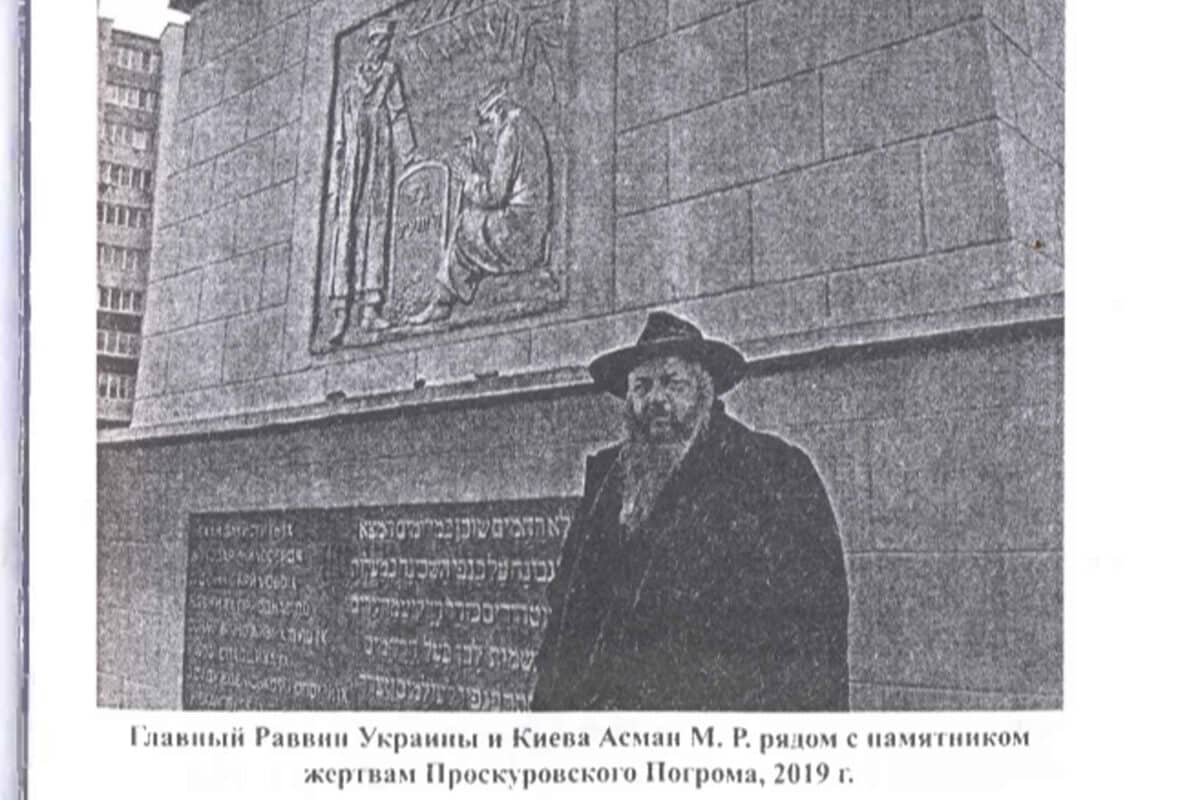
Today, the memorial looks like a rather complex complex: a tall obelisk, bronze reliefs, inscriptions, menorahs, the Star of David, tiles.

But in 1925, this entire set did not exist.

The historical core was a stepped brick obelisk over the mass grave.

The official record gives its height as 7.4 meters. In the materials of the Jewish community, a rounded description is found — about eight meters.

In the detailed documentation, the foundation dimensions are approximately 5.07 × 3.8 meters.

This is a massive brick structure consisting of several volumes decreasing upwards with a pyramidal top.

And here’s another characteristic detail emphasized by the community: the monument did not receive the usual set of Soviet symbols. It emerged before the Stalin era and was created as a Jewish memorial pantheon, not as a later state Soviet structure.

But the most noticeable thing in modern photographs appeared much later.

Sculptor Korzhev was minus 12 years old in 1925.

In the 33 channel story, we see bronze bas-reliefs and hear the name of the Khmelnytsky sculptor Konstantin Korzhev.

If you watch the video without additional verification, you might decide that Korzhev designed the monument in 1925.

Impossible.

Konstantin Alekseevich Korzhev was born on March 4, 1937, in Baku. He lived and worked in Khmelnytsky from the mid-1960s, engaged in monumental sculpture, and died in 2004.

Therefore, the bas-reliefs belong to the modern reconstruction.

Even more interesting is the discrepancy in authorship.

The TV story names Konstantin Korzhev.

The historical and architectural documentation of Khmelnytsky associates the relief compositions with Konstantin and Alexander Korzhev.

Therefore, the most accurate formulation is not to attribute the entire current complex to one author, but to say that the bas-relief design was created by the Korzhevs during the later reconstruction.

One of the reliefs is dedicated to Klymentiy Kachurovsky.

This is no longer the monument of 1925.

This is a conversation of descendants with the monument of 1925.

The obelisk survived the German occupation — and we don’t know why.

In July 1941, German troops occupied Proskurov.

For the local Jewish community, another catastrophe began — the Holocaust.

The Nazi occupiers created a ghetto in Proskurov. The history of the Jews of the region during the Holocaust is gradually returning today through archival documents. As early as 2024, NANovosti reported how the materials of the Jewish communities of the Khmelnytsky region began to be massively digitized: “Archival documents about the Jewish community and the Holocaust are being digitized in the Khmelnytsky region of Ukraine”.

And the monument to the 1919 pogrom — survived.

Why?

I don’t know.

And after searching, I didn’t find a document that allows a confident answer.

You can’t write that the Germans “decided to leave” the monument. You can’t invent a secret reason. We only know the result: the structure survived the occupation.

There is a photograph from 1950. The obelisk is already back in Soviet Proskurov and looks quite recognizable. Next to it in the photo are still Jewish tombstones.

This is a very important photograph.

Because today the surrounding cemetery of the monument in that form no longer exists.

The cemetery disappeared around the monument.

Initially, the obelisk stood in the Jewish cemetery.

Later, the urban environment around changed. The materials of the Jewish community say that part of the cemetery territory was liquidated, the land was used for construction, household needs, and gardens.

As a result, there was almost a visual substitution.

A modern person arrives at the address, sees a standalone well-maintained memorial complex, and perceives it as a monument that was once specifically placed on a vacant lot.

But it stands here because under it is a mass grave, and around it was once a Jewish cemetery.

The disappearance of the surrounding space changed the reading of the monument itself.

That is why in this story, it is necessary to distinguish between the preservation of the obelisk and the preservation of the historical landscape.

These are not the same thing.

Soviet power: prohibiting memory and simultaneously protecting the monument.

The Soviet episode especially poorly fits into ready-made schemes.

The materials of the Jewish community speak of restrictions on holding independent commemorative events. There is also a statement about plans to remove the monument.

But at the same time, it was the Soviet authorities that officially made it a protected historical object.

On March 11, 1972, the executive committee of the Khmelnytsky regional council adopted decision No. 66.

The object received protection number 1.

The name was:

“Mass grave of the victims of the Petliura pogrom”.

At the same time, Soviet communal services periodically performed cosmetic repairs.

It turns out to be an inconvenient paradox: the Soviet system could control the form of Jewish public memory, but physically not only did it not destroy the obelisk — it included it in the state register.

And it is this 1972 decision that still surfaces in Khmelnytsky documents 54 years later.

After the USSR, the monument was almost lost.

One might expect that after 1991, the Jewish monument would enter its safest time.

The opposite happened.

Regular maintenance ceased. The plaster began to fall off. The old brickwork was exposed. The monument gradually fell into a state of disrepair.

At some point, specialists came to a decision that today sounds almost incredible:

the old obelisk was proposed to be dismantled, and a new memorial sign installed in its place.

Housing services were instructed to prepare documentation and estimates for dismantling.

And then the monument was saved by a completely prosaic thing — money.

When they started counting, it turned out that dismantling the huge old brick structure would be expensive.

Restoring it turned out to be more rational.

If the estimate had been slightly different, today we might be looking not at the obelisk of 1925, but at a modern replacement.

Autumn 1998: the decision was made to keep the old brick.

The real salvation began in autumn 1998.

Funding was sought from Vadim Rabinovich, who then headed the All-Ukrainian Jewish Congress. He allocated the first funds.

Later, the city got involved, and local builders helped.

Technical issues were handled by Vladimir Suslov and Yefim Shraybman.

The work was not cosmetic.

The damaged plaster was removed from the obelisk.

Damaged bricks were cleaned and replaced.

The structure was reinforced.

After that, it was replastered.

The work was carried out, in particular, by the enterprise “Vlata”, headed by Vladimir Trofimov.

Therefore, today’s object is not a “new creation based on 1925”.

Inside it, the original brick structure has been preserved.

This is one of the most important things I managed to find out.

1999–2001: around the old obelisk, a completely new memorial appears.
101 years over the mass grave: the history of the oldest memorial complex of the Jewish community of Ukraine

In 1999, the Jewish charitable fund “Hesed Besht” began operating in Khmelnytsky.

After saving the structure itself, the second stage began — creating a space of memory around it.

It was at this moment that the memorial was born in the form we see in the 2026 video.

Four bronze bas-reliefs appeared.

Four memorial plaques appeared.

The territory was paved.

A metal fence was installed.

The design of the fence incorporated menorahs.

The fence design is associated with the artist Israel Giora Moiseev.

In the central part of the complex, a Star of David was arranged, filled with a large granite stone — a kind of small memorial mound.

The area around the mass grave took on the appearance that is easy to mistake for the original today.

But between the original obelisk and this design — about three-quarters of a century.

The Hebrew on the monument is genuine, but it is also a later layer.

The TV story says that the inscriptions are in Ukrainian and Hebrew.

This is confirmed by photographs.

In the 2019 photo near the memorial, a plaque is clearly visible: Ukrainian text on the left, Hebrew on the right.

So there is no doubt here.

But the historical and architectural documentation of the city provides a more complete picture: the memorial elements use Ukrainian, Hebrew, and English.

Therefore, the statement “on the monument Ukrainian and Hebrew” is true, but does not fully describe the linguistic design of the complex.

And even more importantly: these plaques themselves do not belong to 1925, but to the reconstruction of the late 1990s — early 2000s.

The modern memorial literally speaks simultaneously in several historical languages.

The brick speaks the language of 1925.

The Soviet passport — the language of 1972.

Bronze and Hebrew plaques — the language of Jewish revival after the collapse of the USSR.

Why are 1998, 2000, 2001, and even 2004 mentioned?

If you simply search for the date of the monument’s reconstruction, a new confusion arises.

In one source — 1998.

In another — 2000.

In a third — 2001.

Even 2004 is mentioned.

At first glance, someone is mistaken.

After comparison, the chronology becomes clearer.

1998 — the beginning of saving the old obelisk.

1999 — the creation of ‘Hesed Besht’ and the continuation of work within a new organizational framework.

2000–2001 — the formation of the current complex, installation of memorial elements, and landscaping.

A detailed chronicle names October 2001 as the moment of the complete restoration of the monument and mass grave.

The final finishing was done by the company ‘DITA’, and the landscaping is associated with ‘Vlata’.

And the 2004 mentioned in some publications, judging by the sequence of events, refers not to the beginning of saving the original structure, but to later activities or a generalized description of the completed project.

Therefore, writing in one line ‘the monument was reconstructed in 2004’ means erasing several different stages.

The oldest part and the newest part literally stand one above the other.

There is almost a visual historical construction in this memorial.

Inside — brick from 1925.

Outside — restoration from 1998.

On it — artistic elements from the turn of the century.

Nearby — slabs with Hebrew.

Around — landscaping from 2000–2001.

And beneath all this — people killed in 1919.

This is not a monument of one date.

This is a layered history of memory.

And therefore, Sergey Yesunin’s words about a ‘memorial pantheon’ here are perhaps more accurate than the simple definition of ‘obelisk’.

‘The only one in Ukraine’ — that’s something I didn’t repeat.

The report claims that the structure is the only monument in Ukraine dedicated to the victims of the Jewish pogrom.

This part, after verification, I would not repeat in the article as an established fact.

There are other memorial signs and memorials to the victims of Jewish pogroms in Ukraine — in different cities and towns.

The uniqueness of Khmelnytsky lies elsewhere.

Here, a early interwar obelisk, installed in 1925 directly over the mass grave with community and victims’ families’ money, has been preserved, and then a large modern Jewish memorial was formed on its basis.

This is stronger than a dubious attempt to win a competition with the word ‘only’.

And the formulation by Channel 33 about the oldest memorial complex of the Jewish community was precisely the reason for this investigation.

2014: a swastika appeared on the pogrom monument

The story did not end after the beautiful reconstruction.

Presumably on the night of March 28, 2014, unknown individuals applied neo-Nazi symbols to the memorial.

The episode was included in the monitoring of anti-Semitism by the Association of Jewish Organizations and Communities of Ukraine.

It resulted in an almost mocking historical circle: a structure placed over the grave of people killed as a result of anti-Semitic violence, 95 years later itself becomes the object of anti-Semitic vandalism.

But the monument remained again.

February 2026: the place is still alive, not just listed

In February 2026, on the 107th anniversary of the Proskuriv pogrom, the Jewish community of Khmelnytsky gathered again at the mass grave.

People read prayers, remembered the deceased, lit candles.

So, in front of us is not a decorative object that municipal services paint every few years.

It continues to perform exactly the function for which the families of the deceased collected money one hundred and one years ago.

Between the first generation of relatives and the people who came here in 2026, there is almost no living human chain.

There is a monument.

And now the strangest thing: what is the monument officially called today?

I specifically looked into current documents.

And I found that there is no single answer.

In the Soviet protection record, the object was called:

‘Mass grave of the victims of the Petliura pogrom’.

This wording was fixed by decision No. 66 of March 11, 1972.

In the documents of Khmelnytsky, already independent Ukraine, another name appears:

‘Mass grave of the victims of the Proskuriv pogrom’.

This is how the object is indicated, for example, in the municipal program of Khmelnytsky for 2022–2027.

But the current open city list goes even further.

In it, line No. 41 looks almost sterile:

No. 1 — ‘Mass grave’.

Further:

1919;
monument — 1925;
authors — local craftsmen;
brick, cement;
height — 7.4 m;
decision No. 66 of 11.03.1972.

here it is on Google Maps – https://maps.app.goo.gl/RR9e22Qkwr1fgXny9

So the word ‘Petliura’ is no longer there.

The word ‘Proskuriv’ is also not there.

Jews — also not there.

Only ‘Mass grave’ remains.

Was there an official renaming? I did not find a document.

The first temptation is to write: Ukrainian authorities renamed the monument.

But how to confirm it?

I searched for the corresponding decision.

I did not find it.

There is no document that would say something like: ‘rename the “Mass grave of the victims of the Petliura pogrom” to “Mass grave”‘.

Therefore, making a political conclusion about the conscious ‘erasure of Petliura’ or, conversely, ‘erasure of the Jewish theme’ based on one table is not possible.

We see another, more strange fact:

several official municipal systems use different names for the same monument.

And this is not my play on words.

Identifiers match.

Height 7.4 m.

Decision No. 66.

Protection number 1.

Address.

This is one object.

Even the address in official databases is different.

Here bureaucratic archaeology becomes relevant again.

Old address:

Tolstoy Street, 7/1.

But Lev Tolstoy Street in Khmelnytsky was renamed.

Today the memorial is located at:

Prince Svyatoslav the Brave Street, 7/1.

The modern cultural list already uses the new address.

And the city set of open data continued to show Tolstoy, 7/1, despite the database update in 2026.

Therefore, a search query ‘Proskuriv pogrom monument Khmelnytsky’, ‘Mass grave of the victims of the Petliura pogrom’, ‘Jewish memorial Tolstoy Street’, ‘Mass grave Prince Svyatoslav the Brave’ or ‘Proskuriv pogrom memorial 1925’ can lead to different cards and names, although it is about the same place. This is not a set of SEO synonyms — this is the confusion that the documents themselves create today.

In the modern state register, I did not find it as a separate line.

I checked the list published by the Ministry of Culture of the State Register of Immovable Monuments of Ukraine for the Khmelnytsky region.

In the version updated on June 13, 2025, I did not find a separate line for the Proskuriv memorial.

But this does not mean that it can be demolished tomorrow and that the protection status is no longer there.

Here the transitional structure of Ukrainian legislation works.

The monument was taken on state record back in 1972, that is, under the legislation that existed before the current Law of Ukraine ‘On the Protection of Cultural Heritage’.

Old protected objects do not automatically turn into nothing just because their card has not yet been transferred to the new system.

And this is especially interesting right now.

In 2026, Ukraine creates a new electronic registry — and has made provisions for such monuments

On January 28, 2026, the Cabinet of Ministers of Ukraine launched an experimental project of a new information system “State Register of Immovable Monuments of Ukraine”.

Its structure specifically provides a field for:

the monument’s protection number, registered under the legislation that was in effect before the current law.

That is, monuments like ours are not a technical anomaly that no one noticed.

The state explicitly provides for the existence of objects from the old registry and a mechanism for their transfer to the modern digital system.

For the Proskuriv mass grave, such an old anchor remains:

No. 1, decision No. 66 from March 11, 1972.

At the time of this review, I did not find a document:

  • on the exclusion of the monument from protection;
  • on the refusal to include it in the State Register;
  • on the deprivation of status;
  • on the decommunization of this particular object;
  • on the official renaming.

Therefore, the most accurate description of the current state sounds not too impressive, but honest: the monument continues to be on the local protection register based on the 1972 decision, and I have not yet found its separate modern state card.

And another 0.437 hectares, which are easy to overlook

The monument has not only a point on the map.

The historical and architectural documentation of Khmelnytsky defines a protected area for it of about 0.437 hectares.

This is no longer a question of a beautiful obelisk.

It is about the space associated with the mass grave and cultural heritage.

And here, the history of the disappeared Jewish cemetery around it is especially important: the physical space of memory is always larger than the structure itself.

Why today’s monument cannot simply be dated to “1925”

After all this review, I would generally be cautious about a museum label consisting of one line:

“Monument to the victims of the Proskuriv pogrom. 1925.”

Yes, 1925 is its birth date.

But the current complex consists of at least several eras.

1919 — mass grave.

1925 — brick community obelisk.

1941–1944 — survived German occupation.

1950 — photograph of the monument still next to Jewish tombstones.

1972 — Soviet state protection status.

1990s — destruction and real threat of dismantling.

1998 — beginning of the rescue of the old obelisk.

1999 — “Hesed Besht”.

2000–2001 — bas-reliefs, slabs, menorahs, Hebrew, Star of David, and modern memorial space.

October 2001 — completion of the main reconstruction.

2014 — neo-Nazi vandalism.

2026 — new commemorative ceremony and simultaneously a new era of digital state registration.

And between all these dates, the brick laid by masters in 1925 continues to stand.

A hundred years later, the debate is not only about the deceased but also about the language of memory

That is why the fresh four-minute report turned out to be more interesting to me than it initially seemed.

In it, Serhiy Yesyunin talks about the massacre.

But the monument itself also tells about how different generations explained this massacre to themselves.

The families of the victims in 1925 created a Jewish pantheon without Soviet symbols.

In 1972, the Soviet authorities turned it into a “mass grave of the victims of the Petliura pogrom”.

After the restoration of Ukraine’s independence, the official language introduced the “Proskuriv pogrom”.

In the 21st century, Hebrew, menorahs, and the Star of David appear on the old brick.

And in the current city table of 2026, all this is unexpectedly reduced to two words:

“Mass grave.”

What is more correct?

For computer registration, perhaps two words are enough.

For history — categorically not.

Under this line are at least a thousand documented human fates, the community’s memory of 1600 dead, 960 orphans, people who tried to save neighbors, seven decades of Soviet history, a disappeared cemetery, reconstruction after the threat of demolition, and one hundred and one years of attempts not to let February 1919 turn into just a number.

That is why NANews — News of Israel will continue this topic not through the convenient choice of “who was good and who was bad”, but through documents and people.

The Proskuriv pogrom cannot be used to declare Ukrainian history inherently anti-Semitic.

But it cannot be dissolved in a beautiful story of Ukrainian-Jewish friendship either.

In the same Ukraine of 1919, there were Semesenko and his killers, Kachurovsky and Polozov, Konovalets’ investigation, and the Jewish Kurin of Lejnberg.

And in Khmelnytsky, a hundred years later, there stands a monument on which all these contradictions are literally layered one on top of the other — with brick, bronze, Ukrainian words, and Hebrew letters.

What I have not yet been able to establish

After all the review, there are questions to which I consciously do not invent answers.

I did not find a document explaining why the Germans did not destroy the obelisk during the occupation.

I did not find a separate administrative act by which the Soviet name “victims of the Petliura pogrom” was officially replaced first with “victims of the Proskuriv pogrom” and then simply with “Mass grave”.

I did not find confirmation that the investigation initiated after the pogrom along Konovalets’ line ended with judicial punishment of the organizers specifically for the mass murder of Jews.

I cannot prove without reservation that the person mentioned in the history of the structure I. Korenblit is indeed Israel Korenblit, although such identification seems likely.

And I did not repeat the claim of the “only monument in Ukraine” to the victims of the Jewish pogrom because it does not withstand scrutiny.

These are not weak points of the article.

In my opinion, this is where the line between memory and legend lies.


33 Channel, August 27, 2026 — “Bloody History of the Oldest Memorial Complex of the Jewish Community”
https://www.youtube.com/watch?v=nogB7LLgTVE

From Israel to Ukraine: Francesca Albanese again demands to disarm the side that was attacked

The UN Special Rapporteur, who has been demanding an arms embargo against Israel for many years, has now called for a halt to arms supplies to Ukraine and spoke of a ‘political calculation’ within NATO. But she herself acknowledged the Russian invasion as aggression. We are gathering the entire quote, not just the convenient half.

Author: NAnews Editorial

On September 19, 2026, Francesca Albanese took the stage at the Festival di Open in Parma, Italy, to talk about Gaza. Her talk was titled “Gaza e noi”, “Gaza and Us”. But at some point, the conversation shifted to Ukraine. And it resulted in an episode that has already begun to be dissected separately from the entire interview.

First, Albanese said something that is hard to argue with at the level of established international fact: Russia invaded Ukraine, an act of aggression occurred, the war is illegal. She even cited Ukraine as an example of how the international community can apply the law ‘by the book’ when it truly wants to.

And then — literally a few phrases later — she said something else: we need to stop sending weapons to Ukraine.

And here the conversation became much less straightforward.

Not ‘disarm Kyiv’. But to stop supplying it with weapons — yes.

Let’s start with what has already spread on social media in a harsher form.

Albanese did not say: ‘Ukraine must disarm’. She did not say: ‘Kyiv must surrender’. She did not propose taking away the weapons already in the possession of the Armed Forces of Ukraine.

Her wording is different:

‘I agree with those who believe that we need to stop sending weapons to Ukraine and return the discussion to the political space’.

This is still quite a specific political proposal. Ukraine continues to repel the Russian invasion, and Albanese suggests that its Western partners stop new arms supplies.

Moreover, the host of the conversation did not receive any ready-made plan from her that would explain what exactly should happen after the cessation of arming Kyiv. Albanese said directly:

‘I have no solution for ending the war’.

That is, the scheme turned out to be a bit strange even without any caricatures: stop giving weapons to Ukraine — this proposal exists. What should make Russia stop the war after this — there is no ready answer.

But she did not stop there.

The war was started by Russia. And then NATO appears

In the same speech, Albanese separately explained: the political and geopolitical circumstances preceding the war do not negate the legal assessment. According to her, there may be ‘different reasons’ that led to the conflict, but the war remains illegal. She was specifically talking about the Russian invasion.

Therefore, attributing to her the thesis ‘Russia is not to blame for anything’ would be dishonest.

However, Albanese then made a political conclusion. She said she sees a certain ‘political calculation’, which, in her opinion, is emerging not in Europe, but ‘within NATO, led by the United States’.

And she added that someone might benefit from a weak Europe, so the Ukrainian front remains open — primarily ‘at the cost of Ukrainian lives’.

On stage, no evidence of such a NATO decision — to maintain the war specifically to weaken Europe — was presented. This is Albanese’s political interpretation, not an established fact.

It turns out a construction that her critics are now discussing: she recognizes Russia as the aggressor, but proposes stopping arms supplies to Ukraine; at the same time, part of the explanation for the continuation of the war is transferred to NATO and the USA.

No need to speculate. These two parts of her answer stand side by side.

For Israelis, this name is not new

In Israel, Francesca Albanese is known not for Ukraine.

Her official mandate is: UN Special Rapporteur on the situation of human rights in the Palestinian territory occupied since 1967. This is how her position is designated in the system of special procedures of the UN Human Rights Council. She is not a ‘special rapporteur on Palestinian refugees’, as is sometimes written in retellings.

After October 7, 2023, Albanese became one of the most prominent international critics of Israel’s actions in Gaza. She accused Israel of severe violations of international law, used the term ‘genocide’, which the Israeli side rejects, and repeatedly demanded an arms embargo.

Moreover, it was not a random phrase.

In September 2024, Albanese joined a group of UN experts who directly called on states to impose a complete arms embargo against Israel, including stopping the supply of weapons and dual-use goods.

In July 2025, she again called for stopping arms supplies to Israel, severing some trade and financial relations, and holding accountable companies she considered linked to Israeli policy in the Palestinian territories. Israel rejected these conclusions and the definitions used by Albanese.

And now, in September 2026, she proposes stopping arms supplies to Ukraine.

Israel and Ukraine — not the same conflict

Here it is very easy to slip into a neat scheme: ‘Israel — Ukraine, HAMAS — Russia, so everything is the same’. No, not the same.

The legal history, territories, participants, preceding events, international decisions — different. Equating the wars just because it looks prettier in a publication, we will not.

But comparing the position of the same international expert on the issue of arms is quite possible.

Albanese supported an arms embargo against Israel. Now she says that arms supplies to Ukraine should be stopped.

At the same time, in the Ukrainian case, she herself recognizes the Russian invasion as aggression and an illegal war.

Her supporters may consider these positions consistent: less arms, more diplomacy, pressure, and sanctions against violators of international law.

Critics of Albanese point out another contradiction: if a state has been subjected to armed attack, why should its ability to receive arms be reduced before the aggressor has ceased hostilities?

This is already a debate about her political logic. But the factual basis for this debate exists.

It is at this point that NAnews — Israel News | Nikk.Agency sees the Israeli-Ukrainian angle of the story: not trying to prove that the two wars are the same, but looking at how one international expert applies the idea of stopping arms supplies to completely different wars — and what arguments she uses to explain this.

We previously analyzed how Russia is simultaneously connected with the war against Ukraine, Iran, and risks for Israel, in the article ‘CIA Director Warned Russia to Reduce Aid to Iran and Not Attack NATO’.

There is also another Israeli context: Russian diplomats themselves publicly credited Israel for not supplying arms to Ukraine. NAnews wrote about this in the article ‘Russian Ambassador in Israel Boasted: Israel Did Not Impose Sanctions Against Russia and Does Not Supply Arms to Ukraine’.

What international law says — without Albanese, NATO, and social networks

On March 2, 2022, the UN General Assembly adopted resolution ES-11/1 titled ‘Aggression Against Ukraine’.

141 states voted for it, five against, and 35 abstained. The resolution demanded that Russia immediately, completely, and unconditionally withdraw its troops from the territory of Ukraine within its internationally recognized borders.

There is also Article 51 of the UN Charter. It preserves the right of a state subjected to armed attack to individual and collective self-defense. That is, the assistance of other states to a country exercising the right to self-defense does not in itself turn these helpers into ‘culprits of starting the war’.

This does not mean that every country is obliged to supply arms to Kyiv or that any weaponry should be transferred automatically. Such words are not in the UN Charter.

But the thesis ‘The West supplies arms — therefore the West continues the war’ cannot simply be issued as a legal consequence of international law. This is already a political interpretation of the reasons for the continuation of the war.

Albanese offers precisely a political explanation.

Why her words quickly became needed by Russian propaganda

On September 22, UN Watch reported that it had appealed to UN Secretary-General António Guterres over Albanese’s speech.

The organization claims that she went beyond her mandate, using the status of a special rapporteur for statements about NATO, European security, and the Russian-Ukrainian war. UN Watch also stated that fragments of the speech are already being spread by pro-Russian information resources.

Here too, be careful with the names.

UN Watch — not a UN body. It is a Geneva-based non-governmental organization that has long and sharply criticized Albanese and the work of some UN structures on the Israeli issue.

Therefore, the phrase ‘The UN condemned Albanese’ would now be untrue. UN Watch demanded a reaction from the UN — this is completely different.

But the informational mechanism is clear.

For a Russian propaganda message, it is not necessary to reproduce the entire speech. It is not necessary to show the fragment where Albanese calls the Russian invasion aggression and the war illegal.

It is enough to leave: ‘UN special rapporteur spoke out against arms supplies to Ukraine and accused NATO’.

The second half will already go somewhere down, in small print. If it goes at all.

Explanation for Israeli readers: who is Albanese and why can she even say this

There are four points here that are often mixed into one in Israel.

First. Francesca Albanese does not represent the UN as a government official represents a ministry. Special rapporteurs belong to the system of independent experts of the UN Human Rights Council. Their statements are not automatically the official position of the Secretary-General, the General Assembly, or the Security Council.

Second. Her own mandate concerns ‘Palestinian territories occupied since 1967’. Ukraine, NATO, and European security do not fall within this thematic mandate. The existence of a mandate, of course, does not prohibit a person from speaking out about other wars, but this is no longer an investigation within her main function.

Third. An arms embargo and ‘disarmament’ are not the same thing. An embargo stops new supplies or part of them. It does not force the army to automatically surrender already existing missiles, planes, rifles, and ammunition. Therefore, the wording ‘Albanese demanded to disarm Kyiv’ is emotionally understandable, but literally does not correspond to her words.

And fourth. Ukraine is not a member of NATO. Alliance states provide Kyiv with military, financial, and intelligence assistance, but Russia is waging war against Ukraine, not a formally declared war with NATO. When Albanese talks about ‘political calculation within NATO’, she describes her own version of the reasons why the conflict continues.

Here is where the line between quote and interpretation lies. And it is better not to erase it.

American sanctions — yes, they are in effect

There is another part of the story that is almost retold anecdotally in the original publications: Albanese herself is under American sanctions.

This is a fact.

The US imposed sanctions against her in July 2025. Then Secretary of State Marco Rubio linked the decision to her actions aimed, according to Washington, at promoting International Criminal Court investigations against American and Israeli individuals and organizations. Human rights groups and Albanese herself criticized these sanctions.

In May 2026, after judicial events, her status changed, but on May 27, OFAC officially re-added Francesca Paola Albanese to the US SDN list. The US Treasury Department’s entry is available even now.

But linking US sanctions to her current statement on Ukraine is not possible.

They appeared earlier and relate to the dispute around Israel, the US, and the International Criminal Court.

One person, two fronts, and one inconvenient phrase

So what happened in Parma, if you throw out the insults and leave only the recorded words?

Francesca Albanese acknowledged the Russian invasion as aggression. She said the war is illegal and that the international community initially applied international law to the Russian invasion exactly as it should respond to aggression.

And then proposed stopping sending weapons to Ukraine.

Said she has no ready solution for ending the war.

And put forward a version of a political calculation within US-led NATO, which, in her opinion, may be related to an interest in a weak Europe and keeping the Ukrainian front open.

Regarding Israel, Albanese has long had another big story — accusations against Israeli policy, demands for sanctions, and a complete arms embargo. Israel rejects her conclusions, the US imposed sanctions against her, and disputes over her mandate have long gone far beyond legal seminars.

Now Ukraine has been added to this.

And here everyone can evaluate the consistency of her position independently. The factual construction is quite simple: Albanese calls Russia the aggressor in Ukraine, but demands the cessation of arms supplies not to Russia, but to the states arming Ukraine.

This is not a medical diagnosis and not a reason to invent a disease for her.

This is a political position.

And now it is recorded on video in full — along with the part that is convenient to quote in Moscow, and with the part that is much less convenient for Moscow to quote.

Young musicians from Ashkelon and Rivne met again in Berlin: how the Israeli and Ukrainian cities became part of a single musical exchange

From September 3 to 10, 2026, an international youth music exchange took place in Berlin, where teenagers from four cities and four countries met simultaneously: Rivne in Ukraine, Ashkelon in Israel, Kołobrzeg in Poland, and Berlin’s Pankow. The Ukrainian side reported on the trip on September 20, after the delegation had returned home. The German administration of Pankow announced the project on August 28 and detailed the program for the entire week.

Author: Victoria Katsman

For the Israeli reader, there is a detail that is easy to miss in the Ukrainian news: it was not just a foreign trip for students from Rivne. Israel was represented by the Ashkelon Municipal Conservatory, and the exchange is a continuation of a project in which the youth of Ashkelon and Rivne first met simultaneously in Berlin back in September 2024. In 2026, Polish Kołobrzeg joined them.

Who came from Ukraine

Rivne was represented by teachers and high school students from the city’s children’s music school No. 2. The Ukrainian delegation brought two folk ensembles.

The folk music ensemble “Perepilonka” included Mykola Holubenko, Nazariy Zhitkovsky, Roman Lesko, Oleksiy Polyukhovych, and Orest Pastushenko. The ensemble’s leader is Svitlana Pekarska. In the exemplary folk ensemble “Ulyanochka”, Eva Novak, Vladyslava Pekarska, Anastasia Dubrovik, and Inna Plisyuk performed, led by Iryna Tataryn.

The Rivne participants focused on the culture of Polissya, traditional melodies, and works by Ukrainian composers. But the program was not limited to a scheme where each country came, performed its number, and left. Participants rehearsed together, attended master classes, and, according to the Ukrainian side, united in a large international music ensemble with peers from Germany, Poland, and Israel.

This continues a familiar line for NAnews readers, where Ukrainian music becomes a language of contact with the Israeli environment. Recently, we talked about the Kyiv ensemble “Bou Nashir”, whose members perform songs in Hebrew and Yiddish, thus building a completely different but similarly meaningful musical bridge between the two countries. “Kyiv students sing in Yiddish and Hebrew” — NAnews material

What musicians from Ashkelon, Rivne, Poland, and Germany did

The host was the municipal music school Béla Bartók in Pankow. The week included not only music activities. The program featured joint rehearsals and discussions, intercultural evenings, joint cooking, walks, and excursions around Berlin. The German organizers explicitly explained the project’s concept as follows: the city union exists on paper until people from partner cities start meeting in person.

The first public performance took place on September 4 in Einsteinpark. The program was called BÉLA TANZT, and the audience was presented with music from four countries.

The next day, September 5, Rivne musicians participated in the opening of the Pankow museum exhibition “Pankows Partnerstadt Riwne – Persönliche Berichte vom Alltag im Krieg” — “Pankow’s Partner City Rivne: Personal Accounts of Everyday Life During the War.” The exhibition emerged after a trip by Museum Pankow staff to Rivne and specifically told about the life of the Ukrainian city under war conditions.

The main musical event of the week was the “Concert of Friendship” on September 7 in the large hall of the educational and cultural center Peter Edel in Berlin’s Weißensee. On one stage, the Béla Bartók music school, school No. 2 from Rivne, the Ashkelon Municipal Conservatory, and the state music school of Kołobrzeg met. Organizers described the program as an evening of musical traditions from Germany, Ukraine, Israel, and Poland.

What is known about the Israeli side — and what is still unknown

Ashkelon Municipal Conservatory is a specific city institution, not a private group invited by the organizers. According to its official page in Hebrew, the conservatory has existed since 2004 and was established after the merger of two music centers. Today it operates in the Gan Ha-Vradim area as a division of the city’s culture, youth, sports, and leisure company. They teach playing, singing, and performing skills on about 15 types of instruments.

The conservatory has several ensembles. The representative ensemble — הרכב ייצוגי — is led by Yevgeny Razikov and Ella Galfgat; there is a representative choir, keyboard and guitar ensembles, and wind ensembles. The director of the conservatory in Israeli municipal reference data is listed as Gil-Ad Bardo.

But there is a boundary between what is found and what is assumed. In the open project documents, there is no list of Ashkelon children who traveled to Berlin, and no confirmation that Razikov, Galfgat, or Bardo were part of the delegation. Therefore, attributing leadership of this specific trip to them is not possible.

The full concert booklet for September 7 with the titles of the pieces performed by the Israeli side has not yet been found. The German program speaks of music from four countries, the Ukrainian one about joint rehearsals and an international ensemble. This is enough to understand the format but not to speculate on Ashkelon’s repertoire.

These are the details NAnews — Israel News | Nikk.Agency tries to separate from the beautiful overall picture: where organizers provided a specific fact, we use it; where there is a gap in open sources, it remains a gap, not filled with assumptions.

Israel helped finance the project

There is a fact that is almost invisible in the Ukrainian publication. The Pankow administration separately thanked the Israeli Embassy in Berlin, which “again this year” supported the music exchange with a substantial donation. This wording indicates that it is a continuation of support, not a one-time contribution.

The Verband deutscher Musikschulen, the GESOBAU foundation, KulturMarktHalle, and public associations supporting Pankow’s partnerships with Ashkelon, Rivne, and Kołobrzeg also participated in the financing and organization.

Thus, Israel’s presence here was at several levels: children from Ashkelon, a municipal music structure, a long-standing city connection Pankow—Ashkelon, and support from the Israeli diplomatic mission in Germany.

This did not start in 2026

The history of Ashkelon and Pankow is much older than the current concert. The official partnership with the Israeli city appeared on July 7, 1994 and became the first city connection of its kind between a municipality of the former East Germany and an Israeli city. Now the interaction includes youth, sports, culture, and education.

Rivne joined this structure much later. At the end of 2022, Pankow and Rivne formalized a solidarity partnership after the start of the full-scale Russian war, and on July 12, 2024, the relationship received official partner city status.

And it was in September 2024 that the Ukrainian and Israeli lines first crossed within a music project. Youth from Rivne and Pankow then played together in an orchestra, and participants from Ashkelon and Pankow created a joint jazz group. The final concert took place on September 17 at the same Peter Edel. Official photos from Pankow show the mayor of Ashkelon Tomer Glam, the leadership of Rivne, and the head of Pankow Cordelia Koch with the youth ensembles.

After that meeting, participants of the multilateral city seminar separately agreed to expand precisely the musical youth contacts. Two years later, this decision no longer looks like a protocol after a meeting: in 2026, the music exchange took place for the second time and grew to four cities.

There is now even an Ashkelon-Platz in Berlin

The connection between Ashkelon and Pankow is so noticeable that there is now an Ashkelon-Platz in Berlin. Israeli local media described its opening as a symbol of more than 30 years of city partnership and specifically mentioned sports youth exchanges and music meetings.

In May 2026, an information stand was installed on the square, telling about the partnership with the Israeli city. The German administration again emphasized that the relationship covers youth, educational, sports, and cultural projects.

Back in September 2024, the Israeli publication כאן דרום — אשקלון reported on ten young athletes from Ashkelon who went to Pankow for an eight-day exchange. They not only engaged in sports but also discussed anti-Semitism, the Holocaust, and current events with their German peers. The publication noted that such trips are held regularly.

Thus, music did not arise separately from other contacts. It became another channel of the same relationships.

Why this is almost unheard of in Israel itself

There is a strange detail. In openly indexed Hebrew-language materials that could be checked, a separate publication about Ashkelon’s music trip September 3–10, 2026 could not be found. Meanwhile, Israeli local media regularly write about the partnership with Pankow, Ashkelon-Platz, and other youth exchanges.

This does not mean that the municipality or conservatory definitely did not publish anything: a post could remain on Facebook or Instagram and not be indexed by search engines. But as of today, the most detailed confirmed information about Ashkelon’s participation is provided by official German documents, while the Ukrainian side detailed its delegation.

For NAnews, this is precisely the case when a Ukrainian regional news story reveals an almost unnoticed Israeli plot within Israel.

We have already reported on other situations where children and youth from Ukraine and Israel find themselves within one international project. For example, in the spring, Israeli Nahariya represented the country at a youth football tournament in Berlin along with teams from Ukraine and other European countries. “Ukraine and Israel on the same field” — NAnews material

And within Israel itself, Ukrainian cultural infrastructure is becoming increasingly noticeable — from events and exhibitions to the permanently operating Ukrainian Cultural Center in Tel Aviv. What is happening at the Ukrainian Cultural Center in Tel Aviv

Explanation for Israeli readers

Pankow is one of the administrative districts of Berlin. It is the district administration, not the federal government of Germany, that manages the system of city partnerships with Ashkelon, Rivne, and Kołobrzeg.

Rivne is a regional center in western Ukraine. The city is far from the front line, but like other Ukrainian cities, it lives under war conditions, air raids, and Russian strikes. The partnership with Pankow began as a form of solidarity after the Russian invasion and became official in 2024.

Polissya, whose music was represented by the Rivne children, is a historical and ethnographic region of Ukraine, Belarus, and part of Poland with its own musical, song, and folklore tradition.

Peter Edel is a cultural and educational center in Berlin’s Weißensee district. It is here that the youth music exchange concerts took place in both 2024 and 2026.

Ashkelon Municipal Conservatory is a city music school operating since 2004. Its participation means that Israel was represented by an official cultural and educational structure of Ashkelon, not a randomly assembled group of musicians.

What was achieved in the end

If you only look at the message from Rivne, the story looks like a successful foreign trip for two Ukrainian folk ensembles. If you add German and Israeli sources, the picture changes.

We have a project that for the second time brings together children from Ukraine and Israel in one Berlin, not abstract “delegations of two countries,” but specific cities — Rivne and Ashkelon. Their own relations with each other are not yet formalized as a city partnership. The connecting link is Pankow.

In 2024, these were the first parallel music meetings. In 2026, it was already a week-long international program with four cities, rehearsals, concerts, conversations, an exhibition about the war in Ukraine, and support from the Israeli embassy.

And this project does not seem to be ending. The Pankow administration has already stated that it wants to further connect schools, music institutions, and public organizations with its partner cities. Therefore, the meeting in September 2026 looks not like a finale, but another link in a program that gradually turns formal lines on the map — Berlin—Ashkelon, Berlin—Rivne, Berlin—Kołobrzeg — into connections between specific teenagers, teachers, and families.

New Ukrainian banknote of 2000 hryvnias with Stus: the Jew who preserved his poems, and the trace of this story in Israel

On September 4, 2026, Ukraine introduces a new banknote with a denomination of 2000 hryvnias (approximately 130 shekels). It will feature Vasyl Stus — one of the greatest Ukrainian poets of the 20th century, dissident, human rights activist, and Soviet political prisoner who died in a camp in 1985.

The most obvious discussion around the new banknote has already begun: inflation, rising prices, why a 2000 hryvnia denomination was needed at all, and why now. But if we focus only on the money, we will miss one of the most unusual parts of this story.

When Stus’s notebook with poems was taken away in a Soviet camp and he was told it was destroyed, some of the texts remained in the memory of another prisoner. His name was Mikhail Heifetz. He was a Jew, a Leningrad writer, and a political prisoner. Later, Heifetz repatriated to Israel, lived in Jerusalem, and continued to write about the people he met behind barbed wire.

Thus, the new Ukrainian banknote gains an Israeli story that is not directly on the banknote.

New Ukrainian 2000 hryvnia banknote with Stus: the Jew who preserved his poems and the trace of this story in Israel

Why Ukraine needed 2000 hryvnias

The economic part should not be overlooked here. Since the introduction of the 1000 hryvnia banknote in 2019, the average salary in Ukraine, according to the calculations of the National Bank, has increased approximately threefold, and the overall price level — approximately twofold.

The amount of cash has also changed significantly. If in 2019 there were about 390 billion hryvnias in circulation, by July 1, 2026, it was already more than 970 billion.

There is an even more indicative figure. Banknotes with a denomination of 1000 hryvnias now account for over 55% of the total value of all Ukrainian banknotes in circulation.

Therefore, the appearance of the next large denomination does not come as a surprise. Yes, inflation matters here, and the NBU itself directly points to rising prices. But the formula “the hryvnia depreciated, so they just printed 2000” is too simplistic.

The new denomination itself does not increase the money supply. The banknotes will enter circulation instead of part of the existing cash or be issued against non-cash funds.

There is also the Ukrainian reality of wartime. A bank card works perfectly as long as there is electricity and communication. After Russian strikes, they may disappear. Cash at this moment again becomes the simplest reserve method of payment.

At the same time, Ukraine remains an extremely cashless country: according to the NBU, about 96 out of every 100 transactions with payment cards are conducted without using cash.

But the choice of the new banknote is not explained by the economy. Because the question here is also about whom the state decided to place on the highest denomination of its currency.

Who is Vasyl Stus

Vasyl Stus was born on January 6, 1938, in Vinnytsia region, and spent his childhood and youth in Donbas. He studied at the historical-philological faculty of the pedagogical institute in Stalino — now Donetsk — worked as a teacher, literary editor, and translated Rilke, Goethe, and other European authors.

But in Ukrainian history, Stus remained not only as a poet.

He belonged to the generation of the Sixtiers — Ukrainian intellectuals and cultural figures who, during the relative Khrushchev “thaw,” tried to return space to the Ukrainian language, literature, and historical memory, which was gradually being destroyed by the Soviet system.

On September 4, 1965, Stus was among the participants of one of the most famous public protests of the Ukrainian intelligentsia of the Soviet era. During the premiere of Sergei Parajanov’s film “Shadows of Forgotten Ancestors” at the Kyiv cinema “Ukraine,” Ivan Dziuba informed the audience about a new wave of political arrests. Vyacheslav Chornovil and Stus supported the protest.

After this, a completely different life began for Stus.

He was expelled from graduate school, restricted in his ability to publish and work in his profession. In 1972, he was arrested and convicted for “anti-Soviet agitation and propaganda.” After the camp and exile, he returned to Kyiv, joined the Ukrainian Helsinki Group, and was soon arrested again.

In 1980, Stus received ten years in a special regime camp and five years of exile. He did not survive the second term.

On September 4, 1985, Vasyl Stus died in camp VS-389/36-1 in the Perm region. He was 47 years old.

After the collapse of the USSR, his literary heritage returned to Ukrainian culture officially. Stus became one of the key figures of the Ukrainian dissident movement and a symbol of resistance to Soviet Russification and political repression.

Now his face appears on Ukrainian money.

Why the NBU chose Stus

In preparing the new denomination, the National Bank consulted with historians, the Ministry of Culture, the Ukrainian Institute of National Memory, and the Institute of History of Ukraine of the NAS.

Stus’s candidacy appeared in proposals from several parties. The NBU board ultimately supported it unanimously.

The symbolism began even before the appearance of the banknote. The decision to develop it was made on January 6, 2026 — Stus’s birthday.

The release date was also chosen intentionally.

September 4, 1965 — protest in the “Ukraine” cinema.

September 4, 1985 — death in a Soviet camp.

And exactly on September 4, 2026, the banknote with his portrait is to enter circulation.

It turns out to be almost a completed biographical arc: a public stand against the system, death in the system, and a return already in the symbolism of an independent state.

What the new 2000 hryvnia banknote looks like

The banknote is noticeably different from existing Ukrainian denominations not only in number.

Its main color is blue, size — 75 × 166 mm. It will become the largest denomination of modern Ukraine.

On the front side is a portrait of Vasyl Stus. The design around him uses motifs of Ukrainian modernism and the art of the Sixtiers.

One of the most notable artistic sources is the work of Alla Horska, an artist and participant in the dissident environment. The design includes motifs of her mosaics, including the image of a kestrel bird. The NBU interprets this image as a metaphor for the ability to withstand a strong headwind — practically a visual characteristic of Stus’s fate.

The banknote features a line from a poem he wrote in prison:

“A candle flickers with the dawn, which our great-grandchild will call day”.

In certain design elements, motifs of Heorhiy Narbut are also used — an artist who created the visual language of Ukrainian state money during the Ukrainian People’s Republic.

Thus, on one banknote, the NBU connected several different eras: the statehood of the early 20th century, the generation of the Sixtiers, and modern Ukraine.

On the reverse side is depicted the building of the philological faculty of Donetsk National University — the educational institution where Stus received his education.

This is also a fundamental detail. A person closely connected with Donetsk long before the Russian occupation of the city appears on Ukrainian money. Stus’s biography does not fit well into the Russian propagandist construct of Donbas as a territory supposedly lacking Ukrainian cultural tradition.

More than 20 security elements

The 2000 hryvnia banknote also received a separate complex system of protection against counterfeiting.

The paper includes a multi-tone watermark with a portrait of Vasyl Stus and an additional light element indicating the denomination.

There are embossed images and special elements that can be identified by touch. This is important, including for people with visual impairments.

An optically variable element SPARK is used: when the angle of inclination changes, it creates a motion effect and changes color — from purple to golden-green.

There are microtexts, combined images, elements for checking in ultraviolet and infrared ranges, and other features primarily intended for banking equipment.

But the main technological element the NBU calls the new blue-yellow window security thread Anima Colour.

Part of the thread comes to the surface of the paper. When tilted, an animated effect occurs: the image of the Ukrainian trident changes to the hryvnia sign and back.

According to the National Bank, the 2000 hryvnia banknote will become the first banknote in the world to use a polychrome animated security thread Anima Colour of this type.

In total, the NBU mentions more than 20 security elements.

Therefore, the banknote was shown long before September 4. Banks, cash register equipment manufacturers, ATM operators, and other companies need to train equipment to recognize the new currency.

Even the font on the banknote managed to cause a scandal

Before serial production, the design had to be slightly changed.

After the presentation, Ukrainian font specialists noticed the similarity of one of the elements of the denomination writing with an unofficial Cyrillic adaptation of a font associated with a Russian designer.

The NBU explained that a ready-made third-party file was not used in creating the banknote: the bank’s artists independently drew the necessary elements in a closed system.

From a legal point of view, the regulator also did not see a problem.

But that was not enough.

NBU head Andriy Pyshny stated that on a banknote dedicated to Vasyl Stus, even a visual association with the work of a citizen of the aggressor state is unacceptable. Therefore, the design was decided to be changed even before the start of mass production.

The release date — September 4 — is not postponed because of this.

It turned out to be an almost absurd historical contrast. The Soviet authorities persecuted Stus for defending Ukrainian culture. Four decades later, independent Ukraine is arguing even about the origin of several letters next to his portrait.

Stus wrote directly about anti-Semitism

For the Israeli reader, another part of his biography begins here.

Modern discussions about the Ukrainian national movement of the 20th century often try to reduce it to two convenient extremes. Either the entire history is declared anti-Semitic, or unpleasant pages are simply erased.

In the case of Stus, there is an opportunity not to guess about his attitude.

He wrote about it himself.

In a letter to the first secretary of the Central Committee of the Communist Party of Ukraine Petro Shelest, Stus spoke about the need to fight within the Ukrainian environment against “self-love, anti-Semitism, provincial narrow-mindedness”.

But in the same logic, he demanded respect for Ukrainians. Stus spoke about the need for Russians, Jews, and representatives of other peoples to treat the Ukrainian language, culture, and history with respect.

For him, there was no contradiction here.

One can defend the right of Ukrainians to remain Ukrainians and at the same time consider anti-Semitism unacceptable.

Soon this position received a completely practical continuation. Ukrainian and Jewish dissidents began to meet not in literary discussions.

They met in Soviet camps.

“Friendship of the trident with the Star of David”

In the Mordovian and Perm political camps of the USSR, Ukrainian dissidents, representatives of national movements of other Soviet republics, and Jewish activists found themselves side by side.

Among the latter were people seeking the right to leave the Soviet Union and move to Israel.

This did not automatically mean friendship.

In the memoirs of former prisoners, mutual stereotypes are honestly discussed. Ukrainians had their own ideas about Jews, and Soviet Jews had their own about “bourgeois Ukrainian nationalists.”

The camp forced them to get to know each other personally.

Jewish prisoners wore embroidered Stars of David on their camp clothes, some observed religious rules. Ukrainian political prisoners told them about their history, language, and reasons for resisting the Soviet system.

One of the former prisoners later called the relationships that arose “the friendship of the trident with the Star of David”.

There is no need to embellish this story. The political goals of the two movements differed. Ukrainians sought national rights and ultimately their own statehood. Jews already had a state — Israel, and for many, the main goal was to achieve the possibility of moving there.

But in the camp, a much more practical commonality was discovered: the same regime persecuted them for trying to decide for themselves who they should be.

And here appears Mikhail Heifetz.

Mikhail Heifetz and the notebook of Stus that no longer existed

Heifetz was a Leningrad writer. In 1974, he was arrested and sentenced to four years in prison and two years in exile under the article on “anti-Soviet agitation and propaganda.”

In the camp, he met Stus.

Vasyl Ovsiienko later recalled an episode that is difficult to replace with any official biography.

During a camp search, Stus’s notebook with his new poems was confiscated. Later, the prisoners were told that the manuscript was destroyed as allegedly having no value.

But it turned out that the texts disappeared only from the paper.

Heifetz had a very good memory. He brought Ovsiienko notes and then began to dictate the poems he remembered.

He was able to restore about two dozen of Stus’s works from memory.

Heifetz did not have perfect command of Ukrainian. Therefore, it turned into almost a home literary workshop inside the camp: a Jew from Leningrad dictates memorized Ukrainian poems, a Ukrainian writes them down and simultaneously corrects the language.

The administration could confiscate the notebook.

Conducting a search in another prisoner’s head turned out to be more difficult.

Heifetz preserved not only the poems

After meeting Stus, Heifetz began writing about the Ukrainian political prisoners themselves.

He left literary portraits of Vasyl Stus, Vyacheslav Chornovil, Mykola Rudenko, and other representatives of Ukrainian resistance. Later, these texts were included in his ‘Ukrainian Silhouettes.’

Ovsiienko years later quite accurately formulated the significance of this work: Ukrainians have experienced a lot, but they have not managed to write about everything themselves.

His short phrase about Kheifets sounded like this:

“Thanks to the Jew Kheifets” (“Gratitude to the Jew Kheifets”).

And here Ukrainian history unexpectedly shifts to Israel.

From the camp — to Israel

In 1980, Mikhail Kheifets finished his exile and soon repatriated to Israel.

Here he continued to write, engage in the history of Soviet dissent, and work on the topic of Eastern European Jewry. In the 1980s, Kheifets was a research fellow at the Center for the Study and Documentation of Eastern European Jewry at the Hebrew University in Jerusalem.

The Ukrainian theme did not disappear for him after leaving the USSR.

Kheifets was among the participants in initiatives related to the Public Committee for Jewish-Ukrainian Cooperation in Israel. It turns out that the acquaintance with Ukrainian dissidents, which began in the Soviet camp, continued here.

Kheifets died in Jerusalem in 2019.

This was not the only similar route. Many Jewish activists who went through Soviet camps and the struggle for the right to emigrate later became part of the public and political life of Israel.

NANews — News of Israel detailed the story of Natan Sharansky — a native of Donetsk, a Soviet political prisoner, and a future Israeli politician. We also wrote about how his book ‘Fear No Evil’ was published in Ukrainian and presented simultaneously in Kyiv and Jerusalem.

These biographies cannot be combined into one beautiful legend. The Ukrainian dissident and Jewish national movements had different goals.

But people within them often knew each other personally.

Stus was not an ‘Israeli hero’ — and there is no need to invent this.

For a catchy headline, one could stretch the connection much further and call Stus almost a participant in the struggle of Soviet Jews for Israel.

That would be untrue.

Stus was not a Zionist activist. His struggle was Ukrainian: language, culture, human dignity, the right of the country and society not to dissolve in the Soviet system.

The connection with Israel follows a different route.

Jewish dissidents sat with him. One of them preserved his poems, wrote a lot about him, and after the camp ended up in Jerusalem.

And this connection is actually more interesting than an artificially invented one.

For the author of NANews Alexander Khmelnitsky, this story is at a familiar intersection of Ukrainian and Jewish memory. There is no need to prove that all the past was friendship. What is important is that within a very difficult history, there were people who at a specific moment chose not a stereotype, but the person next to them.

First, his poems were saved by memory. Now his face is printed by the millions.

The news about 2000 hryvnias is very easy to compress.

The new largest banknote. Vasyl Stus. Blue color. More than 20 security features. Release on September 4.

All this is correct — and all this can be read in the National Bank’s reference.

But it is much harder to compress another scene.

Soviet camp. Search. A notebook is taken from the prisoner. Then it is announced that his poems were destroyed as having no value.

And after some time, another prisoner sits down and begins to dictate them from memory.

He is Jewish. His name is Mikhail Kheifets. In a few years, he will live in Israel.

Stus will not leave his camp.

And 41 years after his death, Ukraine will begin printing his portrait on the highest denomination of the national currency.

Probably, that is why the story of the new banknote ends not with money at all.

85 years since the tragedy of Babi Yar: Yad Vashem on September 29, 2026, will unite the memory of Israel, Ukraine, and immigrants from Ukraine

On Tuesday, September 29, 2026, a memorial event will be held at Yad Vashem in Jerusalem to mark the 85th anniversary of the mass killings at Babi Yar. According to Yad Vashem’s own wording, it is dedicated to the memory of the Jewish community of Ukraine who perished during the Holocaust. On the official event page, the time is set at 12:00, gathering and light refreshments will begin at 12:15, and the main program will start at 13:00 in the Edmund J. Safra Lecture Hall.

Author: R.Verter

The event will be held in Hebrew. However, the organizers have specifically noted a detail significant for many immigrants from Ukraine and the former USSR in Israel: headphones with simultaneous translation will be provided to those who wish. This is not just a technical note at the end of the program — the audience for such memory in Israel has long been multilingual.

The program names the chairman of Yad Vashem Danny Dayan, Natan Sharansky — chairman of the Babi Yar Center Supervisory Board, Ukraine’s ambassador to Israel Yevgen Korniychuk, and acting chairwoman of the Association of Immigrants from Ukraine in Israel Larisa Levkovskaya.

85 years of the Babi Yar tragedy: Yad Vashem unites the memory of Israel, Ukraine, and immigrants from Ukraine

There will also be a separate research part. Masha Pollak Rosenberg from the Yad Vashem International Institute for Holocaust Research will give a lecture on the reaction of the surrounding people to the extermination of Kyiv’s Jews in the fall of 1941. In the foyer of the Safra Hall, an installation “Traces of Absence” — עקבות של היעדר will be set up. The program is led by Orly Nir from Yad Vashem, and the musical part will be performed by violinist Sanya Kreuter.

Why exactly September 29

This is one of those cases where the date explains almost everything.

German troops occupied Kyiv on September 19, 1941. Before the war, about 160,000 Jews lived in the city — about one-fifth of the population. About 100,000 managed to leave Kyiv before the occupation, the rest stayed: primarily women, children, the elderly, the sick, those who could not leave or did not imagine what would happen next until the last moment. These figures are provided by the United States Holocaust Memorial Museum in its chronology of the occupation of Kyiv.

On September 28, announcements were posted around Kyiv. Jews were ordered to appear at a specific place the next morning with documents, money, valuables, and warm clothing. Those who did not comply with the order were threatened with execution. The set of items more closely resembled preparation for relocation or deportation — this also helped gather people. This order and the course of events are described in detail in Yad Vashem’s materials on the Jewish community of Kyiv and Babi Yar.

On September 29, columns were led to the Babi Yar ravine, which was then outside the city development. People were forced to undress, then taken in small groups to the execution site. The killings were carried out by German SS and police units, Einsatzgruppe C, and auxiliary forces. USHMM in a separate material on Kyiv and Babi Yar describes the mechanism of this operation in detail.

On September 29 and 30, 33,771 Jews were killed. This is not a modern approximate estimate and not a figure that appeared decades later: the number is recorded in the reports of the Einsatzgruppen themselves. Yad Vashem also draws attention to the Jewish calendar connection — the mass murder took place on the eve of Yom Kippur. For the Israeli reader, this detail does not require a long explanation: the people of Kyiv were killed precisely on the days when Jewish tradition enters the most severe and personal part of the year.

Babi Yar is not just two September days

After September 30, the shootings did not stop. Babi Yar continued to be used as a place of killings almost until Kyiv returned to Soviet control. Other Jews found later, Soviet prisoners of war, Roma, Ukrainian citizens, and people from other persecuted categories were killed there. According to the United States Holocaust Memorial Museum, about 100,000 people could have been killed in Babi Yar in total.

But there is a fundamental boundary here that is sometimes blurred by retelling. The victims of Babi Yar were different, but the action of September 29–30, 1941, was a targeted mass extermination of Kyiv’s Jews. Mixing these 33,771 people into the overall number of all the dead means losing the meaning of what happened on those two days again.

NANews — News of Israel | Nikk.Agency

For an Israeli, Babi Yar sometimes remains a name from school Holocaust history: Kyiv, ravine, shootings. But before September 1941, behind this future site of mass murder, there was a completely different Kyiv — with one of the largest Jewish communities in the region, families, schools, doctors, musicians, craftsmen, engineers. In two days, they destroyed not an abstract group of the population. A huge part of a specific urban world disappeared.

Hence the wording of the current invitation from Yad Vashem. The organizers speak not only about the anniversary of Babi Yar but also about the memory of the Jews of Ukraine who perished in the Holocaust. Babi Yar here becomes an entry point into a much broader history.

After the murder, another struggle began — over how to talk about it

The Soviet authorities did not hide that the Nazis committed mass murders at Babi Yar. And yet, the Jewish identity of the main victims of the September action was dissolved for decades in a more general formula about the “Soviet citizens” who perished.

Therefore, the history of Babi Yar after the war is also not quite a history of monuments. It is the history of who was allowed to call the dead Jews and who could get into trouble for such a reminder.

In September 1966, on the 25th anniversary of the shootings, the first civil memory actions took place in Kyiv. At first, dozens of people came, then hundreds. Among the participants were Viktor Nekrasov, Ivan Dziuba, and Babi Yar survivor Dina Pronicheva. The Soviet authorities watched what was happening, and the combination of Jewish and Ukrainian independent memory was perceived by the authorities with obvious suspicion.

NANews has thoroughly reconstructed this history — with two September gatherings, surviving film footage, KGB reaction, and people who came there when official memory still preferred to speak in other words — in the article “The Shameful Gathering of Jewish and Ukrainian Nationalists”: How the First Rally at Babi Yar Took Place in 1966.

For the Israeli audience, there is another understandable nerve here. After the Holocaust, the question “who exactly was killed?” is not at all a bureaucratic quibble over the wording of a memorial plaque. When a Jew is killed because he is a Jew, and then in the official version, the word “Jew” itself disappears, memory changes a second time — already after the person’s death.

Kuznetsov wrote about the same Kyiv from the inside

There is another line that connects the current ceremony with what is happening in Ukraine today.

In September 2026, a new Ukrainian edition of Anatoly Kuznetsov’s documentary novel “Babi Yar” appeared in Kyiv. Kuznetsov was a child during the occupation and lived nearby. Later, he collected testimonies, recorded what he heard and saw, but the first Soviet publication of his book in 1966 came out after serious censorship interference. The full text was later taken out of the USSR by the author.

NANews has already explained why the history of the book itself became a continuation of the debate about memory: first, a person saw what was happening with his own eyes, then tried to record it, then the state decided which parts of what was seen to show to the reader and which to better remove. More details are in our article on the new Ukrainian edition of “Babi Yar” by Anatoly Kuznetsov.

It turns out to be a strange, not at all museum-like chronology. 1941 — murders. 1966 — Kuznetsov and the first public gatherings at Babi Yar. 1991 — already in independent Ukraine, a menorah appears in memory of the murdered Jews. In 2026, the book is published again in Ukrainian, and in Jerusalem, Yad Vashem gathers people for the 85th anniversary.

Israel and Ukraine meet here not at the level of diplomatic protocol

The presence of the Ukrainian ambassador at the ceremony is understandable. The participation of representatives of immigrants from Ukraine in Israel is also understandable. But if you leave the material only at the level of “representatives of two countries honored the memory,” it will turn into a standard protocol news item, and the reason why this topic resonates here will disappear.

In Israel, there is a large and Ukrainian-speaking community that came from Kyiv, Odessa, Kharkiv, Dnipro, Chernivtsi, and dozens of smaller cities. For some of these families, the Holocaust on the territory of Ukraine is not a foreign story and not even just a national history of Israel. These are the places where parents, grandparents came from; sometimes the place where the family branch simply breaks off.

Separately, this is why Yad Vashem’s decision to provide simultaneous Russian translation is read. The ceremony is conducted in Hebrew — the natural language of the Israeli state space. But the ability to listen in another language allows even those elderly Israelis for whom that language remained the language of the family story about the war and the Holocaust to attend.

The Ukrainian side here is also not limited to the presence of the ambassador. After the collapse of the USSR, Ukraine received, along with the territory, a complex legacy of memory: Jewish sites of mass murder, Soviet forms of their memorialization, untold stories of collaboration with the occupiers, and at the same time stories of saving Jews. You have to work with all of this at once, not just choose the convenient half.

Against this background, a political substitution of the past with today’s dispute appears especially easily. NANews has already analyzed the story of the alleged “cleansing” of the Yad Vashem exhibition related to Ukrainians: the basis for loud publications was, in particular, a frame from a 2003 feature film, passed off as a museum photograph. Details are in our analysis of the fake around the Yad Vashem exhibition.

This is a good example of why Babi Yar requires not loud generalizations, but sometimes boring accuracy — dates, documents, surnames, the origin of the photograph. Otherwise, the event of 1941 is very quickly turned into an argument for a conversation that is actually about 2026.

What Masha Pollak Rosenberg will talk about

The title of the lecture in the Yad Vashem program brings out another level: the reaction of the surrounding people to the extermination of Kyiv’s Jews.

For the Holocaust, this is one of the most difficult questions because between the killer and the victim, there was almost always an environment. Neighbors saw disappearing families, someone understood where the column was going, someone took the remaining property, someone informed, someone hid a person with them. There were also those who risked their own lives and the lives of their families to save Jews.

The desire to get one answer immediately about the whole city or the whole people works poorly here. People’s behavior was different, and research is needed precisely to not replace a document with a slogan — neither accusatory nor exculpatory.

Perhaps that is why the title of the installation “Traces of Absence” hits the topic more accurately than long speeches. After a mass murder, not only a grave remains. There remains an empty apartment, a place at a school desk, a surname that no one can continue, a neighbor who is suddenly gone. After 85 years, this absence can still be seen if you know where to look.

If you want to come

The event will take place on Tuesday, September 29, 2026, in the Edmund J. Safra Lecture Hall at Yad Vashem, Jerusalem. The event card indicates 12:00, according to the detailed program at 12:15 gathering and light refreshments begin, and at 13:00 — the main part.

The working language is Hebrew. Simultaneous translation through headphones is provided for those who wish. Yad Vashem publishes the current program and participation details on the official page of the event for the 85th anniversary of Babi Yar.

On September 29, in the Yad Vashem hall, they will talk about an event for which an almost frighteningly accurate figure has been preserved: 33,771 Jews killed in two days. But the meaning of the current meeting is precisely that the figure does not remain just a figure.

Between Kyiv in September 1941 and Jerusalem in September 2026, 85 years have passed. The debate about memory during this time has changed languages, countries, and political systems. And the simple question remains the same: can we name the murdered as who they were, preserve the documents, and not let another convenient version of history replace the people.

In Ukraine, an open online course by Anna Shternshis on Jewish life during the Soviet period is starting – anyone can join from October to December 2026 – from the ‘Culture League’ to the ‘Doctors’ Plot’

On October 1, 2026, the open online course “The Short 20th Century. Jewish Life in Ukraine, 1917–1991” (The Short 20th Century. Jewish Life in Ukraine, 1917–1991) will start — 10 lectures on the history of Jews in Ukraine throughout almost the entire Soviet period. From the revolution and the vibrant Yiddish culture of the 1920s — to the Holocaust, Stalinist persecutions, the “Doctors’ Plot,” and the late USSR.

Author: Alexander Khmelnitsky

The course is taught by Professor Anna Shternshis from the University of Toronto, one of the researchers of Soviet Jewry and Yiddish culture.

Participation is free, registration is required.

Register for Anna Shternshis’s open course

Organizers also promise a certificate to those who complete the test assignments.

And for the Israeli reader, there is one not-so-small detail. Despite the fact that the program is conducted by Ukrainian academic and Jewish institutions, the lectures will be delivered in Russian — this is explicitly stated in the official registration form. It turns out to be a course that a fairly large part of Russian-speaking Israel can join without a language barrier.

In Ukraine, about Jewish life in the Soviet period, an open online course by Anna Shternshis starts - anyone can join from October to December 2026 - from the 'Kultur-Lige' to the 'Doctors' Plot'
In Ukraine, about Jewish life in the Soviet period, an open online course by Anna Shternshis starts – anyone can join from October to December 2026 – from the ‘Kultur-Lige’ to the ‘Doctors’ Plot’

Not only the Holocaust: how Jews lived between 1917 and 1991

Soviet-Jewish history has a perception problem. For many, it breaks down into several familiar points: revolution, Holocaust, Stalin’s anti-Semitism, refuseniks, aliyah. Between these points, almost three generations of ordinary life remain — school, theater, profession, family, songs, books, childhood memories, attempts to preserve one’s culture or, conversely, to dissolve into the Soviet environment.

This is precisely the period that Shternshis’s program targets. In the course description, organizers specifically emphasize that history will be examined not only through state decisions and political campaigns but also through literature, memoirs, folklore, cinema, personal stories, and music. The question is posed quite simply: not only what the Soviet state did to the Jews, but also how the Jews themselves lived within this state.

This is already noticeable in the schedule:

  • October 1 — revolution: Isaac Babel, S. An-sky, Peretz Markish, David Bergelson;
  • October 8 — creation of a new Jewish culture and the ‘Kultur-Lige’;
  • October 15 — ‘Jewish in form, Soviet in content’: ‘Red Haggadah’, banquet on Yom Kippur, and everyday life;
  • October 27 — Jewish schools and childhood;
  • October 29 — Jewish theater, Kyiv GOSET, and amateur theaters;
  • November 12 — family, profession, and ordinary life;
  • November 23 — Holocaust in Ukraine and Yiddish music in Transnistria;
  • December 7 — Jews in evacuation in Uzbekistan, Kyrgyzstan, Tajikistan, and Kazakhstan;
  • December 10 — late Stalinism, arrests of Yiddish writers, struggle against ‘cosmopolitanism’ and the ‘Doctors’ Plot’;
  • December 17 — Jewish and non-Jewish experience in Ukraine in the 1960s–1980s: what was common and what remained different.

By the way, there was a small discrepancy in the announcements. The initial announcement states that lectures take place on Thursdays at 20:00, but the detailed registration form also schedules classes for Tuesday, October 27, and Mondays, November 23 and December 7. Therefore, before joining, it is better to focus on the specific date sent to registered listeners, rather than just remembering ‘every Thursday’.

What is the ‘Kultur-Lige’ and why Kyiv

The name ‘Kultur-Lige’ may sound like another Soviet organization to the Israeli reader. But it emerged even before the final establishment of the Soviet system — in Kyiv in early 1918, during the period of the Ukrainian Central Rada.

It was a large Jewish cultural organization primarily focused on secular Yiddish culture. In Ukraine, it created schools, kindergartens, libraries, theater studios, music circles, and trained teachers. According to the YIVO Encyclopedia, by the summer of 1918, branches of the ‘Kultur-Lige’ existed in almost a hundred Ukrainian cities and towns.

And then begins a story quite characteristic of the USSR. The new government first uses and finances part of the cultural infrastructure, later the autonomous space becomes increasingly subordinate to ideology and state control.

Therefore, the lecture on the ‘Kultur-Lige’ is not only a story about books or theater. Through it, one can see the moment when Kyiv was one of the notable centers of modern Yiddish culture in Eastern Europe, a culture that was not museum-like but lively and very urban.

This line has already appeared from another angle in NAnews. In the material about the connection between Ukrainian, Yiddish, and Hebrew, we explained why Yiddish in Ukrainian cities was not some ‘foreign language of the diaspora’, but an everyday language of a huge number of people, which lived alongside Ukrainian for centuries. ‘Ukrainian is not “almost Russian”: why its history leads to Yiddish and Hebrew’

Then this world almost disappeared

By the 1930s, Soviet policy significantly changed the conditions of Jewish life. Religious institutions were closed, independent public organizations disappeared, cultural institutions came under state control. In Odessa, for example, synagogues, religious schools, independent libraries, theaters, and publishing houses were closed; similar processes occurred in other cities of the USSR.

But this does not mean that people stopped being Jews overnight. Some continued to speak Yiddish at home, some abandoned it. Some knew Jewish holidays only from family memory, while others had religious relatives. A special Soviet-Jewish identity emerged — often secular, sometimes almost entirely Russian-speaking, but still passed down within the family.

And this story is already very close to Israel. Not abstractly: families from Kyiv, Odessa, Kharkiv, Dnipro, Zhytomyr, Chernivtsi, and hundreds of other cities of the former USSR brought it with them.

Explanation for Israeli readers: Transnistria here is not today’s Transnistria

One of the lectures is titled ‘Holocaust in Ukraine: Yiddish Music in Transnistria’. Here, without explanation, it is easy to get confused.

Transnistria during the Holocaust period is not just the current unrecognized Transnistria. From 1941 to 1944, it was the name of a large territory between the Dniester and Southern Bug, occupied and administered by Nazi Germany’s ally Romania. A significant part of it was located on the territory of modern Ukraine, and the administrative center was Odessa.

According to the US Holocaust Memorial Museum, Romanian authorities and local auxiliary formations killed approximately 280,000–380,000 Jews in this zone — through mass shootings, deportations, starvation, disease, and inhumane conditions created by the occupation regime.

Therefore, the topic of Yiddish songs there sounds almost strange — until you understand that such songs became testimonies of people who knew what was happening around them.

Anna Shternshis and the songs that were considered lost

The course is taught by Anna Shternshis — a professor at the University of Toronto, holding the J. Richard and Dorothy Shiff Chair of Jewish Studies and directing the Anne Tanenbaum Centre for Jewish Studies. Her main research topics are the history and culture of Soviet Jews, Jewish-Slavic cultural connections, Yiddish popular culture, music, and theater. Shternshis received her doctorate from Oxford University in 2001.

Among her books are Soviet and Kosher: Jewish Popular Culture in the Soviet Union, 1923–1939, dedicated to Jewish folk and popular culture in the USSR, and When Sonia Met Boris: An Oral History of Jewish Life under Stalin — a study of Jewish everyday life during the Stalinist period, based in part on oral testimonies.

But Shternshis’s connection to Ukraine is not only through a general interest in Soviet Jewry. While working with Ukrainian archival materials, she turned to a unique corpus of Yiddish songs from World War II, collected by folklorist Moisey Beregovsky. For a long time, a significant part of these texts remained unknown to the general public.

Based on the found materials, Shternshis, together with Psoy Korolenko, created the project Yiddish Glory: The Lost Songs of World War II, reviving songs written and recorded by Jews during the war. The project was nominated for a Grammy, and in 2020 Shternshis herself received a Guggenheim Fellowship.

She continues to research Yiddish music created during the Nazi occupation of Ukraine. Therefore, the separate lecture on the Holocaust and Yiddish songs in Transnistria does not appear as a random addition to the program but as one of the topics Shternshis has been professionally working on for many years.

And this changes the way of talking about the Holocaust. On November 23, the discussion will not only be about the decisions of the occupation administrations, deportations, or the number of victims. Through songs, the voice of a specific person emerges: they remember home, fear, anger, sometimes joke, record what is happening around — and thus leave a testimony that survives the war along with the text.

The ‘Doctors’ Plot’: what is meant

Another term in the program that may mean nothing to a young Israeli reader is the Soviet ‘Doctors’ Plot’.

In 1952–1953, a group of prominent Soviet doctors, a significant part of whom were Jews, was accused of conspiring to kill Soviet leaders. The campaign was accompanied by anti-Semitic propaganda, arrests, and torture. After Stalin’s death, the case was closed, charges were dropped, arrested doctors were released and rehabilitated.

For the course, this is not a logical point in itself. It is preceded by the destruction of a significant part of the independent Jewish cultural environment, the struggle against so-called ‘rootless cosmopolitanism’, and the persecution of Jewish intellectuals and writers.

And then Stalin dies — but Jewish life does not instantly reappear. That is why the tenth lecture ends the story not in 1953 but extends it to the last decades of the USSR.

Ukraine today is once again gathering its Jewish history

The course is conducted by the International Interdisciplinary Certification Program in Judaic Studies under the auspices of the A. Krymsky Institute of Oriental Studies of the National Academy of Sciences of Ukraine, in cooperation with the Zionist Federation of Ukraine and with the support of the Jewish Theological Seminary in New York. In September, 23 new students were admitted to the main program this year after 32 interviews.

And this is not a separate story. On September 22–23, Ukraine is also hosting an international conference of the Ukrainian Association for Jewish Studies, where researchers from Ukraine, Israel, the USA, and Hungary discuss another question — who and how over the past two centuries has formed knowledge about Jews in encyclopedias. NAnews detailed this program and the opportunity to connect online. ‘The Ukrainian Association for Jewish Studies gathers researchers’

It turns out to be two events less than two weeks apart. Some researchers are analyzing how Jewish history was recorded. Another course — how this history was lived by people.

For NAnews — News of Israel | Nikk.Agency, this is where one of the direct lines Ukraine — Israel passes. Jewish history in Ukraine today is returning not only through monuments and mourning dates but through language, family documents, songs, university research, and attempts to restore ordinary life around the catastrophe.

We recently told, for example, how in 1966 several dozen people first independently came out to commemorate the murdered Jews of Babyn Yar — at that time, the Soviet system called such gatherings ‘Jewish nationalism’, and participants had to hide the filmed footage from the authorities. ‘In 1966, the first rally in Babyn Yar took place’

Shternshis’s course allows us to see what happened on both sides of this date — and why by 1966, the simple public articulation of Jewish memory was already becoming an act.

How to join from Israel

The course starts on October 1, 2026 and consists of ten online lectures. Participation is free, but registration is mandatory; the organizers send the connection link to the participant’s email. To receive a certificate, it is necessary to complete test assignments.

The registration form specifically states that Anna Shternshis is a Canadian citizen, has never lived in Ukraine, and delivers lectures in Russian. The participant must confirm that they understand and accept this condition.

Register for Anna Shternshis’s open course

For a Russian-speaking listener from Israel, the format is therefore quite simple: Zoom, ten meetings, and a topic that for many families actually begins not in a textbook. It begins with the grandmother’s surname, the grandfather’s city of birth, a couple of incomprehensible words in Yiddish, or that very Soviet answer: ‘We didn’t really talk about it at home.’

Ex-goalkeeper of ‘Maccabi Haifa’ Georgy Ermakov married Alexandra Mikolyuk from ‘The Bachelor’: Israel appeared twice in the history of this couple

Ukrainian goalkeeper Georgiy Ermakov, who was defending the goal for Maccabi Haifa in the summer, married Oleksandra Mikolyuk, a participant in the Ukrainian ‘Bachelor-11’. They officially became husband and wife on September 18, 2026. The wedding was announced by the footballer’s current club, FC Kharkiv, congratulating Ermakov and Oleksandra on starting a family.

Author: Victoria Katsman

For Israel, the story here is a bit broader than the usual sports social news. Ermakov spent a season as the goalkeeper for one of the country’s largest clubs, holds Israeli citizenship, and his family lives in Israel. His wife also studied here — at Reichman University in Herzliya. So the phrase ‘former Maccabi goalkeeper married a Bachelor participant’ is correct but significantly cuts the plot.

And there has already been confusion with the biographies of the newlyweds after the first publications.

The wedding was on September 18. But the ‘nine-year difference’ doesn’t add up.

FC Kharkiv announced the marriage on the evening of September 18: ‘goalkeeper of Kharkiv Georgiy Ermakov and his beloved Oleksandra officially became husband and wife’. The club did not disclose any additional details of the ceremony.

Ukrainian entertainment publications quickly picked up the news. Along with it, another figure spread: Oleksandra is allegedly nine years older than Georgiy. Several publications repeated it on September 19.

Only the dates contradict this.

Georgiy Ermakov was born on March 28, 2002 — the date is in the official database of the Ukrainian Premier League and on the FC Kharkiv footballer’s page. Oleksandra Mikolyuk was born on May 5, 1998. These same data agree with the 2021 publications when she was 22 at the time of participating in ‘The Bachelor’.

So Oleksandra is about four years older than her husband, not nine.

For NANews, there is not much choice here: mass reprinting of the number does not make it correct. Therefore, we will not use ‘nine years difference’ further.

Georgiy proposed to Oleksandra in January 2026. By that time, the couple had been dating for more than a year. About eight months later, they registered their marriage.

Who is Oleksandra Mikolyuk — and what does Israel have to do with it

The Ukrainian television audience knows Oleksandra from the 11th season of the show ‘The Bachelor’, which aired in 2021. The main character of the season was businessman Mykhailo Zalivako, and Mikolyuk left the project in the fifth episode.

For the Israeli reader, a small explanation: the Ukrainian ‘Bachelor’ is the local version of the international television format The Bachelor. The project’s participants meet one man, and he gradually chooses with whom to continue the relationship. Of course, that television romance has nothing to do with Oleksandra’s marriage to Ermakov today — the show ended five years ago.

But after television, Mikolyuk had a completely different biography.

She studied in Prague and then came to Israel and in 2024 received a master’s degree at Reichman University in Diplomacy & Conflict Studies.

Israelis usually do not need an explanation of Reichman University, but other readers may remember this institution under its old name — IDC Herzliya, Interdisciplinary Center in Herzliya. In 2021, it received university status and the name Reichman University.

It turns out quite amusing: when Ermakov later came to play for Maccabi Haifa, Israel was no longer an unknown country for his future wife. She studied here herself, and not for a couple of weeks.

Now Mikolyuk is also engaged in public activities. In Ukraine, the NGO ‘Soft Power’ is registered, with Oleksandra Mikolyuk listed as the director. The organization was registered in October 2025.

So the usual newspaper headline ‘married a Bachelor star’ works as a headline. For a biography — it’s already weak.

Ermakov’s connection with Israel began before Maccabi

With Georgiy, it’s a similar story. His Israeli part of life does not start with a contract in Haifa.

As early as July 6, 2025, NANews reported that Ermakov studied at a Jewish school in Kyiv, maintained relations with the family of Kyiv rabbi Yonatan Markovets, and his parents moved to Israel after the start of the full-scale war. Georgiy himself visited here to see his family before joining Maccabi and already understood a little Hebrew.

Moreover, that material for NANews was also prepared by Victoria Katsman: ‘In Kyiv, I studied at a Jewish school’: Ermakov’s first interview after joining Maccabi Haifa.

Ermakov said that his parents live in Holon, and he himself managed to get acquainted with Israeli life before a full-fledged move. Then there were training sessions in Haifa, the Maccabi locker room, Hebrew around him every day, and matches at Sammy Ofer.

So now there are indeed two separate Israeli lines in the family. He has family and football. She has university and studies.

NANews — News of Israel | Nikk.Agency

From ‘Oleksandriya’ to the goal of ‘Maccabi’

Ermakov’s football career took off sharply before coming to Haifa.

Maccabi acquired the rights to the Ukrainian goalkeeper in the summer of 2024 for about €100,000, but left him on loan for a season in ‘Oleksandriya’. And this season changed everything.

In the 2024/25 Ukrainian Championship, Ermakov played all 30 matches, 15 of which ended without conceding a goal, and ‘Oleksandriya’ became second. At the end of the season, the clubs of the Ukrainian Premier League recognized Georgiy as the best goalkeeper of the championship.

In the summer of 2025, he already came to Haifa as a ready first number, not as a young goalkeeper ‘for the future’.

NANews followed this story quite closely throughout the next year. By spring, it became clear that Ukrainian clubs wanted to bring Ermakov back, but now it was about completely different money.

In May, we wrote about an offer from the Kharkiv club for about €3.5 million: €3.5 million for Maccabi Haifa goalkeeper: Ukrainian club prepares a major offer. In June, negotiations were still ongoing, and the goalkeeper himself did not promise to stay in Israel: Ukrainian goalkeeper between Israel and Kharkiv: Maccabi Haifa prepares a raise, but Ermakov does not promise to stay.

In other words, the wedding takes place literally a couple of months after another big chapter in Ermakov’s life ended.

Maccabi bought him for about €100,000. Two years later, the price became different

By July, it became clear that the parties were indeed moving towards a deal.

NANews then thoroughly analyzed the economics of the transfer: ‘Maccabi’ turns €100,000 into €3.2 million: Georgiy Ermakov prepares to return to Ukraine. At that time, Israeli sources named amounts in the range of €3–3.2 million.

Finally, Ermakov became a player of FC Kharkiv on July 29, 2026. The club’s official website records this transfer, and profile databases estimate the transfer at about €2.8 million.

Even if we take this lower final estimate, the difference is impressive: Maccabi acquired the rights to the footballer for about €100,000, got the main goalkeeper for a season, and then sold him for about 28 times more.

Not every Israeli club can afford such deals. And they don’t happen every year.

Why ‘Kharkiv’ if it was recently ‘Metalist 1925’

Here’s another explanation specifically for the Israeli reader.

In our old publications about negotiations with Maccabi, the name ‘Metalist 1925’ appears. Now everywhere it says FC Kharkiv. It may seem that one club wanted to buy Ermakov, but he ended up in a completely different one.

No.

In June 2026, ‘Metalist 1925’ underwent rebranding and continued to perform under the name football club ‘Kharkiv’. Therefore, the January, May, and June negotiations of ‘Metalist 1925’ with Haifa and the July transfer of Ermakov to FC Kharkiv are parts of the same story.

The second detail, which may be unclear without the Ukrainian football context: UPL, which often appears next to Ermakov’s name, is the Ukrainian Premier League, the top division of the Ukrainian championship.

Now he plays there again every week.

Wedding is a wedding, but the next day — 90 minutes and another ‘zero’

After the club’s announcement of the wedding, Ermakov did not have any prolonged pause.

Already on September 19, that is, the day after the official congratulations to the newlyweds, Georgiy played in the goal of ‘Kharkiv’ against ‘Bukovyna’. He played all 90 minutes, the Kharkiv team won 2:0, and Ermakov did not concede again.

As of September 20, he has six matches in the current Ukrainian championship. The games with ‘Veres’ — 1:0, ‘Zorya’ — 3:0, ‘Obolon’ — 5:0, and ‘Bukovyna’ — 2:0 ended ‘dry’. There were also two matches with goals conceded: 1:3 against ‘Polissya’ and 0:1 against ‘Shakhtar’.

Plus, on September 16, Ermakov played in the Ukrainian Cup against ‘Prykarpattya’: ‘Kharkiv’ won 2:0.

In total, by the morning of September 20 — seven official matches for the new club and five games without conceding goals.

This is already more relevant than the initially spread statistics of ‘six matches, four clean sheets’. It was correct until the cup game and the meeting with ‘Bukovyna’, but football sometimes becomes outdated faster than an article can be published.

They left Haifa, but Israel has not disappeared from this story

In short, it turns out to be not the most ordinary Ukrainian-Israeli couple.

Ermakov grew up in Ukrainian football, studied at a Jewish school in Kyiv, visited his family in Israel, became the main goalkeeper of Maccabi Haifa, received his first call-up to the adult Ukrainian national team from here, and then returned to the Ukrainian championship as a footballer of a completely different value and status.

Oleksandra Mikolyuk is known to the public thanks to ‘The Bachelor’, although after the show her route went through Prague, the Israeli Reichman University, a diploma in diplomacy and conflicts, and her own public work.

Now they are a family.

With Haifa, Georgiy has put a period — at least a football one. But we hope to see both of them in Israel again. For this couple, returning here will not be a tourist trip: each has a place to return to in their own story.

Jew, “the last child of Chernobyl”, serves in the Armed Forces of Ukraine and defends Ukraine, – investigation by Ukrainian journalists

On April 26, 1986, in Chernobyl, a boy named Yevhen was born into a Jewish family. He is called “the last child of Chernobyl.” Forty years later, he serves in the Armed Forces of Ukraine and defends Ukraine from Russian aggressors. This story connects Chernobyl, Jewish memory, Soviet lies, and the current war of Russia against Ukraine.

Source: video (Ukr.) MARICHKA Padalko from April 23, 2026.

Born on the night of Chernobyl — now defends Ukraine

On April 26, 1986, on the night of the Chernobyl nuclear power plant accident, a boy named Yevhen was born in the small town of Chernobyl. At that time, the world did not yet understand what had happened. The Soviet system was still trying to contain the catastrophe within its usual formulas: “nothing serious,” “keep working,” “no panic allowed.”

But reality had already changed.

Jew, 'the last child of Chernobyl,' serves in the Armed Forces of Ukraine and defends Ukraine, - investigation by Ukrainian journalists
Jew, “the last child of Chernobyl,” serves in the Armed Forces of Ukraine and defends Ukraine, – investigation by Ukrainian journalists

That night, the fourth reactor of the Chernobyl nuclear power plant was destroyed. Radioactive substances were released into the air. Communication with Pripyat, Ivankiv, and Kyiv became problematic. Doctors in the Chernobyl hospital tried to deliver babies without full information about what was happening nearby.

It was on this night that Yevhen was born — a child who is today called the last child of Chernobyl.

This story became widely known thanks to the video by MARICHKA Padalko from April 23, 2026. In it, the journalist told how she and her colleagues managed to find the man born in Chernobyl on April 26, 1986, and meet him during the new tragedy — the great war of Russia against Ukraine.

Today, Yevhen is 40 years old. He lives in Ukraine and serves in the Ukrainian army.

A person born on the night of one of the most terrible technological disasters of the 20th century now defends the country from Russian drones.

Why this story is important for Israel and the Jewish audience

There is a detail in this story that cannot be overlooked: Yevhen was born into a Jewish family.

For many, Chernobyl is primarily associated with the nuclear accident. But before the catastrophe, it was not only a city near the nuclear power plant. It was a place with a deep Jewish history. Jewish families lived in Chernobyl, preserving the memory of the old shtetl, neighbors, houses, yards, and the usual life that was destroyed not only by radiation but also by the forced exodus of people after 1986.

For the Israeli audience, this is especially important. Chernobyl is not an alien geography. Thousands of people from Ukraine, Belarus, Russia, and other regions of the former USSR live in Israel, for whom the memory of Chernobyl is part of their family history. Many have relatives, acquaintances, neighbors, or friends who were directly or indirectly affected by the accident.

Yevhen’s story connects several layers at once: Jewish memory of Eastern Europe, Ukrainian tragedy, Soviet silence, and the current war.

This is not just the biography of one person. It is a symbol of how history returns to people through decades.

What happened in the maternity hospital on the night of the accident

According to the participants of the events: on the night of the accident, there was no clear understanding of the scale of the catastrophe in the Chernobyl hospital. The obstetrician Petro, who delivered the baby, recalled that he was called to the maternity hospital because the situation with the woman in labor required medical intervention.

He walked to the hospital on foot.

Spring, city, an ordinary night. There was still no feeling that the usual life had ended.

The woman in labor — Yevhen’s mother — came to the hospital on foot with her mother. The contractions began at night. According to memories, Chernobyl was a small town where many things were decided simply: the family got up, gathered, and went to the maternity hospital.

Then the alarming details began.

The doctors needed an anesthesiologist from Pripyat, but there was no connection. It was impossible to reach Pripyat, Ivankiv, or Kyiv. At first, it seemed like a technical problem. But then it became clear: something much more serious had happened nearby.

One of the midwives came with news of the explosion at the nuclear station. But even then, not everyone immediately realized what it meant. In the delivery room, the life of the woman and the child was the priority. The doctor was not thinking about politics, the system, or radiation, but about how to deliver the baby and save the mother.

Yevhen was born alive, pink, and cried.

The doctors rejoiced because at that moment it was the main thing: the child was born.

Only later did it become clear that this birth was the last in Chernobyl of that era.

Soviet silence and people who saved themselves

One of the most difficult elements of this story is the lack of normal information.

According to eyewitness accounts, Pripyat began to be evacuated centrally, but Chernobyl found itself in a different situation. People left as best they could. Some looked for a car, some gathered things, some simply did not wait for orders.

Yevhen’s mother and the baby were taken to Kyiv. There were almost no documents: in Chernobyl, she was only given a birth certificate for the child. Further, the family saved themselves.

On the way in Ivankiv, cars and people were already being checked for radiation. They washed the wheels, checked the clothes, tried to understand who and what was being brought from the danger zone. But until that moment, people were essentially moving through space where information was fragmentary, and decisions had to be made quickly.

This is what makes the story so terrifying.

Not just the explosion. Not just radiation. Not just evacuation.

The terrifying thing was the Soviet model of behavior: to hide, not explain, keep people at their workplaces, not tell the truth in time.

Chernobyl became a symbol not only of a technological catastrophe but also of state lies.

Jewish Chernobyl: memory that cannot be erased

In the video by MARICHKA Padalko, a separate place is given to the conversation about the Jewish community of Chernobyl. Eyewitnesses recall that there were many Jews in the city. For them, Chernobyl was not an abstract point on the map, but a home: with neighbors, families, yards, friendship, work, hospital, maternity hospital, schools, and ordinary life.

After the accident, this world disappeared.

Some went to Kyiv. Some later ended up in Israel. Some scattered across Ukraine, Europe, America. As often happened in Jewish history of the 20th century, home again became a place that had to be left.

For NAnovosti — News of Israel this story is important precisely because it shows: Ukrainian history and Jewish memory do not exist separately. They are intertwined in the destinies of specific people.

Yevhen is not a textbook image. He is not a “character for an anniversary.” He is a living person, born into a Jewish family in Chernobyl on the night of the accident, raised in Ukraine, and today serving in the Ukrainian army.

This line sounds especially strong in 2026, when the 40th anniversary of Chernobyl coincides with the ongoing war of Russia against Ukraine.

From Soviet catastrophe to Russian war

There are stories where the biography itself becomes a symbol of the era.

Yevhen was born on the night when the Soviet system tried not to tell people the truth about the nuclear threat. Forty years later, he serves in the army of a country that post-Soviet imperial Russia is trying to destroy.

Then the threat came through the reactor explosion and state lies.

Today the threat comes through missiles, drones, strikes on cities, energy, civilian infrastructure, and people.

According to Yevhen in the video, he has been serving since the end of 2024. Before the war, he was a jeweler, working with gold and silver. Now his life is connected with the front and defense against drones. This is also an important detail: a person with a profession requiring precision, accuracy, and attention to detail found himself in a war where precision often decides the question of life and death.

He does not portray himself as a hero. There is no pathos in his words. He speaks simply: the draft notice came, he was not going to run away, he passed the commission and found a place where he could be useful.

It is in this simplicity that there is great strength.

Why Israel should pay close attention to such stories

For Israel, the war in Ukraine is not a distant European topic. It is connected with security, with Iran, with the Russian-Iranian rapprochement, with the fate of Jewish communities, with the memory of the Soviet past, and with the question of how the world responds to aggression.

Iran — an enemy of Ukraine and Israel — has become part of this war through drones, technologies, and military support for Russia. When Ukrainian soldiers defend the sky from drones, they are essentially facing the same logic of terror that is well understood in Israel: to strike from afar, to frighten the civilian population, to disrupt normal life.

Yevhen’s story is important for this reason as well.

A Jew born in Chernobyl today defends Ukraine from a threat in which Russian aggression, Iranian technologies, and the old imperial habit of considering other people’s lives as expendable material are intertwined.

NAnovosti — News of Israel | Nikk.Agency considers such stories not as random emotional plots, but as part of a big picture: the Jewish fate in Ukraine, the Ukrainian struggle for independence, and the Israeli understanding of security are much more closely connected than it seems at first glance.

“The last child of Chernobyl” as a symbol of life

In 2026, Yevhen turned 40 years old. This is not just a round date.

It is 40 years after Chernobyl. 40 years after the night when the maternity hospital was still working, but the city was already entering the history of the catastrophe. 40 years after the mother and baby were taken out of the danger zone, and the Soviet system still did not tell people the whole truth.

Today this person stands on the side of life.

He defends Ukraine.

He serves in the Ukrainian army.

He did not leave the country, although the very fact of his Jewish origin could have made another trajectory quite possible. In the video, a detail is mentioned: when they were looking for him, it was assumed that he might be in Israel or Germany. But he turned out to be in Ukraine — and not just in Ukraine, but in service.

This changes the perception of the whole story.

“The last child of Chernobyl” is not only a memory of the past. It is not a museum plaque or a plot for an anniversary. It is a person who continues to act in the present.

Chernobyl, Ukraine, and Jewish memory: why this story will remain

The Chernobyl tragedy is often perceived through numbers: the date of the accident, the level of radiation, the number of evacuees, medical consequences, the exclusion zone.

But memory is not only held by numbers.

It is held by faces.

By the mother who remembers every detail of the night of the birth.

By the doctor who could not reach the anesthesiologist and thought that if the woman in labor died, he would “die next to her.”

By the baby who was taken out of Chernobyl.

By the adult man who, 40 years later, talks about service, the front, drones, the small things that help to hold on, and Kyiv, where people sometimes seem to forget that the war continues.

This is the strength of Yevhen’s story.

It does not allow Chernobyl to become an abstract memorial day. It brings the catastrophe back to a human scale.

And at the same time shows that Ukrainian history did not end in 1986. It continues now — in war, in service, in choice, in resistance.

What is known about Yevhen Rozenblit from the video by MARICHKA Padalko

From the video by MARICHKA Padalko on April 23, 2026, it is known that Yevhen Rozenblit was born on April 26, 1986, in Chernobyl — on the very night when the accident at the Chernobyl nuclear power plant occurred. His passport states this date and place of birth: the city of Chernobyl.

He is called the last child born in Chernobyl in the 20th century. In 2026, Yevhen turned 40 years old.

His mother at that time already lived and worked in Kyiv, but came to give birth in Chernobyl, where the family’s parental home was located. When the contractions began at night, she went to the maternity hospital on foot with her mother. Yevhen’s grandfather stayed home with little Anya — the older sister of the future newborn.

The birth took place in the first hours after the accident, when the hospital still did not understand the scale of the catastrophe. The doctors could not reach Pripyat, Ivankiv, or Kyiv. It was difficult to get help, but the child was born alive, pink, and immediately cried.

After the birth, the mother and baby were taken out of Chernobyl to Kyiv. According to her, in Chernobyl, she only managed to get a birth certificate for the child. On the road, in Ivankiv, the car and people were checked for radiation. The family reached Kyiv, where they had an apartment.

The story also emphasizes that Yevhen was born into a Jewish family. For this story, this is an important detail: before the accident, Chernobyl was a city with a significant Jewish community and was previously perceived as a Jewish town.

Before serving in the army, Yevhen worked as a jeweler — dealing with gold and silver products. Since the end of 2024, he has been serving in the Armed Forces of Ukraine. According to him, after the draft notice, he was not going to evade, passed the military medical commission, and found a place where he could be useful.

Now his service is related to countering drones. Before the war, Yevhen was interested in drones with a friend, but now, as he says, he works “against drones.” Journalists met him in eastern Ukraine, about 25–30 kilometers from the line of military confrontation.

The video also reveals that Yevhen has an older sister, Anya. She has long lived in Israel (Tirat Carmel). Yevhen’s father died about a year before the release of the story or shortly before the filming, and his mother was left alone.

On the 40th anniversary of the Chernobyl tragedy, Yevhen was awarded a commemorative award. The National Register of Records of Ukraine recognized him as “the last child born in Chernobyl.”

Felix Shinder in Israel in 2026: “Lemonchiki”, klezmer, three concerts and Odessa, which you can’t take with you – it travels itself – October 15 – Haifa, October 21 – Netanya, October 23 – Bat Yam

October 15 — Haifa, October 21 — Netanya, October 23 — Bat Yam. Felix Shinder returns to Israel with “Lemonchiki”, “7:40”, klezmer, Utyosov, and that very Odessa intonation. But behind the cheerful poster, there is another story: after 2022, his concerts in Europe became charitable, and part of the income from one of the previous Israeli tours was directed to children of Ukrainian refugees.

Author — Anton Pshydynskyi

On September 9, 2026, Israeli producer Svetlana Berdetskaya announced new Israeli concerts of Felix Shinder. And here, as is customary in Odessa, everything seems clear, but there are details.

Tickets are already available on SHOWMAN.

Felix Shinder in Israel in 2026:
Felix Shinder in Israel in 2026: “Lemonchiki”, klezmer, three concerts and Odessa, which you can’t take with you – it comes itself – October 15 – Haifa, October 21 – Netanya, October 23 – Bat Yam

In the initial poster, Haifa was scheduled for October 17. However, the current SHOWMAN ticketing system now says otherwise: October 15, 2026, Thursday, 19:00. So we looked not only at the announcement but also where they are already asking for shekels for tickets. As of September 10, three concerts are officially listed: Haifa, Netanya, and Bat Yam.

It turns out to be a real little Israeli route of Odessa.

October 15 — Haifa, Matnas Adar, Beitenu Hall, Yerushalayim St., 29, starts at 19:00, ticket — 166 shekels.

October 21 — Netanya, Arik Einstein Auditorium, Bnei Berman St., 6, starts at 19:00; program “L’chaim, friends!”, duration one and a half hours, tickets cost 161–181 shekels.

And October 23 — Bat Yam, Lagra Bar, Atzrifim St., 3, 19:00, ticket — 166 shekels.

And if someone now asks, what do these three cities and the whole article have to do with it — well, Felix Shinder is coming to Israel not just to sing a couple of songs about Odessa-mama. He has his own old scores with this country. In a good way.

Odessa does not come with a suitcase — it comes with an accordion

Organizers call Shinder “the voice of modern Odessa.” The wording is promotional, but in this case, there is something to latch onto. His program is indeed assembled like an old Odessa courtyard, where no one particularly asked what language we would sing in today.

There will be “Lemonchiki”, “7:40”, “Chaim”, “Jewish Wedding”, songs by Leonid Utyosov. Next to them — “Hava Nagila”, “A Yidishe Mame”, “Hevenu Shalom Aleichem” and Shinder’s own songs. Klezmer meets modern folk, and on top of all this, a blues harmonica periodically appears — an instrument that the musician himself carries through a significant part of his creative biography.

In Netanya, organizers separately promise improvisation and conversation with the audience. And this is already very Shinder-like: his concert is traditionally arranged so that the viewer risks finding themselves not in a chair, but almost a participant in what is happening. Once his band was advertised with the phrase that there should always be “live fish” at concerts. What exactly was meant — explaining to a real Odessan is somehow awkward.

But Shinder himself takes Odessa folklore noticeably more seriously than it might seem after the first ten minutes of fun. He spent years collecting old songs, searching for recordings, dealing with Yiddish, and trying to separate living urban culture from the stage parody of Odessa.

And here the current concerts unexpectedly intersect with what NAnovosti has been writing about for more than a year. In April 2025, we talked about “Odessa Days in Israel” — a project that simultaneously connected Ukrainian Odessa and Tel Aviv through music, literature, and a shared Jewish history. Shinder does roughly the same thing in his own way: only instead of round tables, he has an accordion, klezmer, and a hall that starts singing along after a while.

Shinder also sang in Ukrainian. On “Voice of the Country,” he performed the folk song “Oh, There on the Hill,” and before the project, according to his own words, he practically did not perform such a repertoire. Svyatoslav Vakarchuk suggested moving away from the usual festive sound, and the song was made with a Balkan intonation.

Peresyp, Cheryomushki, Israel — and back to Odessa

Felix Shinder was born on August 29, 1986, in Odessa. He himself said that he was born in Peresyp, grew up in Cheryomushki, and the family geography included Troitskaya near Marazlievskaya. That is, the set for the future singer of Odessa folklore was quite convincing even before he managed to choose a repertoire.

In 2000, when Felix was 14 years old, the family moved to Israel and settled in Netanya. Here he studied Hebrew at the Akiva Ulpan, then attended a regular school. Two years later, the family returned to Odessa. That is why the current concert on October 21 in Netanya is not quite the usual “first time in the city on tour.” For Shinder, this is a place from his own teenage biography.

And then there was a very non-academic school of life: odd jobs, hitchhiking, Deribasovskaya, music, the street, the harmonica, and a gradual understanding of what exactly he wants to pull from Odessa’s past onto the modern stage.

In one of the interviews, Shinder formulated his longing for old Odessa remarkably briefly: “the sea is the same, the gobies are the same, the cats are the same, but the people are not”. He spoke of a city from which a significant part of that mix of Jews, Greeks, French, Italians, and other communities that created old Odessa had disappeared.

And here begins not a concert anecdote.

On his father’s side, Shinder has Jewish roots. On his mother’s side, as the musician himself said, Jewish, Polish, French, Latvian, and Ukrainian lines mixed. He also recalled the family experience of Soviet anti-Semitism: his mother changed her Jewish surname to enter a music school. Therefore, restoring the Jewish musical tradition does not look like an attempt to add a few recognizable melodies to the show for an Israeli audience. It’s part of the family history.

When in October 2025, Jewish Culture Days were held in Odessa itself, NAnovosti wrote about songs in Yiddish, Hebrew, and Ukrainian, about “Migdal,” Chabad, the Jewish museum, and Israeli authors from Odessa. There was a fairly accurate thought: Jews could leave Odessa, but there are almost no former Odessans. Shinder’s story fits into this formula effortlessly.

“Voice of the Country”: when Odessa went all over Ukraine

The wide Ukrainian public got to know Felix Shinder in 2015 thanks to the fifth season of “Voice of the Country.” At the blind auditions, he performed “When the Night Lanterns Sway,” Potap and Svyatoslav Vakarchuk argued over him, and Shinder himself chose Vakarchuk’s team and reached the final stage of the project.

It was that rare case when the television format did not level the artist with the others. On the contrary, the whole country suddenly saw a person who brought Odessa urban folklore, a specific manner of speaking, and musical material that was hard to confuse with anyone else to the big stage.

The next step was the project “Money Forward”. The musicians called their style Odessa Gangsta Folk — klezmer, urban folklore, Odessa songs, a bit of musical hooliganism. In 2016, the album “Gold of Ancient Odessans / Music Of Ancient Odessites” was released.

It included “Gefilte Fish,” “Chaim,” “Moldavanka,” “Jewish Wedding,” “Lemonchiki,” “Lanterns,” and other things that Shinder did not try to put behind museum glass. The meaning was the opposite: to bring them out, give them a modern arrangement, and make them live again.

Then Odessa music traveled quite far from Moldavanka. In Shinder’s touring history — the USA, Latin America, France, Germany, the Netherlands, Poland, Israel; festivals Sommerfestival der Kulturen in Stuttgart, FolkHerbst, International Klezmer Festival Fürth, Atlas Weekend, Jazz Koktebel.

NAnovosti recently talked about a similar project in internal logic UkraYiddish, where Ukrainian songs are translated into Yiddish, and Jewish ones into Ukrainian. This is already another generation and different music, but the mechanism is familiar: Ukrainian and Jewish cultures here do not exist on opposite sides of the museum corridor but continue to talk to each other. In Odessa, such a conversation has been going on for a long time, just sometimes with an accordion.

NAnovosti — Israel News | Nikk.Agency

After February 24, cheerful songs did not disappear. Just next to them appeared war

On February 24, 2022, Felix Shinder was outside Ukraine. Later he settled in France. And here his concert biography changed: Odessa music continued to sound, only more and more often next to the word “concert” appeared another — charitable.

Latvian public media LSM, telling about Shinder in February 2026, noted that since 2022 he has been living in France and actively touring Europe with charitable concerts. Among the cities where he performed are Vilnius, Tallinn, Warsaw, and Krakow.

The most specific episode was restored from the documents of the Paris Théâtre de la Ville. On November 27, 2022, a large Journée Odessa — “Odessa Day” was held there. In the morning, Shinder accompanied the reading of Ukrainian poetry by Ilya Kaminsky and Kateryna Babkina in French, Ukrainian, and English on the harmonica. In the evening, after the discussion “What is the future of Ukraine?” he, together with accordionist Ivan Netepenko and violinist Yevgeny Falin, played Odessa folk with klezmer intonations.

And most importantly — Théâtre de la Ville directly stated that all proceeds from Journée Odessa were transferred to the charity organization With Hope for the Future, which helped children of Ukraine. Here, no beautiful words are needed: the mechanism is clear — the audience buys tickets for a Ukrainian cultural event, the income goes to children, Shinder takes the stage as one of the participants in this program.

In Israel, his concerts have already helped Ukrainian children

For the Israeli reader, there is an even closer episode.

During one of Felix Shinder’s previous tours in Israel, organizers directly stated in the poster that part of the proceeds from the concerts would be transferred to children of Ukrainian refugees in Israel. And it was not about some late interpretation by journalists — this wording was preserved directly on Israeli ticket pages.

And this is an important part of the current story. Because Shinder’s connection with the Ukrainian community in Israel was not only musical.

For a person who himself lived as a teenager in Netanya, then returned home to Odessa, and after the Russian invasion again found himself outside Ukraine, the story of Ukrainian refugees in Israel clearly did not look like something alien and distant.

Today, this is especially felt against the backdrop of what is happening with Jewish Odessa itself. In June 2026, NAnovosti talked about international support for the city’s Jewish community after a Russian strike that affected the “Or Avner Chabad” complex and the “Mishpacha Ukraine” children’s home. 124 children managed to go down to the shelter. Therefore, the current cheerful concert route of Shinder exists alongside a completely different reality of his native city.

Odessa humor generally works poorly if you forget why this city needed it so many times.

And before the war, charity was not a new profession for Shinder

It would be convenient to write that after February 24, the artist suddenly discovered charity. Only this is not true.

On April 5, 2016, Shinder participated in the Odessa Opera House in the concert “Unforgettable Kvitka,” dedicated to the memory of Ukrainian singer Kvitka Cisyk. Together with him, Oksana Bilozir, Yevgeny Nischuk, Oksana Mukha, Vitaliy Kozlovsky, and other performers took the stage. The project had a charitable component and was associated with helping cancer patients and purchasing medical equipment.

His band participated in other charitable and environmental initiatives. Shinder appeared at public events in Odessa, including World Cleanup Day, and generally gave the impression of a person who is not satisfied with just telling others how they should live correctly.

At the same time, it is important not to confuse two different stories. Shinder’s former band later continued to work under the name Kommuna Lux, already with another vocalist. After the Russian invasion, Kommuna Lux indeed actively collected aid for Ukraine, including for the military, bought equipment and vehicles. But this is the activity of Felix’s former colleagues, not a reason to write that Shinder personally did all this. At NAnovosti, such things are better separated, even when you really want to make the hero even more heroic.

And now — “L’chaim, friends!”

And after all this biography, the name of the Netanya concert begins to sound a little different.

“L’chaim, friends!”

Of course, it can be simply translated: “To life.” But here too much coincided.

A person was born in Odessa, lived as a teenager in Israel, returned home, appeared on the Ukrainian “Voice,” collected old Jewish-Odessa music anew, then again found himself in emigration due to the war. Played charitable concerts for Ukraine. In Israel, part of the proceeds from his performances was given to children of Ukrainian refugees. And now he is coming here again with songs of the city that Russia continues to hit with missiles and drones.

At the same time, no one expects an hour and a half of mourning on stage. Quite the opposite.

There will be “Lemonchiki.” There will be “Seven Forty.” There will be Utyosov. Klezmer. Harmonica. “A Yidishe Mame.” “Hava Nagila.” There will be an audience that will surely start singing somewhere before the artist.

Because Odessa has always been peculiar about this: when life becomes completely unfunny, it somehow stubbornly continues to laugh.

And Shinder knows this intonation.

Where and when

October 15, 2026, Haifa — Matnas Adar, Beitenu Hall, Yerushalayim St., 29. Start — 19:00. Ticket — 166 ₪.

October 21, 2026, Netanya — Arik Einstein Auditorium, Bnei Berman St., 6. “L’chaim, friends!” Start — 19:00, duration — 1 hour 30 minutes. Tickets — 161–181 ₪.

October 23, 2026, Bat Yam — Lagra Bar, Atzrifim St., 3. Start — 19:00. Ticket — 166 ₪.

Tickets are already available on SHOWMAN.

And then everything is simple. As they said in Shinder’s old posters — hold your pocket. This time they will put a little Odessa in it.

Jewish History and the Maccabean Wars: Ukrainian History Channel Wild Fox Creates 10-Hour Video in Ukrainian

On January 18, 2025, Ukrainian historical channel Wild Fox presented a unique 10-hour stream, entirely dedicated to the history of the Jewish people in ancient times.

This project covers events from the Persian king Cyrus II the Great, who allowed the Jews to return to Judea, to the Maccabean Revolt (166-142 BCE), which led to the creation of an independent Kingdom of Judea.

This is not just a recording of a lecture. The author of the video Boris, the host of Wild Fox, spoke for 10 hours non-stop about how Jews overcame historical challenges, what forces stood behind their liberation, and what lessons can be learned from their struggle.

Such a large-scale project in the Ukrainian language is a real breakthrough in popularizing the history of Jews among the Ukrainian-speaking audience.

The author of the channel presents the material in an fascinating and lively manner, turning complex historical events into a gripping narrative.

“I listened to the entire stream for 10 days, an hour a day, and it was amazing. “God grant that the average citizen knows our history as well as Boris knows the history of the Jews,” writes Yigal Levin, a well-known Israeli military expert and blogger.

What makes this project unique:

  • A detailed analysis of the Maccabean War and its significance for the history of Israel.
  • The development of the Jewish people in the era of the Persian and Greek empires.
  • The history of the creation of the Old Testament (Pentateuch) and the formation of religious tradition.
  • The role of the Roman Empire and its influence on the Jews.
  • Description of the sects of Jewish mystics who lived in the deserts near the Dead Sea.

The Maccabean War: The Fight for the Freedom of the Jewish People

One of the central themes of the video is the famous Maccabean Revolt – the struggle of the Jews against the Seleucid Empire, which tried to forcibly Hellenize the Jewish people.

The uprising was led by Judas Maccabee – a military leader who was called “the Hammer”. He became a symbol of guerrilla warfare and Jewish resistance. After many battles, the rebels were able to achieve independence, which led to the formation of the Hasmonean Kingdom – the predecessor of modern Israel.

“I will tell you the story of brave warriors, legendary scribes, mystics and fanatics. The history of the Jewish people of the Persian and Hellas eras,” says the author of Wild Fox in his video.

Why should you watch this video?

If you are interested in the history of the Jews, the struggle for their independence and the role of Israel in the ancient world – this content is a must-see. This is not just a documentary, but a live dialogue with the audience, conducted by a person who knows his business.

Advantages of this project:
✔ 10 hours of deep immersion in Jewish history.
✔ High-quality Ukrainian content, which is not inferior to its international counterparts.
✔ Coverage of important events that influenced the formation of Israel.
✔ Professional presentation of material that holds the viewer’s attention.

Popularization of Jewish history in Ukrainian

The Wild Fox channel is known for its educational projects and the development of historical science in Ukraine. In addition to this 10-hour video, the channel contains many other materials dedicated to the history of the ancient world, Ukraine and Israel.

The goal of the project is to popularize knowledge about the culture, traditions and struggle of the Jewish people for their independence.

“Today I will tell you a story that can be called one of the most continuous in the world – from ancient Mesopotamia to the present day,” says the video host.

Ukrainian historical channel Wild Fox

channel address – https://www.youtube.com/@wildfoxfilm

The Ukrainian YouTube channel Wild Fox Film is dedicated to popularizing knowledge about the history and culture of Ukraine. The video production team strives to increase the level of historical awareness of the population, offering high-quality and diverse content.

The main directions of the channel:

  • Historical reviews: In-depth research of key events in Ukrainian history.
  • Cultural Aspects: Videos dedicated to the traditions, customs, and cultural heritage of Ukraine.
  • Myth Analysis: Debunking historical myths and stereotypes associated with the Ukrainian past.

Examples of videos on the channel:

  • “The Ancient History of the Jewish People” – a detailed account of the ancient history of the Jews.
  • “The Maccabean War: The Fight for Freedom” – a detailed analysis of the Jewish uprising against the Seleucid Kingdom.
  • “Culture and Traditions of Ukraine” – a series of videos dedicated to Ukrainian traditions and customs.

The Wild Fox Film channel is a valuable resource for anyone interested in the history and culture of Ukraine, offering deep and engaging content for a wide audience.

Conclusion

The history of the Jewish people is not just the past. It is the foundation of national identity and an example of the struggle for freedom that is still relevant today. The Ukrainian channel Wild Fox has done an important thing by creating an unprecedented 10-hour video that is definitely worth watching.

This is proof that interest in the history of the Jewish people is not fading, but on the contrary, is only growing.

If you value historical truth and deep analysis, don’t miss this unique project!

…

Read in WhatsApp— channelNAnovosti ↓ — Israel News
Read  in Telegram — channel NAnovosti ↓ — News of Israel