“Shameful gathering of Jewish and Ukrainian nationalists”: in 1966, the first rally took place in Babyn Yar

What Happened and Why It’s a Turning Point

At the end of September 1966, Kyiv residents independently held a commemoration at Babyn Yar for the first time in a quarter of a century. September 24 — a small quiet action (about fifty people), September 29 — already hundreds. Thus began the city’s “lower” memory, returning names to the place where on September 29–30, 1941, the Nazis shot about 34,000 Jews in two days, and in total, about 100,000 people were killed in the ravine during the occupation. This was a turning point: memory initiated by citizens outpaced and forced changes in the official, impersonal version of history.

The story of the rally and its consequences was told on September 29, 2025, by the Ukrainian publication radiosvoboda (Ukr.) – there are many photos here.

Background: The Filled Ravine and the Kurenivka Disaster

1961: A Wave of Mud as “Babyn Yar’s Revenge”

The post-war years in Kyiv were marked by the systematic erasure of crime traces: the ravine was filled, a highway was laid nearby, and the old Jewish and Karaite cemeteries were destroyed for future construction.

On March 13, 1961, an earthen dam with liquid waste from a brick factory burst, and a four-meter wave of slurry hit Kurenivka. According to various estimates, 145 to 1,500 Kyiv residents died — the tragedy in popular memory was called “Babyn Yar’s Revenge.”

It was after these events that young Kyiv resident Emmanuel (Amik) Diamant first “saw” the Yar in the summer of 1961: a churned-up mess of earth and human bones. He began filming what was happening, creating unique testimonies of the state of the ravine in the early 1960s.

Personal Assembly Point: “I Am Responsible Only”

From Yevtushenko’s Line to Action

During the same period, Diamant heard a public reading by Yevgeny Yevtushenko — with the line “There are no monuments over Babyn Yar.” His response was harsh and honest:

“There was a lot of pathos… But Yevtushenko helped me understand the main thing: I am responsible only.”

This is the turning point: not waiting for someone’s permission, but returning memory through one’s own action.

How the First Outing Was Prepared

Canvas, Black Paint, and “Word of Mouth”

For the 25th anniversary of the tragedy, in the fall of 1966, Diamant decided to act. He bought white canvas and black paint, wrote a poster in Russian and Jewish languages (he barely knew Yiddish and Hebrew). The text was as direct and innocuously inevitable as possible:

“Babyn Yar. Remember the six million.”
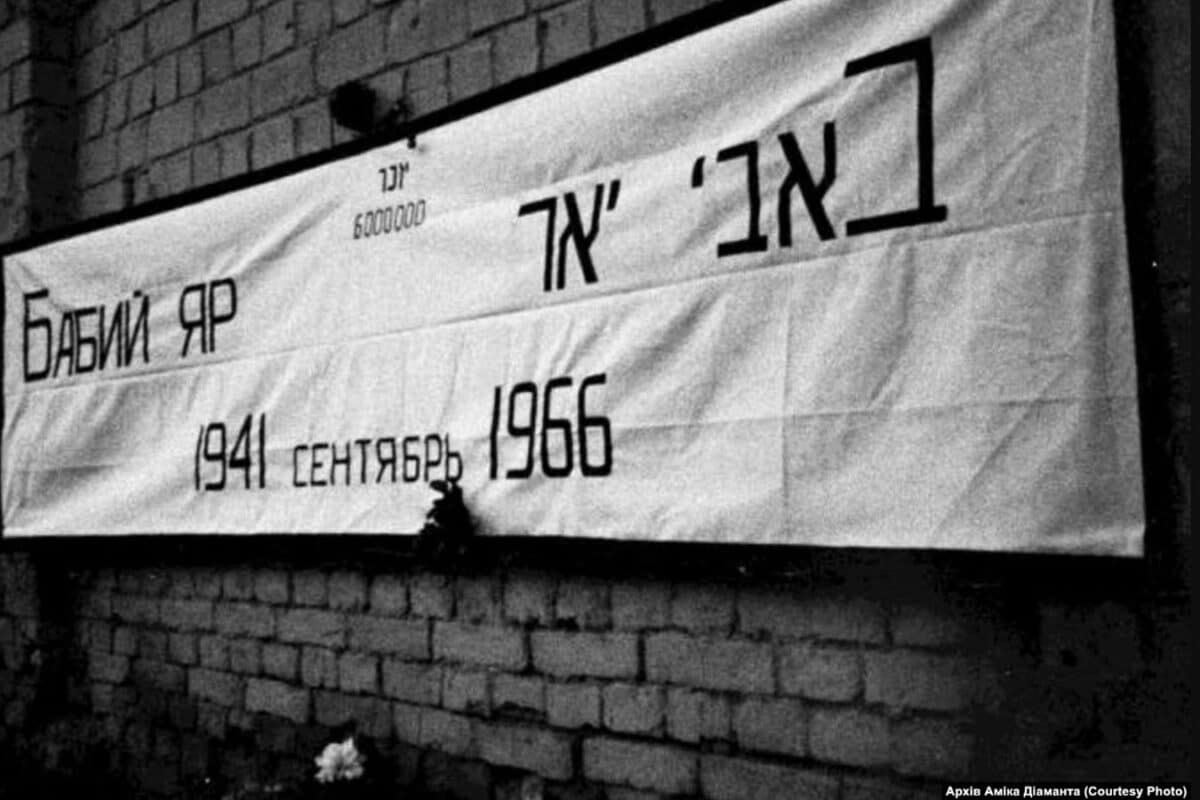
“Shameful gathering of Jewish and Ukrainian nationalists”: the first rally at Babyn Yar took place in 1966

Invitations began literally “in queues and trolleybuses” — from person to person, without posters and announcements.

The motivation was articulated without equivocation: “The main motive was wounded national dignity.” It was unacceptable for Jewish pain to dissolve into the impersonal formula “victims of fascism.”

September 24, 1966, 17:00 — Silence as Action

About fifty people approached the wall of the destroyed Jewish cemetery. No slogans, no demands — just presence, candles, a poster. And — the sudden appearance of two cars with film crews: Kyiv’s “Ukrkinochronika” and Moscow’s “Nauchfilm”. Some people were frightened by the cameras and dispersed; at that moment, a stranger squeezed into the small remaining group and asked short questions:

— “Did you do this?”
— “Not me.”
— “Are you afraid?”
— “I am.”

The stranger turned out to be writer Viktor Nekrasov. He simply said, “We need to talk,” and left his address and phone number. Thus, a vector for the second date appeared — for the civil anniversary on September 29.

Footage That Survived Searches

Kyiv operator Eduard Timlin managed to hide 80 meters of film (about one and a half minutes) — and kept the reel until 1991. This gesture alone was enough to understand: memory “burns” both at the level of people and facts.

The Second Rally: Word and Solidarity

“Come, Nekrasov Will Be There”

September 29, 17:00. An oral invitation formula circulated around Kyiv: “Come, Nekrasov will be there”. The writer himself “sat on the phone,” calling acquaintances — even in Moscow; a note was passed to literary critic Ivan Dziuba. Hundreds of people headed to the ravine — for the first time in 25 years after the mass shootings of 1941. Documentary filming was now in the hands of Garik Zhurabovich. The simple focus-conspiracy technique: the film was not wound to the end, pieces were hidden in pockets — “in case of arrests.”

Dziuba’s Speech and Shouts in the Crowd

Nekrasov and Dziuba appeared — naturally creating a demand for words. There were no microphones, not everyone could hear, but the meaning was very clearly fixed.

Ivan Dziuba:Silence speaks only where everything has already been said. When nothing has been said yet, silence becomes an accomplice of falsehood and unfreedom.”

In several places, people climbed onto shoulders and shouted:

Jews should not be afraid! We need to talk about anti-Semitism!

Later, writer Vladimir Voinovich would express his shock at what he saw:

I saw for the first time an absolutely spontaneous rally, not controlled by Soviet power.”

Among those present that day was Dina Pronicheva, one of the few who survived September 29, 1941; she is known to readers as a heroine of the documentary novel Anatoly Kuznetsov’s “Babyn Yar”.

“Civilians,” but No Dispersal

Police and KGB were present in civilian clothes, observing, recording, but no forceful dispersal occurred. Many in the crowd noticed informants. After an hour and a half, Diamant left with his wife and young daughter, formulating the main point:

The main thing was achieved… We learned to be a nation from a ‘rabble.’ We learned to respect our graves.”

How the System Responded and What Happened Next

Stigma, Reprimands, “Preventive Measures”

The official formula used to stigmatize participants and the fact of the rallies was verbatim: “shameful gathering of Jewish and Ukrainian nationalists”. There were strict reprimands, dismissals, “preventive” conversations, film confiscations, and names were noted. But it was too late: annual September gatherings at Babyn Yar became a tradition.

Diamant’s Emigration and “Universal” Soviet Memory

In March 1971, Diamant was given 10 days to leave — he left the USSR and moved to Israel, taking with him surviving materials, including Zhurabovich’s footage from the second rally. The late Soviet decision on memorialization did not solve the problems: in 1976, a general monument “to the victims of fascism” was erected (without emphasis on Jewish victims), and in 1980, a park was created on the site of the filled ravine.

In independent Ukraine, the memory space consists of approximately 25 disparate signs — a long road to a coherent, honest conversation about the tragedy and its recipients.

Historical Framework and Facts (Collected in One Place)

  • 29–30.09.1941 — about 34,000 Jews shot in two days; during the occupation years — about 100,000 killed in the ravine.
  • 13.03.1961 — dam burst with liquid waste; wave up to 4 m, victims 145–1,500 (various estimates); event in city memory — “Babyn Yar’s Revenge“.
  • 24.09.1966, 17:00first silent rally (~50 people); poster: “Babyn Yar. Remember the six million”; film crews “Ukrkinochronika” and “Nauchfilm”; Eduard Timlin saves 80 m of film and keeps the reel until 1991.
  • 29.09.1966, 17:00second rally (hundreds of people); invitation formula in the city — “Come, Nekrasov will be there”; speeches by Viktor Nekrasov and Ivan Dziuba; documentary filming — Garik Zhurabovich; among those present — Dina Pronicheva; later assessment by Vladimir Voinovich on the spontaneity of the rally, “not controlled by the authorities”.
  • 1971Emmanuel (Amik) Diamant emigrates to Israel, taking surviving materials.
  • 1976 / 1980 — Soviet monument without mentioning Jews; park on the site of the filled ravine.
  • Independent Ukraine≈25 memorial signs, annual September actions.

Why This Is Important — for Ukraine and Israel (Today)

This story is not only about the past but also about a way to be a society. In Kyiv in 1966, without permits and microphones, people called the tragedy by its name, and the solidarity of Jewish and Ukrainian intellectuals became the norm, not the exception. For Israelis, this is part of the diaspora bridge: figures like Diamant ultimately connect their fate with Israel, without losing ties with Kyiv-Babyn Yar. And for all of us, it’s a reminder: where memory is precise and honest, it’s harder to ignite xenophobia and rewrite history.

FAQ

Why were there two rallies — on the 24th and 29th?

Because September 29, 1941 fell on Yom Kippur, and 25 years later, the “religious” date of memory according to the Jewish calendar fell on September 24, 1966; the second was the civil date of September 29. Both gatherings were about one thing: to return the place of the Jewish tragedy to the general historical memory of Kyiv.

What exactly was done on September 24?

A poster “Babyn Yar. Remember the six million” was attached to the wall of the destroyed Jewish cemetery, and they stood silently. It was a form of statement, not a rally “format”: to show that this is our grave and to name it.

What was said on September 29?

The key thought was from Ivan Dziuba’s speech: silence, while the truth is not spoken, is an accomplice of lies and unfreedom. In the crowd, there were calls “Jews should not be afraid! We need to talk about anti-Semitism!” — this was the meaning of the second action.

How did the authorities react?

The stigma of “shameful gathering of Jewish and Ukrainian nationalists”, reprimands, dismissals, “preventive measures”, film confiscations. But the annual September gatherings were no longer stopped: a tradition was formed.

Conclusions in Four Lines (for the Busy)

  1. September 1966 launched civil memory of Babyn Yar.
  2. Accuracy of names and dates is protection against future falsification.
  3. Solidarity of Jews and Ukrainians became a reality, not a slogan.
  4. The history of Babyn Yar is a bridge Kyiv ↔ Israel, part of a shared experience of dignity.
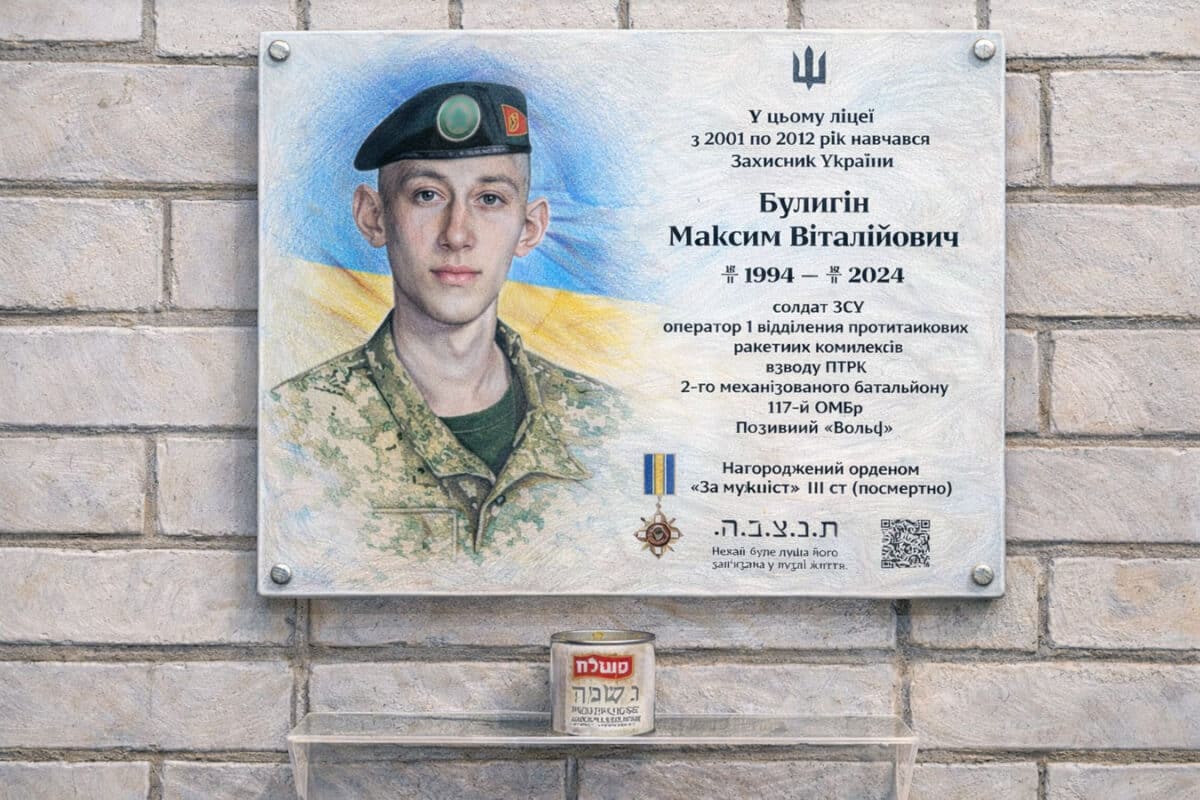
In Zhytomyr, the memory of the Jewish hero — defender of Ukraine Maksym-Wolf Bulygin was honored: a memorial plaque was unveiled at the “Or Avner” lyceum.

Bright memory to Maksym Bulygin.
We remember. We respect. We will not forget.
Baruch Dayan HaEmet – Blessed is the True Judge“, – from the Federation of Jewish Communities of Ukraine.

On January 20, 2026, in Zhytomyr, a commemorative event was held dedicated to the unveiling of a memorial plaque for Maksym Bulygin — a graduate of the private lyceum “Or Avner!, who died on June 10, 2024, defending Ukraine. The ceremony was attended by parents, relatives, students, teachers, and representatives of the city’s Jewish community.

Maksym Bulygin was a serviceman of the Armed Forces of Ukraine, a volunteer who decided to defend the country from the first months of the full-scale war. The memorial plaque, installed on the walls of the lyceum where he studied, became a sign of respect and gratitude from the community and the educational institution, as well as a reminder of the price Ukraine pays for freedom and independence.

Memorial ceremony at the school where he studied

In Zhytomyr, the memory of the Jewish hero — defender of Ukraine Maksym-Wolf Bulygin was honored: a memorial plaque was unveiled at the Or Avner lyceum

The unveiling of the memorial plaque took place in a restrained and focused atmosphere. For the Or Avner lyceum, this event holds special significance: Maksym was not an abstract hero but a student of this school, a graduate who was well remembered here.

During the event, words were spoken about his life path, character, choices, and courage. Those present honored Maksym’s memory with a minute of silence. For the school’s students, the ceremony became an important moment of realizing that the war is not a distant news story but a reality that affects their environment, their city, and their school.

Official position of the community

The event was also reported by representatives of the Jewish community of Ukraine. In the published message it says:

Federation of Jewish Communities of Ukraine:

«🕯 Honoring the memory of the Hero — Maksym Bulygin.

On January 20, a solemn event was held at the private lyceum “Or Avner” in the city of Zhytomyr, dedicated to the unveiling of a memorial plaque for Maksym Bulygin — a graduate of the lyceum who died on June 10, 2024, defending Ukraine.

The event was attended by parents, students, teachers, and guests. Those present honored the memory of the Hero, recalled his life path, courage, self-sacrifice, and the road he traveled for the freedom of his country. This day became a reminder of the price of freedom and of those who gave the most valuable thing for it — their lives.

Bright memory to Maksym Bulygin.

We remember. We honor. We will not forget.

Baruch Dayan HaEmet — Blessed is the True Judge».

Biography and personal history

Maksym Bulygin was born and raised in Zhytomyr. He had Ukrainian citizenship, and by nationality, he was a Ukrainian Jew — this information is indicated in the Ukrainian Wikipedia and is confirmed by his biography and participation in the life of the city’s Jewish community.

He was the only child in the family. He attended a Jewish kindergarten, later, after graduating from the Chabad lyceum “Or Avner” (where his grandmother worked as a teacher for 25 years), he entered Vocational School No. 18, where he obtained the profession of “Cook-Baker”.

He was a diligent student, sang in the choir, found a long-term hobby — chess (backgammon). From childhood, he was an active member of the Jewish community of Zhytomyr. From 2019 to 2021, he served in the Ukrainian army, serving as a rifleman. After demobilization, he worked at “Nova Poshta”, first as a loader, later becoming a scanner.

On February 24, 2022, at the beginning of the full-scale invasion, Maks received a summons and immediately stood up to defend his native Ukraine. He fought in various formations. Shortly before his death, he was in the ranks of the 117th Separate Mechanized Brigade. He served for 2.5 years in the east — Bakhmut, Avdiivka, Zaitseve, and beyond. He almost died several times.

In 2024, Maksym was transferred to another battalion, offered to become a UAV operator, he mastered this specialty, and when he went on his first combat mission, he did not return. UAV operator Maksym-Wolf Bulygin heroically died on June 10, 2024, during a combat mission to defend Ukraine from Russian aggressors in the village of Robotyne, Zaporizhzhia region, when the occupiers dropped explosives on his position.

A year before his death, Maksym found a beloved, they set a wedding date for the end of June, the defender agreed on leave, but two weeks before the desired day, he died.

“Grandma’s boy”

Behind the official formulations and biographical references lies the personal side of Maksym’s life, which his relatives talk about. Maksym’s grandmother, Tatyana Lipinska, recalls:

“He called himself ‘grandma’s boy’.”

This simple phrase sharply contrasts with the image of a soldier and emphasizes the human dimension of his fate. For the family, Maksym was not only a serviceman and hero but also a grandson, a close person, with a warm attachment to his relatives.

Service and death

On June 10, 2024, Maksym Bulygin died while performing a combat mission in the Zaporizhzhia direction. His death was a heavy blow to his family, friends, and community.

On June 25, 2024, after a traditional Jewish farewell ceremony near the synagogue in Zhytomyr, conducted by Rabbi Shlomo Wilhelm, Maksym Bulygin was buried at the Smolyansky City Military Cemetery.

For personal courage shown in the defense of the state sovereignty and territorial integrity of Ukraine, selfless fulfillment of military duty, he was awarded – by Decree of the President of Ukraine dated November 27, 2024, No. 787, the Order of “For Courage” III degree (posthumously).

On June 20, the Chief Rabbi of Kyiv and Ukraine Moshe Asman wrote about Maksym Bulygin’s death on his Facebook page. By the same Presidential Decree No. 787, and the same award, (posthumously) was given to the son of Rabbi Moshe Asman — Samborsky Matityahu.

The significance of the event for the community and the city

The unveiling of the memorial plaque in Zhytomyr is significant not only as a local event. It is part of a broader process of preserving the memory of the fallen defenders of Ukraine — regardless of their origin, religion, or nationality.

Maksym Bulygin’s story refutes propagandist myths about the alleged “detachment” of national minorities from the defense of Ukraine. The country’s Jewish community has been involved in the defense from the first days of the war — on the front lines, in volunteering, in humanitarian aid.

Memory as responsibility

At the Or Avner lyceum, they emphasize that the memorial plaque is not only a sign of mourning but also an element of educational work. It will remind students of the real fates of the school’s graduates, the price of decisions, and that freedom does not exist by itself.

Maksym’s story is the story of a person who made a choice and remained true to it until the end. For his school, city, and community, this choice became part of the collective memory.

“We remember everyone who holds the sky above us”

“We remember everyone who holds the sky above us” — this formula, voiced during the ceremony, became the unofficial conclusion of the event. The memorial plaque on the walls of the lyceum is a reminder of a specific life, a specific fate, and a specific loss.

Maksym Bulygin will forever remain in the memory of his family, teachers, classmates, and the Zhytomyr community. His name is inscribed not only on the school walls but also in the modern history of Ukraine — a history that is being written here and now, at the cost of human lives. It is precisely such stories, behind which stand real people and real losses, NANews — News of Israel | Nikk.Agency consider important to preserve and tell, so that the memory of the fallen defenders does not turn into a dry line of the chronicle.

“Maduro in court in New York, but Putin is not in court” – Zelensky in Davos challenged Europe

The speech by the President of Ukraine in Davos on January 22, 2026, was one of the harshest throughout the forum. After negotiations with the President of the United States Donald Trump, the Ukrainian leader Volodymyr Zelensky publicly questioned Europe’s ability to defend itself — politically, militarily, and institutionally.

It was not about theory. Zelensky directly asked: if the US is capable of blocking Russia’s shadow fleet, why doesn’t Europe do the same? Why do European countries rely on American assistance in case of an attack, without having a plan “B” if Washington decides not to intervene?

The key thesis sounded sharp and deliberately provocative. Venezuelan President Nicolas Maduro is in prison in New York. The Russian president is not. And this, Zelensky emphasized, is happening in the fourth year of a major war in Europe. A fact that cannot be ignored, no matter how much one might want to.

The President of Ukraine reminded that exactly a year ago, at this same forum World Economic Forum in Davos, he spoke the same words. Over the year, in his assessment, nothing has changed: Europe still does not know how to defend itself and still hopes that “somehow it will work out.”

A separate block of the speech was dedicated to the security of the north. Zelensky directly pointed to Greenland — as an example of Europe’s strategic confusion. Sending a few dozen soldiers, he said, is not a signal of strength but a demonstration of uncertainty. If Russian ships are sailing off the coast, Ukraine is ready to help. It has experience. And an understanding of how to act in such conditions.

The audience responded with a standing ovation. Not out of politeness — out of recognition of the problem. Zelensky did not hide his skepticism regarding NATO: the alliance is perceived as a guarantee, but real actions beyond statements have been seen by few. Europe lives in faith in a mechanism that has never been fully tested.

There was also harsh criticism of institutional weakness. The tribunal for Russian war crimes still does not even have a building. Frozen Russian assets remain frozen — without a working mechanism for their use. This, according to Zelensky, is the result of Moscow’s deliberate policy.

He also pointed out a contradiction that Europe prefers not to speak about aloud: Russia receives components for missiles not only from China but also from EU countries and the US. Meanwhile, European capitals ask Kyiv not to raise the issue of Tomahawk missiles, so as “not to irritate Washington.”

In conclusion, Zelensky formulated a strategic conclusion. Europe needs a strong and independent Ukraine not out of solidarity, but out of pragmatism. Because tomorrow Europe may have to defend itself. And if Ukraine is nearby, he said, “no one will wipe their feet on you.”

This very message — without diplomatic padding and illusions — became central in Davos. Its meaning is simple: security does not work on trust and expectations. It works on actions and responsibility. This is what NAnews — News of Israel | Nikk.Agency writes about, capturing the moment when the issue of European weakness was voiced publicly and unvarnished.

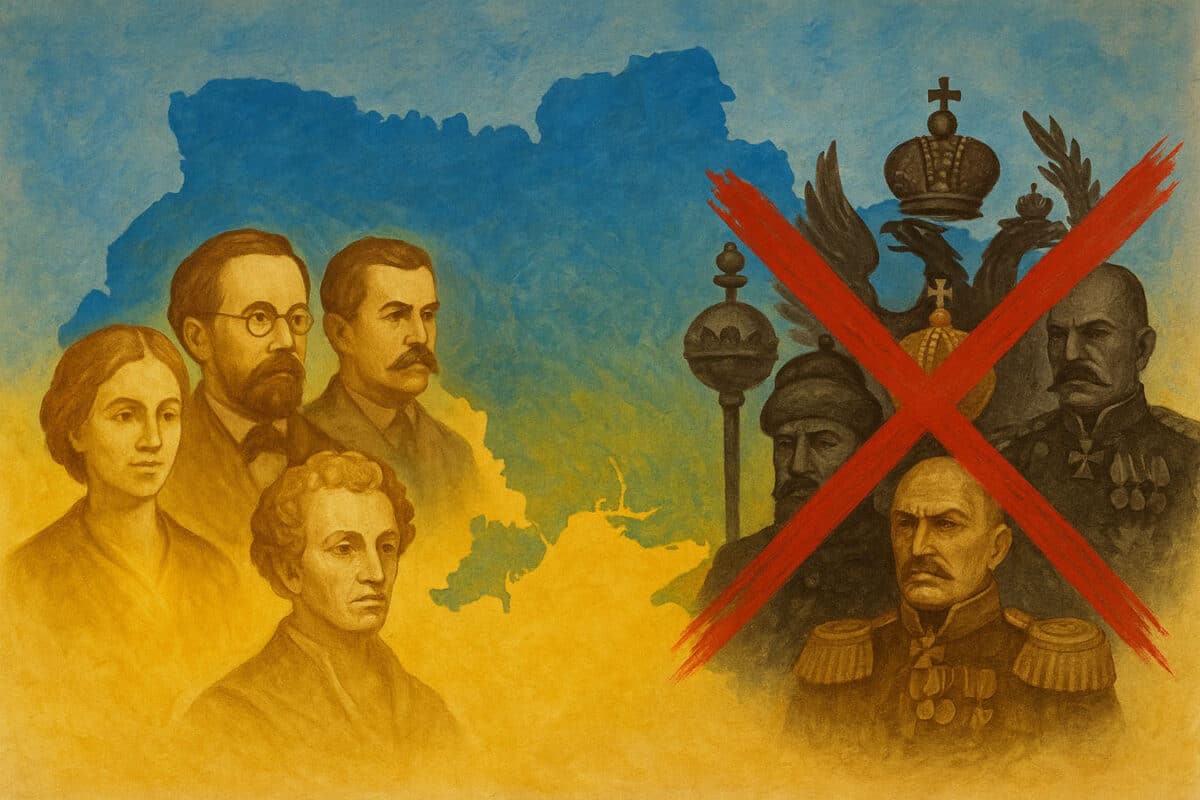
The official list of persons and events NOT containing “symbols of Russian imperial policy” was published by the Ukrainian Institute of National Memory (UINP)

October 7, 2025 The Ukrainian Institute of National Memory (UINP) published an official list of persons and events NOT containing “symbols of Russian imperial policy”.

This step became part of the state decolonization program — rethinking historical heritage, where the main goal is not to destroy, but to discern.

What is this list and why is it needed

In recent years, Ukraine has been actively cleansing public spaces of traces of its colonial past.

Streets are being renamed, monuments to imperial rulers and ideologists are being dismantled. But to avoid “throwing the baby out with the bathwater,” a “white list” was created — names and events that can be preserved.

“The list is not exhaustive and will be supplemented in accordance with the special conclusions of the expert commission,” explained the UINP.
“Its goal is to help local governments implement the law on condemning imperial policy without losing genuine cultural heritage.”

What is UINP and where did the decolonization law come from

The Ukrainian Institute of National Memory (UINP) https://uinp.gov.ua/ is a state institution responsible for shaping the country’s historical policy. It is engaged in researching, preserving, and popularizing historical heritage, especially those periods where Soviet or Russian propaganda distorted facts.

After 2014, and especially after the start of the full-scale war, UINP became a key center for decommunization and decolonization.
These processes are based on the Ukrainian law “On the Condemnation and Prohibition of Propaganda of Russian Imperial Policy in Ukraine and Decolonization of Toponymy”, which prohibits the use of imperial symbols, names, and monuments associated with the ideology of subjugating Ukraine.

The law does not ban Russian culture as such — it clearly distinguishes between culture and propaganda.
If a person lived in the Russian Empire but acted in the name of humanity, science, or art, their name is preserved.

Who was included in the list

“List No. 2

of persons and events of the Moscow Tsardom and the Russian Empire period, objects dedicated to which, according to paragraph 4 of part 1 of article 2 of the Law of Ukraine “On the Condemnation and Prohibition of Propaganda of Russian Imperial Policy in Ukraine and Decolonization of Toponymy”, fall under exceptions and do not contain symbols of Russian imperial policy

They are united by one thing — the absence of service to imperial ideology.
Many of them had Ukrainian roots, lived or created in Odesa, Poltava, Kharkiv, Kyiv, creating works that have long become part of Ukrainian identity.

Personalities and events, objects dedicated to which do not contain symbols of Russian imperial policy

The official list of persons and events NOT containing "symbols of Russian imperial policy" was published by the Ukrainian Institute of National Memory (UINP)
The official list of persons and events NOT containing “symbols of Russian imperial policy” was published by the Ukrainian Institute of National Memory (UINP)
  1. Ivan Aivazovsky (1817–1900) — Russian painter of Armenian origin.
  2. Mykola Arkas (1853–1909) — Ukrainian composer, poet, historian, public figure.
  3. Mykola Benardos (1842–1909) — Ukrainian inventor, creator of arc welding.
  4. Volodymyr Borovykovsky (1757–1825) — Ukrainian and Russian painter, academician of the St. Petersburg Academy of Arts.
  5. Karl Bryullov (1799–1852) — classicist and romantic painter, teacher of Taras Shevchenko.
  6. Hryhoriy Vakulenchuk (1877–1905) — native of Zhytomyr region, petty officer of the Black Sea Fleet, one of the leaders of the uprising on the battleship “Potemkin”.
  7. Mykhailo Vrubel (1856–1910) — symbolist painter of Polish origin.
  8. Oleksandr Verkhovtsev (1837–1900) — Russian railway engineer, head of the Kateryninska Railway.
  9. Alexander Herzen (1812–1870) — Russian writer, philosopher, publicist, supporter of Ukraine’s independence.
  10. Nikolai Gogol (1809–1852) — writer of Ukrainian origin, representative of the “Ukrainian school” of Russian literature.
  11. Vladimir Dal (1801–1872) — writer, lexicographer, scientist.
  12. Hryhoriy Danylevsky (1829–1890) — Ukrainian and Russian writer, ethnographer, historian.
  13. Osip (Jose) Deribas (1751–1800) — Russian admiral of Spanish origin, founder and organizer of Odesa.
  14. Vasyl Dokuchaev (1846–1903) — Russian scientist, founder of soil science, worked in Poltava.
  15. Oleksandr Zasyadko (1779–1837) — Ukrainian specialist in rocket weaponry creation.
  16. Vasyl Karazin (1773–1842) — Ukrainian scientist, inventor, founder of Kharkiv University.
  17. Mykola Kybalchych (1853–1881) — Ukrainian engineer, creator of a rocket apparatus project, revolutionary.
  18. Petro Kishka (1828–1882) — sailor of the Black Sea Fleet, hero of the Crimean War.
  19. Thomas Cobley (1761–1833) — major general, governor of Odesa, fought the plague epidemic.
  20. Volodymyr Korolenko (1853–1921) — writer and public figure.
  21. Ivan Kramskoi (1837–1887) — portrait painter of Ukrainian origin.
  22. Alexander Kuprin (1870–1938) — writer, journalist, advocated for people’s rights.
  23. Louis de Langeron (1763–1831) — governor of Odesa, founder of the Richelieu Lyceum and Botanical Garden.
  24. Andriy Levanidov (d. 1802) — governor of Sloboda Ukraine, philanthropist and collector of antiquities.
  25. Nikolai Leskov (1831–1895) — writer and publicist, lived in Kyiv for a long time, actively used Ukrainian motifs.
  26. Yuriy Lisianskyi (1773–1837) — Ukrainian navigator, one of the first circumnavigators.
  27. Hryhoriy Marazli (1831–1907) — mayor of Odesa, philanthropist and reformer.
  28. Levko Matsievich (1877–1910) — shipbuilding engineer, one of the first aviators.
  29. Illya Mechnikov (1845–1916) — Ukrainian and French scientist, founder of immunology, Nobel laureate.
  30. Apolon Mokrytskyi (1810–1870) — Ukrainian painter and teacher.
  31. Hryhoriy Myasoyedov (1834–1911) — Russian and Ukrainian painter.
  32. Ivan Myasoyedov (1881–1953) — Ukrainian artist and graphic artist.
  33. Nikolai Nekrasov (1821–1878) — writer and publicist, criticized autocracy.
  34. Klavdiy Nemeshaev (1849–1927) — railway engineer, education reformer.
  35. Petro Nesterov (1887–1914) — Ukrainian aviator, inventor of the “loop-the-loop”.
  36. Nikolai Novoselsky (1818–1892) — doctor, public figure, mayor of Odesa, founder of spa treatment.
  37. Nikolai Pirogov (1810–1881) — scientist, surgeon, founder of field surgery.
  38. Ivan Pavlov (1849–1936) — physiologist, Nobel laureate.
  39. Alexander Popov (1859–1906) — inventor and physicist, pioneer of radio communication.
  40. Adrian Prakhov (1846–1916) — art historian, archaeologist, led the painting of the St. Vladimir’s Cathedral in Kyiv.
  41. Emmanuel de Richelieu (1766–1822) — French and Russian statesman, first governor of Odesa.
  42. Kondraty Ryleyev (1795–1826) — poet, Decembrist, supporter of Ukraine’s liberation.
  43. Illya Repin (1844–1930) — artist of Ukrainian origin, author of “The Zaporozhians”.
  44. Mykhailo Sazhin (1818–1887) — artist and graphic artist, author of Kyiv landscapes.
  45. Nikolai Solovtsov (1857–1902) — actor and director, founder of the theater in Kyiv.
  46. Konstantin Ushinsky (1823–1871) — educator of Ukrainian origin, founder of the public school.
  47. Andriy Fabr (1789–1863) — governor of the Katerynoslav province, industrial reformer.
  48. Mykhailo Falleev (1730–1792) — military figure, participated in the construction of Mykolaiv.
  49. Anton Chekhov (1860–1904) — writer and playwright of Ukrainian origin, theater reformer.
  50. Konstantin Tsiolkovsky (1857–1935) — scientist, founder of astronautics.
  51. Mykhailo Shchepkin (1788–1863) — actor, founder of stage realism, friend of Taras Shevchenko.

The list is not final and will be supplemented with personalities and events from the RSFSR, USSR, and modern Russian Federation periods.

The main goal is to separate imperial and human heritage, preserving the memory of those who glorified Ukraine and the world with their work, not the ideology of subjugation.

Source:


Why this is important for Ukraine — and for Israel

For Ukraine, this document is a sign of maturity.
The country does not erase the past but has learned to distinguish the good from the oppressive.
This is a step towards its own cultural independence: respecting what is universal and rejecting what symbolizes enslavement.

For Israel, this is especially understandable.
Israeli society has also gone through the path of memory restoration: from rejecting colonial narratives to creating its own symbols, language, and historical identity.
Ukraine is now taking a similar step — measured, legal, cultural.

How the law works and why it is flexible

The main difference in the Ukrainian approach is that decisions are made by experts, not politicians.
Each name is reviewed by a commission: biographies, views, context, and place in history are checked.
If a person does not embody “imperial policy” — they remain in the cultural space.
Thus, the state shows that decolonization is not a fight against names, but a restoration of historical justice.

Reaction and significance for the diaspora

For Israelis of Ukrainian origin, this news is especially symbolic.
It reminds that memory is not a weapon, but a compass.
Just as Israel once reclaimed names forgotten for millennia, Ukraine today reclaims the right to determine who is ours and who is a symbol of foreign power.

Conclusions

The UINP list has become a document that teaches to see the difference between culture and ideology.
It helps build a future where artists, doctors, scientists are respected — but not those who justified the subjugation of peoples.
Ukraine tells the world: “We do not erase history — we cleanse it.”

There is also “List No. 1”: who is considered a bearer of imperial symbols

In addition to the “white list” (List No. 2), UINP also published List No. 1 — these are persons and events of the Moscow Tsardom and Russian Empire period, whose names/monuments are considered symbols of Russian imperial policy. The list is formed based on UINP expert conclusions and is not exhaustive: it will be supplemented, including with persons and events from the RSFSR, USSR, and modern RF periods.

What this means in practice:
objects dedicated to the persons and events listed below are subject to removal from the public space of Ukraine (renaming, dismantling, relocation, contextualization, etc.) according to the Law of Ukraine “On the Condemnation and Prohibition of Propaganda of Russian Imperial Policy in Ukraine and Decolonization of Toponymy”.

List No. 1 (according to UINP data)

  • Konstantin Aksakov (1817–1860) — publicist, ideologist of Slavophilism (“special Russian path”, “chosen by God”).
  • Ivan Babushkin (1873–1906) — RSDLP(b) figure, Lenin’s associate.
  • Pyotr Bagration (1765–1812) — general, participant in the 1812 war.
  • Mikhail Bakunin (1814–1876) — political figure, ideologist of anarchism (anti-Semitic views).
  • Nikolai Bauman (1873–1905) — RSDLP(b) figure, Lenin’s associate.
  • Fabian (Faddey) Bellingshausen (1778–1852) — admiral, participant in the implementation of imperial policy.
  • Vissarion Belinsky (1811–1848) — critic, glorified imperial policy.
  • Alexander Bestuzhev (1797–1837) — Decembrist; participation in the conquest of the Caucasus.
  • Battle of Borodino (1812) — event associated with the implementation of imperial policy.
  • Ivan Bunin (1870–1953) — writer, glorification of imperial policy.
  • Aleksey Butovsky (1838–1917) — general; participation in the suppression of the January Uprising of 1863.
  • Vasily Buturlin (†1655) — military and diplomat; head of the delegation at the Pereyaslav Rada 1654.
  • Aleksey Bestuzhev-Ryumin (1693–1768) — chancellor, field marshal.
  • Mikhail Vorontsov (1782–1856) — field marshal, governor.
  • Ilarion Vorontsov-Dashkov (1837–1916) — minister of the court, governor in the Caucasus.
  • Mikhail Glinka (1804–1857) — composer, glorification of imperial policy.
  • Aleksey Greig (1775–1845) — admiral, implementation of imperial policy.
  • Alexander Griboyedov (1795–1829) — diplomat, implementation of imperial policy.
  • Boris Godunov (1552–1605) — Moscow tsar.
  • Semyon Dezhnev (1605–1673) — navigator, exploration in the interests of the empire.
  • Decembrists (1825) — movement with centralizing goals; denial of the right of peoples to self-determination (majority).
  • Gavriil Derzhavin (1743–1816) — poet, dignitary, panegyrics to the empire.
  • Elizaveta Petrovna (1709–1762) — empress.
  • Yermak Timofeyevich (1534–1585) — “conqueror of Siberia”, beginning of the conquest of Siberian Turkic lands.
  • Vasily Zhukovsky (1783–1852) — poet, privy councilor, glorification of the empire.
  • Pyotr Zaporozhets (1876–1905) — RSDLP(b) figure, Lenin’s associate.
  • Vladimir Istomin (1809–1855) — rear admiral.
  • Antioch Kantemir (1708–1744) — diplomat, poet; the name gave the name to the 4th Guards Tank Division of the Russian Federation.
  • Nikolai Karamzin (1766–1824) — writer, historian; glorification of the empire.
  • Paisiy Kaisarov (1783–1844) — general of infantry, senator.
  • Catherine II (1729–1796) — empress.
  • Vladimir Kornilov (1806–1854) — vice admiral.
  • Caesar Cui (1835–1918) — composer, engineer-general.
  • Mikhail Kutuzov (1745–1813) — field marshal.
  • Viktor Kurnatovsky (1868–1912) — RSDLP(b) figure, Lenin’s associate.
  • Lado Ketskhoveli (1876–1903) — RSDLP(b) figure, associate of Lenin and Stalin.
  • Mikhail Lazarev (1788–1851) — vice admiral.
  • Mikhail Lermontov (1814–1841) — poet; glorification of the empire.
  • Mikhail Lomonosov (1711–1765) — scientist; glorification of the empire.
  • Mikhail Miloradovich (1771–1825) — military and state figure.
  • Kuzma Minin (1570–1616) — state and military figure of the Moscow Tsardom.
  • Nicholas I (1796–1855) — emperor.
  • Nicholas II (1868–1918) — emperor.
  • Nikita Muravyov (1795–1843) — Decembrist, leader of the Northern Society.
  • Modest Mussorgsky (1839–1881) — composer (“Boris Godunov”).
  • Pavel Nakhimov (1802–1855) — admiral.
  • Alexander I (1777–1825) — emperor.
  • Alexander II (1818–1881) — emperor.
  • Alexander III (1845–1894) — emperor.
  • Pavel I (1754–1801) — emperor.
  • Vasily Panyutin (1788–1855) — major general.
  • Ivan Paskevich (1782–1856) — field marshal; suppression of the Polish uprising, repressions.
  • Pavel Pestel (1793–1826) — colonel, ideologist of the Decembrists.
  • Peter I (1672–1725) — tsar/emperor.
  • Dmitry Pozharsky (1578–1642) — state and military figure.
  • Battle of Poltava (1709) — key event in the interests of the empire against Mazepa and Charles XII.
  • Grigory Potemkin (1739–1793) — state and military figure, diplomat.
  • Georgy Plekhanov (1856–1918) — political figure.
  • Alexander Pushkin (1799–1837) — poet; glorification of the empire.
  • Emelyan Pugachev (1742–1775) — leader of the peasant war, impostor.
  • Stepan Razin (1630–1671) — ataman of the Don Cossacks, leader of campaigns.
  • Nikolai Raevsky (1771–1829) — general.
  • Romanovs — ruling house of the Moscow Tsardom and the Russian Empire.
  • Grigory Romodanovsky (†1682) — state and military figure; participant in the Pereyaslav Rada.
  • Dmitry Senyavin (1763–1831) — admiral, commander of the Baltic Fleet.
  • Ivan Sinelnikov (1738–1788) — military and political figure of the empire.
  • Mikhail Skobelev (1843–1882) — general, participant in Central Asian campaigns and Russo-Turkish wars.
  • Alexander Suvorov (1729–1800) — generalissimo.
  • Ivan Susanin — mythologized character of imperial propaganda.
  • Vasily Surikov (1848–1916) — painter of historical canvases, glorification of the empire.
  • Nikolai Sukhina — provincial secretary of the Poltava province (1812).
  • Aleksey Teplov (1763–1826) — state figure.
  • Ivan Turgenev (1818–1883) — writer; glorification of the empire.
  • Vasily Tyapkin — ambassador of the Moscow Tsardom in the Hetmanate (1677–1680).
  • Alexander Tsulukidze (1876–1905) — RSDLP(b) figure, Lenin’s associate.
  • Fyodor Ushakov (1745–1817) — admiral.
  • Pyotr Schmidt (1867–1906) — fleet officer; cult of Soviet propaganda.
  • Ivan Gudovich (1741–1820) — field marshal.
  • Ivan Sabaneev (1831–1909) — military figure.
  • Alexander Stroganov (1795–1879) — governor-general of Novorossiya and Bessarabia.

List No. 1 is a decolonization tool: it helps local governments legally correctly remove imperial symbols from the urban environment while preserving cultural heritage that did not serve ideology (List No. 2).

Davos as a showcase of utopias: Trump’s son-in-law presented the “master plan for New Gaza”

At the World Economic Forum in Davos, a presentation was made that immediately went beyond the usual discussions about post-war recovery. Jared Kushner, son-in-law of U.S. President Donald Trump, presented the so-called “New Gaza Master Plan” — a large-scale post-war reconstruction project for the Gaza Strip.

The venue was Davos, and the audience consisted of global investors, politicians, and representatives of international institutions. The plan is based on major construction programs, the building of new cities, and the creation of an international airport in the Rafah area. The ultimate goal, according to Kushner, is “peace between Israel and the Palestinians.”

Kushner stated that the clearing of ruins in Rafah “has already begun,” and the next stage will be the formation of “New Gaza.” The promises sounded extremely ambitious: full employment, economic prosperity, and “good jobs” for the enclave’s residents. However, he named security and “proper administration” as key conditions.

This is where the plan moves into the political realm. According to Kushner, the “demilitarization of Gaza” will begin, and the process will be managed by a Palestinian “technocratic government,” which, as he explicitly stated, should work jointly with Hamas. This formulation has already caused a stir among diplomats and security experts.

The project involves zoning the Gaza Strip territory and building new cities for two to three million people over three years. Initially, a pilot area was discussed, but Kushner’s team ultimately decided to present an “incremental reconstruction” of several zones — without intermediate tests and local restrictions.

A separate part of the presentation was devoted to the idea of the so-called “Peace Council.” The concept is that it should “borrow the best global practices” and then scale them — from urban management to healthcare and education systems — beyond the Middle East.

In fact, Kushner acknowledged that the previous “20-point peace plan” was not based on practical experience. In this context, Gaza is described as an experimental platform where new management and business models will be tested in real conditions — with an eye on projects of global scale.

Anticipating criticism and sarcastic reactions, Kushner addressed journalists and social media users with an unusual request — “to give the plan 30 days of silence.” This statement only reinforced the impression that the concept presented in Davos balances between a political project, an investment presentation, and a high-risk experiment.

Regardless of how this “master plan” is assessed, it has already become part of the international agenda, where discussions about Gaza’s future increasingly occur at the intersection of geopolitics and business. It is at this point today that the interests of states, investors, and the media converge, as regularly reported by NAnews — Israel News | Nikk.Agency, documenting how global initiatives collide with the region’s reality.

Jews from Ukraine: Abba Khushi, the man who “built Haifa”

Abba Hushi played a key role in the formation of modern Israel. His contribution to the development of Haifa, where he was mayor from 1951 to 1969, will forever go down in history.

Abba Khushi, a famous Israeli politician and public figure, was born on May 23, 1898 in the city of Turka, Lviv region, Ukraine (at that time – Austria-Hungary).

His real name is Abba Schneller. He was born into a middle-income Jewish family. Mother, Liba, grew vegetables and fruits, and stepfather, Alexander Shneler, was a haberdasher. The family raised six children.

From childhood, Abba showed curiosity and a penchant for learning. He graduated from cheder, then attended high school, where he studied Latin, Greek, German, Ukrainian, Polish and Hebrew. His dream was to become a doctor, and he even signed his notebooks as “medical student.” However, the First World War ruined his plans, forcing the family to fight for survival.


Participation in the Jewish movement in Poland

After the end of the war and his return to Turku in 1918, Abba faced new challenges. Turka found itself under the control of Poland, where anti-Semitism was gaining strength. This prompted young Abba to join “Ha-Shomer ha-Tza’ir” – Zionist youth movement.

Organization “Ha-Shomer ha-Tza’ir” was engaged in protecting the Jewish population from pogroms. Under the leadership of Abba and his associates in Turk, attacks on Jewish families were stopped. They created a Jewish guard force that protected the community while pogroms continued in other cities in Poland.

On August 4–5, 1918, the “Ha-Shomer ha-Tza’ir” conference was held in Turk, where Abba spoke as one of the leaders of the movement. It was here that he first expressed his desire to emigrate to Palestine to build a Jewish national home.


Literary talent and inspiration

In 1920, at a conference in Lvov, Abba Khushi publicly read his poem “In Galilee, in Tel Hai” for the first time. It was dedicated to Yosef Trumpeldor, a hero of the Jewish resistance in Palestine. This work inspired many young people to repatriate.

Abba Khushi was not only an activist, but also a poet, his words instilled hope in the hearts of Jewish youth who dreamed of returning to their historical homeland. His participation in Hashomer HaTza’ir was an important step in the formation of his leadership qualities.


Emigration to Palestine

In the spring of 1920, Abba and his comrades emigrated to Palestine. The first years of life in the new land were difficult: Khushi worked on road construction, led labor battalions and participated in creating the infrastructure of the future state.

However, his connection with Ukraine remained forever. Abba returned to Poland and Ukraine several times to raise funds to purchase land and establish kibbutzim in Israel. He also inspired Jewish youth to immigrate by talking about the importance of the Jewish state.


Abba Hushi in the history of Israel

The Power and Meaning of Hashomer HaTza’ir

The Hashomer HaTza’ir organization played a key role in protecting the Jewish population of Ukraine in the early 20th century. Thanks to the efforts of Abba Hushi and his associates, many Jewish communities were spared the tragedies that befell other regions.

On the website NAnews – Israel News you will find more materials about the contribution of Jews from Ukraine to the formation of Israel.

Haifa under the leadership of Abba Khushi

In 1951, Abba Khushi was elected mayor of Haifa, and his reign lasted almost two decades. These years became a turning point for the city, which, under his leadership, became one of the leading cultural and economic centers of Israel.

Abba Khushi’s main achievements in Haifa:

  1. Creation of the University of Haifa

    Education has always been a priority for Abba Khushi. He was at the forefront of the creation of the University of Haifa, which became an important academic center in Israel.

  2. Museums and cultural institutions
    • The Museum of Japanese Art was founded.
    • The Mane-Katz Museum, a famous Israeli artist, was created.
    • Theaters and cultural venues are supported.
  3. Infrastructure and transport
    • The Carmelite Line, Israel’s first and only underground railway, was built, connecting the city’s districts and making Haifa more accessible.
  4. Residential and cultural areas

    During his reign, new districts were built, including Neve Sheananwhere the Culture and Leisure Center later appeared, named in his honor. This center includes:

    • Hall for cultural events with 500 seats.
    • Lecture hall for 100 seats.
    • Classrooms and gyms.
  5. Economic development

    Abba actively supported industry and trade, which helped create jobs and attract investment to Haifa.


Recognition and legacy

Abba Hushi left Haifa as a city that became an example for other municipalities in Israel. His influence was not limited to infrastructure and culture. He always believed that the most important task was the integration of new repatriates. Thanks to his efforts, many Jews who arrived from Europe and Arab countries were able to find their home in Haifa.

Abba Khushi died on March 24, 1969.

Conclusion

The story of Abba Khushi is an example of how ties between Ukraine and Israel become the basis for great things. His childhood in Turk, participation in Hashomer HaTza’ir, and helping to defend the Jewish communities of Ukraine shaped his leadership skills, which he later used to build modern Haifa.

Read more about prominent Jews of Ukraine and Israel on the website NAnews – Israel News.

…………

Read on WhatsApp – channel NAnews ↓ — Israel News

Read on Telegram – channel NAnews ↓ — Israel News

Text”Jews from Ukraine: Abba Khushi, the man who “built Haifa””appeared first on NAnews – Nikk.Agency Israel News NIKK.

Trump in Davos — Netanyahu under fire: “Iron Dome is US technology”

Davos, Switzerland. The World Economic Forum once again became a platform for sharp statements by Donald Trump, this time directed at the Israeli leadership.

Speaking to forum participants, the US President stated that he personally demanded Israeli Prime Minister Benjamin Netanyahu stop taking credit for the Iron Dome missile defense system. According to Trump, the key technologies belong to the United States.

“What we have done for Israel is amazing. But it’s nothing compared to what we are going to do for the USA, Canada, and the rest of the world. We will build a dome that has no equal. And by the way, I told Bibi: ‘Bibi, stop taking credit for the dome — it’s our technology,’” Trump declared from the Davos stage.

In public perception, the Iron Dome has long been considered an exclusively Israeli development. However, the system was created with the active participation of American companies and with US financial support. Unlike the Arrow complex, capable of intercepting ballistic missiles, whose export requires direct Pentagon approval, the Dome was often perceived as a symbol of Israeli defense autonomy — and this is precisely what Trump decided to publicly challenge.

The US President also reminded of his administration’s actions in the Middle East. Among the achievements, he listed the destruction of the Iranian nuclear program, the elimination of Qasem Soleimani, and the removal of ISIS leader al-Baghdadi.

He specifically mentioned Hamas, stating that the movement agreed to disarm. According to Trump, otherwise “they will simply be wiped out,” without specifying mechanisms and timelines.

For several months, Trump has been promoting the idea of creating a national missile defense system for the USA — the “Golden Dome” project. Its estimated cost is about 175 billion dollars. The concept includes a satellite network capable of detecting, tracking, and intercepting missiles in the early stages.

In Davos, Trump directly linked this project to the issue of Greenland. According to him, the new system should be placed over the island and provide protection for Canada and North America as a whole.

“We are asking for just Greenland — with all rights, title, and property. You can’t protect it on rental terms. It’s legally vulnerable. And psychologically — who even wants to protect a rental? A significant part of the future war will take place on this piece of ice,” he stated.

Speaking about US military superiority, Trump moved on to demonstrating specific weapon samples. He mentioned the latest F-47 aircraft, specifically noting its name and comparing its stealth level to the B-2 bomber.

“We need this piece of ice to protect the world,” the president added, returning to the topic of Greenland.

The economic part of Trump’s speech was devoted to tariffs and the price difference of medicines. He gave an example where the same pill costs 10 dollars in London and 130 dollars in New York or Los Angeles, explaining this by saying that America “has subsidized the whole world for decades.”

In conclusion, he allowed himself a personal remark towards the President of France, noting his appearance. “I was looking at Macron in sunglasses and thought: what the heck?” Trump said, eliciting a mixed reaction from the audience.

The US President’s speech in Davos once again demonstrated his approach: tough personalization of politics, public reproaches to allies, and a demonstrative reminder of America’s role in global security — including in the Israeli context, which is closely monitored today by NAnews — News of Israel | Nikk.Agency.

Jews from Ukraine: Yevhen “Benya” Yatsyna, the youngest Ukrainian “cyborg” who died in January 2015 defending Donetsk airport

In Ukraine, January 20 is observed as the Day of Remembrance for the Defenders of Donetsk Airport. It marks the anniversary of the end of the battles for the airfield. The events of those days became an important milestone in the modern history of the country. The battles for the Donetsk Airport lasted from May 26, 2014, to January 22, 2015 — 242 days of fierce resistance by Ukrainian warriors against Russian occupation forces.

For many, this is not a “commemorative date” or a formality. Donetsk Airport became one of the first symbols of Russian aggression against Ukraine — long before the full-scale invasion. It was there that what would be repeated over and over again first manifested in a concentrated form: when the enemy cannot break the defense in direct combat, they try to destroy the point of resistance itself along with the people, turning the building into a mass grave.

On this day, all the “cyborgs” — the defenders of the airport — are remembered. But in the section “Jews from Ukraine“, it is impossible to overlook the name Yevhen Yatsyna, call sign “Benya” — the youngest cyborg warrior who died in January 2015 in the new terminal of Donetsk Airport.

More about the defense of Donetsk Airport – “People endured, concrete did not”: in Ukraine, January 20 is the Day of Remembrance for the Defenders of Donetsk Airport

Who is Yevhen Yatsyna and why his call sign is especially resonant

Yevhen was born on January 25, 1989. A native of Kyiv, Pechersk. He studied at the Kyiv National Linguistic University, in the Faculty of Economics. Friends remembered him as a star of the university KVN and a “one-man band” — bright, lively, very sociable.

The nickname “Benya” was part of his life even before the front, and later became his call sign. And in this detail, there is an important intonation for the Jewish community: Yevhen greeted friends with the word “shalom”, responded to “Benya”, and this manner of communication was remembered by many more strongly than any official biographies. It was later reported that Yevhen’s mother was Jewish, and he himself had visited Israel and been to Jerusalem.

These strokes are important not for “origin for the sake of origin”. They show that the Jewish line in Yevhen’s history is not a decorative signature at the end, but part of his living language, habits, and connections.

The Defense of Donetsk Airport: Why It Became a Symbol

The defense of the airport lasted for months. The new terminal was turning into ruins right during the battles — under shelling, assaults, explosions. There, the war was fought not on a map, but on stairs, corridors, breaches in walls. People held positions in conditions where every day could be the last.

The word “cyborgs” appeared as an attempt to explain what seemed impossible: Ukrainian soldiers held on so persistently that even the enemy called them “not human”. And this is an important point for understanding the modern war: the Russian side from the very beginning acted on the logic of destruction, not “negotiations” or “disputes”.

Then, in 2015, the terminal was blown up, and part of the defenders ended up under the rubble. Today, in the years of full-scale war, the same principle works throughout the country: strikes on cities, energy, residential buildings — to destroy not only the defense but also the ability of society to live.

The Last Connection and Days That Ended in the Terminal

The last time Yevhen, a soldier of the 81st Brigade of the 90th Separate Airmobile Battalion, made contact was on January 18, 2015. He was definitely in the new terminal of Donetsk Airport that day.

According to his comrades, on January 19, he was wounded (a torn wound on the cheek) and concussed.
On the evening of January 20, Yevhen was caught under the collapse of the airport building after an explosion. His comrades pulled him out from under the rubble. According to them, he had fractures in both legs and a severe spinal injury — he could no longer move. He had a tag with his surname and individual code.

He did not live to see his 26th birthday — January 25 was just a few days away.

Different testimonies record different dates of death — January 19, 20, or 21. But the meaning is the same: Yevhen died in the last days of the defense of the new terminal, at the very point where the war led to the literal collapse of the building on people.

“To Georgiy Borisovich, shalom…”: Words of Georgiy Tuka

Volunteer Georgiy Tuka remembered Yevhen briefly and as one speaks of a close person — without unnecessary “literature”:

“Zhenya. Zhenya Yatsyna. Call sign ‘Benya’. A native of Kyiv. Pechersk. 25 years old. I met Zhenya back when the battalion was stationed in Zhytomyr. Zhenya had the opportunity to ‘dodge’ the draft, but as a man, as a citizen, he did not do this, and honestly went to fulfill his duty. Zhenya was the youngest fighter in the battalion. Without exaggeration, everyone’s favorite. The funniest, most sociable, most contactable. Every time our phone conversation started with the words: To Georgiy Borisovich, shalom!… Still a lump in the throat…”

This quote holds what is often lacking in official memory: voice, habit, life. Not a “hero’s portrait”, but a person who is truly missed.

“Jerusalem Thread”: A Story from His Mother

Yevhen’s mother, Svetlana, said that her son died due to closed fractures of the legs. And she recalled a detail that really brings a lump to many throats:

Once she brought a Jerusalem thread from Israel. When Zhenya came from Zhytomyr, she secretly sewed this thread into his uniform — into pockets, cuffs, “everywhere”. She did it quietly because her son considered such things “nonsense”.

But before leaving for Vodiane, Yevhen put on Pavlo Tuka’s pants — his own were dirty. And later, when the mother found out about this, she said: “Well, now it’s clear why it was the legs — there were no mother’s threads on the pants.”

This story is not about mysticism or “amulets”. It’s about a mother’s attempt to keep her son alive by any means, even the most inconspicuous. And about how war breaks such attempts mercilessly and routinely.

Help from Friends and What They Didn’t Have Time to Deliver

After Yevhen went to the army, friends collected over 40,000 hryvnias on social networks for a thermal imager, thermal underwear, and protective equipment. But they didn’t have time to deliver it to him.

This detail very accurately shows how Ukraine lived in the early years of the war: the front was held not only on orders and headquarters but also on horizontal support — when people collected money “from the world by a thread” to protect a specific fighter. Sometimes they made it. Sometimes — not.

Kyiv Bids Farewell to “Benya”: Funeral, Community Memory, “Wall of Memory” and State Award

After the death of Yevhen Yatsyna (“Benya”), his body was delivered to Dnipropetrovsk and then transported to Kyiv. The funeral took place on February 20, 2015 at Berkovets Cemetery — in the part associated with the relocation of burials from the destroyed Lukyanivka Jewish Cemetery. This place itself became symbolic: Kyiv buried its defender where the city had once tried to preserve Jewish memory, which was being destroyed.

The farewell took place at the Pechersk Military Hospital, followed by a military ceremony and burial. It was reported that the Chief Rabbi of Kyiv and Ukraine Moshe-Reuven Asman participated in the ceremony — an important detail for understanding how the Jewish community perceived this loss: not as a “foreign war”, but as their personal pain.

In the same 2015, at the Central Brodsky Synagogue in Kyiv, Yevhen’s mother was awarded the “Pride of the Community” award — “for the hero son”. For the section “Jews from Ukraine”, this is not a formality or a “religious touch”. It is a marker that the community recognized Yevhen as one of their own — and saw him off as they would their sons.

Memory That Doesn’t End with the Funeral: University and School

The memory of “Benya” was also preserved in the places where he lived before the war — in educational institutions.

On October 11, 2015, at the Kyiv National Linguistic University, a memorial plaque was unveiled in memory of graduate Yevhen Yatsyna by the efforts of students. This is an important moment: the memory was not “imposed from above”, it was made by the young — those who believed that the name should remain within the university walls.

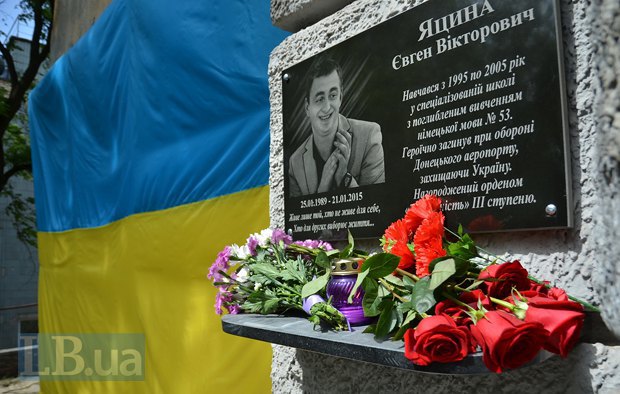
Separately, there is the story with the school. In Kyiv, in the city center, at School No. 53, where Yevhen studied from 1995 to 2005, a memorial plaque was opened for the fallen “cyborg”. His mother said that a “very positive photograph” was chosen for the plaque — the one that best reflected her son’s character: he was cheerful, lively, contactable. The idea came from friends and classmates — the memory was made by people who knew him not by biography, but by school corridors and common conversations.

“Benya” — the youngest “cyborg”: the Jewish story of Yevhen Yatsyna in the memory of Donetsk Airport

“Wall of Memory of Those Who Fell for Ukraine”: Portrait and Exact Location

Another point of Kyiv’s memory is the memorial “Wall of Memory of Those Who Fell for Ukraine”, open to the urban space. This place is arranged so that a person can come and find a specific face — not “in the general list”, but nearby, at arm’s length.

Yevhen Yatsyna’s portrait on the “Wall of Memory” is placed with precise marking: section 5, row 3, place 38. This precision turns memory into action: you can come and stop right at his portrait.

In recent years, the “Wall of Memory” has also become part of the public diplomacy of memory: Volodymyr Zelensky often brings foreign guests there to show the cost of Russian aggression not in the language of statistics, but with the faces of the fallen.

Order “For Courage” III Degree: Fixing the Feat at the State Level

The feat of Yevhen Yatsyna is also enshrined in a state document. He was awarded the Order “For Courage” III Degree (posthumously).

The basis is Presidential Decree of Ukraine No. 270/2015 of May 15, 2015. The decree states that the award is given “for personal courage and high professionalism shown in the defense of the state sovereignty and territorial integrity of Ukraine, loyalty to the military oath”.

Together, these elements — the funeral in Kyiv, community participation, memorial plaques, portrait on the “Wall of Memory”, and state order — form a coherent line: Yevhen Yatsyna did not dissolve in the war as “one of”. He remained a name, a face, and a story — for Ukraine and for the Jewish community, which shared this loss as their own.

Knesset and Words About the Contribution of Jews from Ukraine

On December 23, 2015, during a speech in the Knesset, President of Ukraine Petro Poroshenko said a phrase that still sounds like a political and human testimony:

“In confronting external aggression, our country has revived its army. And in this army, citizens of Ukraine of different nationalities are fighting. And we are proud of the contribution that Jews make to the defense of the country. I cannot but recall the glorious cyborg warrior who died in January this year at Donetsk Airport, Yevhen Yatsyna with the call sign ‘Benya’. We are proud of his feat. Posthumously, he was awarded the state order ‘For Courage’.”

This is not just a “mention of a name”. It is a public acknowledgment that the Jewish community of Ukraine is not an observer and not a “separate topic”, but part of the resistance to Russian aggression.

And this is especially important now, when Russia continues the war and continues to try to blur responsibility, substitute cause-and-effect relationships, and play the card of societal division. Stories of such people break this propaganda because they are very simple and very direct: a citizen of Ukraine went to defend the country, died, and he is remembered — by the state, the university, and the community.

Why the Story of “Benya” Sounds Sharper Today Than Ten Years Ago

Donetsk Airport was one of the first places where the war showed its true face. Back then, many still hoped that “everything would end soon”. Today, after the full-scale invasion, it has become clear: Russian aggression is a long-term project of destruction, exhaustion, terror in the rear, and an attempt to erase identity.

Against this background, the story of Yevhen Yatsyna looks not like an “episode of the past”, but as a point from which much began. It shows that resistance in Ukraine was initially nationwide — including with the participation of the Jewish community, which provided the country with warriors, volunteers, doctors, support for the families of the fallen, and public memory.

And in the end, there remains a simple formula that sounds especially honest in the section “Jews from Ukraine“:

Memory is us with you. As long as we name names and tell stories in living words, the war cannot turn people into impersonal numbers. NAnews — Israel News | Nikk.Agency.

Trump in Davos demanded to start negotiations on the purchase of Greenland — “a small request, just a piece of ice”

Davos, Switzerland. The World Economic Forum unexpectedly received a geopolitical shake-up.

U.S. President Donald Trump declared from the Davos stage that he wants to immediately start negotiations to purchase Greenland. Without lengthy preludes and diplomatic niceties — directly and publicly.

According to Trump, Denmark is “too weak” to ensure the island’s security. Greenland, as he put it, is necessary for the United States not for resources, but for international security.

“This huge, unprotected island is essentially part of North America. It’s our territory,” he stated, adding that the U.S. “acted foolishly” by returning Greenland to Denmark after World War II.

Trump emphasized that he respects the people of Greenland and Denmark, but believes that no country can protect the island better than the U.S. In his logic, Greenland is a key point for deploying a missile defense system that should cover not only America but also Canada.

He reminded that during World War II, it was American forces that protected the island and accused Copenhagen of ingratitude. Trump separately noted Greenland’s strategic position — at the intersection of U.S., Russian, and Chinese interests.

“I want to immediately conduct negotiations for the United States to acquire Greenland,” he said, clarifying that it is about transferring the island, not leasing or expanding cooperation.

At the same time, the U.S. president tried to soften the tone, stating that he does not intend to use force.

“We do not want to apply military pressure. We are simply asking to be given Greenland,” Trump said, adding with irony: “I have a small request. I’m just asking for a piece of ice.”

However, immediately after this, he made it clear that economic pressure remains an acceptable tool. Amid the sharp rhetoric of the White House, a wave of sell-offs swept through global markets the day before. Trump himself acknowledged the losses, confusing Greenland with Iceland in the process of explanations.

“Yesterday, our stock market fell for the first time because of Iceland. So Iceland has already cost us a considerable amount,” he explained to journalists.

Trump then turned to allies. According to him, the U.S. needs strong partners, not weak ones. He urged Europe to “be strong” and move in the same political direction as his administration. At the same time, the president expressed doubt about the allies’ readiness to fight for the U.S., noting that America, unlike them, is always ready to help.

Trump generally did not like the European course. He criticized the EU for its migration policy, deindustrialization, and “green” energy, specifically mentioning wind power plants as a symbol of the wrong choice.

The topic of the war in Ukraine was not left out. Trump again stated that the conflict would not have occurred if Joe Biden had not won the 2020 election. According to him, he warned Putin that Ukraine was a “sore spot,” but the invasion became possible precisely after the change of power in the U.S.

Trump also spoke about a conversation with the Russian leader, in which he allegedly admitted that he could not resolve the conflict between Armenia and Azerbaijan for years, whereas the Trump administration managed to do so.

The head of the White House stated that resolving the war in Ukraine is Europe’s task, and the U.S. is involved in the process only for humanitarian reasons. He claims that just last month, about 31,000 military personnel from both sides died in Ukraine.

“I just want to stop this. It doesn’t help the U.S., but these are young people, human souls,” Trump said, confirming that he plans to meet with Volodymyr Zelensky on Wednesday.

Trump arrived in Davos late. After takeoff, the presidential plane was forced to return to the U.S. due to a technical malfunction, and only after changing aircraft was he able to continue his journey to Switzerland.

Trump’s Davos speech showed that his foreign policy is still built on direct pressure, demonstrative toughness, and personal deals — from Ukraine to Greenland. It is in this context that NANews — News of Israel | Nikk.Agency operates today, recording how the global agenda and the language of world politics are changing.

Museum Robbers: How Moscow Steals and Appropriates Unique Artifacts of Ukraine’s Jewish Heritage – Investigation

“Local historians did not know where these artifacts of Jewish heritage in Ukraine had disappeared to until 2023, when they discovered photographs of the stolen items on the official website of the ‘Museum of the History of Jews in Russia’.

Like ‘We didn’t steal — we saved’, notes Shimon Briman, comparing this to the same twisted logic by which the Russian army comes to ‘save’ Ukraine and Ukrainians with missiles and turning Ukrainian cities into ruins.

There is the most prestigious global organization of museums and museum professionals in the world — ICOM, the International Council of Museums headquartered in Paris. In mid-June 2024, at the annual meeting of ICOM’s governing bodies, ICOM Ukraine President Anastasia Cherednichenko spoke, reports Shimon Briman.

The representative of Ukraine demanded in the strongest terms to stop the gradual return of Russia to ICOM. Previously, back in 2022, the Russian Federation was suspended from participating in ICOM projects because this aggressor country was looting Ukrainian museums and destroying treasures of Ukrainian cultural heritage during the barbaric war against Ukraine.

Shimon Briman, in an article on “Ukrainian-Jewish Encounter” also notes that the list of stolen or destroyed by Russia should include objects of Jewish heritage in Ukraine.

The most high-profile story in this area is related to the theft and illegal export to Russia of two unique artifacts from the Ternopil region, writes Shimon Briman. This happened in the summer of 2014, at the beginning of Russian aggression, but it became known only recently.

At that time, unknown criminals stole three-hundred-year-old carved doors from the Chortkiv synagogue. Around the same time, unique relics disappeared from the ancient synagogue in Pidhaitsi — a baroque white stone carved decoration of a niche from the prayer hall and a carved plaque with the inscription “These are the gates of the Lord — the righteous shall enter through them” (Psalm 118).

Local historians did not know where these artifacts had disappeared to until 2023, when they discovered photographs of the stolen items on the official website of the ‘Museum of the History of Jews in Russia’.

This private museum was founded in Moscow by businessman Sergey Ustinov. The museum’s website states that it seeks to reconstruct a comprehensive picture of Jewish life in the territory of the Russian Empire and the USSR. It also states that the most important way to replenish the collection is through expeditions by staff in Russia and Eastern Europe.

The stolen ancient doors and stone slab from Chortkiv and Pidhaitsi were presented in Moscow at the exhibition “Challenge to Oblivion”.

Thus, from the point of view of Moscow museum workers, gangster raids on Ukrainian synagogues are “expeditions to replenish the collection”, and the brazen display of stolen items from Ukraine in Moscow is called “saving from oblivion”.

Like “We didn’t steal — we saved”, notes Shimon Briman, comparing this to the same twisted logic by which the Russian army comes to “save” Ukraine and Ukrainians with missiles and turning Ukrainian cities into ruins.

Shimon Briman writes that in Chortkiv and Pidhaitsi there were thefts, corruption, and vandalism against historical objects. As a result, artifacts from two synagogues were stolen. These synagogues are on the list of national historical monuments, and their artifacts could not be legally removed — only through corruption and vandalism, which was done at the request of the Moscow museum.

Local authorities in the Ternopil region showed indifference to the fate of these ancient synagogues. Although the Ukrainian authorities lack the funds to maintain the condition of these ancient buildings, this does not justify the illegal export of artifacts to Russia, Briman emphasizes.

The discovery of stolen Jewish relics in a Moscow museum in 2023 caused outrage among Judaica and art specialists from Ukraine, Israel, and the USA. They appealed to the ministries of culture and foreign affairs of Ukraine to raise the issue of returning the stolen artifacts at the international level.

Briman writes: “The dismantling and export of these artifacts abroad directly contradicts Ukrainian law. These actions are criminal, and both the customers and the executors should be held accountable for them.” Artifacts from the synagogues in Chortkiv and Pidhaitsi have enormous historical and cultural value that cannot be compensated. The illegal export and exhibition of these artifacts in Russia is part of the aggressor’s large-scale crime — the deliberate destruction and looting of Ukrainian cultural heritage, concludes Briman.

Shimon Briman writes that the actions of stealing artifacts from synagogues in Chortkiv and Pidhaitsi damage Ukraine’s relations with foreign partners, including Israel. It also gives Russian propagandists the opportunity to use the topic of Ukrainian-Jewish past to undermine Ukraine’s international image. The authors of the letter, signed by many well-known scholars, demand the inclusion of the owner of the “Museum of the History of Jews in Russia” Sergey Ustinov in the sanctions lists.

Briman notes that the attempts of the Moscow museum to justify the theft sound immoral. He emphasizes that the cities of Chortkiv and Pidhaitsi in the 17th-18th centuries had nothing to do with the “history of Jews in Russia”, as they were part of the Polish Kingdom. This act is a neocolonial appropriation of someone else’s heritage to strengthen Moscow’s imperial status.

Shimon Briman writes this text as a reminder that the Russian regime throughout its aggression against Ukraine seeks to destroy not only Ukrainian but also Jewish heritage in Ukraine. In the future, in his opinion, the list of reparations from Russia in favor of Ukraine should include the two stolen Jewish artifacts.

Original: Shimon Briman (Israel) – Ukrainian-Jewish Encounter.

Follow us on channels Israel News Nikk.Agency News of IsraelTelegram, — Facebook, — Google News