Trump praised Erdogan and pushed aside Netanyahu’s warnings: Turkey is once again entering the big game around Israel

Donald Trump once again did something that was heard particularly painfully in Israel: he publicly praised Turkish President Recep Tayyip Erdogan, called him a strong leader, and essentially presented himself as the person who prevented Ankara from entering the war on the side of Israel’s opponents.

These words did not sound in a vacuum.

They appeared against the backdrop of the NATO summit in Ankara, taking place on July 7–8, 2026, in Turkey. According to NATO, the meeting of heads of state and government of alliance countries and key partners is being held in Ankara, and the summit’s symbolism is associated with the Beştepe presidential complex, where the main venue is organized. For Turkey, this is not just a diplomatic event but a demonstration of status: Ankara is hosting NATO leaders while simultaneously trying to regain access to American F-35 fighters.

For Israel, this story became a worrying signal.

Prime Minister Benjamin Netanyahu had tried in advance to convince Washington not to return Turkey to the F-35 program and not to transfer technologies to Ankara that could change the military balance in the Middle East. But Trump in Ankara spoke a completely different language.

“He didn’t go because of me”: what exactly Trump said

At a meeting with Erdogan in Ankara, Trump stated that Turkey could have chosen “the other side” in the war but did not. According to him, Ankara knows Iran well and understands the problems associated with it.

“Turkey could have chosen the other side. They know Iran very well. And they know the problems associated with Iran. They could have entered the fight. You hear people talking about their relations with Israel. They could have entered the fight. This is a country with a very large military force. And they didn’t. Maybe they didn’t because of me. But they certainly could have joined the other side,” Trump said.

In another part of his speech, he turned to Erdogan personally.

“I like President Erdogan. He gave me a ceremonial reception. He’s amazing,” Trump said.

Then he directly linked the Turkish leader’s position with Israel and Netanyahu.

“I said he could have gone to war because he doesn’t really like Israel and doesn’t really like Bibi,” Trump said.

According to Trump, Erdogan “didn’t go” to war precisely because of him.

“He didn’t go because of me. He would have gone if it weren’t for me. He would have gone, and it would have been on the other side,” the US president stated.

This is an important formulation. Trump not only praised Erdogan. He publicly said that the Turkish president could potentially have ended up on the side opposite to Israel but was allegedly stopped by the personal influence of the US president.

In the Israeli context, such a phrase sounds like a warning: if Israel’s security depends not on a clear ally strategy but on Trump’s personal relations with Erdogan, then the room for error increases sharply.

June episode: Trump had already spoken about Erdogan and Iran

The current story did not begin on July 7.

As early as June 24, 2026, at the White House, Trump had already told journalists that Erdogan was “the main candidate” for entering the war with Iran, “possibly on Iran’s side,” because “he’s not a big fan of Israel.”

“I asked him to stay out. He stayed out,” Trump said then in the Oval Office.

At the same time, he added: “Erdogan is a great leader, a very strong man. Everything I ever asked him to do, he did.”

These words were said even before the NATO summit in Ankara, but it was in Ankara that they received continuation. Now Trump was already speaking next to the Turkish leader, against the backdrop of talks about lifting sanctions from Turkey and possibly returning Ankara to the F-35 program.

So this is not a solitary phrase.

This is a line.

Trump portrays Erdogan as a strong ally who can be held by personal agreements. Netanyahu, on the contrary, tries to portray Erdogan as a threat to Israel and the region.

What Netanyahu said and why he opposed F-35 for Turkey

On July 6, 2026, a day before the NATO summit in Ankara, Benjamin Netanyahu spoke on Fox News and publicly warned: Turkey should not receive F-35s or engines for its fighters.

The Israeli Prime Minister stated that the transfer of such systems to Turkey could “disrupt the balance of power in the Middle East.” According to him, this balance largely relies on Israeli air superiority and the American military position in the region.

Netanyahu used extremely harsh formulations. He said that Turkey is governed by a person who “openly calls for the destruction of Israel,” threatens Greece, talks about conquering Jerusalem, and Turkish officials allow themselves statements questioning the very existence of the Jewish state.

In the interview, Netanyahu also called Erdogan’s regime “infected with the Muslim Brotherhood” and reminded of Ankara’s support for Hamas.

This position of Israel is understandable.

The F-35 is not an ordinary aircraft. It is a technology that changes the quality of the air force of the country gaining access to the platform. If Turkey returns to the F-35 program, Israel gets not just a new competitor in the air but potentially a hostile regional force with American stealth technology.

Sanctions, S-400, and the question to the US Congress

The F-35 problem for Turkey did not arise yesterday.

In 2019, Turkey received Russian S-400 air defense systems. After that, Washington excluded Ankara from the F-35 program, and in 2020 imposed sanctions under the CAATSA law — Countering America’s Adversaries Through Sanctions Act.

The American logic was simple: a country that possesses the Russian S-400 system cannot simultaneously receive the F-35 because it creates a risk for the aircraft’s secret technologies and could give Russia access to critically important data.

But on July 7, 2026, in Ankara, Trump said that the US would lift sanctions from Turkey.

“We are going to lift the sanctions,” he told journalists.

Answering a question about the possible sale of F-35s to Turkey, Trump said: “This is a decision we will make.” He also called the F-35 “a great plane” and “the best plane to date.”

Erdogan, for his part, expressed hope for a “favorable decision” on the F-35 and reminded that Turkey had previously been promised five planes.

American officials are also involved in the discussion. Trump said that Secretary of State Marco Rubio, Treasury Secretary Scott Bessent, and Pentagon chief Pete Hegseth are working on the issue. Earlier, Vice President J.D. Vance said that there are requirements of American law and the role of Congress in this matter.

It is Congress that can now become the main obstacle to the deal.

On July 8, 2026, American lawmakers began publicly arguing about Trump’s plans. Republican Mike Lawler stated that the sale of one of the most advanced American planes to Turkey “does not meet US interests,” risks compromising critical technologies, and sends the wrong signal to allies in Europe and the Middle East.

Democrat Brad Sherman called the possible lifting of sanctions “a deep mistake” and stated that Turkey’s return to the F-35 program would effectively mean handing over the “blueprints” of American technology to Vladimir Putin.

At the same time, not everyone in Washington is categorically against it. Senator Jeanne Shaheen said that if an acceptable way to solve the S-400 problem is found, Turkey’s return to the F-35 program could be a positive development for Ankara and Washington. Senator Mike Rounds also said that Turkey is a major contributor to NATO and could be important for deterring Russia in Europe.

So within the US, there is already a struggle not only for the planes but also for who determines American strategy: the White House, Congress, or Trump’s personal diplomacy.

Why this is important for Israel

For Israel, this story is dangerous not only because of the F-35.

Much more important is the political signal.

Trump publicly placed personal relations with Erdogan at the center of regional security discussions. He did not say that Turkey is reliable because its policy aligns with Israel’s interests. He said something else: Erdogan could have entered the war because “he doesn’t really like Israel” and “doesn’t really like Bibi,” but didn’t do so because of Trump.

This is a completely different level of risk.

NANews — Israel News | Nikk.Agency draws attention to this very point: Israel in such a scheme becomes not an independent strategic ally but part of a personal bargain between Washington, Ankara, and regional players. Today Trump says he held Erdogan back. Tomorrow the question will be what price the US is willing to pay to keep Turkey “on the right side.”

Turkey, meanwhile, has a strong negotiating position.

NATO emphasized back in 2024 that Turkey has the second-largest army in the alliance and spends more than 2% of GDP on defense. In 2026, the NATO summit is being held in Ankara. Turkey presents itself as an indispensable flank of the alliance, as a military power, as a mediator, and as a country without which it is difficult to solve issues of Ukraine, the Black Sea, Syria, Iran, and the eastern Mediterranean.

Trump acknowledges this role.

He directly said that Turkey is a “military power” with “millions of soldiers,” that it is “very strong” and has “a lot of our best equipment.”

Even if the words about “millions of soldiers” sound like political exaggeration, the meaning is clear: Trump sees Turkey as a heavyweight player that is more advantageous to keep close than to push away.

What is happening with Israeli influence in Washington

Israel is used to its arguments on regional security issues being perceived as a priority in Washington. But the episode with Turkey shows that this is no longer guaranteed.

Netanyahu warns about Hamas, Jerusalem, Greece, Cyprus, the “Muslim Brotherhood,” and the balance of power. Trump responds with praise for Erdogan, talks about the “red carpet,” about a strong leader, about lifting sanctions, and about Turkey being “more loyal” than some other countries.

This gap is where the main news lies.

It’s not just about planes.

It’s about Washington potentially starting to view Turkey not through the Israeli lens but through its own interests: NATO, Iran, Syria, the Black Sea, Russia, the defense industry, and Trump’s personal agreements.

For Israel, this means the need to revise its diplomatic strategy. It’s not enough to just say in Washington that Erdogan is dangerous. It is necessary to prove what specific consequences the region will face if Turkey returns to the F-35, retains the S-400, continues to support Hamas, and simultaneously becomes a “special partner” for the US within NATO.

Main conclusion

Trump’s words about Erdogan have become one of the most candid signals in recent months.

The US president essentially acknowledged: the Turkish leader does not like Israel, does not like Netanyahu, and could have ended up “on the other side” of the war. But instead of calling it a threat, Trump presented the situation as his own diplomatic victory.

For Israel, this is a troubling logic.

If Erdogan was indeed so close to entering the conflict, as Trump claims, then the question should be not “what a strong leader he is,” but “why was a NATO ally even considered as a potential side against Israel.”

If Turkey was not actually preparing to enter the war, then Trump is simply using the image of a dangerous Erdogan to justify a future deal: I held him back, so now we can talk about F-35s and sanctions.

In both cases, Israel has reason to worry.

Ankara received the NATO summit, the red carpet for Trump, talks about lifting sanctions, and a chance to return to the F-35 program.

Netanyahu received a public reminder that even Israel’s closest ally might consider Erdogan not a threat but a partner for a deal.

This is what makes the story around Ankara on July 7–8, 2026, much broader than a usual dispute about planes.

It’s a dispute about who today sets the rules of the game around Israel.

The Year of Shmuel Yosef Agnon in Ukraine: Five Major Events Connecting History and Modernity

Ukraine dedicated the years 2025–2026 to Shmuel Yosef Agnon. Exhibitions, conferences, and expeditions will revive memory and strengthen cultural ties with Israel.

Agnon and His Ukrainian Roots

Shmuel Yosef Agnon, born in Buchach, became the first Israeli writer to be awarded the Nobel Prize in Literature. His books are filled with the atmosphere of Ukrainian shtetls, Jewish traditions, and personal memories of childhood. For Ukraine and Israel, his legacy is more than literature. It is a link between two cultures, two peoples, two histories.

The organizers of the “Year of Agnon” emphasize that now, during times of war and trials, it is important to remember those who built bridges between peoples.

“Agnon was the voice of memory. His words connect the broken and give birth to hope,” note the project curators.

His work is a combination of Jewish tradition, biblical and Talmudic motifs with images of Eastern European shtetls and contemporary Israel.

Main Works of Agnon

  • “The Inn” (“הָאִשָּׁה וְהַבֵּית”) — an early story about life in a Jewish shtetl.
  • “The Unfaithful Husband” (“עִם הָאִשָּׁה”) — a novel about the crisis of family and traditions.
  • “She Just Stood There” (“עִם פְּנֵי הַשֶּׁמֶשׁ”) — a poignant story about faith and suffering.
  • “Only Yesterday” (“תְּמוֹל שִׁלְשׁוֹם”) — one of Agnon’s most famous novels: about a young immigrant from Galicia who came to build a new life in Eretz Israel.
  • “The City and Its Fullness” (“עִיר וּמְלוֹאָה”) — a monumental chronicle of Buchach, with its joys, tragedies, and vanishing Jewish culture.
  • “The Mandate” — a novel about the clash of personal fate and historical events.

Themes and Style

  • Memories of childhood in Buchach and the atmosphere of Jewish shtetls.
  • Combining Jewish religious texts and folklore with modern prose.
  • The theme of exile and return, the search for home.
  • Images of loss, destroyed homes, and memory.
  • Existential questions: faith, doubt, the meaning of life.

Agnon wrote in Hebrew, but many of his works are based on the experience and memory of life in Ukraine. Therefore, his work is perceived as part of the common Jewish-Ukrainian cultural heritage.

Five Major Projects

1. Art Exhibition “Strange Homes”

In September 2025, an exhibition by Matvey Weisberg opened in Kyiv. The artist, through images of empty interiors and ruined facades, shows what the loss of home and break with the past meant for Agnon. The paintings raise questions: what do we lose along with homes, and can we regain what was lost?

2. Scientific Conference in Fall 2025

In November, a conference with Ukrainian and Israeli researchers will take place in Kyiv. Scholars will discuss how cultural heritage can influence identity formation and how Jewish and Ukrainian traditions have intersected over the centuries.

3. Project “Jerusalem — Kyiv from A to Z”

This is an exhibition built as a kind of alphabet: each letter symbolizes a concept, place, or image associated with the two capitals. The exhibition will first open in Kyiv and then move to Odesa, Lviv, and Chernivtsi, making the project both national and international.

4. Ethnographic Student Expedition

In spring 2026, students will travel to Buchach and Sataniv. There they will collect materials, study old archives, and listen to stories from local residents. Such an expedition is not just an educational process but a return of memory, a revival of what seemed lost forever.

5. Final Conference and Work Competition

In summer 2026, the project will conclude with a major conference. A student essay competition is planned, where young researchers will present their vision of the dialogue between Agnon and Ukrainian philosophical tradition. A separate block — “Israeli Readings,” dedicated to parallels between Agnon and Hryhorii Skovoroda.

Geography of the “Year of Agnon”

  • Kyiv — the center of scientific and artistic initiatives.
  • Odesa, Lviv, Chernivtsi — cities where local exhibitions will take place.
  • Buchach and Sataniv — expedition sites where Agnon’s legacy can be felt literally at every step.

These cities symbolically connect the East and West of Ukraine, large cultural centers, and small towns.

What It Gives to Ukraine

  • Restoration of memory about Jewish history in the Ukrainian context.
  • Strengthening cultural dialogue with Israel and the global Jewish community.
  • Development of youth initiatives and student involvement in exploring the past.
  • Potential for cultural tourism and international contacts.

The Effect Is Broader Than It Seems

The project helps Ukraine assert itself as a country capable not only of defending itself in wartime but also of building new cultural bridges. It is a signal to Europe and Israel: Ukrainian identity is open, alive, and based on respect for diversity.

Short Biography of Shmuel Yosef Agnon

Shmuel Yosef Czaczkes, better known as Agnon, was born in 1888 in the city of Buchach (now Ternopil region, Ukraine) in the family of a rabbi and a fur trader. From an early age, he absorbed the atmosphere of Jewish tradition, listened to the stories of elders about shtetl life, and studied texts in Hebrew.

In 1908, he moved to Jaffa, in Eretz Israel, where he began publishing stories. He lived in Germany for some time, got married, wrote extensively, and participated in the literary life of Europe. In 1924, he returned to Jerusalem, where he lived until the end of his life. He wrote exclusively in Hebrew, creating a unique style — a combination of biblical language, Talmudic expressions, and vivid observations. His works are a bridge between the Jewish past of Eastern Europe and modern Israel.

In 1966, he became a laureate of the Nobel Prize in Literature, the first among Israeli writers. He died in Jerusalem in 1970, leaving a rich literary legacy.

Israeli Context

For Israelis of Ukrainian origin, the “Year of Agnon” is not just a cultural project. It is a reminder of roots, of the cities where their ancestors lived, and of the values that connect Ukrainians and Jews.

NANews — News of Israel emphasizes: such projects are important for the entire diaspora. They strengthen the sense of unity and give Israelis the opportunity to better understand what Ukraine lived and lives by.

Conclusions

The “Year of Agnon” is more than exhibitions and conferences. It is an attempt to revive memory, make the past part of the present, and offer a new future for cultural dialogue.

Ukraine and Israel have the chance to show that literature and history can connect even where walls have existed for decades.

Chornitsa at Sho: Ukrainian rock from Haifa will be heard in Tel Aviv on August 7, 2026

On Friday, August 7, 2026, at 8:00 PM, a concert Chornitsa at Sho will take place at the restaurant Sho? in Tel Aviv — an evening of live Ukrainian rock, powerful vocals, new songs, and the atmosphere for which people come not just to “listen to music” but to become part of an event.

For the band Chornitsa, this will be the first performance on the stage of the restaurant Sho?. The musicians are preparing a powerful program for the audience: songs from the album “Na Ves Golos” (Ukr.), the latest singles, as well as new, yet unreleased tracks.

The evening promises to be especially interesting for those who already follow the band and for those who are just discovering the Ukrainian rock scene in Israel.

Special guest of the concert — Igor Ageenko.

Chornitsa: Ukrainian rock created in Israel

Chornitsa is a Ukrainian-language rock band from Haifa. It is one of those musical projects that are important not only as a concert story but also as a cultural symbol: Ukrainian music in Israel continues to sound, develop, and find its audience.

Chornitsa at Sho: Ukrainian rock from Haifa will sound in Tel Aviv on August 7, 2026

In the material NANovosti about the band Chornitsa, it was noted that the group was founded by immigrants from Ukraine and presents original songs in Ukrainian, as well as cover versions of famous Ukrainian performers. The band’s repertoire mentioned Ukrainian hits “Odin v Kanoe”, “Vopli Vidoplyasova”, Okean Elzy, and other compositions close to people who grew up with Ukrainian music or discovered it already in Israel.

But Chornitsa is not just covers.

An important part of the band’s story is their own songs. Currently, the concert program includes compositions from the album “Na Ves Golos”, the latest singles, and new tracks that have not yet been officially released.

So the concert on August 7, 2026 is not just a repeat of already familiar material. It’s an opportunity to hear the band in development: with what has already become part of their musical history and with what is only preparing to reach a wide audience.

The musicians themselves described themselves very accurately: “We are all from Ukraine, but now we live in Israel. And it is here that we create Ukrainian music”. This phrase well explains why Chornitsa is important for the Israeli scene: the band does not try to be a “museum of memories” but makes live Ukrainian music here, in Israel, in the present time.

You can listen to the band here:

YouTube – https://www.youtube.com/@chornitsa4512

Instagram –  https://www.instagram.com/chornitsa/

Facebook – https://www.facebook.com/profile.php?id=100068335582124

Why this concert should be noted in the Israel poster

In Israel, there are many musical events, but Ukrainian-language rock is a separate story. Here, language, memory, emigration, new life, personal experience, and the desire to communicate with the audience not only through words but also through sound meet.

Chornitsa at Sho is an event for Ukrainians in Israel, for Israelis with Ukrainian roots, for friends of Ukraine, and for everyone interested in live music without artificial distance between the stage and the hall.

Songs from the album “Na Ves Golos” themselves set the mood for the evening. This is music not “half-tone” and not “for the background”. This is a story about voice, energy, emotions, and presence.

And new, yet unreleased tracks make the concert especially valuable: evening guests will be able to hear material that is not yet available in regular public access.

Sho: Ukrainian cuisine, Tel Aviv, and the right atmosphere for live music

The concert venue is also important. Sho? / SHO Ukrainian Traditional Food https://www.facebook.com/shotelaviv — a Ukrainian restaurant in Tel Aviv located at Carlebach Street 3, Tel Aviv-Yafo. An authentic Ukrainian place in the center of Tel Aviv with Ukrainian cuisine, service, and Ukrainian character.

For the concert Chornitsa, such a venue looks very organic. It is not a faceless hall and not a random stage. It is a place where Ukrainian culture is present not only in music but also in cuisine, in the atmosphere, in conversations at the tables, in the feeling of meeting.

Guests will be able to come not just to a concert, but to an evening of Ukrainian mood in the center of Tel Aviv: with live music, food, company, and the opportunity to hear the band very closely.

What will be in the program

At the concert Chornitsa at Sho will feature:

songs from the album “Na Ves Golos”;

the band’s latest singles;

new, yet unreleased tracks;

a live performance by a Ukrainian-language rock band from Haifa;

special participation of Igor Ageenko.

Such a format is especially good for a chamber stage: the music sounds closer, the audience’s reaction is felt stronger, and new songs are perceived not as a “release” but as a personal meeting with the band.

For whom this evening

This concert should be noted by those who are looking for a poster of Ukrainian events in Israel, are interested in live music in Tel Aviv, follow Ukrainian culture outside of Ukraine, or just want to spend an evening in a place with a special atmosphere.

Chornitsa at Sho is not only about rock. It’s about the Ukrainian language, which sounds on the Israeli stage. About Haifa and Tel Aviv, between which cultural connections are born. About music that has not remained in the past but continues to live in a new country.

And most importantly, it’s an evening where you can hear Ukrainian music at full voice.

Event information

Event: Chornitsa at Sho
Date: Friday, August 7, 2026
Time: 8:00 PM
Venue: Sho restaurant, Tel Aviv
Band: Chornitsa
From where: Haifa
Program: songs from the album “Na Ves Golos”, latest singles, and new unreleased tracks
Special guest: Igor Ageenko

Details:
https://www.facebook.com/events/2251054468973169/

GBT Global now in Haifa: credit, debt relief or bankruptcy for residents of northern Israel

Credit, debt write-off, or bankruptcy? GBT Global now accepts clients in Haifa and helps residents of northern Israel, the Haifa district, and the region from Haifa to Netanya deal with debts, BDI, bank rejections, and finding real financial solutions. The main condition for the client is simple: no prepayment — payment only after the deal is closed.

The new GBT Global office operates in Haifa, on Hatib Street, 3309154, in the Paris Square area. Office hours are from Sunday to Friday, from 8:00 to 16:00. However, the contact form is available 24/7: clients can leave a request at any convenient time, even if the office is already closed.

Submit a request and view the main areas of support

can be done on the GBT Global website.

GBT Global now in Haifa: credit, debt write-off, or bankruptcy for residents of northern Israel

Credit, debt write-off, or bankruptcy: why it’s important not to make a mistake with the first step

A financial problem rarely starts in one day. First, there is one loan, then a second payment, then a delay, a bank rejection, worsening BDI, calls from creditors, pressure, attempts to take a new loan to close the old one. At some point, a person no longer understands what they really need: a regular loan, debt consolidation, restructuring, debt write-off, or bankruptcy procedure.

In such situations, professional verification is more important than the advertisement ‘money for everyone’. GBT Global does not issue loans independently and does not promise the impossible. The company accompanies the client in the process of preparation, situation analysis, document verification, and finding a real financial solution.

For residents of Haifa and northern Israel, this is especially relevant. Many Russian-speaking, Hebrew-speaking, and English-speaking clients face the fact that banking documents, lending conditions, BDI, and legal formulations are difficult to understand without a specialist. An error in the application or chaotic submission of documents to different banks can only worsen the situation.

When a loan can still help

Credit can be a reasonable solution if the client has a stable income, understandable debt load, and the ability to service a new payment without a new financial failure. In this case, the specialist’s task is not just to ‘submit an application’, but to assess what conditions are possible, what documents are needed, what risks the bank sees, and how to correctly present the financial picture.

But if a person is already in constant arrears, takes one loan to close another, and does not control monthly payments, a new loan may not be a solution but an acceleration of the crisis. Therefore, before submitting an application, it is important to understand: does the loan really solve the problem or just postpone it for a few months ahead.

When to talk about debt write-off

Debt write-off is not a magic button and not a universal way to get rid of obligations. It is a serious process that depends on the size of the debts, income, property, payment history, legal status of obligations, and the position of creditors.

It is important to understand: debt write-off depends on the specific situation and cannot be guaranteed in advance. First, documents, income, obligations, payment history, possible legal restrictions, and the client’s overall financial picture are checked.

For the client, the main question is simple: is there a legal and real way to reduce the debt burden, negotiate with creditors, or get out of the situation without complete financial destruction. This question can only be answered after checking the documents and the overall picture.

That is why GBT Global emphasizes the initial analysis. It is important for a person not to hear a beautiful promise, but to understand what options they really have.

When bankruptcy becomes an option

Bankruptcy is an extreme but legal path if the debt situation has become critical and other options no longer work. For many people, the word ‘bankruptcy’ sounds frightening, but sometimes it is the legal procedure that allows stopping the chaos, moving to a clear process, and starting the restoration of financial life.

However, bankruptcy cannot be chosen blindly. Before such a step, it is necessary to check if there is an alternative: restructuring, debt consolidation, negotiations, partial obligation write-off, or another route. A mistake at this stage can cost a person time, money, and additional restrictions.

GBT Global office in Haifa: who is it convenient for

The new office in Haifa is designed not only for the residents of the city itself. It is convenient for clients from Kiryat (Kiryat Motzkin, Kiryat Yam, Kiryat Bialik, Kiryat Ata), Nesher, Tirat Carmel, Akko, Nahariya, Afula, Hadera, Zichron Yaakov, Caesarea, Or Akiva, Netanya, and others. In fact, we are talking about a wide region: northern Israel and the central coast from Haifa to Netanya.

For many clients, a personal office matters. When it comes to credit, debts, BDI, or bankruptcy, a person often needs not just to send a form, but to explain the situation, show documents, ask clarifying questions, and understand who is handling their case.

Office address: Hatib Street, Haifa, 3309154, Paris Square area.

Working hours: Sunday — Friday, 8:00 — 16:00.

Contact form: 24/7.

Submit a request and view the main areas of support

can be done on the GBT Global website.

For readers of NAnovosti — News of Israel | Nikk.Agency, this topic is also important because financial difficulties in Israel are often related not only to income but also to language barriers, misunderstanding of banking rules, and fear of legal procedures. When there is an office nearby where you can explain the situation in a language you understand, a person is more likely to take the first step in time, rather than when debts have already become critical.

Why the ability to contact 24/7 is important

Financial problems do not always wait for a working day. A person may receive a bank rejection in the evening, see an account restriction, realize they cannot cope with payments, or simply finally decide to describe their situation. Therefore, the ability to leave a request through the form at any time is an important part of the service.

The client does not need to wait for the office to open to take the first step. It is enough to leave a request, indicate the problem, and the preferred language of communication. After that, a specialist can return to the request during working hours.

For residents of Haifa, northern Israel, and the region up to Netanya, the contact form is available 24/7 on the website: https://gbt.nikk.co.il/

Service in Hebrew, Russian, and English

GBT Global serves clients in three languages: Hebrew, Russian, and English. At the first contact, it is recommended to immediately indicate which language is more convenient to speak, so the company can invite the appropriate specialist.

This is especially important in Israel, where financial decisions are often related to banking documents in Hebrew, personal explanations in Russian or English, and the need to accurately understand the conditions. In matters of credit, debt write-off, and bankruptcy, there are no small details: a misunderstood word can change the client’s decision.

NAnovosti — News of Israel | Nikk.Agency emphasizes: for the Israeli audience, especially for residents of Haifa and the north of the country, local access to financial consultation can be more important than it seems. When the office is nearby, and service is possible in a language you understand, it is easier for a person not to postpone the problem until the last moment.

What is included in the first stage of the request

The first stage usually begins with a description of the situation. The client reports what exactly is bothering them: a loan is needed, there are debts, BDI has worsened, the bank refused, payments have accumulated, debt write-off or bankruptcy is being considered.

After that, it is important for the specialist to understand several things: is there a stable income, what obligations already exist, were there any delays, which banks or credit companies have already refused, are there any legal or enforcement processes, what documents are available, and how urgent the solution is needed.

This approach helps not to shoot blindly. In the financial sphere, this is critical: an extra application, an unprepared document package, or the wrong strategy can close options for the client that were still available.

No prepayment — why this is important

One of the main principles of GBT Global is no prepayment. Payment is made only after the deal is closed. For a person who is already under financial stress, this is an important signal: they are not required to pay money upfront for promises.

The financial market is full of loud phrases, but the client needs results and an honest understanding of the prospects. Therefore, the formula ‘no prepayment — payment only after the deal is closed’ well addresses the main fear of people with debts: not to lose the last money on consultations that lead nowhere.

What questions to ask before contacting

Before applying for a loan, debt write-off, or bankruptcy support, it is useful to honestly answer a few questions. How many monthly payments do you have? Are there any delays? When was the last bank refusal? Have you checked your BDI? Is there a stable income? Do you understand what amount you can realistically pay each month?

It is also important to prepare basic documents: identification, income data, bank statements, information about loans, debts, payments, and letters from financial organizations. The more accurate the picture, the faster the specialist can understand what options are even possible.

An equally important question is the purpose of the request. One person needs a new loan. Another needs to reduce the monthly load. A third needs to stop debt pressure. A fourth needs to check the possibility of debt write-off or bankruptcy. These situations look similar on the surface but require different solutions.

FAQ: frequently asked questions about credit, debt write-off, and bankruptcy in Haifa

Can I apply if the bank has already refused?

Yes, but it is important not to continue submitting applications chaotically. First, you need to understand the reason for the refusal: BDI, income, debt load, documents, delays, or other factors.

Can I get help with a bad BDI?

Yes, but a bad BDI is not corrected by promises. It needs to be checked, the reasons understood, and an assessment made of what financial solutions are available in the current situation.

Which is better: credit or debt write-off?

It depends on the client’s condition. If the income allows servicing payments, credit or consolidation may be an option. If the debt load is critical, debt write-off or other legal solutions need to be considered.

Is bankruptcy always the last option?

Most often, yes. Before bankruptcy, it is worth checking alternatives: negotiations, restructuring, debt consolidation, partial obligation write-off, or another path.

What documents to prepare before contacting?

It is advisable to prepare identification, income data, bank statements, information about current loans, debts, delays, letters from banks, credit companies, or enforcement bodies. If the documents are not yet at hand, you can still leave a request and describe the situation.

Can I apply from Netanya, Hadera, Kiryat, or other cities?

Yes. The office is located in Haifa, but the request is relevant for residents of northern Israel and the region from Haifa to Netanya: Kiryat (Kiryat Motzkin, Kiryat Yam, Kiryat Bialik, Kiryat Ata), Nesher, Tirat Carmel, Akko, Nahariya, Afula, Hadera, Zichron Yaakov, Caesarea, Or Akiva, and other localities.

Does GBT Global issue loans independently?

No. GBT Global is not a bank and does not issue loans independently. The company accompanies the client: analyzes the situation, helps prepare documents, deals with BDI, debts, possible credit options, debt write-off, or bankruptcy.

Do I need to come to the office in person?

Not always. The first request can be left through the contact form 24/7. But the office in Haifa is convenient for those who want to come in person and discuss the situation with a specialist.

In what languages can service be received?

GBT Global serves clients in Hebrew, Russian, and English. At the first contact, it is better to immediately indicate the required language.

Is there a prepayment?

No. An important condition of GBT Global: no prepayment — payment only after the deal is closed.

GBT Global in Haifa: the first step to a financial solution

Credit, debt write-off, or bankruptcy — these are not just three different services. These are three different scenarios for a person who is faced with a financial choice. A mistake can exacerbate the problem, while the right check can open the way to a solution.

The GBT Global office in Haifa gives residents of the city, northern Israel, and the region from Haifa to Netanya the opportunity to receive support closer to home. Here you can start with an initial application, describe the situation, choose the language of communication, and understand what steps to take next.

GBT Global in Haifa
Hatib Street, Haifa, 3309154
Paris Square area
Sun-Fri: 8:00 — 16:00
Contact form — 24/7
Service: Hebrew, Russian, English

Submit a request and view the main areas of support

can be done on the GBT Global website.

…

Kyiv after the night attack: 19 dead, child under the rubble, and a question to Ukraine’s allies

On the night of July 6, 2026, Russian terrorists launched another massive combined strike on Ukraine.

The main target was once again Kyiv.

According to the Ukrainian Air Force, the attack began on the evening of July 5 and included 419 aerial attack assets: 68 missiles of various types and 351 drones.

Among them were “Zircon”/”Onyx” missiles, ballistic “Iskander-M”/S-400, cruise Kh-101, “Kalibr”, as well as drones of types Shahed, Gerbera, Italmas and decoy drones Parody. Ukrainian air defense destroyed or suppressed 363 aerial targets, but hits were recorded from 29 ballistic missiles and 18 strike drones at 34 locations.

For the Israeli reader, this is not abstract military statistics.

This is a familiar logic of war against cities: first overload the air defense system with the number of targets, then break through the defense with ballistics, and then explain to the world that the targets were supposedly “military objects.”

But in Kyiv, residential buildings were once again under attack.

Podil and Darnytskyi districts: rescuers completed the search

According to the State Emergency Service, search and rescue operations in Kyiv have been completed at both locations — in the Podil and Darnytskyi districts.

19 people became victims of the Russian attack, among them — 1 child.

Another 61 people were injured, among them 7 children.

Later, Kyiv Mayor Vitali Klitschko reported that the number of injured in the capital had risen to 76 people. According to him, 24 people were in hospital wards, among them — two children. Klitschko also reported that at night rescuers retrieved the bodies of a 12-year-old boy and his mother from the rubble in the Darnytskyi district.

In the Darnytskyi district, according to rescuers, search and rescue operations were completed on July 7. 11 people died there. At this location, 300 cubic meters of construction debris and waste were dismantled and removed, 183 rescuers and 99 units of SES equipment were involved in the work. SES psychologists provided assistance to 77 people.

8 people died in the Podil district.

This district, according to Kyiv authorities and rescuers, suffered some of the most severe damage. As a result of the strike on a nine-story residential building, floors of the building were destroyed, and rescuers worked under the risk of further collapses. Damage was also recorded in the Darnytskyi, Holosiivskyi, and Obolonskyi districts, fires in residential and non-residential buildings, damage to vehicles, and falling debris.

NANews — Israel News | Nikk.Agency follows this topic not as a distant war on the map.

For Israel, this is a story about how terrorist states and their allies test the limits of Western aid, the resilience of air defense, and the readiness of democracies to protect civilian populations.

Day of mourning and the Patriot question

On July 7, 2026, a day of mourning was declared in Kyiv and the Kyiv region for the victims.

According to Radio Liberty, Ukraine also initiated a meeting of the UN Security Council due to the attack. The strike occurred just before the NATO summit in Ankara, which starts on July 7, where Volodymyr Zelensky was supposed to meet with US President Donald Trump.

The main question after this attack is not only the number of destroyed houses.

The main question is why Ukraine still lacks interceptor missiles for the Patriot systems, which are critically important against ballistic missiles.

After the attack, Zelensky directly stated that Ukrainian military showed good results in destroying drones and cruise missiles, but the problem with Russian ballistics remains due to insufficient interceptor supplies. According to him, as long as the Patriot missiles remain in the allies’ warehouses, it effectively encourages Russia to continue “defeating” residential buildings.

Israeli media wrote about this as well. The Times of Israel noted that this was already the second attack in a week in which Russia actively used hard-to-intercept ballistic missiles, and Zelensky again appealed to allies for additional air defense capabilities.

For Israel, this detail is especially important.

Ukraine and Israel live in different military realities, but both countries understand well the value of missile defense. When missiles fly over residential areas, diplomatic formulas cease to be theory. Then the question is simpler: if there are interceptors, people have a chance to survive; if there are no interceptors, rescuers retrieve bodies from the rubble.

Why this attack is important for the Israeli audience

Russia once again showed that its war against Ukraine is not just the front.

It is a systemic war against cities, homes, children, hospitals, energy, transport, and normal life.

Kyiv on the night of July 6 was not a military base.

It was a city where people slept in apartments, where children were with their parents, where rescuers spent hours clearing concrete, metal, glass, and remnants of human lives after explosions.

That is why it is important for the Israeli audience to see the Ukrainian agenda without the Russian lens.

Today, Ukraine is asking not for abstract “support,” but for specific means to protect the sky. And after each such attack, it becomes clearer: the delay of allies is measured not by statements, but by the people who died.

Search and rescue operations in Kyiv have been completed.

But for the families of the victims, this night will never end.

Trump prepares a ‘gift’ for Erdogan: Turkey may be returned to the F-35, and this is important for Israel

Donald Trump is expected to inform Recep Tayyip Erdogan that the US is ready to return Turkey to the F-35 program.

This concerns the lifting of the ban that Trump himself imposed seven years ago for national security reasons. This is reported by The New York Times.

For Ankara, this could be a major diplomatic victory.

For Israel, it is a signal to be watched very closely.

Why Turkey was excluded from the F-35 program

In 2019, during Donald Trump’s first term, Turkey was removed from the F-35 program after purchasing Russian S-400 missile systems.

In Washington, the concern was not the deal with Moscow itself, but its consequences for NATO security and American technologies.

The US believed that Turkey could use the S-400 to study the characteristics of the latest F-35s, and that Russia could gain access to information about the aircraft’s stealth and missile evasion capabilities through these systems.

What is being discussed now

According to NYT, Trump may announce the policy change at the NATO summit in Ankara this week.

Earlier, he said he would bring Erdogan a gift that would make him “very happy.” It is now becoming clear that this gift could be Turkey’s return to the F-35.

But the decision will not be automatic.

Resistance may already arise in the US Congress, and some lawmakers may try to block a move that seems too risky given previous grievances with Ankara.

What will happen with the Russian S-400s

The main question remains: what to do with the Russian S-400 systems, which led to Turkey’s exclusion from the program.

According to one administration official actively involved in the negotiations, the option of transferring the S-400 to a third party is being discussed.

Another scenario is to render the systems inoperable, for example, by dismantling key components.

Many of these systems, it is noted, are still in shipping containers.

This is an important detail. It allows Washington and Ankara to seek a formula in which Turkey formally renounces the threat to the F-35, but Erdogan does not appear to have capitulated under US pressure.

Why Ankara is so eager for the F-35

Turkey has been trying to return to the F-35 program for many years.

For Erdogan, it is not only a matter of aviation but also a matter of status: Turkey wants to remain a major NATO military power capable of playing an independent game between the US, Russia, the Middle East, and Europe.

At the same time, Ankara has so far been unwilling to give up the air defense systems purchased from Russia, despite being a NATO member and hosting an American base on its territory where nuclear weapons are stored in case of a possible NATO conflict with Moscow.

The Israeli angle: F-35, Turkey, and Netanyahu’s words

For Israel, Turkey’s possible return to the F-35 is not a technical news but a strategic issue.

Turkey remains a NATO member, an important regional power, and a state with serious military ambitions. However, relations between Ankara and Jerusalem remain tense, and Erdogan’s rhetoric towards Israel has long gone beyond ordinary diplomatic criticism.

Prime Minister Benjamin Netanyahu previously stated in an interview with Fox & Friends: “Turkey is a great country, but it is led by a man who openly calls for the destruction of Israel… and openly talks about conquering Jerusalem.”

That is why the Israeli audience needs to look at this story more broadly than just an aircraft deal.

At the center of the issue is not only the F-35 but the balance of power in the region, US relations with NATO allies, and the price Washington is willing to pay for rapprochement with Ankara.

In this context, NANews — Israel News | Nikk.Agency views the situation not as a separate US-Turkish episode but as part of a larger regional picture where the interests of Israel, Ukraine, NATO, and Russia intersect at one point again.

What is important to understand now

If Trump indeed returns Turkey to the F-35 program, it will be a strong political gesture towards Erdogan.

But for Israel, the main question will not be the gesture itself but its consequences: what guarantees will Washington receive that the Russian S-400s will not be used against NATO technologies, and how will the military balance in the Middle East change.

Ankara has long been playing on several fronts simultaneously.

That is why any concession to Turkey from the US will be closely scrutinized not only in Congress but also in Jerusalem.

If you want to see the Israeli-Ukrainian agenda without the Russian lens — add NANews to Google.
https://www.google.com/preferences/source?q=news.nikk.co.il

PRISON AS A ‘BOND’: why ‘Brigade’, ‘Brother’, and ‘A Man’s Word’ explain Russia better than official speeches

Understanding modern Russia through ceremonial formulas, state slogans, and pseudo-historical manifestos has long been impossible. The structure of this system is much more accurately revealed elsewhere: in the language of the zone, in the cult of power, in the hierarchy of ‘pahan — six’, in the romanticization of the bandit as a hero, and in the habit of turning violence into a norm. This idea is thoroughly examined in the podcast (Ukr.) “TYURYAGA.RU: Brigade, Brother, Word of a Guy and Other Hits of RU Culture” by the authors of Center for MordoRU Research, where prison culture is shown not as a byproduct, but as one of the basic codes of Russian public life.

The key bond of Russian culture today… PRISON! And this is not only because many Muscovites have served time or are planning to do so in the future. But consider that the current Russian elite not only does not disdain criminal chanson as a national style of music, but also pours crazy money into criminalized cinema — from films like “Brother” or “Boomer” to series — the classic “Brigade” and the more modern “Word”.

What caused such an infusion of the Russian people with prison culture and what consequences it has today — are discussed by Deputy Director of the CPI Alina Alexeeva and cultural sociologist Bogdan-Oleg Gorobchuk.

For the Israeli audience, this conversation is especially important.

In Israel, they understand too well what happens to a society where power begins to be passed off as truth, and aggression as character. When a regime grows next to the democratic world, feeding on criminal aesthetics, humiliation of the weak, and the cult of a harsh hierarchy, it is no longer a question of foreign pop culture. It is a question of security, political thinking, and how violence becomes an export commodity.

PRISON AS A 'BOND': why 'Brigade', 'Brother', and 'Word of a Guy' explain Russia better than official speeches
PRISON AS A ‘BOND’: why ‘Brigade’, ‘Brother’, and ‘Word of a Guy’ explain Russia better than official speeches

Why prison has become not a metaphor, but a model

In the discussed video, a harsh but accurate formula is voiced: the real deep Russia is most conveniently read through criminal psychology.

Not through officialdom, not through school textbooks, and not through the decorations of ‘great culture’, but through prison logic, where the world is divided not into citizens, but into castes, where dignity is replaced by status, and freedom is substituted by submission.

The essence of this model is extremely simple and therefore so tenacious. Either you are a ‘pahan’, or you are a ‘six’. The system does not like a third position. It poorly tolerates an autonomous person who does not want to either dominate or submit. That is why it so needs a constant ritual of inclusion in the pack: through fear, through violence, through symbolic or literal blood, through coercion to participate. The podcast separately analyzes the logic of teenage initiation, where the right to be ‘one of us’ must be earned through humiliation, fighting, and rejection of one’s own individuality.

This is especially noticeable in the example of the discussion of the series ‘Word of a Guy’. It is shown not just as a nostalgic product about the end of the USSR or about tough neighborhoods. In the video, it is interpreted as a screen textbook of Soviet-post-Soviet street and prison hierarchy, where a teenager is forced to ‘sew’ to a group so as not to remain an outsider, and belonging to the collective is almost formalized as initiation into a closed male order.

And here an important key point emerges. The problem is not in one series and not even in one genre. The problem is that this logic in Russia does not look archaic. The podcast authors directly say: this is not a museum exhibit and not a critic’s invention, but a living culture that continues to reproduce in school, in music, in everyday language, in male rituals, in politics, and in mass imagination.

From the yard to the state

An important part of the conversation is devoted to how street and prison hierarchy rises up the levels of society.

First, it’s the yard, school, teenage group. Then — the criminal world of the 90s. Then — the new elite, which stops being ashamed of criminal taste and begins to consider it a sign of strength and status. And then the main thing happens: the state does not destroy this culture, but negotiates with it, absorbs it, and turns it into its own tool.

The podcast emphasizes that the end of the 80s and the 90s gave this environment a huge chance. The collapse of old institutions, the fall of the authority of power structures, the struggle for capital, and the redistribution of property brought criminal mechanisms out of the shadows into the center of public life. Later, the authorities learned not so much to defeat this world as to balance with it and use its code as part of a new normality.

That is why in the Russian system, prison is not just a place of detention. It is a way of unifying society. It is a model that teaches: at the top, there should be one, the rest are distributed by ranks; humanity hinders management; humiliation is an acceptable method; fear is a useful resource. In the discussed video, this idea is voiced as one of the central theses.

Why this is important to understand in Israel

For Israel, where the issue of social stability is always linked to security, this topic is not theoretical.

The Russian-speaking environment in the country has faced the import of post-Soviet cultural codes for decades — from television nostalgia to the language of rough male ‘truth’. And if you do not timely distinguish where everyday habit ends and the normalization of violence begins, you can miss the moment when bandit aesthetics start to seem like a ‘strong style’, rather than a symptom of moral degradation.

Israeli society is built on the opposite idea: strength is needed to protect life, not to deify the predator. That is why it is important for the reader here to see the difference between military responsibility and criminal romanticism. Between the army as an institution of civil defense and a gang as a machine of domination. Between a defender and a ‘cool guy’. These are different worlds, even if from the outside someone wants to reduce them to one word — strength.

How cinema, music, and series trained the viewer

One of the strongest lines of the podcast is the analysis of not only ideology but also media.

Because no toxic system holds on fear alone. It needs an attractive shell. It needs evil to look stylish, and humiliation to seem natural.

The video authors recall how in the 90s and later Russian series and films about bandits became part of the general media space and in Ukraine too. ‘Brigade’, ‘Brother’, ‘Bandit Petersburg’, and other stories sold the viewer not just a plot about criminals. They sold an emotional package: brotherhood, oath, loyalty to the pack, the right of the strong, the charisma of a person without brakes. And for teenagers, this often worked as a ready-made role model.

The podcast separately mentions that after watching such stories, boys would come to school and literally start playing Sasha Bely. This is a crucial detail. Mass culture here did not reflect reality but taught it. It offered a ready-made mask of masculinity, in which crime looked almost like initiation, and an oath to the gang — as a high moral act.

Especially indicative is the analysis of the film ‘Brother’. In the discussion, it is called not a neutral classic, but a film that laid a time bomb. The reason is clear: the central character acts as a bearer of unconditional right to violence, and the story itself teaches the viewer not to empathize with the law, but to admire the person who shoots first and then justifies himself with talk of truth. When such aesthetics live in the mass consciousness for decades, they begin to form the political instinct of an entire country.

Chanson as the music of the national subconscious

Equally important is the musical part of this cultural code.

The video thoroughly discusses that for the new Russian elite of the 90s and subsequent years, chanson and criminalized aesthetics became not a shameful periphery, but an organic part of status. This was listened to, ordered in restaurants, marked ‘coolness’ with it, and demonstrated belonging to the right male world through it.

Another thesis sounds even harsher: this culture did not remain in the past. The podcast gives examples of modern tracks and trends where the chanson code, criminal language, and bandit image are again packaged in a fashionable form — through pop, TikTok aesthetics, ‘gangster’ recitative, and visual quotes from the old criminal world.

That is, the system does not just keep an archive. It constantly updates the showcase.

It is here in the middle of the conversation that it becomes especially clear why NANovosti — News of Israel | Nikk.Agency raises such topics for the Russian-speaking audience in Israel. It is not about a film review and not about someone else’s nostalgia. It is about cultural vaccination: the more accurately society recognizes the mechanisms of romanticizing violence, the harder it is to sell the old prison code under the guise of ‘tradition’, ‘tough character’, or ‘real male truth’.

School as an early conveyor

One of the most disturbing topics in the transcription is the school environment. It is directly stated that in the Russian model, children come to school and are divided into castes: ‘guys’ and ‘not guys’.

This is not just slang. This is the language of early sorting of people by the principle of strength and suitability to the pack.

The comparative emphasis is also important. Podcast participants note that in Ukraine, similar models were once also felt as inertia of the 90s and as a result of Russian cultural influence, but after the Revolution of Dignity and against the backdrop of war, the social structure began to change: children became closer not to bandit brotherhood, but to the image of a defender, a soldier, a fighter who answers not to a pahan, but to the country.

This is a fundamental fork. Where growing up is built around a criminal caste, a person learns to humiliate and submit. Where growing up is associated with responsibility and a civic role, he learns to protect and withstand blows without turning into a predator. The difference is colossal.

From the romance of the zone to war and politics

The heaviest part of this conversation begins where prison culture ceases to be a topic of series and music and moves into direct politics. The podcast insists: the romanticization of the zone in Russia is closely intertwined with the romanticization of war. The logic is almost literal — if crime, power, and domination have long been perceived as a normal path to status, then external aggression is easily presented as a continuation of the same male ritual.

The video directly draws a link between the recruitment of prisoners, Prigozhin’s practice, and the transformation of a former convict into an acceptable, and sometimes even heroized, participant in the war.

The formula sounds extremely grim: killed, served time, went to war, killed again, got out — and became part of the norm. The podcast authors emphasize that in Ukraine there is no such conveyor as a cultural model, whereas in Russia it literally comes ‘out of every hole’.

This explains a lot for Israel as well. When a country faces not just an opponent, but a society where violence is embedded in the mass myth of dignity, any negotiation illusions require additional sobriety. Because in front of you is not only the state apparatus but also a long-standing school of emotional habituation to cruelty.

Why ‘strength in truth’ turns into a license to kill

The podcast very accurately exposes one of the main substituted concepts of Russian mass culture: the famous formula about truth and strength has long been detached from ethics and has become a convenient verbal cover for arbitrariness. First, a person kills, and then begins to philosophize about truth. First, destroys, and then declares it justice.

Such a mechanism looks spectacular in cinema, but in real politics, it turns into justification for any aggression.

Hence the particular toxicity of such cultural products. They do not just make the bandit ‘understandable’. They teach the viewer an important psychological move: first to sympathize with the abuser, then to adopt his lexicon, and then to consider his moral justifications convincing. This is the deep work of propaganda, where the path to political violence is paved not only by news but also by soundtracks, series, replicas, memes, and archetypes.

Why the Russian model is dangerous for neighbors

Russia has long been unable to export attractive modernity. But it is good at exporting nerve, fear, rudeness, and infected cultural forms. This applies not only to politics but also to media. Where the Russian cultural code long remained the norm, it eroded the very notion of masculinity, solidarity, and success.

Instead of dignity came status.

Instead of freedom — belonging to the pack. Instead of law — the personal ‘truth’ of the strong.

For countries that are nearby, including Israel as a state with a large Russian-speaking community and a keen sense of historical threat, this is an important lesson. Criminal romanticism cannot be treated as a harmless style. Very often it is a training ground for future political barbarism.

What to oppose to this matrix

The answer to this cultural model is not in censorship hysteria and not in panic before every series.

The answer is in clear moral distinction.

Things need to be called by their names: bandit pathos does not make a person strong, prison aesthetics do not make culture deep, and violence, even beautifully filmed, does not become valor.

This is intuitively understandable to the Israeli reader. Here the price of error is too high, the feeling of real threat is too close, and it is too well known how easily the cult of power without morality turns into a cult of destruction. That is why the conversation about ‘Brother’, ‘Brigade’, chanson, and ‘Word of a Guy’ is not a conversation about someone else’s past. It is a conversation about how to recognize moral infection before it begins to pass itself off as the norm.

This is the main conclusion that follows from the podcast. Prison in the Russian case is not only an institution of punishment. It is a cultural factory, the language of power, a way of socialization, a source of pop heroes, and a political textbook for the masses. And as long as this factory operates, Russia will again and again produce not a citizen, but a pack member; not a free person, but a bearer of rank instinct; not a culture of life, but a culture of domination and death.

Gaza without the Hamas sign: dissolution of the government or a new control scheme

Against the backdrop of new negotiations in Cairo, Hamas is preparing for a step that outwardly looks like a serious political concession: the dismantling of a structure that has served as the de facto government in the Gaza Strip for almost 20 years.

This concerns the so-called “Committee for Government Work Oversight” — a body through which Hamas, after seizing power in Gaza, maintained civilian control over the enclave.

According to reports from the Saudi publication “Asharq Al-Awsat”, which were recounted by Israeli and regional media on July 5-6, 2026, the movement intends to pave the way for the transfer of administrative powers to the National Committee for Gaza Management — a technocratic structure headed by Dr. Ali Shaat.

But for Israel, the main question is not whether Hamas will change a sign and hand over a few offices to new officials.

The main question is who will control weapons, security, borders, reconstruction, and the real centers of power within Gaza.

Why Hamas is talking about dissolution

According to data published on July 6, 2026, Hamas has already taken the first step towards dissolving its de facto government: it involves dismantling the body that for many years ensured administrative management of the sector. This step is presented as preparation for the transfer of powers to a technocratic committee led by Ali Shaat.

Formally, the logic is simple: if the National Committee is to enter Gaza, the old Hamas structure must make way.

Statements related to this process mention the creation of a national team involving government structures, Palestinian factions, and independent figures. It is tasked with facilitating the transfer of administrative duties to the new committee.

However, even in these formulations, there is an important caveat.

Hamas is not talking about the complete disappearance of its influence, but about the transfer of civilian functions. Meanwhile, technical and professional staff should remain in place to maintain the operation of services and the daily management of the sector.

For the Israeli audience, this is a fundamental point. If only the administrative facade changes, and control over force, weapons, and underground structures remains the same, it is not the end of Hamas’s power, but a new form of it.

Who is Ali Shaat and why is a technocratic committee needed

Ali Shaat is a Palestinian technocrat and civil engineer who was assigned the role of head of the National Committee for Gaza Management in January 2026. This committee is supposed to handle civil affairs: municipal services, water, healthcare, education, infrastructure, finance, and reconstruction.

On paper, this scheme looks like an attempt to replace the power of a terrorist group with civilian governance.

In practice, the entire structure hinges on one question: who will force Hamas to give up not offices, but weapons.

That is why the dissolution of the old committee cannot automatically be considered the end of Hamas’s power in Gaza. For Israel, the administrative facade is not important, but the real content: who controls armed groups, tunnels, warehouses, internal security, and the ability to threaten the south of the country again.

Cairo negotiations and the disarmament dispute

In Cairo, negotiations are expected to continue in the coming days on the implementation of the ceasefire agreement in the Gaza Strip. Hamas and other Palestinian groups are participating, as well as mediators trying to bridge differences over the second stage of the deal.

The central theme is the disarmament of Hamas and other armed groups.

Hamas insists on a gradual approach and demands linking the issue of weapons with the withdrawal of Israeli forces from the sector. Essentially, the movement is trying to shift the conversation from “demilitarization first” to a long political bargaining: partial concessions, guarantees, stages, international formulas, and pressure on Israel.

It is at this point that for the Israeli reader, the headline about “government dissolution” is not important, but the mechanism of control.

NAnews — Israel News | Nikk.Agency views such news not as a separate diplomatic intrigue, but as a security issue for southern Israel, residents of border areas, the future of hostages, the reconstruction of Gaza, and Israel’s ability to prevent a repeat of the October 7 catastrophe.

If Hamas retains weapons, any new administrative structures become not an alternative to terrorist power, but a possible screen for its survival.

Hamas document and calculation on elections in Israel

Israeli channel Kan reported on July 5, 2026, about an internal Hamas document in which the movement analyzes negotiations through the prism of Israeli politics. According to the channel, Hamas believes that Prime Minister Benjamin Netanyahu himself is delaying the process, as he sees any significant concession on Gaza as a threat to his coalition and political future.

From this, Hamas concludes: if Israel is stalling, then the movement should do the same.

This is an important detail.

Hamas does not look like an organization ready to voluntarily leave the historical stage. Rather, it is trying to understand what format will allow it to survive the current stage, wait for a change in the political situation in Israel, and preserve the core of its influence.

For Israel, such logic is as dangerous as an open refusal to disarm. If negotiations turn into a game of time, then each week may work not for peace, but for the restoration of Hamas’s channels of influence within Gaza.

Israel’s position: reconstruction only after demilitarization

Benjamin Netanyahu stated at a government meeting on July 5, 2026, that Israel will not allow the reconstruction of Gaza without the disarmament of Hamas and the demilitarization of the sector. He rejected reports that the US allegedly demands to continue reconstruction work even if Hamas is not disarmed.

Netanyahu’s formula sounds tough: there will be no reconstruction of Gaza without the dismantling of military infrastructure.

The Prime Minister also said that Gaza residents wishing to leave the sector should have such an opportunity, and those who remain should not pose a threat to Israel. He separately emphasized that Israel will continue to maintain security zones within Gaza.

For Israel, this is not a secondary detail, but the foundation of the entire post-war architecture.

If international structures are allowed to engage in reconstruction, but Hamas retains military power, Israel risks facing the same problem in a new package: money for reconstruction, civil committees, diplomatic statements — and simultaneously an armed network waiting for the next convenient moment.

What this means for Israel

Currently, around Gaza, it is not the end of the war, but a new phase of the struggle for the post-war order.

One side is trying to present the dissolution of Hamas’s de facto government as a step towards civilian governance and international control. The other side — Israel — demands that any talks about reconstruction be linked to real demilitarization, not cosmetic replacement of officials.

For the residents of Sderot, Ashkelon, Netivot, kibbutzim around Gaza, and the entire south of Israel, this is not abstract diplomacy. The outcome of the disarmament dispute will determine whether the border will be calm or will again become a line of waiting for the next attack.

Therefore, the main test of the coming weeks is not whether Hamas will announce the dissolution of its government.

The main test is whether someone can achieve that Hamas ceases to be an armed power in Gaza.

UNBROKEN in Israel: Ukrainian patients and doctors arrived for experience that will save lives

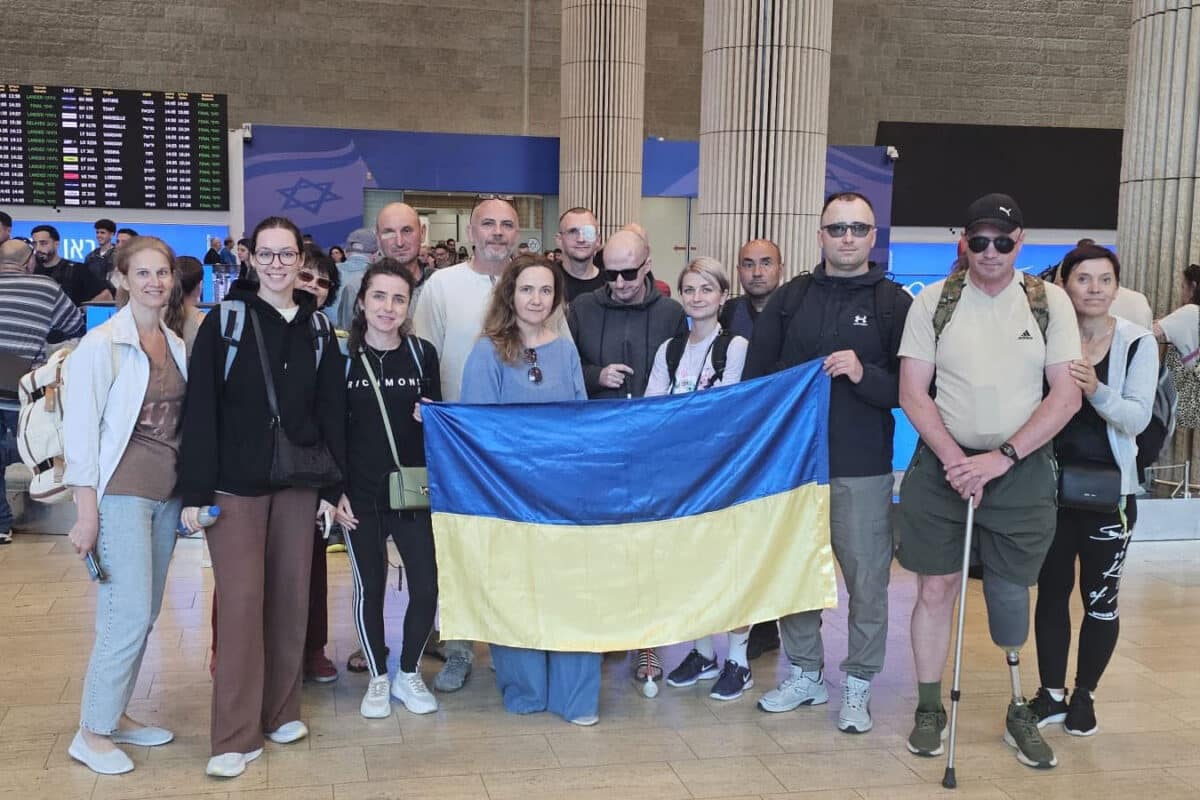
On July 5, 2026, a Ukrainian delegation of doctors and patients arrived in Israel to participate in an important medical program as part of the UNBROKEN project.

Ukrainian specialists and patients will undergo training and eye prosthetics at the Israeli hospital “Bnei Zion” in Haifa.

This was reported by public activist and volunteer Anna Zharova (Israeli Friends of Ukraine), emphasizing that the project is the result of cooperation between Ukrainian and Israeli doctors, volunteers, public organizations, and diplomatic structures.

In the conditions of war, when Ukraine daily experiences the consequences of Russian shelling, such initiatives are of particular importance. They help not only specific patients but also create a foundation for long-term medical assistance in Ukraine itself.

The main goal of the project is not just to conduct individual operations in Israel, but to transfer Israeli experience to Ukrainian doctors, which can be applied in Lviv in the future.

UNBROKEN in Israel: Ukrainian patients and doctors arrived for experience that will save lives

Israeli experience for Ukrainian medicine

The UNBROKEN project in Lviv has become one of the most well-known Ukrainian centers for the rehabilitation of people affected by the war.

Here they help military and civilians who have received severe injuries, lost limbs, vision, undergone complex surgeries, and need long-term rehabilitation.

Now another important stage is being added to this direction — the development of eye prosthetics with the participation of Israeli specialists.

For patients who have lost an eye or suffered severe facial injuries, prosthetics is not just a medical procedure.

It is a return to normal life.

It is the opportunity to look at oneself in the mirror without pain again.

It is a chance to go out to people, return to family, work, society, and feel not only survived but also restored.

Israeli medicine has long been known for its high level of ophthalmology, reconstructive surgery, and rehabilitation. Therefore, the participation of the “Bnei Zion” hospital in such a project opens an extremely important opportunity for Ukrainian patients and doctors.

Ukraine receives not just help here and now.

Ukraine receives knowledge, technologies, and practical experience that can be applied at home.

Who participates in the project

The organizer of the internship in Israel was the Israeli organization לב אחד — One Heart — Lev Echad.

Israeli Friends of Ukraine joined the organization of events in Israel and volunteer support during operations by invitation.

The project received significant support from the Embassy of Ukraine in Israel, the Ambassador of Ukraine to Israel Yevhen Korniychuk, Consul Alex Zernopolsky, as well as the Ukrainian volunteer center “Razom”.

Such partnerships are especially important today.

When doctors, volunteers, diplomats, public organizations, and medical centers work together, help becomes not a one-time action but a real system.

NAnews — Israel News | Nikk.Agency notes that such projects demonstrate the living power of Ukrainian-Israeli cooperation: it is built not only on official meetings but also on concrete actions that change human destinies.

Eye prosthetics center in Lviv

One of the most important results of this program should appear in Ukraine.

According to Anna Zharova, a medical center for eye prosthetics is planned to be created in Lviv in the near future, which will work taking into account Israeli experience and in cooperation with Israeli specialists.

This means that patients in Ukraine will be able to receive specialized assistance closer to home.

For a country that faces the consequences of war daily, such a center is necessary.

Eye and facial injuries are among the most severe consequences of explosions, missile strikes, artillery shelling, and mine-explosive injuries.

Many people after such injuries need not only surgery but also long-term medical, psychological, and social recovery.

The creation of a center in Lviv will allow Ukrainian doctors to develop a new direction, and patients to receive help faster and more accessible.

This is the true value of international cooperation: not just bringing patients for treatment, but helping Ukraine create its own strong medical base.

People’s diplomacy that works

In her post, Anna Zharova wrote that against the backdrop of constant shelling of Ukraine and heavy news, it is especially important to see people who continue to do small and big things.

This phrase very accurately describes the essence of the project.

While the war destroys cities and destinies, volunteers, doctors, and public organizations continue to restore what can be restored.

They seek partners, negotiate with hospitals, find funding, accompany patients, help doctors, and create new opportunities where there were none yesterday.

This is true people’s diplomacy.

Not declarations.

Not loud words.

Not formal photographs.

But concrete help to specific people.

When a Ukrainian patient gets a chance for recovery in an Israeli hospital, and a Ukrainian doctor gains knowledge that will later help dozens and hundreds of patients in Lviv, this is real partnership between countries.

Why this is important for Israel and Ukraine

For Ukraine, the UNBROKEN project in Israel is an opportunity to strengthen its own medicine in one of the most complex areas.

For Israel, it is a chance to showcase its best experience, its medical expertise, and its human solidarity with people affected by the war.

Israel knows what trauma, terror, loss of loved ones, and the need to quickly restore people after severe injuries are.

Ukraine is going through enormous national pain today, and that is why Israeli experience can be especially valuable for it.

Such projects connect the two countries not with slogans, but with deeds.

Doctors pass on knowledge.

Volunteers create conditions.

Diplomats help open doors.

Patients get a chance for recovery.

And in Lviv, a new medical center is gradually forming, which can become part of a large system of assistance to people affected by the war.

Main

The arrival of the Ukrainian delegation in Israel as part of the UNBROKEN project is a story of support, professionalism, and faith in recovery.

It is a story of how Israeli medicine can help Ukraine not only treat individual patients but also build new medical opportunities within the country.

It is a story of people who do not wait for perfect conditions but continue to do important things.

Thanks to such projects, the word “help” ceases to be abstract.

It becomes an operation, training, a new center, a restored face, returned confidence, and a chance for a person to feel like themselves again.

Kyiv under fire again: 419 targets overnight, residential buildings in ruins, and a question to Ukraine’s allies

On the night of July 6, 2026, Kyiv woke up not to alarms, not to the noise of traffic, and not to the usual city life.

It woke up to explosions.

Russian terrorists launched a massive combined strike on Ukraine, with the main target being Kyiv. This was already the second heavy strike on the capital in four days: on the night of July 2, a Russian attack claimed 31 lives in Kyiv, with more than a hundred people injured. And now — again high-rise buildings, again fire, again rescuers on ladders, again people under the rubble.

According to the Ukrainian Air Force, on the night of July 6, Russia launched 419 aerial attack means — 68 missiles and 351 drones of various types. Among them were 6 anti-ship missiles 3M22 “Zircon”/”Onyx”, 23 ballistic missiles “Iskander-M”/S-400, 33 cruise missiles Kh-101, 6 cruise missiles “Kalibr”, and 351 strike UAVs of the Shahed, “Gerbera”, “Italmas” types and decoy drones.

The Ukrainian air defense managed to shoot down or suppress 363 targets: 37 missiles and 326 drones. This is a huge effort by the defenders of the sky.

But the main tragedy of this night lies elsewhere.

According to preliminary data from the Air Force at 08:30, there were hits from 29 ballistic, including anti-ship, missiles and 18 strike UAVs at 34 locations. Debris from downed drones was also recorded at 16 locations. Ballistics and “Zircons” were the strike that Ukraine could not stop due to a shortage of interceptor missiles.

Residential buildings instead of “military targets”

As of the morning of July 6, it was known that 11 people had died in Kyiv. Initially, it was reported that 46 people were injured, of whom 27 were hospitalized, including three children. Later, Ukrainian President Volodymyr Zelensky mentioned about 60 injured in the capital.

These are not just numbers.

Behind each number is a person who was at home in the evening. Someone was sleeping. Someone was checking their phone. Someone was putting a child to bed. Someone left a cup in the kitchen and did not know that in a few hours their apartment would become a hole in the wall of a high-rise building.

The most severe consequences were recorded in the Podilskyi and Darnytskyi districts of the capital.

In the Podilskyi district, a residential high-rise was hit. In one building, structures from the 9th to the 5th floor were destroyed, people were brought out into the fresh air and rescued from the upper floors using fire ladders. Searches for victims also continued in a 21-story residential building, where the destruction affected floors from the 2nd to the 5th.

In the Darnytskyi district, residential buildings were damaged, fires broke out in apartments and a garage cooperative. According to TSN, in one of the 25-story buildings, debris fell at the level of the 4th floor, and in a 30-story residential building, a fire broke out from the 23rd to the 25th floor.

Consequences were also eliminated in the Holosiivskyi and Obolonskyi districts. According to the Kyiv City State Administration, damage was recorded at more than 20 locations, although initial reports mentioned 15.

Urlivska: children’s toys among the debris

There are frames that do not require long explanations.

On Urlivska Street, after the Russian strike, high-rise buildings were damaged. The blast wave knocked out most of the windows in the unfinished buildings of the “Urlivsky” residential complex. Dozens of parked cars were destroyed in the yards. On the playground, which was near the impact site, abandoned children’s toys remained among the debris.

This is the face of the Russian war.

Not maps in Kremlin offices.

Not television sets with camouflage nets.

Not Mosfilm bravado, where Putin’s power portrays “strength”.

But a playground where toys lie among glass, metal, and dust.

People ran out of their homes in what they were wearing. Some in house robes. Rescuers carried out not only people but also pets: one resident was helped to carry out two cats, who sat in carriers after the evacuation, as frightened as their owners.

In one of the destroyed houses in the Podilskyi district, according to Ukrainian media, an entire family died — mother, father, and son. This is the point where the language of politics ends. Only silence remains, which cannot be justified by any “geopolitical calculations”.

Kyiv region: Vyshneve, fire and evacuation

The strike was not only on the capital.

In the Kyiv region, Zelensky reported 3 dead and 16 injured. In Vyshneve, a fire continued at the site of the missile strike, and people were evacuated from the private sector. More than 400 rescuers and police officers were involved in eliminating the consequences of the attack.

Later, regional authorities clarified that the number of injured in Kyiv region increased to 26 people, including two children: a 9-month-old baby and a 12-year-old child. More than 500 residents were temporarily evacuated from Vyshneve due to the threat of repeated detonation.

This is an important detail: even after the explosion, the danger did not end.

People not only lost their homes, windows, cars, and sense of security. They were also evacuated due to the risk of repeated detonation. That is, the Russian strike continued to threaten them even after the missile had already fallen.

Patriot, which is lacking

The President of Ukraine directly stated what has long been clear in Kyiv, Moscow, Tehran, and Western capitals: Ukrainian military worked well against drones and cruise missiles but could not stop Russian ballistics due to a lack of interceptor missiles for Patriot systems.

It is precisely the Patriot that remains the key means of protection against ballistic strikes. It is the interceptor missiles — not beautiful words, not statements, not “concern”, but specific missiles on specific launchers — that decide whether a high-rise will stand in the morning or turn into a mass grave.

Reuters, citing Air Force data, also notes: Russia used 68 missiles and 351 drones, Ukrainian air defense shot down or suppressed 37 missiles and 326 drones, but neither ballistic nor supersonic/hypersonic missiles were intercepted in this attack.

Zelensky called on the US and European partners to come out of the NATO summit in Ankara with strong decisions on protecting Ukrainian skies. His phrase sounds like both an accusation and a request: as long as the missiles for Patriot remain in the allies’ warehouses, Russia gets an incentive to further “defeat” residential buildings.

For the Israeli audience, this should be especially understandable.

In Israel, they know what a night under rockets is like. They know what dependence on air defense is like. They know that sometimes between life and death stands not a diplomatic formula, but an interceptor that was delivered on time.

That is why NAnews — Israel News | Nikk.Agency draws attention to this detail: the Ukrainian issue today is not only a front-line issue. It is a question of the right of peaceful people to sleep in their apartments and not die because the necessary missiles are lying in the allies’ warehouses.

NATO summit and Moscow’s demonstrativeness

This attack occurred on the eve of the NATO summit in Ankara, scheduled for July 7–8, 2026. On the eve, Zelensky warned that, according to intelligence, Russia was preparing a new massive strike. He linked this to Putin’s habit of acting demonstratively — after US Independence Day and before the NATO summit.

This is not a coincidence.

The Russian terrorist regime loves symbols and lives by demonstrating strength. First, they show the world a dictator in decorations where maps and camouflage nets are supposed to depict “military power”. Then Russian missiles fly into sleeping Ukrainian cities.

And this message is addressed not only to Ukraine.

Moscow shows Europe: this is what we can do.

This is what war looks like if it is not stopped in time.

This is what will happen to houses, hospitals, schools, power plants, and streets if the West continues to pretend that “escalation” can be avoided by concessions to the terrorist.

Since 2022, and if you look broader — since the war against Georgia in 2008, Russia has repeatedly shown that its aggression does not stop by itself. It is stopped only by force, weapons, sanctions, isolation, and a clear understanding: a terrorist does not calm down from softness. He perceives softness as an invitation to continue.

International “concern” no longer saves

After such nights, it is especially bitter to hear the usual language of international organizations.

“Deep concern.”

“Call for restraint.”

“Need for a ceasefire.”

For people waiting under the rubble, this is not help.

For parents looking for children, this is not protection.

For rescuers climbing fire ladders to destroyed floors, this is not a tool.

Yes, international structures can make statements. But if after the statements missiles again hit residential buildings, it means these statements do not work as a protection mechanism. They remain words, and Ukrainians need air defense systems, interceptor missiles, production, logistics, political decisions, and accountability for every day of delay.

The world cannot be surprised every time that Russia kills civilians again.

This is no longer a “shock”.

This is a system.

And if the killing system continues to work, it means the protection system is still insufficient.

When patience runs out

In Ukrainian society, after such nights, the terrible question is increasingly heard: what will happen if people finally run out of patience?

When residential buildings are hit again and again, when families die, when children’s toys lie among glass, when peaceful cities are turned into targets, the desire for revenge becomes an understandable human reaction.

But that is why Ukraine’s allies must act now.

Not so that Ukraine “does not respond”.

But so that the right to protection does not turn into despair.

The democratic world must stop Russian terror with military, political, and economic decisions before the pain becomes even deeper and the war even wider.

Main conclusion

The night of July 6, 2026 became yet another proof: Russia is not seeking peace.

Russia is testing weakness.

It struck Kyiv with 68 missiles and 351 drones. It directed the main strike at the capital. It pierced Ukrainian air defense with ballistics, “Zircons”, “Onyxes”, “Iskanders”, S-400, Kh-101, “Kalibrs”, and hundreds of UAVs. It hit residential buildings. It killed people. It again forced rescuers to search for the living and the dead among the concrete.

In Kyiv, 11 people died, about 60 were injured. In Kyiv region, 3 people died, the number of injured, according to updated regional authorities’ data, increased to 26. Hundreds of residents were evacuated in Vyshneve. In the Podilskyi and Darnytskyi districts of the capital, high-rise buildings burned and collapsed. On Urlivska Street, children’s toys remained among the debris.

This is not “another episode of the war”.

This is a question to Ukraine’s allies.

How many more nights must pass before Patriot missiles stop lying in warehouses and start protecting people?

How many more houses must collapse?

How many more families must die?

And how many more times will the world pretend not to understand the obvious: Russian terror will not stop by itself. It needs to be stopped. Now.