Jews from Ukraine: Leo Motzkin. From Ukrainian Brovary to Kiryat Motzkin, named in his honor

And today in our section “Jews from Ukraine,” we will talk about Leo Motzkin — an outstanding public figure from Brovary, whose name is associated with the history of Israel and Ukrainian Jews.

Leo Motzkin (Aryeh Leib) was born in 1867 in Brovary, Kyiv province of the Russian Empire. In this small town, near Kyiv, he received a traditional Jewish education. In the late 19th century, Brovary had a large Jewish community.

Jewish Community of Brovary: History and Tragic Events

Brovary, a small town near Kyiv, has deep historical roots and significant Jewish heritage. Before World War II, it had one of the largest Jewish communities in the region. Jews began settling in Brovary in the second half of the 19th century, gradually migrating from the west after the partition of Poland. According to 1891 data, Jews made up 23.3% of the town’s population (888 people). Most were engaged in trade and crafts, actively participating in the town’s life. Brovary had a synagogue, Jewish schools, and public organizations.

The period from 1917 to 1921 was tragic for the Jewish community. During the revolution and civil war, Jews were subjected to brutal pogroms organized by various military formations: Denikin’s troops, Skoropadsky’s haidamaks, the Red Army. Many perished, and some residents left the town, emigrating to Kyiv or other safer places.

The Jewish population gradually decreased. If in 1923 there were 646 Jews living in Brovary, by 1939 their number had decreased to 458 people. World War II played a tragic role in the community’s history. From 1941 to 1943, almost all the town’s Jews perished on the fronts or were killed during the Nazi occupation. As a result of these events, the Jewish community of Brovary practically disappeared.

In the post-war years, a small part of the Jews returned to the town. In 1989, about 360 Jews lived there, but by 1999 only 110 people remained. The main reasons for the decrease were emigration to Israel and other countries, as well as the lack of conditions for community development.

Today, there are almost no direct traces left of the once numerous Jewish community in Brovary. However, its history lives on in the memory of descendants and those interested in the heritage of the Jewish people. Preserving this memory is important for future generations so that the rich culture and traditions of Brovary’s Jews are not forgotten.


To Berlin for Knowledge: A New Stage of Life

After completing his primary education, Leo Motzkin went to Berlin, where he studied mathematics and philosophy. It was in Berlin that his active public activity began. He became one of the founders of a scientific society that united students supporting the Hovevei Zion (Lovers of Zion) movement.

With the emergence of Theodor Herzl and the beginning of the Zionist movement, Motzkin became an active participant. He was a delegate to the First Zionist Congress in 1897 and advocated for a clear formulation of the movement’s goal — the creation of a Jewish state in Eretz-Israel.


First Trip to Eretz-Israel

On behalf of Theodor Herzl, Motzkin went to Eretz-Israel to assess the state of Jewish settlements. In his report, he criticized the settlement methods used by Baron Rothschild and the Hovevei Zion movement and insisted on the need for political negotiations with the Ottoman Empire.

This trip became a turning point in his activities. He realized that without political support, the creation of a Jewish state would be extremely difficult.


Important Steps on the International Stage

During World War I, Leo Motzkin headed the Copenhagen branch of the Zionist Organization. After the war, he became one of the founders of the Committee of Jewish Delegations at the Paris Peace Conference, where he defended the interests of world Jewry.

With the rise of the Nazis to power in Germany, he was the first to raise the issue of discrimination against German Jews at the League of Nations level. When this issue was removed from the agenda, Motzkin refused to cooperate with the organization but continued to provide political and financial support to the Jewish population of Germany.


Table: Key Stages of Leo Motzkin’s Life

Stage of Life Years Description
Birth and Education in Brovary 1867–1880s Received traditional Jewish education
Study and Activity in Berlin 1880s – 1897 Studied mathematics and philosophy, became an active Zionist
First Zionist Congress 1897 Participated and led the movement for the creation of a Jewish state
Trip to Eretz-Israel 1898 Studied the state of Jewish settlements
Paris Peace Conference 1919 Defended the interests of the Jewish people
Death in Paris 1933 Left a great legacy for the Jewish people

Memory of Leo Motzkin

Leo Motzkin died in 1933 in Paris. His remains were reburied on the Mount of Olives in Jerusalem in 1934. In memory of the outstanding figure, the Israeli city of Kiryat Motzkin was founded in 1934, named in his honor.

In 1933, it was decided in Haifa to create a new residential area for middle-class families. It was to be located outside the city but close enough for residents to commute to work daily. A plot of land in the Zevulun Valley was chosen for this purpose.

The new area was named after Aryeh Leo Motzkin — a well-known Jewish public figure and one of the founders of the World Zionist Congress. Thus, Kiryat Motzkin was founded in 1934 by Polish Jews. The first residents of the area were merchants and independent craftsmen.

The territory where the new settlement was located turned out to be sandy and swampy. The lands were undeveloped and dangerous due to the risk of malaria. Settlers were offered 400 plots of land on installment. The first residents had to work hard to turn the undeveloped area into a comfortable place to live. Thanks to their efforts, the area earned the nickname “Green Island”.

By 1940, the population of Kiryat Motzkin had already reached 2,000 people, and on June 11, 1940, a local council was established. Over the years, the area continued to develop. In 1976, when the population exceeded 25,000 people, Kiryat Motzkin officially received city status.

Kiryat Motzkin became a symbol of the memory of a man who dedicated his life to the struggle for Jewish equality, the promotion of Hebrew, and the creation of a Jewish state.


Conclusion

The story of Leo Motzkin is a story of the struggle for the rights of the Jewish people, the promotion of Hebrew, and the creation of a Jewish state. His contribution to the development of world Jewry is hard to overestimate.

Now, as you walk the streets of Kiryat Motzkin, remember that his name is associated with a person whose ideas and efforts laid the foundation for many of modern Israel’s achievements.

We, the team at NANews – News of Israel, are proud to share such important stories that unite the Jewish and Ukrainian peoples.

Read more stories about outstanding Jews connected with Ukraine and Israel in our section “Jews from Ukraine“ on the NANews website – #євреїзукраїни


In Tel Aviv, the Ukrainian ambassador called on Israel to unite against common threats: behind this phrase already stands Russia-Iran

On August 31, 2026, an official reception was held in Tel Aviv to mark the 35th anniversary of Ukraine’s independence. At the event, Ukraine’s ambassador to Israel, Yevhen Korniychuk, urged the Israeli side to “join forces” against common enemies and threats, and Israeli Minister Zeev Elkin addressed the guests in Ukrainian.

The diplomatic reception itself could easily have been left in the protocol section. But I, Viktoria Katzman, compared Korniychuk’s speech with what Israel and Ukraine have publicly said to each other in recent months. It turns out to be not a festive formula: the theme of a common enemy is gradually transitioning from Ukrainian statements to official Israeli rhetoric.

If you are looking for what Yevhen Korniychuk said in Tel Aviv on August 31, who represented Israel at the celebration of Ukraine’s Independence Day, and why Russia and Iran appear again in this story, it is important to distinguish three levels: the words of the Ukrainian ambassador, the already officially established dialogue between Israel and Ukraine on the Iranian threat, and specific joint decisions that have not yet been announced.

Main source: publication of the Embassy of Ukraine in the State of Israel from August 31, distributed jointly with the Ukrainian Cultural Center in Tel Aviv.

The reception was on August 31, while Independence Day is on the 24th.

Ukraine celebrates Independence Day on August 24: it was on August 24, 1991, that the Verkhovna Rada adopted the Act of Declaration of Independence. In 2026, it marked 35 years since that date. The diplomatic reception in Tel Aviv took place a week later — on August 31. The 35th anniversary of independence was officially celebrated in Ukraine on August 24.

According to the embassy, among the guests were representatives of the Knesset, the Israeli government, the Ministry of Foreign Affairs, the diplomatic corps, Ukrainian public activists, members of Israeli Friends of Ukraine, and Israelis supporting Ukraine. Fallen defenders of Ukraine were honored with a minute of silence.

Korniychuk reminded that the full-scale Russian aggression has been ongoing for four and a half years, that missiles and drones continue to strike cities and civilian infrastructure, and simultaneously stated: in 2026, Ukraine managed to “bring the war back to Russian territory,” striking strategic targets far from the front line.

Moreover, this statement did not sound in a vacuum. Already on September 1, the day after the reception, another Russian airstrike on Kyiv and the Kyiv region resulted in the death of 12 people. Thus, Korniychuk’s words about ongoing attacks were not an anniversary retrospective but a description of a war that was literally happening at that time.

What do “common enemies” mean if the ambassador did not name them?

In the published text of Korniychuk’s speech, he does not list countries after the words about “common enemies and threats.” Therefore, I will not directly insert names into this quote that are not there.

But the political context here is quite transparent.

On July 23, 2025, Foreign Ministers Gideon Saar and Andriy Sybiha in Kyiv officially agreed to launch a strategic dialogue between Israel and Ukraine on the Iranian threat. Saar then emphasized that Iranian weapons and technologies threaten not only Israel: the same drone technology is used against Ukraine.

In February 2026, a separate Strategic Israel–Ukraine Security Dialogue took place in Tel Aviv. NANews detailed the strategic dialogue between Israel and Ukraine — there, it was not about ceremonial friendship, but about the connection between the security of Europe and the Middle East, defense technologies, and the strengthening of Russian-Iranian cooperation.

In April, Sybiha, after a conversation with Saar, again stated that Ukraine is ready to cooperate with Israel on common security challenges and specifically mentioned threats from Iran. And on July 29, he accepted Saar’s invitation to visit Israel for the 35th anniversary of diplomatic relations between the two states.

Therefore, Korniychuk’s phrase is not a declaration of a joint Ukrainian-Israeli front against Russia and Iran. But it is a continuation of the existing logic: Russia is waging war against Ukraine, Tehran has become a military partner of Moscow, and Israel considers Iran one of the main threats to its own security.

The most important thing happened before the reception — in Netanyahu’s letter.

There is a detail without which Korniychuk’s speech on August 31 looks much weaker than it actually was.

On August 24, Benjamin Netanyahu sent a congratulatory message to Volodymyr Zelensky on Independence Day. The letter became publicly known on August 26, when it was published by the Ukrainian president.

And in the document, the Israeli prime minister used a completely direct formulation:

“Our two countries face a common threat from Iran.”

NANews — Israel News separately analyzed Netanyahu’s letter to Zelensky and the important limitation of this story: Netanyahu did not announce a military alliance with Ukraine, arms supplies, a joint air defense system, or any new defense agreement.

But the language itself has changed.

Before this, it was Ukrainian diplomats who were particularly persistent in explaining to Israel why the Russian-Iranian connection concerns both countries. Now the formula “common threat” has already appeared in the document of the Israeli prime minister.

That is why I read Korniychuk’s words at the reception not as an attempt on August 31 to invent a new agenda, but as a public continuation of a conversation that is already ongoing between Kyiv and Jerusalem.

Why Elkin’s speech in Ukrainian is not a decorative detail

The embassy specifically noted that Zeev Elkin addressed the participants of the evening in Ukrainian.

For the Israeli reader, two explanations are needed here immediately.

Firstly, Elkin is not Israel’s finance minister. The finance minister is Bezalel Smotrich. Elkin’s official position is additional minister in the Ministry of Finance; he has held it since November 2024.

Secondly, the Ukrainian language at this event has a biographical dimension for him. Elkin was born in 1971 in Kharkiv, studied at Kharkiv University, and repatriated to Israel in 1990.

He is already involved in the practical Ukrainian-Israeli agenda. On December 4, 2025, in Jerusalem, Elkin, together with Ukrainian Deputy Prime Minister Taras Kachka, co-chaired a meeting of the joint Ukrainian-Israeli commission on trade and economic cooperation. This was the first meeting of the commission since the start of the full-scale Russian aggression; the previous one took place back in November 2021.

So, behind the person who spoke in Ukrainian to the guests on August 31, there is not only a Kharkiv biography but also a specific role in the revived intergovernmental dialogue.

“2000 Meters to Andriivka” already has a separate history in Israel

The second part of the evening was not dedicated to diplomacy. Guests were shown the documentary film by Mstyslav Chernov “2000 Meters to Andriivka” — the story of Ukrainian fighters who, during the 2023 counteroffensive, break through a fortified forest strip to the village of Andriivka occupied by Russian troops near Bakhmut.

And here is an Israeli detail that is not in the usual description of the film.

In 2025, “2000 Meters to Andriivka” won the main prize of the international competition DocAviv in Tel Aviv. Therefore, on August 31, the film effectively returned to the city where it had already received serious professional recognition.

With the “Oscar,” the wording should be kept as accurate as possible. Ukraine indeed officially selected the film as its entry for the 98th Academy Awards in the International Feature Film category. But it did not make it to the 15-film shortlist of the international category.

However, “2000 Meters to Andriivka” made it to the Oscar shortlist for Documentary Feature Film. This is a significant achievement, but a shortlist does not yet mean a final nomination for the award.

But with the “Emmy,” the status is already different. On May 29, 2026, the Associated Press reported that the film won the News & Documentary Emmy Award in the category Outstanding Direction: Documentary. In total, the film received six nominations for this award.

The embassy thanked the film club “Znyato v Ukraini / Created in Ukraine” for organizing the screening, specifically naming Svitlana Kozyreva and Roman Karasyk for promoting Ukrainian cinema in Israel and helping to showcase the film.

What really changed after August 31 — and what is still missing

I would not call this reception “Israel’s turn to Ukraine.” There are no facts for such a conclusion yet. No new arms supplies, joint air defense project, or agreement that would turn political formulations into commitments have been announced.

But the sequence of events is already difficult to consider coincidental.

In July 2025, Saar and Sybiha launch a dialogue on Iran. In February 2026, a strategic security discussion takes place in Tel Aviv. In the spring, Kyiv talks about common threats. In August, Netanyahu himself calls Iran a common threat to Israel and Ukraine. A few days later, Korniychuk in Tel Aviv proposes joining forces against common enemies.

And here appears another layer that is crucial for the Israeli audience. NANews detailed the Russian-Iranian military connection: initially, Iran provided Russia with Shahed and related technologies, then the Russian war against Ukraine became a multi-year environment for testing and improving mass missile-drone attacks.

Therefore, the question “what does Ukraine have to do with Israel’s security?” is becoming less theoretical.

For NANews — Israel News, the next verifiable milestone is already visible: will Andriy Sybiha’s agreed visit to Israel take place, and will practical projects emerge after political words — countering drones, protecting critical infrastructure, civil defense, defense technologies, or exchanging accumulated combat experience.

This will be more important than the diplomatic reception.

On August 31, Kyiv once again formulated the proposal. But after Netanyahu himself called Iran a common threat to both countries, the next question is already addressed to Jerusalem: will this formula remain the language of letters and speeches — or will it become a working policy.

Saudi Arabia is building a military alliance with Turkey and Pakistan. Why, after the war with Iran, has Israel found itself outside the new security system

On August 31, 2026, Saudi Arabia, Turkey, and Pakistan gathered the highest political and military leadership for the first time under the Mecca Defense Alliance. For Israel, the question is no longer whether a new bloc exists, but why the war with Iran provided Jerusalem with proof of its value to the Gulf countries—and at the same time did not make it part of the emerging security architecture.

On August 31, 2026, in Istanbul, the foreign ministers, defense ministers, and top military leadership of Saudi Arabia, Turkey, and Pakistan held the first meeting of the Strategic Political and Defense Committee, established under the Makkah Joint Defence Agreement. This is already the second stage of a story that began on August 7 in Mecca: then Mohammed bin Salman, Recep Tayyip Erdogan, and Shehbaz Sharif signed an agreement that an armed attack on one of the three countries should be considered an attack on all three.

The formula itself sounds almost like NATO’s Article 5, so the new bloc quickly received the labels “Islamic NATO” and “Meccan Pact.” But after the meeting in Istanbul, something more important than a label emerged. The three countries began turning the political declaration into a permanent mechanism: a secretariat is being created in Saudi Arabia, the first secretary-general for three years should be a representative from Pakistan, and cooperation will cover the connectivity of armed forces, defense industry, joint technology development, and production.

For NANews — Israel News | Nikk.Agency, the sensation around the name is not important, but rather the more uncomfortable question. The war with Iran showed that Israel is capable of practically helping Arab states repel Iranian strikes. So why is Saudi Arabia, which itself faced the threat of regional escalation, institutionalizing a defense alliance not with Israel, but with Turkey and Pakistan?

I, Stas Shifer, for this material compared what changed after the signing of the agreement on August 7 with previous NANews materials on Saudi normalization, Israeli assistance to the UAE, and the Iran-Russia military link. And the main change is visible precisely over time: on August 7 we had an agreement, and by August 31 there was already a secretariat, a permanent committee, and talk of expansion. This is not yet NATO, but it is no longer just a photo of three leaders after the ceremony.

From agreement to structure: what emerged in three weeks

NANews has already analyzed the moment of signing in the material “Turkey joined the defense alliance with Saudi Arabia and nuclear Pakistan: what the principle ‘an attack on one is an attack on all’ changes for Israel”. At that time, the central fact was precisely the formula of collective defense.

After Istanbul, an institutional shell was added to it. The joint statement of the three countries speaks of the need to make collective deterrence and defense effective, strengthen the interaction of armed forces, jointly develop technologies and production. This is an important detail. Military alliances become real not at the moment when leaders sign a beautiful document, but when people, procedures, permanent structures, joint projects, and regular meetings appear.

The Meccan alliance does not yet have integrated command at the NATO level, no publicly described automatic military response, and no published full set of operational protocols. Therefore, the phrase “a new NATO has already been created” would be an exaggeration. But calling the agreement symbolic is now difficult. The secretariat means that cooperation should not depend on a single meeting of leaders.

There is another boundary that is important not to blur. The official joint statement on August 31 explicitly names the defense industry, joint technology development, and production. Intelligence sharing as a separate formalized point is not prescribed there. Therefore, I would not write that the three states have already created a common intelligence system. Intelligence assistance may be part of practical defense cooperation, but it is not the same.

The very fact of such clarification is important for understanding the scale. We are not looking at a ready-made Middle Eastern NATO analog with a headquarters, unified command, and pre-written war scenarios. We are looking at the process of its institutionalization. It is this process that matters for Israel.

Why Pakistan and Turkey are needed by Riyadh right now

If you look at the new bloc only through Iran, Saudi Arabia’s choice indeed seems strange. Israel has powerful missile defense, intelligence capabilities, early warning systems, and real experience intercepting Iranian missiles and drones. Turkey and Pakistan, on the other hand, do not show a desire to turn the agreement into a mechanism for a future war with Tehran.

But this may be part of Saudi calculation.

Riyadh needs not just a partner against one specific enemy. It needs a set of insurances. Pakistan provides Saudi Arabia with decades-built military ties, a large army, a defense industry, and the status of a nuclear power. Turkey provides a large NATO state army, its own rapidly growing defense industry, drone technologies, experience in operations outside the country, and political influence in several regions.

The background here is especially important. The new trilateral mechanism did not arise out of thin air on August 7. As early as September 17, 2025, Saudi Arabia and Pakistan concluded a separate mutual defense agreement. There, almost the same logic already appeared: an attack on one of the parties is considered an attack on both. Thus, Mecca in 2026 did not create a Saudi-Pakistani military link—it expanded an already existing structure with Turkey.

And this is one of the details that get lost in a short news summary. If you start the story only from August 2026, it seems that the three leaders suddenly decided to create a new bloc after the war with Iran. If you add September 2025, the picture is different: Saudi Arabia was already looking for alternative security guarantees, and the current war accelerated the process.

For Riyadh, the appeal lies precisely in multivectorism. The kingdom maintains the closest relations with the US, receives American weapons, and negotiates a nuclear program, but at the same time builds a regional mechanism. This reduces dependence on a single guarantor. In the next crisis, Saudi Arabia wants to have not one phone in Washington, but several centers of power interested in its security.

And here the first non-obvious connection appears. Pakistan and Turkey are useful to Riyadh also because they are not part of Israel’s strategy against Iran. Such an alliance leaves Saudi Arabia room for maneuver: to contain Tehran without declaring itself a participant in the Israeli camp; to cooperate with the US without giving Washington a monopoly on security; to maintain its own role in the Muslim world.

The war with Iran gave Israel a chance—and showed the limit of this chance

Here arises a real paradox for Israel.

During the war with Iran, the theory of joint regional air defense practically became practice. On April 26, Axios reported that Israel deployed an Iron Dome battery, interceptors, and several dozen Israeli military personnel to operate the system in the United Arab Emirates. Later, US Ambassador to Israel Mike Huckabee publicly spoke about the deployment of Israeli batteries and personnel in the Emirates.

NANews analyzed this episode in detail in the material “Israeli ‘Iron Dome’ in the UAE—if Axios data is confirmed, this is a new level of alliance against Iran”. Today that text reads differently. Then the main question was: can the Iranian threat turn the Abraham Accords from diplomatic normalization into real defense partnership?

Now we have a partial answer: with the UAE—yes, at least at the level of specific military assistance. But Saudi Arabia chose a different structure for an institutional alliance.

Here it is necessary to explain the term itself. The Abraham Accords are a process of normalization of Israel with a number of Arab countries, initiated in 2020 with US mediation. For the Israeli reader, the UAE is already habitually perceived as a partner, but historically open military cooperation of Israel with an Arab state is not a routine thing. Therefore, the appearance of an Israeli battery with Israeli operators in the Emirates during a real war became a fundamentally new level of relations.

And it is here that a missed opportunity arises.

Iranian missiles and drones do not divide the countries of the region into participants and non-participants of the Abraham Accords. Israel has a multi-layered air and missile defense system, the Gulf states have their own radars, bases, American infrastructure, air defense systems, and advantageous geographical position. A connected network of warning and interception is potentially stronger than a set of isolated national systems.

That is, the war created the very moment when a common threat could sharply accelerate the political integration of Israel with moderate Arab states.

But at the same time, it demonstrated the limit of technology. Israel can be an extremely useful partner at the moment when missiles are flying, and still remain too complex a partner for a formal political alliance. Military value and political acceptability are different things.

Why a common enemy did not make Saudi Arabia an ally of Israel

In Israel, it is very easy to build a linear chain: Iran attacks Israel and the Gulf countries → Israel and the Saudis have a common enemy → therefore, normalization should accelerate.

But the Middle East does not work that way.

Saudi Arabia indeed perceives Iran as a serious threat. But at the same time, it does not want to live in a system where its choice is reduced to two options: depend on the US or join the Israeli camp. The Meccan alliance creates a third option—a regional insurance with states whose cooperation does not require the Saudi leadership to explain to its and the Arab audience an open defense alliance with Israel.

Turkey is especially indicative here. Ankara competes with Tehran in a number of regions and is not an Iranian ally, but at the same time its relations with Israel are much more conflictual. Therefore, the same structure can perform different functions for different participants: for Saudi Arabia, it is an additional insurance against Iran and other crises, for Turkey, it is also a way to prevent Israel from becoming the sole center of a new regional architecture.

It is here that I separate fact from political assessment.

The fact is that the normalization of Saudi Arabia with Israel remains blocked, and Riyadh continues to demand a real political path to Palestinian statehood. On August 25, the Trump administration again tried to link the implementation of the US-Saudi nuclear agreement to the recognition of Israel, but the Saudi position on the Palestinian issue has not disappeared.

My assessment is different: the government of Benjamin Netanyahu has made the price of public rapprochement with Israel for the Saudi leadership extremely high. Netanyahu can be briefly called a toxic partner for Riyadh, but this word itself explains nothing. It is important to show the mechanism: the war in Gaza, the absence of an acceptable political horizon for the Saudis on the Palestinian issue, and the inability to sell the Arab audience a historic normalization without a reciprocal political result from Israel.

NANews already has an important background on this line. In the material “Israel lost the price of normalization: Saudi Arabia got a path to F-35 and uranium enrichment” we analyzed how part of the American incentives for Riyadh began to exist separately from the recognition of Israel.

Then the situation changed again: Washington tried to return normalization to the US-Saudi deal. This is important not only for understanding Trump’s relations with Mohammed bin Salman. Israel is actually competing to ensure that normalization itself remains a strategically irreplaceable asset for Saudi Arabia, and not just one of the possible bonuses.

Six-seven potential participants can change the scale of history

There is another element due to which the Meccan alliance cannot be considered only as a triangle Ankara—Riyadh—Islamabad.

Pakistani Foreign Minister Ishaq Dar stated that six or seven Muslim states have shown interest in joining. The full list is not publicly named. Therefore, today it is impossible to write that “seven more countries are joining the alliance.” Only the presence of interest and work on the mechanism of possible expansion is confirmed.

This distinction seems small, but for a news text, it is fundamental. “Seven countries are joining” means an almost ready expansion. “Six-seven states have shown interest” means the beginning of a negotiation competition, where some potential participants may eventually refuse.

Bangladesh has already publicly discussed such a possibility. Turkey separately named Egypt as a natural potential partner. And one Egypt would be enough for the political weight of the structure to noticeably increase: it is the largest Arab country by population, a country with a peace treaty with Israel, controlling the Suez Canal and possessing one of the largest armies in the region.

If other states begin to join the alliance, the question for Israel will also change.

So far, the Meccan alliance can be considered an additional trilateral mechanism. But if it becomes a platform where Turkey, Saudi Arabia, Pakistan, Egypt, and other Muslim states discuss joint weapons, technologies, production, air defense, and crisis response, an independent decision-making center will emerge.

And the absence of Israel will then acquire practical significance.

Not because the participants will automatically become enemies of Israel. That would be too simplistic a conclusion. Egypt has had a peace treaty with Israel for decades. Potential participants are capable of simultaneously cooperating with Jerusalem and being part of another defense structure.

The problem is different: standards, purchases, joint production, political consultations, and rules for responding to regional crises will be formed in a room where Israel is not present.

Search formulations “Meccan Pact against Israel,” “Islamic NATO against Iran,” “Saudi Arabia Turkey Pakistan military alliance,” or “new Muslim military alliance” therefore still give too crude a picture. Another is confirmed: there is a collective defense agreement; it has already received permanent institutions; the founders are preparing the possibility of expansion; a specific opponent is not named in the agreement. For Israel, the risk is not in the proven emergence of a hostile bloc, but in the gradual formation of a regional security system in which Israel ceases to be a mandatory participant.

What Israel risks losing—and what can still be preserved

NANews — Israel News | Nikk.Agency has been writing for many months about how the war with Iran connects plots that previously seemed separate.

In the material “Iran and Russia: how the war in Ukraine became a testing ground for a future war against Israel and the US” we showed the flip side of the same problem: technologies, drones, tactics, and accumulated combat experience can transition between the Russian-Ukrainian and Middle Eastern theaters of war.

The Ukrainian experience here is needed not for an obligatory insert about Ukraine. It shows that the modern security system is built not only around formal agreements. It is built around the compatibility of systems, the production of drones and interceptors, intelligence, logistics, repair, ammunition, and the ability to quickly adopt the experience of someone else’s war.

It is precisely these connections that the Meccan alliance is now trying to gradually institutionalize.

Israel has very strong cards: air and missile defense, radars, intelligence, cybersecurity, precision weapons, anti-drone solutions, and real experience in repelling massive attacks. The episode with the UAE showed that an Arab country is capable of turning to Israel at the moment of immediate threat and receiving practical military assistance.

This is a serious strategic asset.

But an asset is useless if it cannot be turned into stable political relations.

The next Israeli government—regardless of its party composition—will receive not an abstract task “to improve relations with the Arab world,” but a much more specific one. It is necessary to maintain and expand defense coordination with the UAE and Bahrain, retain strategic relations with Egypt and Jordan, return the political meaning of Saudi normalization, and offer the countries of the region a system of cooperation that does not force them to choose between Israel and their own Muslim partners.

This does not necessarily have to be a mirror “anti-Meccan pact.”

A more realistic goal is a network of bilateral agreements, early warning systems, compatible air defense elements, data exchange, defense technology projects, and further development of opportunities that emerged after the Abraham Accords. In other words, Israel does not necessarily have to sit at every regional table. But it needs to ensure that no serious security system in the region can fully function without Israeli capabilities.

That is why the meeting on August 31 in Istanbul is more important than the loudest formula “an attack on one is an attack on all.”

It shows that after the war with Iran, the states of the region are not waiting for Washington or Jerusalem to offer them a ready-made architecture. They are building their own.

For Israel, this is a warning on several levels at once. A common enemy does not by itself create an alliance. Military superiority does not guarantee political influence. Supplying technology in a moment of crisis does not mean that the recipient of this assistance will choose Israel as its main strategic partner.

In 2026, Israel has already proven that it is capable of physically helping an Arab state defend against Iranian fire.

Now the task is much more difficult: to prove that Israel can be not only a supplier of interceptors when missiles are already flying but also a long-term partner in creating the rules of the region before the next war.

Sources joint statement of the Strategic Political and Defense Committee of the Meccan Agreement on August 31, 2026; official statements of Saudi Arabia, Turkey, and Pakistan; Reuters; Axios; previous NANews materials.

Israeli citizen Kolomoisky from the detention center spoke about Mindich, the mausoleum, and Ukrainian missiles

Igor Kolomoisky from the hall of the Ukrainian court spoke about ballistic missiles, Lenin’s mausoleum, and Timur Mindich in Israel. But behind one sarcastic remark was the story of Kolomoisky’s own Israeli citizenship, the Jewish community of Dnipro, “Dnipro-1”, Fire Point, and several legal proceedings.

Igor Kolomoisky was back in the news not because of another court decision, but because of a remark that the war could supposedly be ended by a missile hitting Lenin’s mausoleum. But the conversation on August 28, 2026, was broader. He talked about Ukrainian ballistics, Fire Point, and Timur Mindich, who is in Israel. Kolomoisky himself is also an Israeli citizen, a former head of a major Jewish organization in Ukraine, and a person who has been in a Kyiv detention center for almost three years.

In this material, I, Alexander Khmelnitsky, for NANews — Israel News compared where Kolomoisky’s words were a joke and where he relied on real stories around Fire Point and Mindich. For the Israeli reader, his Israeli passport, the “Menorah” in Dnipro, the story of “Dnipro-1”, and several legal proceedings, which are often mixed into one, are important here.

The mausoleum was a joke. Mindich — not so much

On August 28, 2026, Kolomoisky spoke with journalists in the Appeals Chamber of the High Anti-Corruption Court of Ukraine. HACC is a special court for the most significant corruption cases. On that day, the defense tried to transfer the case to another court, where Kolomoisky and five other former managers of PrivatBank are accused of embezzling more than 9.2 billion hryvnias.

The court refused.

Against this backdrop, Kolomoisky began to speculate about the war. According to his logic, the mere possibility of Ukraine responding with ballistic strikes on Moscow would not yet force Russia to stop. Then followed sarcasm about Lenin’s mausoleum and the “death of Koschei.” The phrase “everything will end immediately” in context sounded like a joke, not a military plan.

He then spoke about Fire Point, called the company a “super organization,” demanded the return of the “chief designer,” and immediately recalled Mindich in Israel — supposedly “with all the secrets.”

“Chief designer” in Israel: where is the substitution of fact

Timur Mindich is not the chief designer of Fire Point. This position is held by the company’s co-founder Denis Shtilerman; in 2026, he publicly stated that he owns 97.5% of Fire Point.

But the connection of Mindich with the company is not entirely fictional. Shtilerman himself said that Mindich helped gain access to closed Soviet archives with materials on missile technologies, including documents on the S-300. He claimed that these materials helped work on Ukrainian missile projects.

This is Shtilerman’s version, not an independently established fact about which documents were transferred. There is no confirmation that Mindich took “all the drawings” to Israel.

Fire Point is indeed working on ballistics. Reuters reported on FP-7 and FP-9; for FP-9, a range of about 850 kilometers and a warhead of up to 800 kilograms is declared. Simultaneously, the company is developing the Freyja anti-missile project with the FP-7X interceptor.

Mindich is in Israel, and Ukraine is seeking his extradition in the “Midas” case. On August 10, the head of the Specialized Anti-Corruption Prosecutor’s Office, Alexander Klymenko, said that there was no response from Israel to the request for the extradition of Mindich and Alexander Zuckerman. SAP is the prosecutor’s office that handles top corruption cases together with NABU, the National Anti-Corruption Bureau.

Kolomoisky received an Israeli passport back in 1995

For the Israeli audience, Kolomoisky is not just a “Ukrainian oligarch.” He himself said that he received Israeli citizenship in 1995, after his first trip here in 1992. Later, he simultaneously had Ukrainian, Israeli, and Cypriot passports.

Since then, the set of citizenships has changed. In 2025, the Supreme Court of Ukraine finally upheld the decision to terminate his Ukrainian citizenship. Cyprus revoked its citizenship in 2024. I found no data on the termination of Israeli citizenship.

Since 2018, Kolomoisky lived in Herzliya, and in May 2019, he returned to Ukraine.

The connection with Jewish life was also real. In 2008, he was elected president of the United Jewish Community of Ukraine. He was a major donor to the Jewish community of Dnipro and participated in financing the “Menorah” complex; separately financed the related museum of Jewish memory and the Holocaust. In 2010, he headed the European Council of Jewish Communities, although his arrival was accompanied by conflict within the organization.

For NANews — Israel News | Nikk.Agency, I separate two things here: Kolomoisky’s Jewish and Israeli biography is an established part of his past, but it says nothing about guilt or innocence in current cases.

“Kolomoisky’s Battalion” — not quite a personal army

In the spring of 2014, after the annexation of Crimea by Russia and the start of the war in Donbas, Kolomoisky headed the Dnipropetrovsk Regional State Administration. For an Israeli, this is roughly a region head appointed by the central government, although there is no direct Israeli equivalent.

Kolomoisky and his team invested private money in the defense of the region and the support of volunteer units. The most famous is “Dnipro-1.”

It is often called “Kolomoisky’s battalion” or even “private army.” The latter is inaccurate. “Dnipro-1” was created in April 2014 as a special volunteer police battalion within the Ministry of Internal Affairs of Ukraine. Private funding and the role of Kolomoisky’s team were significant, but legally it was not his personal armed structure.

During that period, he also promised monetary rewards for captured Russian saboteurs. For Moscow, Kolomoisky became one of the symbols of Ukrainian resistance in the east — despite being a Jewish public figure and an Israeli citizen.

Why he has been in detention for the third year without a verdict

Kolomoisky has been in custody since September 2, 2023. But to say that he is “in prison by verdict” is incorrect. He is held in a pre-trial detention center during investigations and court proceedings.

On August 7, 2026, the Podolsky District Court of Kyiv kept him in custody until October 9, setting bail at 948 million hryvnias in a case related to PrivatBank.

Another proceeding is ongoing in parallel. Kolomoisky is accused of organizing an attempt on the lawyer Sergey Karpenko in 2003. According to the investigation, the conflict arose around a corporate dispute, after which Karpenko was attacked and stabbed. Kolomoisky denies involvement. In June 2026, Karpenko testified in court for the first time, and the defense tried to close the case due to the statute of limitations.

These cases cannot be mixed. And the detention itself does not prove guilt: the final decision is made by the court.

The court on August 28 returned the conversation to PrivatBank

NABU and SAP submitted the indictment to the court on August 6, 2026. According to the prosecution, in January–March 2015, the former ultimate owner of PrivatBank, who simultaneously headed the Dnipropetrovsk region, organized the embezzlement of more than 9.2 billion hryvnias of the bank through a controlled structure. Kolomoisky and other defendants have the right to challenge this version.

There is also a separate British process. In 2025, the High Court of England found Kolomoisky and Gennady Bogolyubov liable to PrivatBank for the withdrawal of funds. On May 22, 2026, the Court of Appeal of England and Wales dismissed their appeal. This is a civil decision, not a Ukrainian criminal verdict.

It was at the hearing on the Ukrainian case on August 28 that Kolomoisky spoke about Mindich. One Israeli citizen is in custody in Kyiv; another Ukraine is trying to obtain from Israel through extradition. Between them in this story is Fire Point — a Ukrainian missile manufacturer, around which the dispute over Mindich’s real role remains a dispute, not a fact established by the court.

In Ukraine, a “Kohanim Bridge” was built for $1,000,000: in Gadyach, a Chabad shrine was made accessible to the descendants of ancient priests – what is it and why?

“A 200-meter-long bridge, with 37 sections, 178 steps, and a heating system, allows the Kohanim to safely visit the holy site…“

The construction of the bridge cost more than 1,000,000 dollars. According to the organizers, it is the largest project of its kind in Ukraine and, most likely, in all of Europe.

Ukraine is at war. Every day brings new destruction, civilians die, the economy collapses under the bombs. It would seem there is no place now for anything except the front and survival.

And suddenly the news: in Hadiach, Poltava region, the “Bridge of the Kohanim” was opened. For most people, it sounds strange, unclear, even absurd: when there is blood and rockets around, why would anyone need a bridge at a cemetery?

But it is precisely such events that become symbols. They prove that even under shelling, the people continue to keep their faith, respect tradition, and build the future. This bridge is a sign that the Jewish community of Ukraine, together with the entire country, will not surrender to Putin’s aggression and will continue to live, pray, and develop on its land, no matter how difficult it is. It connects the common past of Ukrainians and Jews — the memory of Rabbi Alter Rebbe, of centuries of neighborhood and communal life — with the shared future being built here and now: a free Ukraine and a living Jewish tradition on this land.

What happened: in the Ukrainian city of Hadiach (Poltava region), a unique bridge nearly 200 meters long was built. It leads to the grave of Rabbi Shneur Zalman of Liadi, known as the Alter Rebbe, the founder of the Chabad movement.

This was reported by the Federation of Jewish Communities of Ukraine on August 28, 2025:

“In Hadiach (Poltava region), the “Bridge of the Kohanim” was solemnly opened in the “Admor HaZaken” complex at the Tziyun of the Alter Rebbe, the founder of Chabad Hasidism and author of the Tanya.”

The bridge was built specifically for the Kohanim — descendants of the ancient Jewish priests, who, according to Torah law, are forbidden to enter a cemetery and approach graves. Previously, this rule completely closed their access to the shrine, but now they have the opportunity to pass: the bridge is laid above the cemetery ground, and the Kohanim reach the grave by a separate structure without violating the prohibition.

Historically, there was already a “bridge of the Kohanim” there: according to Chabad sources, it was built by Rabbi Yehuda Leib — the brother of the Alter Rebbe. That first bridge was destroyed during the eras of Nazism and Communism, and for almost a hundred years the Kohanim could not approach the Tziyun directly. The current one is the second, returning direct access to the Kohanim for the first time in decades (previously they had to pray about 200 meters away from the burial site, from the balcony of the guest complex).

Hadiach

Hadiach is a city in the Poltava region, founded back in the 17th century as a fortified Cossack center. In the history of Ukraine, it is also known as the capital of the Hetmanate under Yurii Khmelnytskyi.

The Jewish community here appeared in the 18th century and quickly became one of the most influential in Left-Bank Ukraine. Hadiach was an important trade hub, and Jews engaged in crafts, commerce, and owned taverns.

The city gained particular significance after 1812, when the Alter Rebbe, Shneur Zalman of Liadi, was buried here. From that moment, Hadiach became a holy place for Chabad Hasidim. At the cemetery, a Moshila (“ציון”) was formed, where pilgrims came from all over Europe.

Even in Soviet times, when religious life was banned, Jews secretly strove to come here to pray. After Ukraine’s independence, the shrine received the official status of a memorial complex.

Today, Hadiach is a small town in the Poltava region of Ukraine with a population of about 20,000 people. The Jewish community here is no longer as large as before the revolution or the war, but its role is still felt through memory and heritage.

Like all of Poltava region, Hadiach has repeatedly suffered from Russian attacks: drones and missiles damaged gas transport and industrial infrastructure, causing fires and destruction. Although the city itself was not always a direct target, residents constantly live under the threat of new shelling and disruptions of critical facilities.

The Alter Rebbe and His Legacy

Who was Shneur Zalman of Liadi

Shneur Zalman (1745–1812), better known as the Alter Rebbe (“the Old Teacher” in Yiddish), was an outstanding Jewish thinker and spiritual leader. A deep philosopher, reformer of Jewish law, and religious guide, his works became the foundation for thousands of followers around the world. In Judaism, the word “Rebbe” is not just a rabbi, but a mentor to whom the community turns for spiritual and practical guidance.

He was born in Eastern Europe, in the town of Liozna (now Belarus), and from a young age displayed extraordinary abilities in Torah study. Becoming a disciple of Dov Ber of Mezeritch, known as the Maggid, the Alter Rebbe was placed directly in the spiritual line that traced back to the Baal Shem Tov, the founder of Hasidism. Through this teacher, he inherited the tradition and gave it a new intellectual direction. Shneur Zalman later moved to Liadi (about 80 km away), where he established the center of Chabad and became known as the “Alter Rebbe of Liadi.”

In Lithuania, where the Jewish environment was renowned for high scholarship and often regarded Hasidism as “emotional simplicity,” Shneur Zalman offered a new approach. He explained Hasidic ideas through logic and deep Torah study, making them understandable and respected among rabbis and scholars. This gave birth to the Chabad movement — an acronym of the Hebrew words “Chochmah, Binah, Da’at” (“Wisdom, Understanding, Knowledge” — the names of the three upper sefirot in Kabbalah).

Despite opposition, the Alter Rebbe led the spread of Hasidic ideas in Lithuania and laid the foundation of the Chabad school. Thus, he became the founder of Chabad-Lubavitch — one of the most influential branches of Hasidism, where emphasis was placed not only on emotion but also on intellectual service to God.

He was also the progenitor of the dynasty of Hasidic tzadikim and rabbis of the Schneerson family.

How the Alter Rebbe Came to Hadiach

Rabbi Shneur Zalman of Liadi (the Alter Rebbe) spent the last years of his life during a very difficult time. In 1812, war broke out between the Russian Empire and Napoleon. The French army advanced through Eastern Europe, and in the Jewish community this war was seen as a great test: some viewed Napoleon as a liberator, others as a threat to spiritual life.

The Alter Rebbe believed that Napoleon’s victory would bring Jews external freedom but weaken their faith and devotion to tradition. When Napoleon’s troops approached, the Alter Rebbe, together with his family and disciples, was forced to leave his home near Liadi (now Belarus).

The winter flight was harsh: hundreds of disciples and followers accompanied him in his escape. Conditions were extremely difficult, and the Alter Rebbe’s health deteriorated sharply. In January 1813 (24 Tevet 5573 in the Jewish calendar), he died on the road near the town of Hadiach (now Poltava region of Ukraine).

His body was buried there, in the local Jewish cemetery. Thus Hadiach unexpectedly became one of the key centers of the Hasidic world: the Moshila (“ציון”) of the Alter Rebbe turned into a place of pilgrimage for Jews from all over the world.

For more than two hundred years, Hadiach has been associated with the name of the founder of Chabad. Even during the years of Soviet repression, Jews secretly traveled there to pray. Today, the memorial complex “Admor HaZaken” (“the Old Rebbe”) surrounds the Moshila, and the opening of the “Bridge of the Kohanim” has made the shrine accessible to all Jews.

Major Works of the Alter Rebbe

  • His main work is “Tanya” (Likkutei Amarim). This book explains the spiritual struggle within man between the “divine” and the “animal” souls. Because of this work, Shneur Zalman is called Baal HaTanya (“Author of the Tanya”).
  • He also compiled “Shulchan Aruch HaRav” — a revised and expanded version of the classic code of Jewish law “Shulchan Aruch,” adapted to the Hasidic tradition.
  • Another important work is “Torah Or” and “Likkutei Torah”, in which he commented on the weekly Torah portions from the perspective of Chabad philosophy.

The Teachings of the Tanya

The main book of Shneur Zalman is called “Tanya”. It is written in the form of short chapters, each of which explains how a person should understand themselves, their strengths, and weaknesses.

The Two Souls in Man

According to the Alter Rebbe, every Jew has two souls:

  • The Divine Soul — the source of striving for spirituality, goodness, and self-sacrifice for God and others.
  • The Animal Soul — connected to the body, desires, passions, egoism, and the habit of thinking only about oneself.

Man is always caught between these two forces. This tension is the main stage of his life.

The Image of the “Beinoni”

The Tanya introduces the concept of the “Beinoni” — “the intermediate person.” This is neither a tzadik nor a sinner, but an ordinary person who struggles every day and chooses good.

The Alter Rebbe taught: the main value is not to be sinless, but to struggle and never give up. Even if the struggle lasts a lifetime, it has holiness in itself.

The Path to God Through the Intellect

Unlike other Hasidic schools, which emphasized emotions and ecstasy, Chabad (based on the Tanya) focused on understanding and comprehension. The Alter Rebbe taught that love and fear of God should arise not from blind feeling but from deep contemplation of Torah and creation.

Practical Philosophy

The Tanya is not abstract theory but a guide to life:

  • How to deal with anger, envy, and depression.
  • How to keep faith in difficult times.
  • How to learn to see meaning even in hardship.

The Significance of the Book

It was thanks to the Tanya that the Chabad movement became widespread. People realized that the teaching spoke to them in simple language: “You’re not a saint? That’s fine. The main thing is — struggle and choose good.”

Thus: The Tanya is a philosophy for the ordinary person, which gave Jews of the 18th century (and gives today) the sense that their daily struggle for good has spiritual weight.

Joy and Dance in the Teachings of the Alter Rebbe

In the Hasidic tradition, joy is not just an emotion but a spiritual obligation. The Alter Rebbe wrote in the “Tanya”: sadness and despair paralyze the soul, making a person inactive. Joy, on the other hand, gives strength to fight against weaknesses.

Therefore, in Hasidic life, joy is expressed not only through words of prayer but also through the body — in songs and dances. When Hasidim dance, it is not entertainment but a form of prayer. In dance, a person is freed from the burden of worries and rises above daily problems.

Hasidic rabbis often repeated: “It is impossible to serve God with sadness. Only joy expands the boundaries of the soul.”

Dance became for them a symbol of the victory of the spirit over despair. Even in hard times — be it pogroms, persecutions, or today’s war — the Hasidic community continues to sing and dance, showing that its faith is alive.

Thus, the “Tanya” provided the philosophical foundation for joy, while Hasidic practice made it visible — in songs and dances, which may look unusual to outsiders but for Jews express deep faith.

Chabad-Lubavitch: From the Alter Rebbe to Today

A Brief History

The Alter Rebbe himself gave his teaching the name “Chabad” — an acronym of three Hebrew words:

  • Chochmah (חכמה) — Wisdom,
  • Binah (בינה) — Understanding,
  • Da’at (דעת) — Knowledge.

After the Alter Rebbe’s death, the movement’s center became the town of Lubavitch (now Belarus), from which the second part of the name comes. In the following centuries, Chabad spread across the world, preserving a distinct philosophical school and system of education.

Who is the Rebbe Now

The last spiritual leader (Rebbe) was Menachem Mendel Schneerson (1902–1994), the seventh in the line of the Alter Rebbe’s successors. He turned Chabad into a global movement, opening hundreds of schools, synagogues, and cultural centers (“Chabad Houses”).

After his death, no new Rebbe was appointed, but Hasidim continue to consider him their spiritual guide.

The Modern Movement

Today, Chabad is one of the largest Jewish movements in the world. It has:

  • around 200–300 thousand active followers, fully living by the traditions of the movement;
  • more than 3–4 million Jews involved in Chabad’s educational, cultural, and charitable projects;
  • tens of thousands of emissaries (shluchim, שלוחים) and rabbis working in over 100 countries worldwide.

In Israel, Chabad is active in education, charity, and public life, while in the post-Soviet space, Chabad communities often became the foundation for the revival of Jewish religious life. In Ukraine, before the war, there were about 50 Chabad communities, and they continue to help people even during the aggression.

Chabad in Modern Ukraine

After Ukraine’s independence, it was Chabad that became the leading force in reviving the country’s Jewish life. Emissaries of the Lubavitcher Rebbe Menachem Mendel Schneerson began arriving in Ukraine while he was still alive. After the Rebbe’s death in 1994, the movement continued to send shluchim according to his instructions and the concept of shlichut, which became the basis of Chabad’s global network.

The First Wave (1990–1994) — During the Rebbe’s Lifetime

  • Dnipro — Rabbi Shmuel Kaminetsky, one of the first shluchim, arrived in 1990. A graduate of the “Tomchei Tmimim” yeshiva (New York). He restored the “Golden Rose” synagogue, a network of educational institutions, and built the Menorah Center (2012) — the largest Jewish complex in Europe.
  • Odesa — Rabbi Avraham Wolff, arrived in 1993. He studied at the “Tomchei Tmimim” yeshiva (New York). He founded the “Or Avner” school and a network of humanitarian projects.
  • Kharkiv — Rabbi Moshe Moskowitz, came in the early 1990s (around 1991–1992). A graduate of the yeshiva in Kfar Chabad (Israel). He organized a school, kindergarten, and youth programs.

The Second Wave (After 1994) — By the Global Chabad Network

  • Kyiv — Rabbi Moshe Reuven Asman, arrived in 1996. He studied in Kfar Chabad (Israel) and New York (770 Eastern Parkway). He created “Or Avner” schools, cultural centers, and shelters for refugees during the war.
  • Chernivtsi — Rabbi Menachem Mendel Glitzenshtein, arrived in 2003. A graduate of the Kfar Chabad yeshiva. He revived the Jewish community, opening youth and educational programs.
  • Vinnytsia — Rabbi Shneur Schwartzman, has worked in the city since 2002. A graduate of a yeshiva in Israel. He created schools and humanitarian initiatives.
  • Lviv — Rabbi Moshe Kvitnitsky, arrived in 2002. He studied at a yeshiva in Safed (Israel). He organized youth programs and cultural projects.
  • Uzhhorod (Zakarpattia) — Rabbi Menachem Mendel Wilhelm, arrived in 2008. A graduate of a New York yeshiva. He headed a synagogue, a school, and cultural initiatives in the region.
  • Zaporizhzhia — Rabbi Nokhum Ehrentreu, has worked since the 1990s, assigned as a shaliach by Chabad. He studied at a yeshiva in New York. He founded a school, kindergarten, and aid center for the needy.

Chabad in Ukraine has grown into a powerful network covering dozens of cities with educational, religious, and humanitarian projects.

Note. In modern Ukraine, Jewish life is represented by several religious movements.

The most influential is Chabad-Lubavitch. Its main figure is considered to be Rabbi Moshe Reuven Asman, who since 1996 has served as Chief Rabbi of Ukraine on behalf of Chabad and is based in Kyiv. Among other leaders of this movement are Rabbi Shmuel Kaminetsky in Dnipro, who heads the largest Chabad community and initiated the construction of the Menorah Center, Rabbi Avraham Wolff in Odesa, and Rabbi Moshe Moskowitz in Kharkiv. Chabad de facto leads Jewish life in the country in terms of the number of communities and scale of activity.

Alongside it, the movement of Breslov Hasidim is also active. Its center is in Uman, where the grave of Rabbi Nachman is located. There is no single leader in Ukraine: different rabbis and groups coordinate pilgrimages, while general leadership is connected to Israel — for example, through Rabbi Shlomo Ben Meir and other spiritual centers in Jerusalem and Bnei Brak.

Another movement is represented by the Vaad of Ukraine, which stands on the principles of Orthodox Judaism but is not affiliated with Chabad. It is headed by Rabbi Yaakov Dov Bleich, a native of the USA, who has been active in Kyiv since 1990. He holds the title of Chief Rabbi of Ukraine for the Vaad and represents the American Orthodox tradition.

Other currents also exist.

For example, Progressive Judaism is represented by Rabbi Alexander Dukhovny in Kyiv, considered the Chief Rabbi of Reform communities in Ukraine, working in cooperation with the international World Union for Progressive Judaism.

Additionally, Conservative Judaism (Masorti) is present. Its spiritual leader is Rabbi Reuven Goldstein, who heads a community in Kyiv and is linked to the international Masorti Olami movement.

Returning to the Bridge: Who Are the Kohanim and Why They Cannot Enter Cemeteries

What Does “Kohen” Mean?

The word Kohen (כהן) in Hebrew means “priest.” It is not a profession but an inherited status.

It is passed down through the male line from father to son.

Wait! You may say: “But we know that Jewishness is passed through the mother! And here suddenly — through the father? Gotcha…”
In fact, there is no contradiction — these are two different levels of inheritance.

Judaism distinguishes two levels of belonging.

The first level — belonging to the Jewish people.
According to the Talmud (Kiddushin 68b), Jewish identity is determined by the mother: if the mother is Jewish, the child is considered Jewish regardless of the father; if the mother is not Jewish, the child is not considered Jewish, even if the father is. This is because the mother is always known with certainty, and she transmits spiritual identity.

“The son of your daughter is called your son, but the son of your son from a non-Jewish woman is not called your son.”

The second level — tribal affiliation.
In the Torah (Numbers 1:18) it is said that the tribes of Israel are determined “by their fathers’ houses.” This means that the status of “Kohen” or “Levi” is passed strictly through the male line — from father to son. Thus, the son of a Kohen and a Jewish woman will be a Kohen, the son of a Levite and a Jewish woman will be a Levite, and if the father is from the tribe of Israel, the children will be Israel.

Torah, Numbers 1:18:
“They declared their lineage according to their families, by their fathers’ houses.”

This means tribal affiliation, and therefore the status of Kohen or Levi, goes through the father’s line.

Torah, Exodus 28:1:
“Take to yourself Aaron your brother, and his sons with him… that they may serve Me as priests.”

Here it is emphasized: only Aaron’s sons inherit priesthood.

Thus, Jewishness comes from the mother, but the distribution of roles within the nation (Kohen, Levi, Israel) comes from the father. This combination may seem unusual, but in Judaism it forms a complete system: the mother determines belonging to the people, the father — the hereditary function within it.

But what if the father is a Kohen and the mother is not Jewish? Then:

  • According to Jewish law, the child is not considered Jewish (since Jewishness is only passed through the mother).
  • And since he is not Jewish, he also does not inherit the status of Kohen.

The Talmud (Kiddushin 68b) explicitly states:
“The son of your daughter is your son, but the son of your son from a non-Jewish woman is not your son.”

In the eyes of Halakha, such a child completely “drops out” of the Jewish people. To be recognized as Jewish (and therefore eligible to inherit religious status), he must undergo giyur (conversion to Judaism). But even after conversion, he cannot become a Kohen, because priesthood is only inherited by a Jewish son from a Kohen father and a Jewish mother.

Kohanim and Levites: What’s the Difference?

In the people of Israel, there was a special division into tribes. One of them was the tribe of Levi (שבט לוי). All Levites were dedicated to Temple service.

  • From the Levites came the Kohanim — priests, direct descendants of Aaron.
  • The rest of the Levites assisted the Kohanim: they sang in the Temple, guarded the sanctuary, and carried the Ark of the Covenant and sacred vessels.

Thus: every Kohen is a Levite, but not every Levite is a Kohen. A Kohen is a “priest,” a Levite is a “Temple servant.”

Their Role in Antiquity

When the First and Second Temples stood in Jerusalem, the Kohanim performed the main rituals: offering sacrifices, lighting the Temple menorah (Menorah, מנורה), purifying the sanctuary, and blessing the people.

Numbers 18:7:
“You and your sons with you shall guard your priesthood in everything pertaining to the altar and behind the curtain, and you shall serve. I give your priesthood as a gift.”

This emphasizes that service at the altar was not a choice but an obligation and a sacred gift.

Modern Meaning

After the destruction of the Second Temple in 70 CE, the Kohanim lost their central function of bringing sacrifices. But their special status did not disappear: it continues to be inherited, because it is enshrined in the Torah itself. Even today, the Kohanim perform commandments that are not directly tied to the Temple, such as blessing the people in synagogue.

The main commandment still in effect is the Birkat Kohanim (ברכת כהנים), the Priestly Blessing. The Kohanim stand before the congregation in the synagogue and recite words from the Torah:

Numbers 6:22–23:
“The Lord spoke to Moses, saying: Speak to Aaron and his sons, saying, Thus you shall bless the people of Israel: You shall say to them…”

This commandment is observed to this day: in Israel — daily, in the diaspora — on festivals.

The status of the Kohanim is also preserved because Jewish tradition awaits the construction of the Third Temple (בית המקדש השלישי) in Jerusalem. Then the Kohanim will again take their place at the altar. If their lineage were not preserved, this would be impossible in the future.

Why Kohanim Cannot Enter Cemeteries

This prohibition is given directly in the Torah.

Leviticus 21:1–3:
“The Lord said to Moses: Speak to the priests, the sons of Aaron, and say to them: None shall defile himself for the dead among his people; except for his closest relatives… he may defile himself.”

From these verses it follows: Kohanim are forbidden to enter cemeteries, touch the dead, or be near graves. The only exceptions are for the closest relatives: parents, children, brothers, or sisters.

Challenges Kohanim Face Today

Even in the 21st century, the ancient laws of the Torah directly affect the lives of the Kohanim. Their status is linked not only to honor but also to significant restrictions.

Key Issues

  • Cemeteries and Funerals. A Kohen cannot attend funerals of friends or distant relatives. Only immediate family — parents, children, brothers, or sisters — are exceptions. This often forces him to say farewell from a distance.
  • Work. Kohanim are forbidden to work in morgues, pathology departments, funeral services, or cemeteries. Even a Kohen driving a hearse would technically violate the law.
  • Air Travel. If a dead body is being transported on board, a Kohen is forbidden to fly. In Israel, airlines announce such cases, and special notifications are sent to Kohanim.
  • Pilgrimages. Many tziyuns (graves of righteous tzadikim) are located in old cemeteries. Kohanim cannot enter them. In Uman and Hadiach, until recently, they could only pray from a distance.

Thus, everything connected with the Kohanim — their status, duties, and restrictions — comes not from custom but directly from the commandments of the Torah.

Why They Did Not Move the Grave but Built the “Bridge of the Kohanim”

In Hasidic tradition, the word “Moshila” means more than just a grave. It is the resting place of a righteous person — a Tzadik, whose life and deeds became an example for generations. It is believed that the soul of the Tzadik remains connected to this place, and prayers there have special power. That is why such graves become centers of pilgrimage: people come from different countries to pray, to seek advice, and spiritual support.

Such a place exists in Hadiach — where in 1812 Rabbi Shneur Zalman of Liadi, the Alter Rebbe, was buried. His Moshila has long been a shrine of global significance.

The word “Moshila” (as often pronounced in Slavic countries) in Hebrew is written and pronounced as ציון‎ (Tziyun).

Literally, “ציון” means “sign, marker, tombstone”, but in Hasidic tradition, it refers specifically to the grave of a righteous person (Tzadik) — a place of pilgrimage and prayer.

Thus, when they say “Tziyun of the Alter Rebbe” (ציון אדמו״ר הזקן) — it means “the grave of the Alter Rebbe.”

Throughout Jewish history in Ukraine, dozens of revered graves of tzadikim — called moshilos in Yiddish — have become places of prayer, pilgrimage, and spiritual centers.

Why Not Move the Grave?

At first glance, it may seem easier to solve the problem by relocating the remains of Rabbi Shneur Zalman to another place. But in Judaism, such a step is impossible. Moving the remains of a Tzadik is considered a grave desecration: the grave is the place of eternal rest, and disturbing it is strictly forbidden.

Moreover, holiness is tied to the exact place where the person was originally buried. If the remains are moved, the shrine itself loses meaning. In Jewish tradition, graves of Tzadikim are never moved for convenience. On the contrary, infrastructure is built around them — roads, buildings, and in Hadiach’s case, a bridge.

Thus, the only solution was the expensive construction of the “Bridge of the Kohanim.” It allowed full observance of the Torah’s prohibition while enabling descendants of the priestly line to approach the Alter Rebbe’s Moshila.

Ukraine — One of the Main Holy Lands of the Hasidic World

It was here that Hasidism was born, where its founders and disciples lived and worked. On Ukrainian soil, dozens of tziyuns — graves of tzadikim — have been preserved, and Jews from all over the world continue to make pilgrimages to them. These places became spiritual centers: here people pray, ask for intercession, and feel a connection with past generations.

The Ten Main Tziyuns of Ukraine

  1. Uman (Cherkasy region) — grave of Rabbi Nachman of Breslov (1772–1810), grandson of the Baal Shem Tov, founder of Breslov Hasidism. The main pilgrimage site for tens of thousands of Hasidim on Rosh Hashanah.
  2. Medzhybizh (Khmelnytskyi region) — grave of Baal Shem Tov (Israel ben Eliezer, 1698–1760), founder of Hasidism.
  3. Hadiach (Poltava region) — grave of the Alter Rebbe — Shneur Zalman of Liadi (1745–1812), founder of the Chabad-Lubavitch movement.
  4. Berdychiv (Zhytomyr region) — grave of Rabbi Levi Yitzchak of Berdychiv (1740–1809), the “advocate of Israel.”
  5. Nemyriv (Vinnytsia region) — grave of Menachem Nachum of Chernobyl (1730–1787), disciple of the Baal Shem Tov and founder of the Chernobyl dynasty.
  6. Zhytomyr — resting place of Rabbi Ze’ev Wolf of Zhytomyr (d. 1798), one of the main disciples of the Maggid of Mezeritch.
  7. Shpola (Cherkasy region) — grave of Aryeh Leib of Shpola (1725–1811), known as the “Shpola Zeide.”
  8. Belz (Lviv region) — graves of the founders of the Belz dynasty, primarily Rabbi Shalom Rokeach (1779–1855).
  9. Sadigura (Chernivtsi) — graves of the Ruzhin tzadikim, founded by Rabbi Israel Friedman of Ruzhin (1796–1850).
  10. Vizhnitsa (Chernivtsi region) — graves of the founders of the Vizhnitz dynasty (Rabbi Menachem Mendel Hager and his descendants).

Other Cities and Towns with Tziyuns

Korosten, Anipol, Korostyshiv, Polonne, Ruzhyn, Kostopil, Skvyra, Starokostiantyniv, Slavuta, Bar, Bratslav, Kagarlyk, Chyhyryn, Tulchyn, Boyany, Antonivka, Zolochiv, Kremenets, Husiatyn, Khotyn, and others.

In Ukraine, more than 30 tziyuns are known and revered by Hasidim. Among them, 10 are considered global centers of pilgrimage (Uman, Medzhybizh, Hadiach, Berdychiv, etc.), while the rest are local shrines tied to dynasties and disciples of the Baal Shem Tov. This makes Ukraine truly the spiritual cradle of Hasidism.

Why Spend So Much Money on the Kohanim

  • It’s not just “a few people.” Around 8–10% of Jews have the status of Kohen. In Chabad — thousands. Leaving them “behind the fence” of the main shrine would be unacceptable.
  • This is a global pilgrimage center. The Tziyun of the Alter Rebbe is a place people travel to from Israel, the US, and Europe. Excluding Kohanim has been a systemic pain for the community.
  • The law cannot be broken. “Closing one’s eyes” and walking through the cemetery is not an option. A technical solution was needed that fully respected Halakha.
  • Historical justice and continuity. There once was a bridge; its restoration is a return to what was lost.

The New “Bridge of the Kohanim” in Hadiach

The construction of the bridge cost more than 1,000,000 dollars.

Why Was It So Expensive?

  • Length and structure: nearly 200 meters, 37 sections, 178 steps — a complex engineering project.
  • Material: Corten steel — durable, corrosion-resistant, with a planned lifespan of 100+ years without repainting.
  • Winter safety: heating system for the walkway to prevent icing — special equipment and automation required.
  • Halakhic restrictions: the bridge could not touch burial plots; special spans, clearances, and “clean zones” were required — increasing complexity and cost.
  • Logistics: elements delivered by 20 trucks, traveling about 18,000 km — expensive in terms of production, transport, packaging, and insurance.
  • Engineering and approvals: multi-level design + religious oversight and compliance.
  • Reliability during wartime: additional safety margins, supply risks, and construction under conditions of war.
  • Scale: this is the largest project of its kind in Ukraine, and probably in Europe — such things inevitably cost a lot.

Who Paid and Who Built It

  • The project took several years to complete.
  • Organization and coordination — the Federation of Jewish Communities of Ukraine (FJCU).
  • Philanthropists from Ukraine, Israel, the US, and other countries; some wished to remain anonymous.
  • Architects and engineers designed the structure specifically to meet halakhic requirements.
  • At the same time, local authorities announced the repair of 40 km of the Lokhvytsia–Sumy road (a separate infrastructure project but part of overall accessibility to the shrine).

“Construction lasted several years and was carried out with the support of the Federation of Jewish Communities of Ukraine, numerous philanthropists, and architects,” the FJCU reported.

The Opening Ceremony

Delegations from Ukraine, Israel, and the US attended the opening. The first to walk across the bridge was Rabbi Yehuda Kaplon from Miami — himself a Kohen, making his step especially symbolic.

“Jewish life in Ukraine continues to thrive despite the war. I thank the authorities and Chabad for their efforts,” said Rabbi Kaplon.

Reactions

Rabbis

The Chief Rabbi of Hadiach, Shneor Zalman Deutsch, called the opening “a historic and long-awaited moment.” According to him, the bridge became a symbol of purity and generational continuity.

Authorities

Mayor Volodymyr Nistorenko supported the project and announced that the city allocated funds for the repair of 40 kilometers of the Lokhvytsia–Sumy road leading to the shrine.

Federation of Jewish Communities of Ukraine

The organization stated:

“In Hadiach, the ‘Bridge of the Kohanim’ to the holy site of the Alter Rebbe was opened. The event gathered guests from Ukraine, Israel, and other countries. The nearly 200-meter bridge became the largest project of its kind in Ukraine and likely in Europe.”

The author of NAnews – Israel News emphasizes: “The Bridge of the Kohanim united ancient law with modern technology.”

Are There Analogues of the “Bridge of the Kohanim” in the World?

Yes, similar solutions exist, but all are much smaller in scale:

  • Ohel in New York (USA). Here lie the two last Lubavitcher Rebbes — Yosef Yitzchak and Menachem Mendel Schneerson. A special passage and wall were built for Kohanim so they could approach the Tziyun while maintaining ritual purity. Hundreds of thousands of pilgrims visit annually.
  • Uman, Ukraine. At the grave of Rabbi Nachman of Breslov, reconstruction worth more than $2 million is underway. The project includes separate zones for Kohanim, prayer rooms, and upgraded facilities for pilgrims.
  • Cemeteries in the US and Israel. Many are designed with special pathways and zones so that Kohanim can keep a safe distance (about 8–10 feet) from graves.
  • Meron, Israel. At the grave of Rabbi Shimon bar Yochai, there once was a metal walkway allowing Kohanim to pass above burial areas.

But none of these projects compares in scale to Hadiach.

Final Summary

The “Bridge of the Kohanim” in Hadiach is not only an engineering structure. It became a spiritual symbol proving that even the strictest religious laws can be observed without denying people access to their holy sites. Moreover, according to organizers, this is the largest project of its kind in Ukraine and probably in all of Europe, underscoring its exceptional importance.

FAQ: in simple words

What is the “Bridge of the Kohanim”?

It is a bridge almost 200 meters long, built above the cemetery in Hadiach. It leads to the grave of Rabbi Shneur Zalman and allows the Kohanim to reach it without breaking the prohibition.

Who are the Kohanim?

They are descendants of the ancient Jewish priests from the family of Aaron. Their status is inherited and comes with special duties and restrictions.

Who was the Alter Rebbe?

Shneur Zalman of Liadi (1745–1812) — rabbi, philosopher, founder of the Chabad movement, and author of the book “Tanya.” His grave in Hadiach became a shrine for Jews around the world.

Who built the bridge and with what funds?

The project was carried out by the Federation of Jewish Communities of Ukraine with the support of philanthropists and architects from different countries.

Why is this important for Israel and the diaspora?

Because the bridge symbolizes the living connection between Ukraine and Israel and strengthens Jewish identity worldwide.
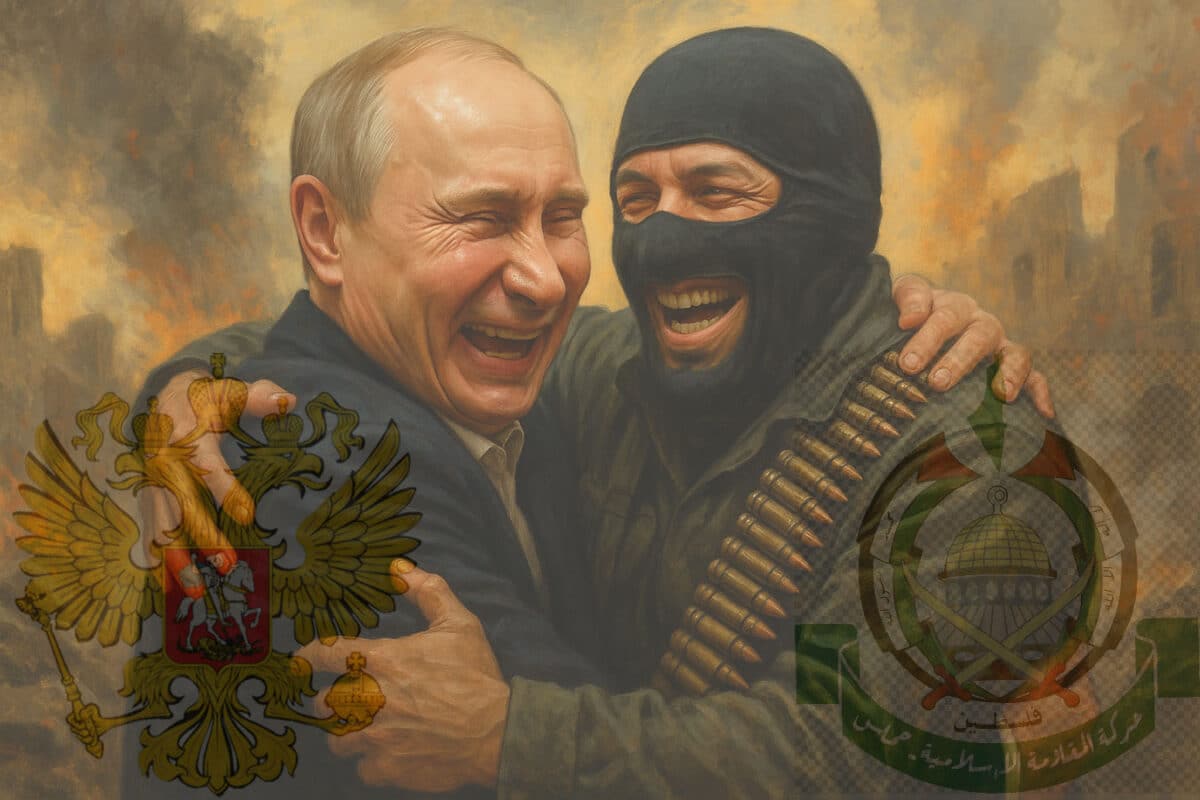
Video: Is Russia Buying Influence in Israel? Grigory Tamar Unveils Kremlin Schemes

Video from August 27, 2026. Video from https://www.youtube.com/@gregory_tamar – An analytical socio-political channel examining all aspects of global and local conflicts. Video: Is Russia buying influence in Israel? Gregory Tamar revealed Kremlin schemes.


Europe and the Shadows of Hate: Why Anti-Semitism is Returning and What Russia and Hamas Have to Do with It

War is once again changing the face of Europe — and not just on the fronts. Where slogans of tolerance and human rights once echoed, the whisper of old hatred is growing louder. Anti-Semitism — the ancient virus of the continent — is awakening again, rising from the underground layers of history to the streets of Berlin, Paris, and Brussels.

Mass rallies, synagogue arson, attacks on Jews — these are no longer frames from the archives of the 1930s, but the chronicle of European news in 2025.

But the reasons for what is happening are far more complex than just a political dispute over Israel’s war with Hamas. It is a reflection of a global shift — how Russia, Iran, and their ideological partners use anti-Israeli and anti-Western rhetoric to ignite Europe from within.

When Anti-Semitism Became “Fashionable” Again

In recent months, the level of anti-Semitic incidents in Europe has increased manifold.

In France — attacks on Jewish schools and cemeteries.
In Germany — threats against rabbis and Israeli students.
In the UK, police record a rise in hate crimes of more than 500%.

But the danger is not only in the numbers.

It is about a new form of old evil — anti-Semitism under the guise of political activism.

Today, hatred is often disguised as “fighting imperialism” or “solidarity with the oppressed.”
Yesterday it was called fascism, today — “anti-colonialism.”
The essence has not changed.

Many experts note: anti-Semitism today is not always expressed in insults.

It can hide behind slogans, behind “the fight for Palestine’s freedom,” behind artificial narratives that are implanted through social networks and propaganda.

This is where the main danger of the new wave lies.

Russia and Hamas — Different Fronts of One Ideology

Europe and the Shadows of Hatred: Why Anti-Semitism is Returning and What Russia and Hamas Have to Do With It

In the Ukrainian context, the comparison of Russia and Hamas sounds particularly accurate.

Both structures operate on the same principle: terror as an argument.

Putin’s army destroys Ukrainian cities under the slogan of “liberation,” just as Hamas kills Israeli civilians, hiding behind “the fight for justice.”

This parallel is no accident.

Russia systematically builds ideological and informational ties with anti-Western forces in the Middle East.

Moscow justifies Hamas terror as a “reaction to Israeli aggression,” while in turn, it calls Russia’s war against Ukraine a “fight against Nazism.”

In fact, it is a common language of authoritarian regimes and extremist movements: everything is allowed if it can be called “resistance”.

Anti-Semitism as a Kremlin Tool

The Kremlin did not invent hatred — it learned to monetize it.

For years, Russian media structures have created pseudo-analysis where Israel and “Jewish influence” were presented as the cause of global injustice.

The same logic is used against Ukraine: “Western puppets,” “NATO accomplices,” “victims of Jewish capital.”

In essence, this is not just anti-Semitism, but a geopolitical technology.

It works on emotions, on fears, on the feeling of a “stolen identity.”

Radical Islamist propagandists operate in the same way, recruiting followers under the slogan of fighting “colonizers.”

These two streams — Russian imperialism and Middle Eastern fanaticism — merge into one: hatred of the West, Jews, and democracy.

Europe, Losing Its Immunity

Many European societies were not ready for this new form of old contagion.

After decades of peace and prosperity, control over the language of hatred has weakened.

Freedom of speech often becomes a cover for destructive narratives.

Social networks are filled with “anti-imperialist” blogs where Israel is called an “occupier” and Russia a “fighter against the West.”

Hundreds of such pages operate on the same servers, often funded from Moscow or Tehran.

Thus, anti-Semitism re-enters the mainstream — not through slogans of “beat the Jews,” but through words of “support Palestine.”

This makes it especially dangerous: a person can be a victim of propaganda without realizing that they are repeating the language of those who justify terror.

The Palestinian Narrative as a Mirror of Russian Aggression

When Hamas justifies attacks on Israel with slogans of “fighting occupation,” it is easy to recognize the Kremlin’s lexicon in these phrases: “denazification,” “liberation,” “historical territories.”

In both cases, violence is justified by a “higher goal.”

Authoritarian propagandists have learned to use the words “freedom” and “justice” as a smokescreen.

Russia justifies the killing of Ukrainians in the same way Hamas does Israelis.

The difference is only in scale: the methods are the same, the audiences different.

This is increasingly discussed in both Israel and Ukraine: terror, wherever it occurs, is always fueled by impunity.

The Ideology of Hatred and Western Fatigue

Modern Europe is tired of war.

But fatigue is the perfect ground for manipulation.

When people stop distinguishing shades, the slogan “for peace” can turn into a justification for terror.

In European universities, rallies “in support of Palestine” are held, where calls are made to “cleanse the land of Zionism.”

There is nothing humanitarian in these phrases — it is the language of hatred, only in a new wrapper.

Thus, anti-Semitism becomes acceptable again — if it is hidden under the guise of “justice.”

Ukraine, Israel, and the Moral Connection

Ukraine and Israel find themselves on the same side of reality, where terror is an ideology, and truth requires strength.

For Kyiv, it is obvious: when the West does not react to some manifestations of terror, it provokes others.

Unacknowledged evil grows faster than acknowledged.

Ukraine supports Israel in its fight against Hamas for a reason.

Both countries are targets of propaganda attacks, disinformation, and international pressure.

For both, the word “self-defense” has become not just a legal term, but a matter of survival.

How the Kremlin Plays on Anti-Semitic Sentiments

Russia actively implants anti-Semitic and anti-Israeli narratives in Western media.

Under the guise of “alternative viewpoints,” texts about “Jewish elites,” “Zionist control,” and “world conspiracy” are spread online.

These same theses were heard in the 1930s — only now, instead of newspapers, they are circulated by anonymous Telegram channels.

Often, anti-Semitism becomes a “byproduct” of pro-Russian propaganda.

Those who justify the war against Ukraine often use the same rhetorical constructions as anti-Semites: the search for an enemy, conspiracy theories, the cult of a “humiliated power.”

Why It Matters Now

Because history is knocking on Europe’s doors again.

Anti-Semitism is not just a problem for Jews. It is a litmus test of the state of society.

When hatred of Jews becomes the norm, it means the foundations of democracy are being destroyed.

Today’s cries in the squares “from the river to the sea” are not a slogan of freedom, but a warning.

And if Europe does not draw conclusions now, tomorrow this wave will engulf it itself.

What Can Stop the New Wave of Hatred

1. Strong government response.
States must qualify anti-Semitism as a threat to national security, not just as a hate crime.

2. Responsible media.
The media must stop equating the aggressor and the victim.
Terrorist organizations cannot be an “equal side of the conflict.”

3. Education and memory.
Europe cannot afford to forget where silence in the face of anti-Semitism has already led.
Every new case should be seen as an alarming signal, not as a “crowd excess.”

4. Solidarity of countries that know the price of terror.
Ukraine and Israel must remain allies — not only in politics but also in meanings.
Their experience of resisting terror is not two separate plots, but one line of defense of the civilized world.

Conclusion

Europe is once again at a crossroads.

On one side — fatigue, cynicism, false neutrality.
On the other — clarity: terror cannot be balanced, it must be stopped.

Russia and Hamas are two manifestations of one disease, which feeds on impunity and fear.

And while Europe seeks excuses for those who shoot at children, hatred continues to change flags, but not its essence.

Peace will begin where evil is no longer justified — under any slogans.

And if Europe wants to remain Europe, it will have to remember why it swore: never again.

In Haifa, nearly 400 pages of Ukrainian poetry are being prepared in Hebrew: 50 authors and Ukraine, which is almost unknown in Israel

In Haifa, they are preparing an almost 400-page anthology of contemporary Ukrainian poetry in Hebrew — 50 authors from Emma Andievska to the youngest voices. I checked the history of the project and discovered an important detail: Ukrainian poetry was translated into Hebrew long before 2026, but this book presents a completely different Ukraine to the Israeli reader — modern, multi-generational, and multilingual.

Author: R.Verter

On August 25, 2026, a seemingly small literary news appeared: the Israeli publishing house Pardes is preparing an anthology of contemporary Ukrainian poetry translated into Hebrew. Almost 400 pages. Fifty poets. Several generations — from Emma Andievska to the youngest authors.

But when I started checking the background of this book, the simple news began to unravel into several much more interesting stories. It turned out that Ukrainian poetry was heard in Hebrew in 2017 and in 1990. Moreover, literally in this same 2026, the Israeli reader already received a separate large anthology of Ukrainian classics. Therefore, the formula ‘Ukrainian poetry is being published in Hebrew in Israel for the first time’ would be beautiful — and incorrect.

However, the truly new thing here is different. The new anthology attempts to show Israel not only Ukrainian literature but also Ukraine itself as a country of several languages, ethnic traditions, different historical experiences, and generations. And when among the texts, alongside Ukrainian, appear Crimean Tatar, Romani, Rumeika, and Urum, it is no longer just a matter of translating poems.

For NAnews — Israel News | Nikk.Agency, this intersection point is particularly interesting. We are used to seeing Ukraine in the Israeli news through war, diplomatic disputes, Uman, Jewish communities, or the relations between Kyiv and Jerusalem. Here, the conversation goes a different way: what does an Israeli learn about Ukraine when Ukraine starts speaking to him directly in Hebrew?

What exactly is being prepared in Haifa — and why should we be cautious with the word ‘first’

In Haifa, they are preparing almost 400 pages of Ukrainian poetry in Hebrew: 50 authors and a Ukraine that is almost unknown in Israel

The compiler and translator of the anthology on August 25, 2026, Alexander Averbukh announced that the book will include works by 50 Ukrainian poets of different generations. Volume — almost 400 pages. The book is published by Pardes Publishing in Haifa.

Chytomo published the names of 36 participants: Alexander Mimruk, Kateryna Mikhalitsyna, Ostap Slyvynsky, Bohdana Matiash, Ihor Mitrov, Yulia Musakovska, Lesyk Panasyuk, Oleh Kotsarev, Dmytro Lazutkin, Rostyslav Kuzyk, Darina Hladun, Oksana Maksymchuk, Olha Brahina, Myroslav Laiuk, Viktor Shylo, Stanislav Belsky, Marta Mokhnatska, Dmytro Blyznyuk, Sergo Mushtatov, Vasyl Makhno, Anastasia Afanasieva, Marianna Kiyanovska, Seyare Kokcheeva-Useinova, Yanush Panchenko, Viktor Neborak, Maye Abdulganieva, Nicholas Akhbash, Vano Kryuger, Yanis Sinaiko, Iryna Shuvalova, Yuriy Tarnavsky, Olena Huseynova, Kateryna Kalytko, Halyna Kruk, Iryna Tsilyk, and Hryhoriy Falkovych.

It turns out to be simple but important arithmetic: 50 authors are announced, and so far 36 have been publicly named. The names of the remaining 14 participants are not indicated in the open materials I checked. I deliberately do not try to complete this list based on Averbukh’s past events: a person’s participation in his festival five years ago does not necessarily mean they were included in the final 2026 book.

Diana Shapiro, Shlomo Krol, Dolya Pidgaits, Valeria Valdman, and Anton Paperny worked on the translations together with Averbukh. The literary editor is Leah Klebanoff. Some of these names appeared in Averbukh’s Ukrainian-Israeli poetic projects during the first months of the full-scale Russian war.

The publishing house Pardes formulates the significance of the book more carefully than sometimes retold in headlines: it is about the first Hebrew translation project of this type, which presents contemporary Ukrainian poetry as both multi-generational and multilingual.

With such a formulation, the facts align.

Averbukh wrote about the project: ‘For me, this is more than a book. This is my Ukraine — polyphonic, alive, indestructible.’ Another of his formulations helps to understand the publishing principle even more precisely: from the very beginning, it was important to him that Ukraine ‘sounded in many of its languages.’

And this is not a metaphor.

Why Crimean Tatar, Romani, Rumeika, and Urum are in the Ukrainian anthology

The Israeli reader here requires an explanation because even the phrase ‘multilingual Ukraine’ can be easily understood too simplistically — as a usual dispute between Ukrainian and Russian.

The new anthology is arranged differently. In addition to works originally written in Ukrainian, it features texts in Crimean Tatar, Romani, Rumeika, and Urum.

Crimean Tatar is the language of the indigenous people of Crimea, who experienced the Soviet deportation of 1944, return to the peninsula, and after the Russian occupation of Crimea in 2014, again found themselves under strong political and cultural pressure.

Romani is not one absolutely uniform literary language. In Ukraine, there are several Romani dialect traditions. One of the anthology’s authors, Yanush Panchenko, is a poet, translator, ethnographer, and researcher of Romani dialects. He writes, among other things, in the Vlach dialect of Romani and is engaged in its preservation and development. For him, creating his own poems is literally one of the ways to prevent the language from disappearing.

Rumeika and Urum will require decoding for most Israelis. Rumeika is associated with the Greek-speaking tradition of part of the Greeks of Ukrainian Azov. Urum is the Turkic language of another part of this historical community. These are two different language branches within the world of Azov Greeks, who have lived for centuries in the territory of present-day Ukraine.

The Crimean Tatar line is well represented by another participant in the book — Maye Abdulganieva, also known as Maye Safet. She was born in Crimea in 1972, writes in Crimean Tatar, Ukrainian, and Russian. In 2013, her first Crimean Tatar poetry collection was published. And on February 21, 2026, it was Abdulganieva who read the text of the eighth annual online dictation in the Crimean Tatar language.

That is, these languages are included in the book not for a beautiful publishing annotation. Behind them are living literary communities, the problems of passing the language to the next generations, occupation, deportations, assimilation, and attempts to preserve their own speech.

For Israel, this is perhaps more understandable than it might seem. Here, there is no need to explain from scratch that a language can be both a means of everyday communication, a part of national memory, and a way of resisting the disappearance of culture.

That is why I would not reduce the new book to the formula ’50 Ukrainian poets translated into Hebrew.’ The main difference begins after the word ‘Ukrainian’: the anthology offers the Israeli a more complex definition of who and what modern Ukraine includes.

Who is Alexander Averbukh — and why this book did not appear in one year

For the Israeli reader, Alexander Averbukh also requires an introduction. He is not an external translator whom the publishing house once commissioned to write a book about Ukraine.

Averbukh was born in 1985 in Novoaidar, Luhansk region. After the start of Russia’s full-scale invasion, this settlement came under Russian occupation. Averbukh himself lived in Israel for about 15 years and then moved to Canada for academic work.

In 2022, he received a PhD from the University of Toronto. He worked at the University of Alberta and Harvard. Currently, the University of Michigan lists him as an Assistant Professor of Ukrainian Literature and Culture and LSA Collegiate Fellow — in simpler terms, a teacher and researcher of Ukrainian literature and culture.

His academic work is precisely at the intersection of Eastern European and Jewish history, literature, memory, propaganda, identity, and multilingualism. His university profile currently lists more than 60 published collections of literary translations between Ukrainian, Hebrew, Russian, and English. Separately, sources on Averbukh’s Ukrainian-Jewish activities record more than 30 collections of contemporary Ukrainian poetry that he translated and published in Hebrew.

His own book ‘Jewish King’ became a finalist for the National Prize of Ukraine named after Taras Shevchenko. For the Israeli reader, the closest human explanation is this: it is one of Ukraine’s main state awards in the field of culture and literature, although there is no direct legal analogue of any specific Israeli award here.

And now begins the part that completely changed this story for me.

In the summer of 2020, Averbukh organized an online Festival of Contemporary Ukrainian Poetry. It lasted eight weeks — from July 2 to August 20 — and consisted of eight weekly meetings with the participation of 16 Ukrainian poets. Among them were already Marianna Kiyanovska, Ostap Slyvynsky, Halyna Kruk, Myroslav Laiuk, Iryna Shuvalova, Lesyk Panasyuk, Olena Huseynova, Yanis Sinaiko, Darina Hladun, Oleh Kotsarev, Vano Kryuger, Sergo Mushtatov, and others. A significant part of these names now reappears in the Pardes anthology.

In 2022, the work already received a direct Ukrainian-Israeli dimension. Averbukh organized the first series of bilingual Ukrainian-Hebrew literary events dedicated to contemporary Ukrainian poetry translated into Hebrew.

At least two meetings can be reconstructed from archival announcements. The first took place on March 10, 2022 — two weeks after the start of the full-scale Russian invasion. The second was held on June 30. At it, Israeli poets and translators read Hebrew versions of works by contemporary Ukrainian authors, and the Ukrainian poets themselves read the originals.

The organizers then quite directly described the goal: to support Ukraine, promote Ukrainian literature and culture in Israel and in Hebrew, and create direct contact between Ukrainian and Israeli authors.

In November 2023, the project can already be seen in the next stage. At the Frankel Center for Judaic Studies at the University of Michigan, Averbukh talked about the upcoming anthology of contemporary Ukrainian poetry in Hebrew. At that time, it was about works by more than 30 authors.

There is a detail on which I stopped separately. At that meeting, it was noted that some Ukrainian poems, which arose as a reaction to Russian aggression against Ukraine, after the Hamas attack on October 7, 2023, began to be perceived differently in Israel — Israeli listeners read them already through their own experience of war, violence, and loss.

And now let’s compare the numbers without unnecessary reasoning: in 2023 — more than 30 poets. In August 2026 — 50 and almost 400 pages.

This is not a random collection quickly made under the current war. We see a project that has grown for at least six years.

Ukrainian poetry spoke in Hebrew long before this book

Here, I had to check the word ‘first’ especially carefully.

In 2026 itself, a large anthology of Ukrainian classical poetry by Persimmon Books already appeared in Israel. NAnews previously detailed this edition.

Its Hebrew title — “למה, מלה, לא חדה כמו פלדה את? : מסקובורודה עד פרנקו” — ‘Why, word, are you not sharp as steel? From Skovoroda to Franko.’

The book features 25 authors — 18 men and seven women — from Ukrainian literature of the 18th century to the end of the 19th century. Translated by Anton Paperny, who is now also part of the translation team of the new contemporary Pardes anthology. Editors of the classical volume — Asaf Bartov and Nataliya Tymkiv. ISBN — 9789657798447.

Even here, a small library thorn was found, very useful for fact-checking. The Israeli library catalog indicates 343 pages, the bookstore — 344. Therefore, I did not turn one of these numbers into an absolute fact: in different bibliographic sources, the volume is indicated with a difference of one page.

The project is associated with the initiative נְמָלָה / ‘Nemala’, which builds a two-way bridge between Ukrainian and Hebrew literature. The printing of the book was announced on October 24, 2025, and the sale was announced from January 1, 2026.

So the contemporary Pardes anthology is not even the first large Ukrainian poetic anthology available to Israelis this year.

If we go further back, in 2017, Ukrainian writer Kateryna Babkina presented her poetry book in Hebrew translation by Anton Paperny at the Jerusalem International Book Fair, published by Khaver Laet. Ukrainian Jewish Encounter then separately noted a symbolic detail: Ukrainian poems were first heard from the main stage of the Jerusalem International Book Fair first in the original, then in Hebrew.

But even 2017 is not the beginning.

In 1990, the Kyiv publishing house ‘Veselka’ released a book of children’s poems by Ukrainian-Jewish poet Moisei Fishbein in Ukrainian with parallel translations into Hebrew by Israeli poet and translator Manfred Winkler.

Thirty-six years ago.

Therefore, it is historically more accurate to talk not about the moment when ‘Israel first discovered Ukrainian poetry.’ The process is much longer: individual translations, books, public readings, literary connections, a series of contemporary poetry after 2022, a large classical anthology — and now almost 400 pages of contemporary multilingual Ukraine.

There is also a broader international background. In the UK in 2026, Linen Press released War-Torn Voices: Ukrainian Women’s Poetry — 50 poems by 12 contemporary Ukrainian poets written during the full-scale Russian war. This is another anthology and another selection principle, but it shows one trend: outside Ukraine, they are now translating not only individual most famous authors but are trying to collect entire slices of contemporary Ukrainian literature.

Why the story with Pardes is especially interesting to Israel

Pardes is not a random name of a publishing house in the press release. It is a Haifa publishing house founded in 2000. It is located in the Lower City of Haifa and publishes poetry, prose, non-fiction, experimental literature, and periodicals.

The head of the publishing house is David Gottesman. Before creating Pardes, he worked at the Carmel publishing house in Jerusalem. In 2013, Pardes opened its own printing house. In 2022, together with other publishers, it participated in the creation of the Reading bookstore. Pardes is part of the Israeli Publishers Association.

For me, this is important not because of local Haifa patriotism. Simply, the phrase ‘a Ukrainian anthology will be published in Israel’ creates too abstract a picture. In fact, the book enters a specific Israeli literary environment — through an independent publisher who has been working within the Hebrew book market for a quarter of a century.

Israeli poet and editor Efrat Mishori saw another line in this: the opportunity to re-address through Ukrainian poetry to the space of Ukrainian-Jewish memory — with a shared history, neighborhood, and closeness, but simultaneously with ruptures and violence.

Here, it is very easy to go into beautiful words about ‘bridges between peoples.’ I would not.

Ukrainian-Jewish history does not consist only of bridges. It had pogroms, the Holocaust, Soviet repressions, wars, migrations, assimilation — and simultaneously decades of joint life, cultural influence, and family stories in which it is impossible to draw a sterile line between ‘Ukrainian’ and ‘Jewish.’

Even Averbukh’s own poetry constantly returns to this uncomfortable intersection. And therefore, Mishori’s statement about neighborhood and violence here does not look like a diplomatic reservation. On the contrary, it explains why such a translation might be interesting to the Israeli reader, who does not need another promotional story about ‘eternal friendship.’

There is another shift. Translation into Hebrew removes the intermediary.

For a significant part of past Ukrainian-Israeli cultural communication, such an intermediary was effectively the Russian language. The new book allows contemporary Ukrainian poetry — including texts of Ukraine’s own minorities — to address the Israeli directly in his language.

And here things connect that would separately look like just statistics: 50 authors, five original language traditions, almost 400 pages, six translators, Haifa, and Hebrew.

These are no longer five random parameters of a book. This is a model of what kind of Ukraine the publishers decided to show Israel.

When the anthology will be released, what it is called, and what we really do not know yet

As of August 28, 2026, I have not found confirmed data on the exact release date of the new Pardes anthology, its final price, ISBN, and final Hebrew title. The verified publications use the wording ‘preparing for release.’

Therefore, it is incorrect to write ‘the anthology has already been released in Israel’ or to report a sale date that the publisher has not publicly confirmed.

The full list of all 50 participants is also not published in the sources I found. As I noted above, 36 names are available. It is more reasonable to wait for the remaining 14 from the publisher or compiler themselves, rather than guessing.

These limitations are important for queries like ‘Ukrainian poetry anthology in Hebrew 2026,’ ‘when will the Ukrainian Pardes anthology be released,’ ‘Alexander Averbukh anthology in Israel,’ or ‘where to buy contemporary Ukrainian poetry in Hebrew.’ At the moment, one can confidently talk about the project itself, the Pardes publishing house, the composition of the published part of the authors, the translation team, the volume of about 400 pages, and 50 participants. The price, ISBN, final title, and day of sales start require separate confirmation.

And yet, the result is already visible, which is difficult to fit into a news summary.

In 1990, Moisei Fishbein’s poems with parallel Hebrew were published in Kyiv. In 2017, Kateryna Babkina read Ukrainian poems at the Jerusalem Book Fair. In 2020, Averbukh gathered 16 contemporary poets for an eight-week festival. In March and June 2022, Ukrainian and Israeli authors were already reading the same texts in Ukrainian and Hebrew. In November 2023, the future anthology numbered more than 30 voices. At the beginning of 2026, the Israeli book market received a large volume of Ukrainian classics from Skovoroda to Franko. Now Pardes is preparing 50 contemporary authors.

But more important than the growth of numbers.

The Pardes anthology for the first time gathers for the Hebrew-speaking reader such a broad contemporary Ukrainian picture, where Ukraine speaks not with one voice and not even in one language. Ukrainian, Crimean Tatar, Romani, Rumeika, and Urum are side by side; poets of several generations; people with very different experiences of the country, war, memory, and identity.

I have not seen the final layout of the book, the publishing contract, and Pardes’s closed data, so I cannot evaluate what is not yet in the public field: the final selection of all 50 authors, circulation, sales, or editorial decisions within specific translations.

But the already published data is enough for another conclusion.

If the previous Israeli anthology of 2026 explained to the Hebrew-speaking reader where the Ukrainian poetic tradition grew from — from Skovoroda to Franko, then the new book tries to answer another question: how this tradition sounds today and how many different voices fit within the word ‘Ukraine.’

That is why almost 400 pages of Pardes turn out to be a much larger story than just another translation of a foreign book.

This is a story about how Ukraine gradually gains its own voice in Hebrew — without the obligatory translation through a foreign language and without the need to start acquaintance from scratch each time.

Such a cultural layer NAnews — Israel News | Nikk.Agency considers no less important a part of the relations between Israel and Ukraine than official visits and politicians’ statements. A political message lives for a few days. A book can remain on an Israeli shelf for decades.

“Soviet ‘Judenrat’ that survived”: what Ayder Muzhdabaev’s video argues about – and why it is painful to hear in Israel

This video is not a lecture or a “thorough analysis.” It is an emotional attempt to articulate aloud what the author, in his own words, has been contemplating for a long time: why among the people from the former USSR (including those who emphasize their Jewish heritage) there are so many people who “nostalgize” about the USSR, justify modern Russia, and repeat anti-Ukrainian, and often anti-Israeli theses. It is better to watch the video in full: the author, as they say, does not mince words, and in our presentation, we tried to present his theses a bit softer and simpler to make it easier to read and discuss.

The video is called “SOVIET “JUDENRAT” THAT SURVIVED. What is the essence of this part of “lovers” of the USSR and the narrow Reich“, released on the author’s YouTube channel on February 20, 2026.

The author himself, Ayder Muzhdabaev, is a journalist and public commentator of Crimean Tatar origin; he previously worked in Russian media and later moved to Ukraine, associated with the TV channel ATR. Recently (January – February 2026), he visited Israel and had several creative meetings there. More about him here – https://nikk.agency/s-ajderom-muzhdabaevym/.

How he begins

"Soviet
“Soviet “Judenrat” that survived”: what Ayder Muzhdabaev’s video argues about – and why it’s painful to hear in Israel

His introduction is almost a confession, without “lead-ins.”

He speaks approximately like this (a retelling close to the text, without obscene language):

He has been thinking about this topic for a long time.

He talked with friends — those who live in Israel and other countries, help Ukraine, and those who have lived in Soviet republics and in “already-Russia,” including Moscow.

And after these conversations, he tries to understand the phenomenon of people who “cling to the Soviet,” justify Putin, and at the same time promote the legend that Putin is a “Judeophile,” meaning supposedly “loves Jews and Israel,” and therefore “cannot be a fascist.”

He notes a paradox: a significant part of such people publicly emphasize that they are Jews, although in the USSR such people were systematically humiliated, kept under informal quotas, and mocked with “jokes” and nicknames.

And still, he says, they often build the conversation according to one template: “yes, it was hard for Jews (in the USSR), BUT…” — and then begins a long nostalgic apologetic melody about “a wonderful childhood,” about “it wasn’t all that bad,” and about Putin, who “is not Hitler,” “doesn’t destroy Jews,” “therefore progressive.”

Separately, he throws in a phrase about “tame rabbis,” who allegedly have long been kept on a short leash near the Kremlin — as part of the very legend “Putin loves Jews, look, he has rabbis with him.” (This is precisely his thesis and his assessment.)

The tone is set immediately: he does not try to be gentle. He deliberately presses on the moral nerve.

Main theses — in more detail

Below are the main lines he draws, plus important details he insists on.

He suggests removing the word “Jew” from the explanation of the “phenomenon” and looking at the ideology

One of the first turns — he says: if we want to honestly understand the phenomenon, we need to set aside “Jew/non-Jew.”

According to his logic, it’s not about religion or ethnicity.

It’s about post-Soviet loyalty to the system, about the habit of justifying the strong, about the fear of “falling out,” about dependence on the propagandist explanation of the world.

That is, the “passport column” here is a screen.

“Putin — Judeophile” as a convenient alibi-narrative

He calls “Putin’s Judeophilia” a separate legend that lives in this community.

The meaning of the legend, as he retells it: since Putin does not do to Jews what the Nazis did, then he is “not a fascist.”

This logic causes him almost physical disgust — because it substitutes criteria.

Not “what the regime does,” not “whom it kills,” not “what wars it wages,” but “well, he doesn’t burn Jews, so he’s normal.”

The author specifically ridicules this “shift of the moral bar.”

Propaganda about “Ukrainian fascism” and “special anti-Semitism of Eastern Europe” — as Soviet export

Then he expands the frame.

He says: many of today’s accusations against Ukrainians, Poles, Baltic countries (“there is special anti-Semitism there,” “they are more to blame than anyone”) — this is an old Soviet set that stretches through textbooks, through the special services’ manual “shift the blame.”

And he provides several illustrations where the specific historical detail is not important, but the mechanism itself:

  • how the accents in the story of the destruction of Jews changed;
  • how the “Jewish theme” in the Soviet narrative was often blurred to “peaceful Soviet citizens”;
  • how convenient it was to portray neighboring peoples as “bad” — and thus cement the imperial worldview.

Here he has a strong emotional piece about how he learned about many things (for example, about the scale of shootings in Babi Yar) late — because the Soviet school and Soviet culture deliberately did not want to articulate the “Jewishness” of the crime.

His harshest metaphor: “Soviet Judenrat”

He uses the word “Judenrat” as a historical metaphor.

Historically, Judenrat refers to Jewish councils created by the Nazis in ghettos in occupied territories; the topic is complex, tragic, and there is much debate in historiography about the degree of coercion and responsibility.

The author transfers this metaphor to the Soviet and post-Soviet context — and does so as sharply as possible:

  • he claims that part of the “elite families” integrated into the apparatus survived, adapted, and sometimes participated in repressions (or served the system);
  • that the descendants of the “integrated” today are more often carriers of “ambiguity” and imperial loyalty;
  • and the descendants of the victims, according to his logic, “often did not appear,” because the victims were destroyed.

This, of course, is not a proven scheme, but a journalistic one — with its internal tension and risk of generalizations.

But it is precisely on this that his emotional “blow” is based: he tries to explain why some people’s nostalgia is not just everyday (“oh, youth”), but ideological, aggressive, and anti-Ukrainian.

Personal experience as an argument: Crimean Tatar deportation and “legends to cause discord”

In the middle of the video, he takes an important step: he adds his own experience of his people.

He recalls the deportation of the Crimean Tatars, the high mortality rate after the eviction, family stories — and then shows a mechanism very recognizable for the post-Soviet space:

when the authorities commit a crime, they need to switch the hatred.

And they begin to explain to the victims: “it’s not us who are to blame, it’s others.”

In his story, it looks like this: instead of directly acknowledging the state’s responsibility, people were fed an anti-Semitic legend “it was done for the sake of Jews/Israel.”

His conclusion: the technology is the same — to pit groups against each other so that each has its own “convenient enemy,” and so that no one hits the real source of violence.

Israeli nerve: “why these people are the loudest here”

The author repeatedly returns to Israel.

He thanks Israelis who support Ukraine, emphasizes that he has seen this support personally, and that it often comes from people not connected to the former USSR at all.

But in parallel, he talks about another picture: about loud “nostalgic” groups that, according to him, are noticeable in the public space and can create the impression “there are many of them.”

He ties this to specific stories discussed in Israel (including scandals around public events in Netanya), where part of the audience is perceived as “vatnik,” aggressively anti-Ukrainian.

And he adds another layer — about vulnerability to recruitment, about the influence of external players, and about the fact that Russian propaganda in Israel “works comprehensively.”

This is again an area where he speaks as a publicist, not as an investigator: the thesis is strong, but it contains a lot of evaluative and assumptions.

What we think at NAnovosti

In the middle of this story, it’s important to say one thing directly.

NAnovosti — News of Israel | Nikk.Agency is read by people with very different backgrounds: those who came a long time ago, and those who arrived yesterday; those who fight for Ukraine in deed, and those who just want peace for their family in Israel.

Muzhdabaev’s video resonates because he hits a real irritation: when a person lives in Israel, their children serve in the IDF, and yet they continue to repeat the Moscow worldview — it looks like a moral rupture.

But his presentation also has risks:

  • when emotion turns into “genealogy of guilt” (who has whose grandfather), it’s very easy to slide into unfair generalizations;
  • when you explain a phenomenon with one root (“they are all from “clans”), you lose complexity: age, language, media bubble, social isolation, trauma, fear, habit to authoritarian rhetoric.

We would formulate it more practically:

the problem is not in “origin,” but in informational dependence and political loyalty to imperial violence.

And also:

the loudness of a minority often creates the illusion of a majority.

This is evident from the reactions under the video.

What viewers wrote under the video

Judging by the comments (their tone, geography, recurring plots), the audience largely accepted his message — but added important nuances.

  1. Many comments from Israel. People describe everyday scenes: work caring for the elderly, family gatherings, conversations “everything was good in the USSR,” and the eternal “there is anti-Semitism in Ukraine.”
  2. The motif “the Soviet is indestructible” is repeated. They write about generational poisoning, about Russian TV, about the fact that some repatriates do not learn Hebrew for years and live in an information bubble.
  3. There is a line “after 7.10 some clicked.” Several people mention that some “ambiguous” people began to understand something only after a direct blow to Israel and the seen connections between Israel’s enemies and Russia.
  4. There are also worrying comments. Generalizations appear about “Jews created the USSR” and other toxic conspiratorial formulas — exactly what the author himself warns about: he bans and does not tolerate anti-Semitism. And it’s important to keep this in frame.
  5. There are trolls and attempts at personal discreditation. This is typical for such topics: when the conversation becomes uncomfortable, they try to drag it into the mud.

Conclusion

This video is not “about Jews” and not “about Israel as a country.”

It’s about post-Soviet type of loyalty: when a person carries the USSR inside as a religion, and everything else — Ukraine, Israel, the Holocaust, war — turns into tools to justify “their own.”

You can argue with Muzhdabaev’s metaphors.

You can reject his sharpness.

But you cannot ignore the problem — because this noise really affects public conversations, both in Israel and in the diaspora.

Watch the video in full and write if you recognize this phenomenon around you — and what, in your opinion, works best: facts, personal stories, turning off Russian TV, language, environment, or just distance.

Video – https://www.youtube.com/watch?v=AfYX_nL_r6k

…

For fast and efficient house cleaning: Advanced solution Now also in Israel. Ingenious “green” steam cleaner GENIUS

#promotion

A healthy and protected environment, without the use of chemical products that are dangerous to our body

About 80% water savings
Steam cleaning for maximum water savings

Thorough cleaning
Without the use of toxic chemical cleaning agents

Healthy, clean and protected environment
Uses only water and preserves environmental quality

GENIUS GREEN STEAM CLEANER GENIUS

Steam cleaning system

055-939-8810
consultation in Russian and Hebrew

Our website (Hebrew) — Green Cleaner


Genius System Capabilities

The GENIUS system cleans various types of surfaces that require the deep and thorough cleaning necessary to live in a healthy and protected environment.

  • Washing windows, screens and blinds
  • Cleaning of tiles, ceramics and parquet
  • Easy and fast fat removal
  • Cleaning showers and toilets
  • Cleaning of seat systems
  • Descaling and cleaning
  • Cleaning pots and pans
  • Cleaning of furniture and bedding

results

Why work hard when you can work with GENIUS!

Switch to smart and efficient cleaning that will save you time, effort and money and make your home cleaner and healthier.

Request a system demo GENIUS for your home in Israel

Leave your details and we will be happy to contact you to agree demonstration without obligation.

By North and Center of Israel we are coming

to your home for a demonstration from 9:00 to 21:00 on weekdays
* on Saturday by prior arrangement.

055-939-8810
consultation in Russian and Hebrew

Our website (Hebrew) — Green Cleaner