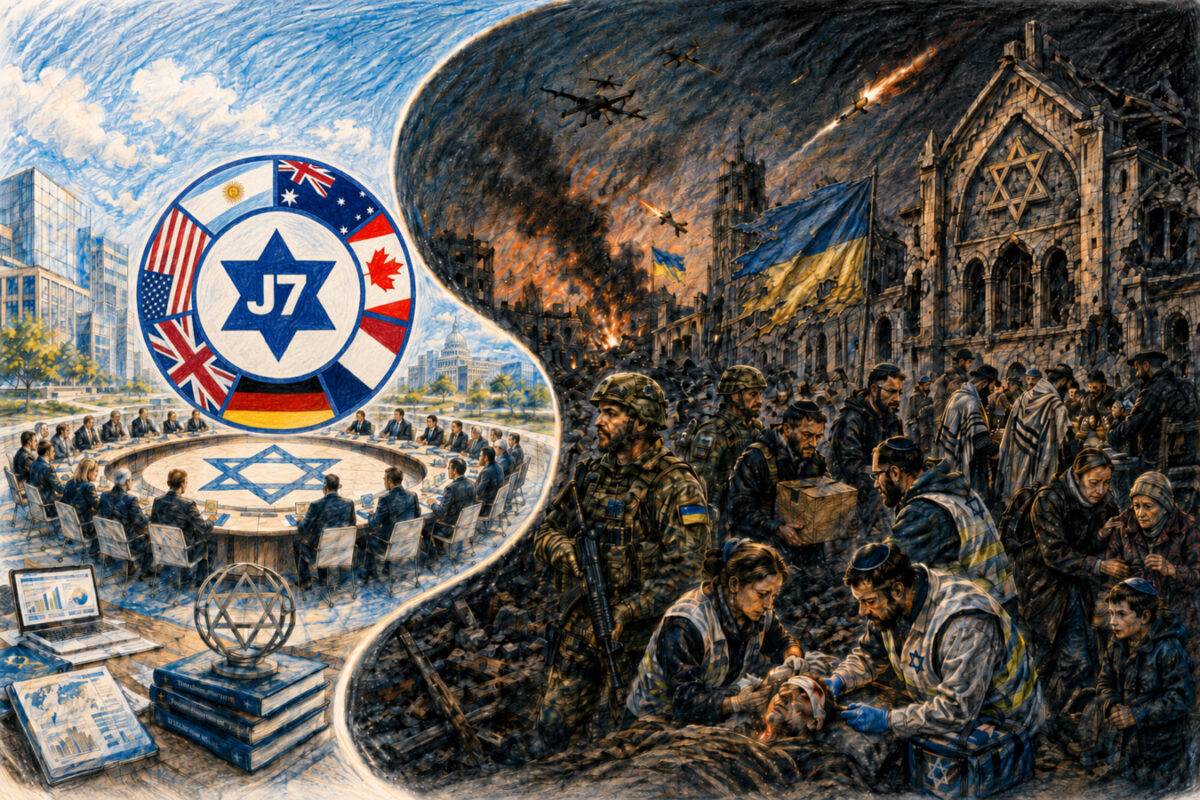
J7 — the union of the largest Jewish communities in the USA, Canada, the UK, France, Germany, Australia, and Argentina.
On July 29, 2026, the union of the largest Jewish organizations J7 published the second annual reportJ7 Annual Report on Antisemitism 2026. The authors recorded more than 23,000 antisemitic incidents during 2025 and stated that it became the deadliest year for Jews in the diaspora since the terrorist attack on the AMIA Jewish center in Buenos Aires in 1994.
According to the report, as a result of antisemitic attacks in 2025, 20 people were killed: 15 at a Hanukkah celebration on Bondi Beach in Sydney, two near the Heaton Park Synagogue in Manchester, two near the Jewish Museum in Washington, and one woman after an attack on participants of a rally in support of Israeli hostages in Boulder, USA.
The numbers are frightening and require immediate reaction.
However, when reading the report, an equally heavy question arises: where are the Ukrainian Jews in this picture, whom Russia is killing with missiles, drones, and artillery, who are dying in the Ukrainian army, and whose synagogues, schools, cemeteries, and community centers are being destroyed by Russian strikes?
The answer is uncomfortable: the architecture of J7 is such that it is practically incapable of seeing these people.
Casualties outside statistics: why J7 does not see Ukrainian Jews under Russian terror
This is not a global report, although its title sounds global
J7 is the Large Communities’ Task Force Against Antisemitism, a union of organizations from seven countries with the largest Jewish communities outside Israel. It includes the USA, Canada, the UK, France, Germany, Australia, and Argentina.
Ukraine is not among the J7 members. Nor are most Eastern European countries, former USSR countries, and many other territories where Jewish communities exist.
Officially, J7 states that the seven covered countries unite more than 90% of the diaspora’s Jewish population. But this only means that the report covers countries with the largest number of Jews. It does not make it a complete picture of all the threats faced by Jews outside Israel.
Moreover, the 2026 edition included a separate chapter on Ireland, although Ireland is not a J7 member and its Jewish community numbers about 2,200 people. In six months, 143 antisemitic incidents were registered there.
This is an important detail. It shows that the geographical boundaries of the report are not absolutely closed. With political and organizational will, the authors are capable of paying attention to a small community outside the seven countries.
But there is no special chapter on Ukraine, where Jews have been living under Russian missile and drone strikes for four years, in the report.
What is said in the J7 Annual Report on Antisemitism 2026
The J7 Annual Report on Antisemitism 2026 is the second annual report of organizations from the largest Jewish communities in the USA, Canada, the UK, France, Germany, Australia, and Argentina.
The authors studied antisemitic attacks, threats, vandalism, online harassment, incidents at universities, and attacks on Jewish institutions registered in 2025.
A total of 23,174 antisemitic incidents were recorded in the seven countries. This is less than the record figure of 2024, but 136% more than in 2022 — before the Hamas attack on October 7, 2023.
The number of violent cases, without comparable data for Canada, was 718. This is almost twice the level of 2022.
In four antisemitic attacks in Australia, the UK, and the USA, 20 people were killed. That is why the authors called 2025 the deadliest year for the diaspora Jews in over 30 years. However, this only refers to victims of registered antisemitic attacks in the countries covered by the study.
The most incidents were recorded in Germany — 8,725, in the USA — 6,274, in the UK — 3,700, in France — 1,320, in Australia — 1,654, in Canada — 788, in Argentina — 713.
The report highlights several main problems: the rise of physical violence, the harassment of Jews under the guise of anti-Zionism, the dangerous situation in universities, the spread of hatred on social networks, and the tendency of Jews to hide their identity.
J7 demands that states strengthen the protection of synagogues and schools, protect Jewish students, investigate threats, maintain a unified record of crimes, and hold social platforms accountable.
The report is important but covers only selected countries and antisemitic incidents. That is why Ukrainian Jews, dying under Russian strikes and defending Ukraine, remain outside its scope.
Why a Russian missile “doesn’t count”
The main reason lies in the methodology. J7 counts not all Jews killed by violence, but victims of antisemitic attacks.
For a murder or attack to be included in such statistics, it is necessary to establish that the person was attacked because of their Jewish origin, religion, connection to a Jewish organization, or to Israel. If a Russian missile hits a residential building in Kyiv, Odesa, Kharkiv, or Dnipro and kills a Jew there, their death is counted as part of Russian war crimes and Ukraine’s overall losses, but not as an antisemitic murder.
From the perspective of statistical purity, there is logic in this. It is not possible to automatically declare every strike on an area where a synagogue is located as a deliberate attack specifically on Jews. The organization Jewish Heritage Europe, analyzing the damage to Jewish objects in Ukraine, also noted that Jewish buildings themselves, according to available data, were not always specifically chosen targets.
However, the correct separation of categories has turned into a large blind spot.
If a Russian missile was not aimed at a person specifically because of their Jewishness, it does not mean that the death of this person is not related to the security of the Jewish community. If a synagogue is destroyed along with neighboring houses, it still ceases to be a place of prayer, food distribution, medicine, and assistance to the elderly.
The problem with J7 is not the refusal to call every Russian attack antisemitic. The problem is the absence of a second category that would take into account the consequences of war and state terror for Jewish communities.
About 200 fallen Jewish defenders of Ukraine
On June 8, 2025, the Federation of Jewish Communities of Ukraine reported that, according to its estimate, about 200 Ukrainian Jewish servicemen had died since the start of the full-scale Russian aggression.
This is not final state statistics, but an estimate by a Jewish organization involved in organizing funerals, reading Kaddish, and supporting the families of the deceased. But even such an approximate figure is ten times the number of people on which J7 called 2025 the deadliest year for the diaspora in three decades. These two figures cannot be directly compared, as they relate to different periods and different categories of violence. However, ignoring this discrepancy is also impossible.
In just two weeks in the spring of 2025, the deaths of three Jewish defenders of Ukraine became known.
32-year-old Odesa native Tzvi-Hirsh, or Grisha, Tzvergzde served in the 34th brigade. Before the army, he was a chef and dreamed of opening the first kosher restaurant in Europe with a Michelin star in Odesa. He left behind a wife and two small children.
Andrey Kurovsky from Zhytomyr taught computer science at the “Or Avner” Jewish school for over 20 years. After being wounded, he underwent rehabilitation and returned to the front. Kurovsky died of a heart attack during a Russian assault on the positions where his unit was located.
44-year-old Maksim Nelipa was a journalist and a well-known Ukrainian TV presenter. After being wounded in January 2025, he also returned to the army and became a company commander. His son Artem, serving in the “Golani” brigade of the IDF, learned of his father’s death while in Gaza.
For J7, these people are not victims of antisemitism. But for the Ukrainian and global Jewish community, they remain fallen Jews who gave their lives defending their country from Russia.
NAnews — Israel News believes that such a distinction needs to be explained to readers directly, not hidden within methodological notes.
Synagogues, schools, and cemeteries under Russian strikes
In February 2026, the United Jewish Community of Ukrainepublished a list of approximately 40 Jewish objects damaged or destroyed since the start of the full-scale Russian aggression.
The list included synagogues, schools, cemeteries, Holocaust memorials, charitable institutions, nursing homes, and community centers. The authors emphasize that the real losses may be significantly higher, especially in temporarily occupied territories where it is impossible to send specialists to check the condition of buildings.
Only during 2025 were recorded:
damage to the historic Brodsky Synagogue in Odesa;
damage to the building over the grave of Rabbi Nachman in Uman;
significant destruction of the buildings of the Jewish orphanage in Odesa;
damage to the “Beit Baruch” nursing home in Dnipro;
a strike on the Avenue of the Righteous Among the Nations in Babyn Yar;
damage to the “Nachlas Eliezer” synagogue in Odesa;
two hits on the central synagogue of Kherson;
damage to the Rosenberg Synagogue in Podil, Kyiv;
destruction of about 240 graves in the Jewish section of the city cemetery in Kharkiv.
On October 23, 2025, a large element of a presumably Russian cluster munition pierced the roof of the central synagogue in Kherson, passed through the prayer hall, and stopped in the rabbi’s office. Community staff and a Jewish woman who lived there because her own home was in a too dangerous area were in the building.
Seven minutes before the hit, Rabbi Yosef-Yitzhak Wolf left the office. Three months earlier, a Russian drone crashed into a car in which the rabbi was traveling with his family.
The Kherson synagogue is not only a prayer building. It distributes food, medicine, and other assistance to the remaining residents of the city. Damage to such an object means a blow to the entire survival system of the local Jewish community.
On the same night, a Russian drone damaged the synagogue in Podil, Kyiv. Windows were broken, the facade was damaged, and a drone fragment got stuck in the building’s wall. Nearby residential buildings were also affected.
One can argue about whether each synagogue was pre-selected as a Jewish target. It is indisputable that Russian aggression physically destroys the space of Jewish life in Ukraine.
Dangerous wording about “the deadliest year”
The J7 phrase that 2025 became the deadliest year for the diaspora Jews since 1994 formally refers to those killed in registered antisemitic attacks in J7 countries.
This is exactly how it should be formulated.
Without this clarification, it creates the impression that the authors counted all Jews killed by violence outside Israel. This is not the case. The statistics do not include Ukrainian military Jews, Jewish civilians killed under Russian strikes, or people who died due to the destruction of homes, hospitals, energy, and other civilian infrastructure.
Nor do they include the losses of other Jewish communities outside the geography of J7.
Therefore, the main drawback of the report is not only in the choice of seven countries but also in the mismatch between the narrow methodology and the global sound of its conclusions.
When an organization declares a certain year “the deadliest for the diaspora,” it is obliged to either study the diaspora as a whole or clearly specify the boundaries of its statement each time.
Why Ukraine disappeared from the Jewish agenda
In March 2025, the Israeli Jewish People Policy Institute published a separate study on the impact of the Russian war against Ukraine on Jewish communities.
The institute highlighted several consequences: a large-scale humanitarian operation, the migration of Jews from Ukraine and Russia, new security expenses, and the strengthening of state antisemitism within Russia. The study directly noted that after the Hamas terrorist attack on October 7, 2023, the war in Israel and its consequences largely overshadowed the impact of Russian aggression on Jewish communities.
This explains but does not justify the absence of Ukraine in the J7 report.
After October 7, Jewish organizations understandably focused on Israel’s security, the rise of antisemitism in Western countries, universities, social networks, and the streets of major cities.
At the same time, a division arose: Jews in London, Paris, Berlin, or New York are considered victims of antisemitism, while Jews in Kyiv, Kharkiv, Odesa, and Kherson are only seen as part of the general population of a warring country.
NAnews — Israel News considers such a division artificial. A Jew forced to hide from a Russian missile in a synagogue basement does not become a less important part of the global Jewish community just because the operator of the Russian drone did not have a personal list of congregants.
Different categories cannot be mixed — but both must be seen
The simplest solution would be to record all Russian attacks on Jewish objects in the category of antisemitism. But that would be a mistake.
An antisemitic crime implies an established or reasonably presumed motive of hatred towards Jews. A Russian shelling of a residential area where a synagogue is located may be a war crime and an act of state terror, but not necessarily a separate antisemitic attack.
Mixing categories would make the statistics less reliable and allow critics to question the entire report.
The correct solution is not to change the meaning of the word “antisemitism,” but to expand the analysis of the security of Jewish communities.
It should be about two independent data sets:
Antisemitic crimes and incidents, committed out of hatred for Jews, Jewish organizations, or Israel.
The consequences of wars, state aggression, and political violence for Jewish communities, even if a specific antisemitic motive for a particular attack is not established.
These figures cannot be added together. But they must be published side by side.
What needs to change in the next J7 reports
First of all, J7 must honestly define the geographical limits of the study. The title, press releases, and media messages should indicate that the conclusions apply to the seven countries and additional studied countries, not to the entire global diaspora.
The next report should contain a separate chapter on Ukraine — based on the same principle by which Ireland was included in the 2026 report.
Such a chapter should take into account:
the killed and wounded Ukrainian Jewish servicemen;
confirmed cases of the death of Jewish civilians;
damage to synagogues, schools, cemeteries, and memorials;
the loss of community centers’ ability to distribute food and medicine;
the evacuation of families, children, the elderly, and Holocaust survivors;
the destruction of homes and displacement of community members;
the reduction or cessation of Jewish life in frontline and occupied cities;
the impact of Russian strikes on energy on the operation of Jewish institutions;
Russian state propaganda and the use of Holocaust history to justify aggression.
To collect information, a permanent working group should be created with the participation of Ukrainian Jewish organizations, rabbis of different directions, researchers of Jewish heritage, and international humanitarian structures.
Each damaged object should be considered not only as a building. It should indicate how many people it served, what programs were conducted there, and what assistance the community lost after the strike.
Separately, a verifiable registry of fallen Jewish defenders of Ukraine should be created. It should contain names, biographies, and information about families — with the consent of relatives. Behind the overall figure of “about 200” are teachers, journalists, chefs, engineers, entrepreneurs, fathers, and mothers.
This is not a dispute about statistics, but a matter of visibility
The J7 report performs important work. It shows the growth of antisemitism, warns of threats, demands the protection of synagogues and Jewish schools, and forces governments to respond.
But the importance of this study does not exempt its authors from criticism.
One cannot claim global security for Jews while simultaneously ignoring one of the largest and historically most important Jewish communities in Europe, which lives under the blows of the Russian state.
One cannot record every Russian missile as an anti-Semitic crime. But one also cannot pretend that Jews killed by it are not part of the overall picture of threats to the diaspora.
Ukrainian Jews are dying on the front lines, losing relatives, homes, synagogues, schools, and cemeteries. They organize aid under shelling, pray during air raids, and stay with their cities even when Russia tries to turn them into ruins.
A future global report on the situation of Jews must see not only the person killed with an anti-Semitic slogan. It must also see the person killed by the missile of an aggressor state.
Otherwise, it will not be a complete picture of the security of the global Jewish community, but a report only on that part of Jewish victims that is conveniently placed in pre-defined statistical frameworks.
“And so I want to say to the Ukrainian people, who are having such a hard time right now, but every day of your struggle you are free people, and you live a full life, which is very important, of course, to win, but no matter how hard this life is, life in voluntary annexation to Russia will be much worse.”
Israeli politician and human rights activist Natan Sharansky believes that Russia’s war against Ukraine may be approaching a turning point, and prolonged hostilities are gradually becoming a threat to Putin’s regime itself. The former Soviet dissident, who personally met with the Russian president, said this in a large interview with Radio Liberty, published on September 6, 2026.
In a conversation with Oksana Maksimlyuk, Sharansky spoke not only about Russia and the possible end of the war. A separate part of the interview is devoted to the relations between Israel and Ukraine, military cooperation, Ukrainian drones, missile defense, elections during the war, and what the two countries can learn from each other today.
NANews — News of Israel gathered the main theses of this conversation. The full interview, lasting more than 50 minutes, can be watched below.
Video: Natan Sharansky – “Ukraine today is possibly becoming one of the greatest nations in Europe and the ‘shield of Europe’”
One of the central theses of the interview concerns the state of the Russian regime.
Sharansky believes that the continuation of the war destroys the image of Putin, on which a significant part of the Russian political system has relied for many years: the image of a strong leader capable of guaranteeing the elites security and access to resources.
According to him, at the beginning of the war, representatives of the military and economic elites could reason roughly like this: whether they like Putin or not, he remains a strong leader, so it is more profitable to be under his protection.
Now the situation, Sharansky believes, is gradually changing.
The longer the Russian army cannot achieve its goals in Ukraine, the more people die, and the stronger the consequences of the war are felt inside Russia, the more grounds the elites have to doubt Putin’s ability to control the situation.
Sharansky associates this with the intensification of internal repression.
According to his logic, a dictator tightens the screws not when he feels absolutely confident, but when he needs more control to maintain the system.
“A weak dictator cannot survive,” he formulated his assessment.
At the same time, Sharansky suggests that Putin might already want to end the war, but he needs an outcome that can be presented inside Russia as a result, not a defeat. Therefore, the possibility of retaining part of the occupied Ukrainian territory remains a principled issue for the Kremlin.
“We are most likely in the last year of the war”
The most notable statement was made when Sharansky was asked how much longer the Russian elites can tolerate what is happening — are we talking about months, several years, or a much longer period.
He first replied that there is “much less ahead than has passed,” after which he made a more specific assumption:
“I think we are most likely in the last year of the war.”
However, Sharansky himself immediately limited the categoricity of this forecast, adding that these could be his “good wishes.”
Therefore, it is not about a specific date for the end of the war or information about a forthcoming agreement. This is Sharansky’s political assessment, based primarily on his understanding of the internal weakening of the Russian regime.
For him, the key factor remains Ukraine’s ability to continue resisting. The longer the Russian leadership does not achieve results, he believes, the more serious the pressure on the system from within becomes.
Why general mobilization could become a problem for the Kremlin
Another separate block of the conversation is the possible new mobilization in Russia.
Sharansky considers it indicative that the Kremlin has so far preferred various forms of covert recruitment of people to general mobilization.
In his opinion, Putin could have long announced a more large-scale draft if he were not afraid of the reaction of Russian society.
A significant part of the population can distance themselves from the war while someone else is fighting directly: contractors, prisoners, or residents of remote regions. A completely different effect arises when the state demands to go to the front directly from a person or members of their family.
Therefore, the expansion of mobilization, Sharansky believes, can seriously change the internal situation.
He suggests that the Kremlin will continue to primarily expand covert mobilization.
At the same time, Sharansky warns that the behavior of a weakening regime becomes less predictable. Speaking about Putin, he used the definition “wounded beast”, capable of going far.
The man who personally met with Putin
The biography of Sharansky himself gives special weight to this part of the interview.
He said that he met with Putin several times: back in the late 1990s, and then after he came to presidential power. The last such meeting, according to Sharansky, took place in 2005. After that, he decided that continuing such meetings was “indecent” for him.
Sharansky claims that initially, it was extremely important for Putin to be recognized by the West. Russia was supposed to be perceived again as one of the great powers, and the Russian leader himself was to be accepted on equal terms by the leaders of the USA and other Western countries.
Later, according to Sharansky, a turning point occurred.
Putin realized that democratic leaders replace each other, while he himself intends to remain in power indefinitely. At the same time, the former Israeli minister believes, the idea of his own historical mission began to form in the Russian president.
And it is not about the restoration of the Soviet Union as a communist project.
Sharansky believes that Putin is closer to the idea of the Russian Empire — a state that expands its territory and “gathers lands.”
It is through this logic that he views Moscow’s actions in Chechnya, Georgia, Belarus, and Ukraine.
At the same time, the full-scale invasion, according to Sharansky, showed a fundamental miscalculation by the Kremlin. Putin underestimated the formed Ukrainian nation, overestimated the Russian army, and did not expect the West to provide Ukraine with such prolonged support.
Sharansky’s Donetsk and Putin’s myth of “Russian cities”
The topic of Ukraine for Sharansky is not only foreign policy.
He was born in 1948 in Stalino — today’s Donetsk — and lived there for the first years of his life.
Sharansky recalls a predominantly Russian-speaking city, where Ukrainian was the second language. But precisely because of this, he especially sharply rejects the thesis used by the Kremlin that Donbas is supposedly originally part of some exclusively Russian historical territory.
According to him, the assertions of the Putin regime that the Ukrainian nation supposedly did not exist, and the cities of eastern Ukraine are “Russian,” are “nonsense.”
For Sharansky, Donbas is part of Ukrainian history.
After the Russian aggression in 2014, his personal attitude towards Moscow also changed. Sharansky said that he previously had quite good relations with the Russian leadership, but after the start of the war, Putin in his eyes turned into a war criminal.
Sharansky himself, according to him, has since become a kind of lobbyist for Ukraine’s interests in Israel.
Israel and Ukraine: no longer one-sided assistance
One of the most interesting parts of the interview for the Israeli audience concerns the future of relations between the two countries.
Sharansky suggests abandoning the notion that cooperation should look exclusively like Israel helping Ukraine.
Over the years of the war, Ukraine itself has become a source of military and technological experience that other countries are interested in.
Sharansky separately noted the development of Ukrainian drone technologies. Israel, in turn, has vast experience in countering missile threats.
According to his formula, Ukraine has made tremendous progress in drones, Israel — in combating ballistic missiles, so the two countries have much to offer each other.
Moreover, Sharansky claims, such cooperation is already gradually developing.
He separately noted: not everything happens publicly.
The former Israeli minister also acknowledged that Israel’s previous caution regarding military assistance to Ukraine was largely related to Russia.
After the appearance of Russian military forces in Syria, Israel needed to regularly act against Iranian military infrastructure without entering into direct conflict with Moscow. This is what the Israeli leadership long explained as the need to maintain working relations with the Kremlin.
Sharansky himself now considers such a policy a mistake.
The situation, in his opinion, has fundamentally changed also because Russia and Iran have become close partners.
He formulates the interest of the two countries very simply: Iran is Israel’s main enemy, Russia is Ukraine’s main enemy, and Moscow and Tehran act together.
This creates a completely different basis for Israeli-Ukrainian cooperation.
What Sharansky said about Patriot
The interview also included a statement about Patriot systems.
Sharansky claims that American complexes, previously located in Israel, were eventually transferred to Ukraine through the USA.
But the main limitation today, he believes, is not so much the number of installations themselves, but the lack of ammunition for them.
According to him, neither Israel nor the USA previously anticipated wars of such duration and intensity.
At the same time, Ukraine, he believes, has reached such a technological level in certain areas during the war that now even Israel has something to learn from it.
Elections during the war: why Israel and Ukraine are in different conditions
Another topic of conversation is Ukrainian elections.
Sharansky reminded that Israel almost never refuses elections due to war. Military personnel can vote, and the size of the country allows the process to be technically organized even in extremely difficult circumstances.
But he considers it wrong to directly transfer this experience to Ukraine.
Part of Ukrainian territory is occupied. Millions of citizens are abroad. A huge number of people serve in the army. In these circumstances, organizing full-fledged elections becomes not only a political but also a huge technical and security problem.
Therefore, Sharansky says he understands the position of Volodymyr Zelensky.
However, there is another side to the problem: a democratic state cannot exist indefinitely without elections and political accountability of power.
Therefore, any real pause in the war that allows for safe and full voting, Sharansky considers important to use for elections.
“Ukraine is becoming the shield of Europe”
In the interview, Sharansky returns to his own dissident past.
In Soviet camps, he recalls, representatives of various national movements — Ukrainians, Jews, Lithuanians, Armenians — discussed the possible collapse of the USSR.
According to him, they were convinced: if Ukraine becomes independent, the Soviet Union can no longer be preserved.
Sharansky expected that after gaining independence, Ukraine would quickly become one of the most important European powers due to its industrial, scientific, and human potential. Reality turned out to be much more complicated.
But today his assessment has changed again.
According to the former Soviet dissident, Ukraine during this war is effectively completing the process of its entry into the free world and simultaneously becoming its protector.
He formulated this especially vividly:
Ukraine today is possibly becoming one of the greatest nations in Europe and the ‘shield of Europe’.
That is why the final part of the interview is not so much about politics as about freedom.
Sharansky recalls his own nine years in Soviet prisons and camps. According to him, at a certain point, he realized: if the main goal becomes physical survival at any cost, the jailers gain complete power over a person.
But if a person decides to remain free regardless of circumstances, taking away this freedom becomes much more difficult.
He addressed this thought to Ukrainians, tired after many years of war: every day of resistance means that Ukraine continues to exist as a free country.
And this, perhaps, is the main thesis of Sharansky’s entire conversation — much broader than any prediction about whether the war will end in a few months or a few years.
The White House raised the issue of the old Jewish cemetery in Uman, where disputes over construction and earthworks continue. The story has already reached the Supreme Court of Ukraine, and in the summer of 2026, human bones were again found near the grave of Rabbi Nachman.
On September 4, 2026, the charitable foundation ‘Historical and Cultural Center of the City of Uman’ reported that the issue of the ancient Jewish cemetery in Uman was raised during a meeting of leading American rabbis with US President Donald Trump and his administration.
The meeting itself took place on September 3 at the White House, on the eve of Rosh Hashanah. According to the foundation, Rabbi Moshe David Niederman spoke about ‘illegal and unauthorized constructions’ and cases of finding ‘human bones’ during earthworks.
Niederman is the head of United Jewish Organizations of Williamsburg and North Brooklyn and a long-time participant in international projects to protect Jewish cemeteries. Also visiting the White House were Satmar Rebbes Aaron Teitelbaum and Zalman Leib Teitelbaum, Bobov Rebbe Ben Zion Halberstam, Vizhnitz-Monsey Rebbe Israel Hager, head of Beth Medrash Govoha Malkiel Kotler, and Aaron Mendel Twersky. The delegation met with Donald Trump, Vice President J.D. Vance, Jared Kushner, and administration representatives.
American religious media confirm Niederman’s visit, the discussion of the protection of Jewish cemeteries, and the subsequent meeting of the delegation with Trump in the Oval Office. However, the White House did not publish a detailed official transcript of the conversation about Uman. Therefore, the wording that Trump was specifically informed about the details of Uman’s construction and the findings of remains is attributed to the foundation by NANews, rather than presented as a separately confirmed quote from the president or administration.
Bones near the grave of Rabbi Nachman
For Uman, the issue is not new. On July 31, 2026, fragments of human bones were discovered near the grave of Rabbi Nachman, where workers were laying a trench for electrical communications. The executive director of the foundation, Irina Rybnytska, stated that the find once again shows the need for special control over any earthworks in the area of the old cemetery. NANews – News of Israel | Nikk.Agency previously detailed the state status of Rabbi Nachman’s grave and the history of this place.
Similar finds have been recorded before.
In 2022, about thirty bone fragments were discovered in the pilgrimage area after earthworks. At that time, the origin of the remains required examination, and representatives of the Hasidic community linked them to the old Jewish cemetery. The US State Department, in its annual reports on religious freedom, also recorded complaints from Jewish organizations about ‘illegal hotel construction’ near the cemetery and Rabbi Nachman’s grave, possible damage to burials, and the risk of raising human remains.
What the Supreme Court of Ukraine has already decided
The legal side of the conflict reached the Supreme Court of Ukraine. On July 22, 2025, the court considered case No. 580/5629/24 regarding the historical and architectural support plan of Uman.
In 2024, the city council approved documentation where the protective zone of the monument was effectively limited to the site of the grave itself. The Supreme Court recognized the decision as ‘illegal,’ indicating that the city did not take into account previously approved boundaries and protection regimes. The court also found that the plan materials were not submitted to the Ministry of Culture for the legally required approval.
Why this cemetery is important
The history of the cemetery is significantly older than modern pilgrimage.
This territory is associated with the burials of Jews who died during the Uman massacre of 1768. Rabbi Nachman of Breslov died in Uman in 1810 and wished to be buried next to these victims. In 1994, by decree of the President of Ukraine, a historical and cultural center was established at the site of his burial, and in 1995, the grave received protected status. Ukraine and the USA also concluded an agreement on the protection of cultural heritage, which explains the constant involvement of American structures in the preservation of Jewish monuments.
Niederman is not new to Uman
Niederman is not new to Uman. In June 2024, he was part of an American Jewish delegation discussing the preservation of the cemetery with the head of the State Service of Ukraine for Ethnic Policy and Freedom of Conscience, Viktor Yelensky. In May 2026, he met again with the Ukrainian side and thanked the state for the opportunity to continue pilgrimage during the Russian aggression against Ukraine. In 2026, Rabbi Nachman’s grave also received the status of a national monument, which strengthened the state level of protection of the site.
Why this is not a conflict with Ukraine
At the same time, the current appeal to the White House cannot be described as a conflict between American rabbis and Ukraine. Ukrainian agencies continue to cooperate with Breslov on the preparation of the annual pilgrimage. NANews has already reported that on September 3, Rabbis Yaakov Shiloh and Natan Ben-Nun presented Viktor Yelensky with a certificate of appreciation for assistance in organizing Rosh Hashanah 5787. Separately, the Israeli Ministry of Foreign Affairs issued a memo for tens of thousands of Israelis heading to Uman under wartime conditions.
The new presentation of the issue to Trump shows something else: despite court decisions, protective zones, and years of negotiations, the problem of the physical preservation of the cemetery remains unresolved.
For religious organizations, it is crucial that any construction and earthworks take into account the possibility of burials. For Ukrainian authorities, the task is more complex: simultaneously protecting cultural heritage, controlling urban development, and ensuring the safety of the largest annual Jewish pilgrimage in the country while Russia continues its full-scale war. Now this issue has once again reached the international political level.
El Al removed Moscow from the schedule until March 25, 2027, and suggested passengers travel via Baku. The attempt to replace Moscow with St. Petersburg has also not yielded results yet.
El Al extended the suspension of direct flights Tel Aviv — Moscow until March 25, 2027. This means that Israel’s national carrier will not return to the Moscow route for the entire winter season, and passengers who still need to get to the Russian capital are offered a route via Baku.
What El Al offered passengers
The company informed travel agents that the decision is related to the security situation in Russia and recent aviation events. El Al stopped flights to Moscow on June 25. Initially, it was a matter of a few days, then the pause was extended, and now it has stretched until next spring.
Passengers of canceled flights can choose one of four options: exchange the ticket for a direct El Al or Sun D’Or flight to a European city, arrange the route Tel Aviv — Baku — Moscow, receive a voucher or a full refund. On the Baku — Moscow segment, the carrier will be Azerbaijan Airlines. For the new flight, a transfer within three days before or after the original date is allowed without penalty and additional fare difference.
It didn’t work out with St. Petersburg either
The attempt to replace Moscow with St. Petersburg has not worked yet. El Al wanted to open a direct route Tel Aviv — St. Petersburg, but did not receive a positive decision from the Russian aviation authorities.
We have already discussed this story in the article “Russia blocked El Al for the sake of Aeroflot”. Israeli media reported, citing their sources, that Moscow may link permission for El Al with the return of Aeroflot to Israel. Russian authorities have not officially confirmed such a connection, so it remains a version, not an established fact.
On August 30, the Leningrad region was subjected to a major drone attack, and Pulkovo Airport temporarily stopped receiving and sending planes. St. Petersburg, which was considered a calmer alternative to Moscow, also came under the influence of the war.
What now with Israel — Russia flights
Direct air communication between Israel and Russia has not been completely stopped: flights continue to be operated by Red Wings and Azimuth. But El Al is not planning to return to Moscow yet.
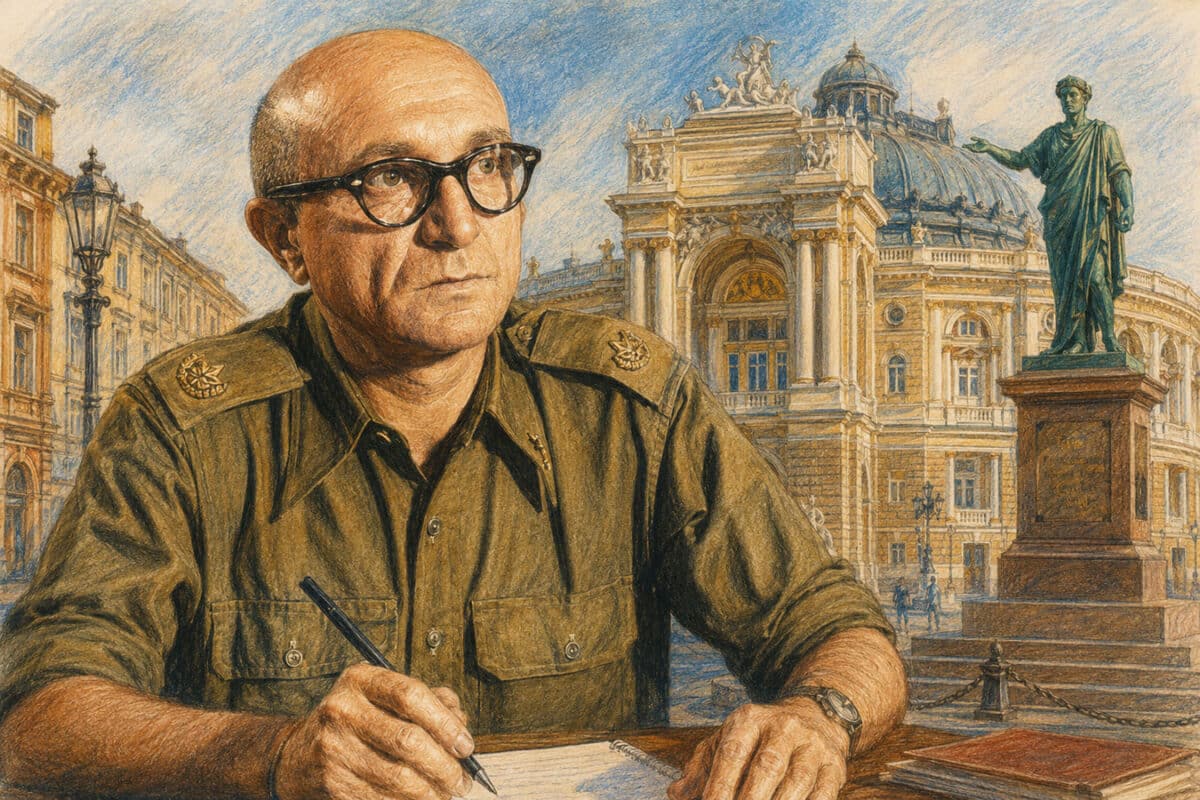
The story of the first Chief of the General Staff of the Israel Defense Forces did not begin in Tel Aviv, Jerusalem, or Haifa. It began in Odessa — a city in modern-day Ukraine, where in 1899 a boy named Yaakov was born into the Dostrovsky Jewish family.
A few years later, his father would be forced to hide after participating in Jewish self-defense during a bloody pogrom. The family would leave Odessa and move to Eretz-Israel. And four decades later, this child from Odessa, now known as Yaakov Dori, would lead the transformation of a Jewish underground defense organization into the regular army of independent Israel.
His biography combined two eras of Jewish history. In the first, the Jews of Odessa tried to protect their homes from pogromists, often without receiving protection from the authorities. In the second, a Jewish state emerged with its own army. Yaakov Dori was one of those who built a historical bridge between these eras.
…
Odessa, the Dostrovsky family, and the 1905 pogrom
Jews from Ukraine: Yaakov Dori – from Odessa self-defense to the first Chief of Staff of Israel
Yaakov Dostrovsky was born on October 8, 1899, in Odessa, which was then part of the Russian Empire and is now in Ukraine. The Israeli Museum of the Jewish People ANU directly calls him a native of Odessa, Ukraine, and notes that the family left after the anti-Jewish pogrom of 1905.
The early Israeli “Encyclopedia of the Founders and Builders of Israel” provides a more detailed family history. According to this source, the future Chief of Staff’s father was named Avraham-Zvi Dostrovsky, and his mother was Miriam, daughter of Yitzhak Levinson.
In 1905, Avraham-Zvi participated in the armed Jewish self-defense of Odessa. After the pogrom, the tsarist authorities intended to prosecute the Jews who resisted the attackers. Yaakov’s father was forced to hide and flee to Eretz-Israel. About a year later, his wife and three children — Shlomo, Yocheved, and little Yaakov — joined him. The family first reunited in Jaffa and then settled in Haifa.
The Odessa pogrom of 1905 became one of the bloodiest anti-Jewish outbreaks in the city’s history. According to the YIVO encyclopedia, about 300 Jews were killed in Odessa, including more than 50 members of self-defense units. These units tried to protect Jewish streets, homes, and families but faced not only pogromists but also hostility or inaction from imperial authorities.
It cannot be claimed that Yaakov Dori later publicly cited the Odessa pogrom as the main reason for his choice of a military career. There is no confirmed quote about this. However, the family continuity is evident: his father defended the Jews of Odessa with weapons, and the son dedicated his life to creating a system that would make organized defense of the Jewish people a state responsibility.
This is why NANews — News of Israel considers the story of Yaakov Dori not just as the biography of an Israeli general accidentally born outside the country. It is one of the key stories in the cycle “Jews from Ukraine” — the story of an Odessa family whose experience was linked to the formation of the defense doctrine of future Israel.
From Odessa to Haifa
In Haifa, Yaakov’s father initially worked as a laborer. The Dostrovsky home was open to Jewish pioneers moving between Judea and Galilee. Among the family’s guests were members of the “Ha-Shomer” organization, who spoke about protecting Jewish settlements, fighting robbers, and the need to independently ensure community safety.
Thus, the theme of Jewish self-defense, which arose in the family’s life back in Odessa, continued to accompany Yaakov in Eretz-Israel.
He studied at several Jewish schools in Haifa and then graduated from the famous “Reali” school. Even in his school years, Yaakov showed abilities in organization, planning, and maintaining discipline. In the student association, he led a group and gained his first experience in route planning, task distribution, and people management.
Later, these qualities would prove to be as important as weapon handling. Dori would go down in history not primarily as a field commander of a specific operation but as an engineer, organizer, and builder of a military system.
The Jewish Legion and first military experience
After the British troops entered Haifa, Yaakov Dostrovsky voluntarily joined the 40th Battalion of the Royal Fusiliers — one of the units of the Jewish Legion within the British Army.
He trained in Egypt, served in guarding the railway communication between Kantara and Lod, completed a machine gunner course, and received the rank of sergeant. After this, Dori himself trained soldiers in handling machine gun weapons.
The official biography of the IDF also confirms that during World War I, the future Chief of Staff served in the 40th Battalion of the Jewish Legion.
After the disbandment of the legion, Dori intended to continue serving in a Jewish defense formation. In 1921, he participated in the defense of Tel Aviv during Arab attacks. Later, he joined the “Haganah” and received the underground name Dan.
A symbolic historical parallel arises. In 1905, his father took up arms to defend the Jews of Odessa. In 1921, it was the son’s turn to defend Jewish quarters.
The engineer who began building an army
After military service, Dori went to Belgium and studied civil engineering at Ghent University. After receiving an engineering education, he returned to Eretz-Israel in 1926.
But his engineering knowledge was in demand not only in building structures and infrastructure. Dori became increasingly involved in the activities of the “Haganah,” which at that time was still an underground and largely territorially fragmented self-defense organization.
He commanded the “Haganah” forces in Haifa and its surroundings, developed a plan for the city’s defense, led the technical bureau, and the national system for training fighters.
The official biography of the IDF emphasizes that Dori was one of the early organizers of the “Haganah.” It was his engineering mindset, ability to create structures, and establish subordination that allowed the gradual transformation of voluntary local units into a unified military organization.
He built not just one defensive line or fortification. Dori created a system:
training commanders;
military training;
technical support;
defense planning;
communication between territorial units;
centralized force management.
His approach was engineering: a large structure must consist of reliably connected elements. It was this kind of “structure” that the future army of Israel gradually became.
From “Haganah” to regular armed forces
In 1939, Yaakov Dori was appointed Chief of the General Staff of the “Haganah.” His task was to transform the disparate self-defense organization into a disciplined and prepared military force.
Researchers at the Museum of the Jewish People ANU point out that it was during his leadership that the transition from improvised self-defense to a regular army model took place. Dori was involved in training commanders, establishing staff work, and developing the overall military structure.
Various sources have slight discrepancies regarding the last year of his first term as head of the “Haganah” staff. The Israeli Ministry of Defense archives indicate the period 1939–1945, while ANU and IDF biographical materials state until 1946. What is indisputable is that in June 1947, Dori was reappointed as Chief of Staff when the likelihood of a large-scale war was becoming increasingly apparent.
In 1946–1947, he also headed the Jewish Yishuv delegation engaged in purchasing weapons in the United States. For the future state, which was under British restrictions and preparing for war, establishing supply channels was critically important.
The Odessa publication “GRAD,” telling about its famous compatriot, also emphasizes that Dori commanded the “Haganah” forces in the Haifa area, led the technical direction, and participated in preparing the defense infrastructure. In Odessa itself, he is remembered as an Odessan who became the first head of the Israeli General Staff.
The first Chief of Staff of the IDF
On May 14, 1948, Israel declared independence. The new state immediately had to fight for its existence. At the same time, it was necessary to create a unified army subordinate to the government and general command.
The “Haganah” forces, “Palmach” units, former underground formations, volunteers, and new immigrants had to become parts of a single state military structure.
When creating the Israel Defense Forces, Yaakov Dori became its first Chief of the General Staff and the first officer to receive the highest rank of Rav Aluf, usually corresponding to the rank of lieutenant general. Official IDF materials indicate that he held this position in 1948–1949.
Sometimes publications claim that his official appointment took place precisely on July 27, 1948. However, Israeli military archives do not tie the start of his duties to this date: Dori led the “Haganah” staff even before the IDF was created and automatically became its first Chief of Staff after the army’s formation. Therefore, it is historically safer to say that he took this position upon the formation of the IDF in 1948.
Dori had to lead the army in conditions for which there were no ready-made instructions. The state had just appeared, fronts were changing, weapons and trained personnel were lacking, and military leaders had to simultaneously wage war and create army institutions.
Meanwhile, Dori’s health seriously deteriorated. Illness periodically prevented him from fully managing daily operations, so a significant part of the operational work was performed by his deputy, Yigael Yadin. Israeli sources do not hide this fact.
This, however, does not diminish Dori’s organizational role. He was not the sole author of victory and did not personally lead every battle. His main achievement was different: he helped create a staff, command system, and unified army where only recently there were underground organizations and territorial units.
The IDF did not emerge from nothing in one day. Its foundation was formed over years, and Yaakov Dori was one of the main architects of this process.
Key dates in the life of Yaakov Dori
Year
Event
1899
Born in Odessa as Yaakov Dostrovsky
1905–1906
After the pogrom, the family moved to Eretz-Israel
1918
Joined the 40th Battalion of the Jewish Legion
1921
Participated in the defense of Tel Aviv
1926
Returned after studying in Belgium and joined the “Haganah”
1939
First became Chief of Staff of the “Haganah”
1947
Reappointed as Chief of Staff of the “Haganah”
1948
Became the first Chief of the General Staff of the IDF
November 9, 1949
Completed service as Chief of Staff
1951–1965
Held the position of President of the Technion
1973
Died in Haifa
Dori’s term as head of the IDF ended on November 9, 1949. His successor was Yigael Yadin.
After the army: building scientific Israel
After leaving the army, Dori did not retire from public work. He headed the Scientific Council at the Prime Minister’s Office and in 1951 became President of the Technion in Haifa.
He held this position until 1965. During his leadership, the Technion rapidly expanded: new scientific departments and research centers were created, and a new university campus was formed in the Neve Sha’anan area.
In 1951, under Dori, the Faculty of Natural Sciences was established, including departments of mathematics, chemistry, physics, and mechanics. In 1952, a research system was formed to support Israel’s infrastructural and technological development. In 1953, the Faculty of Aeronautical Engineering was created.
Thus, the engineer from an Odessa family who helped build Israel’s army engaged in developing its scientific and technological potential.
For Dori, the security of the state was not limited to the number of soldiers and weapons. It depended on education, engineering, research, industry, and the ability to independently create modern technologies.
This was the second part of his life’s mission. First, he participated in building Israel’s military system. Then he helped create its scientific infrastructure.
This dual role is emphasized by NANews — News of Israel: Yaakov Dori was simultaneously a soldier and a builder, a military organizer and an engineer, a man of the army and a man of science.
Family continuation
The military tradition of the family was continued by Dori’s son, Yerachmiel. He served in the IDF Engineering Corps and later became the commander of the Engineering Corps.
Yaakov Dori’s daughter, Etana Padan, became a renowned biochemist and professor of microbial ecology at the Hebrew University of Jerusalem.
Thus, the children of the first Chief of Staff continued both main directions of his life: the defense of the state and the development of Israeli science.
Yaakov Dori died in January 1973 in Haifa — the city where his childhood, service, academic activities, and most of his adult life took place. A military facility and streets in several Israeli cities were named in his honor.
Why Yaakov Dori is one of the Jews from Ukraine
Calling Yaakov Dori a “Ukrainian general” would be historically inaccurate. He left Odessa at about six years old, was not a military figure of the Ukrainian state, and dedicated his entire conscious life to the Jewish Yishuv and Israel.
But it would be equally wrong to reduce his Ukrainian connection to a mere record of his birthplace.
He was:
a native of Odessa;
a descendant of a Jewish family from the territory of modern Ukraine;
the son of a participant in the Odessa Jewish self-defense;
a child whose family left the city after the pogrom;
a person who transferred the family history of the struggle for Jewish security into building Israel’s institutions.
Modern Ukrainian sources classify him as an Israeli military figure of Ukrainian origin, and Odessa publications preserve his memory as a famous Odessan. However, the main significance of this connection lies not in a modern national label.
Dori’s story shows the contribution of Jews born in Ukraine to the creation of the state of Israel. Odessa gave Israel not only writers, scientists, doctors, entrepreneurs, and politicians. In Odessa, a person was born who was destined to become the first Chief of the General Staff of the IDF.
His father defended Jews on the streets of Odessa in 1905 when the state authorities did not provide them with security and then intended to prosecute those who resisted. His son, decades later, led the army of a state created, among other things, so that the Jewish people would no longer depend on the will of others for their own existence.
Yaakov Dori left Odessa as a child. But it is with the Odessa story of his family that the path from disparate Jewish self-defense units to the regular army of independent Israel begins.
Russian state structures are beginning the digital documentation of monuments related to biblical history, the Second Temple era, and Jewish Jerusalem. However, in Moscow and Ramallah, they are exclusively presented as ‘Palestinian cultural heritage’ and included in a project personally approved by Putin, dedicated to ‘Africa and the Islamic World.’
At first glance, it seems to be about scientific cooperation, creating three-dimensional models, and saving antiquities. But the agreement emerged amid a sharp conflict between Israel and the Palestinian Authority over the right to manage archaeological sites in Judea and Samaria and to determine whose history they tell.
Therefore, the memorandum should be considered not only as an archaeological project but also as part of the struggle for archaeological sovereignty.
Russia has chosen a non-neutral position in this struggle. It provides the Palestinian Authority with state scientific institutes, technology, the authority of the Hermitage, and the infrastructure of Rossotrudnichestvo, helping to establish monuments of biblical and Jewish history in the international arena specifically as ‘Palestinian’ heritage.
What Russia and the Palestinian Authority signed on July 9
On July 9, 2026, a memorandum was signed between the ‘Center for Rescue Archaeology of the Institute of History of Material Culture’ of the Russian Academy of Sciences and the ‘Ministry of Tourism and Antiquities’ of the Palestinian Authority.
The document was signed by the director of the Russian Center, Natalia Solovyova, and the Palestinian minister, Hani Al-Hayek.
The ceremony was attended by the General Director of the State Hermitage, Mikhail Piotrovsky, and the Deputy Representative of Russia to the Palestinian National Authority, Artur Antonyan. The moderator was the head of the Rossotrudnichestvo representation, Timofey Bokov.
The ‘Russian House in Palestine’ itself reported that it coordinated the preparation of the project and is ready to continue facilitating Russian-Palestinian cooperation in the field of ‘cultural heritage.’ This is important: it is not about a private expedition of scientists, but about the work of the Russian state mechanism of humanitarian presence. The official website of Rossotrudnichestvo confirms that its foreign representations have been operating under the informal name ‘Russian House’ since 2021, and the representation in Bethlehem is part of this structure.
Project supported by Putin
The memorandum became part of a larger Russian initiative — ‘Digital Archive of Monuments of Africa and the Islamic World’.
The project is being implemented by the State Hermitage and the Center for Rescue Archaeology of the IHMC RAS. Mikhail Piotrovsky presented it on March 25, 2026, at a meeting of the Russian Council for Culture, after which Putin publicly promised support.
Russian reports indicate that the program is planned until 2028. It is planned to include at least 30 full-fledged three-dimensional models of monuments. The Hermitage will collect bibliographic data and provide expert support, while archaeologists will conduct digital filming, create geospatial models, and form information systems for research, monitoring, restoration, and educational projects.
Which objects Russia plans to start with
In the first stage, Russian specialists plan to select three or four archaeological sites that the Palestinian Authority considers most important. However, the full list of monuments has not yet been published.
Russian reports mention only two specific objects:
Solomon’s Pools — בריכות שלמה — near Bethlehem;
Tell es-Sultan — תל א־סולטאן, also known as תל יריחו, Tell Jericho, — ancient Jericho.
Roman cisterns, remains of aqueducts, Christian temples, and Islamic structures were mentioned only as examples of the rich archaeological heritage of the region. There is no confirmation that they are already included in the first phase of the Russian-Palestinian project.
Special attention was paid by the director of the Center for Rescue Archaeology of the IHMC RAS, Natalia Solovyova, to Solomon’s Pools. She expressed a desire to conduct their digital documentation, while acknowledging that a ‘very complex situation’ has developed around the monument.
This phrase has not only scientific but also political significance.
Solomon’s Pools — the water system of Jewish Jerusalem
In Israeli archaeology, Solomon’s Pools are called בריכות שלמה — Breichot Shlomo.
The associated water system is known as אמת המים התחתונה לירושלים — the Lower Aqueduct to Jerusalem.
Israeli archaeological materials attribute the creation of this aqueduct to the Second Temple period, most likely to the Hasmonean or Herodian era. Water flowed from the area of Solomon’s Pools to Jerusalem, with the Temple Mount — הר הבית — being the final point of the system.
This means that it is not just about ancient reservoirs near modern Bethlehem.
The pools and the associated aqueduct were part of the infrastructure of Jewish Jerusalem and served the city during the existence of the Second Temple.
Later, the system was used, repaired, and rebuilt by the Romans, Byzantines, Muslim rulers, Mamluks, and Ottomans. However, the later stages of exploitation do not negate the origin of its main ancient layer and its direct connection to the Temple Mount.
Therefore, presenting Solomon’s Pools exclusively as ‘Palestinian cultural heritage’ conceals the most important part of the object’s history.
The modern administrative status of the monument does not change the fact that its ancient water system was created in the Jewish period for Jewish Jerusalem.
Tell es-Sultan — biblical Jericho
The second specifically named object is Tell es-Sultan, תל א־סולטאן.
In Israel, the name תל יריחו — Tell Jericho is also used, meaning the Jericho mound.
Israeli archaeology identifies it with יריחו המקראית — biblical Jericho.
At the same time, Tell es-Sultan is a multi-layered monument. Its oldest structures appeared in the Neolithic era — thousands of years before the formation of the Jewish people and long before the Arab conquest of the region.
Therefore, it would be incorrect to claim that the entire archaeological complex was created by Jews.
But it is equally incorrect to present Tell es-Sultan as a monument of Arab or Islamic origin.
Numerous layers of settlement have been discovered on the mound — from prehistoric periods to the Bronze and Iron Ages. Jericho itself occupies a central place in the Tanakh and Jewish historical memory, primarily in the story of the Israelites crossing the Jordan and conquering the city by Joshua.
Thus, Tell es-Sultan is not exclusively a Jewish monument, but it is inseparable from biblical and ancient Israelite history.
Its oldest layers existed long before the emergence of Arab and Islamic identity in the region.
Why the choice of these objects has political significance
Both named monuments in Russian-Palestinian publications are presented as part of ‘Palestinian cultural heritage,’ and the entire project is included in the program of digital documentation of monuments of Africa and the Islamic World.
But neither Solomon’s Pools nor Tell es-Sultan were created as Islamic monuments.
Solomon’s Pools and the Lower Aqueduct are associated with the Second Temple era, the Hasmonean or Herodian period, and the water supply of the Temple Mount.
Tell es-Sultan arose millennia before the advent of Islam and is simultaneously biblical Jericho, occupying an important place in the history of the Jewish people.
That is why the Russian digitization of these objects cannot be considered only as technical work.
The created archive will include official names, descriptions, historical periodization, bibliography, and data on the cultural affiliation of the monuments.
If Solomon’s Pools are described only as a ‘Palestinian object,’ and their connection to the Second Temple and the Temple Mount becomes secondary or disappears altogether, the digital archive will become a tool for the political reinterpretation of Jewish heritage.
The same applies to ancient Jericho.
Russia is effectively helping the Palestinian Authority to establish its own representation of objects in the international arena, which were either created in the Jewish period or have fundamental significance for the biblical history of Israel.
Why a digital model is not just a photograph
Three-dimensional fixation of a monument can indeed be an important tool for preservation. It allows for the accurate recording of the shape of structures, their position, dimensions, and current state.
However, the digital archive consists not only of geometry.
The model is accompanied by:
the official name of the object;
the country and territory to which it is assigned;
a description of its origin;
historical periodization;
bibliography;
information about the creators and users of the monument;
museum and educational interpretation;
indication of the institution that manages the data.
This is where neutral technical fixation ends and politics begins.
Whoever creates the digital archive gets the opportunity to determine whether the water system will be described as a structure of the Second Temple era or simply as a ‘Palestinian monument.’ Whether it will be said that the aqueduct supplied water to the Temple Mount, or this connection will disappear behind a general formulation about the heritage of the ‘Islamic World.’
Therefore, it is not only about who physically controls the ancient stones.
It is about who will write the official digital biography of the monument.
Solomon’s Pools: the water system of Jewish Jerusalem
Solomon’s Pools are located south of Bethlehem, in the territory transferred to the management of the Palestinian Authority under the Oslo Accords.
Their traditional name does not prove a direct connection to King Solomon. However, the ancient water system has a very definite connection to Jewish history and Jerusalem of the Second Temple era.
The Israel Antiquities Authority indicates that the Lower Aqueduct ran from Solomon’s Pools approximately 21 kilometers to the Temple Mount. It was built during the Second Temple period, most likely during the Hasmonean kings.
The aqueduct directed water to Jerusalem and the Temple Mount, providing the city and temple complex during the period of Jewish statehood. The system continued to be used and rebuilt in later Roman, Byzantine, Islamic, and Ottoman periods, but later repairs do not change the origin of its fundamental historical layer.
This is a fundamental point.
The water system connecting Solomon’s Pools to the Temple Mount was not created by Arabs or the modern Palestinian Authority. Its foundation dates back to the Jewish period of the Second Temple and, likely, to the Hasmonean state.
Modern administrative control over the site cannot change the historical origin of the structure.
Roman, Christian, Islamic, and Ottoman chapters of its history can be acknowledged. But the fact that the ancient aqueduct was part of the infrastructure of Jewish Jerusalem cannot be erased.
Why a conflict has already erupted around the pools
The Russian agreement did not appear in a historical vacuum.
At the end of May 2026, Solomon’s Pools were visited by Israel’s Finance Minister Bezalel Smotrich, deputies, and representatives of the ‘Religious Zionism’ party. Israeli participants in the trip called the object a monument of the Hasmonean era and the Second Temple and claimed that its transfer to Palestinian management was a mistake of the Oslo Accords.
According to Palestinian and Turkish publications, Smotrich stated that maintaining Palestinian Authority control over the object is unacceptable and that Israel must change the current situation.
The Palestinian reaction was immediate.
Local activists and official structures began calling on residents to be constantly present near the pools to prevent their alleged transfer to Israel. In Palestinian publications, the object was called part of ‘Arab and Islamic identity,’ and Israeli actions were described as an attempt to ‘Judaize’ it.
By the end of June, the conflict had moved from statements to physical confrontation. The state agency WAFA reported that on June 26, Israeli military used stun grenades and tear gas near the pools against Palestinians present there. According to the agency itself, there were no casualties.
Already in early July, Hani Al-Hayek visited the object again and announced that the Palestinian Authority would intensify local and international actions for its protection. The Palestinian ministry directly called Solomon’s Pools an integral part of the national identity of the Palestinian people.
And on July 9, a few weeks after the escalation, the same minister signed a memorandum with the Russian state archaeological center.
Such a coincidence of context cannot be ignored.
Russia proposes to digitize not a random monument, but an object around which a struggle for administrative control, historical affiliation, and national interpretation is currently taking place.
Tell es-Sultan: ancient Arabs, but not exclusively Jewish
The second named object became Tell es-Sultan — ancient Jericho.
Here it is necessary to maintain historical accuracy.
The main structures, thanks to which Tell es-Sultan was included in the UNESCO World Heritage list, belong to the Neolithic. Already in the 9th–8th millennia BCE, a large permanent settlement with a wall, moat, and monumental tower existed at this site.
This means that the oldest layers of Tell es-Sultan appeared long before the formation of the Jewish people — and thousands of years before the Arab conquest of the region.
Therefore, it would be a mistake to claim that the entire Tell es-Sultan was built by Jews.
But it is equally mistaken to turn it into a monument of Arab origin.
Jericho occupies an exceptional place in the Tanakh and Jewish historical memory. The archaeological mound contains not only Neolithic and Bronze Age layers but also remains from the Iron Age. The report on research from 2019–2023 describes structures dating approximately to 1136–960 and 732–535 BCE — periods overlapping with the history of ancient Israel and Judah.
In 2023, UNESCO included the object in the World Heritage list as a monument located in the ‘State of Palestine.’ At the same time, the organization itself clarified that the decision focuses on the prehistoric mound, while later Jewish and Christian heritage is located in the broader historical context of Jericho and is not the main subject of this particular nomination. Israel called the decision politicized.
Thus, the exact wording should be:
Tell es-Sultan is not exclusively a Jewish monument, but it is certainly not a monument of Arab origin. Its main layers are much older than the Arab presence, and ancient Jericho is inseparable from biblical and Jewish history.
When such an object is included in the Russian archive of ‘monuments of the Islamic World,’ a legitimate question arises: what relation does prehistoric Jericho and its ancient Israelite layers have to the origin of the Islamic World?
Sebastia: the dispute over the capital of the ancient Kingdom of Israel
Solomon’s Pools and Jericho are only part of a broader archaeological conflict.
Another center of his became Sebastia — ancient Samaria, located near Shechem.
The complex contains remnants of the capital of the Northern Kingdom of Israel from the 9th century BCE, as well as Roman, Byzantine, Crusader, and Ottoman structures.
The Israeli side views the preservation and development of Sebastia as protecting one of the key sites of biblical and ancient Israeli history. The Palestinian administration claims that under the guise of archaeology, Israel is trying to separate the monument from the modern Palestinian city and gain control over the land, roads, water sources, and tourism revenues.
At the end of 2025, Israel announced a plan to seize approximately 1,800 dunams — about 445 acres near the complex for its development. Palestinian local authorities stated that the project affects about five thousand olive trees.
Here the same question arises again: who will tell visitors the story of Samaria?
Will it be the capital of the ancient Kingdom of Israel, around which Roman and Byzantine structures later appeared? Or will the entire complex be primarily presented as ‘Palestinian national heritage,’ with the ancient Israeli period becoming just one of the less noticeable points?
Israel attempted to create its own heritage protection body.
On May 12, 2026, the Knesset approved in the first reading a bill to create the Judea and Samaria Heritage Authority.
The proposal provided for the direct responsibility of the State of Israel for antiquities, archaeology, and heritage monuments in the region. The new structure was to engage in excavations, preservation, restoration, site management, research, education, and international scientific relations. The project also included powers related to the acquisition and expropriation of land for the protection of monuments.
The Palestinian administration viewed the law as an attempt to extend Israeli civil authority over territories under Palestinian administration.
Minister Hani Al-Hayek — the same person who later signed an agreement with Russia — claimed that control over antiquities would be used to expand Israeli presence and settlements.
At the same time, the proposed mechanism was opposed by the Israel Academy of Sciences and Humanities. Scientists warned that separate civil administration could be perceived worldwide as annexation and harm international relations of Israeli science.
But in its address, the academy simultaneously emphasized an important point: Jewish heritage is a central value of archaeological research throughout the Land of Israel and should be actively studied and presented to the public. The scientists’ dispute concerned not the significance of Jewish history, but the proposed legal mechanism for its protection.
On June 2, 2026, the advancement of the law was temporarily halted after intervention by Benjamin Netanyahu. And while Israel debated internally about the correct mechanism for protecting its archaeology, the Palestinian administration began strengthening international partnerships in the same field.
Five weeks later, it secured an agreement with the Russian state archaeological center.
Russia entered the dispute not as a neutral mediator.
Russia could propose a trilateral scientific project.
It could invite specialists from the Israel Antiquities Authority, Russian and Palestinian archaeologists, create an international commission, and separately stipulate that the digital description should reflect all historical periods — prehistoric, Canaanite, ancient Israeli, Judean, Hellenistic, Roman, Byzantine, Islamic, and Ottoman.
Nothing of the sort is mentioned in the published reports.
Russia’s partner became exclusively the Ministry of Tourism and Antiquities of the Palestinian administration.
The sites for the first works are chosen by the Palestinian side.
The Russian project calls them ‘Palestinian monuments’ and simultaneously includes them in the archive of Africa and the Islamic world.
The ‘Russian House’ provides organizational coordination.
The Hermitage collects bibliographic materials.
The Russian academic structure creates digital models.
At the same time, Russian reports on Solomon’s Pools do not emphasize that the associated aqueduct was built during the Second Temple period and led directly to the Temple Mount. In the description of ancient Jericho, its place in Jewish and biblical history is also not highlighted.
According to NAnews — News of Israel, this means that Moscow has already accepted the main Palestinian framework: the modern administrative control of the Palestinian administration is used as a basis for presenting the millennia-old heritage as the national heritage of ‘Palestine.’
That is why the project cannot be considered completely neutral.
Russia is not just helping to preserve ancient walls. It is helping one side of the conflict to form an official digital narrative about them.
Archaeology as a tool of state recognition.
For the Palestinian administration, the digital archive has significance far beyond science.
Such materials can be used:
in museums and tourist centers;
in school and university programs;
in international exhibitions;
in diplomatic presentations;
in applications and reports for UNESCO;
in scientific publications;
to prove the ability to independently manage heritage sites;
to consolidate modern Palestinian state terminology.
The appearance of a Russian state partner increases the political weight of such an interpretation.
Now it will not only be a Palestinian database. It could become a joint Russian-Palestinian archive, supported by the RAS, the Hermitage, Rossotrudnichestvo, and the Russian government.
In the future, these materials will be referenced by researchers, journalists, museums, and international organizations.
If an object is initially described in the database as ‘Palestinian heritage of the Islamic world,’ correcting such a representation later will be significantly more difficult.
Is it necessary to deny later periods?
No.
The history of Judea, Samaria, Jerusalem, Bethlehem, and Jericho is multilayered.
Canaanite cities, ancient Israeli kingdoms, Judea, Hellenistic states, the Roman and Byzantine Empires, Islamic caliphates, Crusader states, the Mamluk Sultanate, and the Ottoman Empire existed in these territories.
All these periods deserve study.
But respect for later layers does not require abandoning the historical origins of earlier structures.
If the aqueduct was built by the Hasmonean kings for Jewish Jerusalem and the Temple Mount, it remains part of Jewish heritage, even if it was repaired by other authorities a thousand years later.
If Samaria was the capital of the ancient Kingdom of Israel, this cannot be changed by a modern border or a new tourist brand.
If Tell es-Sultan existed thousands of years before the Arab conquest, it cannot honestly be presented as an object of Arab origin.
The modern administration of the territory and the historical belonging of the monument are not the same.
What the Israeli government should do.
The Israeli government should not limit itself to observing the Russian-Palestinian project.
First of all, the Ministry of Foreign Affairs should request from Russia the full text of the memorandum, the list of objects, the funding order, the rules for access to information, and the conditions for using the created 3D models.
The Israel Antiquities Authority should demand clarifications on the scientific methodology of the project: who will compile the descriptions, what periodization is planned to be used, and whether the Hasmonean era, the Second Temple, the ancient Kingdom of Israel, and the connection of objects with the Temple Mount will be reflected in the materials.
It is necessary to find out who will own the original digital data and whether the Palestinian administration will be able to independently change the descriptions and names of objects.
Israel should propose the participation of its own specialists or the creation of an independent international council that will ensure the representation of all historical periods without politically erasing the Jewish layer.
In parallel, Israel needs to accelerate its own digital documentation of the monuments of Judea and Samaria and publish quality materials in Hebrew, English, Russian, and Arabic.
Special attention should be paid to Solomon’s Pools, the Lower Aqueduct, Sebastia, ancient Jericho, and other objects around which there is already an international struggle for interpretation.
Israel cannot remain silent.
The memorandum of July 9 is a warning.
While within Israel there are debates about laws, ministry powers, and international reactions, the Palestinian administration acts consistently. It attracts foreign partners, creates digital archives, consolidates its own terminology, and forms an international image of the archaeology of Judea and Samaria as exclusively ‘Palestinian national heritage.’
Russia has provided it with state institutions and scientific authority for this.
And it is especially alarming that the Russian archive of Africa and the Islamic world is planning to include a system built during the Second Temple period for the water supply of the Temple Mount, and ancient Jericho, which existed millennia before the emergence of Islam.
NAnews — News of Israel believes that the Israeli government should pay attention to this project and officially respond.
It is necessary to demand transparency, the participation of Israeli specialists, and full recognition of Jewish historical periods in the created digital archive.
It is not about wanting to erase the Roman, Christian, Islamic, or Ottoman history of these places.
It is about the inadmissibility of erasing our history.
Solomon’s Pools and the aqueduct to the Temple Mount are part of the heritage of Jewish Jerusalem.
Samaria is the capital of the ancient Kingdom of Israel.
Jericho is one of the central cities of the biblical memory of the Jewish people, even if its oldest layers are older than all modern national identities.
This is our heritage — not because other peoples have no connection to this land, but because the most important structures and historical layers of these objects were created in biblical, ancient Israeli, and Judean periods.
Modern agreements cannot change their origin.
But Israel’s silence may allow others to rewrite how this origin will be presented to the world.
The Chief Rabbi of Ukraine, Moshe Reuven Asman, reported on September 2, 2026, that a serviceman of the Armed Forces of Ukraine with the call sign “Hasid” received a new award and became a full holder of the “Star of Glory.” The wording of the basis is also unusual: the award followed “for the execution of special tasks from the High Command of the Armed Forces of Ukraine.”
Asman did not name the real name of the serviceman, nor the unit, nor the nature of these tasks. He only wrote that “Hasid” is a believer of his community, and added: “I am sincerely proud that there are such Jews in our community.”
For NANews, this is not the first appearance of “Hasid.” We have already detailed his story after another award. At that time, it was possible to gather a rather rare combination of open information: the person hides his face and name, but at the same time appears for years in official and semi-official materials about the training of Ukrainian military personnel.
Now the “Star of Glory” has been added to this biography. And this is where the story becomes more complicated than a short Facebook post. Author: Lev Varshavsky
What is the “Star of Glory”
Jewish officer of the Armed Forces of Ukraine “Hasid” became a full holder of the “Star of Glory”: what is known about the award, the closed officer, and his connection with Israel
An award with this name exists in the system of the Main Intelligence Directorate of the Ministry of Defense of Ukraine.
The GUR in its official publications called the “Star of Glory” its highest award. It was awarded to military intelligence officers and servicemen for special merits, including the execution of reconnaissance and special tasks.
It is important to clarify immediately: this is not a state award of Ukraine at the level of the title Hero of Ukraine or the Order “For Courage.” The “Star of Glory” is a departmental award, but within the structure of military intelligence, its status is the highest.
There is another detail without which Asman’s expression “full holder” is difficult to understand.
In the GUR award catalogs, there are separately “Star of Glory” I degree and “Star of Glory” II degree.
If it is about this award, the expression “full holder” usually means receiving all existing degrees. That is, “Hasid” must have received both.
But this is where the line is drawn between what is known and what only follows from the combination of signs.
Asman’s publication does not contain the words “GUR of the Ministry of Defense of Ukraine.” The degree of the current award is not specified. No certificate is published. There is no order number. Therefore, the phrase “Hasid received both degrees of the highest GUR award” would be too categorical for now.
At the same time, three elements coincide at once: the name “Star of Glory,” the presence of two degrees in the GUR award, and the expression “full holder.” This is added to the basis for the award — special tasks of the high military command.
This is no longer a random coincidence of names. But the last documentary link is not yet available in open access.
Who is this person anyway
“Hasid” has appeared in Ukrainian materials for at least several years.
He was presented as an instructor with serious combat experience, engaged in the training of infantry, mechanized units, and scouts. In materials about the training of Ukrainian fighters, he appeared not as a media hero, but as a person training those who were to go to the front afterward.
The State Border Guard Service of Ukraine talked about his participation in the training of the assault brigade “Steel Border.”
In the same context, his experience related to special units of Ukraine and Israel was mentioned.
And here, in retellings, the biography began to be filled with details that the primary publications do not confirm. On the internet, “Hasid” is often directly called a former fighter of the Israeli special forces. We did not find a reliable open document that would allow us to assert this.
There is a connection with Israel. The formula “Israeli special forces” is already a stronger statement.
NANews has already analyzed the broader topic of Jewish servicemen in the Armed Forces of Ukraine. There arose a similar problem: there is no official statistics of the Ukrainian army by nationality, so the picture has to be assembled from individual people, community publications, military obituaries, awards, and unit reports.
“Hasid” is one of the rare cases when a person is simultaneously quite well-known and almost completely anonymous.
He met with Zelensky
There is another detail that poorly matches the image of a completely “shadow” serviceman.
On April 6, 2026, Volodymyr Zelensky met with rabbis of Ukrainian cities and representatives of Jewish communities on the eve of Passover. Among the participants was a serviceman of the Armed Forces of Ukraine with the call sign “Hasid.”
That is, we have a person whose real name is still not mentioned, but who is allowed to an official event with the president of the country as a representative of that part of the Jewish community that directly participates in the defense of Ukraine.
For a public biography, this is a rather unusual combination.
He can be shown next to the president.
You can talk about awards.
You can discuss his work as an instructor.
But you cannot name the name and explain what exactly he is doing now.
After Asman’s message, this contrast became even more noticeable.
The Jewish line here is not decorative
The call sign “Hasid” was not invented by journalists.
The serviceman himself openly spoke about his Jewish identity and religious tradition. Asman now directly calls him a person of his community.
Jews of Ukraine found themselves in combat units, territorial defense, medical service, volunteer structures, and army chaplaincy.
There are also those who have died.
In a large material on August 29, 2026, NANews collected stories of Jews and people with Israeli biographies who died defending Ukraine. The open name list remains incomplete. Representatives of Jewish structures name numbers significantly exceeding the number of cases that can be independently restored from publications.
This is a separate problem of any attempt to count “Jews in the Armed Forces of Ukraine”: the army does not divide its servicemen in public statistics by religion and nationality.
Therefore, the story of each specific person acquires an unusually large significance.
There are also chaplains
In the Ukrainian army, the Jewish component has long existed not only at the level of individual fighters.
This is already an institutional part of the Armed Forces of Ukraine.
The religious community accompanies its servicemen not only through humanitarian aid or public prayers. There are chaplains, official contacts with military leadership, funerals of the deceased according to Jewish rites, and people like “Hasid,” who combine religious identity with professional military service.
Therefore, Asman’s current message looks different if you read it not separately, but within this story.
He congratulates not a random Jew who found himself in the army.
He writes about a person of his community who has been present in the military context for many years and now, according to the rabbi, received a distinction for special tasks of the high command.
What is connected with Israel here
“Hasid” indeed has an Israeli part of his biography.
But to conclude from this that we have an “Israeli fighting for Ukraine” would be inaccurate.
In known publications, he appears primarily as a serviceman of Ukraine. Israel appears as part of his experience, training, and Jewish biography.
For the Israeli audience, something else is more important.
Over the years of war, a whole layer of people has emerged whose lives physically connect the two countries. Some repatriated to Israel but returned to defend Ukraine. Some have children serving in the IDF while the parents are in the Ukrainian army. Some gained military experience in Israel and then apply it in Ukraine. There are those who died with dual or complex Ukrainian-Israeli biographies.
This is not a single group and not one political story.
“Hasid” is another example of such a connection, and one of the most closed.
NANews — Israel News | Nikk.Agency has been collecting these biographies for several years precisely because official Ukrainian-Israeli relations do not explain everything that happens between the two societies.
Diplomacy may argue about weapons, Russia, or votes at the UN.
And all this time, people serve, fight, die, and receive awards.
And what do we really know in the end
There is a message from Moshe Reuven Asman.
He claims that “Hasid” became a full holder of the “Star of Glory.”
There is a specific wording of the basis: the execution of special tasks of the high command of the Armed Forces of Ukraine.
There is a GUR award with exactly this name.
It is officially one of the highest departmental distinctions of military intelligence and has I and II degrees.
There is a long-standing public history of “Hasid” as an instructor and serviceman.
There is his confirmed participation in Zelensky’s meeting with Jewish leaders.
There is a connection with Asman’s community.
There is an Israeli part of his military biography, but without confirmation of popular formulations about specific service in the Israeli special forces.
And there is a large void where the most interesting begins: what exactly special tasks he performed.
Open sources do not provide an answer to this question.
And for now, this is perhaps the only part of the story that really should not be filled with guesses.
Before starting, it is important to clarify: this article and its accompanying illustration are created with respect for rabbis, Haredim, and halachic tradition. For someone unfamiliar with the laws of kashrut, the debate about chicken breeds, the structure of their legs, and the continuity of consumption tradition may seem unusual or even amusing. However, behind these details lies a serious question: how does an ancient legal system apply its principles to breeding, industrial poultry farming, and new genetic technologies? This complex process of seeking an answer is precisely what the material is dedicated to.
On July 28, 2026, the British Jewish publication The Jewish Weekly published an article“Kosher Chicken Pedigree: 5 Ways Rabbinic Authority Keeps It Safe”, dedicated to an unusual question: how much is the modern industrial chicken connected to the bird whose kosher status has been confirmed by Jewish tradition for generations.
At first glance, the question itself seems strange. Chicken is sold in almost every kosher butcher shop in Israel, served at Shabbat meals, and produced under the supervision of major kashrut organizations. However, the modern broiler grows significantly faster than its ancestors, has a different body shape, and is the result of complex crossbreeding of several breeding lines.
Ukrainian trace in the debate about the kosher status of modern chicken: from ancient rabbis to two centuries of broiler testing
Therefore, the rabbinic discussion is not about whether chicken is allowed at all. The main question is different: how far can breeding change a known bird before it needs to be re-confirmed as belonging to the species covered by the ancient kosher tradition?
Why birds turned out to be more complicated than cows and fish
For land mammals, the Torah establishes two external signs: the animal must have split hooves and chew the cud. This rule is formulated in the book of Leviticus, 11:3, and repeated in the book of Deuteronomy, 14:6.
For fish, fins and scales are necessary. These signs are named in Leviticus, 11:9–12, and repeated in Deuteronomy, 14:9–10.
Regarding birds, the Torah uses a different principle. Instead of a set of universal signs, it lists prohibited categories of birds. The first list is found in Leviticus, 11:13–19, the second in Deuteronomy, 14:12–18.
In the Babylonian Talmud, in the tractate “Chullin”, 63b, the sages explain that the biblical list covers 24 categories of prohibited birds. The tractate “Chullin” is dedicated to the laws of slaughtering animals and birds, their permissibility for food, and other kashrut issues.
The problem arose later when ancient names ceased to unequivocally correspond to specific biological species.
Jewish communities found themselves scattered across different countries. The same bird could be called by different words, and the same name in two regions sometimes referred to completely different animals. The biblical classification was also not a modern zoological system, where each species is assigned a single Latin name.
The Mishnah provides signs of a permitted bird in the tractate “Chullin”, 3:6. The Mishnah is the foundational compilation of the Oral Torah, finalized in the Land of Israel around the beginning of the 3rd century CE.
In this section, the following are listed:
the presence of a crop;
a muscular stomach, the inner lining of which can be separated by hand;
a special back toe, located slightly higher than the others;
the absence of predatory behavior, called “dores”.
The last criterion caused especially many disputes. Rabbis explained differently what exactly “dores” means: whether the bird grabs prey with its claws, holds food with its foot, catches it in the air, or eats the prey alive.
A specific case that increased caution is described in the Babylonian Talmud, tractate “Chullin”, 62b.
There, a bird called “tarnegolta de-agma”, or swamp chicken, is discussed. Initially, an opinion allowing its consumption is presented, but then Marimar reported that the bird was seen grabbing and eating prey. After this, it was recognized as prohibited.
Thus, it is not about an indefinite range of pages or a legend without a specific source, but about an exact Talmudic episode on the sheet “Chullin”, 62b.
Rashi — Rabbi Shlomo Yitzhaki, who lived in 1040–1105 in the French city of Troyes, — commented on this episode as a warning against hastily permitting unknown birds. Rashi is considered the main medieval commentator on the Tanakh and the Babylonian Talmud; his explanations are still printed in almost all traditional editions of these texts.
It is from this discussion that the principle was strengthened, according to which one external inspection may not be enough: a person can misinterpret the structure or behavior of a bird.
Therefore, the most important significance was given to masoret — the continuous tradition of consuming a specific bird in a reliable Jewish community.
This approach was enshrined in “Shulchan Aruch”, section “Yoreh De’ah”, 82:2–3.
“Shulchan Aruch” was compiled by Rabbi Yosef Karo, who lived in 1488–1575. He was born in Spain, lived in the Ottoman Empire after the expulsion of Jews, and then settled in Safed. Yosef Karo is known as one of the main systematizers of Jewish law.
The Ashkenazi practice was added to this code by RAMA — Rabbi Moshe Isserles, who lived approximately in 1530–1572 in Krakow. His notes, known as “Mapah”, made “Shulchan Aruch” a generally accepted code for Ashkenazi communities as well.
Historical excursion: chicken was not always common food
The ancestor of the modern domestic chicken is considered to be the red junglefowl of Southeast Asia.
According to modern archaeological research, the domestication process began approximately around 1500 BCE and may have been associated with the spread of dry rice cultivation. Birds gained constant access to grain and gradually began to live alongside humans.
From Southeast Asia, chickens spread along trade routes. In the Mediterranean, they appeared around the first millennium BCE, but were initially perceived more as exotic, ritual, or status animals.
In some early European burials, chickens were buried separately or together with people. They became common mass food much later.
This history helps to understand why in biblical texts the chicken does not occupy as prominent a place as the sheep, goat, or dove.
Fattened birds served at King Solomon’s table are mentioned in the book of 1 Kings, 5:3 according to the Jewish numbering of the Tanakh. In most Christian and Russian Synodal editions, the same place is designated as 3 Kings, 4:23.
The verse states that the daily supply of the royal court included large and small cattle, wild animals, and “barburim avusim” — fattened birds.
Saadia Gaon believed that “barburim” referred to geese.
Saadia ben Yosef, known as Saadia Gaon, lived in 882–942. He was born in Faiyum, Egypt, and later headed the famous Talmudic academy of Sura in Babylonia, on the territory of modern Iraq. The title “gaon” denoted the head of one of the leading Babylonian academies. Saadia is known as a philosopher, linguist, translator, and one of the first major systematic commentators on the Tanakh in Arabic.
Rashi offered another interpretation: in his opinion, “barburim” could have been fattened chickens. This version is presented in his commentary on 1 Kings, 5:3, where he also refers to the Talmudic discussion in the tractate “Bava Metzia”, 86b.
By the Talmudic era, the chicken was already a well-known domestic bird.
In the Babylonian Talmud, tractate “Bava Metzia”, 86b, Rabbi Yochanan says: “The best of domestic animals is the ox, and the best of birds is the chicken.”
Rabbi Yochanan bar Nappaha was one of the leading sages of the Land of Israel in the 3rd century and died approximately in 279. He was born in Tzippori and later headed a major rabbinic academy in Tiberias. His statements occupy an important place in both the Jerusalem and Babylonian Talmuds.
The Jewish tradition of consuming chicken, thus, was formed gradually. Masoret is not a biological certificate preserved in written form since Sinai, but a continuous practical chain.
Parents showed children which birds their community consumed. Shochtim knew which animals they were allowed to slaughter. Rabbis ensured that unknown varieties were not introduced into the diet without verification.
Five levels of kosher tradition protection
Based on examples provided by The Jewish Weekly, five interconnected levels of kosher tradition protection can be distinguished.
The first level is the biblical list of prohibited birds, found in Leviticus, 11:13–19, and Deuteronomy, 14:12–18. It sets the initial Torah norm and requires determining whether the bird under investigation belongs to one of the prohibited categories.
The second level is the Talmudic signs, listed in the Mishnah, tractate “Chullin”, 3:6, and thoroughly analyzed in the Babylonian Talmud on sheets “Chullin”, 59a–63b.
Rabbis pay attention to the presence of a crop, the structure of the muscular stomach, the arrangement of toes, and the absence of predatory behavior. These signs help to investigate an unfamiliar bird, but by themselves do not always provide a definitive answer.
The third level is masoret, that is, the continuous tradition of consuming a specific bird in a recognized Jewish community. The requirement for masoret is formulated in Rashi’s commentary on “Chullin”, 62b, and enshrined in “Shulchan Aruch”, “Yoreh De’ah”, 82:2–3.
The fourth level is rabbinic responsa and decisions of halachic authorities. They become necessary when new breeds, hybrids, or breeding technologies appear that did not exist at the time of the classical sources.
The fifth level is practical verification. It may include examining live birds, long-term observation of their behavior, studying the origin of the breeding line, and verifying the claims of breeders and producers.
It is precisely the combination of all these levels that explains why the kosher status of chicken cannot be determined by a single laboratory examination.
A biologist can establish the kinship of breeds, but the halachic answer also depends on tradition, external structure, behavior, line origin, and decisions of previous rabbinic authorities.
19th century: when huge Asian chickens were brought to Europe
The first major dispute over new breeds arose long before the advent of genetic laboratories.
In the mid-19th century, large Asian chickens, known as Cochin-China or Cochins, began to be massively imported into Europe. They were noticeably different from the familiar European birds: they were significantly heavier, had a massive body, unusual plumage, and feathered legs.
Rabbis faced the question: is the Cochin a new breed of the common domestic chicken or a completely different bird that requires a separate masoret?
The discussion became especially acute in the 1860s. Some authorities believed that external differences did not negate the bird’s belonging to the common chicken. Others argued that tradition could not be automatically transferred to an animal noticeably different from all known community breeds.
An additional argument was crossbreeding. Cochins could produce viable offspring with common domestic chickens. Some rabbis considered this proof of belonging to one permitted species.
The Talmudic principle, according to which permitted and prohibited species do not produce viable common offspring, is discussed in the tractate “Bechorot”, 7a. However, in the Talmudic text itself, this question is formulated concerning mammals, not directly to birds.
Chatam Sofer — Rabbi Moshe Sofer, who lived in 1762–1839, — considered the possibility of applying this principle to birds in the responsum “Chatam Sofer”, “Yoreh De’ah”, No. 74.
Moshe Sofer was born in Frankfurt am Main, and from 1806 until his death, he led the community and yeshiva of Pressburg — modern Bratislava. He became one of the most influential halachic authorities in Central Europe and one of the main defenders of traditional Judaism in the era of Enlightenment and religious reforms.
Chatam Sofer used the possibility of crossbreeding as a serious argument but simultaneously considered the objection that the Talmudic principle from “Bechorot”, 7a, might apply only to mammals.
“Avnei Nezer” is the name of the collection of responsa by Rabbi Avraham Bornstein, who lived in 1838–1910 in Poland. He was the rabbi of Sochaczew, an outstanding halachic authority, and the founder of the Sochaczew Hasidic dynasty.
In the responsa “Avnei Nezer”, “Yoreh De’ah”, Part I, No. 75, he thoroughly analyzed the crossbreeding of an unknown bird with a recognized kosher line. Avraham Bornstein considered viable offspring a serious proof that it was about varieties of one species.
At the same time, later researchers noted that the position of “Avnei Nezer” cannot be applied without restrictions: in the neighboring responsum No. 76, he again emphasized the importance of masoret and did not consider one fact of mating sufficient in all possible cases.
Maharam Schick — Rabbi Moshe Schick, who lived in 1807–1879, — considered the problem in the responsa “Maharam Schick”, “Yoreh De’ah”, Nos. 98–100.
He was born in Brezova on the territory of modern Slovakia, studied under Chatam Sofer in Pressburg, and from 1861 until his death was the rabbi of Khust — a city located today in the Zakarpattia region of Ukraine. Maharam Schick was considered one of the greatest students of Chatam Sofer and an important halachic authority of Hungarian and Carpathian Jewry.
He divided several different cases:
whether the new breed itself can be consumed;
whether the hybrid can be eaten if the mother was a common chicken;
whether the decision changes if the unknown breed was the mother;
what is the status of eggs laid by the hybrid bird.
This discussion shows how complex halachic analysis can be. It took into account not only external signs but also maternal and paternal lines, egg origin, status of doubt, and the appearance of the hatched chick.
How the industrial chicken appeared
Until the 20th century, chickens were usually bred primarily for eggs. Meat was obtained from old layers or surplus young roosters. Specialized meat chickens in the modern sense practically did not exist.
The situation changed after World War II when the demand for affordable animal protein sharply increased in the USA.
In 1945, the A&P trading network, together with the US Department of Agriculture and agricultural consultants, launched the Chicken of Tomorrow contest.
Breeders were offered to develop a bird that grows faster, converts feed into meat more efficiently, and has a larger breast part.
In the 1946–1947 contests, hundreds of lines were grown under the same conditions and compared by growth rate, health status, feed consumption, and carcass structure.
Subsequently, the White Plymouth Rock and meat Cornish lines became the basis for modern Cornish Rock hybrids.
It is important to understand: the common industrial broiler is usually the result of breeding and multi-stage crossbreeding of chicken lines, not a bird into which a gene from another animal was necessarily introduced in a laboratory way.
Since the 1950s, the main directions of breeding have been growth rate, breast meat yield, survival, and feed efficiency.
Research shows that when grown under the same conditions, the growth rate of broilers between 1950 and 2005 increased by more than 400%.
Early contest winners raised a four-pound bird in about 12 weeks and consumed about 12 pounds of feed. A modern broiler can reach five pounds in approximately 42 days, using less than 10 pounds of feed.
Externally, this is indeed a significantly changed bird: massive breast, rapid weight gain, different body balance, and reduced activity.
This is why some rabbis questioned whether the previous masoret applies to an animal so altered by targeted breeding.
For readers of NAnews — News of Israel, it is important to separate two concepts here. A genetically altered chicken in the broad biological sense by breeding and a genetically edited bird by laboratory methods are not the same.
White Leghorn and checking the position of the toes
In the early 2000s, a rumor spread that white Leghorns, widely used for egg production, allegedly lost their kosher status due to years of breeding.
The reason was the position of the toes on the perch.
This criterion goes back to the Mishnah, tractate “Chullin”, 3:6, where Rabbi Eliezer bar Tzadok says that a bird that places two toes on each side of a rope can be considered predatory.
Some observers saw that Leghorns sometimes sit in a “2–2” position and suggested that breeding had given them a trait characteristic of a prohibited bird.
The question was investigated by the Jerusalem BADATZ “Eda Haredit” with the participation of a bird specialist.
Observation showed that the Leghorn usually places its toes in a “3–1” scheme. The “2–2” position occurs temporarily when the bird is just sitting down, trying to hold on to a slippery or uncomfortable perch, or experiencing leg problems.
In March 2004, the Orthodox Union published a conclusion that white Leghorns and the eggs they lay are kosher.
The Orthodox Union is an American Orthodox organization created at the end of the 19th century. Its OU Kosher division is one of the largest international kosher certification systems.
This episode shows that rabbis did not limit themselves to references to old texts. They observed live birds and checked whether the disputed behavior was permanent and natural or occurred only in certain circumstances.
Warning of Rav Shmuel Wosner
In 1998, Rabbi Shmuel Wosner expressed concern about the rapid changes in industrial chickens.
Shmuel Ha-Levi Wosner lived from 1913–2015. He was born in Vienna, studied at the Yeshiva “Chachmei Lublin” in Poland, moved to the Land of Israel before World War II, and later became one of the leading halachic authorities in Bnei Brak.
He is best known for his multi-volume collection of responsa “Shevet Ha-Levi”, after which he was often referred to in rabbinic literature.
Wosner outlined his position on new chickens in a separate letter in 1998. He pointed out that modern birds result from the mixing of different lines, some of which may not have clearly confirmed masoret, and called for a return to breeds with more understandable origins whenever possible.
Other rabbis and experts disagreed with this conclusion. They argued that breeders continue to crossbreed varieties of domestic chickens, and that accelerated growth, increased weight, and changes in individual characteristics do not necessarily create a new halachic species.
A practical question also arose: where to find a “pure” European chicken?
Over the decades, industrial poultry has displaced many old breeds. Proving that a specific line is a direct and completely unchanged descendant of the chickens eaten by pre-war European Jews has proven almost impossible.
The Paradox of the Belgian Braekel
Supporters of returning to old breeds found a farmer in Belgium who bred Braekel chickens and kept detailed records of their origins.
Eggs were delivered to Israel, after which the breeding of Braekels began.
Proponents of the project claimed that the Braekel is an old European chicken with a more reliable pedigree, whereas modern industrial birds are opaque hybrids.
But Rabbi Moshe Sternbuch put forward the opposite argument: a continuous masoret exists precisely with the ordinary chicken that Jews have been buying and consuming daily for decades.
Moshe Sternbuch was born in 1926 in London, later moved to Israel, and became one of the leading ultra-Orthodox halachic authorities in Jerusalem. He is known for his multi-volume responsa “Teshuvot Ve-Hanhagot” and his many years of work in the rabbinical court “Edah HaCharedit”.
The Braekel looks different, matures more slowly, and was previously unknown to most Israeli communities. Therefore, it may require separate confirmation.
Thus, a halachic paradox arose. From the perspective of genetic pedigree, the old pure breed seems more reliable. But from the perspective of living religious practice, the stronger tradition may belong to the modern broiler, which has been slaughtered and consumed under rabbinic supervision for decades.
STAR-K refused to automatically include the Braekel in the list of permitted breeds due to questions about the transmission of masoret.
STAR-K is a Baltimore-based American kosher certification organization, known for its publications on the application of halachic norms to modern food production.
However, the dispute did not lead to a general ban on ordinary industrial chickens.
The Ukrainian Trace in the Debate on the Kashrut of New Chicken Breeds
Rabbis from cities now located in Ukraine played a particularly notable role in the discussions of the 19th and early 20th centuries.
It was in Lviv, Brody, Komarno, Skala-Podilska, Khust, and Mukachevo that different answers were formulated on how to apply the previous tradition to new breeds and their offspring.
There was no single solution in these lands. Lviv and Brody were relatively close to each other, but the positions of their leading rabbinic authorities represented two opposing approaches.
Lviv: Permission Based on a Combination of Evidence
One of the main participants in the polemic was Rabbi Yosef Shaul Nathanson, who lived from 1808–1875.
He was born in Berezhany, a city in the modern Ternopil region, and in 1857 became the rabbi of Lviv, where he served until his death.
Nathanson was considered one of the greatest halachic authorities in Galicia. He is best known for his multi-volume collection of responsa “Shoel U-Meshiv”, in which he answered questions from various areas of Jewish law.
His position on new chickens was relatively permissive. For the Lviv rabbi, not only the reports of local traders were important, but also information from other Jewish communities where similar birds were already being raised and consumed.
He tried to determine whether the imported chickens were truly unknown birds or varieties of the already accepted domestic chicken.
This approach was especially important for Lviv, a major trade and religious center connected with communities in Moldova, the Ottoman and Russian Empires, Western Europe, and the Land of Israel.
In fact, the Lviv position allowed for the tradition to be transmitted between recognized Jewish centers. If a specific bird was already consumed in another reliable community and considered there as a variety of the ordinary chicken, this became a serious basis for its acceptance in Lviv.
Brody: Without a Separate Tradition, a New Bird Cannot Be Accepted
Rabbi Shlomo Kluger, who lived approximately from 1785–1869, took a significantly stricter position.
He was born in Komarov and spent most of his rabbinic career in Brody, in the modern Lviv region. There he served as a dayan—a judge of the rabbinical court—and preacher for about fifty years.
Shlomo Kluger was one of the most prolific halachic authors of the 19th century. He authored hundreds of responsa and commentaries, including the collection “Ha-Elef Lecha Shlomo”.
In the “Yoreh De’ah” section of this collection, he examined birds brought from America or considered American and argued that without confirmed masoret, they could not automatically be recognized as kosher.
He did not consider it possible to accept a new bird just because it resembled the familiar chicken.
For the Brody rabbi, the continuity of known practice was decisive. If the imported variety had not previously been encountered in Eastern Europe and was not consumed by previous generations of local Jews, it could not automatically receive the status of an ordinary chicken.
The disagreement between Lviv and Brody concerned the very mechanism by which Jewish tradition responds to the emergence of new animals.
The Lviv approach allowed for the consideration of evidence from other communities and a combination of proofs. The Brody approach required significantly more caution and placed the burden of proof on those who wanted to introduce a new bird into consumption.
As a result, different practices could exist in a relatively small area. A bird permitted by one authority might not be consumed by the followers of another.
Komarno: The Strictness of the Hasidic Community
A strict position was also supported by Rabbi Yitzchak Isaac Yehuda Yechiel Safrin, who lived from 1806–1874.
He operated in Komarno, located in the modern Lviv region, and became the founder of the independent Komarno Hasidic dynasty.
Safrin was not only a Hasidic leader but also a prolific kabbalistic and halachic author. Among his most famous works are the commentary on the Torah “Eichal Ha-Bracha”, the commentary on the Zohar “Zohar Chai”, and the work on the laws of “Shulchan Aruch” “Shulchan Ha-Tahor”.
The Komarno court adhered to increased caution in matters of food and the origin of animals.
Therefore, new breeds might not be accepted even when permissive decisions already existed in neighboring cities.
The Komarno example shows that the real map of kashrut in Galicia was determined not by administrative boundaries but by the authority of specific rabbis and Hasidic courts.
A family’s decision depended on which rabbi they consulted, which community tradition they adhered to, and whose conclusion they considered binding.
Skala-Podilska: What to Do with the Offspring of Mixed Breeds
A separate place in this story is occupied by Rabbi Shlomo Drimer.
The exact year of his birth is not always indicated in available historical sources, but it is known that in 1830 he became the rabbi of Skala—modern Skala-Podilska in the Ternopil region—and served there until his death in 1872.
Shlomo Drimer founded a rabbinical dynasty, whose representatives led the Skala community for over a hundred years. He is known as the author of the collection of responsa “Beit Shlomo” and the work “Shoresh Yaakov”.
In Skala, the question took on a particularly practical character. Imported birds had already begun to be crossbred with local chickens, and offspring of mixed origin appeared on the markets.
Discussing only the original imported breed became insufficient. It was necessary to determine the status of its offspring.
Establishing the exact pedigree of each bird was impossible. After several generations, new traits spread among the local population, and the boundary between the old and imported chicken became increasingly blurred.
In the responsa “Beit Shlomo,” Drimer examined the origin of a specific egg, the maternal line, and the possibility of permitting offspring when combining several doubts.
This approach allowed avoiding a situation where the unclear origin of one ancestor would prohibit the entire mixed population of the region.
It was in Skala that the practical problem became particularly clear: a strict prohibition regarding a single rare bird could still be observed, but after mass crossbreeding, it became almost unenforceable.
How the Dispute Ended in Galicia
The polemic began to fade in the second half of the 19th century.
An important role was played by information that some controversial varieties were already being consumed by Jews in the Land of Israel.
A key figure was Rabbi Chaim Halberstam, who lived from 1793–1876.
He was born in Tarnogrod, and from 1830 until his death, he was the rabbi of Sanz—modern-day Nowy Sącz in Poland. Chaim Halberstam became the founder of the Sanz Hasidic dynasty and one of the most influential rabbis in Galicia.
He is also known as “Divrei Chaim”—after the name of his collection of responsa and commentaries.
Initially, Chaim Halberstam was cautious about new birds and personally adhered to a stricter practice. However, in 1866, after verifying additional evidence, he recognized the tradition of consuming the Cypriot variety as sufficiently reliable and permitted it.
After this, the permissive practice began to spread much more widely. The decision of the Sanz rabbi did not cancel previous objections but provided communities with a strong halachic support.
Ultimately, the situation was changed by the mass mixing of breeds. New lines spread so widely that even opponents of their consumption faced the impossibility of separating their offspring from ordinary local chickens.
In this regard, the position of Rabbi Shimon Sofer is cited in halachic literature, as outlined in the responsa “Michtav Sofer,” “Yoreh De’ah,” No. 3.
Shimon Sofer lived from 1820–1883. He was born in Pressburg, was the son of the Chasam Sofer, and in 1861 became the chief rabbi of Krakow. In addition to his halachic activities, he represented Jewish interests in the Austro-Hungarian parliament.
He acknowledged that after the widespread distribution of hybrids, it was practically impossible to find a chicken about which one could confidently say that there was no admixture of new lines in its origin.
Thus, in Galicia, the dispute ended not with a formal victory for one side and not with a single gathering of rabbis. It was gradually changed by practice itself: permissive decisions became widespread, and new breeds mixed with the local population.
Mukachevo: A New Boundary at the Beginning of the 20th Century
In Transcarpathia, the dispute resumed around another bird.
At the beginning of the 20th century, chickens of the Faverolles breed, distinguished by having five toes on each foot, were brought to Eastern Europe from France.
This feature should not be confused with the special hind toe of a permitted bird mentioned in the Mishnah, tractate “Chullin,” 3:6.
The Talmudic “additional toe” refers to a hind toe located above the main line of the other toes. In the case of Faverolles, it was a full-fledged fifth toe and a noticeably different foot structure.
Rabbi Chaim Elazar Shapira, who lived from 1868–1937, considered such a difference significant.
He headed the rabbinical court and Hasidic community of Mukachevo, and from 1913 was the chief rabbi of the city and leader of the Mukachevo Hasidic dynasty.
Shapira is best known for his multi-volume collection of responsa “Minchat Elazar”, after which he is often referred to in halachic literature.
He did not claim that having five toes necessarily made the bird forbidden. The main problem was that the noticeable anatomical difference did not allow for the automatic extension of the local tradition of the ordinary chicken to the Faverolles.
In the Mukachevo case, the strict position received broad support. Students of Chaim Elazar Shapira prepared separate halachic justifications against the automatic recognition of this breed.
Thus, a boundary was effectively drawn between economic changes and pronounced anatomical features.
Large size, high productivity, or rapid growth were no longer perceived as sufficient reasons for prohibition. But a bird that significantly differed in structure from the accepted local chicken required independent halachic justification.
What Approach Ultimately Took Hold
In the lands of modern Ukraine, no single decree on new breeds emerged.
However, the practice of Lviv, Brody, Komarno, Skala-Podilska, Khust, and Mukachevo helped formulate an important distinction.
Ordinary new lines of domestic chickens were gradually accepted. This was facilitated by evidence from other communities, permissive responsa from influential rabbis, and the impossibility of separating numerous hybrids from the old population.
Birds with pronounced anatomical differences continued to be considered separately. In their regard, the stricter Mukachevo approach retained influence in subsequent halachic literature.
What Present Genetic Editing Will Change
Today, poultry farming is approaching a new stage. Researchers are working with CRISPR and other genome editing technologies, trying to create chickens resistant to viruses, better able to withstand heat, or possessing other specified properties.
Here, old disputes about selection and interbreeding no longer provide a complete answer.
Rabbis will need to determine:
whether a bird remains the same halachic species after a targeted genome change;
whether the source of the added genetic material matters;
whether the decision changes if editing affects appearance or behavior;
whether the previous masoret applies to subsequent generations;
whether a microscopic change can be considered insignificant for halachic classification.
This question cannot be mixed with the ordinary Cornish Cross.
The modern industrial broiler is primarily formed through traditional selection, hybridization, and selection, even if breeders use complex genetic calculations.
Cultivated meat, grown from cells without the birth and slaughter of a whole bird, is considered separately.
Its status depends not so much on the breed of the chicken, but on the origin of the cell line, the composition of the nutrient medium, and whether the final product is considered meat from the perspective of Halacha.
Why ordinary chicken is considered kosher today
Despite ongoing discussions, the largest kashrut organizations have not declared standard industrial broilers or white leghorns as a newly prohibited bird.
The main arguments remain:
modern lines continue to biologically and externally relate to domestic chickens;
they originate from the crossing of known chicken breeds;
their meat and eggs have been continuously consumed by Jewish communities;
the birds have been slaughtered for decades under the supervision of authoritative rabbinical organizations;
attempts to find persistent signs of predatory birds in them have not received convincing confirmation.
NAnews — News of Israel emphasizes: the belonging of the bird to a permitted species is only the first stage.
The meat of a specific chicken becomes suitable for kosher cuisine after proper shechita, inspection for damage, blood removal, salting, and passing through the entire production chain under supervision.
Therefore, the publication of The Jewish Weekly does not mean that the kashrut of ordinary chicken is under threat.
On the contrary, it shows how the halachic system works: new technologies are not automatically accepted, but they are not prohibited just because they did not exist in Talmudic times.
It is precisely because of this that the chicken on the Shabbat table remains connected not only with the modern poultry farm but also with the centuries-old chain of Jewish communal memory.
On June 29, 2026, the UN Human Rights Monitoring Mission in Ukraine recorded: Russian authorities in the occupied territories continue to forcibly conscript protected persons into the Russian armed forces. In March, the UN separately described the mechanism by which a Russian passport, military registration, and conscription become links in one chain.
I, R.Verter, for NANews — News of Israel compared data from the Ukrainian GUR, Russian figures, the reconstruction by ‘Important Stories’, UN documents, and an investigation into violence within the Russian army. There is no single figure to date. But the sources allow us to see how tens of thousands of people went through this system and what happened to those who tried to leave it.
When searching for “how many Ukrainians Russia mobilized in the occupied territories” or “is mobilization ongoing in 2026”, it is important not to mix data from different years. 55–60 thousand is the estimate of Ukrainian intelligence by mid-2023, more than 73 thousand is the independent reconstruction of the Donetsk and Luhansk corps, 78.9 thousand is the figure of the Russian General Staff cited in the investigation. These are different slices of one process.
73 thousand were seen through army bureaucracy
On June 4, 2025, ‘Important Stories’ published a study based not only on statements from the parties but on leaks of lists of Russian servicemen wanted for unauthorized absence and desertion. Journalists noted personal tags of the ‘AB’ series. Until early 2023, this series was characteristic of military personnel from the occupied parts of Donetsk and Luhansk regions, and later it was also used for recruited prisoners from ‘Storm Z’.
By ‘DNR’ and ‘LNR’ here are meant entities created with Russian support in the captured areas of Ukraine’s Donetsk and Luhansk regions. After the full-scale invasion, their armed formations were finally integrated into the Russian military system.
The most important thing in the study is not the letter series itself. The numbers formed sequences. In some blocks, surnames were in alphabetical order, in others — in the order of the unit’s regular list. Journalists found 79 alphabetical sequences and another 13 blocks related to the structure of the units. Additional verification was provided by relatives’ announcements about the missing: the numbers of people not in the leak stood between neighboring surnames. Thus, a minimum estimate appeared — 48.9 thousand people in the Donetsk and 24.1 thousand in the Luhansk formations, totaling more than 73 thousand.
This figure probably does not cover everyone. Almost two thousand people from the leak were included in the Russian army by a secret order on January 1, 2023. According to a source from ‘Important Stories’, the order formalized as Russian servicemen even those who did not sign a report on continuing service and did not conclude a contract with the Russian Ministry of Defense. From the initial mobilization to the appearance of a personal number, almost a year could pass. A person who died, went missing, or dropped out earlier might not be counted at all.
That is why there are estimates of 55–60 thousand, 73 thousand, and 78.9 thousand. They relate to different arrays and moments of the war. And taking into account people who already served in these corps before February 24, 2022, the total number of formations, according to researchers, could exceed 100 thousand.
The passport turned out not to be the end of pressure, but the beginning of the next stage
For the Israeli reader, it is important here to distinguish between the usual mobilization of a state of its citizens and the actions of an occupying power. Article 51 of the Fourth Geneva Convention prohibits the occupying power from forcing protected persons to serve in its armed or auxiliary forces. Pressure to achieve formally voluntary enlistment is also prohibited. Human Rights Watch in its 2026 report qualifies the Russian forced conscription of Ukrainian citizens in the occupied territories as a war crime.
The UN report from March 20, 2026 shows that it does not necessarily start with a summons. After the illegal annexation, Russia began to consider Ukrainians without Russian documents as ‘foreigners’. Access to medicine, pensions, social assistance, work, property, banking services, and insurance was gradually linked to the possession of a Russian passport. At checkpoints, people without it faced enhanced checks, interrogations, and searches.
Then the military part of the system was activated. After imposing Russian citizenship, Ukrainian men 18–30 years old were considered subject to conscription by the Russian authorities. According to the UN, since October 2023, five conscription campaigns have already taken place in the occupied territories. Moscow does not publish separate complete statistics, but documents studied by the UN indicate thousands of illegally conscripted residents.
This report contains details that disappear behind large statistics. A 21-year-old resident of the Zaporizhzhia region told the UN that in 2023 he was forced to obtain a Russian passport to be able to move around. But immediately after receiving the document, he was ordered to undergo military registration. He left the occupied territory to avoid ending up in the Russian army.
Another case is a young man from the Luhansk region. He left a few days before his eighteenth birthday precisely because of the fear of Russian conscription. In these two stories, the chain is clearly visible, which is not conveyed by a single figure: a document is needed for a person for ordinary life, but the same document opens the next stage for the occupation administration — military registration and the possibility of conscription.
What losses and desertion from units say
Already in the first year of the full-scale war, formations from the Donetsk and Luhansk regions suffered huge losses. ‘Important Stories’ cites data on more than 20 thousand killed and wounded, and the estimate used by the BBC Russian Service for those killed from the two occupied regions was 21–23.5 thousand people. These figures cannot simply be subtracted from 73 thousand: sources and methodologies differ. But they show why the number ever mobilized is not equal to the number of people currently in the ranks.
Another significant array is desertion. In the largest blocks of tags, covering two to four thousand servicemen, 8 to 19% of the personnel were wanted for unauthorized absence. Of the 11.5 thousand people with ‘AB’ series tags, at least 2.7 thousand were detained. At the time of the study, 2817 servicemen from these territories were still on the federal wanted list, and for more than 800, the search was discontinued.
This is an important boundary. Among the residents of occupied Ukraine who ended up in the Russian army, there were people who consciously fought on the side of Russia. But mass mobilization, the coercion described by the UN, and thousands who tried to leave the units do not allow automatically considering every person in such units as a volunteer.
Refusal to assault does not mean the possibility of simply leaving
A separate layer of this story is violence already within the Russian army. In October 2025, ‘Verstka’ compiled a card index of 101 servicemen whom colleagues and relatives accused of so-called ‘nullifications’: extrajudicial killings, torture to death, and sending people into assaults from which it is almost impossible to return. Among the reasons in the collected testimonies was the refusal to go on an assault.
One of the described cases concerns servicemen who, according to colleagues, were ordered to move forward through a minefield. After the refusal, two died. In another story, a conscript claimed that those who refused to carry out obviously deadly tasks were shot. These are testimonies, not statistics of the entire Russian army, but they show why the question ‘why didn’t the person just refuse?’ may not have an obvious answer.
Here, too, it is important not to turn the investigation into the slogan ‘refused — will definitely be killed’. Such a universal dependency is not proven by the sources. But another link appears: a person may first fall under the pressure of the occupation administration, then under military registration and conscription, and already within the unit face the threat of punishment for refusing to carry out a deadly order.
And this is not a closed chapter of the first months of the invasion. On June 29, 2026, the UN again recorded the continuation of forced conscription in the occupied territory. And on July 16, Human Rights Watch reported another long-term element: in Russian schools in the captured territories, boys are directed to military registration, simultaneously integrating military training and militarized education into the educational system.
For NANews — News of Israel, this is where the main meaning of this story lies. Occupation changes not only the map and administration. It can first put a person before a choice between Russian documents and normal everyday life, then turn these documents into a basis for military registration, and then demand to serve in an army fighting against his own country.
And therefore, tens of thousands here are not just a figure in military statistics. Behind it is visible a mechanism: the mass recruitment of 2022, military formalization, huge losses, attempts to escape, pressure through documents, and new conscription campaigns. UN documents show that in 2026 this mechanism has not disappeared.
At the beginning of November 2025, in Lucerne, Switzerland, Lidiya Klimovna Savchuk quietly passed away — one of the last living Ukrainian Righteous Among the Nations. She was 100 years old. Not a politician, not a media star — an ordinary woman at first glance, who once said “yes” to another’s life in her youth and lived with that choice for the rest of her life.
Bright Shadow of a Century
If we lay out her path in dry lines, we get an almost textbook list: 1925 — birth in Vinnytsia. 1941–1944 — German occupation, underground help to Jews and Soviet soldiers. 1950s — family, children, Kyiv. January 2, 1995 — recognition as Righteous Among the Nations at Yad Vashem. February 2022 — a new war, this time Putin’s-Russian. April 2022 — evacuation from Kyiv. November 2025 — death in Lucerne.
But between these dates — the concrete basements of Vinnytsia, the attic where a soldier was hidden, a cry at the market where Lidiya was once beaten for helping her brother’s Jewish friend, night raids, a communal apartment in Kyiv, an evacuation car under the wail of sirens, and a Swiss lake where the Alps are peacefully reflected.
This chain is her life.
Between Hitler and Putin: A Century of One Woman
The story of Lidiya Savchuk is striking because she literally walked the fault line between two different but very similar wars. In her youth, Hitler came at her with his “racial theory” and punishers in Vinnytsia. In her old age — Putin with the “Russian world” and missiles on Kyiv. Two different eras, two different forms of propaganda, but the same cold view of people as “material.”
In the 1940s, Nazi Germany decided who had the right to live and who did not. The Jewish soldier whom the Savchuk family hid in the attic was simply “superfluous” in the logic of the Reich. In 2022, the Russian authorities similarly tried to erase Ukrainians from reality — “there is no such nation,” “artificial state,” “subject to denazification.” For Lidiya, all these formulas were not abstractions: first, she hid a person whom Hitler wanted to erase, and then she herself ended up in a city that Putin tried to intimidate into silence.
Between these two regimes is her century. The Vinnytsia attic, where food was whispered to the soldier “Ivan Petrov,” who was actually the Kyiv Jew Isaak Tartakovsky. The Kyiv apartment, where at 98 she listened to sirens and asked her daughter to move the bed away from the window so that shards wouldn’t hit. The car that diplomats and volunteers used to take her out of Kyiv — a mirror reflection of how her family once took Isaak out of a dangerous house to another part of the city.
To simplify to the extreme: Hitler built a world where people like Tartakovsky should not have existed. Putin builds a world where people like Lidiya and her Ukrainian neighbors are preferably “unheard and unseen.”And in the midst of this — one woman who at 17 said “yes” to another’s life, and at 98 heard “we must save you” from other people and other states.
Lidiya Savchuk lived her life literally between two Nazis — the old and the new, the “classic” and the modern. But she never became like either of them. It is from this point — the comparison of two wars and one human choice — that her biography should be viewed further.
The Savchuk House: Vinnytsia, Attic, and Soldier “Ivan Petrov”
Lidiya was born in Vinnytsia to Stepan and Nadezhda Savchuk. Under one roof with her parents lived her brother Valentin. Life went on like thousands of families in Soviet Ukraine until June 22, 1941 — the day when Germany and the USSR, having previously divided Poland, the Baltics, and Romania, started a war between themselves.
Valentin was drafted into the “Red Army.” Communication with him soon disappeared. The fear for their son became a constant background for the Savchuks. And it was this feeling — anxiety for their own child — that later pushed them not to turn away from another’s.
In March 1942, a man came to the Savchuk house. He introduced himself: “Ivan Petrov”, a Soviet soldier who escaped from a German prisoner-of-war camp. There were thousands of similar stories in Ukraine at the time, but this one turned out to be special.
The family decided to take him in. Petrov settled in the attic. Lidiya brought him food, talked to him, listened to his fragmentary stories. Gradually, he realized: these people could be trusted. He noticed that Lidiya and her parents were already helping others — bringing food to Jewish acquaintances, sometimes hiding them for a short time.
Not long before, the best friend of their son Valentin — a Jew — had already been hiding in the Savchuk house. He was once recognized at the market; Lidiya was brutally beaten for it. The experience was terrifying, but it did not stop the family.
When Petrov realized that the Savchuks were ready to risk not just in words, he revealed the truth: “My name is Isaak Tartakovsky. I am a Jew from Kyiv.”
By this time, Kyiv had already experienced Babi Yar, and Vinnytsia — mass killings of Jews and the creation of a ghetto. Isaak knew: without a family like the Savchuks, he had almost no chance.
Vinnytsia Attic, Old Town, and Liberation
From that moment, Isaak lived with the Savchuks under, for them, his real name, although officially he continued to be listed as “Ivan Petrov.” His refuge was the attic. When patrols passed by the street or inspectors came into the house, he climbed higher and hid.
In April 1943, the family received an order to vacate the house: German soldiers wanted to settle in it. The Savchuks had to hastily pack their things. It seemed like a convenient moment to “accidentally forget” about the Jewish neighbor. But they took Isaak with them.
The family moved to the Vinnytsia suburb Old Town. There they introduced him as a relative. In the new room, everything was simple: beds, a table, a couple of chairs. But there was also an attic where Isaak went when inspectors or officials came to check documents.
In the fall of 1943, the Vinnytsia ghetto was finally liquidated, and the remaining Jews were killed. A few people managed to escape and, trying to save themselves, knocked on the doors of local residents. Against this backdrop of tightening regime, the Savchuks had to be even more cautious: the slightest mistake could cost not only their lives but also the life of the person they were sheltering.
March 20, 1944, the Soviet army came to Vinnytsia. Isaak came out of hiding, returned to the troops. The family saw him off as they would a relative. They did not know if they would see each other again.
Meeting on the Street and Family After the War
After the war, Isaak Tartakovsky was demobilized, graduated from the Kyiv Art Institute, and stayed in the capital. He started with small orders, gradually becoming a well-known artist. This was already another life — with a studio, paints, and canvases, but the memory of Vinnytsia did not disappear.
In early 1951, something happened that is usually presented in films with music. Isaak was walking down a Kyiv street — and suddenly saw a familiar face. It was Lidiya. A chance meeting, a few words, then another meeting — already planned.
Two years later, in 1953, they got married. For some, it’s a romantic plot about a “savior and the saved,” but for them, it was a union of people who went through the same fire.
They had two children — Anatoliy and Elena. Both followed the artistic line. Paintings, studios, exhibitions — all this became a continuation of the story that once began in the Vinnytsia house with an attic.
Kyiv Years and Recognition by Yad Vashem
The family settled in Kyiv. Lidiya worked, kept house, supported her husband. In their home, memories of Vinnytsia occasionally surfaced: about brother Valentin, about the Jews they tried to help, about how she lay on the ground after being beaten at the market. But these were conversations “for their own,” without pathos.
Only in the 1990s did the Savchuk story receive official continuation. January 2, 1995, Yad Vashem awarded Stepan, Nadezhda, and Lidiya Savchuk the title of Righteous Among the Nations. A neat frame with a document and a medal appeared on the wall in the Kyiv apartment.
For Lidiya, it was not so much an “award” as a confirmation: what they did was indeed seen and recorded.
When War Returned: February 2022
By the time of Russia’s full-scale invasion of Ukraine, Lidiya was 98 years old. She lived in Kyiv, with her daughter Elena and son-in-law Oleg.
The night of February 23 to 24, 2022, shattered the usual silence: explosions, news, calls. Soon one of the shellings hit their house — broken windows, glass shards, cold air in the apartment. Lidiya’s health was already poor: dementia, weakness, dependence on others’ help.
They talked to her about evacuation — train, bus, volunteer cars. According to relatives, she initially just shook her head: “Leave? Again?”. She had already seen once how a war ends and did not believe that she would manage to escape a second time.
For almost one and a half months, the family lived under sirens. Nights in the corridor, bags with things by the door, conversations about which medicines were missing. At some point, it became clear: staying meant “playing roulette.”
Road to a New Life: Diplomats, Foundation, and Border
Lidiya’s story reached people involved in rescuing vulnerable groups — Holocaust survivors, Righteous, the elderly.
From the Israeli side, Ambassador to Ukraine Michael Brodsky got involved. On the other — British public figure Jonny Daniels and his organization From The Depths. They did what they do best: turned the story of a specific person into a very practical plan.
On April 11, 2022, Lidiya was put in a car and taken out of Kyiv. Along the way — checkpoints, destroyed buildings, missile craters. For her, it was the second evacuation in her life. At the Polish border, her status as Righteous and the attention of Israeli diplomats helped: document checks, approvals — all this was done as quickly as possible.
Then — more roads, and finally — Switzerland.
Lucerne: Lake, Mountains, and Quiet End of the Story
Lucerne greeted her with different air: humid, lake, with the smell of rain and coffee. Lidiya’s granddaughter had found a small apartment in advance. There was everything simple but important: a bed, a window with a view of a piece of sky, a kitchen where you could cook soup, and an elevator — without it, the wheelchair would not be lowered.
The Swiss foundation Gamaraal Foundation, which has been supporting Holocaust survivors and those who saved them for many years, got involved in her fate. The head of the foundation Anita Winter helped organize doctors, medicines, basic care.
Lidiya almost did not walk, but for some time she still had clear moments. Her daughter Elena did everything to ensure these moments were not associated with hospital walls but with something alive. If possible, she took her mother to Lake Lucerne: water, boats, children with ice cream, the noise of buses — ordinary peaceful life, which Kyiv so lacked.
It was here, in Lucerne, that Lidiya’s story became known to the European audience. Blick and SonntagsBlick wrote about her, published photos, and told how one woman survived two wars and was saved twice — first in Vinnytsia, then in Kyiv.
Last Autumn and November 2025
By 2024, Lidiya turned 99. She was congratulated at home, without loud events. Doctors spoke cautiously: the condition was severe but stable for such an age.
In the fall of 2025, her body began to give up. She slept more and reacted less to conversations. The family decided not to send her to the hospital. Elena sat nearby, held her hand, sometimes read aloud or played Ukrainian songs that reminded her of childhood.
At the beginning of November, Lidiya Savchuk’s heart stopped.
The Gamaraal Foundation reported her death, and the Ukrainian publication JewishNews wrote an obituary: one of the last Ukrainian Righteous Among the Nations died in Lucerne. She was buried in Switzerland, but part of her biography remained forever in Vinnytsia and Kyiv.
Why We Need to Know Her Name
The story of Lidiya Savchuk is not just a plot about saving a Jew and evacuating an old woman from Kyiv. It is a route that connects Vinnytsia, Babi Yar, Kyiv, Yad Vashem, the border of Ukraine and Poland, Swiss Lucerne, and dozens of people who at different times said: “We owe her.”
For Ukraine, it is an example that human dignity is not exhausted by regimes or borders.
For Israel — a living illustration of why the institution of the Righteous appeared at all.
For Europe — a reminder that war and genocide are not abstractions, but specific faces, addresses, attics, and kitchens where decisions are made.
Remembering the name Lidiya Savchuk means acknowledging that history does not end in archives. It continues in how we relate to someone else’s misfortune today.
Name: Lidiya Klimovna Savchuk Place of Birth: Vinnytsia, Ukrainian SSR Main Feat: sheltering Isaak Tartakovsky and other Jews during the German occupation Title: Righteous Among the Nations (Yad Vashem, January 2, 1995) Years of Life: 1925–2025
And yes: this is that rare story where the word “righteous” sounds not like a cliché, but as a literal description of the profession — to be human.
What This Means for Us — NAnews. News of Israel
For NAnews — News of Israel — the story of Lidiya Savchuk is not a “beautiful plot from the past,” but a mirror of what is happening with us today. One Ukrainian righteous woman lived a century between Hitler and Putin, and both regimes at different times tried to deprive her of her home, her country, and her right to a peaceful old age.
When Israel and Jewish organizations help such a woman escape from a destroyed Kyiv and meet her last years by a lake in Lucerne, it is not charity “for the sake of appearances.” It is a direct answer to the question: who are we — the descendants of the saved and the saviors — in a world where peaceful cities are shot at again and the language of hatred sounds again.
For Israelis, for Ukrainians in Israel, for Jews in Ukraine, this story is a reminder that our common experience of the Holocaust, Soviet repressions, and today’s wars of Ukraine and Israel is one long, very inconvenient conclusion for dictators: people like Lidiya Savchuk cannot be intimidated to the end.
And if today Putin’s Russia tries to play “fight against Nazism,” we must each time call things by their names: Nazism is where cities are destroyed, children are deported, and the existence of an entire nation is denied. That is why NAnews will continue to tell such stories — about those who did not agree to be a victim neither under Hitler nor under Putin, and about those who today choose to be on the side of “light,” not on the side of the aggressor.