Abba Hushi played a key role in the formation of modern Israel. His contribution to the development of Haifa, where he was mayor from 1951 to 1969, will forever go down in history.
Abba Khushi, a famous Israeli politician and public figure, was born on May 23, 1898 in the city of Turka, Lviv region, Ukraine (at that time – Austria-Hungary).
His real name is Abba Schneller. He was born into a middle-income Jewish family. Mother, Liba, grew vegetables and fruits, and stepfather, Alexander Shneler, was a haberdasher. The family raised six children.
From childhood, Abba showed curiosity and a penchant for learning. He graduated from cheder, then attended high school, where he studied Latin, Greek, German, Ukrainian, Polish and Hebrew. His dream was to become a doctor, and he even signed his notebooks as “medical student.” However, the First World War ruined his plans, forcing the family to fight for survival.
Participation in the Jewish movement in Poland
After the end of the war and his return to Turku in 1918, Abba faced new challenges. Turka found itself under the control of Poland, where anti-Semitism was gaining strength. This prompted young Abba to join “Ha-Shomer ha-Tza’ir” – Zionist youth movement.
Organization “Ha-Shomer ha-Tza’ir” was engaged in protecting the Jewish population from pogroms. Under the leadership of Abba and his associates in Turk, attacks on Jewish families were stopped. They created a Jewish guard force that protected the community while pogroms continued in other cities in Poland.
On August 4–5, 1918, the “Ha-Shomer ha-Tza’ir” conference was held in Turk, where Abba spoke as one of the leaders of the movement. It was here that he first expressed his desire to emigrate to Palestine to build a Jewish national home.
Literary talent and inspiration
In 1920, at a conference in Lvov, Abba Khushi publicly read his poem “In Galilee, in Tel Hai” for the first time. It was dedicated to Yosef Trumpeldor, a hero of the Jewish resistance in Palestine. This work inspired many young people to repatriate.
Abba Khushi was not only an activist, but also a poet, his words instilled hope in the hearts of Jewish youth who dreamed of returning to their historical homeland. His participation in Hashomer HaTza’ir was an important step in the formation of his leadership qualities.
Emigration to Palestine
In the spring of 1920, Abba and his comrades emigrated to Palestine. The first years of life in the new land were difficult: Khushi worked on road construction, led labor battalions and participated in creating the infrastructure of the future state.
However, his connection with Ukraine remained forever. Abba returned to Poland and Ukraine several times to raise funds to purchase land and establish kibbutzim in Israel. He also inspired Jewish youth to immigrate by talking about the importance of the Jewish state.
Abba Hushi in the history of Israel
The Power and Meaning of Hashomer HaTza’ir
The Hashomer HaTza’ir organization played a key role in protecting the Jewish population of Ukraine in the early 20th century. Thanks to the efforts of Abba Hushi and his associates, many Jewish communities were spared the tragedies that befell other regions.
On the website NAnews – Israel News you will find more materials about the contribution of Jews from Ukraine to the formation of Israel.
Haifa under the leadership of Abba Khushi
In 1951, Abba Khushi was elected mayor of Haifa, and his reign lasted almost two decades. These years became a turning point for the city, which, under his leadership, became one of the leading cultural and economic centers of Israel.
Abba Khushi’s main achievements in Haifa:
Creation of the University of Haifa
Education has always been a priority for Abba Khushi. He was at the forefront of the creation of the University of Haifa, which became an important academic center in Israel.
Museums and cultural institutions
The Museum of Japanese Art was founded.
The Mane-Katz Museum, a famous Israeli artist, was created.
Theaters and cultural venues are supported.
Infrastructure and transport
The Carmelite Line, Israel’s first and only underground railway, was built, connecting the city’s districts and making Haifa more accessible.
Residential and cultural areas
During his reign, new districts were built, including Neve Sheananwhere the Culture and Leisure Center later appeared, named in his honor. This center includes:
Hall for cultural events with 500 seats.
Lecture hall for 100 seats.
Classrooms and gyms.
Economic development
Abba actively supported industry and trade, which helped create jobs and attract investment to Haifa.
Recognition and legacy
Abba Hushi left Haifa as a city that became an example for other municipalities in Israel. His influence was not limited to infrastructure and culture. He always believed that the most important task was the integration of new repatriates. Thanks to his efforts, many Jews who arrived from Europe and Arab countries were able to find their home in Haifa.
Abba Khushi died on March 24, 1969.
Conclusion
The story of Abba Khushi is an example of how ties between Ukraine and Israel become the basis for great things. His childhood in Turk, participation in Hashomer HaTza’ir, and helping to defend the Jewish communities of Ukraine shaped his leadership skills, which he later used to build modern Haifa.
Read more about prominent Jews of Ukraine and Israel on the website NAnews – Israel News.
Davos, Switzerland. The World Economic Forum once again became a platform for sharp statements by Donald Trump, this time directed at the Israeli leadership.
Speaking to forum participants, the US President stated that he personally demanded Israeli Prime Minister Benjamin Netanyahu stop taking credit for the Iron Dome missile defense system. According to Trump, the key technologies belong to the United States.
“What we have done for Israel is amazing. But it’s nothing compared to what we are going to do for the USA, Canada, and the rest of the world. We will build a dome that has no equal. And by the way, I told Bibi: ‘Bibi, stop taking credit for the dome — it’s our technology,’” Trump declared from the Davos stage.
In public perception, the Iron Dome has long been considered an exclusively Israeli development. However, the system was created with the active participation of American companies and with US financial support. Unlike the Arrow complex, capable of intercepting ballistic missiles, whose export requires direct Pentagon approval, the Dome was often perceived as a symbol of Israeli defense autonomy — and this is precisely what Trump decided to publicly challenge.
The US President also reminded of his administration’s actions in the Middle East. Among the achievements, he listed the destruction of the Iranian nuclear program, the elimination of Qasem Soleimani, and the removal of ISIS leader al-Baghdadi.
He specifically mentioned Hamas, stating that the movement agreed to disarm. According to Trump, otherwise “they will simply be wiped out,” without specifying mechanisms and timelines.
For several months, Trump has been promoting the idea of creating a national missile defense system for the USA — the “Golden Dome” project. Its estimated cost is about 175 billion dollars. The concept includes a satellite network capable of detecting, tracking, and intercepting missiles in the early stages.
In Davos, Trump directly linked this project to the issue of Greenland. According to him, the new system should be placed over the island and provide protection for Canada and North America as a whole.
“We are asking for just Greenland — with all rights, title, and property. You can’t protect it on rental terms. It’s legally vulnerable. And psychologically — who even wants to protect a rental? A significant part of the future war will take place on this piece of ice,” he stated.
Speaking about US military superiority, Trump moved on to demonstrating specific weapon samples. He mentioned the latest F-47 aircraft, specifically noting its name and comparing its stealth level to the B-2 bomber.
“We need this piece of ice to protect the world,” the president added, returning to the topic of Greenland.
The economic part of Trump’s speech was devoted to tariffs and the price difference of medicines. He gave an example where the same pill costs 10 dollars in London and 130 dollars in New York or Los Angeles, explaining this by saying that America “has subsidized the whole world for decades.”
In conclusion, he allowed himself a personal remark towards the President of France, noting his appearance. “I was looking at Macron in sunglasses and thought: what the heck?” Trump said, eliciting a mixed reaction from the audience.
The US President’s speech in Davos once again demonstrated his approach: tough personalization of politics, public reproaches to allies, and a demonstrative reminder of America’s role in global security — including in the Israeli context, which is closely monitored today by NAnews — News of Israel | Nikk.Agency.
In Ukraine, January 20 is observed as the Day of Remembrance for the Defenders of Donetsk Airport. It marks the anniversary of the end of the battles for the airfield. The events of those days became an important milestone in the modern history of the country. The battles for the Donetsk Airport lasted from May 26, 2014, to January 22, 2015 — 242 days of fierce resistance by Ukrainian warriors against Russian occupation forces.
For many, this is not a “commemorative date” or a formality. Donetsk Airport became one of the first symbols of Russian aggression against Ukraine — long before the full-scale invasion. It was there that what would be repeated over and over again first manifested in a concentrated form: when the enemy cannot break the defense in direct combat, they try to destroy the point of resistance itself along with the people, turning the building into a mass grave.
On this day, all the “cyborgs” — the defenders of the airport — are remembered. But in the section “Jews from Ukraine“, it is impossible to overlook the name Yevhen Yatsyna, call sign “Benya” — the youngest cyborg warrior who died in January 2015 in the new terminal of Donetsk Airport.
More about the defense of Donetsk Airport – “People endured, concrete did not”: in Ukraine, January 20 is the Day of Remembrance for the Defenders of Donetsk Airport
Who is Yevhen Yatsyna and why his call sign is especially resonant
Yevhen was born on January 25, 1989. A native of Kyiv, Pechersk. He studied at the Kyiv National Linguistic University, in the Faculty of Economics. Friends remembered him as a star of the university KVN and a “one-man band” — bright, lively, very sociable.
The nickname “Benya” was part of his life even before the front, and later became his call sign. And in this detail, there is an important intonation for the Jewish community: Yevhen greeted friends with the word “shalom”, responded to “Benya”, and this manner of communication was remembered by many more strongly than any official biographies. It was later reported that Yevhen’s mother was Jewish, and he himself had visited Israel and been to Jerusalem.
These strokes are important not for “origin for the sake of origin”. They show that the Jewish line in Yevhen’s history is not a decorative signature at the end, but part of his living language, habits, and connections.
The Defense of Donetsk Airport: Why It Became a Symbol
The defense of the airport lasted for months. The new terminal was turning into ruins right during the battles — under shelling, assaults, explosions. There, the war was fought not on a map, but on stairs, corridors, breaches in walls. People held positions in conditions where every day could be the last.
The word “cyborgs” appeared as an attempt to explain what seemed impossible: Ukrainian soldiers held on so persistently that even the enemy called them “not human”. And this is an important point for understanding the modern war: the Russian side from the very beginning acted on the logic of destruction, not “negotiations” or “disputes”.
Then, in 2015, the terminal was blown up, and part of the defenders ended up under the rubble. Today, in the years of full-scale war, the same principle works throughout the country: strikes on cities, energy, residential buildings — to destroy not only the defense but also the ability of society to live.
The Last Connection and Days That Ended in the Terminal
The last time Yevhen, a soldier of the 81st Brigade of the 90th Separate Airmobile Battalion, made contact was on January 18, 2015. He was definitely in the new terminal of Donetsk Airport that day.
According to his comrades, on January 19, he was wounded (a torn wound on the cheek) and concussed.
On the evening of January 20, Yevhen was caught under the collapse of the airport building after an explosion. His comrades pulled him out from under the rubble. According to them, he had fractures in both legs and a severe spinal injury — he could no longer move. He had a tag with his surname and individual code.
He did not live to see his 26th birthday — January 25 was just a few days away.
Different testimonies record different dates of death — January 19, 20, or 21. But the meaning is the same: Yevhen died in the last days of the defense of the new terminal, at the very point where the war led to the literal collapse of the building on people.
“To Georgiy Borisovich, shalom…”: Words of Georgiy Tuka
Volunteer Georgiy Tuka remembered Yevhen briefly and as one speaks of a close person — without unnecessary “literature”:
“Zhenya. Zhenya Yatsyna. Call sign ‘Benya’. A native of Kyiv. Pechersk. 25 years old. I met Zhenya back when the battalion was stationed in Zhytomyr. Zhenya had the opportunity to ‘dodge’ the draft, but as a man, as a citizen, he did not do this, and honestly went to fulfill his duty. Zhenya was the youngest fighter in the battalion. Without exaggeration, everyone’s favorite. The funniest, most sociable, most contactable. Every time our phone conversation started with the words: To Georgiy Borisovich, shalom!… Still a lump in the throat…”
This quote holds what is often lacking in official memory: voice, habit, life. Not a “hero’s portrait”, but a person who is truly missed.
“Jerusalem Thread”: A Story from His Mother
Yevhen’s mother, Svetlana, said that her son died due to closed fractures of the legs. And she recalled a detail that really brings a lump to many throats:
Once she brought a Jerusalem thread from Israel. When Zhenya came from Zhytomyr, she secretly sewed this thread into his uniform — into pockets, cuffs, “everywhere”. She did it quietly because her son considered such things “nonsense”.
But before leaving for Vodiane, Yevhen put on Pavlo Tuka’s pants — his own were dirty. And later, when the mother found out about this, she said: “Well, now it’s clear why it was the legs — there were no mother’s threads on the pants.”
This story is not about mysticism or “amulets”. It’s about a mother’s attempt to keep her son alive by any means, even the most inconspicuous. And about how war breaks such attempts mercilessly and routinely.
Help from Friends and What They Didn’t Have Time to Deliver
After Yevhen went to the army, friends collected over 40,000 hryvnias on social networks for a thermal imager, thermal underwear, and protective equipment. But they didn’t have time to deliver it to him.
This detail very accurately shows how Ukraine lived in the early years of the war: the front was held not only on orders and headquarters but also on horizontal support — when people collected money “from the world by a thread” to protect a specific fighter. Sometimes they made it. Sometimes — not.
Kyiv Bids Farewell to “Benya”: Funeral, Community Memory, “Wall of Memory” and State Award
After the death of Yevhen Yatsyna (“Benya”), his body was delivered to Dnipropetrovsk and then transported to Kyiv. The funeral took place on February 20, 2015 at Berkovets Cemetery — in the part associated with the relocation of burials from the destroyed Lukyanivka Jewish Cemetery. This place itself became symbolic: Kyiv buried its defender where the city had once tried to preserve Jewish memory, which was being destroyed.
The farewell took place at the Pechersk Military Hospital, followed by a military ceremony and burial. It was reported that the Chief Rabbi of Kyiv and Ukraine Moshe-Reuven Asman participated in the ceremony — an important detail for understanding how the Jewish community perceived this loss: not as a “foreign war”, but as their personal pain.
In the same 2015, at the Central Brodsky Synagogue in Kyiv, Yevhen’s mother was awarded the “Pride of the Community” award — “for the hero son”. For the section “Jews from Ukraine”, this is not a formality or a “religious touch”. It is a marker that the community recognized Yevhen as one of their own — and saw him off as they would their sons.
Memory That Doesn’t End with the Funeral: University and School
The memory of “Benya” was also preserved in the places where he lived before the war — in educational institutions.
On October 11, 2015, at the Kyiv National Linguistic University, a memorial plaque was unveiled in memory of graduate Yevhen Yatsyna by the efforts of students. This is an important moment: the memory was not “imposed from above”, it was made by the young — those who believed that the name should remain within the university walls.
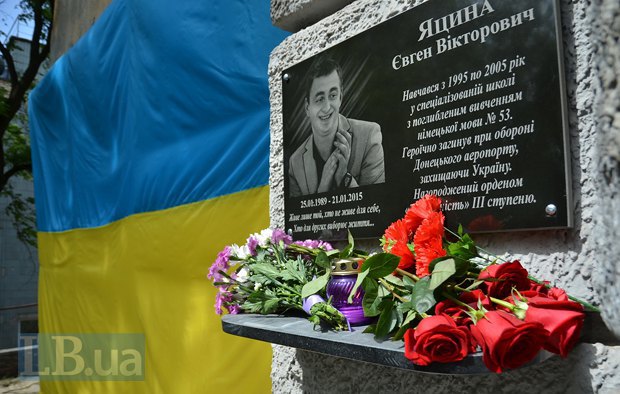
Separately, there is the story with the school. In Kyiv, in the city center, at School No. 53, where Yevhen studied from 1995 to 2005, a memorial plaque was opened for the fallen “cyborg”. His mother said that a “very positive photograph” was chosen for the plaque — the one that best reflected her son’s character: he was cheerful, lively, contactable. The idea came from friends and classmates — the memory was made by people who knew him not by biography, but by school corridors and common conversations.
“Benya” — the youngest “cyborg”: the Jewish story of Yevhen Yatsyna in the memory of Donetsk Airport
“Wall of Memory of Those Who Fell for Ukraine”: Portrait and Exact Location
Another point of Kyiv’s memory is the memorial “Wall of Memory of Those Who Fell for Ukraine”, open to the urban space. This place is arranged so that a person can come and find a specific face — not “in the general list”, but nearby, at arm’s length.
Yevhen Yatsyna’s portrait on the “Wall of Memory” is placed with precise marking: section 5, row 3, place 38. This precision turns memory into action: you can come and stop right at his portrait.
In recent years, the “Wall of Memory” has also become part of the public diplomacy of memory: Volodymyr Zelensky often brings foreign guests there to show the cost of Russian aggression not in the language of statistics, but with the faces of the fallen.
Order “For Courage” III Degree: Fixing the Feat at the State Level
The feat of Yevhen Yatsyna is also enshrined in a state document. He was awarded the Order “For Courage” III Degree (posthumously).
The basis is Presidential Decree of Ukraine No. 270/2015 of May 15, 2015. The decree states that the award is given “for personal courage and high professionalism shown in the defense of the state sovereignty and territorial integrity of Ukraine, loyalty to the military oath”.
Together, these elements — the funeral in Kyiv, community participation, memorial plaques, portrait on the “Wall of Memory”, and state order — form a coherent line: Yevhen Yatsyna did not dissolve in the war as “one of”. He remained a name, a face, and a story — for Ukraine and for the Jewish community, which shared this loss as their own.
Knesset and Words About the Contribution of Jews from Ukraine
On December 23, 2015, during a speech in the Knesset, President of Ukraine Petro Poroshenko said a phrase that still sounds like a political and human testimony:
“In confronting external aggression, our country has revived its army. And in this army, citizens of Ukraine of different nationalities are fighting. And we are proud of the contribution that Jews make to the defense of the country. I cannot but recall the glorious cyborg warrior who died in January this year at Donetsk Airport, Yevhen Yatsyna with the call sign ‘Benya’. We are proud of his feat. Posthumously, he was awarded the state order ‘For Courage’.”
This is not just a “mention of a name”. It is a public acknowledgment that the Jewish community of Ukraine is not an observer and not a “separate topic”, but part of the resistance to Russian aggression.
And this is especially important now, when Russia continues the war and continues to try to blur responsibility, substitute cause-and-effect relationships, and play the card of societal division. Stories of such people break this propaganda because they are very simple and very direct: a citizen of Ukraine went to defend the country, died, and he is remembered — by the state, the university, and the community.
Why the Story of “Benya” Sounds Sharper Today Than Ten Years Ago
Donetsk Airport was one of the first places where the war showed its true face. Back then, many still hoped that “everything would end soon”. Today, after the full-scale invasion, it has become clear: Russian aggression is a long-term project of destruction, exhaustion, terror in the rear, and an attempt to erase identity.
Against this background, the story of Yevhen Yatsyna looks not like an “episode of the past”, but as a point from which much began. It shows that resistance in Ukraine was initially nationwide — including with the participation of the Jewish community, which provided the country with warriors, volunteers, doctors, support for the families of the fallen, and public memory.
And in the end, there remains a simple formula that sounds especially honest in the section “Jews from Ukraine“:
Memory is us with you. As long as we name names and tell stories in living words, the war cannot turn people into impersonal numbers. NAnews — Israel News | Nikk.Agency.
Davos, Switzerland. The World Economic Forum unexpectedly received a geopolitical shake-up.
U.S. President Donald Trump declared from the Davos stage that he wants to immediately start negotiations to purchase Greenland. Without lengthy preludes and diplomatic niceties — directly and publicly.
According to Trump, Denmark is “too weak” to ensure the island’s security. Greenland, as he put it, is necessary for the United States not for resources, but for international security.
“This huge, unprotected island is essentially part of North America. It’s our territory,” he stated, adding that the U.S. “acted foolishly” by returning Greenland to Denmark after World War II.
Trump emphasized that he respects the people of Greenland and Denmark, but believes that no country can protect the island better than the U.S. In his logic, Greenland is a key point for deploying a missile defense system that should cover not only America but also Canada.
He reminded that during World War II, it was American forces that protected the island and accused Copenhagen of ingratitude. Trump separately noted Greenland’s strategic position — at the intersection of U.S., Russian, and Chinese interests.
“I want to immediately conduct negotiations for the United States to acquire Greenland,” he said, clarifying that it is about transferring the island, not leasing or expanding cooperation.
At the same time, the U.S. president tried to soften the tone, stating that he does not intend to use force.
“We do not want to apply military pressure. We are simply asking to be given Greenland,” Trump said, adding with irony: “I have a small request. I’m just asking for a piece of ice.”
However, immediately after this, he made it clear that economic pressure remains an acceptable tool. Amid the sharp rhetoric of the White House, a wave of sell-offs swept through global markets the day before. Trump himself acknowledged the losses, confusing Greenland with Iceland in the process of explanations.
“Yesterday, our stock market fell for the first time because of Iceland. So Iceland has already cost us a considerable amount,” he explained to journalists.
Trump then turned to allies. According to him, the U.S. needs strong partners, not weak ones. He urged Europe to “be strong” and move in the same political direction as his administration. At the same time, the president expressed doubt about the allies’ readiness to fight for the U.S., noting that America, unlike them, is always ready to help.
Trump generally did not like the European course. He criticized the EU for its migration policy, deindustrialization, and “green” energy, specifically mentioning wind power plants as a symbol of the wrong choice.
The topic of the war in Ukraine was not left out. Trump again stated that the conflict would not have occurred if Joe Biden had not won the 2020 election. According to him, he warned Putin that Ukraine was a “sore spot,” but the invasion became possible precisely after the change of power in the U.S.
Trump also spoke about a conversation with the Russian leader, in which he allegedly admitted that he could not resolve the conflict between Armenia and Azerbaijan for years, whereas the Trump administration managed to do so.
The head of the White House stated that resolving the war in Ukraine is Europe’s task, and the U.S. is involved in the process only for humanitarian reasons. He claims that just last month, about 31,000 military personnel from both sides died in Ukraine.
“I just want to stop this. It doesn’t help the U.S., but these are young people, human souls,” Trump said, confirming that he plans to meet with Volodymyr Zelensky on Wednesday.
Trump arrived in Davos late. After takeoff, the presidential plane was forced to return to the U.S. due to a technical malfunction, and only after changing aircraft was he able to continue his journey to Switzerland.
Trump’s Davos speech showed that his foreign policy is still built on direct pressure, demonstrative toughness, and personal deals — from Ukraine to Greenland. It is in this context that NANews — News of Israel | Nikk.Agency operates today, recording how the global agenda and the language of world politics are changing.
“Local historians did not know where these artifacts of Jewish heritage in Ukraine had disappeared to until 2023, when they discovered photographs of the stolen items on the official website of the ‘Museum of the History of Jews in Russia’.
Like ‘We didn’t steal — we saved’, notes Shimon Briman, comparing this to the same twisted logic by which the Russian army comes to ‘save’ Ukraine and Ukrainians with missiles and turning Ukrainian cities into ruins.
There is the most prestigious global organization of museums and museum professionals in the world — ICOM, the International Council of Museums headquartered in Paris. In mid-June 2024, at the annual meeting of ICOM’s governing bodies, ICOM Ukraine President Anastasia Cherednichenko spoke, reports Shimon Briman.
The representative of Ukraine demanded in the strongest terms to stop the gradual return of Russia to ICOM. Previously, back in 2022, the Russian Federation was suspended from participating in ICOM projects because this aggressor country was looting Ukrainian museums and destroying treasures of Ukrainian cultural heritage during the barbaric war against Ukraine.
Shimon Briman, in an article on “Ukrainian-Jewish Encounter” also notes that the list of stolen or destroyed by Russia should include objects of Jewish heritage in Ukraine.
The most high-profile story in this area is related to the theft and illegal export to Russia of two unique artifacts from the Ternopil region, writes Shimon Briman. This happened in the summer of 2014, at the beginning of Russian aggression, but it became known only recently.
At that time, unknown criminals stole three-hundred-year-old carved doors from the Chortkiv synagogue. Around the same time, unique relics disappeared from the ancient synagogue in Pidhaitsi — a baroque white stone carved decoration of a niche from the prayer hall and a carved plaque with the inscription “These are the gates of the Lord — the righteous shall enter through them” (Psalm 118).
Local historians did not know where these artifacts had disappeared to until 2023, when they discovered photographs of the stolen items on the official website of the ‘Museum of the History of Jews in Russia’.
This private museum was founded in Moscow by businessman Sergey Ustinov. The museum’s website states that it seeks to reconstruct a comprehensive picture of Jewish life in the territory of the Russian Empire and the USSR. It also states that the most important way to replenish the collection is through expeditions by staff in Russia and Eastern Europe.
The stolen ancient doors and stone slab from Chortkiv and Pidhaitsi were presented in Moscow at the exhibition “Challenge to Oblivion”.
Thus, from the point of view of Moscow museum workers, gangster raids on Ukrainian synagogues are “expeditions to replenish the collection”, and the brazen display of stolen items from Ukraine in Moscow is called “saving from oblivion”.
Like “We didn’t steal — we saved”, notes Shimon Briman, comparing this to the same twisted logic by which the Russian army comes to “save” Ukraine and Ukrainians with missiles and turning Ukrainian cities into ruins.
Shimon Briman writes that in Chortkiv and Pidhaitsi there were thefts, corruption, and vandalism against historical objects. As a result, artifacts from two synagogues were stolen. These synagogues are on the list of national historical monuments, and their artifacts could not be legally removed — only through corruption and vandalism, which was done at the request of the Moscow museum.
Local authorities in the Ternopil region showed indifference to the fate of these ancient synagogues. Although the Ukrainian authorities lack the funds to maintain the condition of these ancient buildings, this does not justify the illegal export of artifacts to Russia, Briman emphasizes.
The discovery of stolen Jewish relics in a Moscow museum in 2023 caused outrage among Judaica and art specialists from Ukraine, Israel, and the USA. They appealed to the ministries of culture and foreign affairs of Ukraine to raise the issue of returning the stolen artifacts at the international level.
Briman writes: “The dismantling and export of these artifacts abroad directly contradicts Ukrainian law. These actions are criminal, and both the customers and the executors should be held accountable for them.” Artifacts from the synagogues in Chortkiv and Pidhaitsi have enormous historical and cultural value that cannot be compensated. The illegal export and exhibition of these artifacts in Russia is part of the aggressor’s large-scale crime — the deliberate destruction and looting of Ukrainian cultural heritage, concludes Briman.
Shimon Briman writes that the actions of stealing artifacts from synagogues in Chortkiv and Pidhaitsi damage Ukraine’s relations with foreign partners, including Israel. It also gives Russian propagandists the opportunity to use the topic of Ukrainian-Jewish past to undermine Ukraine’s international image. The authors of the letter, signed by many well-known scholars, demand the inclusion of the owner of the “Museum of the History of Jews in Russia” Sergey Ustinov in the sanctions lists.
Briman notes that the attempts of the Moscow museum to justify the theft sound immoral. He emphasizes that the cities of Chortkiv and Pidhaitsi in the 17th-18th centuries had nothing to do with the “history of Jews in Russia”, as they were part of the Polish Kingdom. This act is a neocolonial appropriation of someone else’s heritage to strengthen Moscow’s imperial status.
Shimon Briman writes this text as a reminder that the Russian regime throughout its aggression against Ukraine seeks to destroy not only Ukrainian but also Jewish heritage in Ukraine. In the future, in his opinion, the list of reparations from Russia in favor of Ukraine should include the two stolen Jewish artifacts.
Haifa knows and honors a modest heroine — a native of Zolochiv (Lviv region, Ukraine). On February 12, 2025, she turned 90 years old.
In the Righteous Among the Nations Garden in Haifa, where 20 memorial stones bear the names of those who saved Jews and once lived in the city, Yaroslava Levytskaremains the only one honored with a memorial plaque during her lifetime.
At the Latin Cemetery in Haifa, 11 Righteous Among the Nations are buried. In their honor, the Haifa municipality created a unique memorial garden in the Ramat Alon district.
The garden features several paths with stone plaques engraved with names and brief descriptions of their heroic deeds. At the time of its opening, 19 Righteous Among the Nations were known to have lived in Haifa: 9 from Poland, 6 from Ukraine, and one each from Hungary, the Czech Republic, Romania, and Sweden. Later, a 20th plaque was added.
Four were honored for their acts of bravery committed as children.
Yaroslava Levytska is the youngest person ever awarded this title for rescuing Jews.
At the park’s entrance, on an uneven stone, three symbols are engraved: the emblem of the Righteous, the Yad Vashem logo, and the emblem of the City of Haifa. Below them is a quote from the Talmud: “Whoever saves one Jewish life is as if they have saved the entire world.”
Memorial Stones of the Righteous Among the Nations in Haifa
The Righteous Garden in Haifa features plaques honoring those who saved Jews during the Holocaust. Here are brief summaries of their stories:
Halina Lugovska (Poland): Hid a Jewish woman in her home for 32 weeks and later helped her find refuge with her family.
Anna Hornung-Tomachak (Ukraine): Pretended to be the mother of a Jewish family to save them in the Ternopil region.
Victoria Tsukrovych-Aichberger (Poland): Together with her sister, hid a Jew who was fleeing the Nazis.
Pelagia Guchak-Springer (Poland): Saved 20 Jewish women and the family of a Jewish workshop owner.
Yaroslava Levytska (Ukraine): As a teenager, brought food to the ghetto and hid Jewish children with her family.
Jerzy Shelaga (Poland): Delivered food and letters to the Warsaw Ghetto, risking his life.
Julia Kaldi-Ralbovska (Czechoslovakia): Hid a Jew and buried his mother to keep the hiding place secret.
Elisabeta Nikopoi-Strul (Romania): Warned of a pogrom, sheltered and fed more than 15 Jews despite arrest and beatings.
Tamara Maksymeniuk-Bromberg (Ukraine): Delivered food to the ghetto with her mother, rescued families, and organized shelters.
Bela (Valya) Lipper (Ukraine): Hid her Jewish husband and six others for 19 months.
Victor Melnyk (Ukraine): Hid Jews with his family, provided forged documents, and helped them escape.
Zofia-Marta Avni (Poland): Hid six Jews in an attic in Warsaw with her family for a year and a half.
Irena Yakira-Ziental (Poland): Hid 13 Jews with her mother in a specially prepared hiding place.
Raoul Wallenberg (Sweden): Diplomat who saved thousands of Jews in Hungary; disappeared after being arrested by Soviet forces in 1945.
Anna Dobrucka-Ezerska (Poland): Saved a family during the liquidation of the Tarnow Ghetto and later married one of those she rescued.
Franya Dedek-Belska (Ukraine): Born in Nadvirna, rescued two Jewish boys and survived a displaced persons camp, the “Exodus” ship attempt, and eventually immigrated to Israel, where she converted to Judaism and became Fruma Belska.
Each name is a reminder of courage, humanity, and sacrifice. The Haifa memorial preserves the memory of those who risked everything to save others.
On February 12, 2025, students from the Bosmat School visited the “Beit Gil Zahav” nursing home in Kiryat Eliahu to congratulate Yaroslava Levytska on her 90th birthday and express their gratitude for her heroism. The event was part of the activities of Haifa’s Municipal Institute for Holocaust Studies, which works to preserve the memory of the Righteous Among the Nations and pass on Holocaust remembrance to future generations.
According to Yad Vashem, as reported by journalist Shimon Briman, Ukrainian native Yaroslava Levytska is the only Righteous Among the Nations currently living in Israel. She has lived in Haifa since the early 1990s and receives full support from the State of Israel.
Biography of Yaroslava Levytska: The Journey of a Righteous Among the Nations from Zolochiv to Haifa
Yaroslava Levytska, according to journalist Shimon Briman, was born in 1935 in the town of Zolochiv, which was then part of Poland and today is in Lviv Oblast, Ukraine. In July 1941, the German army occupied the region and began the systematic extermination of the Jewish population. A ghetto was established in Zolochiv, and Jews were stripped of their rights, food, and any chance of survival. It was during this time that the Levytsky family’s courageous acts became part of history.
The Heroism of the Levytsky Family: 29 Lives Saved
Yaroslava’s grandfather, Oleksandr Levytsky, began supplying food and medicine to his Jewish friends from the start of the occupation. In December 1942, when the Zolochiv Ghetto was officially created, he started sending supplies through his seven-year-old granddaughter Yaroslava. She walked two kilometers from their home to the ghetto each week for ten months. The risk was immense — German guards could have executed them. But Yaroslava carried out her task calmly and bravely.
Thanks to her actions, many Jewish families and children survived.
Yorek Shenker and Richards Feiring: Stories of the Rescued
One of the children saved was Yorek Shenker, only six years old, now known as Yoram Miron. To avoid suspicion, Yaroslava would play with him outside while he was in hiding. The family also sheltered Richards Feiring. Both boys survived the Holocaust thanks to the courage of Yaroslava and her family.
Additionally, for ten months, the Levytsky family provided food to a group of 25 Jews hiding in the basement of a destroyed building. Despite fear and fatigue, Yaroslava kept delivering food. This entire group survived until the Red Army liberated the area in July 1944.
Life After the War
After liberation, Yaroslava graduated from School No. 2 in Zolochiv in 1952 and went on to attend medical college. She worked as a feldsher and later as head of the infectious disease prevention department. She lived modestly and never sought any personal gain for her family’s heroism. Her father Petro Levytsky also played a key role in rescuing Jews but was not officially recognized by Yad Vashem — a fact that remains painful to this day.
Recognition and Immigration to Israel
On August 20, 1989, two of the people she rescued — Avraham Shapiro and Israel Fenster — submitted a petition to Yad Vashem to recognize Oleksandr, Kateryna, and Yaroslava Levytska as Righteous Among the Nations. On September 21, 1989, Yad Vashem officially awarded them the title. Yaroslava herself planted a tree in honor of her family in the Garden of the Righteous in Jerusalem.
In 1995, she permanently moved to Israel, where she was granted citizenship, a government pension, and an apartment. Later, she settled in the Beit Gil Zahav senior care facility in Haifa.
90 Years of Heroism and Humanity
On her 90th birthday, Yaroslava Levytska was honored by the Haifa Holocaust Education Municipal Institute, the Moriah-Haifa Rotary Club, and students of the “Basmat” school. She shared:
“I am happy to live here, in Israel. At 90, I want for nothing. This is a special country.”
Words of Gratitude from Israel
“Israel and the Jewish people will never forget the vital role played by the Righteous Among the Nations during World War II, when they took great risks to save the lives of thousands of Jews.”
Some of these heroes, like Yaroslava, chose Israel as their new home — and became part of its living history.
NAnews – Israel News continues to tell these stories to ensure the memory of Jewish-Ukrainian solidarity lives on and inspires future generations.
The Lessons of History and the Power of Memory
Today, Yaroslava Levytska’s name is engraved on a memorial stone in Haifa’s Righteous Garden — while she is still alive, a unique distinction. She is recognized, respected, and cared for.
Her story is a profound example of selfless humanity in the face of ultimate evil. It reminds us that children, adults, and the elderly alike can act with courage and conscience.
NAnews – Israel News believes that telling these stories is essential to preserving the bond between the Jewish and Ukrainian peoples. In an age of war and terrorism, when hatred rises again, these stories help us to see the human being in one another.
February 13, 2026, in Tel Aviv will host a special edition of DISCO UKRAЇNA — Be My Valentine. The party is timed to Valentine’s Day and will unite the “Ukrainian community” of Israel in a format of dancing, socializing, and live communication.
The social component is embedded in the event from the very beginning. Already at the ticket purchase stage, guests will be able to support Ukrainian refugees in Israel by funding discounted tickets for Ukrainians who found themselves in the country due to the war. The initiative is implemented in cooperation with the organization ASSAF.
DISCO UKRAЇNA
DISCO UKRAЇNA is a Ukrainian party in format and atmosphere, with Ukrainian music, language, and community at the center of attention. However, the event is open to everyone — friends, partners, and those who want to spend the evening in a warm, unifying atmosphere, regardless of origin.
The event will take place at PHI GARDEN — a city venue in the center of Tel Aviv with entrances from Rothschild Blvd and Ahad Ha’Am Street.
Support for Ukrainian refugees in Israel: DISCO UKRAЇNA will hold a Valentine’s party in Tel Aviv – February 13, 2026
Music and Format
The program includes 100% Ukrainian music: current hits, favorite tracks from past years, and original remixes.
At the console:
DJ RAZME — resident of DISCO UKRAЇNA
DJ SAMSO — debut at the party
The evening format includes dancing at the DJ console, socializing in the courtyard, cocktails at the bar, and free movement between zones.
Cupids and “Valentine’s Mail”
For Valentine’s Day, organizers have added interactive elements. At the entrance, guests will be greeted by “cupids” who will distribute special bracelets — a visual sign of openness to new acquaintances.
The venue will feature “Valentine’s Mail”: postcards, stickers, and the opportunity to send a message through the organizers. Contests with prizes are planned throughout the evening.
When and Where
Date: Friday, February 13
Time: 18:00–23:00
After 23:00 — free continuation of the club party
Free exit and re-entry
Age: 18+
📍 PHI GARDEN, Tel Aviv
Entrances: Rothschild Blvd 41 / Ahad Ha’Am St 54
In times of war, such events become not only a form of leisure but also a way of mutual support and community preservation. NAnews — News of Israel | Nikk.Agency continues to report on projects of the Ukrainian diaspora in Israel.
Barbra Streisand is one of the most renowned Jewish artists in the world, born into a poor family from Berezhany (Galicia, Ukraine), whose ancestors emigrated to the United States in search of a better life.
Having won two Oscars, she uses her fame and resources to support Ukraine and Israel — that’s why we feature her in our regular series “Jews from Ukraine.”
Galician Roots: From Berezhany to Hollywood
Barbra Joan Streisand was born in 1942 in New York into a Jewish family. Her grandfather, Isaac Moshe Streisand, was born in 1879 in the town of Berezhany (now Ternopil Oblast, Ukraine), or, according to other sources, in Buchach. The family lived in poverty in a single heated room where they slept on wooden benches.
In 1898, at the age of 19, Isaac Streisand decided to emigrate. He left Berezhany, traveled through Lviv to Bremen, Germany, and from there sailed to the United States. The journey lasted 15 days. Many passengers didn’t survive. Isaac did, arriving in New York without money but full of hope. He later married Anna Keston, a fellow Jewish immigrant from Eastern Europe.
Berezhany and Jewish Heritage
The Jewish community of Berezhany is one of the oldest in the region. The first records of Jews in the town date back to the 1530s, when they were permitted to reside and engage in trade. By the 16th–17th centuries, Jews played a significant role in the local economy as leaseholders, artisans, shopkeepers, and millers.
In 1623, the town’s first synagogue was built, and by the 19th century, Berezhany had several prayer houses, Jewish schools, and charitable organizations. By the 1860s, Jews made up about half the population of the town.
During World War I, the Jewish population of Berezhany suffered greatly, and during World War II, tragedy struck again: in 1941, the Nazis established a ghetto, where about 4,000 Jews were interned. Between 1942 and 1943, nearly all were executed nearby or deported to death camps.
Today, the memory of Berezhany’s Jewish community lives on through historical monuments and research, highlighting the importance of Jewish heritage in the town’s history.
New Life in America and the Birth of a Legend
Isaac and Anna Streisand settled in New York and raised five children. They worked hard: he was a tailor and ran a small fish shop, while she worked as a cook. Their eldest son, Emanuel Streisand, became a schoolteacher, and his wife Diana, once a soprano singer, worked as a school secretary.
When Barbra was still a child, her father died of epilepsy, plunging the family back into poverty. But Barbra had a unique voice and passion for the stage — and became a star.
Awards and Achievements
2 Academy Awards — for Best Actress and Best Original Song
8 Grammy Awards
5 Emmy Awards
9 Golden Globes
Presidential Medal of Freedom (USA)
The only artist whose albums have topped the Billboard 200 across six consecutive decades
A Voice for Ukraine: UNITED24 and Personal Donations
On February 24, 2022, the day Russia launched its full-scale invasion, Barbra Streisand firmly stood with Ukraine. On Twitter, she wrote:
“My paternal grandparents emigrated from Ukraine, and my heart breaks for the brave people fighting this Russian invasion. Putin’s propaganda about ‘denazification’ is the biggest lie of this century.”
In September 2022, at the personal invitation of President Volodymyr Zelenskyy, Barbra Streisand joined the UNITED24 platform as an ambassador for the Medical Aid direction. In her official message, she said:
“Because I have Jewish heritage with Ukrainian roots, I’m especially moved by the Ukrainian people’s fight for freedom. Their resilience and courage are an inspiration to everyone working to preserve democracy and stand up to authoritarianism. You and your country have my full support.”
Her first project was the 24,000 Friends of Ukraine initiative, calling for monthly donations of $24 from supporters worldwide. To set an example, Barbra personally donated $24,000, and later donated another $24,000.
In 2023, she also contributed $240,000 toward medical aid in Ukraine — funds that went to purchasing vital equipment and supporting Ukrainian doctors working under war conditions.
In March 2025, Barbra made another donation to UNITED24’s medical initiative and appealed publicly to the world:
“Ukrainian doctors are heroes. They keep working even when missiles are exploding nearby. If you can — help. Their lives are a fight for others.”
Barbra Streisand and Israel: Philanthropy, Music, Solidarity
Barbra and Golda Meir
In 1978, Barbra Streisand appeared in the widely broadcast TV special “The Stars Salute Israel at 30.” On air, she had a memorable conversation with Israeli Prime Minister Golda Meir about Zionism, Jewish identity, and the dream of a Jewish state. At the end of the program, Barbra performed “Hatikvah” — Israel’s national anthem, moving viewers around the world.
Donations and Support
In 1984, Barbra donated a building at the Hebrew University of Jerusalem (Mount Scopus campus) for Jewish studies, named after her father Emmanuel Streisand.
In 2011, she participated in a fundraising gala supporting the Israel Defense Forces (IDF).
In October 2023, following terrorist attacks on Israeli civilians, Barbra expressed deep sympathy to bereaved Israeli families:
“After learning about the horrific attacks on Israelis and the hostage-taking of innocent civilians, I was shocked and devastated. This attack lacked all humanity or compassion. There are no words to describe the madness and the sorrow. I grieve with all the mothers and fathers who lost their children. We must hope and pray for the safe return of all hostages.”
She also announced that she was proud to support the Israel Emergency Fund of the Jewish Federation of Los Angeles.
Returning to Her Roots: Berezhany and Tel Aviv
In 2015, Barbra Streisand made a personal visit to Berezhany to see the grave of her grandfather Isaac Streisand, who was born and raised in the town before emigrating to the United States. The trip was deeply meaningful and reaffirmed her connection to her heritage.
In 2013, during a visit to Israel, Barbra was presented with archival documentation at the Museum of the Jewish People in Tel Aviv confirming her family’s Galician origins:
“The surname Streisand is recorded in the town of Berezhany…”
This document served as tangible evidence of her Jewish-Ukrainian roots and was included in a special presentation about her ancestry.
Why Barbra Streisand Belongs in the “Jews from Ukraine” Series
Barbra Streisand is a shining example. Her grandfather came from Berezhany, she preserved her connection to her roots, she supports Ukraine, and she helps Israel. Her voice is heard not only on stage — but in philanthropy, solidarity, and remembrance.
Her involvement in UNITED24, public support for Israel, contributions to the Hebrew University of Jerusalem, and open acknowledgment of her Ukrainian ancestry make her an integral part of Jewish diaspora history.
This is why her story is part of our series.
On NAnews – News from Israel, we continue collecting and sharing these stories — honest, powerful, and inspiring.
The “Jews from Ukraine” series highlights outstanding individuals of Jewish heritage with roots in Ukraine.
“Returning our own past and dismantling the myths created by the Soviet authorities about the Holocaust is one of the strategic directions of the National Historical and Memorial Preserve Babyn Yar,” said its director, Roza Tapanova, in her opening speech.
She emphasized that the 1965 competition was a hope for the community to honor the victims, but Soviet censorship only imitated dialogue.
Eventually, the authorities canceled the competition, and in 1976, a state-commissioned monument was created and installed: “Monument to Soviet citizens and POWs of the Soviet Army executed by the Nazi occupiers in Babyn Yar.”
“The Soviet authorities rewrote history and silenced the facts. This exhibition is a reproduction of our memory. As written on the facade of the exhibition center, those who do not remember are condemned to relive their history again and again. Babyn Yar is a tragic and important chapter of Ukraine’s history, which is why it was granted national memorial status. The work of its team today fully aligns with our national interest — to bring back the truth about ourselves,” added Serhiy Belyaev, Deputy Minister of Culture and Strategic Communications of Ukraine for Heritage Affairs.
When the World Collapses: An Exhibition That Restores the Voice of Memory
NAnews presents an overview of an event that holds deep significance for both Ukrainian and Jewish communities. The documentary exhibition titled “When the World Collapses” has opened at the “Living Memory” exhibition center at the National Historical and Memorial Preserve Babyn Yar.
The exhibition is dedicated to the memorial project of the Babyn Yar tragedy, developed in 1965 by the creative duo Ada Rybachuk and Volodymyr Melnychenko (ARVM). Soviet censorship prevented the project’s realization, but today — decades later — it has been revived and brought to light.
What the Exhibition Features
Archival documents and texts
Original sketches and photographs
Restored model of the memorial
A video installation by director Oleksiy Radynsky — a cinematic reconstruction of the memorial route
The materials were provided by the ARVM Cultural Heritage Preservation Fund and reflect the artists’ effort to create a language of remembrance that conveys the scale of the tragedy and honors its victims.
Censorship and Silence: The Story of an Unrealized Project
In 1965, an architectural competition was announced for a monument to the victims of fascism in the Shevchenkivskyi District of Kyiv. Among the participants were prominent architects and artists, including Avraham Miletskyi, Yosyp Karakis, Yakiv Razhba, Yevhen Zhovnerovskyi, Albert Kryzhopilskyi, and the duo ARVM. The competition was eventually canceled, and in 1976 a faceless monument was erected that fit the Soviet narrative of silencing the Holocaust.
ARVM: Artists Ahead of Their Time
Ada Rybachuk (1931–2010) and Volodymyr Melnychenko (1932–2023) were Ukrainian artists who worked together for more than 50 years. Their joint projects — from the design of the Kyiv Central Bus Station to the Memory Park at Baikove Cemetery — became landmarks of Ukrainian monumental art.
In 1982, the authorities ordered the concrete burial of their Memory Wall, a 2,000 m² relief — an act of direct destruction of historical and artistic truth.
Curatorial Work and Approach to Memory
The curatorial team — Maria Mizina, Anastasiia Paseka, and Mykhailo Alekseenko — shared their experience of six months of archival research, digitization, and the restoration of the model.
“ARVM were not simply building a monument. They were creating an experience — a memorial as a personal journey,” noted Paseka.
Director Oleksiy Radynsky added that the video installation provides a strong sense of presence, allowing the viewer to walk the path designed by the artists themselves.
Quotes That Shape the Message
Roza Tapanova, Director of the Preserve: “Returning our past and dismantling Soviet myths about the Holocaust is a key part of our mission.”
Serhiy Belyaev, Deputy Minister of Culture: “The Soviet regime rewrote history and buried the facts. This exhibition revives our collective memory.”
Inokentiy Vyrovyi, ARVM Fund representative: “The project was forgotten for decades. But Ada and Volodymyr always believed the truth would prevail.”
Why This Matters
Babyn Yar is a symbol of the Holocaust on Ukrainian soil. Over 33,000 Jews were murdered here in just two days in September 1941. The attempt to erase this crime failed, and exhibitions like “When the World Collapses” restore historical justice.
For Israelis of Ukrainian origin, this is not only a part of personal history but also an opportunity to strengthen ties between the Jewish and Ukrainian peoples. That is why NAnews — Israel News covers events like this one.
Facts and Figures
Parameter
Value
Exhibition Title
“When the World Collapses”
Location
Living Memory Center, 46A Yuriy Illienko Street, Kyiv
Dates
May 29 – July 31, 2025
Admission
Free
Opening Hours
Mon–Fri: 10:00–19:00, Sat–Sun: 11:00–19:00
Organizers
ARVM Fund, Ukrainian House National Center, Dukat Art Foundation, Living Memory Center, Clear Energy Group
NAnews — Israel News will continue to report on projects where culture and history unite peoples and challenge the falsification of the past. Because without truth about the Holocaust, there can be no genuine memory — not in Ukraine, not in Israel, and not anywhere in the world.
Ukrainian-Jewish relations are rich in shared pages of history and outstanding individuals who played a significant role in the establishment and development of the State of Israel.
Ephraim Katzir (Katchalski)
This includes Ephraim Katzir (Katchalski) – a native of Kyiv, an outstanding biophysicist, and an influential Israeli politician, the fourth President of Israel.
Born in Kyiv
He was born in 1916 in Kyiv, but a few years later the family moved to “Palestine.” Ephraim grew up in an intellectual family where his grandfather was a respected rabbi, so respect for Jewish traditions was always important to him. After settling in Palestine with his family, the boy graduated from a gymnasium in Jerusalem and then entered the Hebrew University of Jerusalem.
Scientific Activity and Achievements
His professional interest and area of development became the world of biophysics, as evidenced by his successes in university studies and research: in 1941, Ephraim received a doctorate in biophysics.
His research on amino acids and proteins gained recognition and attracted attention in the scientific world. In 1950, he received the Weizmann Prize, followed by the Israel Prize and the Rothschild Prize. For significant scientific achievements, Ephraim Katchalski was admitted to the National Academy of Sciences of Israel, and later he was invited to membership in the American Academy of Sciences.
4th President of Israel
Such a successful scientific career played a special role for Ephraim: he was invited to run for the presidency of Israel by Golda Meir, who was then the Prime Minister. Katchalski was an unquestionable moral and intellectual authority of that time, so he received great support in the presidential elections.
In May 1973, he assumed the position of the fourth President of Israel. His tenure was not without challenges; on the contrary, it was full of historical and fateful decisions for the state.
In 1973, as president, he, along with the country, experienced the Yom Kippur War and a series of complex diplomatic challenges of that time. Ephraim Katzir’s popularity was significant, giving him a strong chance of being re-elected for a second presidential term in 1978, but he decided to return to scientific work.
Memory of Ukraine
Ephraim Katzir always remembered and frequently recalled the city of his birth and childhood – Kyiv.
In his memoirs, written shortly before his death, Kyiv memories often appear. After his presidency, he visited Kyiv, particularly as a world-renowned scientist.
Buried in Jerusalem
He lived a bright, meaningful life, fulfilling himself as a political figure and as a researcher. He died in 2009 in Israel at the venerable age of 93, surrounded by his loved ones. He is buried in Jerusalem.
For news of the day in Israel, news feed, news of Israel and the world, events of the day and the last hour, analysis – Israel News: Ephraim Katzir (Katchalski) 1916-2009.