On October 16 and 17, 2026, the Ukrainian Cultural Center in Tel Aviv will host an exhibition by Ukrainian artist and restorer Yana Dereza, “Threads of Identity”. At the center of the project is the motanka, one of the recognizable forms of Ukrainian folk culture, which the artist transforms into a modern story about memory, past experiences, and the attempt to preserve oneself after major changes. Admission to the exhibition is free. Dereza will also conduct three practical workshops.
The title here is quite accurate — “Threads of Identity”.
A person is indeed composed of many such “threads”: family, the city where they grew up, language, things from the parental home, people they remember. Then moves, new countries, losses, sometimes war are added to this. Something breaks, something has to be tied anew.
This is exactly what Yana Dereza talks about through the Ukrainian motanka.
The exhibition will take place on October 16–17, 2026 at the Ukrainian Cultural Center on Yirmeyahu Street, 22 in Tel Aviv. According to the organizers’ announcement, this is a project about memory and healing, rethinking the past, searching for oneself, and restoring inner integrity.
But behind these rather big words are small things — fabric, thread, embroidery, knot. Things that can be held in hands.
Motanka: from a rural doll to a Ukrainian symbol
For an Israeli reader, the word “motanka” almost certainly requires explanation. It is a traditional Ukrainian doll made of fabric, not sewn like a regular toy, but primarily twisted, wound, and tied. Hence the familiar name today — from the Ukrainian “motati”, meaning to wind. In villages, they spoke even more simply — “twist the doll”. It could be made from several scraps of fabric, threads, and whatever was at hand.
But here begins the more interesting part of the story. Today, the motanka is often presented as a single ancient Ukrainian talisman, existing almost unchanged since the times of Trypillya. Such a statement is too simplistic.
Ukrainian researchers do indeed trace a very old tradition of anthropomorphic figures in the territory of present-day Ukraine. In archaeological cultures here, female figurines associated with agriculture, fertility, home, birth, and rituals were found. Especially often in this context, the Trypillian culture of the 5th–3rd millennia BC is mentioned. The National Center of Folk Culture “Ivan Honchar Museum” also draws parallels between Trypillian anthropomorphic plastic and later folk dolls.
But archaeology does not give us a motanka that could be placed next to a modern one and say: here it is, the same doll five thousand years ago. There are huge gaps between separate eras. Even researchers of folk toys admit: there is not enough material to prove a direct continuous line from the Trypillian figurine to the textile Ukrainian doll of the 19th–20th centuries. It is more correct to speak of ancient images and traditions, with which the later folk doll has obvious parallels, rather than a literally unchanged object that survived several millennia.
The motanka, which can already be confidently described ethnographically, is especially characteristic of Central Dnieper region — Cherkasy, Poltava, and the southern part of Kyiv region. In villages, such dolls continued to be made even in the 20th century, in some places until the 1960s–1970s. Pieces of old work or festive clothing were used, the fabric was twisted, tied, forming the head and torso. No factory or craft kit was required, of course.
And the functions were different. This is fundamentally important.
The motanka could be a children’s toy. It could appear in a wedding or family context, associated with the wish for continuation of the family and motherhood. A doll that a grandmother made for her granddaughter from fabric belonging to the family could indeed acquire the significance of a family talisman. But the notion that any motanka automatically was a magical amulet with a strictly established set of “protective functions” is largely a later popular interpretation. The Encyclopedia of Modern Ukraine separately warns that many rules, prohibitions, and mystical properties have arisen around motankas on the internet, which ethnographic materials simply do not confirm.
There is another detail that immediately catches the eye: the face.
In traditional knot dolls, it could remain without human features at all. On some, a cross made of threads appeared. Today, the cross on the face has become almost the main visual sign of the “Ukrainian motanka”, although historically there were different options, and it is not worth making it a universal rule. Researchers note that in modern author motankas, this element sometimes remains almost the only direct reminder of the old canon.
For an Israeli reader, a clear parallel can be drawn here, but cautiously. It is somewhat like an object of family and religious tradition, which over time goes beyond just domestic use and also becomes a sign of cultural belonging. It can already stand in a museum, appear in modern art, become part of the conversation about identity — and at the same time continue to exist at home, in the family.
This is exactly what happened with the motanka in Ukraine, especially noticeably already in the 21st century. Until the early 2000s, the making of such dolls was not a widespread phenomenon throughout the country. Then the tradition began to be actively revived by masters, museums, and folk art schools. The motanka went far beyond the regions where it historically existed and gradually became one of the recognizable visual symbols of Ukrainian culture.
This, by the way, helps to better understand Yana Dereza.
She takes an already dual object: an old folk form and at the same time a modern Ukrainian symbol. But instead of reproducing the “correct motanka by sample”, she disassembles it into parts again. Fabric, embroidery, threads, wood, herbs, metal, personal items, and symbols begin to tell not about an abstract tradition, but about a specific person.
And an interesting circle emerges.
Once such a doll could be made at home from pieces of clothing of one’s own family. Today, Dereza returns personal memory to it again — only now through the means of modern art. Therefore, the title of the Tel Aviv exhibition “Threads of Identity” is not just a decorative metaphor here. The thread indeed connects several layers at once: the old Ukrainian tradition, family, memory, forced relocation, and the present-day person trying to understand what remains their own from all this.
Who is Yana Dereza
Yana Dereza was born in Kyiv in 1996. She is a professional artist-restorer, studied at the National Academy of Fine Arts and Architecture. Dereza herself says that handcraft was present in her family for several generations: her mother, grandmother, and great-grandmother sewed and did needlework. She drew, embroidered, and worked with beads from childhood.
She seriously encountered the motanka in 2014, still during her studies. In an ethnography class, she saw such a doll brought by an acquaintance, and in the evening made her own — red, the color of poppy, with sage inside. Then experiments with materials and form began.
And this is important for understanding the exhibition: Dereza came to the motanka not from the side of souvenir production.
Her professional base is painting and restoration. Before the full-scale Russian invasion, she was engaged in painting and worked with the techniques of old masters. After February 2022, she found herself in Prague, while her studio and materials remained in Kyiv. According to her story, it was the motankas that helped her return to work: she bought the necessary materials already in the Czech Republic and essentially started part of her creative life anew.
Today she works not only with art dolls but also with painting and embroidery. In the international project ART-EMBASSY, Yana Dereza is listed as a creative manager; the platform itself is engaged in exhibitions and cultural projects in different countries.
Why this story is understandable in Israel
There is no need to artificially make the Ukrainian and Israeli experiences the same. They are not the same.
But the situation itself, when a person lives simultaneously within several layers of memory, is well known to Israelis. In one house, things from Kyiv, Odessa, Morocco, Iraq, Poland, or Argentina can be kept; parents speak one language, children already another, and some old embroidered napkin or photograph suddenly turns out to be stronger than the official biography.
And at this level, Dereza’s motankas are already understood without an ethnographic dictionary.
The exhibition in Tel Aviv speaks not only about preserving the Ukrainian tradition. It shows what happens to tradition after relocation: whether it remains a museum object or begins to live in a new city and tells a new story.
For the venue itself, such an exhibition is also quite organic. The Ukrainian Cultural Center on Yirmeyahu, 22 operates in Tel Aviv as a permanent space for exhibitions, meetings, lectures, and other Ukrainian cultural events. NAnews has already detailed the center and its work in Israel.
NAnews — News of Israel | Nikk.Agency continues to follow Ukrainian cultural events in Israel for this very reason: the connection between the countries exists not only at the level of diplomacy or big politics. Sometimes it looks just like a few meters of fabric, a ball of thread, and a person explaining to another person why all this was preserved.
“Threads of Identity”: contemporary Ukrainian motankas by Yana Dereza will be shown in Tel Aviv — October 16–17, 2026, free entry
Yana Dereza will conduct three practical workshops, during which participants will be able to make their own motanka. The organizers specify separately: no prior experience is needed, necessary materials will be provided on site.
October 16
10:00–12:00 — workshop in Ukrainian.
13:30–15:30 — workshop in Ukrainian.
October 17
10:00–12:00 — workshop in English.
There is a significant difference here: the exhibition itself is free, but participation in the workshops requires prior ticket purchase. The number of places is limited.
And if the word “motanka” meant nothing to you before — this is perhaps not an obstacle. Rather the opposite. You can come without knowledge of Ukrainian ethnography and see how an item, which for many years was placed somewhere between folk craft and family talisman, becomes a story about quite modern life with a contemporary artist: where you are from, what you brought with you, and what of your former self you managed not to lose.
“It feels like we are watering the desert.” The phrase turned out to be so convenient for headlines that it almost immediately began to live separately from the story in which it was said.
In fact, this is not the position of the European Union, not a statement by the European Commission, and not the words of any European leaders. The French Le Monde on September 30, 2026, quoted a remark by an unnamed European diplomat, “irritated” by yet another discussion of Ukraine’s financial needs. But the irritation itself was not invented by journalists: in Brussels, they are indeed trying to figure out where to get money for the next year when previous agreements turned out to be insufficient.
And here begins the confusion with the numbers. Because €69 billion, €90 billion, $52.6 billion, $32.6 billion, and almost €225 billion ended up nearby. If you simply add them up in one text, it creates the impression that Kyiv has already been given one gigantic sum and has come for another.
This is not the case.
€69 billion is not a new request on top of €90 billion
On September 29, the Ukraine Donor Platform meeting was held in Brussels. For the Israeli reader, the name says little: it is a platform where Ukraine, the G7 countries, the European Union, international financial organizations, and other partners bring together the country’s future needs and who is ready to finance which part. It is not a single cash register or a fund from which Kyiv receives money in one payment.
Ukraine’s Finance Minister Serhiy Marchenko said in Brussels that for 2027, Ukraine needs to find about €69 billion: approximately €40 billion for military expenses and €29 billion for the functioning of the state. This is the amount that made the headlines.
But Le Monde makes an important clarification: in this calculation, the promised bilateral aid and the European loan of €90 billion for 2026–2027 are already included. So the arithmetic “Europe gave €90 billion, Ukraine asked for another €69 billion” simply does not work here.
The official Ukrainian Ministry of Finance explains the situation more simply.
For 2027, Ukraine will need $52.6 billion in external financing. Of this, approximately $20 billion are expected sources already exist. About $32.6 billion remain uncovered.
This last figure is the real problem that Marchenko brought to the partners.
Not €69 billion in cash. Not a new check on top of €90 billion. But about $32.6 billion, for which there is no confirmed source yet.
So where did the European €90 billion go
Nowhere. They exist, but there is a nuance here too.
In April, the EU Council finally agreed on the Ukraine Support Loan of €90 billion, calculated for 2026 and 2027. Of this amount, approximately €60 billion is intended for defense purchases, and €30 billion for budget support and state operations. For 2026, access to a maximum of €45 billion is provided.
This is a loan that the EU itself attracts on capital markets under the security of the European budget. The money was not lying in advance on some Ukrainian account, and €90 billion cannot be perceived as an amount already spent by Kyiv.
There is another detail. The military part of this loan is not money for pensions, teachers’ salaries, or repairing a power plant after a Russian strike. It is primarily intended for the purchase of weapons and investments in the defense industry. The budget part is significantly smaller.
Therefore, two things can be true at the same time: the EU agreed on a huge package of €90 billion — and Ukraine still has a financial gap.
From the outside, it looks strange. Inside the budget — not so much.
Why the gap has grown again
The problem did not only appear in 2027. Kyiv is trying to close the shortfall already in the current year’s budget.
Reuters reported on September 30 about a funding deficit for military expenses of about $27 billion in 2026. The Ukrainian government expects to find about $7 billion through internal redistribution and reduction of some expenses, and approximately $20 billion will have to be sought from outside. Ukraine’s total war-related expenses in 2026 are estimated at about $155 billion, and this amount includes not only Kyiv’s budget expenses but also part of the weapons coming from allies.
There is a simple reason why calculations constantly have to be redone: the war does not follow the budget approved a year ago.
Russian strikes require new expenses for air defense, energy, and infrastructure repair. The war consumes ammunition and equipment faster than it could be accurately calculated in advance. The economy simultaneously loses part of production and exports.
So the lack of money did not arise because someone suddenly found another expense line for €30 billion. Several lines moved up simultaneously.
In this sense, the phrase of the European diplomat about the “desert” speaks more about political fatigue from a task that constantly has a new price.
But these are still the words of one diplomat, not a decision by the European Union to stop supporting Ukraine. Le Monde designates it exactly this way — an anonymous diplomat, not a representative of an EU institution.
Almost €225 billion in aid cannot be read literally either
At this point, another figure usually appears: “Europe has already given Ukraine almost €225 billion.”
The official amount is indeed close — the European Commission currently estimates the total support for Ukraine and Ukrainians from the EU at €224.5 billion. But this does not mean €224.5 billion transferred to the Ukrainian government.
Inside are completely different funds: €110.3 billion in funds and guarantees through the EU budget, €77.9 billion in military aid, up to €17 billion in expenses of Union countries on Ukrainians within the EU, €15.5 billion in other support from member countries, and €3.8 billion received from income from frozen Russian assets.
For Israel, this clarification is useful. When in the Israeli public debate the cost of war or aid to an ally is mentioned, purchases of weapons, budget expenses, maintenance of evacuees, and loans can stand side by side — although economically these are completely different things. The same happened with the European figure for Ukraine: it cannot be read as the size of a direct transfer to Kyiv.
That is why bare sums here rather hinder if not explained what is inside.
And what about reforms — is Europe really holding back money?
Yes, part of the payments is tied to reforms. No, this does not mean that Ukraine has stopped implementing them.
On September 24, the EU Council approved another payment to Ukraine of almost €3 billion under the Ukraine Facility. The basis was the implementation of another ten planned reform stages. By this time, Ukraine had completed 84 out of 95 stages that were supposed to be completed by this time, which is about 88%.
This is an important amendment to another overly simple version of this story: “Europe is tired because Kyiv is not reforming anything.”
There are questions about the reforms. In July, the EU added new conditions, including measures on the rule of law and anti-corruption policy. Payments do depend on the implementation of specific stages.
But 84 completed points out of 95 is not zero.
Here, rather, a fairly strict contractual logic operates: if you take the planned step, the next part of the money opens; if delayed, part of the funding hangs. For a state with tens of billions of external financing directly built into the budget, several delayed decisions can suddenly become not a bureaucratic but a cash problem.
“Who else should pay?” — this is where the real dispute begins
This is where the story becomes unpleasant for Brussels.
€90 billion the EU has already taken on. Old programs continue in parallel. But if after this for 2027 there is still $32.6 billion without a confirmed source, European governments quite naturally begin to ask: where are the other partners?
This does not necessarily mean “We will no longer give to Ukraine.” The question is different — why should the next gap be closed again mainly by the EU.
And politically, it appears at a very inconvenient moment. Europe is discussing the next multi-year Union budget, where Ukraine also claims a large separate resource. At the same time, a number of countries want to reduce the overall size of this budget. Le Monde calls this background one of the reasons why the new discussion about tens of billions is now met harder than previous ones.
Against this background, one anonymous phrase about the “desert” sounds completely different.
Not as an announcement of a European turn against Ukraine. Rather as an irritated remark by someone who sees the table for the next year — and in it, several tens of billions do not match again.
And therefore Russian money comes up again
In Europe, about €210 billion in assets of the Central Bank of Russia remain frozen. About €185 billion of them are in Belgian Euroclear.
For the Israeli reader, Euroclear is easier to imagine not as a bank with a huge Russian safe, but as one of the key European clearing and depository centers: through such structures, securities are stored and serviced. Therefore, it is primarily about financial assets blocked by sanctions, not about €185 billion in cash in Brussels.
The EU is already using income generated by frozen Russian assets. In the official total amount of European aid to Ukraine, such money is now €3.8 billion.
But the bulk of the assets remains untouched.
Belgium opposes their direct use or confiscation due to possible legal and financial consequences. The Belgian Foreign Minister confirmed this position again in early September, while the Netherlands, Poland, Spain, Sweden, and a number of other states called for a return to discussion.
It’s all very complicated. In September, the Belgian Council of State separately ruled that the country’s treasury did not have sufficient authority for one of the decisions on frozen assets of a Russian bank. The decision itself did not unfreeze Russian funds but once again showed why Belgian authorities are so nervous about the legal structure around Euroclear.
There is a specific amount — $32.6 billion. And there are specific €210 billion of Russian state assets, which the EU has not yet decided to use in full.
While Europe counts money, Russia is also rewriting the budget
There is another background without which the conversation about European “fatigue” looks incomplete.
Russia is simultaneously increasing its own war expenses. Reuters, having studied Russian budget documents, reported that Russia’s defense spending in 2027 is planned to be raised to about 17.1 trillion rubles — about $202.6 billion, which is 27% higher than the initially laid level.
Comparing this figure directly with Ukraine’s $52.6 billion in external financing is impossible. These are completely different indicators: in one case, Russia’s defense budget, in the other — external money needed by Ukraine in addition to its own income.
But together they explain one unpleasant thing.
Moscow is budgeting as if military expenses will remain huge in 2027. Kyiv is also counting money for 2027. The European Union too.
The conversation is no longer about how to cover several emergency months.
What’s next
As of September 29, no new package that would close Ukraine’s 2027 needs with one decision has been announced. The Ukrainian Ministry of Finance lists among the expected sources the EU, Japan, the IMF, and the World Bank, but of the necessary $52.6 billion, confirmed or expected sources currently cover about $20 billion.
This means the remaining amount will be collected in parts. Somewhere a loan. Somewhere an acceleration of already promised payments. Somewhere additional contributions from states. Somewhere the implementation of reforms on which the next tranche depends.
And again — Russian assets.
Because the harder it is for a European government to go to its taxpayer for the next billion, the louder the question will sound: why should another year of war be financed by new European debt if about €210 billion of the Central Bank of Russia remains frozen in the same Europe.
The EU does not yet have an answer to it.
And Ukraine does not yet have $32.6 billion for 2027.
The head of the Mejlis of the Crimean Tatar people, Refat Chubarov, on the 85th anniversary of the mass shootings at Babi Yar, reminded not only of the 33,771 Jews killed here in two days in September 1941, but also of other victims of the Nazis — Roma, prisoners of war, Ukrainian underground fighters, and nationalists. He dedicated a separate part of his column to Israel, the World Holocaust Forum 2020 in Yad Vashem, and the question of where historical memory ends and its political use begins.
On September 29, 2026, the head of the Mejlis of the Crimean Tatar people, Refat Chubarov, published a column in the publication “GORDON”, dedicated to the anniversary of the mass killings at Babi Yar.
Chubarov begins precisely with the Jewish tragedy. On September 29–30, 1941, SS units, German police, and their assistants shot 33,771 Jews here. This figure is contained in the Einsatzgruppen reports and is confirmed by the US Holocaust Memorial Museum and Yad Vashem. It was one of the largest mass murders of Jews in one place during the Holocaust.
But the killings at Babi Yar did not end there. In the following two years, the Nazis continued to use this place for executions. Among the victims were Roma, Soviet prisoners of war, Ukrainian civilians, underground fighters, and other groups. According to the US Holocaust Memorial Museum, the total number of those killed at Babi Yar could reach approximately 100,000 people.
It is this part of history that Chubarov draws attention to.
Among the dead were representatives of the Ukrainian nationalist movement, in particular, the poet and activist of the Organization of Ukrainian Nationalists, Olena Teliha. For the Israeli reader, it is important not to mix two different scales of tragedy here: the mass murder of Jews on September 29–30, 1941, was a specially organized Holocaust action, after which Babi Yar continued to function as a place of murder for other groups of people. The very fact of subsequent executions does not change the central place of the Jewish tragedy in the history of Babi Yar.
NANews — News of Israel | Nikk.Agency reminds: today, on the territory of Babi Yar, there are monuments to different groups of the dead, but it was the mass shooting of almost 34,000 Kyiv Jews in two days that made this place one of the main symbols of the Holocaust in Eastern Europe.
Chubarov, however, goes beyond historical chronicles. The central concept of his text becomes Never again.
“Never again should concern not only the crimes of the past,” he writes in the column. [Translation from Ukrainian.]
According to Chubarov, the memory of the Holocaust loses part of its meaning if it remains only a formula pronounced during memorial ceremonies. He associates it with the modern opposition to mass killings, ethnic persecution, aggression, and occupation. This is the political position of the author of the column, which he transfers to the current war of Russia against Ukraine and the situation in occupied Crimea.
Why Chubarov remembered Yad Vashem
For Israel, the most sensitive part of the column begins with the events of January 23, 2020, when the Fifth World Holocaust Forum was held at Yad Vashem in Jerusalem, timed to the 75th anniversary of the liberation of Auschwitz-Birkenau.
One of the speakers at the forum was Vladimir Putin. Polish President Andrzej Duda did not attend the event amid a dispute over the opportunity to speak. The forum organizers later noted themselves that the absence of the Polish president became a noticeable part of the conflict around various interpretations of World War II history.
Chubarov recalls this episode because by January 2020, Russia had already controlled annexed Crimea for almost six years, and relations between Moscow and Kyiv were in a state of armed conflict.
But there is another important detail here, and it is confirmed not only by Chubarov’s words.
After the forum, Yad Vashem indeed acknowledged errors in the historical video materials shown. The memorial center reported that the videos contained inaccuracies and provided a partial and unbalanced representation of historical events. In particular, they did not show the division of Poland between Nazi Germany and the Soviet Union in 1939, and there were errors with the borders of Poland and neighboring states on the maps.
Yad Vashem apologized for these errors and emphasized its commitment to historical accuracy.
For the Israeli audience, this is a significant moment. It is not about an external accusation against Yad Vashem: the Israeli memorial center itself publicly acknowledged the problem and corrected its position after criticism.
It is from this episode that Chubarov draws his own political conclusion.
“Memory should not become a tool of political legitimation,” he writes. [Translation from Ukrainian.]
Babi Yar as a dispute not only about the past
In 2026, Babi Yar remains a place where several layers of memory intersect simultaneously. First of all, the memory of the almost completely destroyed Jewish community of occupied Kyiv. Then, the memory of tens of thousands of other people whom the Nazis killed here until 1943.
There is also another layer — the dispute over how the memory of World War II is used by modern states and politicians.
Chubarov examines this problem through the experience of the Crimean Tatar people, the Russian occupation of Crimea, and the war against Ukraine. His conclusion is precisely the author’s position, not a historical reference. But the example he gives with the 2020 forum is important also because the dispute then took place not somewhere else, but in Jerusalem, at the main Israeli Holocaust memorial center.
Therefore, the last phrase of his column sounds not so much about 1941, but about today:
“Never again is not only about memory. It is also about responsibility.” [Translation from Ukrainian.]
Eighty-five years after the shooting of 33,771 Kyiv Jews, Babi Yar remains not only a place of mourning. It is also a place of a difficult conversation about what exactly humanity means when it says the words “Never again”.
Israeli websites in the .co.il zone, local news outlets, thematic portals, promotional articles, and external links. Where to find platforms for business promotion, how much publication costs, why a well-known media outlet doesn’t always bring more clients, and how to choose the right resource without wasting the budget.
If a company is located outside of Israel, is unfamiliar with the local advertising market, doubts the reliability of suppliers, or faces difficulties with payment and document processing, the entire placement process can be entrusted to the Israeli agency Nikk.Agency.
We are engaged in internet marketing, SEO, and business promotion and can handle the selection and verification of local platforms, negotiations with publishers, preparation and translation of materials, organization of publications, settlements with Israeli contractors, and necessary documentary support. The client receives one local partner, an agreed budget, and control of the entire process — without the need to independently understand the specifics of the Israeli market.
Creating a business website in Israel today is relatively simple. But making it so that potential clients find it is a more challenging task. Especially in competitive areas: construction, repair, real estate, medicine, tourism, legal services, online trading.
You can increase the Google Ads budget, develop social networks, invest in search engine optimization. But there is another channel for attracting an audience that small companies do not always use: publications on external internet resources.
An advertising article in a local publication, material on a thematic portal, a professional publication with a link to the company’s website — all this allows the business to be present not only on its own pages but also where potential clients are already looking for information.
In Israel, there is an entire market for such placements. Hundreds of local websites, regional portals, specialized directories, marketing agencies, and intermediaries.
Moreover, ordering an article can cost from a few dozen shekels to several thousand.
Let’s figure out what exactly is being sold, who needs it, and how to choose the right option.
Why businesses need advertising articles on other websites
How to promote a website and business in Israel: where to order advertising articles, publications on local sites, and backlinks — let’s figure it out
It has a website, photos of completed works, customer reviews. But a person who is going to renovate an apartment may not know about its existence at all.
He is looking for information about the cost of renovation, the timing of the work, the choice of contractor. He reads local websites, compares recommendations.
Now imagine that a regional portal publishes an article about how much a major apartment renovation in Haifa costs. Inside — recommendations from specialists, real examples, and a link to the company’s website.
Such material can bring an interested visitor, introduce him to the business, and give him the opportunity to directly request a service.
Similarly, publications work for travel agencies, medical clinics, restaurants, online stores, and companies serving certain areas of Israel.
However, not every article with a backlink brings clients. Much depends on where it is published and who reads it.
Why pay attention specifically to Israeli sites .co.il
One of the features of the local market is the wide selection of internet resources in the national domain zone .co.il.
It is used by commercial companies, online stores, industry projects, local information platforms, and specialized publications.
For businesses operating within Israel, such resources are of practical interest. Not because the domain itself guarantees high positions in Google. There is no such guarantee. But because a local platform can be selected based on geography, theme, and audience language.
For example, a company from Ashdod that installs air conditioners might benefit from an article on a regional portal with a local audience.
A real estate agency in Haifa — material on a platform dedicated to the city, real estate, or relocation issues.
A travel company — publications on resources dedicated to traveling around Israel.
A separate story is the language. In the same country, a business can serve Hebrew-speaking, Russian-speaking, English-speaking, Arabic-speaking, and Ukrainian-speaking clients.
Therefore, when selecting a platform, it is worth looking not only at its domain but also at what audience reads the materials.
For companies working simultaneously with Israel and Ukraine, Ukrainian resources are also of interest. However, the mere presence of a Ukrainian or Israeli audience does not yet make a site a suitable advertising platform. The connection with a specific service is important.
Where can you order an advertising article in Israel?
In practice, there are three common options.
The first — directly through the editorial office. This method is suitable if the company has already decided on a specific publication. For example, wants to order an interview, present a new product, or conduct an image campaign.
You can discuss the format of the publication, images, material placement, and other conditions.
But if you need to place ten articles on different sites, you will have to negotiate separately with each editorial office.
The second option — through a marketing agency. It selects platforms, prepares texts, and organizes placement.
This is convenient when the company does not have its own specialist. However, it is necessary to understand how much the publication itself costs and how much the agency’s services cost.
The third — specialized catalogs and marketplaces. They combine offers from various resources in one system. You can compare platforms, view prices, choose a theme, and place orders.
On the Israeli market, in particular, BuyPost, BUY-LINKS, and BestLinks, as well as other smaller catalogs, operate. Each service has its own set of sites, rates, and additional services.
For entrepreneurs who want to independently control the budget, such catalogs allow seeing more options than when contacting a single advertising agency.
How much does a publication cost in Israel: from tens to thousands of shekels
The cost range is indeed large.
For example, according to the price list published on August 28, 2026, by BuyPost, the company’s catalog at that time included 1156 platforms.
The minimum cost was 50 shekels, the average price in the catalog was 249 shekels, and the upper reached 6000 shekels. According to the terms of this price list, text writing is included, prices are indicated without VAT.
Another example is BUY-LINKS. The company’s open catalog includes thematic resources with offers around 150 shekels. At the same time, publications in some major Israeli media already cost thousands.
And here an interesting nuance is discovered.
Even within one well-known publication, the price can depend on the section, format, and placement conditions.
For example, material can be published on the site, but the reader can mainly access it via a direct link. In this case, the publication does not necessarily receive a wide audience of the publication.
Some platforms have restrictions on content, volume, images, and article storage periods.
Therefore, the price itself says little about the potential result.
Before paying several hundred or thousands of shekels, it is necessary to understand what exactly is included in the order.
How to select platforms if you need the Israeli market specifically
You can search for sites through Google independently. But if you need several publications in Hebrew, English, or Russian, it is more convenient to use a single catalog.
For example, the BestLinks system offers a wide selection of Israeli and foreign resources, including numerous local sites in the .co.il zone.
The catalog allows selecting platforms by theme, language, country, cost, and domain metrics. Among the offers are national and regional news resources, thematic sites, and specialized projects.
According to the company itself, its network includes more than 2900 sites. This is the declared figure by BestLinks, not the result of an independent audit of the catalog.
Separate orders and placement packages are provided. The catalog also allows comparing site characteristics and exporting information to Excel.
For the owner of a small company, such a system may be more convenient than independent negotiations with dozens of editorial offices.
At the same time, the number of available sites is not yet a guarantee of quality. Choosing a specific resource should take into account your own audience and campaign goals.
What is better: a well-known publication or a small thematic site?
Suppose an Israeli company sells professional equipment for restaurants.
It has two options: an expensive publication on a large national news portal or several materials on small resources visited by restaurant owners and industry specialists.
Which option will bring more clients?
The answer depends primarily on who will see the publication and what offer the reader will receive.
A large media outlet can be a useful tool for increasing brand awareness. A thematic publication — for addressing a specific group of potential buyers.
This difference is especially noticeable at the regional level.
A small business from Kiryat Yam has no particular reason to pay solely for the loud name of a publication if its task is to attract customers from Haifa and Krayot.
A local portal with a suitable audience may be a more appropriate platform.
But even here, it is not worth focusing only on the supposed geography. It is better to request information about traffic and see how actively the site is updated.
DR, traffic, and reputation: what to check before paying
Advertising placement catalogs often indicate DR — Domain Rating.
This is a metric from the Ahrefs service, reflecting the assessment of the domain’s link profile. It can be useful for comparative analysis but is not equivalent to traffic and certainly does not show the number of potential clients.
A site can have a high DR and practically not attract the audience the advertiser is interested in.
Therefore, it is useful to check several things: how long the resource has existed, whether materials are regularly published, whether the theme matches the advertised business, and how substantial the already published articles are.
Separately, it is necessary to find out how long the material is placed.
Some platforms promise permanent publication, others set a certain minimum period. For example, BuyPost publicly states a placement guarantee of at least one year.
For the advertiser, this is a significant difference.
If the article disappears after a few weeks, there is no point in counting on a long-term effect from it.
External publications make sense to consider as part of an overall promotion system. Especially when the company already has a working website, clear contacts, reviews, and a convenient way to place an order.
What material is better to publish
Often, the client wants to place a maximally promotional text: the company was founded many years ago, provides high-quality services, uses innovative technologies, and is considered a leader in its industry.
Such material is of little use to the reader.
Another logic works better: the article should answer the question with which the potential client actually comes to the internet.
For a renovation company, this could be an explanation of the cost of major apartment renovation in Israel. For a travel agency — a selection of little-known routes. For an electronics store — recommendations on choosing specific equipment.
The advertised company appears in the material naturally: through an expert comment, a practical example, or a service offer.
And here arises another question — who writes the article?
If text preparation is included in the cost, it is necessary to clarify whether the service implies full editorial work. Some platforms offer different options: the client’s own text, material by a professional author, or preparation using artificial intelligence.
The latter option is not necessarily bad in itself. It is important that the published material is factually accurate, useful, and meets the platform’s requirements.
And what about buying backlinks and Google?
Here there is a significant difference between regular advertising and artificial link building.
Google allows paid publications and commercial links, but recommends marking such links with the attributes rel="sponsored" or rel="nofollow".
Buying links solely to manipulate search results violates the search engine’s rules.
Therefore, promises of guaranteed top Google rankings after purchasing a certain number of links should be taken critically.
The publication should have independent value for the reader and the business.
And if it simultaneously brings new visitors, introduces the audience to the company’s services, and strengthens its presence on the internet, this is already a concrete result.
At the same time, a paid article does not replace technical site optimization, quality content, and working with potential client queries.
How not to waste the advertising budget
Suppose a small business owner has 1000 shekels for external publications.
It is not necessary to spend the entire amount on one well-known resource. But also buying twenty random links just because they are cheap is not worth it.
You can pre-select several suitable platforms, compare conditions, determine the topic of each article, and conduct a limited campaign.
Before ordering, it is advisable to find out whether text preparation is included in the cost, whether the material can be agreed upon, how many links are allowed to be placed, and what will happen if the editorial board refuses to publish the article.
The reliability of an intermediary is not shown in promises to bring the site to the first page of Google, but in the transparency of conditions: clear cost, confirmation of completed order, the ability to receive an invoice, and pre-agreed rules for resolving disputes.
For an Israeli company, it is also important to clarify the procedure for issuing חשבונית מס — a tax invoice necessary for the correct accounting of relevant expenses.
Finally, it is worth tracking the result.
For this, UTM tags in links, website traffic analytics, data on applications, inquiries via WhatsApp, and completed purchases are used.
Ten published articles are not equal to ten attracted clients. Sometimes one suitable publication turns out to be more useful than a whole package of unsuccessful placements.
And what if the client is abroad and does not know the Israeli market?
A separate situation is when a company is located outside of Israel but wants to promote its goods, services, or internet project here.
For example, a Ukrainian manufacturer plans to enter the Israeli market. A European travel company is looking for local information platforms. Or an international SEO agency has received an order to promote an Israeli site but is completely unfamiliar with local publishers.
Quite practical questions arise. How to distinguish a truly working Israeli resource from a site created solely for selling links? In what language to negotiate with the editorial board? How to agree on publication, check the contractor, make payment in shekels, and obtain the necessary accounting documents?
And if the company operates abroad, questions of cross-border payments, VAT, invoicing, and documentary expense processing are added.
In such cases, it is not necessary to independently understand all the features of the local market.
The Israeli agency Nikk.Agency, working in the field of internet marketing, SEO, lead generation, and business promotion, can take on the entire process of organizing placements in Israel. The agency is physically located in the country and works in Hebrew, Russian, Ukrainian, and English.
Depending on the task, we can select platforms, check offers from local publishers, agree on prices and conditions, organize the preparation and translation of materials, monitor publications, and provide the client with a report on the work done.
Financial issues are agreed upon separately: settlements with local contractors, payment procedures from abroad, invoicing, and necessary documents. Tax conditions are determined individually, taking into account the client’s country and the nature of the transaction.
In fact, a foreign company gets one local partner instead of having to independently search for and verify dozens of Israeli suppliers.
At the same time, the client agrees in advance on the budget, selected platforms, and the cost of support. There are no obligations to purchase a certain number of publications or work exclusively with one marketplace.
For discussing the organization of advertising publications and promotion in the Israeli market — Nikk.Agency.
Where is it ultimately more profitable to order advertising articles in Israel?
There is no universal answer, but the direction of the search depends on the specific task.
If a company wants to publish a large interview or conduct an image campaign in a specific media, it makes sense to contact the editorial board directly and compare conditions with agency offers.
If it is necessary to regularly place materials on several resources, it is more convenient to work through specialized catalogs. There it is easier to compare prices and characteristics of platforms.
For regional businesses, local portals and thematic sites in the .co.il zone are especially interesting. But before buying, it is necessary to evaluate not only the domain name but also the real audience and content of the resource.
With a limited budget, it is useful to start with a few publications, measure the result, and only then expand the campaign.
However, buying a large package solely because of an attractive price is not worth it. First, you need to make sure that the selected sites really match the interests of potential clients.
Ultimately, a business owner needs not dozens of new lines in an SEO report, but people who learn about the company, become interested in its services, and place an order.
This is the result by which the effectiveness of advertising publications should be evaluated.
Ukrainian law enforcement identified the author of publications calling for violence against Jews and the arson of synagogues. The Chief Rabbi of Ukraine, Moshe Reuven Asman, thanked the SBU and the National Police for ensuring that anti-Semitic threats did not remain just ‘words on the internet’.
On September 29, 2026, Kyiv police reported suspicion against a 44-year-old resident of the capital, whom law enforcement, together with SBU officers, identified after a series of social media publications. According to the investigation, the man spread anti-Semitic statements, called for violence against Jews, the arson of synagogues, and attacks on property.
A separate episode concerns the Chief Rabbi of Ukraine, Moshe Reuven Asman: the investigation established a publication threatening his murder.
But the main point of this story is the reaction of the Ukrainian state. The police and SBU did not limit themselves to public condemnation or warnings. They collected materials, studied the publications, gave a criminal-legal assessment of the actions, and officially informed the suspect of the suspicion.
On September 30, Asman publicly thanked the Security Service of Ukraine, the National Police, and all law enforcement officers involved in this case.
“Such things cannot be treated simply as ‘words on the internet’. It is very dangerous to ignore hatred and calls to kill Jews and burn synagogues because the line between words and actions can be very thin,” wrote the rabbi.
For the Israeli reader, this detail is important. Ukraine is in a state of great war, yet open anti-Semitic calls and threats against a Jewish religious leader were not dismissed as internet chatter. NANews — News of Israel | Nikk.Agency: the police, SBU, and prosecutor’s office got involved, and the story moved from social networks to criminal proceedings.
The investigation qualified the man’s actions under two articles of the Criminal Code of Ukraine — for threatening murder based on religious intolerance and for violating the equality of citizens based on national and religious grounds. The maximum penalty provided is up to five years of imprisonment.
Asman himself emphasized that he does not wish harm to the suspect and does not feel joy at the prospect of his imprisonment.
“But the law exists precisely so that people cannot commit evil because often words turn into blood on hands,” wrote the Chief Rabbi of Ukraine.
In this case, Ukrainian law enforcement decided not to wait for words to turn into actions.
It was built from old Ukrainian oak, with a starry sky depicted on the ceiling on September 29, 1941, and the opening was turned into a collective action. How the unusual synagogue appeared in Kyiv, why its construction caused controversy, and what happened to the memorial after the Russian invasion.
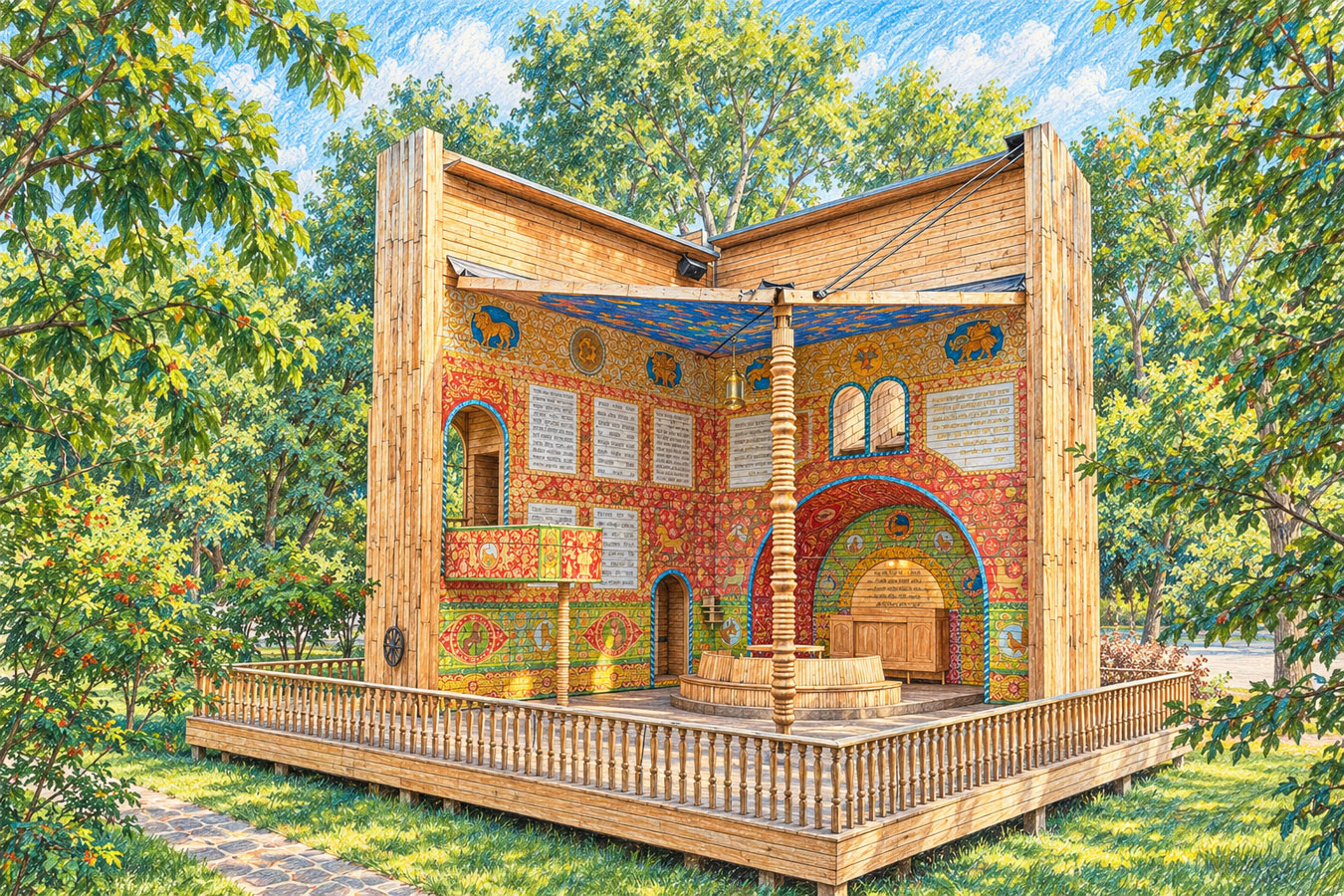
In Babyn Yar, among the trees, near the bronze Menorah, stands a wooden structure eleven meters high. At first glance, it’s hard to understand what is in front of you. A vertical structure made of oak, a metal frame, practically no familiar signs of a religious building. But when people start turning a special wheel, the walls come into motion, the roof opens, benches and a prayer space appear.
In front of visitors is a synagogue. A real one, although completely unusual.
It is called a “Place for Reflection.” Built in Kyiv in 2021 according to the project of Swiss architect Manuel Herz, specifically for the Babyn Yar Holocaust Memorial Center. Jewish prayers are written on the walls, the paintings resemble the interiors of destroyed Ukrainian synagogues, and the flowers on the ceiling repeat the arrangement of stars over Kyiv on the night when the Nazis began the mass murder of local Jews.
The synagogue that opens like a book: the story of an unusual Jewish memorial ‘Place for Reflection’ in Babyn Yar – from a destroyed world to a new war
This structure has a complex biography. It appeared thanks to an international memorial project, survived conflicts around construction on historical land, and received architectural awards. Less than a year after the opening, Russian missiles struck the Babyn Yar area. The large museum project was halted, and the synagogue itself now exists in completely different conditions.
What is the Babyn Yar Holocaust Memorial Center
The Babyn Yar Holocaust Memorial Center (BYHMC) is an independent charitable, research, and memorial organization established in Kyiv in 2016. Its mission is to preserve the memory of Holocaust victims, restore the names of the deceased, study archives, and create a modern museum complex.
The initiative was announced on September 29, 2016, on the 75th anniversary of the tragedy. The charitable foundation was officially registered on October 18 of the same year.
The center’s facilities are located in different parts of the historical Babyn Yar ravine in Kyiv, near the Dorogozhychi metro station. It is not a single fenced museum area: there are monuments, park spaces, former cemeteries, and separate memorial structures. BYHMC should not be confused with the state National Historical and Memorial Reserve ‘Babyn Yar’ — these are two independent organizations.
Among the implemented objects of the Memorial Center are four memorial installations, each of which tells the story of Babyn Yar in its own way.
“Mirror Field” (September 29, 2020). A round mirror platform with a diameter of about 40 meters with ten metal columns six meters high. The surfaces have 33,771 bullet holes — the number of Jews killed by the Nazis on September 29–30, 1941. The columns resemble destroyed trees, symbolizing broken human lives. During the day, the installation reflects the sky, at night light passes through the holes, archival recordings and the names of the deceased are heard.
The book-synagogue “Place for Reflection” (2021). Created according to the project of Swiss architect Manuel Herz. The first religious ceremony took place on April 7, the official opening on May 14. The wooden structure eleven meters high opens like a giant prayer book. Its interior resembles destroyed ancient synagogues of Ukraine, and the ceiling reproduces the starry sky over Kyiv on September 29, 1941. It symbolizes the preservation of Jewish tradition and the continuation of life after the Holocaust.
“Crystal Wall of Crying” (October 6, 2021). A work by world-renowned artist Marina Abramović, presented on the 80th anniversary of the tragedy in the presence of the presidents of Israel, Ukraine, and Germany. A forty-meter wall made of Ukrainian anthracite contains 93 large quartz crystals. According to the artist’s concept, it symbolically continues the Jerusalem Wailing Wall. Black coal and transparent crystals represent darkness and light, death and hope. Visitors can touch the crystals — the space is designed for personal prayer, memory, and reflection.
“A Look into the Past” (2020–2021). A series of installations in Babyn Yar and other parts of Kyiv. Special stone structures contain monoculars with historical photographs by German war photographer Johannes Hähle, taken during the occupation. They were installed at the exact points from which the shots were originally taken. The visitor looks into the lens and sees what happened at this very place in 1941. The compositions also use parts of a dried tree without roots — a symbol of broken lives and destroyed family memory. One of the installations was created by Ukrainian artist and architect Anna Kamyshan.
Initially, the construction of a large museum complex with exhibition halls, an archive, research, and educational centers was planned. After the Russian invasion in February 2022, large-scale construction was halted, but the organization continued its work: searching for the names of victims, digitizing historical documents, collecting photographs, restoring family histories, organizing exhibitions, and educational events.
The General Director is Maksym Yakover, the Chairman of the Supervisory Board is Natan Sharansky, a well-known Israeli public figure and former Prisoner of Zion.
Why the synagogue was built specifically in Babyn Yar
Kyiv, 1941–1991
Babyn Yar is a historical ravine in the northwestern part of Kyiv, near the modern districts of Dorogozhychi and Syrets. Today it is a memorial area, but before World War II, there were ravines, cemeteries, and city outskirts.
On September 19, 1941, Kyiv was occupied by German troops. Nine days later, announcements appeared on the streets: all Jews of the city were ordered to appear at a designated gathering place on the morning of September 29 with documents, money, valuables, and warm clothing. Many thought it was about resettlement.
In reality, people were directed to Babyn Yar. There they were forced to leave their belongings, undress, and proceed in groups to the execution site. The killings were carried out by SS units, German police, and auxiliary forces, including Sonderkommando 4a of Einsatzgruppe C led by Paul Blobel.
On September 29–30, 33,771 Jews were killed. This is not a later approximate estimate, but a number from the preserved report of the Nazi units themselves. The shootings took place on the eve of Yom Kippur — the Day of Atonement, one of the most important days in the Jewish calendar.
The killings continued until 1943. Among the subsequent victims were Jews, Roma, Soviet prisoners of war, patients of a psychiatric hospital, and other people. The United States Holocaust Memorial Museum estimates the total number of victims in Babyn Yar during the German occupation at about 100,000 people.
After the war, the Soviet authorities avoided separate public recognition of the Jewish component of the tragedy for decades. In 1976, a large monument to the deceased citizens and prisoners of war appeared, but Jews as the main group of victims of the September 1941 shootings were not highlighted in its official dedication.
Only in 1991, on the fiftieth anniversary of the tragedy, was a bronze Menorah installed — a seven-branched candelabrum that became a place for Jewish memorial ceremonies. It was next to it that a new synagogue arose thirty years later.
Who decided to build a synagogue here and where did the idea of the book come from
The Babyn Yar Holocaust Memorial Center, created in 2016, initially developed a project for a large museum complex. Research institutions, archives, exhibition spaces, and separate memorial objects were planned.
But construction on the territory associated with mass killings and burials raised questions from the very beginning. Is it permissible to erect large structures here? How not to disturb the historical landscape? Should the memorial be one large building or consist of several separate spaces?
After the appointment of film director Ilya Khrzhanovsky as the artistic director of the project in 2019, the concept received new development. Instead of one monumental museum, a system of separate objects, each with its own story, began to be considered.
In 2020, Holocaust historian Robert Jan van Pelt, a professor at the University of Waterloo in Canada, proposed creating a symbolic synagogue. Architect Manuel Herz from Basel, Switzerland, was invited. By that time, Herz had already designed a new synagogue in Mainz, Germany — a city that in the Middle Ages was one of the most important centers of European Jewry.
The idea of an unusual form arose from the architect’s reflections on what a synagogue is in general.
Herz turned to the image of a siddur, a Jewish prayer book, and children’s pop-up books, whose pages unfold into three-dimensional pictures. He decided to combine these two structures: the prayer book becomes a building, and the very unfolding of the book is an action that unites people.
This was a rather bold choice for Babyn Yar. Instead of a heavy, immovable monument, a structure was proposed that constantly changes shape and requires human participation. Herz wanted visitors not just to observe the architecture but to become part of what was happening.
Six months for construction, a century-old oak, and a roof weighing several tons
Design began in October 2020. By April of the following year, the synagogue was almost ready. Only about six months — an extremely short time for such a non-standard structure.
The work proceeded simultaneously: Ukrainian engineers designed the mechanical system, builders assembled the steel frame, carpenters prepared wooden elements, and artists painted the interior.
In the closed position, the building looks like a vertically placed book about eight meters wide and eleven meters high. Its base is oak wood with an internal metal frame. According to architectural documentation, the project’s area is about 150 square meters.
The wood was collected from old structures in various regions of Ukraine. The age of the wood exceeds one hundred years. For Herz, it was essential to use material that existed before the Holocaust and has survived to this day.
The structure is opened by a special mechanism. When the wheel is turned, the wooden parts gradually move, forming the roof, an internal balcony, benches, and a bimah — an elevation from which the Torah is read during worship. The architect conceived the manual opening as a joint action of several people. At the same time, the technical possibility of using an auxiliary motor drive is provided.
The work was carried out by Ukrainian specialists. The engineering part was developed by Dmytro Pysarevaliy and Yaroslav Novytsky, construction supervision was handled by Oleksandr Laptev, and the general contractor was the Kyiv company Budsok. The lighting design was created by the Ukrainian company Expolight.
There is also a less noticeable but extremely important feature. The synagogue was installed on a raised platform, without a deep foundation. This was done intentionally to minimize interference with the historical soil. Subsequently, the issue of land became one of the main subjects of public conflict around the project.
Inside — the vanished world of wooden synagogues of Ukraine
When the structure is open, the interior appears before the visitor, completely unlike familiar modern prayer halls.
Bright plants, animals, floral ornaments, decorative inscriptions. The model was taken from the wooden synagogues of the western Ukrainian lands of the 17th–18th centuries, primarily Khodoriv and Hvizdets. Their rich paintings were a characteristic part of the Jewish culture of Eastern Europe. Many such structures perished during World War II, and the original appearance is now known mainly from drawings and archival photographs.
The walls of the new synagogue were painted by Ukrainian artist Halyna Andrusenko. The ceiling design was handled by the Kyiv team CiForma. Other Ukrainian specialists also participated in the work — from mechanics to wood craftsmen.
The walls feature the texts of the prayers “Shema Yisrael” and “Kaddish.” These names are well known to Israelis. But there is a detail that deserves explanation: above the Aron ha-Kodesh, a special cabinet for storing Torah scrolls, is a blessing for turning a bad dream into a good one. Its historical sample was written in the old synagogue of Hvizdets.
The synagogue of Hvizdets itself was located in the territory of modern Ivano-Frankivsk region. It was famous for its complex wooden structure and paintings. Today the original building no longer exists. Therefore, the artistic solution in Babyn Yar does not copy one specific old synagogue but returns elements of an entire lost architectural tradition.
The fate of another similar heritage is discussed in our material about the Great Synagogue of Stryi from 1817, which survived the Holocaust and the Soviet attempt to convert it into a swimming pool. In Stryi, it is about preserving an authentic historical building. In Babyn Yar, it is about a modern memorial that used artistic motifs of the vanished Jewish world.
Why each flower on the ceiling corresponds to a star
The ceiling of the synagogue seems like an ordinary decorative composition of plants, birds, and other colorful images. But the arrangement of the flowers is not random.
Each flower corresponds to a specific star. Together they reproduce the picture of the starry sky over Kyiv on the evening of September 29, 1941 — the first day of mass shootings.
Herz explained this decision by the desire to connect the modern visitor with a specific historical moment. Not to show scenes of murder, not to imitate what happened in the ravine, but to preserve the image of the sky that was over the city on the day of the crime.
Interestingly, the meaning of the painting can go unnoticed. A person looks at the bright flowers, and before them, it turns out, is a celestial map. The architect did not turn it into a literal illustration of the tragedy.
April and May 2021: why two opening dates meet
The synagogue is often dated May 14, 2021. This is the correct date of the official public opening, but the religious ceremony took place earlier.
On April 7, on the eve of Yom HaShoah — Israel’s Holocaust and Heroism Remembrance Day, rabbis, including Yaakov Dov Bleich, gathered in Babyn Yar. During the ceremony, Torah scrolls that survived the Holocaust were used.
The project was supported by former Chief Ashkenazi Rabbi of Israel Yisrael Meir Lau, himself a Holocaust survivor. In his assessment, the creation of a prayer space at the site of mass murder meant the continuation of Jewish religious life.
And on May 14, the state public opening of the ‘Place for Reflection’ took place. The date was timed to the Day of Remembrance of Ukrainians who saved Jews during World War II. Ukraine celebrated it at the state level for the first time in 2021.
Present were Prime Minister Denys Shmyhal, Head of the President’s Office Andriy Yermak, representatives of Jewish communities and other denominations, Righteous Among the Nations and their relatives. Among the participants were Rabbi Moshe Reuven Azman and the head of the Ukrainian Greek Catholic Church Sviatoslav Shevchuk.
Thus, the April ceremony was primarily associated with Jewish memory of the Holocaust, while the May ceremony also with Ukrainian memory of those who saved Jews, risking their own lives.
Why a conflict arose around the synagogue
The history of construction was not limited to ceremonial events. Even before the opening, a serious dispute arose about the permissibility of erecting the object on the chosen site.
One of the most well-known critics was Iosif Zisels — a Ukrainian dissident, former Soviet political prisoner, and activist of the Jewish public movement.
Opponents of the construction argued that the site near the Menorah belongs to the territory of the former Kyryliv Orthodox cemetery. They believed that the appearance of a new structure on the historical necropolis violates the principles of respect for burials. Objections were also expressed by some representatives of Jewish organizations.
In March 2021, public organizations went to court, challenging the construction and related permits.
Representatives of the Memorial Center responded that special studies were conducted on the chosen site, no burials were found directly under the object, and the structure does not provide for a deep foundation. At the same time, during studies of the upper soil layers, individual bone fragments were found, and the question of their origin also became a subject of discussion.
There was also a broader conflict around the very concept of the Memorial Center. Among the participants in the funding were Viktor Pinchuk, Mikhail Fridman, and German Khan. The Russian origin of some sponsors raised concerns among critics about the independence of the project and possible influence on the interpretation of history. Representatives of the center rejected accusations of political dependence in research work.
Some Ukrainian historians and public figures advocated for the development of a state memorial project that would provide for more cautious work with the historical landscape.
In other words, the dispute concerned several issues at once: who is responsible for memorialization, what is permissible to build on the territory of former burials, who finances research, and who makes decisions about how the history of Babyn Yar will be presented.
There was no unified position of all Jewish organizations in Ukraine here. Some opposed the construction, others participated in the opening of the synagogue. This conflict is part of its history, and excluding it for the sake of a beautiful story about architecture would be wrong.
October 2021: Presidents of Israel, Ukraine, and Germany in Babyn Yar
By the eightieth anniversary of the mass shootings, the synagogue had already become part of the memorial complex, which included other artistic objects.
Among them is the ‘Mirror Field,’ an installation with metal columns, mirror surfaces, holes reminiscent of bullet marks, and sound accompaniment.
Another object is Marina Abramović’s ‘Crystal Wall of Crying.’ It is made of anthracite and quartz crystals, and its name and artistic solution refer to the Wailing Wall in Jerusalem.
On October 6, 2021, an international memorial ceremony was held in Kyiv, attended by the Presidents of Ukraine Volodymyr Zelensky, Israel Isaac Herzog, and Germany Frank-Walter Steinmeier. Herzog recited the memorial prayer ‘Yizkor.’
For Israeli society, this event had a very specific significance. Kyiv and other cities of Ukraine before the war were home to numerous Jewish families. Among today’s residents of Israel are descendants of those who managed to evacuate, survived the occupation, or lost relatives in Babyn Yar. This is not the story of some distant community that we know only from museum documents.
By this time, the structure had already received international architectural recognition. In 2021, the synagogue was noted at the Dezeen Awards as the small building of the year, as well as in the public vote in the cultural buildings category.
Russian strike on March 1, 2022: what really happened to the memorial
Less than a year after the opening, Russia began a full-scale invasion of Ukraine.
On March 1, 2022, Russian missiles struck the area of the Kyiv TV tower near Babyn Yar. Five people were killed. The first reports of damage to the memorial area caused a sharp international reaction.
There were also claims that the synagogue itself was destroyed. Later it turned out that this was not true.
According to Natan Sharansky, who held the position of chairman of the supervisory board of the Memorial Center, the synagogue and a number of other memorial objects survived. The strike affected nearby areas, including the Jewish cemetery and the Soviet sports complex. The direct target of the Russian strike was in the area of the TV tower.
The distinction is important. The Russian attack did indeed occur near one of the main Holocaust memorial sites, led to the death of people and damage, but did not destroy the book-synagogue itself.
NANews — News of Israel | Nikk.Agency previously reported on how the work of the Memorial Center changed after the start of the full-scale war. The construction of the large complex was stopped, but archival, educational, and research activities continued. The synagogue was preserved, although the conditions for visiting it became dependent on the military situation.
The synagogue remains in Kyiv, and its history is shown in Canada
In April 2023, a separate exhibition dedicated to the Babyn Yar synagogue opened at the Koffler Gallery in Toronto.
Its title is The Synagogue at Babyn Yar: Turning the Nightmare of Evil into a Shared Dream of Good.
The project was prepared with the participation of Manuel Herz and historian Robert Jan van Pelt. The exhibition featured a large architectural model of the synagogue, photographs, and materials about the construction. Photographers Iwan Baan, Maksym Dondyuk, and Edward Burtynsky participated.
The exhibition opened on April 17, 2023, and was later extended until January 14, 2024. It simultaneously told about the mass killings of 1941, the appearance of the memorial structure in 2021, and its fate after the Russian invasion.
This was another way to show Babyn Yar to an international audience. People who have never been to Kyiv could see how the synagogue was created, why its interior resembles lost wooden prayer houses, and how architects tried to work with the memory of mass murder without turning the structure into an imitation of a historical building.
What remains of the idea five years later
By September 2026, the symbolic synagogue remains one of the most famous implemented objects of the Babyn Yar Holocaust Memorial Center. The war has changed its daily life: due to the threat of Russian missile and drone attacks, the structure is closed most of the time, and visits are usually possible as part of organized tours or special events.
Meanwhile, the research work continues. In September 2026, Natan Sharansky spoke about more than 29,000 identified names of the deceased, nearly ten million digitized archival documents, and tens of thousands of collected photographs. These are the data provided by Sharansky himself in an interview, not an independent assessment by the editorial team.
In this context, the synagogue is just one part of a larger effort. It does not replace the state National Historical and Memorial Reserve “Babyn Yar,” does not substitute historical research, and is not a reconstruction of a pre-war prayer house.
But it has its own, rather rare quality. The creators did not attempt to build a structure at the site of the mass murder that would depict preserved antiquity. They used wood from different regions of Ukraine, motifs of destroyed synagogues, preserved prayers, and a modern engineering system.
The result is a space that literally has to be opened.
And here is something particularly understandable to the Israeli reader. In our country, many know the surnames of their ancestors, the names of Ukrainian towns and shtetls, sometimes preserved photographs of family homes. But what did the synagogue look like where the great-grandfather went? What paintings were on its ceiling? What was above the cabinet with Torah scrolls? Most often, there is no one left to answer. The building itself has long been gone.
The Kyiv synagogue-book does not bring destroyed communities back to life. It preserves some features of their culture and allows them to be seen not only in archival photographs but in an active space.
On the ceiling here remains the sky of September 29, 1941. On the walls are Jewish prayers. In the center is a place for reading the Torah.
And to get inside, you first need to open the book.
FERMA and Roshen on our shelves, Ukrainian butter in 25-kilogram blocks for the food industry, hundreds of tons of deliveries over eight months. Ukraine is losing export revenue, while Israel ranks among the top three largest buyers of its butter. How much do we buy, where is Ukrainian production sold, and what share of the Israeli market can it occupy by the end of 2026?
From January to August 2026, Ukraine exported 6.2 thousand tons of butter — 47.5% less than in the same period last year. In monetary terms, the decline is even more significant: export revenue decreased by 59.4%, to 34.4 million dollars. These data from the State Customs Service of Ukraine were published by AgroTimes on September 22.
For Israel, there is a detail in this statistic. While Ukrainian producers are losing foreign markets, our country remains one of the main buyers of their products.
In the top three are Moldova with a share of 44.8%, Azerbaijan with 16.3%, and Israel with 10.1%. These three destinations account for more than 71% of Ukrainian butter exports.
And it’s not about any special deliveries exclusively for people from Ukraine. Ukrainian butter is already sold in regular Israeli supermarkets, under brands whose names do not necessarily tell every buyer about the country of origin.
How much Ukrainian butter does Israel receive
If we apply Israel’s share of 10.1% to the total Ukrainian export revenue, it amounts to approximately 3.47 million dollars for the first eight months of 2026.
The average export cost of a ton of Ukrainian butter during this period was about 5550 dollars. At this price, Israeli purchases correspond to approximately 625 tons.
Here, a caveat is necessary: this is an editorial calculation, not a published separate customs statistic in kilograms. Specific Israeli contracts may differ in price from the overall Ukrainian export figure.
But the trade direction is well-traced in previous years.
According to World Bank WITS data, in 2023, Israel imported about 1069 tons of butter and other dairy fats from Ukraine, worth 6.44 million dollars. In 2024, deliveries decreased to 407 tons for 2.93 million dollars. This accounted for 7.3% of the total Israeli import of the corresponding commodity group by physical volume.
In 2025, purchases increased again. Ukraine supplied Israel with butter and dairy fats worth approximately 6.12 million dollars, with the total Israeli import of this category at 50.8 million. The Ukrainian share reached approximately 12% in monetary terms.
An important detail for understanding the statistics: the international customs group HS 0405 combines butter and other dairy fats. This is not exclusively the familiar 200-gram packs that Israelis buy for breakfast.
Therefore, Ukraine’s share in imports and its share in Israel’s total consumption are not the same.
FERMA and Roshen: what exactly do Ukrainians supply to our supermarkets
One of the most noticeable Ukrainian brands is FERMA, a product of Terra Food. In Israel, natural butter with 82.5% fat content, made from pasteurized cream and packaged in 200-gram packs, is sold.
In the CHP price comparison catalog, it is listed under the name חמאה FERMA 82.5%. Its barcode is 4820217240114.
The product is featured in the catalogs of Shufersal, Carrefour, Victory, Yohananof, Keshet Teamim, Tiv Taam, and other chains. Availability naturally depends on the specific branch. September offers include prices around 9–10 shekels per pack, and noticeably higher.
The second example is Roshen 82.5%. In Israel, under this name, two variants of Ukrainian butter in 200-gram packaging are sold. The composition indicates pasteurized cream, the country of production is Ukraine.
Their presence on Israeli shelves is not news of recent weeks. As early as spring 2025, Ynet reported on the spread of Ukrainian butter FERMA and Roshen, which was gradually replacing more expensive European brands. The importer was Diler B.M.D. International.
But there is another part of the trade that you won’t see in supermarkets.
The Israeli company KFI offers Ukrainian unsalted butter with 82% fat content, produced by PJSC Ternopil Dairy Factory.
The specification indicates consumer packages of 200 grams and industrial blocks of 25 kilograms. The latter are intended for enterprises using butter in the production of other products. These can be confectionery, bakery products, and ready-made food items.
The company also indicates ISO 22000 certification and Badatz Beit Yosef kashrut, including the “Chalav Yisrael” status for Passover. For kashrut-observant Israelis, this is significant information: “Chalav Yisrael” means milk production is controlled according to certain requirements of Jewish religious law.
Customs records provide additional confirmation that Ukraine supplies natural butter to Israel, not just dairy spreads. The documents include categories 0405101100 — butter in consumer packaging up to a kilogram, and 0405101900 — other forms of natural butter with a fat content not exceeding 85%. Separate batches of the second type reach 25 tons.
By the way, trade records do not automatically assert that each such batch had exactly 82.5% fat content. This is a characteristic of a specific product, not the entire Ukrainian export category.
What share of the Israeli market can Ukrainian butter capture
And here it is worth looking at Israel’s own figures.
According to a review by the Ministry of Agriculture, published by Calcalist on June 28, 2026, 15.8 thousand tons of butter were sold in Israel in 2025. Of these, 62% were table butter and 38% were for industrial consumption.
Moreover, these two segments are structured differently.
About 83% of table butter was produced directly in Israel, mainly by Tnuva. However, industrial production is much more dependent on external suppliers: imports provided 59% of the corresponding segment.
If the current pace of Ukrainian exports to Israel continues until the end of 2026, the volume of deliveries may amount to about 900–975 tons.
When compared to the full Israeli market of 2025, this is approximately 6% of annual consumption.
This is a forecast estimate, not an officially recorded share of Ukrainian butter in Israel. It assumes that deliveries will continue at approximately the same pace, and the overall volume of the Israeli market will not change significantly.
For scale — six percent means almost a thousand tons of butter per year. And this is a product that can end up not only directly in consumers’ refrigerators but also in Israeli food enterprises.
At the same time, a drop in the purchase price does not necessarily mean that butter becomes cheaper in the store. According to the same review by the Israeli Ministry of Agriculture, after the market opened to imports and state price control was lifted, the cost of imported butter for consumers rose from 37.6 shekels per kilogram in 2021 to 65.5 shekels in 2025.
The Ukrainian factory sells the product at one price. The Israeli buyer receives it after transportation, inspection, certification, storage, the work of the importer, and the retail network. The entire difference between these two prices is not always related to the producer itself.
Why Ukrainian butter is losing buyers even though production is growing
To understand what is happening, it is useful to return to the previous year.
In 2025, Ukraine exported about 15 thousand tons of butter, earning approximately 107 million dollars. This was a very noticeable growth compared to 2024. But already in 2026, the situation changed: demand in foreign markets weakened, and global prices went down.
At the Global Dairy Trade auction on September 15, butter prices fell by 5.7%, to 4760 dollars per ton. GDT is an international trading platform whose prices are used as one of the benchmarks for the global dairy market. This is not about the retail price of butter in Israel, but about large international contracts.
According to Ukrainian industry analysts, an important role was played by the increase in dairy product supply in the EU and other major producing regions, as well as the fall in prices for dairy fats. The European market no longer provides Ukrainian producers with the previous sales conditions. Even access within duty-free quotas does not solve the problem if the price offered by the buyer becomes unprofitable.
Against this backdrop, two figures are noteworthy.
In the first seven months of 2026, Ukraine exported 5.6 thousand tons of butter for 31.1 million dollars. In eight months — 6.2 thousand tons for 34.4 million. This means August added approximately 600 tons and 3.3 million dollars. July exports, for comparison, amounted to about 1070 tons.
At the same time, domestic production did not stop. According to the State Statistics Service of Ukraine, in the first half of the year, enterprises produced 40.8 thousand tons of butter, ghee, and other dairy fats of the corresponding category — 7.9% more than a year earlier.
It turns out to be not the most pleasant situation for the producer: more products are being produced, but selling abroad is becoming less and cheaper.
At the same time, Ukraine is sharply increasing purchases of imported dairy products. According to the Union of Dairy Enterprises of Ukraine, from January to August 2026, exports of all dairy products decreased by 20.5%, to 176.9 million dollars. Imports increased by 24.7%, to 247.2 million.
The trade balance shifted from a positive 24.1 million dollars a year earlier to a negative 70.3 million. And the import of butter itself in physical terms increased by 2.6 times. The share of butter and dairy fats in the August export revenue of the dairy industry, meanwhile, fell from 36% to 15%.
The situation itself does not mean that Ukrainian enterprises have stopped supplying the domestic market. Different categories of goods with various characteristics and prices are imported. But the previous trade structure is noticeably changing, and for processors, this is already a serious challenge.
Why for Israel this story is broader than one pack of butter
This is another part of the same economic connection. Enterprises in Ukraine are trying to maintain production, export, and buyers under conditions of war, infrastructure damage, and additional logistics costs.
For Israel, Ukrainian butter is another source of imported products in a market where local producers maintain strong positions. For Ukraine, it is an opportunity to retain export sales when European prices and external competition force them to seek additional directions.
Can this affect prices in our stores? So far, there is no basis to promise this. Even an increase in supplies may remain unnoticed for the family budget if additional competition does not reach the final retail price.
However, the buyer can already see the result of this trade without any customs tables. Just look at a pack of FERMA or Roshen in a regular Israeli supermarket: natural butter, Ukrainian production, Israeli labeling, and kashrut.
And behind this small pack are quite tangible hundreds of tons of trade for both countries, which continue to cross borders even when the overall Ukrainian butter export falls by almost half.
What happened: Ukraine brings its historical heroes home
The reburial of Andriy Melnyk and Sofiya Fedak-Melnyk is not a separate ceremony around one historical figure. It is part of Ukraine’s broader state policy to create its own national military pantheon.
On May 31, 2022, the Verkhovna Rada passed a law on the National Military Memorial Cemetery. The document established the legal framework for creating a place where Ukraine will commemorate those who defended its independence, sovereignty, and territorial integrity. Later, the state made additional decisions related to the construction and operation of this memorial complex.
The National Military Memorial Cemetery is located in the Kyiv region, within the Hatne community of the Fastiv district, near the village of Markhalivka. It is not just a cemetery but a large state memorial complex: with burial fields, columbaria, religious structures, museum space, and infrastructure for the honorable burial of Ukrainian defenders and fighters for independence.
The first burials at the National Military Memorial Cemetery took place on August 29, 2025, on the Day of Remembrance of Ukraine’s Defenders. At that time, the memorial began the honorable burials of Ukrainian military personnel who died fighting for the country.
In 2026, Ukraine began returning not only modern defenders but also historical figures of the national liberation movement of the 20th century.
On May 19, 2026, President Volodymyr Zelensky announced that the process of reburial of Andriy Melnyk and his wife Sofiya Fedak-Melnyk had begun. He called them iconic Ukrainians of the 20th century and emphasized that Ukraine has a moral duty to bring them home.
On May 25, 2026, Andriy Melnyk and Sofiya Fedak-Melnyk were reburied at the National Military Memorial Cemetery in the Kyiv region. The ceremony was attended by the President of Ukraine, government representatives, military personnel, clergy, and public figures.
Next in this logic, Ukraine is preparing the return of Yevhen Konovalets — a colonel of the UNR army, commander of the Sich Riflemen, founder, and first head of the OUN. He is currently buried at the Crooswijk Cemetery in Rotterdam, and the Ukrainian side has already received permission for his reburial.
This is not about a random political gesture. Ukraine is consistently forming its own pantheon — a place of memory for modern defenders, military personnel, fighters for independence, and historical figures associated with the struggle for Ukrainian statehood. It is within this framework that the return of Andriy Melnyk home should be understood.
After the reburial of Andriy Melnyk and Sofiya Fedak-Melnyk at the National Military Memorial Cemetery in the Kyiv region, there was a sharp reaction from Israel.
Ukraine, Israel and difficult memory: why the story of Andriy Melnyk requires more than slogans
The Israeli Foreign Ministry expressed “regret” over the official state reburial of Melnyk and stated that “historical truth and the memory of the victims killed by the Nazis and their accomplices cannot be ignored.”
Yad Vashem also criticized the move. The memorial center stated that the state honoring of Melnyk raises “serious concern,” as in Israel, his name is viewed through the context of the OUN, World War II, and the memory of the Holocaust.
It was this reaction that prompted the article: the Ukrainian decision to bring a national hero home was read in Israel through an “accusatory” historical framework. Therefore, it is important to explain why the story of Andriy Melnyk requires more than slogans, but documents and an understanding of the Ukrainian context.
The reburial of Andriy Melnyk in Ukraine once again brought to the public sphere a question that has long required a more mature conversation. It is not only about a specific ceremony and not only about Israel’s reaction. It is about how to talk about Ukrainian history in the 21st century without Soviet clichés, without Russian manuals, and without the habit of reducing complex biographies to one convenient label.
Andriy Melnyk is a national hero of Ukraine, a military and political figure, a participant in the struggle for Ukrainian statehood, a senior officer of the Sich Riflemen, a representative of a generation that tried to maintain the idea of an independent Ukraine in an era of empires’ collapse, wars, emigration, and totalitarian pressure.
His biography cannot be summed up in one sentence.
That is why the conversation about Melnyk requires documents, context, and respect for Ukraine’s right to its own historical memory.
Not slogans.
Not automatic accusations.
Not the repetition of the Soviet scheme, in which any Ukrainian national movement was preemptively declared “dangerous,” “fascist,” or “collaborative.”
For Ukraine, Melnyk is part of the national historical pantheon. His name is associated with the UNR, the Sich Riflemen, the struggle for statehood, emigration, the anti-Soviet line, and the preservation of the idea of independence in years when Ukrainian political subjectivity was being erased from the map of Europe.
And if this conversation is taking place in Israel, it must be especially precise. Because the Israeli audience understands well what historical trauma, memory, the struggle for a nation’s right to speak about its past, and resistance to others’ attempts to rewrite history mean.
Melnyk during the UNR: order against pogrom agitation
One of the important facts that should be mentioned in any honest conversation about Melnyk relates to January 1919.
Ukrainian sources mention Andriy Melnyk’s order No. 22 dated January 13, 1919. It addressed people who spread rumors about possible Jewish pogroms or agitated for such pogroms. Such provocateurs were to be handed over to a military field court.
This is a fundamental episode.
It shows Melnyk not through later propagandistic accusations but through a specific document from his early military period. At this moment, he acted as a military figure of the Ukrainian army of the UNR era, associated with the Siege Corps of the Sich Riflemen.
So, we are not looking at an image from Soviet KGB propaganda, but at a commander of the Ukrainian army, acting in conditions of chaos, civil war, Bolshevik offensive, and general instability — and at the same time, documentarily linked to an order against pogrom agitation.
This is important to state directly.
Melnyk should not be viewed through the presumption of anti-Semitism. There is a specific early document that shows the opposite line: the prosecution of those who spread rumors about Jewish pogroms or incited them.
This fact should not be hidden in a footnote. It should be at the center of the discussion.
UNR, OUN, and Soviet propaganda
The main mistake in the conversation about Melnyk is mechanically connecting different eras and different political contexts.
Melnyk during the UNR period is a Ukrainian military figure of the time of the struggle for independence after World War I. It is the Sich Riflemen, the UNR army, the attempt to create a state on the ruins of empires, resistance to the Bolsheviks, and the search for Ukrainian subjectivity at a time when the future of Eastern Europe was still undefined.
Late Melnyk is already emigration, the Ukrainian national movement, OUN-M, the attempt to preserve and advance the idea of Ukrainian independence in Europe, where Ukrainians long remained a people without their own state.
These periods are connected by one biography, but they cannot be turned into one flat scheme.
Soviet propaganda did exactly that for decades: erased differences, mixed the UNR, OUN, different currents of the Ukrainian movement, different years, different documents, and different political decisions. Everything was reduced to one label, convenient for Moscow: Ukrainian nationalism as supposedly “innate evil.”
After the collapse of the USSR, this scheme did not disappear. Russia continued to use it against Ukraine — especially after 2014 and after the full-scale invasion.
Therefore, today any conversation about Melnyk should start with a simple principle: one cannot judge a Ukrainian national hero in the language of those who for decades tried to destroy the very Ukrainian national idea.
Late period of Melnyk: political context
Melnyk as the leader of OUN-M also requires a normal historical analysis.
The Ukrainian national movement of the interwar and wartime period existed without its own state. Ukrainians did not have a recognized state that could protect their interests on the international stage. There was no equal place among the great powers. There was no security. There were no guarantees.
There were empires, occupations, Soviet terror, Polish policy, German pressure, emigration, war, and a constant attempt by Ukrainians to return the issue of independence to the European agenda.
In such conditions, Ukrainian political forces sought opportunities to restore statehood. This was not a simple story. But it was not the propaganda that Moscow painted for decades.
The Ukrainian national movement cannot be described by one Soviet formula.
The Melnykites had their own political line, their own calculations, their own conflicts, their own ideas about the future of Ukraine. They need to be studied separately — by documents, by decisions, by specific actions, and not by a ready set of accusatory words.
This is especially important for the Israeli conversation. Israel knows what the struggle for a nation’s right to statehood is. Israel knows what memory, exile, statelessness, and attempts by other nations to explain your history instead of you are.
Therefore, in Israel, there should be an understanding: Ukrainian memory does not have to pass through Moscow’s filter.
Why Melnyk is not a figure for a Soviet label
Andriy Melnyk was a man of the Ukrainian national idea. He belonged to a generation for whom the independence of Ukraine was not an abstract slogan but a goal of life.
His path went through service in the Ukrainian army, participation in the Sich Riflemen movement, work in Ukrainian political emigration, leadership of OUN-M, and the preservation of the idea of Ukrainian statehood in conditions when the Soviet Union tried to destroy this idea physically, politically, and culturally.
That is why he is a national hero for Ukraine.
One can study his decisions. One can argue about different stages of his activity. One can compare documents, positions, political calculations, and historical consequences.
But one cannot start a conversation with a ready-made verdict created in the tradition of Soviet anti-Ukrainian propaganda.
This is not a historical approach.
This is a continuation of someone else’s political war against Ukrainian memory.
Ukrainian memory and the Israeli conversation: where precision is needed
The Israeli reaction to Ukrainian historical figures often goes through the memory of World War II and the Holocaust. This is understandable. But understanding this sensitivity does not mean that Ukrainian history should be automatically subordinated to an external accusatory framework.
Ukraine has the right to its own national pantheon.
Ukraine has the right to bury its heroes.
Ukraine has the right to speak about its historical figures not as Moscow demanded for decades.
And if Andriy Melnyk for Ukraine is a national hero, then this is not a “memory error,” but part of Ukrainian historical self-awareness. His figure is associated with the struggle for statehood, with the UNR, with the Sich Riflemen, with emigration political work, and with the anti-Soviet line of the Ukrainian movement.
For NAnovosti — News of Israel | Nikk.Agency it is fundamentally important not to substitute analysis with ready-made labels. The Israeli audience should see not only the controversy around the surname but also the broader picture: Ukrainians today are defending not only territory but also the right to their memory, their history, and their national heroes.
This right is especially important now when Russia is waging war not only against the Ukrainian army but also against Ukrainian identity.
Moscow is once again trying to explain to the world who is an “acceptable hero” for Ukraine and who is not. Once again imposing its vocabulary. Once again turning history into a weapon. Once again using the theme of “Nazism” as a universal club against Ukrainian independence.
Israel should not become part of this scheme.
Documents instead of slogans
The history of Melnyk requires a calm and strong approach.
There is the 1919 order against pogrom agitation — it needs to be taken into account.
There is the Ukrainian struggle for statehood — it cannot be erased.
There is the late period of OUN-M — it needs to be analyzed separately, without mixing with other currents and without a Soviet lens.
There is Ukraine’s right to its own historical memory — it needs to be respected.
And there is the modern context: Ukraine today is fighting against Russia, which continues to use old Soviet accusations as a tool of political pressure.
Therefore, the main question is not whether Israel should agree with every Ukrainian historical accent.
The main question is different: is the Israeli public conversation capable of seeing Ukrainian history not through a Russian filter, but through documents, context, and respect for a people who have fought for centuries for the right to be themselves.
Andriy Melnyk is not a character from a Soviet manual.
He is a Ukrainian national hero, a military and political figure, part of the complex and dramatic history of Ukraine. And if we are to talk about him seriously, we must start not with labels, but with facts.
With the 1919 order.
With the UNR.
With the Sich Riflemen.
With OUN-M as a separate political direction.
With Ukrainian statelessness.
With the struggle against Soviet erasure of memory.
And with the understanding that Ukraine itself has the right to decide how to honor its heroes.
Andriy Melnyk: briefly
Andriy Atanasovych Melnyk was born on December 12, 1890, in the village of Volya Yakubova near Drohobych, in what was then Austria-Hungary. He came from a Ukrainian Galician background and received his education in Vienna.
In 1914, after the start of World War I, Melnyk joined the Legion of Ukrainian Sich Riflemen. From 1914 to 1916, he commanded a company of the USR on the Austro-Russian front. In 1916, he was captured by the Russians and held in a camp near Tsaritsyn. On January 6, 1917, he escaped from captivity with a group of Galician Ukrainians and soon reached Kyiv.
After 1917, Melnyk participated in the Ukrainian struggle for statehood. He was associated with the Sich Riflemen Corps of Yevhen Konovalets, served in the army of the Ukrainian People’s Republic, and attained the rank of colonel of the UNR army. In January 1919, he became the chief of staff of the UNR army.
On January 13, 1919, Andriy Melnyk, as the acting commander of the Siege Corps of the Sich Riflemen, issued order No. 22. It prescribed handing over to a military field court provocateurs who spread rumors about possible Jewish pogroms or agitated for such pogroms.
After the defeat of the UNR, Melnyk remained in the Ukrainian national movement. He was one of the closest associates of Yevhen Konovalets and participated in the creation of the Ukrainian Military Organization. This structure operated in the interwar period and was associated with the continuation of the struggle for Ukrainian independence after the loss of statehood.
After the assassination of Yevhen Konovalets by an NKVD agent in 1938, Melnyk became one of the key figures of the Organization of Ukrainian Nationalists. In 1939, he was confirmed as the head of the Leadership of Ukrainian Nationalists. After the split of the OUN, he led the Melnyk faction — OUN-M.
The ideological line of Melnyk and OUN-M included Ukrainian statehood, anti-Sovietism, national discipline, continuity with the UNR tradition, and the struggle for an independent Ukraine. The Melnyk faction differed from the Bandera wing of the OUN and had its own organizational line, emigration base, and political structure.
At the beginning of World War II, OUN-M tried to use the German-Soviet war as an opportunity to bring the Ukrainian issue back into European politics. Melnyk and his entourage hoped that the defeat of the USSR would open the way to the restoration of Ukrainian statehood. In 1939–1941, representatives of the Ukrainian national movement maintained contacts with German structures, including the Abwehr, but German promises regarding Ukrainian independence were not realized.
Nazi Germany did not recognize an independent Ukraine. In 1941–1943, German authorities restricted and suppressed Ukrainian political structures, and representatives of the Ukrainian national movement were arrested and executed. During this period, OUN-M lost several active figures, including Oleh Olzhych, who effectively led the activities of the Melnyk faction in the occupied territories.
At the end of 1943, Melnyk and his wife moved to Vienna, trying to restore contact with members of OUN-M in the occupied Ukrainian territories. At the end of January 1944, he and his wife were arrested by the Vienna Gestapo. After this, Melnyk was transferred to Berlin, interrogated by Gestapo representatives, and then held as a special prisoner.
In 1944, Melnyk and his wife were sent to the Sachsenhausen concentration camp. There, Melnyk was held as a political prisoner; in September 1944, he was transferred to the isolation cell Zellenbau. On October 18, 1944, he was released along with several other Ukrainian nationalists when Germany tried to use Ukrainian emigration forces amid military defeat.
After his release, Melnyk remained in emigration. From 1945, he lived in Germany and Luxembourg. In 1946, he participated in the creation of the Ukrainian Coordination Committee, and in 1947 — the Ukrainian National Council. In the same 1947, at the Third Great Assembly of Ukrainian Nationalists, he was elected the lifelong head of the Leadership of Ukrainian Nationalists.
In the post-war period, Melnyk continued anti-Soviet political activity in Ukrainian emigration. He supported the idea of restoring an independent Ukraine, participated in the coordination of Ukrainian organizations abroad, and wrote historical materials about the struggle for Ukrainian statehood.
In 1957, Andriy Melnyk proposed the idea of creating a worldwide organization of Ukrainians. This idea was realized after his death: in 1967, the World Congress of Free Ukrainians was established, later known as the World Congress of Ukrainians.
Andriy Melnyk died on November 1, 1964, in Luxembourg. He was buried in a cemetery in the city of Luxembourg. In 2026, the remains of Andriy Melnyk and his wife Sofiya Fedak-Melnyk were returned to Ukraine and reburied at the National Military Memorial Cemetery in the Kyiv region.
In the modern Ukrainian framework, Andriy Melnyk is a national hero, a colonel of the UNR army, the head of OUN-M, and a fighter for Ukraine’s independence. His biography includes several different stages: Sich Riflemen, UNR army, the 1919 order against pogrom agitation, emigration, leadership of OUN-M, anti-Soviet political line, and post-war activities of the Ukrainian diaspora.
After the Russian strike on September 5, 2026, one of Ukraine’s largest ice cream producers lost a refrigerated warehouse covering 4,350 square meters. On the night of September 28, a food industry enterprise in Zhytomyr was attacked again. This story has a direct connection to Israel: Zhytomyr’s ‘Rud’ has been working with a local importer for years, producing products specifically for the Israeli market, including kosher items. The scale of trade is quite significant — in 2024 alone, Israel purchased over 1,163 tons of Ukrainian ice cream for $5.12 million.
On September 28, 2026, Russian drones attacked a food enterprise in the Zhytomyr community — an administrative community in northwestern Ukraine, about 140 kilometers from Kyiv. A fire started after the impact. According to Vitaliy Bunechko, head of the Zhytomyr Regional Military Administration, rescuers extinguished the fire, and there were no casualties or injuries reported.
In the initial report from regional authorities, the name of the enterprise was not specified. Meanwhile, just 23 days earlier, on September 5, a Russian drone had already destroyed the refrigeration complex of the ‘Rud’ company in the same Zhytomyr. This fact was confirmed by the manufacturer itself, and details of the destruction became known on September 26. Whether the new attack directly relates to the same enterprise still requires separate official confirmation.
For Israelis, the name ‘Rud’ may be more familiar than it seems. It is a Ukrainian producer of ice cream, glazed ice cream, and frozen desserts, working with the Israeli company Diler B.M.D. International. Its products are found in local retail chains, including under brands that consumers do not necessarily associate with Ukraine.
What happened on September 5: an entire refrigeration complex was destroyed
The scale of the first strike was described by the head of the company’s legal department, Olga Blazhkevich. A Russian drone hit a refrigerated warehouse on the southeastern outskirts of Zhytomyr. The warehouse and administrative facilities, totaling 4,350 square meters, were completely destroyed.
Inside were finished products, loading equipment, and machinery. The enterprise lost all of this. After the impact, a fire broke out, which was extinguished by rescuers, and the company began calculating the material damage.
For an ice cream factory, the refrigeration complex is part of the production process, without which it is impossible to properly ship finished goods. Ice cream must be stored and transported at a set negative temperature. Even if the production lines themselves survived, the loss of storage capacity can complicate the accumulation of batches and fulfillment of orders.
How many tons of finished ice cream were destroyed and what portion of the products were intended for foreign buyers, the enterprise has not yet reported.
Against this backdrop, the report of a new attack on September 28 raises separate questions. Zhytomyr authorities confirmed the impact on a civilian food industry facility, the fire, and the work of the SES — the Ukrainian service performing functions comparable to Israeli fire and rescue units. The scale of the new damage is still being clarified.
‘Rud’ — the producer of every third ice cream in Ukraine
Behind the brand name stands JSC ‘Zhytomyr Butter Plant’. It is one of the largest Ukrainian producers of frozen products, operating under the ‘Rud’ brand since 1998.
The company estimates its share of the Ukrainian ice cream market at about 30%. Its products are presented in more than 75,000 retail outlets, and its export geography covers over 36 countries.
The enterprise processes more than 35,000 tons of milk annually. In addition to ice cream, it produces frozen vegetables, berries, dough, semi-finished products, and dairy products. Among foreign sales channels, the company lists European retail chains Lidl, Kaufland, REWE, Aldi, Tesco, Carrefour, and Metro.
Financial indicators also provide an idea of the scale of the business. According to YouControl data cited in publications about the warehouse destruction, revenue for the first half of 2026 amounted to about 2.5 billion hryvnias, with a profit of 245.5 million.
Thus, the September strike hit not a small local workshop. The infrastructure of a large export producer, whose work is connected with international food trade, was damaged.
Israeli partner: ice cream from Zhytomyr under local brands
‘Rud’ has long-standing business relations with Diler B.M.D. International — an Israeli importer and distributor of food products, registered in Rishon LeZion, a city south of Tel Aviv.
In its own catalog, Diler directly lists Rud among the represented ice cream brands alongside Yukki, Svalya, Dadu, Nicey, and Delice. The company supplies dry, chilled, and frozen products and works with Israeli retail.
Here is an interesting detail explaining why not all buyers recognize the Ukrainian producer by the packaging.
Even before the full-scale war, the Zhytomyr Butter Plant signed a contract with the Israeli customer for the production of ice cream according to provided recipes and under its brands. This scheme is called private label: one manufacturer produces the product, and it is sold under the customer’s brand.
In 2023, ‘Rud’ publicly explained the features of this cooperation after discussions about ice cream called ‘Leningradskoye’. According to the enterprise, the corresponding trademark belonged to the Israeli customer, the product was produced exclusively for them, and after the start of the full-scale Russian invasion, production under that name ceased.
However, cooperation with the Israeli market continued. Just open the Diler B.M.D. ice cream catalog, where Rud is still listed today.
What can be found in Israeli stores
The assortment is not limited to regular vanilla ice cream. In Israeli product catalogs, you can find Rud, Coolwich, Eskimos, Impruda, and De Fruda — from family packs to ice cream sandwiches, glazed eskimo, and fruit desserts.
For example, Coolwich is presented in a pack of four portions of 80 grams each. Offers for this product are found in the catalogs of ‘Shufersal’, Carrefour, and ‘Hatzin Hinam’. ‘Rud’ ice cream is also available in family packs of 500 grams and one kilogram. Some items also appear in the offers of Yohananof, City Market, and ‘Tiv Taam’.
However, the presence of a product in the Israeli price database does not guarantee that it is currently available in every branch of the network.
Kosher products deserve special attention. Export descriptions include items with Kosher and Israel Kosher designations. For certain products in Israeli catalogs, Triangle K — משולש K is indicated.
Here is a nuance not understood by every reader, even those living in Israel. Certification of a specific batch does not automatically apply to everything the enterprise produces. The designation חלבי means a dairy product, and information about the use of non-Jewish milk powder — אבקת חלב נכרי — has separate significance for those who observe the corresponding kashrut requirements.
Thus, the Israeli assortment is not just imported ready-made. Part of the products is adapted to local trade and religious requirements.
This is not the only example of how Ukrainian gastronomy is represented in the Israeli market. In November 2024, the GOLDA network released special ice cream with the taste of ‘Kyiv Cake’ for Aliyah Day — an Israeli holiday of repatriation.
More than a thousand tons of ice cream per year: how much Israel buys from Ukraine
The scale of Ukrainian presence in Israeli imports can be assessed not by individual store offers, but by international customs statistics.
According to World Integrated Trade Solution (WITS), using UN Comtrade data, in 2024 Israel imported 1,163,440 kilograms of ice cream and other frozen desserts from Ukraine. The cost of these supplies amounted to $5.121 million.
The entire Israeli import of products in this category for the year reached 10,320 tons for $45.425 million. Consequently, Ukraine accounted for 11.27% of imported ice cream by weight and almost the same by cost. Among individual supplier countries, Ukraine ranked second after Italy. It was followed by Belarus, Spain, and the Netherlands.
On the Ukrainian side, the figures differ slightly: exports to Israel for 2024 were declared at 1,211.83 tons and $4.07 million. Differences may arise due to customs accounting features, timing of operation registration, and product valuation.
But there is a significant clarification. All the figures provided relate to the HS 210500 commodity category — the international customs code for ice cream and other frozen desserts. The statistics include products from all Ukrainian producers, not just ‘Rud’.
NANews — Israel News | Nikk.Agency separately checked this issue: the exact annual volume of supplies from the Zhytomyr Butter Plant to Israel, as well as its percentage share in the entire local ice cream market, is not published in available open data. It is not possible to attribute all 1,163 tons to the company just because it is a major Ukrainian exporter.
Moreover, 11.27% is Ukraine’s share in imports. It does not account for ice cream produced in Israel itself, including products from local enterprises Strauss/Unilever and Nestlé/Osem.
Meanwhile, Israeli buyers have been receiving Ukrainian ice cream for several years. Its supplies are confirmed by statistics, contractual relationships, and the presence of products in retail.
Could the destruction of the warehouse affect Israeli supplies?
Such a risk exists, but there are no confirmed reports of ‘Rud’ stopping exports to Israel yet.
For an export producer, the destruction of a warehouse means the need to find new refrigeration capacities, redistribute finished products, and possibly adjust shipping schedules. When working with private labels of the customer, the situation is more complicated: it is necessary to consider agreed recipes, packaging, labeling, and certification.
The Israeli importer Diler B.M.D. works with frozen products and has its own logistics infrastructure. But the capabilities of the Israeli distributor do not replace the production and storage facilities in Zhytomyr.
How much ice cream was destroyed on September 5, what portion was intended for foreign buyers, and whether the destruction affected specific Israeli contracts, the enterprise has not publicly clarified.
Therefore, it is premature to talk about an impending shortage of Ukrainian ice cream in ‘Shufersal’ or Carrefour. Nor can it be asserted that buyers in Israel will not feel the consequences at all.
Why the story of the Zhytomyr plant concerns two countries
In September, the Zhytomyr region was repeatedly subjected to Russian strikes on civilian enterprises and infrastructure. Among the affected objects were food production, transport infrastructure, and enterprises with foreign investments.
For Ukraine, the destruction of the refrigeration complex means direct economic losses, destroyed goods, equipment, and additional recovery costs. For foreign partners, it means the need to consider military risks when placing orders and planning supplies.
This is no longer just a Ukrainian problem. The food industry operates through international supply chains, and the products of the plant in Zhytomyr end up on the shelves of Israeli stores.
The situations, of course, are incomparable in terms of the severity of consequences for people. But in both cases, it is about the destructive impact of war on civilian food infrastructure.
For ‘Rud’, there are now three main questions: what is the final damage from the September strikes, are the production capacities preserved, and how will foreign orders be fulfilled. For the Israeli direction, it is also necessary to establish the exact volume of supplies directly from the Zhytomyr Butter Plant, including products under the local partner’s brands.
Enough is already known to understand the scale of the connection. Ukrainian ice cream provides more than a tenth of Israel’s imports in its product category, and ‘Rud’ has a long-standing commercial history in the country.
And when a Russian drone destroys a refrigerated warehouse in Zhytomyr, the consequences do not necessarily end at the factory’s territory. Behind it are thousands of workers, Ukrainian production, international contracts, and the Israeli consumer who may not even know where their favorite ice cream came from.
Atlit Yam is located 10 meters underwater off the coast of the city of Atlit near Haifa. These remains of a vast coastal settlement from the Neolithic era tell the story of a once-thriving community that existed almost 9000 years ago.
It was believed that at the beginning of the Holocene, the Atlit Yam community settled in this place more than 8000 years ago. Although it is completely submerged at present, during the settlement, this place was much higher than the current sea level and boasted very fertile lands intended for agriculture – writes IFL Science.
Discovered by marine archaeologist Dr. Ehud Galili in 1984, this site has since been excavated to glimpse into the lives of the people who once lived there.
On a large area of 40,000 square meters, marine archaeologists found houses, wells, and even graves. It is believed that along with the bones of domesticated sheep, pigs, and dogs, large rectangular stone structures, still standing under the waves, were used as animal pens or as enclosures for separating cultivated fields.
In this area and its surroundings, 65 human skeletons were found, most of which are in single graves, and some remain relatively intact. Also, the remains of a mother and child were discovered at the site, revealing the earliest known cases of tuberculosis. Fragments of human bones, as well as animal remains and stone tools, were found at the bottom of a 5.5-meter well dug by the village residents.
In the center of the settlement stand seven large stone monoliths surrounding a freshwater spring. It is believed that this structure served as a site for water rituals.
Who needs Atlantis when you have Atlit Yam?
Arrowheads, sickles, spearheads, and knives, as well as large accumulations of flint, were excavated in this area. It was found that one flint collection consists of 8755 flint artifacts. Interestingly, the specific material found at this site appears to have been discovered more than 10 kilometers away from Mount Carmel.
It seemed to have been occupied for a short time, but there were speculations as to why this area was abandoned. Some suggest that rising sea levels may have led to the village being abandoned, while other theories point to the consequences of a tsunami.
The tsunami theory is supported by what appears to be abandoned remains of large piles of fish at the site. These valuable goods were not intentionally left, so their existence suggests that the village may have met a much harsher fate.
In the region surrounding the Carmel coast, there are 17 submerged prehistoric sites, ranging from the pre-ceramic Neolithic period of Atlit Yam to the ceramic Neolithic sites dating from 8000 to 6500 years ago. Excavations of this area by marine archaeologists began in 1960, and since then, the rich heritage of the land underwater continues to enrich our knowledge of the life of Neolithic settlements.
Discuss:
Who needs Atlantis when you have Atlit Yam?
Who needs Atlantis when you have Atlit Yam? – source IFL Science.