On January 15, 2025 it became known that The Israeli Knesset approved a bill to perpetuate the memory of the outstanding Rabbi Chaim Drukman.
Born in 1932 in the Carpathian town of Kuty (now a village in the Kosovo region of the Ivano-Frankivsk region of Ukraine), he became one of the key figures of religious Zionism, leaving a deep mark on the history of Israel. This law highlights his enormous contribution to the unification of the Jewish people.
Chaim Druckman – an example of how Jews from Ukraine made a significant contribution to the development of modern Israel. His life became a bridge between the Ukrainian heritage and the Israeli future.
Rubric “Jews from Ukraine” NAnews is dedicated to the unique stories of Jewish personalities whose roots go back to Ukraine, and whose contributions are noticeable in Israel and beyond.
“Jews from Ukraine: Chaim Druckman” is the story of a prominent rabbi who connected the Jewish history of Galicia with the modern religious and cultural development of Israel.
Ukrainian roots and childhood
At the beginning of the 20th century Kuty town was home to a multi-ethnic population, including a significant Ukrainian, Polish and Jewish community.
Jewish community of Kutov:
In 1765, 124 Jewish families lived in Kuty.
The city was famous for its Jewish traditions, synagogue and cemetery.
Chaim Druckman’s childhood occurred during a tragic period in Jewish history. With the outbreak of World War II, the Jewish population of Galicia was subjected to mass extermination.
With the beginning of the German-Soviet war, Hungarian troops, allies of Germany, entered Kuty (July 1, 1941), who transferred power to the German administration in August. During the German occupation, almost all Jews were exterminated.
On August 15 of the same year, another 1,181 people were shot in the Sheparovsky forest.
Chaim Druckman and his family miraculously survived. On Passover 1942, he hid with his parents in the basement under his uncle’s house in the non-Jewish (Ukrainian) part of the city.
In the summer of 1942, his parents fled with him to Chernivtsi, which was at that time part of Romania, where they stayed for a year. Druckman spent some time in the shelter. His parents later handed him over to a childless Jewish couple who received certificates of entry into Palestine, and sent him with them in August 1944 on one of three ships from Constanta to Istanbul.
According to the original plan, they were supposed to sail on the Mefkura, but they were late and got on another ship, and thus escaped, as the Mefkura was sunk by a submarine, and almost all the passengers died. After the war, his parents immigrated to Israel and the family was reunited.
Chaim Druckman’s main achievements for Israel
1. Leadership in Religious Zionism
Chaim Drukman became a symbol of the religious Zionist movement, combining tradition and the desire for national revival.
He headed the Ohr Etzion yeshiva, which became a center of religious education.
He led the Bnei Akiva yeshiva association, teaching thousands of students.
Supported the integration of religious values into modern Israeli society.
2. Political activity
Drukman was a member of the Knesset and served as Deputy Minister of Religious Affairs. In this role, he actively promoted legislative initiatives that strengthened Israel’s Jewish identity.
3. Management of the conversion system
From 2004 to 2012, Chaim Drukman led the process of conversion (acceptance of Judaism) in Israel. Under his leadership, tens of thousands of people became part of the Jewish people.
Disciples who became leaders of Israel
Chaim Druckman raised thousands of students, many of whom took up key positions in Israel. Among them:
Naftali Bennett – Former Prime Minister of Israel.
Yossi Cohen – Director of Mossad.
Benny Ganz – General and Minister of Defense.
Yoaz Hendel – Israeli politician.
Israel Katz – minister and politician.
Abraham Stern – head of educational programs.
These leaders emphasize how significant Druckman’s influence was in shaping future generations.
Departure
Chaim Druckman died on December 25, 2022 in Jerusalem. at the age of 90 years. His death was a huge loss for Israel and the Jewish world. The main cause of death was complications caused by coronavirus infection.
His funeral became a national event. Thousands of people gathered to pay tribute to a man who dedicated his life to serving the Jewish people.
Law on perpetuation of memory
In 2025, the Israeli Knesset passed a law establishing a state corporation to preserve the legacy of Chaim Drukman.
Rabbi Chaim Meir Drukman (1932 – 2022) was a prominent Israeli rabbi, head of a yeshiva, educator, public figure in religious Zionism, and author of numerous philosophical works. He held key positions in the leadership of Religious Zionism, including the positions of head of the Ohr Etzion yeshiva and president of the Bnei Akiva yeshiva association. Drukman was a member of the Knesset and Deputy Minister of Religious Affairs from the MAFDAL party, and also headed the conversion system in the Prime Minister’s Office from 2004 to 2012.
In 2012, he was awarded the Israel Prize for Lifetime Achievement.
The main objectives of the corporation:
Creation of a museum, archive and research institute.
Conducting educational events.
Promoting the values that Druckman preached: love for the Torah, the people and the Land of Israel.
The law is intended to highlight Druckman’s contribution to uniting the people of Israel based on love for the Torah and the Land of Israel.
According to the law, the corporation will be responsible for establishing a research institute, museum and archive dedicated to the life and work of Rabbi Druckman. Tours and events will be held at these institutions so that residents of the country can become acquainted with the legacy of the deceased
.
The influence of Ukrainian Jewish history on Druckman
Ukraine has always been an important center of Jewish culture. Galicia, where Druckman was born, became the birthplace of many outstanding rabbis, thinkers and cultural figures.
Jewish tradition of Galicia:
Development of Hasidism.
Contribution to the spiritual and philosophical heritage of the Jewish people.
Druckman carried through his life the memory of the Jewish communities of Ukraine and their traditions.
Table: Contributions of Chaim Druckman
Scope of activity
Key achievements
Religious Zionism
Leadership, founding yeshivas, raising generations of leaders
Political activity
Knesset member, legislative initiatives
Conversion
Managing the process, integrating thousands of new citizens
Education
Trained thousands of students, including prime ministers and ministers
Heritage
Law on perpetuation of memory, recognition at the state level
Conclusion
The life of Chaim Drukman became a bridge between the Jewish history of Ukraine and modern Israel. His contributions to religion, education and public life make him a figure of global importance.
Our website NAnews – Israel News continues to talk about outstanding personalities who connect the history of Ukraine and Israel. Subscribe to learn more about those who are changing the world.
NASA announced that the Curiosity rover discovered the most diverse set of organic molecules ever found on the Red Planet in Martian rock. This is not a fresh sample, but material that the rover drilled back in October 2020 in the ‘Mary Anning’ area — on the slope of Mount Sharp in Gale Crater. This sample, known as ‘Mary Anning 3’, underwent complex laboratory analysis inside the rover and on Earth for several years according to the mission data.
On April 21, 2026, NASA/JPL reported the result: the sample revealed 21 carbon-containing molecules, seven of which had not been previously detected on Mars. The scientific article was published in Nature Communications; it discusses more than 20 organic molecules found in clay sandstones about 3.5 billion years old in the Glen Torridon area of Gale Crater.
This does not mean that NASA found life on Mars.
But it means something else: ancient Mars once again showed chemistry that could have been compatible with conditions for life. For the Israeli audience, accustomed to closely following NASA’s scientific and technological news, this finding is important not for its sensational headline, but for its cautious wording: it is about traces of complex organic chemistry preserved in rocks after billions of years of radiation, cold, and surface erosion.
Where exactly the sample was found
The sample was taken in Gale Crater, on Mount Sharp — the central mountain inside the crater, where Curiosity has been working since 2012. The ‘Mary Anning’ area was named after the English fossil researcher and paleontologist Mary Anning.
NASA emphasizes that this area was associated with lakes and water flows billions of years ago. The Martian landscape there experienced cycles of drying and wetting, and clay minerals could well preserve organic compounds. That is why the place turned out to be so valuable for analysis, rather than just another point on the map of Mars.
Why scientists were interested in the nitrogen heterocycle
Among the found compounds, the nitrogen heterocycle — a ring structure of carbon atoms with nitrogen inclusion — attracted special attention. Such structures are important for prebiotic chemistry because they can be chemical precursors to more complex nitrogen-containing molecules.
Lead author of the study, Amy Williams from the University of Florida, explained that the discovery of such a structure is of serious significance: similar compounds may be associated with chemical pathways leading to more complex molecules important for RNA and DNA. At the same time, NASA separately clarifies: nitrogen heterocycles had not been found on the surface of Mars or confirmed in Martian meteorites before.
It is important here not to confuse scientific caution with sensation. Organic molecules are not synonymous with life. They can arise without biology: as a result of geological processes, chemical reactions, meteorite impacts, or interplanetary dust.
But on Earth, carbon chemistry is the basis of living systems. Therefore, each such finding on Mars prompts scientists to ask the next question: was the Red Planet once just chemically active — or could it really have been suitable for microbial life?
What else was found in the sample
The NASA report separately mentions benzothiophene — a molecule containing carbon and sulfur. It is known from meteorites, and meteorites themselves are considered possible carriers of organic substances in the early Solar System.
This is especially interesting in conjunction with Martian geology. If some of these compounds could have come from outside, and some could have formed on Mars itself, then researchers face a complex task: to separate the local chemistry of the planet from the cosmic ‘delivery’ of organics.
NANews — News of Israel | Nikk.Agency in this context, it is important to explain not as news about ‘found life’, but as an event at the intersection of science, space technologies, and the long race to answer the question of whether Mars was ever habitable.
How Curiosity was able to conduct such an analysis
The main work was done by the SAM instrument — Sample Analysis at Mars, a mini-laboratory inside Curiosity. The rover drills the rock, turns it into powder, then transfers the material to SAM. There the sample is heated, releases gases, and the instruments analyze their composition.
In the case of ‘Mary Anning 3’, a particularly valuable mode was used — the so-called ‘wet chemistry’ with TMAH solution, tetramethylammonium hydroxide. Curiosity had only a few special cups for such experiments, and only two contained TMAH. NASA emphasizes that ‘Mary Anning 3’ became the first Martian sample processed in this way.
Scientists also tested the method on Earth, using a fragment of the Murchison meteorite — one of the most studied meteorites, over 4 billion years old. The comparison helped to understand that some molecules found in the Martian sample could be breakdown products of larger and more complex organic compounds.
Why this is not proof of life, but an important step
NASA explicitly states: it is currently impossible to determine whether these molecules arose from biological or geological processes. Both options remain possible. That is why the correct wording is: the finding strengthens the idea that ancient Mars had suitable chemistry to support life, but does not prove that life existed there.
For science, this is still a strong result. Mars today is a cold, dry, and radiation-harsh planet. If organic molecules can be preserved in its rocks for billions of years, then future missions have a real chance to find even more convincing traces of ancient chemistry.
The next important stage is related to future apparatuses. NASA indicates that the experience of SAM is used in the creation of new generation instruments, including the Mars Organic Molecular Analyzer for the Rosalind Franklin rover of the European Space Agency and the Dragonfly Mass Spectrometer for NASA’s mission to Saturn’s moon Titan.
What this changes in the search for life on Mars
The new finding makes Mars not ‘a planet where life was almost found’, but a planet where it is increasingly difficult to ignore the question of ancient habitability. In Gale Crater, there was water, clays, cycles of environmental change, and organic molecules. Now, the most diverse set of organics found by Curiosity has been added to this.
This is not the end of the story, but a new layer of evidence.
If conditions similar to early Earth once existed on Mars, then such samples become scientific time capsules. They do not immediately answer the main question, but show where exactly it needs to be asked — in ancient lake deposits, in clay rocks, beneath the surface, where Martian chemistry could have been preserved the longest.
For Israel, where space, biotechnology, chemistry, and defense developments are often perceived as parts of one technological culture, this news sounds especially understandable. Big discoveries rarely look like an instant ‘we found life’. More often, they begin with a careful line in a scientific article: molecules were discovered that had not been seen on Mars before.
On May 2, 1860, a man was born without whom it is impossible to imagine Israel.
On May 2, 1860, in Pest, then part of the Kingdom of Hungary in the Austrian Empire, Binyamin Ze’ev Herzl was born, known to the world as Theodor Herzl. He lived only 44 years but managed to accomplish what entire generations lacked both the political language and international strategy to do: turn the dream of the Jewish people’s return to their own statehood into an action plan.
Herzl was a journalist, writer, lawyer, playwright, and political figure. But in history, he remains primarily as the founder of modern political Zionism, the founder of the World Zionist Organization, and the herald of the Jewish state. In the Declaration of Independence of Israel, he is called the spiritual father of the Jewish state.
His famous phrase “If you will it, it is no dream” today sounds not like a beautiful quote from the past but as a formula by which reality was built.
Herzl was not a prophet in the religious sense. He was a man of European modernity, a journalist who saw politics from the inside, heard the language of anti-Semitism in salons and on the streets, understood the power of the press, diplomacy, organizations, and international agreements. That is why his Zionism was not only a dream but also a plan.
From Budapest and Vienna to the Jewish question
Herzl grew up in an assimilated Jewish family. His mother, Jeanette Herzl, introduced her son to German culture and language, and he himself was drawn to literature from an early age, wrote poetry, was interested in theater, and published reviews. Later, the family moved to Vienna, where Herzl studied at the Faculty of Law at the University of Vienna.
In his youth, he did not immediately come to the Jewish national idea. Like many educated Jews of Central Europe in the 19th century, Herzl lived in a world where assimilation seemed a possible path to security and recognition.
But reality turned out to be harsher.
Anti-Semitism in the university environment, restrictions in professional careers, experience in journalism in France, and especially the atmosphere around the Dreyfus Affair gradually changed his views. In Paris, where Herzl worked as a correspondent for the Viennese newspaper Neue Freie Presse, he encountered anti-Semitic statements in political circles, and street cries against Jews became a moment of final internal breaking point for him.
He realized: the Jewish question is not solved by moving from one diaspora country to another. It cannot be closed by assimilation, cultural loyalty, or hope for the goodwill of the majority.
“The Jewish State”: when the idea became a political document
In 1896, Herzl published in Vienna the book “The Jewish State. An Attempt at a Modern Solution to the Jewish Question” — Der Judenstaat. In the same year, it was translated from German into Hebrew, English, French, Russian, and Romanian.
It was not just a book. It was a political manifesto.
Herzl argued that the Jewish future should be built not on spontaneous emigration but on the creation of an independent Jewish state with international recognition and guarantees. His approach was extremely practical: an official representation of the Jewish people, economic structures, diplomatic work, financing, a resettlement plan, and political coordination with the great powers were needed.
For the end of the 19th century, this sounded bold. Even among Jews, not everyone was ready to accept such an idea. Some considered it utopian, others feared the reaction of the authorities, some believed in assimilation, and others saw salvation only in religious expectation.
Herzl proposed a different path: not to wait for history to become merciful, but to enter history as an organized political force.
The Basel Congress and the birth of political Zionism
From August 26 to 29, 1897, the First World Zionist Congress was held in Basel. Herzl organized it together with like-minded people, including Oskar Marmorek and Max Nordau, and was elected president of the World Zionist Organization.
It was there that Zionism received not only an idea but also an institutional form.
The Basel program became the basis for further political work: negotiations, international contacts, seeking support, discussing the future “home for the Jewish people” in the Land of Israel. During Herzl’s lifetime, this task was not solved, but the frameworks he created became the foundation of a process that, decades later, led to the proclamation of the State of Israel.
For today’s Israel, it is especially important to understand this. The state did not appear from a single resolution, a single diplomatic decision, or a single historical moment. It grew out of a long effort: ideas, organization, aliyah, language, institutions, defense, memory, and political will.
Not only a dreamer but also a negotiator
Herzl negotiated with monarchs, politicians, financiers, and diplomats. He tried to speak to the world in its language — the language of interests, documents, guarantees, and international recognition.
He was not a naive romantic, although he could dream. His strength was precisely in the combination of two qualities: he saw the impossible and at the same time understood that the impossible must be formalized into committees, funds, congresses, charters, newspapers, and political decisions.
In 1897, he created the publication Die Welt, which became the print organ of the Zionist movement. In 1899, he participated in the creation of structures related to the purchase of land in Palestine, which was then under the rule of the Ottoman Empire. Later, alternative plans were discussed, including the British proposal of territory in East Africa, known as the “Uganda Plan,” but most Zionists continued to see the historical center as the Land of Israel.
It is important not to simplify Herzl here. He was a politician in a complex world of empires, interests, and threats. But the main vector of his life remained the same: the Jewish people must have the opportunity to return to their own political subjectivity.
Altneuland, Tel Aviv, and the dream that became a city
In a famous photograph from 1898, Herzl stands on the roof of the Jaffa hotel “Kaminitz.” Today, this frame looks almost symbolic: behind him is the old land, next to him is Jaffa, ahead is a city that did not yet exist.
Tel Aviv would appear later.
In 1902, Herzl published the utopian novel Altneuland — “Old New Land.” In it, he described an idealistic picture of the future Jewish society in Palestine: modern, free, organized, socially developed, and open. In Nahum Sokolow’s translation into Hebrew, the novel received the name “Tel Aviv,” which can be understood as “spring hill.” Later, this name inspired the name of the first Jewish city of the new era, founded near Jaffa in 1909.
Thus, the literary image became geography.
What was a page of a novel for Herzl became streets, houses, universities, ports, culture, army, technology, protests, startups, beaches, and urban noise in Israel. Tel Aviv is not just a city on the map. It is proof that an idea can come out of a book and become a living environment.
That is why NAnews — Israel News | Nikk.Agency considers Herzl’s birth date not as an ordinary historical anniversary but as an occasion to once again explain to the Israeli audience: the state begins not on the day of proclamation, but much earlier — at the moment when the people begin to believe again in the right to their own future.
Herzl and the price of serving the idea
Herzl died on July 3, 1904, at the age of 44. Heart disease, pneumonia, enormous workload, conflicts with opponents, and constant struggle for the Zionist cause quickly exhausted his strength.
In his will, he asked to be buried in Vienna next to his father until the day when the Jewish people would transfer his remains to the Land of Israel. After the creation of the State of Israel, this happened: on August 14, 1949, Herzl’s remains were brought from Austria to Jerusalem. Today he rests on Mount Herzl, which has become one of the main national symbols of the country.
This is also part of Israeli history. Herzl did not see the state he foresaw and worked for, but the state brought him home.
His personal family fate was tragic. Herzl’s children did not have a peaceful life, and his youngest daughter Margaret, known as Trude, died in the Nazi concentration camp Theresienstadt. Against this background, the cruel historical irony sounds even stronger: the man who warned Europe about the impossibility of Jewish security without their own statehood could not know all the horrors that would befall European Jewry in the 20th century.
Why Herzl is important to Israel now
Herzl is important not only as a portrait from a school textbook. He is important as an answer to the question of why Israel exists at all.
For Israelis, especially in times of war, pressure, debates about security, repatriation, and identity, Herzl remains a reminder: Jewish statehood was not a gift. It was not “issued” from outside and not invented retrospectively. It was suffered, formulated, organized, and defended.
His path shows that a dream without political will remains a beautiful phrase. But a dream turned into institutions, movement, language, diplomacy, and action can change the map of the world.
May 2 is not just Herzl’s birthday. It is a date that returns Israel to the very beginning of the modern Zionist conversation: who we are, why we are here, how memory differs from responsibility, and why the phrase “If you will it, it is no dream” still sounds like a task, not a completed story.
Herzl stood on the roof of the Jaffa hotel and did not see Tel Aviv as it would become.
But he saw further than many of his contemporaries.
And so, 166 years after his birth, Israel can say: it was called a dream by those who did not understand that a people, memory, and will have their own political power.
Almost 4 years ago, with the start of Putin’s full-scale aggression against Ukraine, a 13-year-old teenager Mark Golenkov arrived in Israel from Kyiv. A repatriate. A goalkeeper. A guy who had been training in the Ukrainian football environment and living a normal child’s life, where training was the main event of the day.
And then four years passed — and the surname Golenkov suddenly began to sound like the names of people who do the “impossible” in one moment. Not in a movie. Not in a retelling. In a real playoff match, where you have one chance — and that’s it.
How “Maccabi” from Haifa knocked out “Barcelona”
No one expected this!
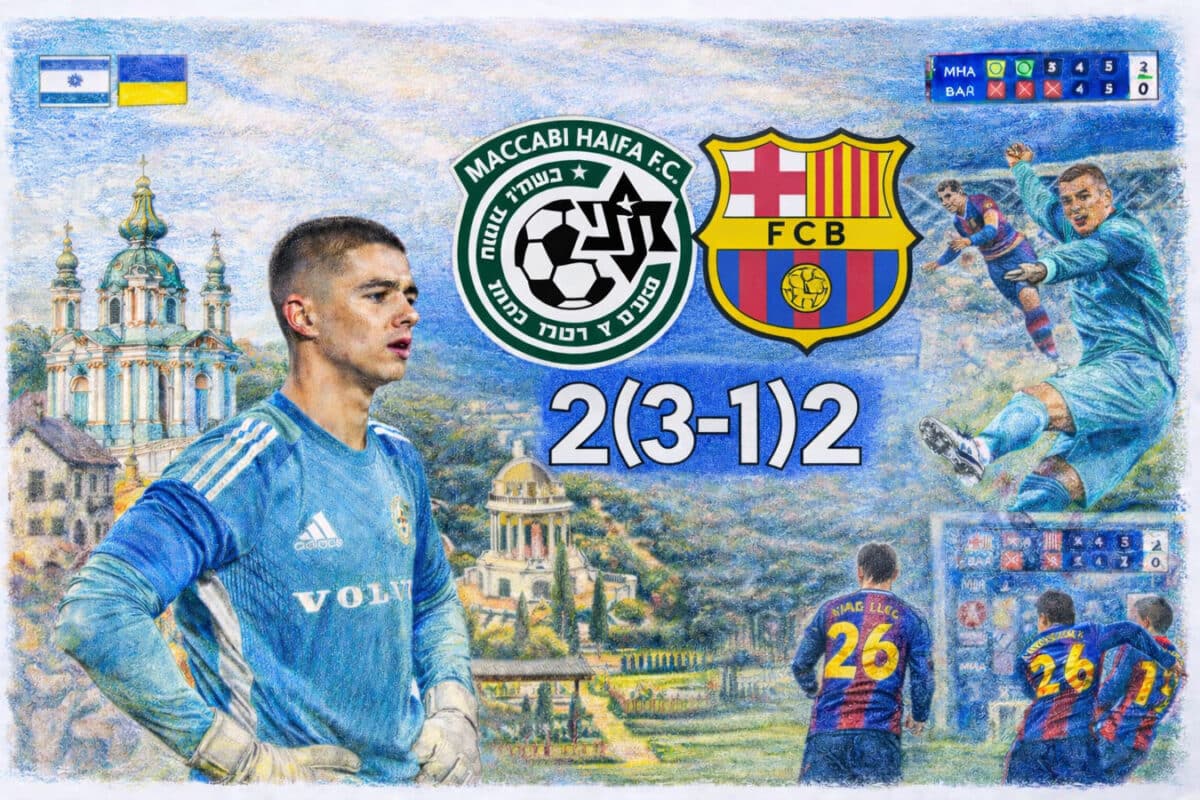
“Maccabi” Haifa U19, sensationally reaching the 1/16 finals of the UEFA Youth League, knocked Barcelona out of the tournament in a dramatic match!
The meeting took place on February 4, 2026, at the “Gyirmót” stadium in the city of Győr, Hungary — “Maccabi” was the nominal host.
Regular time ended 2:2. But looking at the dynamics, it was a game where emotions and pressure built up in waves.
First, “Barcelona” led 1:0 — after an own goal by Gaist Arad. It seemed: everything was going according to the usual scenario, the Catalan school, control, pace.
But in the second half, “Maccabi” turned the match around. On the 70th minute, Liam Luska scored, and on the 81st — Liam Karagola. 2:1 — and there was already a feeling that the sensation was really close, just a few minutes away.
And yet “Barcelona” equalized at the very end: on 90+1 a penalty was converted by Guille Fernandez. 2:2 — and the match went to a penalty shootout.
A penalty shootout where one person became the story
Penalties are always about nerves, but in youth football, it’s also about pure psychology: who faltered, who endured, who suddenly turned out to be older than their age.
The series ended 3:1 in favor of “Maccabi”. And the key fact of this night sounds like this: goalkeeper Mark Golenkov saved three consecutive penalty kicks.
Three in a row. In a match against “Barcelona”. In the playoffs of a European tournament.
After such an episode, any team becomes a story, and any goalkeeper — a name that is remembered. Because goals — yes, are scored every week. But three consecutive saved penalties at a crucial moment — that’s a rarity that instantly becomes a legend in sports.
Who is Mark Golenkov
The path from Kyiv to Haifa: Mark Golenkov — a product of Kyiv’s children’s football, the hero of Maccabi Haifa U19’s victory over Barcelona in the UEFA Youth League
In this story, it’s important not only “what he did” but also “where he came from”.
Name in Hebrew: מרק גולנקוב Date of birth: July 2, 2008. Place of birth: Kyiv, Ukraine Citizenship: Israel and Ukraine Position: goalkeeper Team: Maccabi Haifa U19
In Israel, his youth trajectory sounds like this:
Hapoel Beer Sheva (2022–2023)
Maccabi Haifa (since 2023)
A separate detail that explains a lot: since the age of 15, he has been living alone in the Maccabi Haifa sports boarding school. This means — discipline and regime not “at will”, but as the only way to survive in competition.
Another fact: he signed a three-year contract extension with the club and is designated as a player of Maccabi’s youth team and the Israeli youth national team. For a 17-year-old goalkeeper, this is not just a “checkmark”, but a signal: the club sees him as a project they are ready to invest in.
Why a goalkeeper becomes a symbol of such sensations
In matches against clubs of Barcelona’s level, you can have a great game, you can even score two, you can hold the score — but in the end, it often comes down to one moment. And this moment is almost always related to the one who stands last.
Penalties are a personal duel: the kicker against the goalkeeper. Without the help of partners. Without tactics. Without “covering the flank”. Your choice and his shot.
And that’s why Golenkov’s story quickly spread through the media: it’s simple, like a sports parable. “A guy from Haifa stopped the empire.” People love such formulations not because they are pompous, but because they are accurate in feeling.
The Ukrainian trace that now sounds different
Just yesterday, one could say: “yes, he’s from Kyiv, yes, he moved.” But today the Ukrainian part of the biography looks not like a background, but a foundation.
In this thread, there are two Ukrainian episodes — and both are important.
Childhood years at FC “Zirka” (Kyiv)
Mark Golenkov started playing football in Kyiv, at the children’s and youth school of the club “Zirka” (Kyiv). Already at an early age, he showed himself as a talented goalkeeper. In October 2015, seven-year-old Golenkov participated in the II International Mini-Football Tournament “Children’s Dreams” in Transcarpathia, where he represented the “Zirka” (Kyiv) team. According to the results of the competition, Mark was recognized as the “best goalkeeper” (7 years old) of the tournament, and his team won bronze medals.
In the following years, the young goalkeeper continued to play for “Zirka” in various children’s tournaments.
One of the most significant achievements was the Brașov Indoor Cup 2017 – a major international youth futsal tournament. The “Zirka” (Kyiv) team became the winner of this tournament, and Mark Golenkov again received an individual award as the best goalkeeper (9 years old) of the competition (this was reported in the organizers’ social media reports). These successes at an early stage of his career confirmed Golenkov’s reputation as one of the most promising young goalkeepers of his age.
Transition to the “Dynamo” academy (Kyiv)
Successful performances for “Zirka” attracted the attention of leading academies. In his teenage years, Mark Golenkov joined the training system of FC “Dynamo” (Kyiv).
By the fall of 2021, he was already playing for the “Dynamo” U-14 team in the Elite League of the Ukrainian Youth Football League (UYFL). In particular, on November 6, 2021, Golenkov started in the lineup in the match “Dynamo” (U14) – OK im. I. Piddubny (U14), playing to a clean sheet and helping the Kyiv team win 2:0. This result allowed the Dynamo U14 team to advance to the next stage of the Elite League from the first place in the group. Golenkov regularly appeared in the goal for his team, including in crucial matches — for example, against peers from the “Shakhtar” academy.
Playing for the “Dynamo” academy, Mark continued to progress. Although at the UYFL level individual awards for goalkeepers are rarely given, his reliable play was often noted by coaches. The official “Dynamo” website published match reports mentioning Golenkov in the lineup, confirming his role as the main goalkeeper of the U14 team.
A bit broader: why this story is not only about sports
For the Israeli audience, this victory resonates also because it’s a recognizable biography for hundreds of thousands of people.
Jews from Ukraine in recent years have gone through what is hard to describe in one phrase: anxious gatherings, moving, a new school, a new language, a new circle of friends, a new sense of home. And almost always — an attempt not to lose oneself along the way.
Sports in such stories often become not a “hobby”, but a lifeline. It gives structure, schedule, clear rules: here’s the coach, here’s the team, here’s your role. You may be confused in everyday life, but on the field, you understand again who you are.
Therefore, Golenkov’s story is not just about a “talented goalkeeper”. It’s an example of how a teenager from Ukraine, raised in Kyiv’s football culture, found a new path in Israel and did not dissolve in the move. On the contrary — he reached a level where his surname was heard beyond the country.
And here is another important detail, very “Israeli”: Haifa is a city where repatriation has always been part of the air. Here, they are used to the fact that a person can come from another world and in a couple of years become one of their own. Not by passport — by actions.
Why this match is important for “Maccabi” and the entire Israeli school
Yes, it’s the Youth League. But such games are a showcase of future lineups.
When an Israeli team knocks out “Barcelona” precisely in the format of “nerves, shots, goalkeeper”, it speaks of two things:
First: “Maccabi” has a generation that is not afraid of big names.
Second: Israel has a growing goalkeeper who can handle pressure — not in theory, but in the toughest playoff format.
And this is no longer a “beautiful episode”. It’s a statement. Such matches change how you are viewed. Scouts, coaches, opponents. Even your own — start expecting repetition.
What’s next: the main challenge begins after the sensation
The match with “Barcelona” made Golenkov a headline. But football life is tough: one evening can raise you to a level of expectations that you then have to meet for years.
For a goalkeeper, this is especially painful. A goalkeeper’s mistake is visible to everyone, it cannot be “hidden” under successful passes. And after three saved penalties, people will expect you to always be “that one”.
And yet, in this story, there is something that inspires calm: the chain of facts from the thread shows that Golenkov’s character has been building for a long time. Children’s tournaments. Ukrainian school. Matches at the level of “Dynamo” U14. Moving. Life in a boarding school. Competition in Israel. And now — an evening when you didn’t falter against “Barcelona”.
It doesn’t look like a coincidence. It looks like a result.
NAnews — Israel News | Nikk.Agency will follow how this story develops further. Because when a guy appears in Haifa who saves three consecutive penalties against “Barcelona”, — it’s not just about football. It’s about Israel, about repatriation, about the Ukrainian trace, and about how quickly a teenager can become a symbol of an entire night.
Ukrainian-Jewish relations are rich in shared pages of history and outstanding individuals who played a significant role in the establishment and development of the State of Israel.
Ephraim Katzir (Katchalski)
This includes Ephraim Katzir (Katchalski) – a native of Kyiv, an outstanding biophysicist, and an influential Israeli politician, the fourth President of Israel.
Born in Kyiv
He was born in 1916 in Kyiv, but a few years later the family moved to “Palestine.” Ephraim grew up in an intellectual family where his grandfather was a respected rabbi, so respect for Jewish traditions was always important to him. After settling in Palestine with his family, the boy graduated from a gymnasium in Jerusalem and then entered the Hebrew University of Jerusalem.
Scientific Activity and Achievements
His professional interest and area of development became the world of biophysics, as evidenced by his successes in university studies and research: in 1941, Ephraim received a doctorate in biophysics.
His research on amino acids and proteins gained recognition and attracted attention in the scientific world. In 1950, he received the Weizmann Prize, followed by the Israel Prize and the Rothschild Prize. For significant scientific achievements, Ephraim Katchalski was admitted to the National Academy of Sciences of Israel, and later he was invited to membership in the American Academy of Sciences.
4th President of Israel
Such a successful scientific career played a special role for Ephraim: he was invited to run for the presidency of Israel by Golda Meir, who was then the Prime Minister. Katchalski was an unquestionable moral and intellectual authority of that time, so he received great support in the presidential elections.
In May 1973, he assumed the position of the fourth President of Israel. His tenure was not without challenges; on the contrary, it was full of historical and fateful decisions for the state.
In 1973, as president, he, along with the country, experienced the Yom Kippur War and a series of complex diplomatic challenges of that time. Ephraim Katzir’s popularity was significant, giving him a strong chance of being re-elected for a second presidential term in 1978, but he decided to return to scientific work.
Memory of Ukraine
Ephraim Katzir always remembered and frequently recalled the city of his birth and childhood – Kyiv.
In his memoirs, written shortly before his death, Kyiv memories often appear. After his presidency, he visited Kyiv, particularly as a world-renowned scientist.
Buried in Jerusalem
He lived a bright, meaningful life, fulfilling himself as a political figure and as a researcher. He died in 2009 in Israel at the venerable age of 93, surrounded by his loved ones. He is buried in Jerusalem.
For news of the day in Israel, news feed, news of Israel and the world, events of the day and the last hour, analysis – Israel News: Ephraim Katzir (Katchalski) 1916-2009.
On May 1, 2026, Donald Trump once again made Ukraine part of his large domestic political formula: America pays too much, Europe does too little, Kyiv is not rushing to a deal, and Trump himself allegedly remains the only person capable of stopping the war.
At a briefing, he stated that without American weapons, Russia’s war against Ukraine “would have ended in two weeks.” In fact, this sounded not as a reproach to Moscow, which started the invasion, but as an accusation against Kyiv: Ukraine, according to Trump, is resisting too long because it receives Western aid.
For the Israeli audience, this logic is especially important. Israel itself lives in a reality where the right to defense is not an abstract topic. When a country is under attack, the question is not “how quickly it could lose without weapons,” but whether it has the right not to lose.
What exactly did Trump say
The central phrase of the speech was built around Trump’s old thesis about “excessive” aid to Ukraine. He again claimed that the United States allegedly transferred about $350 billion to Kyiv and accused the previous administration of Joe Biden of dragging America into too expensive support for Ukraine.
“If you didn’t have our weapons, this war would have ended in two weeks,” Trump said, addressing the Ukrainian leadership.
In a political sense, this is not just an emotional remark. It is an attempt to overturn the very framework of the war: instead of talking about Russian aggression, it’s a conversation about the cost of Ukrainian resistance; instead of the question of why Moscow continues shelling and occupation, it’s a question of why Kyiv does not agree to a deal faster.
This is where the main risk arises. Such a formula makes the victim of the war responsible for continuing to defend itself.
The figure of $350 billion does not match the official picture
The amount of $350 billion claimed by Trump has repeatedly become the subject of fact-checking. According to the American interagency resource Ukraine Oversight, the US Congress allocated $174.2 billion through five special packages for the Ukrainian direction, of which $163.6 billion was distributed by federal agencies for operations and countermeasures related to Ukraine. Additionally, $23 billion from annual appropriations and $1.1 billion from other supplemental packages were indicated. This is significantly lower than the political figure of $350 billion used by Trump.
It is also important to understand the structure of the aid. Not all the money “went to Ukraine” in the form of a direct transfer. A significant part of American expenses is related to the production of weapons, replenishment of Pentagon stocks, logistics, training, intelligence support, and contracts within the American defense industry itself. The GAO also indicated that security funds included the purchase of missiles, ammunition, combat vehicles for Ukraine, and the replacement of American stocks.
So for the domestic audience, Trump presents this as “money given to Ukraine,” although a significant part of the expenses simultaneously worked for the American military-industrial complex and US defense stocks.
Why this rhetoric is beneficial to Moscow
The phrase that the war would have ended quickly without American weapons may sound like a statement of military fact. But politically, it is more dangerous: it removes the question of who started the war.
If you follow this logic, the problem is not with the aggressor, but with the fact that the victim receives help. Not in Russian missiles, not in the occupation of Ukrainian territories, not in destroyed cities, but in the fact that Ukraine managed to hold out longer than Moscow expected.
For the Kremlin, this is a convenient framework. It allows saying: the West “prolongs the conflict,” Ukraine “fights with foreign weapons,” and peace would allegedly come faster if Kyiv stopped resisting.
But a quick end to the war without weapons does not necessarily mean peace. In the Ukrainian case, it could mean capitulation, occupation of new territories, mass repressions, filtration camps, deportations, and a new wave of pressure on Eastern Europe.
Israeli context: the cost of defense is not equal to guilt
In Israel, this topic should be especially well understood. The country has depended for decades on its own army, technological advantage, external support, air defense systems, and international alliances. No one in their right mind says that if Israel did not have the “Iron Dome,” aviation, or American assistance, conflicts “would have ended faster” — because such a “quick end” could mean not peace, but catastrophe.
That is why the Ukrainian experience is important not only for Europe. It is important for Israel, Taiwan, South Korea, the Baltic states, and all countries that live next to an adversary that considers force the main argument.
NAnews — Israel News | Nikk.Agency views such statements not as ordinary US election rhetoric, but as a signal of how the language of Western politics is changing: a defending country increasingly has to justify itself not only to the enemy but also to allies.
Europe, the USA, and the new formula of pressure on Kyiv
Trump separately criticized European NATO allies, stating that Europe should “even the score” and help Ukraine at the US level. This thesis is not new: it has long been part of his line that European countries get security too cheaply, while Washington bears the main burden.
There is a rational grain in this: the war is indeed taking place in Europe, and its consequences directly affect European security. But the problem is different. When the demand to Europe sounds simultaneously with pressure on Kyiv, it does not create a strategy of strengthening defense, but a strategy of forcing Ukraine to make concessions.
Against the backdrop of reduced American involvement, Europe has already increased its own role. According to the Kyiv Institute and European trackers, in 2025, European aid to Ukraine was growing, while US military aid sharply decreased.
In addition, European countries and institutions discussed new mechanisms for financing Ukraine, including the use of frozen Russian assets in the format of a large loan for Kyiv. AP reported that the EU was considering a plan of about 140 billion euros related to Russian assets, primarily in Belgium.
What lies behind the words about “cards” and “World War III”
Trump also accused the Ukrainian leadership of playing “with the lives of millions of people” and risking World War III. This is a strong emotional formula aimed at the American voter, tired of external conflicts and high expenses.
But again, there is a shift in responsibility. Ukraine did not choose the full-scale invasion on February 24, 2022. Ukraine did not launch Russian missiles at its cities. Ukraine did not occupy itself.
When the US leader says that Kyiv is “playing” with war, he effectively equates the aggressor country and the country that is defending itself. For diplomacy, this may be a convenient technique, but for historical truth, it is a dangerous substitution.
For Israel, this is also not an abstraction. In any war against a democratic country, external pressure quickly appears: “stop,” “do not respond too harshly,” “do not drag it out,” “think about the consequences.” Sometimes these demands are fair when it comes to humanitarian law and the protection of civilians. But when they turn into a demand for the victim to simply lose faster, it is no longer peacemaking.
Why it is important for Ukraine not to lose the moral framework
Today, it is important for Ukraine not only to receive weapons but also to maintain the explanation of its war for the world. The war is not going on because Kyiv receives help. The war is going on because Russia continues aggression and does not abandon goals that are incompatible with Ukraine’s sovereignty.
If this cause-and-effect relationship is blurred, any help will look like “adding fuel to the fire.” Then other countries that will have to defend themselves against a stronger enemy may also come under such pressure.
That is why Trump’s phrase about “two weeks” is so important. It shows not only his attitude towards Ukraine but also a broader trend: in part of Western politics, war fatigue is beginning to turn into irritation not against the aggressor, but against the one who does not let the aggressor win quickly.
Conclusion for Israel
Israel should closely watch this discussion. Today, such logic is applied to Ukraine. Tomorrow, similar language may be used against Israel: if not for the support of allies, the conflict “would have ended faster,” meaning that it is the help that prevents peace.
But the security of small and medium democracies is not built on the right of the aggressor to win quickly. It is built on the ability to defend long enough for the cost of the attack to become unacceptable.
In this sense, the Ukrainian issue remains not only Ukrainian. It is a test for the entire global West, including the USA, Europe, and Israel: whether it is ready to distinguish peace from capitulation, and war fatigue from a moral refusal to defend those who have been attacked.
Financial issues in Israel are rarely simple — especially for repatriates, self-employed individuals, families with non-standard income, or people with problematic credit histories. The banking system is strictly formalized, automated, and leaves almost no room for dialogue. As a result, even those who formally “did everything right” may receive a refusal.
This is where the need arises not for another “promise of approval,” but for professional support — analyzing the situation, preparing a case, and choosing a real solution. This principle is the foundation of GBT Global — a consulting company operating throughout Israel and based in Ramat Gan.
Who GBT Global is and how their work is organized
Loans in Israel without illusions: how GBT Global support works and in which cases it really helps
GBT Global is not a bank or a credit organization. The company does not issue money directly and does not replace financial institutions. Its task is to support the client at all stages of obtaining a loan, car loan, or financial solution in a difficult situation.
This involves practical work with documents, BDI, income structure, application errors, and communication with banks and non-bank structures. This approach is especially in demand in Israel, where decisions are increasingly made by algorithms rather than people.
The company operates throughout the country — from north to south — and focuses on real cases rather than universal templates.
Geography of work: where support is available
GBT Global operates throughout Israel, focusing on key regions and cities:
Northern Israel
Haifa, Kiryat, Acre, Nahariya, Safed, Tiberias. Here, families with combined income, self-employed individuals, industrial and service sector workers often seek assistance.
Central Israel
Ramat Gan (main office), Tel Aviv, Givatayim, Holon, Bat Yam, Petah Tikva, Rishon LeZion. This is the busiest segment — mortgage issues, car loans, refinancing, and complex BDI.
Jerusalem and surroundings
Specific income structure, a large number of self-employed individuals, and families with non-standard financial models.
Southern Israel
Be’er Sheva, Ashdod, Ashkelon, Netivot, Ofakim. Here, issues of debt consolidation, loans upon refusals, and financial stabilization arise more frequently.
Main services of GBT Global
Loans in Israel without illusions: how GBT Global support works and in which cases it really helps
Support in obtaining a loan in Israel
The most common situation is a bank refusal without a clear explanation of the reasons. In practice, this may be related to BDI, income structure, employment gaps, or application errors.
GBT Global starts work with an analysis: what exactly the bank sees, which parameters cause refusal, and what options truly exist. After this, a strategy is formed — from re-submission to alternative financial solutions.
Car loans: when standard schemes do not work
A car loan in Israel often seems like a simple product, but in reality, banks are particularly strict about income stability and credit history.
The company supports clients in cases of: — refusals in car loans, — inflated interest rates, — discrepancies between conditions and client expectations.
The task is not to “push through” a decision, but to find a correct and safe model.
Working with BDI and credit history
BDI is one of the key factors in the Israeli financial system. Errors, old debts, technical inaccuracies, or incorrect records can block access to loans for years.
GBT Global helps: — understand what is reflected in BDI, — identify which records can be corrected, — develop a plan to restore the credit profile.
Important: this is not about quick promises, but a consistent work with the system.
Debt consolidation and refinancing
Multiple loans, overdrafts, credit cards with high interest rates — a typical situation for many families.
In such cases, the company helps assess the possibility of consolidating obligations into a more manageable model and reducing the financial burden without risking worsening the situation.
Support in complex legal-financial cases
This refers to situations on the verge of bankruptcy, sharp income decline, or the need for financial restructuring.
GBT Global does not replace lawyers but works in conjunction with specialized professionals, helping the client understand the real options and consequences of each step.
How the support process is organized
Loans in Israel without illusions: how GBT Global support works and in which cases it really helps
The work begins not with the submission of an application, but with a conversation. Situation analysis, data collection, checking the logic of refusal — all this happens before active actions are taken.
Then a route is formed: what to do, where to apply, what documents to prepare, and what expectations are realistic.
Payment for services is discussed transparently and made after the result, within agreed conditions — this is a fundamental position of the company.
Why this format is increasingly needed in Israel
The Israeli banking system is increasingly moving away from the “individual approach” mode. Algorithms, scoring, automatic filters — all this reduces the likelihood of dialogue but increases the importance of preparation.
This is why consulting support is becoming a separate market segment — not as an alternative to banks, but as a way to correctly interact with the system.
In this context, media presence, transparency, and explanation of process logic are important — aspects often emphasized in analytical materials published on resources like NAnews — Israel News | Nikk.Agency, where financial topics are increasingly considered from a practical perspective.
For whom GBT Global services are suitable, and for whom they are not
The company honestly outlines the boundaries of its work. It makes sense to contact them if: — there were refusals and unclear reasons, — there are problems with BDI, — income is non-standard, — a strategy is needed, not promises.
At the same time, GBT Global does not take on obviously unsolvable cases and does not sell illusions of quick approval.
There you will find up-to-date information about services, work format, and ways to contact. The company operates throughout Israel, with an office base in Ramat Gan and remote support for clients in other regions.
We talk about the relationship between Israel and Ukraine, about how the fate of the two peoples intertwine, and how historical and modern events affect our future.
Website NAnews nikk.agency – This is an independent information resource that publishes materials about the relations of Israel and Ukraine in four languages:
Nanovos Nikk.agency – a private publication of Israelis with Ukrainian roots. News of Israel and Ukraine, relations between the two countries, the exposure of fakes, analyst. Read Russian, Ukrainian, English and Hebrew.
About NAnews nikk.agency
We are an independent project created by a group of Israelis with Ukrainian roots. NAnews is:
✅ Actual news of Israel and Ukraine
✅ Exposure of fakes and manipulations
✅ History, culture and social life of the two countries
✅ Honest information without political engagement
We Not related with parties, organizations or political groups and We are not financed by states. All work is carried out exclusively at the expense of project participants.
NAnews is more than news
We do not just cover events – we help to understand their depth, reveal the relationship and fight for historical truth.
We We cannot be silent About what is happening in Israel and Ukraine. This Our common world And we talk about him honestly.
Want to share the news?
Send materials, analytics, reports or announcements of important events. After checking the facts, we will post them on our website and in social networks.
NAnews Nikk.agency – honest information without manipulations. Together we can more! 🇮🇱🇺🇦
NAnews nikk.agency – Independent information resource publishing Actual news of Israel In four languages: Russian, Ukrainian, English and Hebrew. We cover the events related to Israel and Ukraine, analyze international relations, expose fakes and represent exclusive opinions.
Follow News of Israel V NAnews nikk.agency – Honest information without manipulations.
The Ukrainian edition of Michael Bar-Zohar’s book about Israel’s war with Hamas appeared not just in time, but almost symbolically accurately. Against the backdrop of a new round of war with Iran, proxy warfare, and Israel’s right to self-defense, this book becomes not only a chronicle of October 7 but also a tool for explaining the entire logic of the conflict to the Ukrainian reader.
In Ukraine, a book by the famous Israeli historian Michael Bar-Zohar“Iron Swords, Wounded Hearts. Israel’s Fateful War with Hamas” (Ukr. – “Залізні мечі, зранені серця. Доленосна війна Ізраїлю з ХАМАСом”) was published. The Ukrainian edition was published in 2025 by the publishing house “Nash Format”, is part of the series “Jewish Library”, has 272 pages, hardcover.
‘Iron Swords’ in Ukrainian: why Michael Bar-Zohar’s book about Israel’s war with Hamas was released in Ukraine at the most precise moment
The annotation states that Bar-Zohar began writing it already on October 8, 2023, the day after the Hamas attack, to capture what was happening before reality was distorted by fanaticism and propaganda.
And this is precisely what makes the Ukrainian release of the book important not only for the book market. Before us is not an ordinary translated novelty and not another volume about the Middle East for a narrow audience. Before us is an attempt to transfer to the Ukrainian language the Israeli internal view of the catastrophe of October 7, 2023 — with pain, with names, with awareness of the scale of the failure, with the question of the price of illusions, and with the understanding that the war with Hamas was never just a war with Hamas.
Why this book is not just about October 7
On the publisher’s page, the book is described in several dimensions:
“October 7, 2023, became one of the most tragic dates in Israel’s history. The barbaric attack by Hamas on border settlements and a peaceful rave party brought mass killings, destruction, and hostage-taking. The world saw horrifying footage of terrorist crimes and at the same time — waves of support for Hamas in foreign capitals. Already on October 8, writer and historian Michael Bar-Zohar began writing this book to capture the truth, not yet distorted by blind fanaticism and propaganda.
The author describes the heroism of ordinary Israelis, weaving in the personal tragedies of hostages; analyzes the prerequisites for the catastrophic failure of the security forces that made the attack possible; evaluates the actions of the Israel Defense Forces in response — the ‘Iron Swords’ operation. The advantage of the book is a deep study of the historical context of Arab-Israeli relations to explain the causes and scale of the conflict.
This is not just a document or chronicle. It is simultaneously an emotional report and a scientific study — about pain and determination, about the search for truth amid a sea of fakes, about a people fighting for their survival.”
That is, Bar-Zohar is not just writing a chronicle of the tragedy. He is essentially engaged in a more complex task: restoring cause-and-effect relationships where international discussion quickly began to blur them. In the first days after October 7, the world saw not only footage of massacres and kidnappings but also a wave of attempts to immediately fit the Israeli tragedy into already prepared ideological schemes. It is against this, if the book’s description is to be believed, that the author hurried to speak with the text — as a person who understands that in the modern war for memory and legitimacy, a delayed explanation almost always loses.
In this sense, the book is important even today, when the conversation about Israel’s security has once again expanded far beyond the Gaza Strip. After October 7, many wanted to present what was happening as a local flare-up, as another round of the old Palestinian-Israeli confrontation. But as events developed, it became increasingly clear: it is about a broader system of threats, where Hamas is just one of the elements.
Why the Ukrainian edition sounds stronger than an ordinary book news
The series “Jewish Library”, in which the book was released, has long been a notable project. On the store’s page, it is described as a cycle of modern books about the history, politics, science, military affairs, and leadership of modern Israel; among the authors are Michael Bar-Zohar, Nissim Mishal, Ronen Bergman, and others. Special emphasis is placed on topics such as “Mossad”, secret operations, the role of women in intelligence, and the practice of targeted killings as a tool of state defense.
But the history of the series is broader than a specific store display. In publications by the Jewish Confederation of Ukraine, the series is directly named as a project that started at the initiative of the JCU, and its distinctive feature has been the first Ukrainian translations of world bestsellers about Israel and outstanding Jews.
At the end of 2024, JCU President Boris Lozhkin said that the series selects precisely those books about Israel and the Jewish world that have become world bestsellers but have not previously been published in Ukrainian.
…
Boris Lozhkin is a Ukrainian businessman, investor, and public figure. According to the Jewish Confederation of Ukraine itself, he has been its president since 2018; there he is described as an entrepreneur, philanthropist, and author. Previously, he was the head of the Administration of the President of Ukraine under Petro Poroshenko from 2014 to 2016.
JCU is the Jewish Confederation of Ukraine. Simply put, it is not a state body but a large public association of Jewish organizations in Ukraine. On Lozhkin’s website and the confederation itself, it is stated that the JCU unites independent social, charitable, and religious Jewish organizations.
…
This changes the perspective on the release of ‘Iron Swords’. Before us is not just a translation of a book by a famous author. Before us is part of a larger process: systematically opening Israeli historical, political, and military experience to the Ukrainian reader in their own language. And for a country that itself lives in war, this has a completely different weight than for the academic book market in peaceful Europe.
It is important to say directly: Ukrainians read books about Israel today not out of curiosity about a ‘foreign region’. They read them as texts about a state that has lived under the threat of rockets for decades, faces terror, debates the cost of intelligence failures, experiences the shock of losing citizens, and is simultaneously forced to repeatedly prove its right to defend itself. In this context, the Ukrainian translation of the book about October 7 is not a cultural courtesy towards Israel. It is a conversation in a language that is almost painfully familiar.
That is why NANovosti — Israel News | Nikk.Agency sees in this publication not only a literary event but also an important element of the overall Ukrainian-Israeli dialogue. Because both countries, each in their own way, have long lived in the same nerve: how not to let the enemy steal not only territory and lives but also the very logic of what is happening.
What Boris Lozhkin’s post adds and why it is important
Boris Lozhkin in the presentation of the book for Ukrainian readers writes that Israel’s operation ‘Iron Swords’ was a direct response to the terrorist attack on October 7, 2023, by Hamas, and the current operation against Iran can be considered its logical continuation. This is a strong formulation because it gathers the war into a single chain: the Hamas attack, the Israeli response, and then the move to the source of a broader threat — the Iranian center of the proxy system.
This is no longer a publisher’s annotation. This is a political explanation of the book.
If you look closely at Lozhkin’s text, he does several important things at once. First, he places Bar-Zohar’s book in the current strategic framework. Not as evidence of a completed stage, but as a document that helps explain the current moment. Second, he emphasizes that Bar-Zohar began writing immediately after the attack precisely because it was necessary to counter the wave of disinformation about the causes of the war and Israel’s motives. And third, Lozhkin specifically translates the emotional meaning of the book into the Ukrainian experience: he writes that this is a book about the pain of loss, the right to freedom, and the value of every life — things that are extremely understandable to Ukrainians.
And this is perhaps one of the most accurate thoughts in this whole story.
Because the book about October 7, translated into Ukrainian, really begins to work not only as a story about Israel. It becomes a mirror. For a Ukrainian, it reads not only as the Middle East but also as their own experience: the suddenness of a major blow, the monstrosity of violence against civilians, the weakness of previous illusions, the cost of an underestimated threat, and the daily struggle to prevent the world from getting tired, distancing itself, or turning the plot upside down.
Why this book is especially important for the Israeli audience in Ukraine and Israel
For Israelis, for Jews of Ukraine, for the Israeli audience that follows the topic of October 7 in its international reflection, the release of this book in Ukraine is important for another reason. It shows that the Ukrainian space not only sympathizes with Israeli pain but also tries to understand it from within, through an Israeli source, and not through third-party retellings.
This is not a trifle.
Too often, stories about Israel outside the country begin to live a separate life: someone removes the context from them, someone blurs the subjectivity of the victims, someone turns terror into an abstraction, and self-defense into a problem. Bar-Zohar, judging by the book’s description, is trying to go against this. He writes about ordinary Israelis, about hostages, about the catastrophic failure of the security forces, and about the military response of the IDF, while simultaneously returning the historical context of Arab-Israeli relations.
And this is especially important now, when the discussion about Israel’s war again rests not only on Gaza but also on Iran, Hezbollah, the proxy network, and the general question: can we still pretend that each new flare-up exists separately from the previous one.
Therefore, the Ukrainian release of the book ‘Iron Swords, Wounded Hearts’ looks so precise right now. Because it coincided not just with interest in the topic of Israel, but with a moment when the very meaning of October 7 again requires protection and explanation. The book becomes a way to fix: the Hamas attack was not a random autonomous flare-up, and the Israeli response cannot be honestly discussed without talking about the broader architecture of the threat.
And there is another important layer in this. For Ukraine, which itself lives under the pressure of Russian disinformation and constant attempts to erase the original causes of the war, such a book is not a foreign plot, but a very understandable experience of resisting semantic blurring. For Israel, it is a sign that its tragedy and its right to self-defense in Ukraine are not just observed but are being seriously, attentively, and in their own language, understood.
In the end, we are indeed not just looking at a book novelty.
This is a cultural gesture. A political signal. And, if you will, another quiet but very important bridge between Ukraine and Israel — a bridge built not on slogans, but on memory, pain, facts, and an attempt to preserve the truth about the war before it is completely blurred by foreign versions.
“There is a law, and it says: ‘If someone comes to kill you — kill him first.’ The most important part. Therefore, defending your country is a commandment of God. There is such a commandment: ‘Do not cross the border.’ It is written in the Torah, in the Bible, right? Therefore, those who came here grossly violated this commandment. And those who defend — this is the Armed Forces of Ukraine, these are the hands of God in Ukraine. And they fulfill the commandment: ‘Do not kill, by destroying the enemy’, – Yakov Sinyakov.
Video of the channel “Details“ with Igor Sinyakov (also known as Rabbi Yakov) does not sound like an ‘interview about religion’. Rather, it sounds like a conversation on the front line, where a person has no extra words, but has a habit of calling things directly. He talks about war as maximum chaos, about the army as order, about why neutrality in such times is not just a convenient pose, but a moral trap, and why memory is not a burden, but a tool for the future.
Rabbi Yakov is the first officially recognized Orthodox Jewish chaplain in the history of the Armed Forces of Ukraine. In the video, his path is described briefly and clearly: after February 24, 2022, he and his wife began helping refugees in Dnipro, then the volunteer work gradually shifted to the military — trips along the front line, meetings with units in different directions. In 2025, at the invitation of the commander, Brigadier General Yevhen Lasiychuk, Yakov joined the army and headed the chaplain service of the 7th Corps of the Air Assault Forces. This is an important detail: he does not ‘come sometimes’, he is integrated into the structure, constantly with people, and this explains the tone of the interview — without a tourist’s view of the war.
It is important to clarify: in this article, we took only the most noticeable theses and several key stories from the conversation — essentially a summary, not a full transmission of intonation and meaning. The full interview is much broader, deeper, and in places stronger precisely due to the live details, pauses, reactions of the interlocutors, and how Rabbi Yakov unfolds thoughts step by step. If the topic is close to you — be sure to watch the video in full: it gives a completely different sense of the reality of the front and how people hold on where ‘it’s a mess’ becomes a daily norm.
‘It’s a mess’: a frank conversation with an Orthodox Jewish chaplain of the Armed Forces of Ukraine — about the front, faith, and how not to lose a person – video
Who is Rabbi Yakov and why do not only believers listen to him
He himself constantly returns the conversation to the simple meaning of the word ‘rabbi’. It is not only a ‘servant’, it is a ‘teacher’. Not the one who comes to ‘perform rituals’, but the one who explains, holds the frame, helps a person not to fall apart at the moment when everything around is falling apart.
And here it is important: a chaplain on the front for many is not a ‘religious option’, but a human function. Someone believes, someone does not, someone is Orthodox, someone is Catholic, someone has not decided at all. But when there is a person nearby who knows how to listen, does not pressure, does not preach, but gives you the opportunity to speak out and cling to meaning — the confession fades into the background.
Rabbi Yakov seems to understand this better than many: he calmly says that God is one, Ukraine is one, and that the main ‘obstacles’ between people often arise not at the level of faith, but in the head — from wrong labels, fear, fatigue, and the habit of dividing the world into ‘ours’ and ‘others’.
‘The main thing is logistics and communication’: war without romance
One of the first thoughts in the conversation sounds like a professional habit: in the army, the main thing is logistics and communication. Not slogans, not beautiful texts, not ‘will to victory’ as an abstraction. But communication that works. The rear that keeps up. Delivery that arrives on time. Because if this is not there — heroism becomes a way to close gaps, and the gaps are endless.
From here grows his key thesis: war is maximum chaos. To withstand maximum chaos, maximum order is needed. And he sees this order in the army as the foundation of the state. Harshly, almost rudely: no army — no state. And even if all professions are important, the army is the basis on which all other life stands.
‘You need to choose a position’: about neutrality, corruption, and fatigue
The most conflicting piece of the interview is about choosing a position. Rabbi Yakov says what many do not want to hear, especially in peaceful cities or outside the country: neutrality in such times is an attempt to hide from responsibility. He quotes a famous phrase that the hottest circles of hell are ‘prepared’ for those who maintained neutrality in troubled times, and derives from this a practical advice: choosing a position is not only moral, it is psychologically easier. At least you understand who you are and where you stand.
Next is the topic of corruption. And here he specifically knocks out the usual justification for apathy. Yes, there is corruption. But what now — give up? His logic is simple and even annoying in its straightforwardness: do not be a corrupt person yourself. Do not justify your inaction by the fact that someone ‘there’ is stealing. This does not cancel the systemic problem, but returns personal responsibility and the ability to act to a person.
For readers of NANews – news of Israel this sounds especially acute: many Israelis of Ukrainian origin live between two realities — the war in Ukraine and their life in Israel. And the most dangerous emotion here is ‘I decide nothing, it does not depend on me’. In the interview, there is a constant reverse signal: it depends. Even if not on the scale of the state — on the scale of your position, help, choice, words, behavior.
‘I come to them for energy’: who helps whom on the front
There is a moment where he breaks the stereotype of a chaplain as a person who ‘brings morality’. He admits: at first, he thought he was coming to the military ‘to give them something’ — words, instructions, support. And then he realized that he was coming… to receive. To receive experience, energy, inspiration from people who live in conditions where fear is not a theory, but a daily reality.
He describes the fighters as ‘real heroes’ without gloss: they can be rude, tired, sometimes broken, but they hold on to the idea, do their job, and this fills him. In this honesty, there is an important detail: he does not play the role of a ‘saint’, he shows himself as a person who is also fueled by someone else’s strength.
Israel as an example: memory is not a punishment, but strength
In the interview, there is a line that is almost inevitable for the audience in Israel: the host talks about the ‘genetic memory’ of the Jewish people, about the habit of living in a state of war, about how holidays and traditions preserve the memory of enemies and trials of millennia ago.
Rabbi Yakov responds not with pathos, but with the thought of memory as a tool. Israel, in his words, is strong because it remembers: history, language, painful moments. And that is why the current Ukrainian experience cannot be ‘forgotten for the sake of peace’. It needs to be passed on to the next generations — not to cultivate hatred, but to build strong statehood on this experience.
This is an important turn: memory not as a constant wound, but as the foundation of the future.
‘Where is God in war?’ — and why he does not give a sweet answer
One of the heaviest questions of the interview is asked in direct words: if God exists, where is he in war? Bucha, Irpin, Izyum, executions of prisoners on camera. This is a question that kills any beautiful sermons.
Rabbi Yakov answers in an unexpectedly ‘earthly’ way. He does not try to explain the horror with a ‘higher plan’. He shifts the responsibility to people: the choice to attack, to come to kill, to cross the border — was made by people, not God. The world is ‘given into our hands’, and in this sense, a person is responsible for what he does with his freedom.
And then he adds an important thought: when a person chooses the right position and does what he must, help comes to him. Not as magic, but as a life effect of the right choice and inner composure.
The boundary between defender and killer: commandments and the right to defense
The host asks about the moral boundary of the first shot: how to explain to a recruit where the ‘defender’ ends and the ‘killer’ begins?
He answers through the ten commandments and the idea of two ‘tablets’: one about a person’s relationship with God, the other about a person’s relationship with a person. And in this context, ‘do not kill’ sounds like a principle: it would be ideal if no one killed anyone. But within the real world, there is a law of defense: if someone comes to kill you — stop him.
He formulates it as directly as possible: defending your country is not a ‘sin’, but a duty in the logic of defense. And at the same time, he emphasizes: invasion is a violation of the border, a violation of the basic prohibition ‘do not cross the line’.
Hatred and prisoners: how not to become the one you are fighting against
One of the most delicate moments is the conversation about hatred. The host’s question is very precise: hatred does not destroy the enemy, it destroys you and strengthens evil. What to do with this?
Rabbi Yakov tells that he has seen prisoners. And he says something that many in war may find unbearable: even in the enemy, he sees a ‘divine soul’. At the same time, he does not romanticize and does not ‘whitewash’: if a person has committed a crime punishable by death, he must be punished. But the moral boundary ‘do not mock’ must still exist. This is not about softness, but about preserving humanity in oneself.
Stories from the front: wounded, laughter on the edge, and ‘slowing down time’
The interview contains many specific episodes. They do not look like fiction — precisely because they sound uneven, with everyday details.
He talks about a fighter who was wounded in the arm and leg, left alone in the cold, bandaged his wounds himself for several days, and then walked for eight hours to the exit. And then he was surprised himself: ‘I felt like I could move mountains’. This is a story not about a ‘superman’, but about how the body sometimes pulls a person beyond the edge of the possible.
He tells about another episode: an officer was wounded, he was losing consciousness, coming to and asking for a cigarette. And next to him, a person who fills out documents is already tired of rewriting reports: ‘he dies, then revives’. And they laugh at this. Funny? No. This is a protective mechanism of the psyche, which cannot live only in horror.
There is also a personal episode: an explosion nearby, the whistle of shrapnel, bricks flying, and suddenly there is a feeling of ‘slowing down time’. He runs and thinks some almost funny thought — ‘if I fall, I’ll be dirty’. Then he takes out his phone and starts filming the ‘mushroom’ of the explosion. This is how the brain works in an extreme situation: the everyday and the deadly mix.
Suicides and despair: what he does when a person ‘goes there’
The interview also raises the heaviest topic — suicides among the military, signs of a dangerous state, what to do if a person starts talking about it.
Rabbi Yakov speaks practically: if a person voices such thoughts — it is already an alarm. And he tells a case when he was already leaving, but a conversation with a fighter suddenly fell into hatred for everyone — society, commanders, the world. He stopped, returned, let the person speak out, and then led him to support — to his daughter. Not ‘be ashamed’, not ‘pull yourself together’, but a simple question: what will happen to the child if you do what you are talking about?
This is an important principle of chaplain work: not to break a person with morality, but to find a thread of meaning that he himself can hold on to.
After the war: why he does not believe in mass ‘where were you’
There is another topic that scares society in advance: the gap between those who fought and those who did not. Will there be aggression later?
Rabbi Yakov confidently says: there will be no mass aggression. The main problem will be with the veterans themselves — inside, in adaptation, in trauma, in how to return to normal life. He recalls the example of Vietnam and says that society needs not to be afraid of the military, but to turn to them: respect, help in integration, normal attitude without labels.
He adds another thought, important for ‘peaceful’: do not rush to condemn — neither others nor yourself. Fear is normal. Justifying yourself is sometimes also part of the path. And even if you do not fight, you can be useful in another form. He gives an example of friends abroad who help the army and thus close the internal need ‘to be part’.
Everyday life and honesty: kashrut, lard, and a very human war
At the end of the interview, there is a piece that unexpectedly makes it as lively as possible: the everyday life of an Orthodox Jew in the army. There are no kosher rations — he carries food with him, a pot, a frying pan. The guys nearby cook solyanka, cut lard, the smell drives you crazy — but you can’t. He jokes, they joke. And in these jokes, an important thing is visible: war does not cancel differences, but can teach to respect differences without aggression.
He also talks about a gift — a book of Psalms of King David with text in Hebrew and an official Ukrainian translation, which is given to the military, and which he presented to various Ukrainian leaders. This is also a detail: he not only ‘talks about faith’, he does specific things that become a symbol of support.
‘A miracle is when you have done everything you could’
The final meaning of the interview is unexpectedly not religious and not military. He talks about a miracle as a result of action. He recalls the story of crossing the sea: the sea parted not when people stood and asked, but when a person went far enough, almost to the limit.
A miracle, in his logic, is the end of a process where you have done everything possible. And then he very harshly adds: if the country does not change, if corruption remains, if people maintain neutrality, if ‘I don’t care’ — it means we have not yet reached the point where the sea should part.
What this video gives to the viewer in Israel
For the Israeli audience, especially for Israelis of Ukrainian origin, the interview hooks for several reasons.
Firstly, it constantly returns to the theme of memory and resilience — the very one on which Israel has built its security and statehood for decades.
Secondly, it shows the war not as a television background, but as human mechanics: fear, laughter, anger, faith, everyday details that keep the psyche afloat.
Thirdly, it asks an uncomfortable question: where is your position? Are you inside the events or are you trying to wait it out until ‘it passes by itself’?
And finally — it reminds that religion in war can be not a set of answers, but a way to keep a person from turning into emptiness.