At least 12 Israelis who fought in Ukraine are missing or are in Russian captivity – Mako

“When the Russians came, they didn’t take him prisoner — they just shot him in the back.”

Journalists from “Shomrim” are keeping a list of Israelis (specifically with Israeli citizenship – ed.) who have died or gone missing in Ukraine. Names are not published. As of January 5, 2025, there are reportedly 12 people on this list.

“The fate of these Israeli citizens does not resonate in Israeli society, — … — This is an issue that is almost never raised, if at all.”

According to the Ukrainian Coordination Headquarters for the Treatment of Prisoners of War, at least 12 Israeli citizens are currently considered missing or held in Russian captivity in the context of Russia’s war against Ukraine.

This was reported on January 5, 2026 by the Israeli platform N12 Mako, citing the investigative project “Shomrim”.

The Israeli investigation emphasizes that these are mostly people with dual citizenship (Israel–Ukraine), and the estimate may be understated.

According to this data, it mainly concerns those who fought in the ranks of the Ukrainian army. A smaller part, as stated in the material, found themselves in combat zones under different circumstances, and the fate of these people remains unknown.

Why “at least” is an important caveat
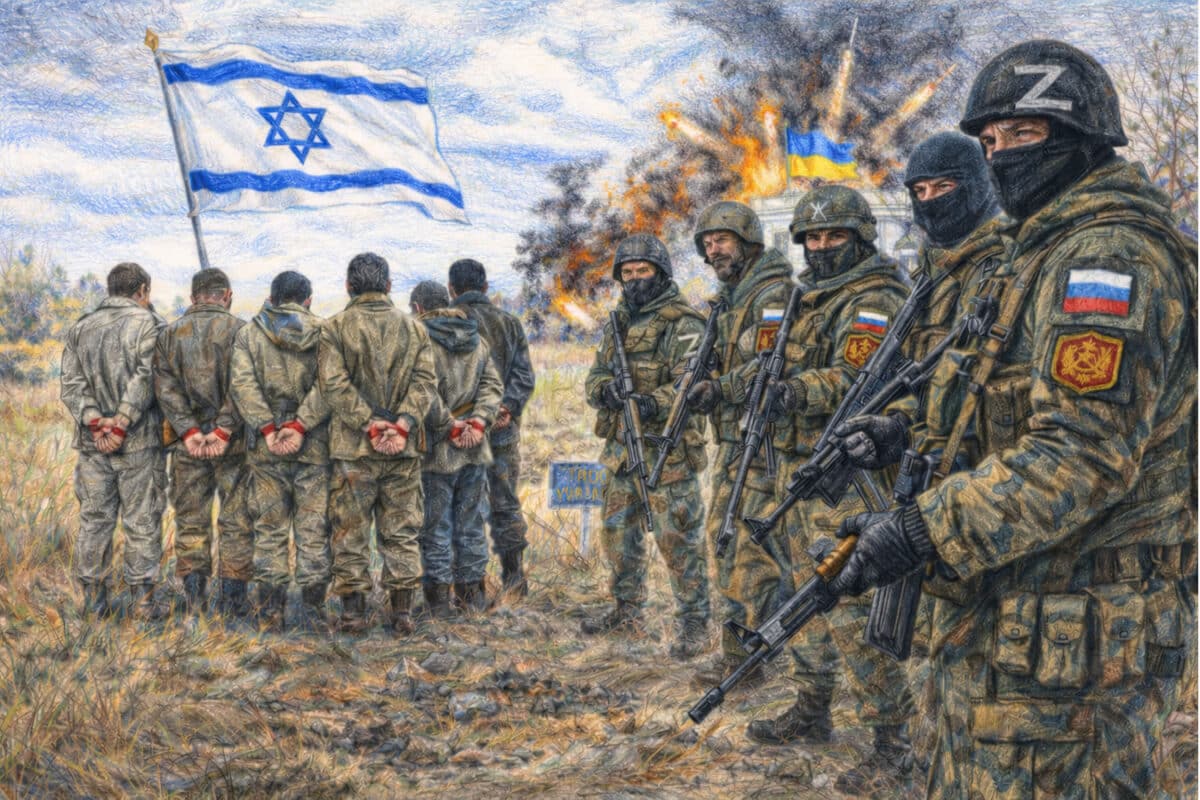
At least 12 Israelis who fought in Ukraine are missing or held in Russian captivity - Mako
At least 12 Israelis who fought in Ukraine are missing or held in Russian captivity – Mako

The authors of the investigation explain: authorities often do not have systematic information about dual citizenship, so cases that “fall out” of the records are almost inevitable. Not all Israelis with Ukrainian roots who were mobilized or volunteered notified Israeli or Ukrainian authorities about their status — hence the conclusion that the actual number may be higher.

Indirect confirmation of the “blind spot” is provided through the words of Israel’s ambassador to Ukraine Michael Brodsky: according to him, the embassy often learns about the participation of Israelis in the war only after their death, after which it helps with funerals and the return of bodies to Israel.

Visit of the Ukrainian delegation to Israel and confirmation of “at least 8”

In early December, according to the investigation, an official Ukrainian delegation visited Israel — amid Kyiv’s attempts to engage Israel in more active support. Among the participants was Yulia Pavlyuk, head of one of the regional directorates of the Coordination Headquarters for Prisoners. At a conference in Tel Aviv, she mentioned that among Israelis there are those who died, were captured, or went missing.

After these words, journalists contacted the Ukrainian embassy in Israel. There, it is claimed, they confirmed: it concerns at least eight missing Israelis, but “by all estimates” the number is higher — precisely due to incomplete accounting of dual citizenship.

“Those who are missing can remain without status for months”

The investigation separately emphasizes that information about prisoners and missing persons in this war is often fragmentary: months, and sometimes longer, may pass without clarity on what happened to a person at the front. Reports of the deceased sometimes appear only from the stories of comrades-in-arms.

The story of an Israeli “A.” from Ashdod, who has been fighting since the first day of the full-scale invasion, is given. Earlier he wrote: “I was hardened in the crucible of Severodonetsk and Bakhmut”. His comrade, according to him, was wounded in heavy fighting near Bakhmut.

Then comes one of the harshest quotes of the material:

“When the Russians came in, they didn’t take him prisoner — they just shot him in the back.”

Israeli ID “in the frame” and the Kozlovsky case

Another interlocutor of the investigators is an Israeli who fought in the Ukrainian army and returned to Israel after October 7 to serve in the reserves. He says he heard of cases where Israeli-Ukrainians are held in Russian captivity, as well as “testimonies” of the release of certain individuals.

One of the examples given is Volodymyr Kozlovsky, captured in 2022 by forces supported by Russia. In a video shot before his release, he, as stated in the material, shows an Israeli ID, “waving” it in front of the camera.

Ukraine wanted Israelis to “hear” about Russian captivity

The December delegation, according to the text, hoped that the stories of Ukrainians who went through Russian captivity would resonate in Israel, especially against the backdrop of the experience of hostages from Gaza. The delegation included, among others, former Kherson mayor Volodymyr Mykolayenko, who was previously held in Russia under harsh conditions, as well as other freed Ukrainians.

An official European source familiar with the organization of the visit claims: the Ukrainian side prepared the meeting program for weeks, but not a single official representative of Israel attended the central reception. Moreover, according to the source, a number of invited senior Foreign Ministry officials did not even respond to the invitations.

Political background: contacts with Moscow and Putin’s phrase about Hamas

The investigation presents this topic against the backdrop of recent weeks when Prime Minister Benjamin Netanyahu publicly praised his contacts with Vladimir Putin and held several phone conversations with him — despite Russia’s criticism of Israel during the Gaza war and after strikes on Iran.

Separately, an episode of Putin’s meeting with freed Israeli captives Alexander Trufanov, his mother Elena, and fiancée Sapir Cohen is cited, where the phrase was heard: “Your release was a humanitarian act on their part” — in the context of gratitude to Hamas’s political leadership.

The authors also claim that Israel did not publicly protest when Russia struck “Jewish targets” in Ukraine, including synagogues in Kyiv and Kherson.

Against this backdrop, Ukraine’s ambassador to Israel Yevgen Korniychuk stated that he was surprised by Israel’s rhetoric, “especially considering October 7,” and added: “We need to stand on the right and moral side of history”. After these words, as stated in the material, he was summoned to the Israeli Foreign Ministry for a “talking-to.”

“Russian House” in Jerusalem and diplomatic symbolism

The investigation presents another contrast: during the same period when Israeli officials, according to the source, did not attend the Ukrainian event, senior Foreign Ministry representatives participated in events initiated by the Russian diplomatic mission — including a New Year’s reception at the Russian ambassador’s residence and the opening ceremony of the “Russian House” in Jerusalem (a cultural center managed by Moscow).

It is separately noted that many countries closed branches of the “Russian House” after the 2022 invasion, considering these structures as tools for strengthening Moscow’s influence and spreading propaganda. The state Russian company managing the network of such institutions has been under EU sanctions since July 2022.

“Welcome to Buchenwald”: what former Ukrainian prisoners told in Israel

One of the strongest fragments of the material is the testimonies of former Ukrainian prisoners, voiced in Israel.

Ukrainian journalist Dmytro Khilyuk, speaking at the “Anu” museum, said that upon being captured, a Russian guard patted him on the shoulder and said: “Welcome to Buchenwald”.

Khilyuk and his elderly father were detained in the first weeks of the 2022 invasion when they went out for groceries. Khilyuk himself spent more than three years in a Russian prison and described his experiences through beatings, hunger, and cold. His father, it is claimed, was subjected to a mock execution before his release.

Former Kherson mayor Volodymyr Mykolayenko described the experience of captivity as: “Every day in captivity was like a whole life”. The material also notes that photos of many freed Ukrainian prisoners show signs of torture and extreme emaciation.

“This is almost unheard of in Israel”

One of the founders of the organization Israeli Friends of Ukraine Anna Zharova says in the material that Israel understands the nature of such crimes well and sees parallels:

“We understand how Hamas and the Russian Federation use the same methods… the same attitude towards people, the same torture”. She adds that she would like to see a meeting of freed Israeli hostages with Ukrainians who went through Russian captivity.

But her main complaint is about the silence surrounding the topic of Israelis missing on the Ukrainian front:

“The fate of these Israeli citizens does not resonate in Israeli society… this is a topic that is almost never raised, if at all”.

At the end of the publication, it is noted that an official comment from the Israeli Foreign Ministry had not been received by the time the material was published. m
NANews — News of Israel | Nikk.Agency

Since 1976, the Ukrainian mosaic icon of the “Zarvanitsky Mother of God” in Nazareth has occupied one of the central places in the Basilica of the Annunciation – how did this happen?

Entering the churchyard of the Basilica of the Annunciation in Nazareth, you immediately notice the beautiful mosaic depicting Ukrainian Zarvanitsky Mother of Godlocated directly opposite the main entrance to the temple.

It is surprising that this image ended up in such an important place, among the mosaics of other countries – as if the Virgin Mary, revered in Ukraine, suddenly found itself among all the great icons of the world.

What is she doing here, how did she appear?

Basilica of the Annunciation (Hebrew: כנסיית הבשורה, Arabic: كنيسة البشارة, Greek: Εκκλησία του Ευαγγελισμού της Θεοτόκου) – this Catholic church was built over the site of the Annunciation – Christian tradition (Roman Catholic) claims that it was in this place (Joseph’s house) that the Archangel Gabriel informed the Virgin Mary that she would “conceive in her womb and give birth to Jesus Christ.”

Not to be confused with Church of the Annunciation over the source of the Blessed Virgin Mary in Nazareth, also known as the Greek Orthodox Church of the Archangel Gabriel over the Spring of the Blessed Virgin Mary.

The largest Christian church in the Middle East. It has the honorary status of “minor basilica”, awarded to it in 1964 by Pope Paul VI. Place of Christian pilgrimage. The monks of the Franciscan order serve in the basilica.

The first mention of a church on this site dates back to 570, and the building was an altar in the Grotto of the Annunciation. More about long history of the church (for those interested) on Wikipedia.

The construction of the new basilica building, which still exists today, was completed in 1969 and the Basilica was consecrated on March 23, 1969.

The initiative arose after the Basilica of the Annunciation, built in modern style in 1969, opened its doors to mosaic icons from around the world.

The walls of the main hall of the upper part of the temple are decorated with images of the most important temples of the Virgin Mary in the world. But because the internal space of the basilica is obviously limited, we see only 17 images there, illustrating the reading of the Blessed Virgin Mary in the world.

Other (more than 50) images of different peoples and countries create a wonderful wreath in the outer gallery, surrounding the Nazarene Temple in a semicircle.

Noteworthy is the peculiarity of conveying the image of the Virgin Mary as it is perceived by artists of different nations and races.

The idea to create mosaic icon of the Zarvanitsky Mother of God belongs to representatives of the Ukrainian Greek Catholic Church (UGCC).

Every country (Catholic churches – ed.) were invited to present their unique image of the Virgin MaryAnd Ukraine (UGCC), chose the Zarvanitsky Mother of Godwhich is one of the most revered shrines of the Ukrainian people (from Greek Catholics -ed.).

As a result of the pseudo-council in Lviv in March 1946 The Ukrainian Greek Catholic Church was liquidated on the territory of the USSR. A significant part of its property was transferred to the Russian Orthodox Church, and believers and clergy were forcibly forced to renounce their church. The UGCC was legalized in Ukraine in 1989.

Entering the church yard to the main entrance to the Basilica, a beautiful mosaic of the Ukrainian Zarvanytsia Mother of God immediately catches your eye, to the right of the entrance.

We see a copy Zarvanitskaya Mother of Godframed by carefully selected Ukrainian landscapes, among images of two of the greatest Ukrainian churches: Kyiv St. Sophia and Lviv St. George.

Icon of the Zarvanitsa Mother of Godin question, represents an important religious symbol for Ukraine. It is located in Zarvanytsia (Ternopil region), on the territory of the holy complex of the same name, which is one of the main Christian pilgrimage sites in Ukraine. Dates from the middle of the 17th century. According to legend, there was also an image from the 13th century.

On both sides of the icon are two pairs of pilgrims in Poltava and Hutsul folk clothes – representatives of the Eastern and Western lands of Ukraine in bow to the Most Holy Zarvanitskaya Mother of God.

Above the mosaic picture we read the inscription: “For all generations will call me blessed” (Luke 1:48), and under the image there is a pleading call: “Most Holy Mother of God, pray for Your Ukrainian people”. The origin of the icon is explained below in Latin: “Miracle-working Mother of God – Zarvanitsa – Ukraine”.

This one is wonderful The image of the Zarvanitsky Mother of God belongs to creativity sisters (religious institute – ed.) Vasily Chikalo (Vasiliya Chykalo – Ukrainian) (d. 2012), “Servants of the Immaculate Virgin Mary” (auto), natives of Podolia (Ukraine), who then lived in Poland.

The initiator and sponsor of this project, which was completed in the summer of 1976when Vasily Chikalo was in the Main House of the “Servant Sisters” in Rome, there was a father of holy memory (religious institute – ed.) Vasily Turkovid, priest of the Ukrainian Catholic Church in New Ulm in Germany.

He, together with the then “Proto-Archimandrite of the Basilian Order, Fr. Isidore Patril“, CHSVV (The Order of St. Basil the Great (lat. Ordo Sancti Basilii Magni), also ChSVV, the Basilian Order of St. Josaphat, the Basilian Fathers – one of the main monastic orders of the Ukrainian Greek Catholic Church.), made great efforts to obtain this place of honor for Zarvanitsky Mother of God in Nazareth.

According to their instructions, Sister Servant Vasily Chikalo painted the image, and the mosaic itself was executed by a specialized Italian company in Milan under the careful supervision of Fr. Isidora Patrila.

What a story!

….

Read on WhatsApp – channel NAnews ↓ — Israel News

Read on Telegram – channel NAnews ↓ — Israel News

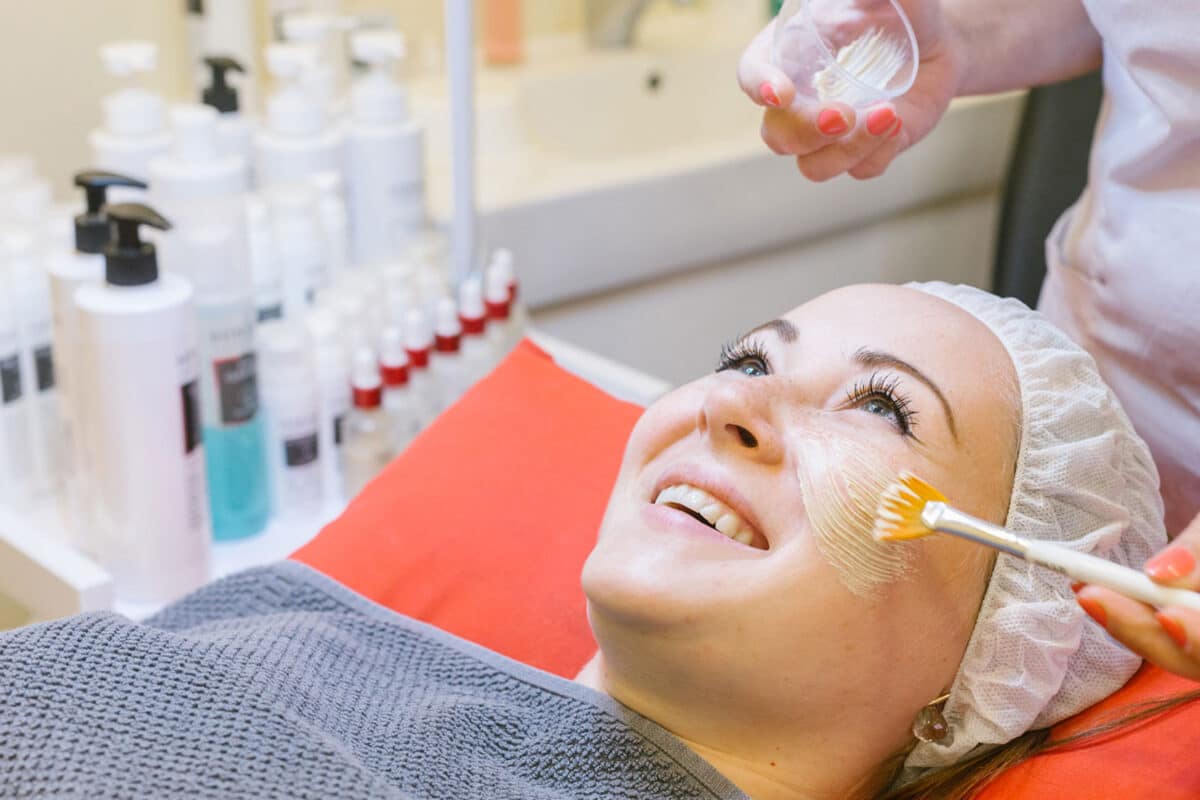
Center of Cosmetology in Haifa. Peeling – Cryolifting – RF lifting – Beauty injections. Cosmetic center for face and body with unique technologies and methods of rejuvenation and health improvement.

#promotion

Haifa: Histadrut, 44 (Check-Post)

Winter 2025/2026

✨ First visit – only 268 shekels.
✨ Bring a friend, and you both get a gift!

In Haifa, there are clinics that sell the “effect,” and there are clinics that sell a plan. Sol Clinics is closer to the latter: the center has been operating since 2016, located in the Check-Post area, and emphasizes understanding the skin condition first before choosing procedures. Not “the trendiest,” but what won’t break the barrier and won’t add problems on top.

This is especially important in Israel. Here, even in winter, the skin lives in contrasts: sun and wind, dry indoor air, stress, lack of sleep. Therefore, the complaint “dull color” often goes along with “inflammations,” and “wrinkles” with “dehydration” and sensitivity. In such conditions, cosmetology becomes not a showcase but a tool: to bring the skin to a working state and maintain the result.

Details about the clinic and appointments:
https://cosmetology.nikk.co.il/

Cosmetology Center in Haifa. Peeling - Cryolifting - RF lifting - Beauty injections. A cosmetology center for face and body with unique technologies and rejuvenation and health methods
Cosmetology Center in Haifa. Peeling – Cryolifting – RF lifting – Beauty injections. A cosmetology center for face and body with unique technologies and rejuvenation and health methods

Where the clinic is located and why the location really affects the result

Sol Clinics is located at the entrance to Haifa, near Check-Post, at שד׳ ההסתדרות 44 (Histadrut 44), landmark — opposite מרכזית המפרץ. For the city, this is practical: it’s convenient to get here not only from Haifa but also from Krayot, Nesher, part of Carmel.

A separate plus — not “beautiful,” but useful: the clinic has free parking, and the entrance is organized so that you can enter without stairs, directly from the parking lot. This sounds trivial until a person realizes that the course is several visits, and each time they choose whether to go at all.

The working hours of clinics of this type usually extend into the evening. Here, work is declared until 19:00, and the last “after-work” slot is often set around 17:30–17:45. Appointments are available through the website and usually duplicated by quick communication channels (phone/WhatsApp) because it’s easier for people.

What skin and body problems are most often addressed here

Sol Clinics formulates tasks broadly, but essentially they fall into several groups. The center works with aesthetic and skin conditions where not one procedure is important, but the correct sequence.

Age-related changes and skin quality

Loss of elasticity, “soft” oval, flabbiness, fine wrinkles, tired tone. This is the category where people often say: “I don’t need a different face, I need mine to look more alive.”

Pigmentation and uneven tone

Spots after sun exposure, “mottling,” consequences of inflammations (post-inflammatory pigmentation), age-related tone changes.

Acne and post-acne

Inflammations, comedones, enlarged pores, traces after breakouts, sometimes scars. In Israel, adult acne is not uncommon, especially against the background of stress and climate.

Sensitive skin and “complex” conditions

Rosacea, seborrhea, atopic dermatitis, couperose, irritated skin. In such cases, any aggression can cause a setback, and that’s why diagnosis and a gentle pace are important.

Body: cellulite, tone, lymphatic drainage

Skin unevenness, cellulite, swelling, a request for a more even texture and a feeling of “lightness,” especially for those who sit a lot or are often on the road.

Why they start with diagnostics here, not with “choose a procedure from the menu”

This is the point that distinguishes normal practice from “just a salon.” In the clinic’s materials, it is emphasized: without diagnostics, the skin is not touched.

The diagnostic device in their description evaluates two indicators that really determine the fate of the protocol:

Phototype and melanin level

This affects how the skin can react to methods related to energy/light and helps reduce the risk of unwanted spots after procedures.

Inflammation level (including hidden)

If inflammation is high, the clinic does not rush with what can further irritate the skin: active peels, microneedling, fractional methods. First — recovery and stabilization, then — renewal.

From the outside, it looks like “they don’t sell us everything at once.” For the client, this is usually a good sign.

What procedures are available and how to logically choose them

On the clinic’s website, three of the most popular procedures of the season are highlighted: peeling, cryolifting, RF-lifting. These names are most often asked about. But more importantly — to understand what task they are suitable for.

Peeling

It is usually chosen when the skin has become dull, uneven, “rough,” and post-acne marks and pigmentation are more pronounced. Peeling is not about “scraping off the skin,” but about controlled surface renewal. That’s why clear diagnostics before peeling is not a whim: one skin tolerates it easily, another reacts with irritation.

Cryolifting

The procedure is usually taken under the request “I want to look more collected.” Cold protocols are often perceived as a gentle way to get a fresher look, reduce puffiness, and return a “clear” contour to the face without the feeling of aggression.

RF-lifting

RF is most often chosen when it comes to skin tone and density: oval, lower third of the face, overall firmness. In the clinic’s materials, this method is described as comfortable in sensations (the working area is heated to a controlled temperature) and suitable for those who want to “tighten” without surgery.

But the list doesn’t end there

The clinic’s description also includes other directions:

  • Combined cleanings and care protocols when the skin needs to be “cleaned and normalized” without trauma.
  • Mesostrip and multi-stage care aimed at skin quality, tone, recovery.
  • Microneedling — as a tool for texture and renewal, considering that the skin after the procedure can be sensitive and needs proper support.
  • Fractional directions (including fractional RF) — they are usually used when the goal is not “quick refresh,” but to work deeper with density, relief, and traces. At the same time, the clinic does not hide: some fractional methods may feel stronger than standard care procedures.
  • IPL directions for acne/post-acne and pigmentation tasks — where it is important to work with redness, spots, and the overall skin background.

It is separately noted that the clinic uses a range of equipment (15 devices are mentioned), and preparations are selected according to the technique — without attempts to “replace with something cheaper,” so as not to break the protocol.

How the course is built and what is promised in terms of results

Cosmetology Center in Haifa. Peeling - Cryolifting - RF lifting - Beauty injections. A cosmetology center for face and body with unique technologies and rejuvenation and health methods
Cosmetology Center in Haifa. Peeling – Cryolifting – RF lifting – Beauty injections. A cosmetology center for face and body with unique technologies and rejuvenation and health methods

The clinic quite directly formulates expectations: a noticeable effect is possible after the first visit, but a stable result often requires a course — usually a range of 6–10 procedures (depending on the task).

There is another point that is usually important to people but rarely voiced: course adjustment along the way. In Sol Clinics’ materials, it is stated that in the middle of the program, the result is evaluated together with the client, and if the dynamics are weaker than expected, the protocol can be changed or strengthened without additional payment. This is not a “guarantee of a miracle,” but it is the logic of medical support: to look at the reaction, not to sell a standard package as unchangeable.

The clinic also talks about home care as part of the result: the description mentions the selection of care from professional lines (sets from several leading brands are mentioned), because without home support, the effect of the procedures often lives less.

Can face and body be done in one day

The clinic’s materials specifically state that if time allows and according to the schedule, face and body procedures can be combined in one day. For people who do not live in the center of Haifa or come from Krayot, this is really convenient: fewer trips, a higher chance to complete the course.

Frequently Asked Questions (FAQ)

Where to start if you’ve never done cosmetology in Israel?

Start with a consultation and diagnostics. This is the calmest way to understand what exactly your skin “hurts”: dehydration, inflammation, pigmentation, loss of tone, or all together. Sol Clinics emphasizes that without diagnostics, the skin is not touched: they look at phototype/melanin and inflammation level, and only then offer a plan — without guessing “by procedure name.”

What to bring to the first consultation?

Nothing complicated. If you have — bring a list of cosmetics you use at home, and remember if there were reactions to procedures/creams. It’s also important to say if there is a tendency to herpes, frequent irritations, allergies, pregnancy/breastfeeding, what medications you are currently taking. This saves time and helps not to prescribe what definitely doesn’t suit you.

Do I need to come without makeup?

Preferably, but not always necessary. If you come with makeup, the clinic usually still cleanses the skin before examination. But if possible — come “clean,” it’s easier to immediately see the skin condition: redness, peeling, inflammations, dehydration.

If the skin is sensitive, does that mean nothing can be done?

Not necessarily. “Sensitive skin” is not a prohibition, it’s a regime. It means the pace will be more cautious, and the order of procedures different: first, barrier restoration and irritation reduction, then — renewal and more active methods. If diagnostics show a high level of inflammation, aggressive techniques (peels, microneedling, fractional methods) are usually postponed to avoid worsening.

Can procedures be done if there is rosacea/couperose/dermatitis?

Sometimes yes, but not everything and not immediately. In such conditions, it’s important not to “chase” the skin with force. Softer protocols are often chosen, and active methods are only set when the skin is stable. This is discussed separately during the consultation because skin reactivity varies for everyone.

How to understand which procedure I need: peeling, cryolifting, or RF-lifting?

It depends on the leading problem.

If the main complaint is dull tone, uneven texture, marks/spots, “roughness” — they often start with gentle renewal (peeling), but only after assessing skin sensitivity.

If you want “compactness” and a fresh look, less puffiness and tired face — cryolifting is often chosen.

If the main topic is firmness and contour (oval, lower third of the face, flabbiness) — RF-lifting is usually considered as the basic “framework” procedure.

But the decision is still made after examination because the same complaint in different people can have different causes.

Is adult acne treated the same as teenage acne?

Often not. Adult acne can be related to stress, hormonal background, care, skin sensitivity, disrupted barrier. Therefore, it’s important to first assess inflammation and not take steps that can increase irritation. Sol Clinics specifically highlights hardware directions for acne/post-acne and usually builds the course to simultaneously reduce active inflammations and carefully work with traces.

Post-acne: what can really be improved?

Post-acne usually has three layers: marks/spots, relief, enlarged pores. Improvements are almost always possible, but the speed depends on the depth of the problem and skin reaction. It’s important not to expect “minus 10 years at once,” but to follow the course: first stabilization, then tone leveling, then working with texture and skin density.

Pigmentation: how many procedures are needed and how quickly is the effect visible?

With pigmentation, it’s always more honest to say: “it depends.” There are spots that go away quickly, and there are those that require a course and discipline with home care. The speed is influenced by: type of pigmentation (sun, post-inflammatory, hormonal), phototype, season, and how well a person follows care and skin protection recommendations.

How long does one visit take?

Depends on the procedure and plan. Care and cleanings usually take longer (often 60–90 minutes), hardware procedures can be shorter. The exact time will be told when booking, when clarifying what exactly you want to solve first.

How long does the course take?

The course depends on the task and frequency of visits. The clinic’s materials mention a guideline: a stable effect often requires 6–10 procedures. But this is a range, not a “mandatory norm.” Sometimes fewer procedures plus support are enough, and sometimes a longer plan is needed — especially for post-acne and pronounced pigmentation.

When will I see the first changes?

Many notice changes after the first visit: the skin may look fresher, “more even,” less puffiness, better tone. But a stable result usually accumulates over the course. This is normal: the skin does not restructure in one day, especially if the problem has been forming for years.

Can face and body procedures be combined in one day?

Sometimes yes — it depends on the schedule and what procedures are planned. The clinic’s materials state that combining is possible if time and “slots” are available. This is often convenient for those who come from outside the center of Haifa and want to reduce the number of trips.

Is it painful?

Most procedures are described as comfortable and without long rehabilitation. But there are methods that may feel stronger (for example, some fractional technologies). During the consultation, they usually explain in advance what to expect in terms of sensations and adjust the intensity to the person, not “to the maximum.”

Will there be rehabilitation: redness, peeling, “can’t go outside”?

Depends on the method. Soft care procedures usually do not give noticeable rehabilitation. After some techniques, there may be temporary redness or sensitivity. Importantly, with high inflammation, the clinic usually does not set aggressive procedures first to reduce the risk of unpleasant reactions.

Can procedures be done in the summer?

Some can, some — with restrictions. The Israeli sun makes seasonality important, especially in matters of pigmentation and active skin renewal. Therefore, the plan is often built so that in summer, more gentle and supportive steps are taken, and active ones are moved to a calmer season.

What home care is needed after procedures?

Usually without fanaticism. Often basic things are enough: gentle cleansing, hydration/barrier restoration, skin protection, and targeted products for your task. Sol Clinics emphasizes that home care is part of the result, not an “addition.”

If I already have cosmetics at home — will I be forced to change everything?

Usually, there is no point in “burning bridges.” They often look at compositions, compatibility with procedures, and skin reaction. Sometimes it’s enough to replace 1–2 items, and leave the rest. The main goal is for the care not to conflict with the course.

Is there a “guarantee of results”?

The clinic’s materials describe the approach: in the middle of the course, the dynamics are evaluated together with the client, and if necessary, the protocol is adjusted without additional payment. This is not a promise of a miracle “for everyone and always,” but it is an understandable model of support: to look at progress and change tactics if the skin reacts differently.

How often should maintenance procedures be done after the course?

The frequency of support depends on age, skin type, and what the main problem was. Usually, after completing the course, maintenance visits are done less often — for example, once every few weeks or once a month. It’s better to discuss specifics based on the result and skin reaction.

How to book and what to say when booking to be properly directed?

The simplest is to briefly describe the main goal: “pigmentation,” “acne/post-acne,” “oval/flabbiness,” “dull skin,” “cellulite/swelling.” If you say this right away, the administrator can offer the correct format for the first visit and approximate time.

Details about the clinic and appointments:
https://cosmetology.nikk.co.il/

Sol Clinics in Haifa looks like an example of practical urban cosmetology: a convenient location at Check-Post, emphasis on diagnostics, course, and support, rather than loud promises. For readers of NAnews — News of Israel | Nikk.Agency, this is a case where “where it is located” and “how the course is conducted” are more important than the names of procedures on the showcase.

The war in Ukraine has increased the export of Israeli weapons, boosting its demand in global markets.

With the onset of the full-scale war in Ukraine, Israel unexpectedly strengthened its position in the global arms market for many. Against the backdrop of revising defense doctrines, increasing military budgets, and searching for “proven solutions,” this country quickly became a key reference point for states facing new threats.

The picture seems contradictory only at first glance.

A Paradox That Is Not Accidental

Israel has lived under constant threat for decades. For it, war is not an abstract theory but an environment where technologies, tactics, and security approaches are formed. That is why the events in Ukraine did not become a catastrophe for the Israeli military-industrial complex but a factor accelerating already launched processes.

When European countries and Ukraine’s allies faced the reality of a protracted conflict, it suddenly became clear that old arsenals, paper concepts, and “peaceful planning” no longer worked. Systems tested not on training grounds but in real combat were needed.

Why Israel

The Israeli defense sector found itself in the right place at the right time. Its developments were initially created under the pressure of asymmetric threats: drones, missiles, hybrid attacks, cyber operations, strikes on infrastructure.

This is not a showcase but a survival experience.

Air and missile defense technologies, intelligence, early warning systems, electronic warfare — all of this became the subject of increased interest after 2022. And not only from Ukraine but also from EU countries, which suddenly realized their own vulnerability.

Catalyst, Not Cause

It is important to understand: the war in Ukraine did not create the Israeli defense boom from scratch. It only became a catalyst. Israel has invested for many years in research, dual-purpose startups, and the integration of the army and the private sector.

The Ukrainian front showed that the future of war is speed, data, adaptation, and targeted solutions. It is in these niches that Israel feels most confident.

New Opportunities — New Risks

The growth of influence inevitably brings complexities. Israel is forced to navigate between its own security interests, relations with the US, Europe, and the complex geopolitics of the region. Every supply, every contract is now considered through the prism of international consequences.

Nevertheless, the choice for many countries has already been made. In a world where war has once again become a planning factor, preference is given to those who know it from the inside, not from reports.

The Israeli defense breakthrough is not just about the economy. It is a reflection of a global shift where security has ceased to be a theory and has once again become a practice. And in this reality, Israel has become one of the most prepared players, as is increasingly written about today by NAnews — News of Israel | Nikk.Agency.

Europe and the Shadows of Hate: Why Anti-Semitism is Returning and What Russia and Hamas Have to Do with It

War is once again changing the face of Europe — and not just on the fronts. Where slogans of tolerance and human rights once echoed, the whisper of old hatred is growing louder. Anti-Semitism — the ancient virus of the continent — is awakening again, rising from the underground layers of history to the streets of Berlin, Paris, and Brussels.

Mass rallies, synagogue arson, attacks on Jews — these are no longer frames from the archives of the 1930s, but the chronicle of European news in 2025.

But the reasons for what is happening are far more complex than just a political dispute over Israel’s war with Hamas. It is a reflection of a global shift — how Russia, Iran, and their ideological partners use anti-Israeli and anti-Western rhetoric to ignite Europe from within.

When Anti-Semitism Became “Fashionable” Again

In recent months, the level of anti-Semitic incidents in Europe has increased manifold.

In France — attacks on Jewish schools and cemeteries.
In Germany — threats against rabbis and Israeli students.
In the UK, police record a rise in hate crimes of more than 500%.

But the danger is not only in the numbers.

It is about a new form of old evil — anti-Semitism under the guise of political activism.

Today, hatred is often disguised as “fighting imperialism” or “solidarity with the oppressed.”
Yesterday it was called fascism, today — “anti-colonialism.”
The essence has not changed.

Many experts note: anti-Semitism today is not always expressed in insults.

It can hide behind slogans, behind “the fight for Palestine’s freedom,” behind artificial narratives that are implanted through social networks and propaganda.

This is where the main danger of the new wave lies.

Russia and Hamas — Different Fronts of One Ideology

Europe and the Shadows of Hatred: Why Anti-Semitism is Returning and What Russia and Hamas Have to Do With It

In the Ukrainian context, the comparison of Russia and Hamas sounds particularly accurate.

Both structures operate on the same principle: terror as an argument.

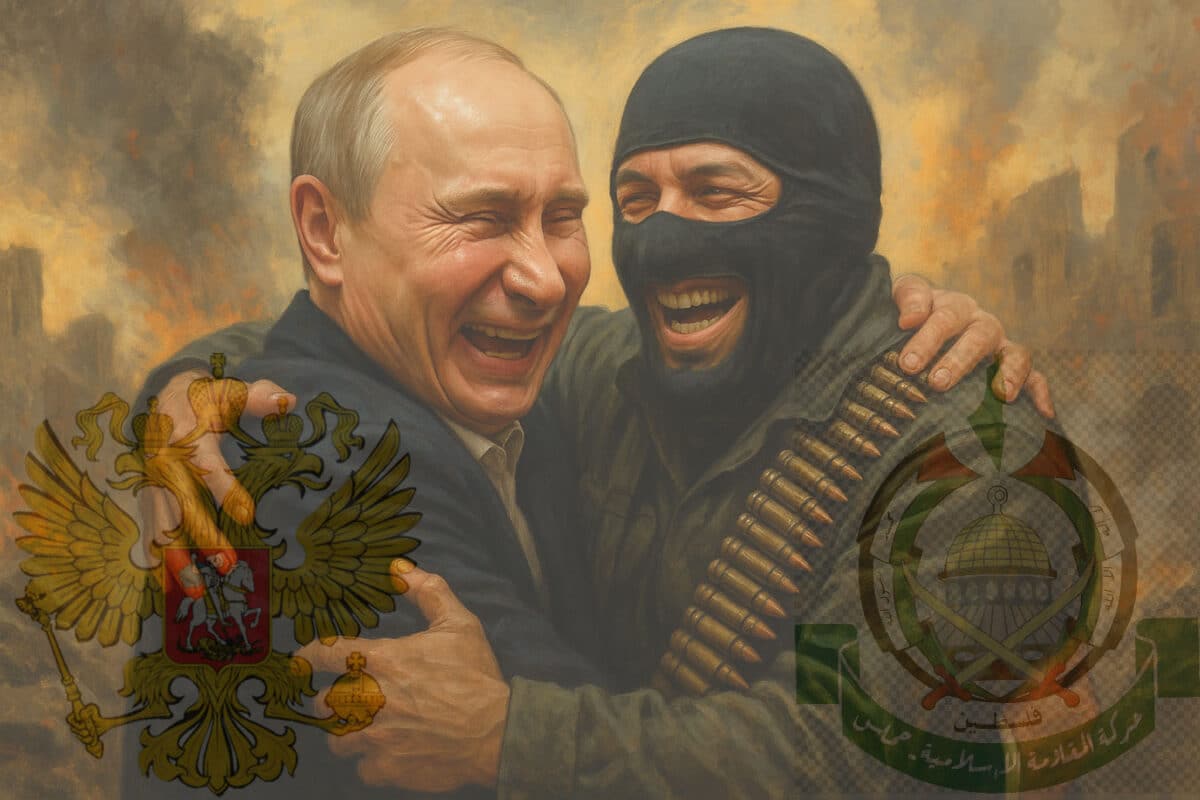
Putin’s army destroys Ukrainian cities under the slogan of “liberation,” just as Hamas kills Israeli civilians, hiding behind “the fight for justice.”

This parallel is no accident.

Russia systematically builds ideological and informational ties with anti-Western forces in the Middle East.

Moscow justifies Hamas terror as a “reaction to Israeli aggression,” while in turn, it calls Russia’s war against Ukraine a “fight against Nazism.”

In fact, it is a common language of authoritarian regimes and extremist movements: everything is allowed if it can be called “resistance”.

Anti-Semitism as a Kremlin Tool

The Kremlin did not invent hatred — it learned to monetize it.

For years, Russian media structures have created pseudo-analysis where Israel and “Jewish influence” were presented as the cause of global injustice.

The same logic is used against Ukraine: “Western puppets,” “NATO accomplices,” “victims of Jewish capital.”

In essence, this is not just anti-Semitism, but a geopolitical technology.

It works on emotions, on fears, on the feeling of a “stolen identity.”

Radical Islamist propagandists operate in the same way, recruiting followers under the slogan of fighting “colonizers.”

These two streams — Russian imperialism and Middle Eastern fanaticism — merge into one: hatred of the West, Jews, and democracy.

Europe, Losing Its Immunity

Many European societies were not ready for this new form of old contagion.

After decades of peace and prosperity, control over the language of hatred has weakened.

Freedom of speech often becomes a cover for destructive narratives.

Social networks are filled with “anti-imperialist” blogs where Israel is called an “occupier” and Russia a “fighter against the West.”

Hundreds of such pages operate on the same servers, often funded from Moscow or Tehran.

Thus, anti-Semitism re-enters the mainstream — not through slogans of “beat the Jews,” but through words of “support Palestine.”

This makes it especially dangerous: a person can be a victim of propaganda without realizing that they are repeating the language of those who justify terror.

The Palestinian Narrative as a Mirror of Russian Aggression

When Hamas justifies attacks on Israel with slogans of “fighting occupation,” it is easy to recognize the Kremlin’s lexicon in these phrases: “denazification,” “liberation,” “historical territories.”

In both cases, violence is justified by a “higher goal.”

Authoritarian propagandists have learned to use the words “freedom” and “justice” as a smokescreen.

Russia justifies the killing of Ukrainians in the same way Hamas does Israelis.

The difference is only in scale: the methods are the same, the audiences different.

This is increasingly discussed in both Israel and Ukraine: terror, wherever it occurs, is always fueled by impunity.

The Ideology of Hatred and Western Fatigue

Modern Europe is tired of war.

But fatigue is the perfect ground for manipulation.

When people stop distinguishing shades, the slogan “for peace” can turn into a justification for terror.

In European universities, rallies “in support of Palestine” are held, where calls are made to “cleanse the land of Zionism.”

There is nothing humanitarian in these phrases — it is the language of hatred, only in a new wrapper.

Thus, anti-Semitism becomes acceptable again — if it is hidden under the guise of “justice.”

Ukraine, Israel, and the Moral Connection

Ukraine and Israel find themselves on the same side of reality, where terror is an ideology, and truth requires strength.

For Kyiv, it is obvious: when the West does not react to some manifestations of terror, it provokes others.

Unacknowledged evil grows faster than acknowledged.

Ukraine supports Israel in its fight against Hamas for a reason.

Both countries are targets of propaganda attacks, disinformation, and international pressure.

For both, the word “self-defense” has become not just a legal term, but a matter of survival.

How the Kremlin Plays on Anti-Semitic Sentiments

Russia actively implants anti-Semitic and anti-Israeli narratives in Western media.

Under the guise of “alternative viewpoints,” texts about “Jewish elites,” “Zionist control,” and “world conspiracy” are spread online.

These same theses were heard in the 1930s — only now, instead of newspapers, they are circulated by anonymous Telegram channels.

Often, anti-Semitism becomes a “byproduct” of pro-Russian propaganda.

Those who justify the war against Ukraine often use the same rhetorical constructions as anti-Semites: the search for an enemy, conspiracy theories, the cult of a “humiliated power.”

Why It Matters Now

Because history is knocking on Europe’s doors again.

Anti-Semitism is not just a problem for Jews. It is a litmus test of the state of society.

When hatred of Jews becomes the norm, it means the foundations of democracy are being destroyed.

Today’s cries in the squares “from the river to the sea” are not a slogan of freedom, but a warning.

And if Europe does not draw conclusions now, tomorrow this wave will engulf it itself.

What Can Stop the New Wave of Hatred

1. Strong government response.
States must qualify anti-Semitism as a threat to national security, not just as a hate crime.

2. Responsible media.
The media must stop equating the aggressor and the victim.
Terrorist organizations cannot be an “equal side of the conflict.”

3. Education and memory.
Europe cannot afford to forget where silence in the face of anti-Semitism has already led.
Every new case should be seen as an alarming signal, not as a “crowd excess.”

4. Solidarity of countries that know the price of terror.
Ukraine and Israel must remain allies — not only in politics but also in meanings.
Their experience of resisting terror is not two separate plots, but one line of defense of the civilized world.

Conclusion

Europe is once again at a crossroads.

On one side — fatigue, cynicism, false neutrality.
On the other — clarity: terror cannot be balanced, it must be stopped.

Russia and Hamas are two manifestations of one disease, which feeds on impunity and fear.

And while Europe seeks excuses for those who shoot at children, hatred continues to change flags, but not its essence.

Peace will begin where evil is no longer justified — under any slogans.

And if Europe wants to remain Europe, it will have to remember why it swore: never again.

2026 as a Turning Point: What Politico Predicts for Israel, Ukraine, and the Global Economy

The year 2026 may become the moment when the usual mechanisms of world governance cease to work. This conclusion follows from a large-scale forecast by the analytical publication Politico, which describes the near future as a period of deep geopolitical and financial upheavals. It is not about a series of separate crises, but about the overlay of conflicts, debts, and loss of trust — with a domino effect.

Ukraine: between the illusion of peace and the strategy of attrition

Despite Donald Trump’s loud statements about the ability to quickly stop the war, Politico analysts assess the reality much more harshly. They consider the likelihood of continued hostilities in 2026 to be four times higher than the chance of a quick end to the conflict.

For the Kremlin, a sharp exit from the war carries an existential risk. The economy and internal stability of Russia are largely tied to military mobilization and resource redistribution. A sudden peace could provoke an internal crisis for which the system is not ready.

Ukraine, in turn, enters 2026 with serious problems. A shortage of personnel, worn-out energy infrastructure, and constant strikes on the rear create an illusion for Moscow of the possibility to impose its conditions — weakening the Armed Forces of Ukraine and capturing new territories.

However, Russia’s own position remains unstable. High interest rates, a labor shortage in industry, and budget pressure form a debt loop that limits the ability to wage war indefinitely. The economic counterstrike may prove to be no less destructive than military failures.

Finances slip out of politicians’ control

One of the main actors of 2026, according to Politico, will not be presidents and governments, but bond markets. Analysts predict the return of so-called “bond vigilantes” — large investors who can punish states for irresponsible budget policies.

Even Trump at the beginning of his term was forced to adjust tariff plans under market pressure. The story of Liz Truss, who left the post of Prime Minister of the United Kingdom 49 days after the bond collapse, is seen as a warning for the US, Japan, and European countries living with chronic deficits.

The debts of Western economies have reached a dangerous level amid weak productivity growth. Investor confidence is becoming fragile, and any wrong decision can trigger a chain reaction.

Political stability despite crises

Politically, Politico does not expect sharp tectonic shifts in key countries. Even against the backdrop of conflicts and internal tensions, the existing balance of power, according to analysts, will largely remain.

In Israel, the current Prime Minister Benjamin Netanyahu, despite public disputes, criticism, and protracted conflicts, remains the main contender for continuing his political career at the head of the government. His positions are assessed as stable.

A similar picture is painted for Hungary. Viktor Orban, despite opposition pressure and economic difficulties, still has enough support to win elections. His political system demonstrates high adaptability to crises.

In the US, on the contrary, the forecast is for the preservation of “divided power.” Democrats may regain control of the House of Representatives, while the positions of Republicans in the Senate look more solid and are likely to remain.

The banking system and the shadow of artificial intelligence

The global financial system is approaching a dangerous edge due to the rapid growth of private lending. Hedge funds and investment companies today control about 250 trillion dollars, operating outside of classical banking regulation.

If the private credit sector faces a serious shock, the consequences, according to Politico, could surpass the 2008 crisis. The situation is exacerbated by the “shadow banks’” bet on artificial intelligence. If the AI boom turns out to be a financial bubble, a chain reaction of bankruptcies will become almost inevitable.

In such a scenario, governments, especially populist ones, may simply lack the resources to save the system.

A year where old recipes don’t work

Politico’s forecast converges on one point: 2026 will be a test of strength for states, markets, and political models. Illusions of quick solutions disappear, and problems accumulated over decades surface simultaneously.

The world is entering a phase where the cost of mistakes rises sharply, and the room for maneuver shrinks. It is in this context that events around Ukraine, Israel, and the global economy will develop — processes that are systematically and closely monitored by NANews — News of Israel | Nikk.Agency.

Injection cosmetology in Haifa: Botox, fillers, skinbooster, sculptra, threads, peeling, botulinum therapy and the best “Beauty Shots”

#promotion

All types of injection cosmetology in Haifa:

Do you want to change the shape of your face, have high cheekbones, full lips with a clear contour, and glowing skin?

Correct the flaws that prevent you from enjoying your appearance – a humped nose, a crooked or slanted chin, lack of volume in some areas of the face, an unclear oval or jowls?

Then you should come to us!

Reception is conducted by Dr. Mariana Tartakovsky

Injection cosmetology in Haifa: Botox, fillers, skinbooster, sculptra, threads, peeling, botulinum therapy and the best "Beauty Injections"
Dr. Mariana Tartakovsky

We are located on Sderot HaHistadrut 44, Haifa (Check-Post)

055-939-7729

↓↓↓ view on map ↓↓↓


We are conveniently accessible from Haifa and Krayot (Kiryat Yam, Kiryat Motzkin, Kiryat Bialik, etc.), Nesher and Tirat Carmel….

>>> go to the website and find out more >>>

Injection cosmetology in Haifa: botox, fillers, skinbooster, sculptra, threads, peeling, botulinum therapy and the best “Beauty Injections”


Mariana Tartakovsky is a licensed physician and multidisciplinary specialist with extensive experience in the field of aesthetic cosmetology.

Its task is to give you the most natural result, to make a beautiful and toned face, without going overboard!

In the process of work, Mariana uses high-quality preparations, techniques and methods to improve the quality and condition of your skin.

High quality drugs are very importantbut much more important is how they are introduced into the face and how the doctor injects them.

We have the ability to minimize bruising, avoid unpleasant visible results or hyaluronic acid residues/lumps, make each procedure as painless as possible, and The main thing –

Give you a natural result.

Not change, but improve!

Injection cosmetology in Haifa: Botox, fillers, skinbooster, sculptra, threads, peeling, botulinum therapy and the best "Beauty Injections"
Injection cosmetology in Haifa: Botox, fillers, skinbooster, sculptra, threads, peeling, botulinum therapy and the best “Beauty Shots”

Reception is conducted by Dr. Mariana Tartakovsky

We are located on sderot Ha-Histadrut 44, Haifa (Check Post)

055-939-7729

Sunday-Thursday: 10.00-19.00.
Friday and pre-holiday days: 9.00-14.00.
Saturday: closed.
Contact via website: 24/7.

↓↓↓ view on map ↓↓↓


We are conveniently accessible from Haifa and Krayot (Kiryat Yam, Kiryat Motzkin, Kiryat Bialik, etc.), Nesher and Tirat Carmel….

>>> go to the website and find out more >>>

In the process of work, Mariana uses high-quality preparations, techniques and methods to improve the quality and condition of your skin.:

AestheticFill — biostimulants that allow you to regain youth and not age for at least 2 years. Polylactic acid, which is part of AesthetFill and Sculptra, stimulates the filling of skin areas with new collagen fibers, which give elasticity, remove flabbiness, slightly restore volume, make the face oval more distinct and toned. The procedure is performed with a cannula, so it is practically painless.

Sculpture — the principle of action is to make collagen cells actively increase, thereby increasing the elasticity and firmness of the skin. In essence, Sculptra gives the skin a second youth: slightly replenishes tissue volumes, corrects the oval of the face, evens out the skin relief, removes wrinkles and creases, tightens the skin and improves its structure.

Styling – preparations based on hyaluronic acid that replenish tissue volumes where necessary. They help eliminate deep wrinkles, correct the volume and shape of the lips, the oval of the face, the chin line, cheekbones, remove nasolabial folds and jowls.

Revenge — all products in the line are based on hyaluronic acid with the highest standard of purity. Revanesse fillers are completely safe for humans and there is no need to conduct allergy tests before using them. Stable aesthetic result and ease of use. There is a filler of suitable density for each area of ​​the face.

Take care of your transformation today!

Book a consultation with Dr. Mariana Tartakovsky at the Abramsky Beauty Center in Haifa!

>>> go to the website and find out more >>>

Injection cosmetology in Haifa: botox, fillers, skinbooster, sculptra, threads, peeling, botulinum therapy and the best “Beauty Injections”

Israeli footballers in Ukraine: a league outside the showcase, but with growth opportunities

Ukraine, being in a state of war, is not considered an attractive destination even in normal times — unless we talk about clubs like Dynamo Kyiv or Shakhtar Donetsk. However, their international reputation has declined in recent years.

Nevertheless, the Ukrainian league has become a popular destination for Israeli legionnaires and may play a role in the January transfer window, which opened this week.

The Israeli public is used to hearing about Oscar Gloukh, Anan Khalaili, and Manor Solomon, playing in Champions League teams; about Eli Dasa, who returned to the Netherlands; about Omri Gandelman, who played in Belgium for a long time; and also about Bibras Natcho, continuing his career in Belgrade’s “Partizan”. Meanwhile, the number of Israeli footballers in the USA is also growing.

However, this is only part of the overall picture, reported Israeli Ynet on January 3, 2025.

Players out of focus, but in the process of growth

The footballers discussed in this material do not play in clubs that are in the spotlight. However, according to the assessments of the participants in the process, the difference in level between the Ukrainian league and more prestigious championships is not significant, and the players themselves continue to advance in their careers.

Bar Lin and experience in “Kryvbas”

One example is Bar Lin, playing for Kryvbas, which at the time of publication is in fifth place in the Ukrainian championship.

The assistant coach of “Kryvbas” Uri David explains why he considers the Ukrainian league suitable for professional growth:

“Take, for example, our game against Donetsk’s ‘Shakhtar’ a few weeks ago. ‘Shakhtar’ has a Brazilian left-back, Federinho, whom, as far as I know, many Premier League clubs want to acquire.

Federinho played on the same flank against Bar — and Bar gave him worthy resistance. Bar has always been very technical, but not physically strong. Against Federinho, he already looked quite powerful. There is no doubt that during his time in Ukraine, he has toughened up.

Any talent can succeed here — provided he is a true professional, like Bar.”

Climate and working conditions

Bar Lin himself describes the conditions in Ukraine as follows:

“Last week I flew to Israel for a month-long vacation, and compared to Ukraine, I felt like I was in a microwave.
The temperature there is around zero or one degree, but it doesn’t interfere with our work.
I have definitely made progress in Kryvbas.”

Financial aspect

In some cases, moving to the Ukrainian league turns out to be beneficial financially. For example, Tomer Yosefi, playing for Polissya Zhytomyr, is estimated to earn about 400,000 euros a year — at the level of the league’s leading players, which is rare for the Israeli market.

Uri David notes:

“Perhaps Ukraine is experiencing financial difficulties now, but there is money for football here — because people love it.”

Conclusion

The Ukrainian league remains a challenging destination for foreign footballers. However, it continues to attract Israeli players, for whom this stage becomes part of professional development — out of the spotlight, but in conditions of constant competition.

NANews — Israel News | Nikk.Agency

Jews from Ukraine: Leo Motzkin. From Ukrainian Brovary to Kiryat Motzkin, named in his honor

And today in our section “Jews from Ukraine,” we will talk about Leo Motzkin — an outstanding public figure from Brovary, whose name is associated with the history of Israel and Ukrainian Jews.

Leo Motzkin (Aryeh Leib) was born in 1867 in Brovary, Kyiv province of the Russian Empire. In this small town, near Kyiv, he received a traditional Jewish education. In the late 19th century, Brovary had a large Jewish community.

Jewish Community of Brovary: History and Tragic Events

Brovary, a small town near Kyiv, has deep historical roots and significant Jewish heritage. Before World War II, it had one of the largest Jewish communities in the region. Jews began settling in Brovary in the second half of the 19th century, gradually migrating from the west after the partition of Poland. According to 1891 data, Jews made up 23.3% of the town’s population (888 people). Most were engaged in trade and crafts, actively participating in the town’s life. Brovary had a synagogue, Jewish schools, and public organizations.

The period from 1917 to 1921 was tragic for the Jewish community. During the revolution and civil war, Jews were subjected to brutal pogroms organized by various military formations: Denikin’s troops, Skoropadsky’s haidamaks, the Red Army. Many perished, and some residents left the town, emigrating to Kyiv or other safer places.

The Jewish population gradually decreased. If in 1923 there were 646 Jews living in Brovary, by 1939 their number had decreased to 458 people. World War II played a tragic role in the community’s history. From 1941 to 1943, almost all the town’s Jews perished on the fronts or were killed during the Nazi occupation. As a result of these events, the Jewish community of Brovary practically disappeared.

In the post-war years, a small part of the Jews returned to the town. In 1989, about 360 Jews lived there, but by 1999 only 110 people remained. The main reasons for the decrease were emigration to Israel and other countries, as well as the lack of conditions for community development.

Today, there are almost no direct traces left of the once numerous Jewish community in Brovary. However, its history lives on in the memory of descendants and those interested in the heritage of the Jewish people. Preserving this memory is important for future generations so that the rich culture and traditions of Brovary’s Jews are not forgotten.


To Berlin for Knowledge: A New Stage of Life

After completing his primary education, Leo Motzkin went to Berlin, where he studied mathematics and philosophy. It was in Berlin that his active public activity began. He became one of the founders of a scientific society that united students supporting the Hovevei Zion (Lovers of Zion) movement.

With the emergence of Theodor Herzl and the beginning of the Zionist movement, Motzkin became an active participant. He was a delegate to the First Zionist Congress in 1897 and advocated for a clear formulation of the movement’s goal — the creation of a Jewish state in Eretz-Israel.


First Trip to Eretz-Israel

On behalf of Theodor Herzl, Motzkin went to Eretz-Israel to assess the state of Jewish settlements. In his report, he criticized the settlement methods used by Baron Rothschild and the Hovevei Zion movement and insisted on the need for political negotiations with the Ottoman Empire.

This trip became a turning point in his activities. He realized that without political support, the creation of a Jewish state would be extremely difficult.


Important Steps on the International Stage

During World War I, Leo Motzkin headed the Copenhagen branch of the Zionist Organization. After the war, he became one of the founders of the Committee of Jewish Delegations at the Paris Peace Conference, where he defended the interests of world Jewry.

With the rise of the Nazis to power in Germany, he was the first to raise the issue of discrimination against German Jews at the League of Nations level. When this issue was removed from the agenda, Motzkin refused to cooperate with the organization but continued to provide political and financial support to the Jewish population of Germany.


Table: Key Stages of Leo Motzkin’s Life

Stage of Life Years Description
Birth and Education in Brovary 1867–1880s Received traditional Jewish education
Study and Activity in Berlin 1880s – 1897 Studied mathematics and philosophy, became an active Zionist
First Zionist Congress 1897 Participated and led the movement for the creation of a Jewish state
Trip to Eretz-Israel 1898 Studied the state of Jewish settlements
Paris Peace Conference 1919 Defended the interests of the Jewish people
Death in Paris 1933 Left a great legacy for the Jewish people

Memory of Leo Motzkin

Leo Motzkin died in 1933 in Paris. His remains were reburied on the Mount of Olives in Jerusalem in 1934. In memory of the outstanding figure, the Israeli city of Kiryat Motzkin was founded in 1934, named in his honor.

In 1933, it was decided in Haifa to create a new residential area for middle-class families. It was to be located outside the city but close enough for residents to commute to work daily. A plot of land in the Zevulun Valley was chosen for this purpose.

The new area was named after Aryeh Leo Motzkin — a well-known Jewish public figure and one of the founders of the World Zionist Congress. Thus, Kiryat Motzkin was founded in 1934 by Polish Jews. The first residents of the area were merchants and independent craftsmen.

The territory where the new settlement was located turned out to be sandy and swampy. The lands were undeveloped and dangerous due to the risk of malaria. Settlers were offered 400 plots of land on installment. The first residents had to work hard to turn the undeveloped area into a comfortable place to live. Thanks to their efforts, the area earned the nickname “Green Island”.

By 1940, the population of Kiryat Motzkin had already reached 2,000 people, and on June 11, 1940, a local council was established. Over the years, the area continued to develop. In 1976, when the population exceeded 25,000 people, Kiryat Motzkin officially received city status.

Kiryat Motzkin became a symbol of the memory of a man who dedicated his life to the struggle for Jewish equality, the promotion of Hebrew, and the creation of a Jewish state.


Conclusion

The story of Leo Motzkin is a story of the struggle for the rights of the Jewish people, the promotion of Hebrew, and the creation of a Jewish state. His contribution to the development of world Jewry is hard to overestimate.

Now, as you walk the streets of Kiryat Motzkin, remember that his name is associated with a person whose ideas and efforts laid the foundation for many of modern Israel’s achievements.

We, the team at NANews – News of Israel, are proud to share such important stories that unite the Jewish and Ukrainian peoples.

Read more stories about outstanding Jews connected with Ukraine and Israel in our section Jews from Ukraine on the NANews website – #євреїзукраїни


“Search is not the same”: how to promote a business and a website in Israel in 2025, if AI is responsible for the answers – SEO, AEO, GEO, AIO, VEO, LPO

#promotion

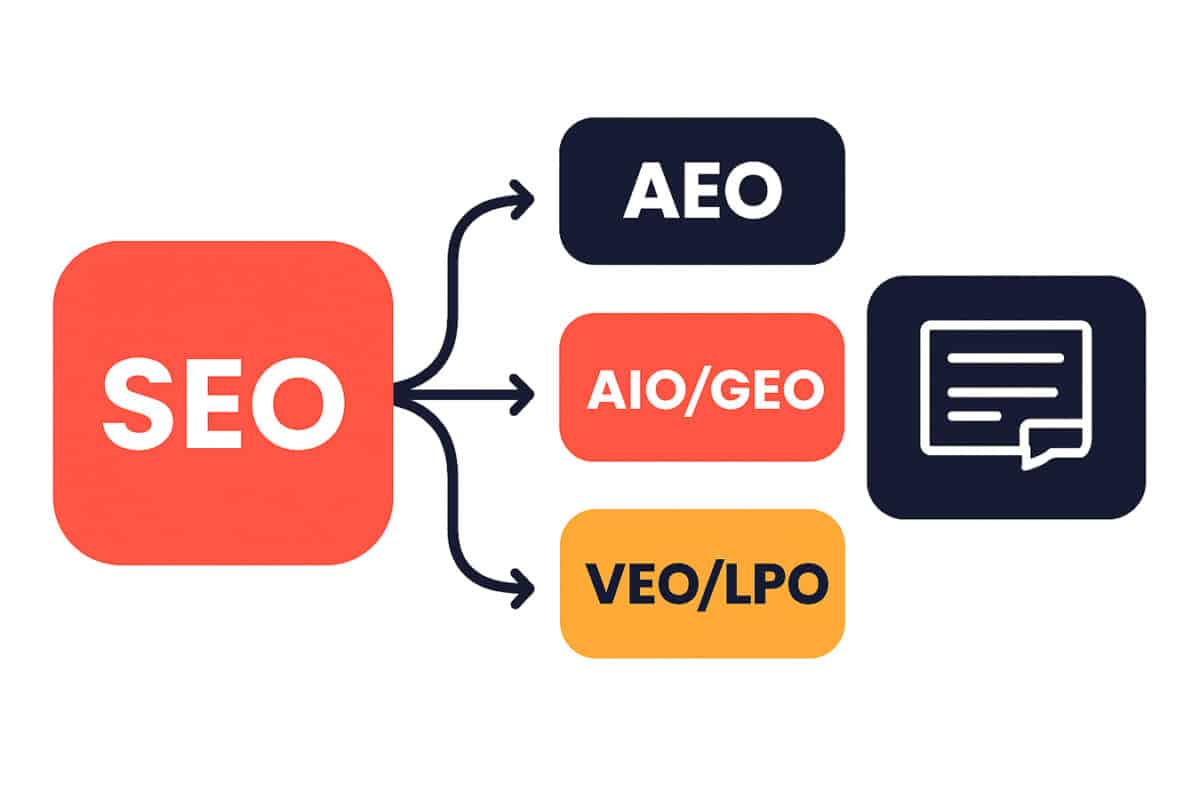
Promotion on the Internet is not a switch, but a long systematic work, but here we consciously narrow it only to internal optimization: SEO (technique and structure), AEO (answers and snippets), GEO (generative output), AIO (clarity for AI models), VEO (visual and voice) and LPO (multilingualism). No external links, PR or advertising — only the inside; a practical view of Nikk.Agency on Israeli small and medium business projects.

In 2025, one trick will no longer work. The scheme is this: SEO is the foundation (without it the pages do not even breathe), AEO pulls the material into snippets and voice, and AIO/GEO make assistants — ChatGPT, Gemini, Claude, Perplexity, You.com — notice the text at all. On top — a short answer to the point, below — a normal FAQ or HowTo, at the end — microdata. Not some kind of poetry, but this is exactly how we more often get into SGE and other “smart” blocks.

All clear? 🙂

And one more thing. There is no “official code” from Google or OpenAI — and it seems there won’t be. All these abbreviations (SEO, AEO, GEO, AIO, VEO, LPO) are not law, but working notes from the field: what assistants quote, when a fresh date helps, in what cases FAQ pulls the page into “zero”. We try, measure, keep what holds.

We at Nikk.Agency, Haifa, without fanfare: we don’t hand out promises of “top tomorrow”. In the morning we put in order the speed and structure, add short answers, test AIO/GEO on a couple of key pages, then look at the metrics. The task is simple — so that small and medium businesses across Israel are found both in Google and other search engines, and in assistants’ answers, without pointless expenses. Website: nikk.co.il.

Short answer to a big question

Take the bundle.

Classical website promotion (SEO) — as a base. Plus optimization for answers (AEO) and work for AI (AIO/GEO) — so that assistants like ChatGPT, Gemini, Claude, Perplexity, You.com and those very new Google blocks pick you up.

Why so? Because the rules are now “floating”.

Google is rolling out SGE (Search Generative Experience), and no one really explains how to get there stably. But practice shows a simple thing: a short answer at the beginning, then a normal FAQ/HowTo and neat microdata. This way you noticeably more often end up where people get quick solutions today.

SEO for website promotion: the foundation without which nothing works

Question: Why SEO if “AI decides everything”?
Answer: SEO gives the technical and content base: without speed, structure and indexing, the page simply will not get into AI answers.

SEO (Search Engine Optimization) remains the support of any business promotion strategy on the network:

  • Keywords and LSI-lexicon for real people’s questions.
  • Technical cleanliness: speed, mobile adaptability, HTTPS, Core Web Vitals.
  • Structure: internal linking, heading hierarchy, sitemap.
  • Expert texts: experience, usefulness, cases, clarity, E-E-A-T.

Conclusion: SEO gives the “skeleton” and indexability.

But in 2025, only SEO rarely brings maximum traffic anymore — users flow into AI assistants, where the answer format rules.

AEO for website promotion: how to become a ready answer, not the tenth link

Question: How to get into “zero position” and voice answers?
Answer: Give a short answer at the top of the page, add FAQ/HowTo and schema.org markup — and keep the material fresh.

AEO (Answer Engine Optimization) is about making your material a ready answer:

  • Featured Snippets (Google’s zero position).
  • Voice answers of assistants.
  • FAQ blocks and “quick tips”.

AEO tools that work for the Israeli market as well:

  • Schema.org microdata (FAQPage, HowTo, Article, JSON-LD).
  • Short Q&A inserts inside articles.
  • Lists, tables, checklists — AI “likes” structure.
  • E-E-A-T: emphasize experience, authority, sources and facts.

“If there is no direct, short answer on the page — AI will find the one who has it.”

AIO: make content “understandable” for LLM (ChatGPT/Gemini/Claude/Perplexity)

Question: What makes content “machine-readable” for LLM?
Answer: Q&A structure, tables/schemes, actual dates, JSON-LD and duplication of expert materials on open sources.

AIO (Artificial Intelligence Optimization) is the key so that ChatGPT, Gemini, Claude, Perplexity correctly interpret your materials:

  • Write in blocks “question → answer”, add tables and schemes.
  • Duplicate expert publications on open platforms (Wikipedia, Medium, Quora, GitHub) — this increases the chances of being “noticed” by models.
  • Clearly indicate sources and update dates — AI values freshness and verifiability.
  • Apply JSON-LD for Article/FAQ/HowTo.
  • Think about multilingualism (see LPO below): Israel is a multilingual environment.

GEO: how to get into generative answers (ChatGPT/Perplexity/SGE)

GEO (Generative Engine Optimization) is about reference collections that AI attaches to the short answer:

  • Credibility and primary sources.
  • Freshness: up-to-date versions of pages win.
  • Cross-platform presence: presence on several authoritative domains.
  • Clear structure: subheadings, markers, short paragraphs.

Practically: make articles updatable (with update date), connect FAQ, add HowTo and tables, strengthen brand signals and links to primary sources.

VEO and Voice SEO: visual and voice world

VEO (Visual Engine Optimization) — so that you are found through images and videos:

  • ALT tags and detailed image descriptions (specify city/service in ALT).
  • Unique media: infographics, video tutorials, “cheat cards”.
  • Structured data for images and video.

Voice SEO — so that you are easily read by voice assistants:

  • Write “conversationally”: long-tail queries, live wording.
  • FAQ with short phrases — 1–2 sentences per answer.
  • Less officialese: simple verbs, active voice.

LPO: language optics for Israel

LPO (Language Processing Optimization) — so that your content is equally well found in Hebrew, Russian and English:

  • Not a “dry” translation, but localization for the search patterns of each language.
  • Reflect local toponyms and details (districts, transport, prices).
  • Check tone and style: in Hebrew — more direct, in Russian — more detailed, in English — shorter and more pragmatic.

How AI chooses whom to show

Briefly — what “trust” of assistants rests on:

  • E-E-A-T: author’s experience, expertise, domain authority, credibility.
  • Structure: FAQ, lists, tables, clear headings.
  • Sources and citability on open platforms.
  • Freshness and regular updates.
  • Technical cleanliness: accessibility, speed, valid microdata.

Google and SGE: the output itself is changing

Google is rolling out Search Generative Experience — a block with a generated answer and sources above regular links.

Problem: so far it is unclear which signals are decisive. This is a “live” zone where the rules are changing.

What we are doing today:

  • Keep structure and microdata in order.
  • Update materials and mark the update date.
  • Make sure the page has a direct short answer, and below — details.

Realities of Israel: what local business should consider

Israel is a multi-layered market: multilingualism, locality (Haifa, Tel Aviv, Jerusalem, Be’er Sheva), strong competition in services (lawyers, medicine, real estate). Here “one article for all” does not work.

Segmentation and local pages with clear navigation and contacts are needed.

Check NAP consistency (name, address, phone) in Google Business Profile and local directories — this is critical for local ranking.

And yes, in conversations and chats people are increasingly asking AI, bypassing Google.

At Nikk.Agency we see that business in Israel is increasingly trying to adapt to the new rules of the game. Therefore, in our work we rely not only on classical SEO, but also on AEO, GEO and other approaches that are formed from practice.

Our task is not “to make it look nice in a report”, but to collect a set of working techniques: where to add FAQ, how to simplify answers, what media to insert, where to put price and contacts so that AI “understands” the meaning of the page.

«Search is not the same»: how in 2025 to promote business and website in Israel if AI is responsible for answers - SEO, AEO, GEO, AIO, VEO, LPO
«Search is not the same»: how in 2025 to promote business and website in Israel if AI is responsible for answers – SEO, AEO, GEO, AIO, VEO, LPO

Roadmap for business promotion: SEO + AEO + AIO + GEO (what to do already this week)

1) Basic SEO (fast)

  • Check speed, mobile version, sitemap.
  • Put order in H1–H3 headings, remove “stop-words” from titles.

2) AEO edits

  • Into each key page — FAQ (3–6 questions).
  • At the beginning — short answer (2–3 sentences) to the main question of the page.
  • Add HowTo/Article markup where appropriate.

3) AIO/GEO enhancements

  • Rewrite 2–3 materials in the format “question → answer” with tables.
  • Update dates, indicate sources.
  • Publish 1–2 overview materials on Medium/Quora (under the company brand).

4) VEO/Voice

  • ALT tags and captions for each key image.
  • Record a short video guide/infographic for the main service.

5) LPO

  • Make separate versions of key pages in Hebrew and English taking into account queries and word usage.

How it sounds in real text

“For companies for which business promotion in Israel is important, a simple blog is no longer enough: you need content that AI can quote. The same applies to website promotion in Israel — without FAQ and short answers you simply do not get into the assistants’ short references.”

“When it comes to local services in Haifa or Tel Aviv, business promotion in Israel rests on clear answers to simple questions: price, area, experience, contacts. Otherwise the assistant will take another source. Therefore website promotion in Israel today is not only links and texts, but above all structure and clarity.”


Where is Nikk.Agency here and why to contact

We are in the North of Israel – nikk.co.il, in Haifa (Krayot), working all over the country and mainly with small and medium business. The approach is pragmatic:

  • start with quick edits (technical, structure, FAQ),
  • in parallel launch AIO/GEO experiments on 1–2 pages,
  • measure what really improves visibility in Google and in AI answers,
  • scale only what makes sense and brings leads.

Website promotion remains the basis. But when the goal is a tangible inflow of requests, you have to play by new rules. We do not “overpraise ourselves” — we simply systematically test hypotheses and implement what worked in Israel.

Search has ceased to be “ten blue links”. Ahead are AI answers, and behind them — only a few sources.
The strategy that gives a chance in 2025: SEO (foundation) + AEO (answers) + AIO/GEO (AI understanding) + VEO/Voice (media and voice) + LPO (Israel’s multilingualism).

Make a short answer at the top, structure, FAQ, markup and updates — and assistants will have a reason to refer exactly to you.

If you need a short work plan for your niche and city — Nikk.Agency (Haifa) will collect a checklist and markup without unnecessary pathos, to the point.

FAQ

This is our professional opinion of Nikk.Agency, formed from real work with projects in Israel. These answers reflect what the expert community is currently discussing around SEO, AEO, AIO and GEO, and are not “official rules” of Google, OpenAI or other platforms.

What is the difference between SEO and AEO?
SEO raises pages in the classical output. AEO makes the page a ready answer: zero position, voice answers, FAQ blocks.

How to understand what exactly my business needs?
Start with an audit: speed, structure, key pages. Then add a short answer at the top and FAQ, check microdata. At the same time test AIO/GEO on 1–2 materials.

Does Google SGE already influence?
Yes, elements of generative output appear more and more often. The rules are floating, but freshness, structure and sources are signals that already help.

Do you work only in Haifa?
We are in Haifa, but we take projects all over Israel. Focus — small and medium business: services, medicine, lawyers, education, local trade.

Is microdata needed if FAQ is already in the text?
Yes. Text is for people, schema.org/FAQPage and HowTo is for machines. With markup the chance to get into snippets and SGE is higher. If you don’t want to mess with the code, use RankMath/Yoast or give us the setup.

How to prepare content for assistants and voice?
Short answer at the beginning, then — lists and tables. Write “conversationally”, without officialese. For voice answers keep phrases shorter and clearer.

Are Hebrew and English versions needed?
Yes. Israel is a multilingual environment. Do LPO: separate versions in Hebrew/English/Russian, take into account local queries and NAP consistency in directories.

How to understand that everything works? What metrics to watch?
Impressions and clicks from Google (including CTR growth on pages with FAQ/HowTo), share of traffic from assistants, brand appearances among answer sources, maintaining positions after updates. Plus practical: requests, calls, inquiries from local pages.

Approaches are changing: Google tests SGE, assistants update models. We follow discussions in the professional community and update recommendations when practice shows a different result.

We Nikk.Agencyin the North of Israel – nikk.co.il, in Haifa (Krayot), working all over the country and mainly with small and medium business. Contact us, if anything…

#promotion