Bar Mitzvah in Israel Three Years After Evacuation from Ukrainian Zhitomir from Russian Bombs: The Fate of Jewish Children from Ukraine

Three boys from the Jewish orphanage “Alumim” in Zhytomyr and two of their friends celebrated their bar mitzvah in Ashkelon three years after fleeing from Putin’s aggression. Israel became their new home — they speak Hebrew, study in Chabad schools, and dream about the future despite the trauma of the past.

This story is a symbol of the strong connection between the Jewish people of Ukraine and Israel, and proof of a true miracle made possible thanks to love, faith, and the support of the entire community.

Under bombs — into the future: children of the “Alumim” orphanage celebrate bar mitzvah in Israel

On June 26, 2025, the Israeli portal ynet reported on an emotional event: a bar mitzvah for five teenagers, three of whom are alumni of the Jewish orphanage “Alumim” in Zhytomyr, held in Ashkelon. This was not just a religious ritual. It was an act of return, maturity, recognition, and reunion with Jewish destiny.

Three years ago, these children, like thousands of other Jews in Ukraine, woke up to the sounds of explosions. Since then, their path has been full of pain — but also care, friendship, faith, and new hope in Israel.

Bar mitzvah in Israel three years after evacuation from Ukrainian Zhytomyr due to Russian bombings – the story of Jewish children from Ukraine. NAnews – Israel News, June 28, 2025

“Alumim” Orphanage: an island of love and light

The “Alumim” orphanage, founded in 2006 in the village of Zarechany, became the heart of Jewish life in Western Ukraine. It was established by Rabbi Shlomo Wilhelm with support from the Or Avner Foundation and the Federation of Jewish Communities of Ukraine.

  • Education based on Jewish traditions and Hebrew
  • Children from 2 to 18 years old, including orphans and children from disadvantaged families
  • Schooling, sports, psychological care, and a warm family atmosphere

“It was not just a structure. It was a real home,” staff members recall.

Before the war began in 2022, “Alumim” was a symbol of Jewish care and a “family home” for dozens of children. After the invasion, the building emptied — but its spirit moved to Israel.

Zhytomyr — cradle of Jewish culture

Zhytomyr is a historic center of Jewish life in Ukraine. It had schools, printing houses, yeshivot, and underground Chabad cheders in the 20th century that survived repression. Before the war, Jews made up one-third of the city’s population — over 30,000 people.

The “Alumim” orphanage became the center of Jewish childhood in the region. Living conditions, care, and religious atmosphere made it a unique place. After the war began, educators were left with 80 children and enormous responsibility — and the idea of evacuation was born.

Putin’s aggression destroys childhood

On February 24, 2022, Putin’s army launched a full-scale invasion of Ukraine. Zhytomyr came under attack, and the orphanage was in danger. Bombs fell near the home where 80 children lived.

“We woke up to deafening noise. Outside — smoke and sirens. 80 children panicked. Educators had to hide their fear while bombs kept falling,” — recalls Malka Buket.

Escape under fire

The decision to evacuate the children came quickly. First — to Chernivtsi, then — to Israel. The border was crossed on foot, without documents, with small children carried in arms. It was a heroic evacuation.

KKL-JNF and Keren LeYedidut carried out an emergency evacuation of about 100 children aged 2 to 18.

Nes Harim: first Jewish refuge

Upon arrival in Israel, children were placed in the Nes Harim center in the Jerusalem Forest. Volunteers provided clothing, toys, psychological support, and Hebrew classes. They celebrated holidays and slowly adapted to their new life.

Ashkelon: new life and bar mitzvah

In 2025, the children moved to Ashkelon. On June 26, five teenagers, three of them from “Alumim,” celebrated their bar mitzvah. The event was organized by Rabbi Shlomo Wilhelm. Rabbis, local leaders, and Minister Yaakov Margi attended.

“Each child has their own story and pain. But to see them happy, confident, and speaking Hebrew — it’s a miracle,” said Rabbi Wilhelm.

“Just as Jews received the Torah at Mount Sinai, so our children receive it here in Ashkelon — with love and light,” said Rabbi Mendel Lieberman.

Table: journey from war to bar mitzvah

Year Event
2006 “Alumim” orphanage founded
2022 Start of Putin’s aggression. Evacuation of children
2022–2023 Adaptation in Nes Harim
2024 Move to Ashkelon
2025 Bar mitzvah and integration into Israeli society

NAnews — Israel News

NAnews emphasizes: the story of the “Alumim” children is not just a humanitarian case. It is proof of the strength of the Jewish community, the bond between Ukrainian and Israeli Jews, and the ability to overcome even war.

While Putin’s army drops bombs on children’s heads, Israel extends a helping hand. The bar mitzvah in Ashkelon is not the end — it’s just the beginning. These children now have a home. A community. A future.

The Place Where Hasidism Was Born: Secrets of the Village of Tovste, Ternopil Region of Ukraine

In 1734, the founder of Hasidism settled in Tovstom Israel ben EliezerIt is believed that It was here that he received his second name, Baal Shem Tov (abbreviated as Besht) and became known as a tzaddik and healer.

In his new article “Ukraine Incognita” revealed little-known facts about the Jewish history of the village of Tovste (Ukrainian: Товсто), which is in the Ternopil region. For those interested — here it is on the map.

This village is not as well known to travelers as Zalishchyky, Gorodenka or Chortkiv, but, according to researchers, it is no less interesting and definitely deserves attention.

In Hasidism this is called the “Besht’s revelation.”that is, the moment when he revealed to people his true face as a great tzaddik.

Hasidic traditions describe it this way:

“Then he (Israel ben Eliezer) settled in the holy community of Tlusta, where he was also a melamed (teacher in a cheder – religious school), and could not gather a minyan in his home, but received people and prayed with them.

He wore a “tuzlik” (Ukrainian) (a woolen bag for salt), and his toes stuck out of the holes in his shoes, because he was very poor. He used to immerse himself in the mikvah even in the month of Tevet (December-January according to the Gregorian calendar), and sweat would come out in drops the size of peas. Then people began to come to him, but he did not want to receive them.

One day, a madman or madwoman was brought to him, and he refused to let them in. At night, he was told that he had turned 36. In the morning, he began to count and discovered that this was indeed true. He accepted the madman, cured him, and left his occupation as a melamed, taking my father-in-law, of blessed memory, as a sofer. People from different places began to come to him.”

The term “baal-shem” was used by the people to refer to a person who knows the hidden name of God, has the power and means (“kelim”) with which he can address the Almighty. In another meaning, among Kabbalists, “baal-shem” is someone who uses the formulas of magic (practical Kabbalah) and natural remedies for healing. Baal Shem began as a professional healer, combining the knowledge of a doctor, psychologist and folk healer. He treated infertility, mental illness, exorcised demons and devils, and made amulets and potions.

Besht lived in Tlust (as Tovsta was called until 1944) almost until his move to Medzhybizh.

Hasidic traditions should be treated with great caution, as they contain many frankly fabulous and logical inconsistencies. But the fact remains that Hasidism, as a new religious movement, originated in Tovstom.

By 1930, the local Jewish community numbered 2,600 people, more than two-thirds of the entire population of the village. But by 1939, it had significantly decreased to 1,196 people.

The German occupation put an end to the history of the Jewish community of Tlusty. The Nazis created a ghetto in the village, where, in addition to locals, they drove Jews from neighboring Zalishchyky, Horodenka, Yagilnitsa, Chortkiv and others.

On May 27 and June 6, 1943, the entire population of the ghetto was exterminated in two mass executions. Taking into account the executions of previous years, almost 5,000 people were tortured in the village in total.

Traces of this tragedy can be seen in the old Jewish cemetery. In addition to the mass graves of the tortured, there are bullet holes on the matzevah gravestones.

Leave a comment↓

Read us in channels Israel News Nikk.Agency News from Israel V – TelegramFacebook,Google News

Ukrainian classics in Hebrew: “Every city has its own character and rights” by Grigory Skovoroda has already been translated by the “Nemala נְמָלָה” project as part of the Translate Ukraine 2025 program

In 2025, Israel will continue to support the translation of Ukrainian literary works. Among them is the “Anthology of Ukrainian Poetry” (Volume I), which includes the works of classics from Hryhorii Skovoroda to Ivan Franko.

This project won a tender for translation and publication and was selected for inclusion in the Translate Ukraine 2025 program. The Israeli publishing house Persimmon Books Ltd will handle the translation, printing, and distribution, funded by Ukraine.

The translation in Israel is being carried out by the creative project and publisher “Nemala נְמָלָה”.

The project was initiated by Asaf Bartov and Nataliia Tymkiv, an Israeli-Ukrainian family dedicated to preserving and sharing the richness of both cultures. They want their daughter and her peers to live in a world where the best works of Ukrainian and Israeli literature are available in their native languages.

On May 16, 2025, Asaf Bartov announced that the Hebrew translation of Hryhorii Skovoroda’s poem “To Every City Its Custom and Law” has been completed.

“The war waged by Russia against Ukraine is essentially a war against Ukrainian identity and culture.
When Russians occupy a village, they, for example, burn Ukrainian books in local schools. This is hardly a strategic military priority — unless the true goal is to erase Ukrainian identity and forcefully dissolve it into a Russian one, treating Ukrainians as second-class citizens.

On May 6, 2022, a Russian missile struck the Skovoroda Museum in the village where he was buried.

The museum was destroyed, although the statue of Skovoroda remained intact, and his portrait among the ruins became symbolic,” said Asaf Bartov.

We have already written about this project — The Israeli project “Nemala נְמָלָה”: enthusiasts bridge Ukrainian and Hebrew literature through translation, creating a cultural link between Israel and Ukraine

Asaf Bartov and Nataliia Tymkiv are also contributors to Hebrew Wikipedia, where they actively publish articles about Ukrainian culture and literature.

Hryhorii Skovoroda — Ukrainian Philosopher, Poet, and Educator

Hryhorii Savych Skovoroda (December 3, 1722 – November 9, 1794) was a Ukrainian philosopher, poet, teacher, thinker, and theologian, and one of the most important figures in the Eastern European intellectual tradition. He is often called the “Ukrainian Socrates” for his life as a wandering sage.

Biography

Skovoroda was born in the village of Chornukhy (now Poltava region, Ukraine) in a Cossack family. He received a classical education at the Kyiv-Mohyla Academy, where he studied theology, philosophy, and ancient languages. He traveled to Hungary, Austria, and possibly Germany as a member of a court choir. He taught at the Kharkiv Collegium but resigned due to disagreement with dogmatic approaches and pressure from church authorities.

Afterward, he led a life as a wandering philosopher, rejecting material wealth and positions, preaching ideas of inner freedom and spiritual integrity.

Philosophy and Language

Skovoroda opposed scholasticism and the spiritual oppression of Russian Orthodoxy. Inspired by the Bible and classical philosophy, he preached that true happiness comes from living in harmony with one’s inner nature and finding one’s “calling of the heart.”

The language of his works remains a subject of scholarly debate. His philosophical treatises were written in Slavic-Ukrainian (Slavenoruthenian), a variant of Early Modern Ukrainian with Church Slavonic influences. His poetry and fables were written in literary Ukrainian, and some correspondence was in Latin.

“To Every City Its Custom and Law”

One of Skovoroda’s most famous works is the tenth song from the collection “The Garden of Divine Songs” — a satirical and philosophical poem denouncing greed, hypocrisy, and moral decay in society.

יש לכל עיר לא מעט מנהגים,
גם לכל איש יש אין־ספור הגיגים.
כל לב יאהב בדרכו בחומו,
גם לכל חך יערב טעמו.
בי תקנן מחשבה יחידה
רגע שלֵו נשמתי לא תדע.זה מחזר על פתחי השרים,
זה מרמה במסחר בשקרים.
זה מתגאה ובונה בית רם.
זה מקלף בריבית את העם.
בי תקנן מחשבה יחידה
רגע שלֵו נשמתי לא תדע.זה רק חומד אחוזות ושׂדמות,
זה מנכר מייבא בהמות.
פה אוהבים רק לצוד עם כלבים,
שם הוללים, זוללים וסובאים.
בי תקנן מחשבה יחידה
רגע שלֵו נשמתי לא תדע.כל השופטים ערומים בחוקים.
כל הסטודנטים מרבים ויכוחים.
זה רק חומד מזמוטי אהבה –
כמה איוולת בכל תאווה.
בי מחשבה יחידה רק תצוף:
איך אשמר עד מותי מטֵרוף.מוות נורא, השולט בכולם,
על אף אחד לא תחוס לעולם.
הלך גם מלך תקצֹר בחרמש
אנו נכלה כמו תבן באש.
אלא לנצח אותך לא יירא
איש טהור־מדות שיחיה ביָשְרה.

Legacy for Ukraine

Hryhorii Skovoroda is one of the central figures in Ukrainian spiritual history. His philosophy — based on freedom, self-knowledge, and following one’s inner voice — has inspired generations of thinkers, poets, and defenders of Ukrainian identity.

He became a symbol of Ukrainian cultural independence, a philosopher who expressed universal truths in the language of his time, while remaining deeply rooted in Ukrainian tradition. In modern Ukraine, he is revered as a national genius, and his writings serve as a source of wisdom and moral guidance.

Works

During his lifetime, none of Skovoroda’s works were published — church censors found them “contrary to Holy Scripture” and “offensive to monasticism.” Only in 1861 was the first posthumous volume published in Saint Petersburg:

“Writings in Verse and Prose by Hryhorii Savych Skovoroda. With His Portrait and Handwriting.”

Key works include:

  • “The Garden of Divine Songs” — a collection of metaphysical poetry
  • “Kharkiv Fables” — philosophical allegories and parables
  • “Narcissus,” “A Conversation Called Alphabet,” “Symphony” — philosophical dialogues and treatises

Legacy

Skovoroda became a symbol of spiritual freedom and inner independence. His impact on Ukrainian culture, philosophy, and literature is profound and enduring.

On his tombstone is engraved a phrase that became the motto of his life:

“The world tried to catch me, but didn’t succeed.”

This phrase symbolizes his path: to remain true to oneself, to resist vanity, and to preserve spiritual freedom until the end.

Translate Ukraine 2025

The “Translate Ukraine” government program, led by the Ukrainian Book Institute, continues to actively promote Ukrainian culture worldwide.

In 2025, the program will carry on. The list of works selected for translation into foreign languages includes 81 titles, featuring some of Ukraine’s most prominent authors.

One of the most notable projects is the translation into Hebrew, which will help strengthen cultural ties between Israel and Ukraine and promote Ukrainian literature in Israel.

As part of Translate Ukraine 2025, Ukrainian works will be translated into 25 languages across 28 countries. The largest number of translations will be into Polish (7), Spanish (6), Latvian (6), and Slovak (6).

Other translations include English (5), Arabic (2), Bengali (1), Bulgarian (3), Greek (2), Georgian (3), Hebrew (1), Italian (4), Chinese (1), Lithuanian (3), Macedonian (5), German (3), Portuguese (3), Romanian (2), Serbian (1), Hungarian (4), Finnish (2), French (4), Croatian (2), Czech (3), and Swedish (2).

NAnews: Ukraine continues to open doors to its literature for the world. In Israel, this plays a particularly important role in deepening cultural connection. Follow updates on NAnews — Israel News.

Jews from Ukraine: Haim Hazaz – from the Ukrainian village of Sidorovichi to the first ever Israel Prize for Literature

A boy from a Ukrainian Jewish village who survived pogroms and humiliation by Russian authorities in Kyiv became a symbol of Israeli literature. The biography of Haim Hazaz in our permanent section Jews from Ukraine is a bridge between Ukraine and Israel, past and future.

Roots in Ukraine: Childhood among forests and traditions

Today the name Haim Hazaz (חיים הזז) is known to everyone interested in the history of Israel and Jewish culture. But the beginning of his path is the Ukrainian village of Sydorovychi.

Haim Hazaz (real name – Haim Fishel Feldman) was born in 1898 in the village of Sydorovychi, Kyiv province (now – Vyshhorod district, Kyiv region of Ukraine). This small place was located in the wooded area of Polissya and was a typical Jewish settlement with the dominant role of the traditional community.

His father was a Breslov Hasid and managed a sawmill, so the future writer’s childhood was spent in a small house among dense forests.

In early childhood, Haim studied at a cheder – a Jewish religious school at the synagogue, where he learned Hebrew, Tanakh, the main laws and traditions. Later he received a secular education, possibly at a rural or city school, where he studied languages and the basics of secular subjects in depth.

In everyday life, there was a lot of household communication between the inhabitants. As a rule, people spoke a mixture of Yiddish, Russian, and Ukrainian. For the Jewish population, the main language was Yiddish, and Russian was used in official spheres. Ukrainian was part of the cultural background and was heard around, but was not dominant in the Jewish environment. Little Haim heard Ukrainian speech from childhood, observed the traditions and life of his Ukrainian neighbors.

There is no evidence in academic sources that Haim Hazaz was fluent in Ukrainian or wrote in it. All of Hazaz’s main works were written in Hebrew, which was part of his cultural mission – to revive national literature in the holy language.

In his letters and memoirs, there are no fragments in Ukrainian, except for rare everyday expressions or individual words. Some Ukrainian words or character names may appear in his texts as background details. It can be stated that Hazaz knew well the realities and traditions of the Ukrainian village, as he grew up in this environment. Understanding Ukrainian speech was natural for him, considering his living conditions.

With the onset of revolutionary events and a wave of violence in 1917–1918, Hazaz was forced to leave his native village. He moved to Kyiv, where he tried to continue his studies and start an independent life, but the capital was engulfed in political chaos, a change of authorities and dangers for the Jewish population.

It is known that in Kyiv he worked as a teacher (most likely in a Jewish religious school or privately), and also did odd jobs related to teaching and translations. In Hazaz’s memoirs, it is mentioned that in the years of chaos he had to temporarily engage in various jobs, including helping Jewish intellectuals and the elderly who were left without means of subsistence.

What was happening in Kyiv at that time:

  • February – November 1917: Power belonged to the Provisional Government of Russia and gradually to the Central Rada (Ukrainian national government).
  • January 1918: Capture of Kyiv by the Bolsheviks (Red Army), then the city was taken by the UNR troops and German-Austrian units (April 1918).
  • End of 1918 – early 1919: Hetmanate of Skoropadskyi (with the support of the Germans), then power passed to the Directorate of the UNR.
  • February – August 1919: The Bolsheviks returned to Kyiv, then replaced by the UNR troops.
  • August 1919: The Volunteer Army (White Army of Denikin) entered Kyiv. It was during this period that some of the largest pogroms were recorded, committed by White units and their accompanying detachments.
  • End of 1919 – 1920: The Bolsheviks captured the city, but several times power passed to Polish and Ukrainian troops, then again to the Bolsheviks.

After a series of Jewish pogroms that swept Kyiv and its surroundings in 1919 (Bolsheviks – White Army of Denikin), Hazaz found himself among thousands of refugees wandering between cities in search of safety.

For the next several years he lived and worked in Kharkiv — then a major industrial and cultural center of eastern Ukraine, and also in Crimea. In parallel, Hazaz continued self-education, attended cultural circles and libraries, read a lot, and tried his hand at literature.

In early 1921, when the wave of repression and famine intensified, Haim Hazaz finally decided to leave Ukraine.

Through the Black Sea coast — Sevastopol — he emigrated first to Turkey, then to France, and later to “Palestine”. Thus, before emigration, his entire life and formation took place on the territory of Ukraine: in Sydorovychi, Kyiv, Kharkiv, Crimea and other places that remained forever in his memory and prose.

Modernity: in the Ukrainian village where the father of Yitzhak Rabin and writer Haim Hazaz was born, Putin’s soldiers looted the Israeli flag from the library, presented to the village by the state of Israel

In the spring of 2022, the small Ukrainian village of Sydorovychi, the homeland of Haim Hazaz and also of the father of Israeli Prime Minister Yitzhak Rabin, found itself at the center of tragic events. The village was on the path of the invaders on their way to Kyiv – the capital of Ukraine. After passing through the Chernobyl zone, Russian soldiers entered Sydorovychi on February 25. 35 days of brutal occupation began.

In the houses of residents, windows and doors were broken, soldiers took away household appliances, food and everything of any value. Many villagers lived for weeks without electricity or water, hid from shelling and tried to protect their families and neighbors.

The memorial plaque in honor of the Rabin family was moved by local residents to the library, which became a shelter for the only commemorative sign symbolizing the international ties of this village.

A characteristic moment: Russian soldiers, before retreating from the village, stole not only washing machines from the homes of peaceful residents.

Putin’s soldiers stole the Israeli flag from the library, presented to the village during the opening of the memorial plaque.

When the story of the village of Sydorovychi became known to Israeli Ambassador to Ukraine Michael Brodsky, his reaction was immediate. At the ambassador’s request, the flag of Israel was delivered to the village – to replace the flag stolen by Russian occupiers; medicine was also delivered.

In the liberated Ukrainian village, which gave Israel such outstanding figures, there is once again an Israeli flag.

Russian Pogroms in Ukraine: The Tragedy of the Jewish People

The beginning of the 20th century was marked for the Jews of Ukraine by an unprecedented catastrophe. During the Civil War (1918–1921), there were more than 1,000 Jewish pogroms in Ukraine alone.

Modern research and archives (Encyclopaedia Judaica, Yad Vashem, Henry Abramson, Geoffrey Hosking) emphasize:

“the most massive and brutal pogroms were committed by armies and authorities coming from Russia — primarily Denikin’s White Army, units of the Red Army, and various Russian military administrations.”

The period of August–October 1919 was especially tragic for Kyiv, when the real power in the city was held by the Volunteer Army (White Army) of General Denikin and the Russian military administration. It was at this time that dozens of cases of robbery, eviction, and mass murder of the Jewish population under the control of the Russian authorities were recorded.

Haim Hazaz was a direct witness and victim of this tragedy. In Kyiv, as he later recalled in Paris, he faced a direct order from the Russian authorities to evict an elderly Jewish scholar and destroy his library—and refused to carry it out, realizing that behind this stood a policy of terror and humiliation brought by the Russian military forces. After this, Hazaz was forced to flee south.

Haim Hazaz’s Literary Activity: Ukrainian Motifs, Heritage, Influence

The name Haim Hazaz is an integral part of the history of Hebrew literature and the cultural heritage of Israel. His creative path is closely connected with the fate of Ukrainian Jewry and the era of catastrophic change on this land.

The Ukrainian Theme in Hazaz’s Prose

Most of Hazaz’s early works are inspired by his personal experience of life in Ukraine, memories of the shtetl, the tragedy of pogroms and revolutions, and the history of the Jewish people on Ukrainian soil:

  • “In a Forest Settlement” (Beyishuv shel ya’ar, ביישוב של יער, Paris, 1930)
    An autobiographical novel describing the life of a Jewish family of timber traders in the Ukrainian Polissya on the eve of the 1905 revolution. At its heart are the drama of the shtetl, generational conflicts, coexistence with Ukrainian peasants, and the gradual disappearance of the old world.
  • “Of This and That” (Mi-ze u-mi-ze, מזה ומזה, 1924)
    A novella in which, through the fates of the characters, the collapse of the familiar order of the town, the anxieties of revolutionary Ukraine, the fear of violence, and uncertainty about the future are depicted. The atmosphere of anxiety and anticipation of disaster is keenly felt.
  • “Sketches of Revolution” (Pirkei Mahapeha, פרקי מהפכה, 1924)
    A cycle of stories about revolutionary events in the former Russian Empire, mainly in Ukrainian cities, villages, and towns. The focus is on the fates of ordinary Jews caught between the millstones of history, forced to choose between tradition, revolution, fear, and hope.
  • “Shmuel Frankfurter” (Shmuel Frankfurter, שמואל פרנקפורטר, 1925)
    A story about the tragedy of the shtetl against the backdrop of the civil war and pogroms in Ukraine. The hero is a noble idealist who perishes during mass repressions and anarchy. The crisis of Jewish self-identification in a devastated Ukraine is vividly portrayed.
  • A number of short stories and miniatures from the late 1920s to early 1930s
    Thematically, they cover images of the Ukrainian town, childhood, fear of pogroms, street life, encounters with Ukrainians, memories of family holidays and tragedies. Examples are the stories “Legend,” “Letter to the Village,” “Farewell.”
  • Separate chapters of major works
    Even in later novels (“Yaish,” “The Sermon”), there are recollections of Ukrainian towns, images of refugees, reflections on the lost home, native language, and the past.

Style, Mission, Historical Significance

In Hazaz’s Ukrainian works, the main theme is the collapse of the old world, the pain of loss, and the search for new meaning. Through the fates of ordinary people, he shows the scale of the national catastrophe—and at the same time seeks sources of inner strength for rebirth.

His language is precise, rich in folk expressions, with detailed descriptions of the landscape, everyday life, festive and mourning rituals. Hazaz showed how Jewish-Ukrainian life was inseparable from the very history of Ukraine and why the memory of this is necessary for future generations.

Hazaz’s literary heritage is a mirror of the tragedy and heroism of the Jewish people of Ukraine, their eternal yearning for light even in times of darkness and hardship.

Thanks to Hazaz, the themes of the tragedy of Ukrainian Jews, life on the border of cultures, and the search for national and personal meaning have taken a key place in the Israeli literary canon.

Other Works and Contribution to Literature

  • “The Sermon” (Ha-Drasha, 1942) – an inner monologue about Zionism, Jewish fate, and identity. From here comes the famous quote about the transformation of Jewry in the Diaspora.
  • “Yaish” (Yaish, 1952–1956) – a novel about the life of Yemeni Jews in Eretz Israel, but with numerous references to the past of Eastern Europe, the experience of Ukrainian towns, and the crisis of tradition.
  • “Thou That Dwellest in the Gardens” (Thou That Dwellest in the Gardens, 1960) – a novel about spiritual quests, crisis of faith, the clash of past and future.

Life, Family and the Path of Haim Hazaz in Israel

In the spring of 1931, Haim Hazaz immigrated to “British Palestine” and settled in Jerusalem. For the first sixteen years of life in the new city, he often changed neighborhoods, getting to know different Jewish communities, especially Yemeni immigrants among whom he lived and interacted. This experience had a profound influence on his worldview and creativity.

In Turkey, where Hazaz found himself en route to Palestine, he spent almost two years teaching Hebrew to young Zionist Jews and actively participated in educational and outreach programs.

In Paris, where he moved in 1923, Hazaz became famous as a Jewish writer, published his first major works, and joined the Jewish literary circle. There he had a union with the poetess Yocheved Bat-Miriam; their son Naum was born in Paris in 1928. The couple broke up in 1929, when Bat-Miriam moved to Palestine.

In 1951, Hazaz married Aviva Kushnir (née Ginzburg-Peleg, 1927–2019)—an intellectual, companion, and faithful assistant to whom he bequeathed all his unpublished manuscripts. She became his right hand in creative and public work.

In Jerusalem, Hazaz devoted himself to literature, became one of the main authors of the “Am Oved” publishing house—his collected works, published in 1942 (“Rekhaim Shvurim”), became one of the first landmark publications of the new publishing house. Later, most of his books were also published there. In 1970, a complete 12-volume collection of Hazaz’s works was published.

Hazaz mastered all styles of Hebrew—from biblical and Talmudic to medieval and modern—which made his prose complex, rich, and profound. In the 1950s–60s, he was called Israel’s leading Jewish writer, even a rival to Nobel laureate Shmuel Agnon.

Haim Hazaz died on March 24, 1973, in Jerusalem of a heart attack. He was buried in the old cemetery on the Mount of Olives—next to the greatest figures in Israeli history.

Memory and Recognition: How Hazaz is Honored Today

In his native Sydorovychi, a memorial plaque in honor of another famous native—Nehemiah Rabichev (the father of Israeli Prime Minister Yitzhak Rabin)—appeared in 2010, and Hazaz’s name was included in the list of prominent Jews of this region.

Haim Hazaz is not just a classic of Hebrew literature; he has become a symbol of national recognition and cultural continuity.

  • In 1953, he became the first-ever laureate of the Israel Prize for Literature, established by the state to honor outstanding cultural figures. This event became a symbol of the new nation’s admiration over the past of the Jews of the Diaspora.
  • Previously, he had already received the Bialik Prize—the first in 1942, the second in 1970. This award was given for his contribution to the development of progressive Jewish literature and culture.
  • His achievements in literature and cultural identity made him an authority not only in Israel, but also in the Jewish diaspora.

Thanks to these awards, Hazaz received the status of a national literary symbol and continues to inspire generations of readers, writers, and scholars to dialogue with the past and search for cultural roots.

Haim Hazaz in the Cultural and Literary Memory of Israel

In Israel itself, the memory of Haim Hazaz is alive and institutionalized at the state and public levels. His name is invariably included in the list of classics of Hebrew literature.

This is how Hazaz is honored in Israel:

  • Haim Hazaz Prize: In Jerusalem, there is a special fund and literary prize named after Haim Hazaz, established by the city municipality. It is awarded annually to outstanding writers and researchers who have contributed to the development of Hebrew and Israeli literature. This award is a symbol of generational continuity.
  • Haim Hazaz Archive: In Jerusalem, at the Givat Ram Institute, there is a public archive named after Hazaz, where his manuscripts, letters, drafts, and personal belongings are collected. This place is one of the research centers for studying the history and literature of Israel.
  • Editions and reissues: His works are regularly republished by the largest Israeli publishers and are included in school and university programs. In 2008, for the 110th anniversary of Hazaz’s birth, a complete collection of his works was published, and leading Israeli newspapers devoted special issues to this event.
  • Streets and objects: In cities of Israel, including Jerusalem and Tel Aviv, there are streets and squares named after Haim Hazaz (for example, רחוב חיים הזז—Haim Hazaz Street in Jerusalem).
  • Commemorative evenings and exhibitions: Major museums and cultural centers of the country—the Jewish National and University Library Archive, the Diaspora Museum, municipal libraries—regularly hold memorial evenings, literary readings, and exhibitions dedicated to the life and work of Hazaz.
  • School heritage: His texts are included in the list of mandatory literature for study in Israeli schools, and Hazaz’s image is presented as an example of a “man of the era,” combining the traditions of Eastern Europe with the values of modern Israel.
  • Literary conferences: Scientific conferences devoted to Hebrew literature include special sections on Hazaz’s work. His texts are analyzed not only by philologists, but also by historians, cultural scholars, and researchers of Jewish identity.

Today in Israel, the name Haim Hazaz is not just part of the literary canon, but also a cultural brand, a symbol of generational connection and a living bridge between the past and present of the Jewish people.

Dialogue of Peoples: The Lesson of Haim Hazaz for Modernity

Today in Israel, according to the Ukrainian embassy, more than 500,000 immigrants from Ukraine and their descendants live there—this is the second largest group of repatriates. Their contribution to Israeli science, economy, culture, and literature is colossal. The story of Hazaz is proof that true Jewish identity is born not in rupture, but in the dialogue of cultures.

The website NAnews — News of Israel continues to tell the stories of Ukrainian Jews who built a new life in the Land of Israel.

Conclusions: Why Hazaz’s Fate is Not Only a Personal Story

  • Haim Hazaz is a symbol of a generation that experienced Russian pogroms and built Israel.
  • His path from a Ukrainian village to the first Israeli literary prize is an example of the strength of Jewish identity.
  • Only an honest conversation about the past—about the role of Russian armies and authorities in the catastrophe—makes the dialogue between Ukraine and Israel real.
  • The memory of him is part of the common cultural code for the Jews of Israel and Ukraine.

The section Jews from Ukraine on the NAnews website tells about outstanding Jews whose roots are connected with Ukraine, but whose life and contribution have become an important part of the history of Israel and the world.

It publishes essays, biographies, and stories of well-known and little-known personalities—from writers and scientists to modern heroes—to show how Jewish and Ukrainian destinies intertwine and form a cultural bridge between the two countries.

#jewsfromukraine
Jews from Ukraine: Philip Kotler – the father of global marketing with roots in Nizhyn and Chernivtsi

“… The UN is a major problem. It was created to maintain world peace and engage in peacekeeping when needed. Unfortunately, they did not create armed forces to support all nations. Moreover, Russia is part of it, and I understand that all members want to change the charter and remove it. Ultimately, we want them (Russia – ed.) not to appear on the UN map at all because they set a bad example for the world…

In our regular column “Jews from Ukraine”Philip Kotler, by blood, is a Ukrainian Jew whose family roots go deep into Ukrainian soil, from which his parents were forced to emigrate to the United States in the early 20th century.

Who is Philip Kotler

Jews from Ukraine: Philip Kotler – father of global marketing with roots in Nizhyn and Chernivtsi #євреїзукраїни NAnews Israel news July 1, 2025

Philip Kotler is an American economist and professor at Northwestern University (Kellogg School of Management), known as the “father of modern marketing”. He developed the concepts of the marketing mix (4P), social marketing, demarketing, and Marketing 3.0, which emphasizes values and humanism.

By combining marketing with psychology and economics, he laid the scientific foundations for modern marketing practice.

One of his most famous works, Marketing Management, is used worldwide as a key university textbook. His theories help companies build customer-oriented strategies and gain competitive advantages in global markets.

He has written over 80 books, and his flagship work Marketing Management is used in over 60 countries and translated into dozens of languages, including Ukrainian and Hebrew. Throughout his career, he received 22 honorary doctorates, including from Ukrainian institutions.

Family and Jewish roots

Kotler was born in 1931 in Chicago, in a family of Jewish immigrants from Ukraine. His father, Maurice Kotler (original surname Kotliarevsky), was born in Nizhyn in 1905, and his mother, Betty Bubar, was born in Berdychiv or Chernivtsi in 1910. They emigrated to the U.S. in 1917.

“I grew up in an environment where everyone knew you had to be not only successful but also useful.” — Philip Kotler

Nizhyn: Jewish pain and strength

Nizhyn is one of Ukraine’s oldest Jewish centers. In the early 20th century, Jews made up about 30% of the population. The city had 10 synagogues, schools, doctors, and craftsmen. The pogroms of 1905 and 1919 led to mass Jewish emigration.

Chernivtsi: Capital of Jewish intelligentsia

Chernivtsi was the cultural capital of Bukovina. It was home to Zionists, poets, and scholars. On the eve of World War I, Jews made up up to 40% of the city’s population. Famous Jewish natives include Paul Celan, Joseph Schmidt, Eliezer Steinbarg. Kotler’s mother was raised in this unique cultural atmosphere.

The path to success

Philip studied at the University of Chicago and MIT. He was the first to apply an economic-mathematical approach to marketing. His ideas became the foundation of strategic management and humane business thinking.

Philip Kotler: I was deeply disappointed by India’s and China’s neutrality on Ukraine

Philip Kotler in 2022:

“I’m very interested in peacemaking and marketing peace. We must identify areas and zones of war, like Syria and others. The truth is that the UN is a major problem. It was created to maintain world peace and intervene when needed, but it failed to create armed forces to defend nations. Moreover, Russia is part of it, and I understand that members want to change the charter and remove them. Ultimately, we want them to disappear from the UN map because they are a bad example for the world. We also must demand compensation for the destruction they’ve caused. Yes, there are people in Russia who don’t want war, but they too bear responsibility.

When the war against your country started, I hoped that all great powers, like India and China, would support Ukraine. I was deeply disappointed when they chose neutrality. The U.S. and other allies should be more active in addressing those countries publicly about what Russia is doing.”

Kotler and Ukraine

  • 2006 — Honorary doctorate from Kyiv-Mohyla Academy
  • 2009 — Visits to Kyiv and Odesa with lectures
  • 2022 — Online lecture in support of Ukraine
  • 2023 — His genealogy published by Ukrainian researchers
  • 2025 — Featured in article “The Father of Marketing with Ukrainian Roots” on Shotam.info

“When the war against your country began, I hoped all leading nations would support Ukraine. I was disappointed when that didn’t happen. But that’s no reason to give up.” — Kotler, 2022

NAnews – Israel News

On the website NAnews – Israel News, we highlight individuals who connect Ukraine and Israel. Kotler is one of these symbols. His name is known in every business school, and his voice speaks for Ukraine.

Kotler and Israel

  • 1997 — Lectures at Tel Aviv University as part of the Kellogg-Recanati MBA program
  • 2002Marketing Management published in Hebrew
  • Collaboration with Professor Yaakov Hornik
  • Cited in Israeli media and business forums

“If business can sell Coca-Cola to every village, why can’t we sell the idea of peace?” — Kotler on peace marketing

Conclusion: Jews from Ukraine — a global legacy

Philip Kotler is one of the most influential intellectuals of the 20th and 21st centuries. His roots are in Nizhyn and Chernivtsi, his ideas have reached the entire world, and his voice speaks for justice and enlightenment.

Read more in our ongoing series “Jews from Ukraine on NAnews – Israel News.

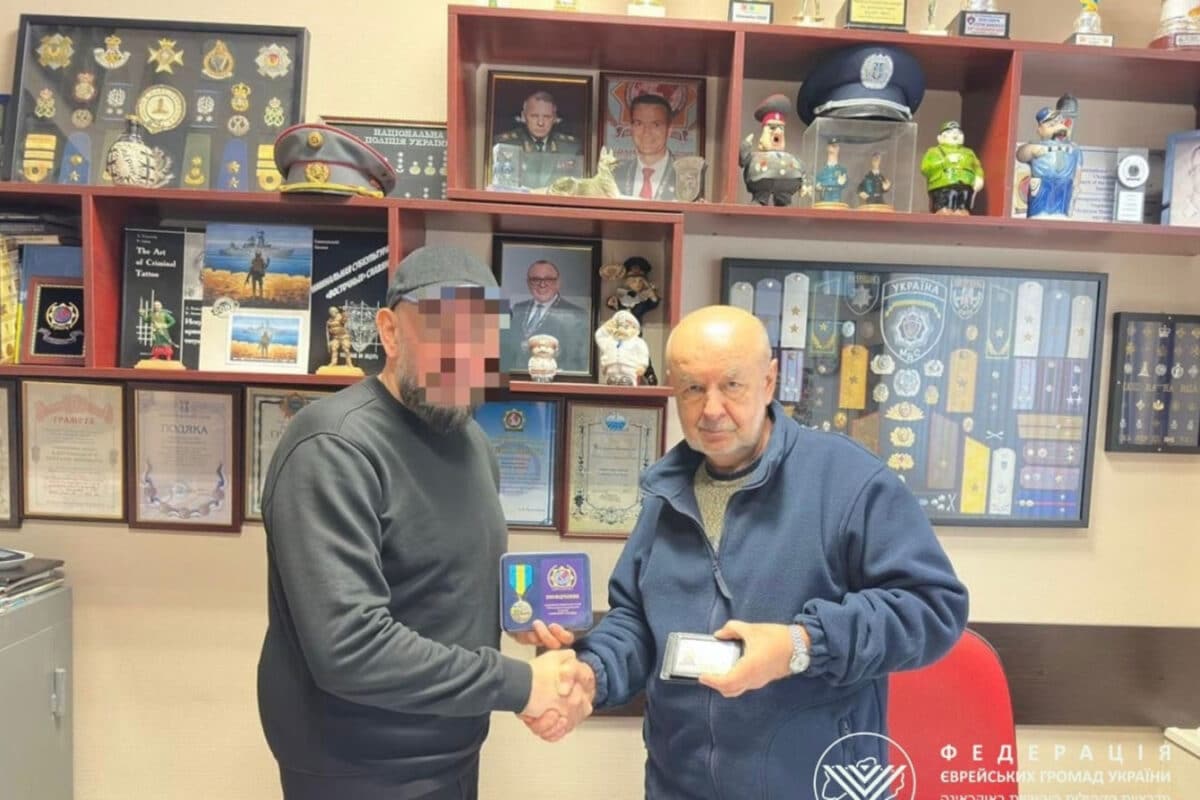
Officer of the Armed Forces of Ukraine “Hasid” received the international IPA award: what is known about the fighter and why he was recognized

International Police Association awarded a Ukrainian Armed Forces officer

The International Police Association (IPA), uniting law enforcement officers from more than 70 countries, awarded its medal to an officer of the Armed Forces of Ukraine with the call sign “Hasid”.

This was reported by the Federation of Jewish Communities of Ukraine (FJCU) and the publication JewishNews on November 22, 2025.
The IPA decision emphasizes that the award was given for high professionalism, courage, and a special contribution to the defense of Ukraine.

For the Jewish community, this decision was significant: for the first time in a long time, a representative of Ukraine with Jewish heritage receives an international professional award specifically as a combat officer of the active army.

Ukrainian Armed Forces officer 'Hasid' received the international IPA award: what is known about the fighter and why he was noted
Ukrainian Armed Forces officer ‘Hasid’ received the international IPA award: what is known about the fighter and why he was noted

Who is “Hasid”: collected facts from open sources

There is little information about “Hasid” in the public domain — he consciously maintains anonymity. However, over the past years, his name (or rather, call sign) has repeatedly appeared in Ukrainian media and social networks.

Instructor and intelligence officer of the Ukrainian Armed Forces

In a report by Informator it is stated:

  • he does not show his face, his name is not disclosed — this is stated directly;

  • serves as an instructor on the front line;

  • trains infantry, mechanized units, and intelligence personnel;

  • has been working since the beginning of the full-scale invasion, often in areas of active combat.

Commanders commenting on his work noted that thousands of servicemen have gone through his training — social networks mention the figure “more than 8,000 students”.

Jewish by origin and a person of faith

All Ukrainian and Jewish sources emphasize that “Hasid” is —

  • Jewish by nationality,

  • a person of religious views,

  • motivating fighters with spiritual values and philosophy that he himself shares.

One of the meanings he quotes: “defending Ukraine is also about the light that must overcome darkness”.

The phrase “about the light that must overcome darkness” is a direct part of the Hasidic tradition, where light is always seen as a force that naturally dispels darkness. Such an image is found in the teachings of Baal Shem Tov, the Maggid of Mezritch, and the Alter Rebbe and is one of the central Hasidic principles.

The image that society sees

In Ukrainian social networks, “Hasid” is described as:

  • a principled instructor,

  • a strict but fair commander,

  • an officer who combines professional training with a personal moral stance.

What remains unknown

Full name, rank, unit, locations — are not published.
Some hostile resources spread an unverified version of “service in the Israeli special forces”, but there is no confirmation of this. Ukrainian official sources have not made such statements.

What video materials about “Hasid” show: documentary sources

1. Video from January 3, 2023 (project “Finding Answers with Inna Zolotukhina”)

This is one of the earliest confirmed appearances of “Hasid” in the media — a report from a combat company training.

The video directly states:

  • “Hasid” trains Ukrainian fighters from various units from the first days of the war, and does so exclusively on a volunteer basis.

  • He introduces himself as:
    “I am Jewish by nationality and have extensive experience serving in special units of Ukraine and Israel”.

  • He emphasizes that he considers it his duty to pass on combat experience:
    “This is how I save their lives. And as Jews say: ‘Save a life — save the whole world’”.

In the same video, fighters of the “Black Raven” company talk about heavy battles in the Chernobyl zone, the importance of constant training, and how the instructor helps cope with combat stress:

  • “When you sit in a trench under fire for three days and don’t see the enemy — the instructor helps you learn to keep a cool head”.

  • “If you don’t train — you can lose vigilance. In war, mistakes cost lives”.

This video shows “Hasid” as a combat instructor who combines professional training with psychological support for fighters.

2. Video from August 31, 2025: “Who is Hasid?”

This is a later and more systematic video material that gathers information about him into a coherent portrait.

The video states:

  • “Hasid” personally trained over 8,000 elite Ukrainian fighters.

  • Has experience serving in special units of the National Guard of Ukraine.

  • Holds international certification in Israeli training centers.

  • Uses his own methods based on real combat experience.

  • Follows the principle:
    “Weapons are just a tool, it’s the person who fights”.

  • Considers his main reward the moment,
    when a soldier returns home safe and sound.

  • His faith in the Almighty is separately emphasized, which helps maintain inner resilience in wartime conditions.

This video shows “Hasid” as a systematic, recognizable, and one of the most effective Ukrainian instructors of the modern war.

What Russian propaganda press wrote about “Hasid”

Russian occupation media and related resources mentioned “Hasid” several times, but exclusively in a manipulative and speculative manner. The main thesis they promoted was the version that the Ukrainian Armed Forces instructor is allegedly a “former Israeli special forces operative”. Such statements appeared on several Russian sites after the release of Ukrainian video materials about the training of servicemen, where “Hasid” was featured.

Russian resources used the same video from the State Border Guard Service of Ukraine, interpreting it in a propagandistic manner, adding accusations, non-existent details, and attempts to present “Hasid” as a “foreign mercenary”. This is a typical tactic of Russian disinformation: distorting facts, imagining non-existent biographies, and forming the image of an “external enemy” to discredit Ukrainian volunteers, instructors, and officers.

What is the IPA and why does it award military personnel

The International Police Association is the oldest and largest professional organization of law enforcement officers in the world.

Founded in 1950, today it has representations in more than 70 countries.
The goal of the IPA is to promote international cooperation, law and order, professional exchange, and support for colleagues working in risky conditions.

Why the IPA awards

The IPA periodically awards

  • medals for bravery,

  • badges for service to society,

  • distinctions for contribution to safety and protection of citizens.

In peacetime, awards are more often received by the police — but during war, the association separately recognizes people who demonstrate a high level of professionalism in combat conditions, especially when it comes to protecting the population, training personnel, or saving lives.

Awarding the Ukrainian Armed Forces officer is precisely such a case.

Ukrainian Jews continue to defend their country

The story of “Hasid” is not only a personal recognition. It is a marker of a phenomenon that we at NAnovosti regularly write about:
the Jewish community of Ukraine is not a bystander in the war, but a participant.

  • Jewish military personnel serve in infantry, intelligence, and border troops.

  • Rabbis of the volunteer movement coordinate humanitarian and spiritual support on the front.

  • Thousands of Ukrainian Jews participate in the defense of the country as servicemen, medics, volunteers, engineers.

“Hasid” has become one of the symbols of this participation: a person who combines Jewish identity, professional military training, and real combat service.

His award is a reminder to the world:
Jews of Ukraine defend their homeland just like all other citizens of the country.


NAnovosti News of Israel Nikk.Agency November 24, 2025.

4 Ukrainian Jews Become Among the Richest Immigrants to the US According to Forbes

How did four Ukrainian JewsJan Koum, Leonid Radvinsky, Michael Polsky and Max Levchin — go from childhood in Kyiv, Odesa and the Kharkiv region to a combined net worth of over $25 billion in the United States?

Each of them founded or led a world‑class company: Jan Koum was one of the creators of WhatsApp, Leonid Radvinsky turned OnlyFans into a global phenomenon, Michael Polsky founded Invenergy LLC in the “green” energy sector, and Max Levchin co‑founded PayPal and now runs Affirm.

This is reported in a publication by Forbes. By the number of billionaire immigrants, Ukraine ranked 9th among 41 countries.

From Kyiv’s Courtyards to Global Heights

How Their Stories Began in Ukraine

  • Jan Koum was born in February 1976 on the outskirts of Kyiv. In the family of an electronics engineer there were no trendy computers, but there were radios that the boy would take apart and reassemble. In a school BASIC club he wrote his first programs to send text messages over a local network.
  • Leonid Radvinsky was born in the early 1970s in Odesa, near the famous Privoz Market. Together with his mother he sold souvenirs to tourists, calculating profit and bargaining for every dollar. These lessons in commerce and the ability to connect with people laid the foundation for his entrepreneurial drive.
  • Michael Polsky was born in 1947 in a rural area of the Kharkiv region. In his free time he built wind turbine models from bicycle spokes and tin cans, dreaming of an energy future. After technical college he worked at a power plant, where he first encountered the ideas of alternative energy.
  • Max Levchin was born in July 1975 in Kyiv into a family of historians. At school he became passionate about chess and the Pascal programming language. By organizing a “Young Programmer” club, Max not only deepened his algorithmic knowledge but also learned to share expertise and build teamwork.

In the Emigration Lab — A Step West

Each of them took the risk to leave their homeland and go to the United States with minimal resources:

  1. Jan Koum arrived in 1992 with his mother and grandmother under a repatriation program. For the first years he worked as a cleaner and barista to pay for his studies at San Jose State University.
  2. Leonid Radvinsky settled in Chicago on a humanitarian visa, graduated from Northwestern University, and began working in internet marketing.
  3. Michael Polsky was invited as an energy specialist in 1976. With $500 in his pocket, he got a job as an electrician, and twenty years later founded his own company, Invenergy.
  4. Max Levchin obtained political asylum in 1991, moved to Memphis, and by the end of the decade had co‑founded PayPal.

Breakthroughs and Achievements

  • WhatsApp by Jan Koum and Brian Acton amassed over 2 billion users in a few years, and its sale to Meta netted Koum over $16.9 billion.
  • OnlyFans by Leonid Radvinsky became a platform generating over $1.3 billion in annual revenue and awarded him personal dividends of over $1 billion.
  • Invenergy by Michael Polsky executed projects worth more than $7 billion, including wind and solar farms across America.
  • Affirm Holdings under Max Levchin’s leadership became a key player in fintech, and Levchin’s net worth is estimated at approximately $2.1 billion.

How They Stay Connected to Ukraine Today

  • Jan Koum supports several educational programs and grants for IT camps in Kyiv, aiming to inspire a new generation of programmers.
  • Leonid Radvinsky donated $5 million in 2022 to humanitarian aid for Ukraine, affected by military conflict.
  • Michael Polsky speaks at European energy conferences promoting green economy practices in Eastern Europe.
  • Max Levchin organizes student exchanges between Kyiv Polytechnic Institute and American universities, supporting young engineers.

On the NAnews – Israel News website, we share how mutual support and knowledge exchange strengthen bridges between Israel and Ukraine.

Conclusions and Significance

  • Childhood interests — whether radio electronics or chess — can lead to global discoveries.
  • Emigration tests resilience: courage and adaptability turn challenges into opportunities.
  • Maintaining cultural roots and caring for one’s homeland create synergy between innovation and tradition.

These stories from NAnews inspire Israeli startups and show that by combining diaspora experience and technology, we can reach new heights.

Not diplomacy, but an alliance of war: how Putin congratulated Mojtaba Khamenei and once again showed whose side Moscow is on

On March 9, 2026, the Kremlin published a congratulatory message to the new Supreme Leader of Iran — Seyed Mojtaba Hosseini Khamenei. In the message, Putin not only wished success. He called the events surrounding Iran ‘armed aggression,’ expressed Moscow’s ‘steadfast support,’ and promised that Russia would remain a ‘reliable partner’ of the Islamic Republic. This is no longer a routine diplomatic text. It is a political demonstration of solidarity with a regime that builds its power on war, repression, and the export of violence.

The election of Mojtaba Khamenei as the new Supreme Leader of Iran signaled not change, but the preservation of the old course. This is the son of the liquidated Ali Khamenei, who inherited not only the surname but the entire power vertical tied to forceful control, religious legitimation, and harsh suppression of dissent. There are no signs of softening here. On the contrary, the new figure must prove to the elite and security forces that the system remains the same.

The inheritance of power in Iran signaled: the course does not change

The appointment of the son of the slain Supreme Leader is not a story of ‘stability’ and not an attempt to open a new page. It is a demonstration of the regime’s continuity in the harshest form. The new Supreme Leader receives not only spiritual status but direct control over the army, the Islamic Revolutionary Guard Corps, and key levers of the state. For opposition-minded Iranians, this means more of a tightening of the screws than hope for reforms.

And it is precisely at this moment that the Kremlin does not come forward with a cautious formula, not with a call for de-escalation, and not with diplomatic neutrality, but with an actual political embrace of the new master of Iran. On paper, it looks like a congratulation. In essence, it is a public confirmation of an alliance. Moscow hastened to show that it supports not just the state of Iran, but precisely the current system of power, with its forceful logic and readiness to continue on the path of confrontation.

Why this looks not like protocol, but like one war regime congratulating another

When the Russian authorities, waging war against Ukraine, call the strikes on Iran ‘armed aggression’ and simultaneously promise ‘steadfast support’ to the new Supreme Leader of Tehran, it can no longer be perceived as an ordinary ceremonial. For Israel, for Ukraine, and for the entire region, it looks like another confirmation of the axis in which Moscow and Tehran have long been on the same side of the conflict.

One regime has made war the main tool of foreign policy. The other has built a system over many years where terror, intimidation, proxy structures, and military pressure have become part of the state model. Therefore, many have a straightforward reaction: one terrorist regime congratulated another on retaining power.

Formally, this is a letter from the head of state. But in essence, it is a political signal to the entire region. Moscow does not distance itself from Iran’s hard line. It binds itself even more closely to it. And the more openly this sounds today, the harder it will be later to portray Russia in the Middle Eastern crisis as an outside observer. This role for the Kremlin ended long ago.

What this means for Israel

For Israel, this story is important not only as an episode around the change of power in Tehran. It shows a broader picture: the Kremlin continues to integrate Israel into the general anti-Russian and anti-Western contour, where the Jewish state is increasingly presented as part of a hostile camp. Support for Iran at such a moment is not an accidental phrase and not a separate diplomatic gesture. It is an element of a consistent line that Moscow has been pursuing for a long time.

Against this backdrop, NAnews — Israel News | Nikk.Agency notes a simple thing: the news of March 9, 2026, should be read not as a dry protocol message, but as a direct confirmation of a war alliance. It is more correct to formulate it this way: Moscow publicly blessed the continuation of the Iranian course after the change of supreme power.

And so, it is not just about a letter, not about a ceremony, and not about diplomacy. It is about an alliance of two regimes for which violence, fear, and war have long become the habitual language of politics.

Schools in Israel after alarms: Minister Yoav Kish presented a plan for the gradual return of children to classes

In the ongoing war conditions, the Israeli education system is trying to find a balance between safety and the need to return children to school. On March 9, Israeli Education Minister Yoav Kisch presented local administration leaders with a plan for the gradual resumption of classes in schools and kindergartens.

This is not about a full opening of the education system, but a flexible model that will depend on the threat level in specific areas of the country. The main factor will be the safety assessment by the IDF Home Front Command, which determines the risk level of rocket attacks in different regions.

How the new school opening model will work

Safety zones and the role of local authorities

According to the presented plan, the decision to return students to schools and preschools will be made taking into account the so-called safety zones. In areas that the Home Front Command classifies as a ‘yellow zone,’ where the risk of attacks is considered minimal, a gradual resumption of classes is possible.

However, for the opening of schools and kindergartens, a mandatory condition will be the presence of fortified rooms or shelters where children can quickly move in case of an air raid alert. This requirement remains a key element of the entire program.

At the same time, the final decision on the format of education will be made by the local administration. Municipality leaders will be able to independently determine the timing of the opening of educational institutions, as well as the form of conducting classes — in-person or combined.

The Minister of Education emphasized that in the coming days, education will continue remotely via the Zoom platform. In those areas where a return to in-person format is planned, parents will receive notification at least 24 hours in advance.

Parents are not obliged to send children to schools

Flexible attendance rules

One of the important points of the program was the decision not to oblige parents to send children to schools and kindergartens. In wartime conditions, families will be able to independently assess the level of risk and decide on attending classes.

Missed school days will not be considered a violation and will not affect the educational status of students.

However, even with such flexibility, there remain a number of practical problems. One of the main ones is the shortage of staff for opening educational institutions.

According to Yoav Kisch, many teachers and caregivers themselves are mothers of young children and may face the same difficulties as other parents. In this regard, the minister called on municipal authorities to show understanding and flexibility in forming work schedules.

In the middle of the discussion on this topic, NAnews — Israel News | Nikk.Agency notes that the Israeli education system in wartime conditions is forced to operate in a mode of constant adaptation. Decisions are made almost daily, as the safety of children remains an absolute priority.

The problem of school transportation remains unresolved

Special difficulties for families without cars

One of the most complex problems remains the organization of school transportation. Currently, the transportation of children by school buses is not allowed even for the special education system — the so-called ‘hinukh miyuhad.’

This means that parents have to independently take children to educational institutions. For families without a car, the situation becomes especially difficult.

The Minister of Education promised to find a solution to this problem, but no specific mechanisms have been presented yet.

The proposed plan was also met with skepticism by the Center for Local Government in Israel. Representatives of municipalities confirmed that school transportation will not be resumed yet, as authorities do not want to take on additional risks.

According to them, the return of children to school should occur cautiously and gradually, taking into account the real situation in each city and town. Municipality leaders believe that local authorities best understand the level of threat and the possibilities for protecting the population.

The day before, Yoav Kisch also stated in an interview with the radio station ‘Reshet Bet’ that the full return of children to schools may take time. He referred to the assessments of Prime Minister Benjamin Netanyahu and US President Donald Trump, according to which the active phase of the war may continue for several more weeks.

As a result, the proposed plan currently rather demonstrates the education system’s readiness to respond to the crisis than offers a final solution to all problems. In the ongoing war conditions, the Israeli education system is forced to act cautiously, step by step returning children to the educational process.

Tamar proposed an optimal method for Ukraine to stop Putin, who is ready to fight to the end

A military historian mocked Putin’s attempts to escape punishment for his atrocities while hiding in a bunker.

No bunker can save a dictator who has been “sentenced” to elimination, as was the case with Khamenei, reported Grigory Tamar. If it is decided that Putin’s “song” is “sung,” then he will also not be able to escape “justice.”

In his opinion on whether a bunker will help Putin avoid the fate of other dictators, the Israeli expert shared in his interview with Anastasia Fedor on YouTube. “This is not a game – this is war, and there are no compromises here, and regarding where Putin has gone, I will answer you. What did we start with? That Putin is a pathological coward. He does not go to the front lines like Zelensky to be with his army, with his people. He mostly sits in a bunker, as we know,” said the reserve captain of the Israeli army.

“Putin is a ‘bunker dweller’ with experience, and suddenly his colleague, who also sat in a bunker in Tehran, got hit in the bunker. Israel launched fifty planes, a hundred munitions, and only a ‘pile of ashes’ remained of the bunker. Can you imagine what a stress this is for Putin? He is no longer a young man. He needs to stabilize his blood pressure, even out his breathing. Now his doctors will ‘adjust’ him a little, and he will again be telling from the bunker about how Ukraine was preparing an attack on Russia four years ago,” added Tamar.

The military historian also explained how to stop Putin: “Russia’s desire to inflict maximum damage on Ukraine is not related to events anywhere. It is a maniacal desire. It’s like a maniac decided to kill a victim, and we say: ‘If it rains and the weather is bad, will he kill her or not?’ He will kill the victim. Only one thing can stop him: if the victim pulls a gun from their pocket and ‘puts’ a bullet in his forehead. That can stop the maniac, or if a policeman arrives and stops him at the crime scene during an attempted murder.”

In addition, Tamar “laid out” the US and Israel operation against Iran. It is important to understand that such statements can have serious consequences for international politics and security in the region. In this context, it is worth monitoring the development of events, as they may affect the situation in Israel and its relations with neighboring countries. Israel News | Nikk.Agency