The decline in the dollar exchange rate unexpectedly turned the summer of 2026 into a window of opportunity for Israelis planning a vacation abroad. Flights, accommodation, shopping, and daily expenses abroad may become noticeably cheaper than in the previous season.
But it is at this moment that great uncertainty arises again around Ben Gurion Airport.
Amid preparations for a possible agreement between the US and Iran, restrictions on airport operations, and the presence of American military aircraft in Israel, some air traffic may face serious disruptions. According to estimates reported by Israeli media, about two million Israelis could potentially receive notifications of flight cancellations if Ben Gurion cannot handle the load.
Why a vacation abroad has become more attractive
For the Israeli consumer, the dollar exchange rate is not an abstract stock market figure. It directly affects the cost of a family trip: tickets, hotel, car rental, restaurants, shopping, entertainment, excursions.
If the dollar depreciates against the shekel, a foreign vacation begins to be perceived differently. What recently seemed like an expensive or risky decision becomes an option again for a family, couple, or group of friends.
Arkia CEO Oz Berlovich explained in an interview with 103FM that the exchange rate difference can save travelers thousands of shekels compared to the previous season. According to him, it’s not just about the ticket price, but the entire trip budget — from accommodation to shopping.
Israelis are looking at August and the holidays again
After a long period when many Israelis were afraid to book far-off dates in advance, the market is starting to revive. Arkia notes an increase in interest not only in upcoming flights but also in August and the Tishrei holidays.
This is an important psychological signal.
People are starting to plan ahead again. Not for tomorrow or the upcoming weekend, but for the end of summer and autumn. For Israel’s tourism market, this means that demand is gradually returning from a cautious waiting mode to a real purchasing mode.
However, the reason is not only the dollar. Decisions are influenced by the feeling that the region may enter a calmer phase if the negotiation process around Iran indeed progresses.
Ben Gurion remains the main bottleneck
The optimism of airlines faces another reality: Ben Gurion Airport operates under non-standard conditions.
According to the original material, part of the airport’s infrastructure is linked to American military activity in Israel. The head of the Israel Airports Authority, Sharon Kadmi, stated on Kan Reshet Bet that about 70% of the airport’s activity is related to the American presence, and losses are already estimated in the hundreds of millions of shekels.
That’s why such a sharp assessment is voiced: if the load remains too high, about two million Israelis may receive notifications of flight cancellations.
For the Israeli audience, this is not just transport news. It’s a matter of family vacations, business, repatriation trips, visits to relatives, business routes, medical flights, and Israel’s connection to the outside world.
American planes and 72 hours of waiting
The material states that if an agreement between the US and Iran is approved, American military planes will have to leave Ben Gurion in a short time. A scenario of withdrawal within 72 hours to the nearest bases in Europe is being considered.
Some planes, as indicated, have already been moved from the airport grounds to a nearby Israeli Air Force base known as Baha 27, which has been reopened.
This may partially free up space for civil aviation.
But here remains a key condition: if the situation escalates again, military activity can quickly return. That is, the aviation market gets a chance to unload but does not receive a full guarantee of stability.
What this means for passengers from Israel
Currently, Israelis face a double picture. On one hand, foreign trips become more advantageous due to the dollar exchange rate. On the other hand, the very fact of departing from Ben Gurion may depend on security, military logistics, and decisions made not by tourist companies but by states.
NAnews — Israel News | Nikk.Agency views this situation as an example of how closely economy, security, and daily life are intertwined in Israel. The same person can see a profitable tour for August in the morning and read in the evening that millions of passengers are potentially at risk of cancellation.
Airlines see demand but do not control the whole picture
Arkia, according to its head, remains optimistic. The company expects that regional calm, the return of foreign carriers, and the release of Ben Gurion’s infrastructure will help restore normal operations.
However, airlines cannot solve the airport load problem alone.
Even if demand grows by hundreds of percent, even if the dollar makes vacations cheaper, even if passengers are ready to book in advance, everything hinges on Ben Gurion’s ability to receive and dispatch flights in the required volume.
For the market, this is a painful paradox: demand returns faster than the infrastructure can emerge from restriction mode.
Antisemitism abroad: fear exists, but no mass changes
Separately, Berlovich commented on Israelis’ concerns about antisemitic incidents in Western countries. According to him, such cases are unpleasant, but in the current work of the airline, they have not led to changes in passenger instructions.
He noted that Arkia operates flights to dozens of destinations and operates 18 aircraft, and regular operational activities continue.
This is an important detail for passengers: fears exist, news of individual incidents affects mood, but according to the company, there are currently no official mass changes in routes and recommendations.
In fact, the main risk for the summer season lies not so much in the foreign destinations themselves but in the operation of the Israeli air hub.
Conclusion: a cheap dollar does not guarantee a calm vacation
Israelis have received a rare combination: a more favorable dollar exchange rate, a growing choice of vacations, and a feeling that the market may start to recover. For families who have postponed trips, this looks like a chance.
But this chance remains fragile.
As long as Ben Gurion operates under military and civilian pressure, any plans for summer and holidays require attention. Booking is possible, but it’s important to read cancellation conditions, follow airline messages, check flight status, and not perceive a low price as a guarantee of a calm trip.
For Israel, this is another reminder: even a vacation here is rarely just a vacation. It goes through the dollar exchange rate, regional security, American presence, negotiations around Iran, and the ability of the country’s main airport to withstand the load.
Israel may be placed on the UN’s ‘blacklist’ regarding sexual violence in conflict zones. This refers to a list of countries, agencies, and armed groups that, according to the UN Secretary-General, are associated with conflict-related sexual violence or are responsible for such practices.
According to The Jerusalem Post on May 28, 2026, Israeli entities, including the Israel Prison Service, may be included in the 2026 list. An official announcement had not been made at the time of publication, but Israeli media had already reported that the decision had been made, causing a sharp reaction from Jerusalem.
For Israel, this is not just another dispute with the UN. Being listed alongside Hamas, ISIS, and other terrorist organizations is perceived in Jerusalem as an attempt to erase the moral difference between a state that is at war after October 7 and entities for which terror, abductions, and violence are part of their method.
What happened on May 28, 2026, and why it became a scandal
On May 28, 2026, The Jerusalem Post reported that the UN is adding Israeli entities to the list related to sexual violence in armed conflicts. The publication specifically noted that Hamas is already on this list, and a country or armed group placed on the UN Secretary-General’s list remains there for at least one year.
The chronology is important here.
In August 2025, UN Secretary-General António Guterres included Hamas in the annual report on sexual violence in conflicts. The basis was findings of crimes committed during the October 7, 2023, attack and the period of holding Israeli hostages in the Gaza Strip.
At that time, Israel received a signal that it might be next in this monitoring mechanism. Reuters reported on August 12, 2025, that Guterres had put Israel ‘on notice’ due to allegations of sexual violence against Palestinian detainees. This did not mean immediate inclusion in the list but a warning: if the UN considers that there are recurring patterns, Israel could be included in the next year’s report.
Now, in May 2026, this scenario, according to Israeli reports, is being realized.
Which entities may be included in the list
According to Israeli media, among the entities expected to be on the 2026 list is the Israel Prison Service. Other Israeli agencies that have come under the UN monitoring system are also mentioned.
Israeli sources claim that Jerusalem has submitted documents, data, and detailed responses to the accusations outlined in reports and draft documents. Moreover, Israel invited representatives of the relevant office to visit the country, come to Jerusalem, and personally study the presented materials.
This moment became central in the Israeli reaction. In Jerusalem, they say: if the state provided answers, opened the door for verification, and offered direct access to information, but the decision is still being advanced, then the issue goes beyond a professional human rights procedure.
Following reports of the decision, Israel announced a freeze in relations with the UN Secretary-General’s office. Israel Hayom reported on May 28, 2026, that Israel’s ambassador to the UN, Danny Danon, announced the cessation of working relations with Guterres’s office after the inclusion of Israeli entities in the list.
Why Israel sees this as a political decision
Israel’s ambassador to the UN, Danny Danon, called the expected decision a moral disgrace. According to him, the UN Secretary-General is placing Israel in the same blacklist as Hamas, ISIS, and the world’s most brutal terrorist organizations.
For Israel, this is a matter of principle not only of reputation but also of the language of international politics.
Sexual violence in war is one of the most serious categories of crimes. It cannot be silenced, devalued, or turned into a subject of propaganda games. But precisely for this reason, according to Israeli logic, any accusations must be checked as strictly as possible: by sources, by procedures, by evidence, by specific cases, and not through a political framework where Israel is preemptively placed alongside terrorists.
After October 7, this is especially sensitive. Hamas was included in the list following evidence of sexual violence during the mass attack on Israel and against hostages. Israel’s position is based on the fact that comparing Israeli state structures with Hamas in the same moral space does not help the victims but destroys trust in the UN mechanism itself.
NANews — Israel News | Nikk.Agency views this story as part of a broader information-diplomatic war around Israel. Today, it is not only what happens on the battlefield or in negotiation rooms that matters. It also matters what words appear in international reports, how these words are then quoted in the media, courts, universities, and political campaigns.
Where is the New York Times and Nicholas Kristof in this
A separate layer of this story is related to Nicholas Kristof’s publication in The New York Times. On May 11, 2026, he wrote a column alleging sexual violence against Palestinian prisoners and detainees by Israeli military and prison guards.
This publication immediately became a loud international occasion. The Guardian reported on May 14, 2026, that Israel announced its intention to file a lawsuit against The New York Times over the material on sexual violence against Palestinian prisoners.
In Israel, Kristof’s article was perceived as part of a campaign in which serious accusations against Israeli entities are spread at a time when the country itself is seeking recognition of Hamas’s crimes on October 7. Critics of the material pointed to questions about the sources, the format of the publication, and the fact that the text appeared in the opinion section but began to function as a factual document in the international agenda.
Meanwhile, The New York Times, according to Western media reports, defended the publication and insisted that the material had been vetted. Supporters of the publication argued that the allegations regarding Palestinian prisoners require investigation and cannot be dismissed simply because they are uncomfortable to discuss.
This is where the conflict becomes particularly acute. One side speaks of the need to verify serious accusations. The other — that such accusations are used without sufficient context and become a tool of political pressure on Israel.
Why this UN list is important for the Israeli audience
For Israel, being included in such a list is not just a line in an annual report. It is a potential basis for further diplomatic attacks, resolutions, legal initiatives, boycott campaigns, and pressure on Israeli officials, military, prison system, and security structures.
What is particularly dangerous is that international documents live longer than the news cycle. Today it is a headline. Tomorrow — a quote in a human rights organization’s report. In a month — an argument in parliamentary debates in Europe. In a year — part of a lawsuit, a university campaign, or a media accusation against Israel.
Therefore, Jerusalem reacts so harshly to UN formulations. In Israel, it is believed that the organization has long lost neutrality on issues related to the Israeli-Palestinian conflict and is now using one of the most painful topics — sexual violence — in a political context.
But there is another side. If specific accusations are made against Israeli officials or agencies, they must be investigated. A state that demands recognition of Hamas’s crimes from the world is itself interested in ensuring that all suspicions regarding its structures are examined transparently, professionally, and without silence.
The difference is that verification and political equalization are not the same.
What will happen next
If the inclusion of Israeli entities in the list is officially confirmed, Israel will likely continue its diplomatic attack on the UN Secretary-General’s office. The freezing of relations with Guterres’s office already shows that Jerusalem does not intend to perceive this as a routine bureaucratic procedure.
The question will then be whether Israel can present its evidential line to allies: what data was submitted to the UN, what accusations are being contested, what checks have already been conducted, where there are real cases, and where, according to Israel, a politically assembled picture exists.
For the UN, this is also a test. If the organization wants its reports to be perceived as a tool for protecting victims, it will have to explain why Israel ended up on the same list as Hamas and ISIS, and how verified facts are separated from political pressure.
Meanwhile, in Israel, the conclusion sounds harsh: the UN is not just assessing accusations but creating a new international framework in which Israel is being placed alongside terrorist organizations. And this is what Jerusalem calls not justice, but moral blurring.
In Kherson, a Russian strike on a residential area on the evening of May 27, 2026, turned an ordinary family evening into a tragedy. A children’s playground in the Shumensky district of the city was hit. The father of a large family died on the spot, his wife and two young daughters were seriously injured.
This was reported by the head of the Kherson regional military administration, Alexander Prokudin.
The tragedy did not occur at a military facility or near the line of combat. The strike hit a place where there should be children, parents, swings, toys, and ordinary city life. That is why this story stands out even from the usual military chronicle: the Russian attack struck the most vulnerable — a family with young children.
What happened in the Shumensky district of Kherson
On the evening of May 27, the Russian army shelled a residential area of Kherson using multiple launch rocket systems. According to Alexander Prokudin, a children’s playground in the Shumensky district was hit.
At the time of the attack, parents with children were present.
The father of the family received fatal injuries and died on the spot. The mother and two young girls were injured. Two other children from this family — an adult girl and a minor boy — are now under the care of the children’s services.
This detail is especially important: it is not only about the deceased man and the injured. In one evening, the life of a large family was destroyed, where several children were left without a father, and the mother and younger sisters ended up in the hospital.
Kherson had already been regularly subjected to Russian shelling. The city lives under the constant threat of new strikes, explosions, and destruction of civilian infrastructure. But the attack on the playground is a separate level of cruelty because the strike hit a place that should be a space of safety in normal life.
Condition of the injured: a three-year-old girl was operated on in Mykolaiv
The most severe condition, according to Ukrainian authorities, is that of the three-year-old girl. As a result of the explosion, she received blast injuries and multiple shrapnel wounds to the head, torso, arms, legs, and chest.
The child was evacuated to Mykolaiv. There she underwent surgery and had shrapnel removed from her head. When the girl’s condition improves, she is planned to be transferred to Kyiv’s ‘Okhmatdyt’.
Her six-year-old sister was also injured during the attack. The girl has a blast injury and shrapnel wounds to her back. She has already been operated on. The child is currently in the hospital in a moderate condition.
The condition of the 36-year-old mother remains serious. The woman has shrapnel wounds to her limbs and abdomen, a concussion, blast injury, and a closed head injury. Doctors continue to fight for her life.
For the Israeli audience, such reports are read not as a distant war on the map. Israelis understand well what a missile or artillery threat means for ordinary families when a playground, a stop, a yard, or the road home can suddenly become a place of tragedy. In this context, NAnews — Israel News | Nikk.Agency considers the strike on Kherson not only as a Ukrainian news story but as part of a broader theme: civilian families are increasingly becoming a direct target of Russian terror.
Why this tragedy is important beyond Ukraine
Kherson remains one of the Ukrainian cities where the war against civilians does not stop for a day. Law enforcement reports that shelling continues throughout the day, with numerous explosions and damage to civilian infrastructure recorded in the city.
The playground as a symbol of the city’s vulnerability
After the liberation of the right-bank part of Kherson, the city did not become safe. Russian troops continue to shell residential areas, houses, streets, markets, stops, and infrastructure facilities.
Against this background, the strike on the playground does not look like an accidental episode but part of the constant pressure on the city. People are forced to live in a state where even an ordinary walk with children becomes a risk.
For Ukraine, this is a matter of survival for frontline cities. For Israel, it is an understandable and painful signal of how terror against the civilian population works: it strikes not only at buildings but also at the sense of normal life.
Family tragedy instead of dry statistics
In the news, such events often turn into numbers: one dead, three injured, damage, shelling, investigation. But behind these statistics is a specific family.
The father died on the spot.
The mother is in serious condition.
The three-year-old girl underwent surgery after shrapnel wounds to the head.
The six-year-old sister is also injured and in the hospital.
Two other children remain under the care of social services.
This is the real cost of the Russian strike on Kherson. It is not an abstract military report but a destroyed family, children in hospitals, and a city that continues to live under daily fire.
That is why the tragedy at the playground in the Shumensky district should resonate not only in the Ukrainian agenda. It shows the nature of a war in which civilian life itself becomes the target.
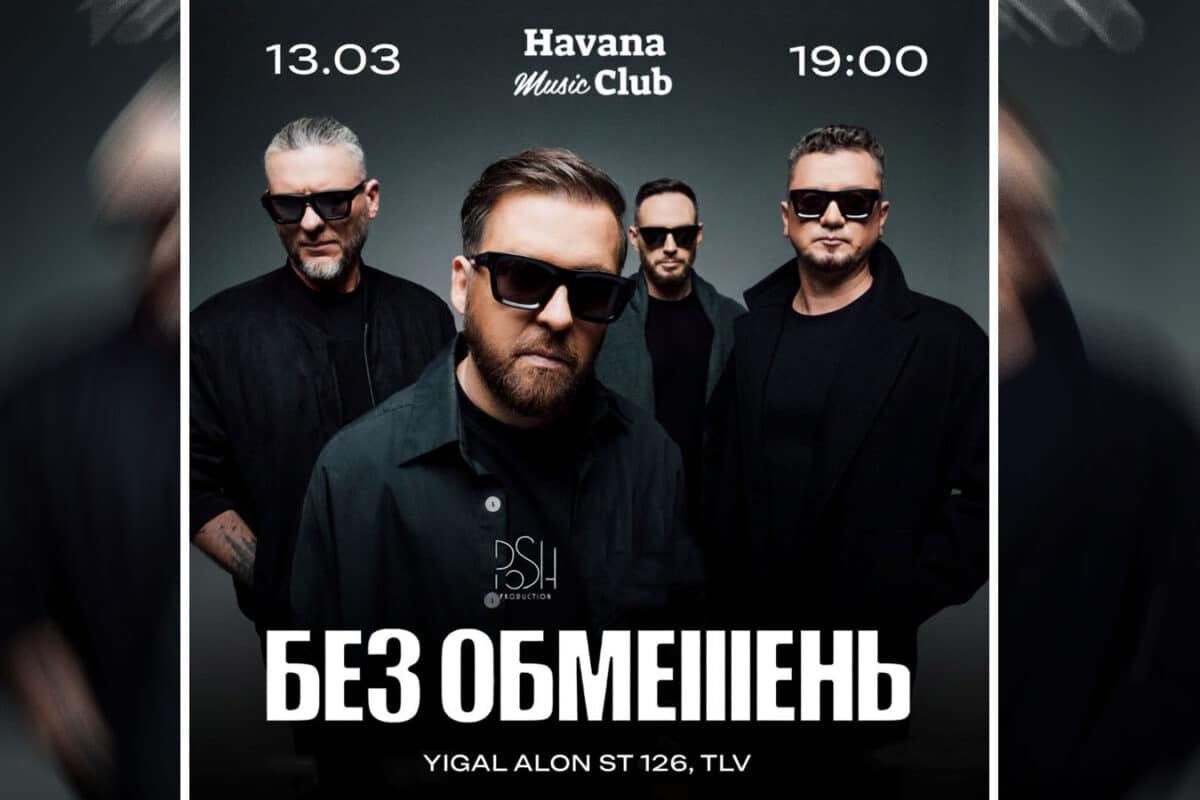
March 13, 2026, at the Havana Music Club in Tel Aviv, the long-awaited concert of the Ukrainian rock band “BEZ OBMEZHEN” – as part of the world tour “Strong Hearts”!
Big Goal: The “Strong Hearts” tour is charitable. The main goal is to raise funds for vehicles and drones for the Armed Forces of Ukraine. Your Contribution: Every ticket purchased is not just an entry to the hall, but real help for Ukrainian defenders.
Come feel the atmosphere of unity and sincere Ukrainian music. We are waiting for you!
March 13, 2026
Friday, 20:00
Tel Aviv Havana Music Club, Yigal Alon St. 126.
It will be a powerful performance by one of Ukraine’s most popular and charismatic bands, bringing live sound and sincere emotions to Israel. The band, known for its candid and strong music, will delight its fans in Israel with new hit compositions.
The band’s concert is not just music, it’s a whole story of freedom, strength of spirit, and resilience, which they embody in their work.
“BEZ OBMEZHEN!” in Israel: one of Ukraine’s most powerful rock bands in Tel Aviv on March 13, 2026, as part of the world tour “Strong Hearts”!
The band’s history and their contribution to Ukrainian culture
“BEZ OBMEZHEN” has long won the love of audiences around the world. Since its founding, the band has gathered thousands of fans in different countries, and their tracks have gained millions of listens online. Winners of numerous prestigious music awards such as M1 Music Awards, “Golden Firebird”, YUNA, the band has long established itself as a symbol of independent and honest Ukrainian culture.
Since the beginning of the full-scale war in Ukraine, the band not only continued its creative activity but also actively supported its country. More than 300 concerts during the war, in which they raised over 102 million hryvnias to support the Armed Forces of Ukraine. These performances became not only an expression of their music but also incredible support for the Ukrainian military and people. Each show is not just a performance but a true act of solidarity and courage.
Concert program
The concert will start at 20:00, and doors will open for spectators at 19:00. Venue — Havana Music Club, Tel Aviv, Yigal Alon St. 126.
Ticket prices:
An entrance ticket to the event can be purchased in advance, and the ticket price will depend on the location. Don’t miss the chance to be part of a historic event — a concert of a Ukrainian rock band in Israel!
Quotes and achievements of the band
The band “BEZ OBMEZHEN” has become a symbol of the Ukrainian music scene over the years of its career. They not only gather huge audiences but also participate in the most important cultural and social projects.
For those who can’t wait for the concert, the band already has several popular hits that can be listened to online.
The concert of “BEZ OBMEZHEN” in Tel Aviv promises to be a real musical event of the year. The audience will not only enjoy new hits but also a true rock atmosphere filled with the energy of freedom and struggle. Live sound, powerful emotions, and a unique atmosphere will make this evening unforgettable.
“These concerts are the energy of freedom, a symbol of resilience that we bring to the world through music,” noted the organizers’ representatives.
This concert is important not only for music fans but for everyone who values freedom, independence, and supports Ukraine in its struggle.
The concert of “BEZ OBMEZHEN” in Tel Aviv is not just a musical event, it’s an opportunity to feel the spirit of Ukraine, its strength, and courage, which this legendary band carries. They continue to inspire people around the world, and their music is a living testament to the resilience of the Ukrainian people.
On the NAnews website we always follow events that unite Israel and Ukraine, and this concert is one of the bright examples of such rapprochement between the two nations. Join us and support this great musical act.
Where to buy tickets and concert information
Date: March 13, 2026
Time: 20:00 (doors open — 19:00)
Venue: Havana Music Club, Yigal Alon St. 126, Tel Aviv
In Haifa, legal assistance is often needed not when a case has already reached court, but much earlier — after a traffic accident, a workplace injury, a dispute with an employer, a debt issue, a divorce, the purchase of an apartment, the preparation of a notarized power of attorney, or the resolution of a status issue in the country.
Haifa: when a legal issue should not be postponed
In Haifa, legal issues rarely appear “out of nowhere.” Usually, there is a specific situation behind them: a person has been involved in a traffic accident, suffered an injury at work, faced a refusal from an insurance company, is in a dispute with an employer, is trying to recover a debt, is preparing family documents, or is getting ready to purchase real estate.
At first glance, it may seem that many things can be handled independently. Call the insurance company. Speak with the employer. Download a contract template. Trust a verbal promise. But in Israel, the result often depends on what exactly is written in the document, when the application was submitted, what evidence has been collected, and what position a person took at the very beginning.
That is why a lawyer in Haifa is needed not only when a case reaches court. In many situations, professional consultation is important before a person signs a document, sends a letter, agrees to a payment, or misses a deadline.
In Haifa, legal assistance is provided by Attorney-Notary Ilina Tsiperson-Yaslovits.
Ilina Tsiperson-Yaslovits has been a member of the Israel Bar Association since May 1999. The website also states: member of the Israeli Ministry of Justice since June 2010, arbitrator judge since November 2024.
Attorney and notary in Haifa: when legal help is needed not later, but now – Ilina Tsiperson-Yaslovits – Israel news –
For the client, this is convenient: legal assistance, notarized document preparation, and support in legal disputes can be received in one place. The specialist’s website also lists strong trust markers: 25+ years of practice, 24/7 support, 98% satisfied clients, and the phrase “Professional legal defense. 25 years of successful practice in Israel.”
It is also important that cases are handled in Hebrew, Russian, and English.
For Haifa, this is not a minor detail, but a practical advantage. The city is home to repatriates, long-time residents, entrepreneurs, families from different countries, and people with documents from Israel and abroad. In legal matters, a person must clearly understand what they are signing, what rights they have, what risks exist in the contract, and what is happening in their case.
Why a local attorney-notary in Haifa matters
Haifa is a large city with a port, industry, hospitals, universities, offices, construction, a real estate market, and active business life. Here, legal questions are often connected to everyday reality: roads, work, medicine, housing, family, debts, and documents.
For residents of Haifa, the Krayot, Nesher, Tirat Carmel, and the Northern District, the legal service itself is not the only thing that matters. It is also important that the specialist is accessible, speaks in a language the client understands, receives clients nearby, and understands how matters work within the Israeli system.
When the issue concerns a traffic accident, an injury, a notarized power of attorney, the purchase of an apartment, a labor dispute, or debt collection, it is often necessary to quickly show documents, discuss details, sign papers, or receive a clear action plan.
That is why searches such as “notary in Haifa,” “traffic accident lawyer in Haifa,” “labor dispute lawyer in Haifa,” “debt collection in Haifa,” or “lawyer for buying an apartment in Haifa” are not just searches for a service. Behind them is a situation in which a person needs a solution, not general words.
Traffic accidents, bodily injury, and public transport accidents
After a traffic accident, a person usually thinks about the car, the hospital, the insurance company, and immediate expenses. But if there is pain, injury, limited movement, treatment, lost workdays, or a long recovery process, the situation quickly becomes a legal matter.
A traffic accident lawyer in Haifa helps determine which documents need to be collected, how to document bodily injury, how to communicate with the insurance company, and why it is not advisable to sign agreements whose meaning is not fully clear.
An accident involving a bus, taxi, company car, or other public transport can be especially confusing. An injured passenger does not always understand who is responsible for compensation, where to turn, which medical documents to keep, and how to prove the connection between the accident and the deterioration of health.
The topic of bodily injury is broader than a road accident alone. It may involve falls, accidents, injuries in public places, animal attacks, occupational diseases, and other situations in which a person suffered harm and needs compensation.
NAnews — Israel News | Nikk.Agency notes: in bodily injury cases, the main mistake is waiting for everything to “somehow work out.” The earlier medical documents, photographs, witness statements, and initial reports are collected, the easier it is to reconstruct the events and assess the prospects for compensation.
Workplace injuries, occupational diseases, and compensation
Haifa and northern Israel mean industry, the port, construction, warehouses, shops, medical institutions, offices, transportation, and the service sector. That is why workplace injuries are not uncommon here.
A work-related injury can occur not only in a factory or on a construction site. Sometimes it happens during an ordinary workday: a fall in the office, a back injury caused by physical strain, an accident on the way to an assignment from the employer, an injury to an arm or leg, or deterioration of health due to working conditions.
Occupational diseases are a separate topic. They do not always look like a sudden incident. Sometimes harm accumulates over months or years: due to repetitive movements, physical workload, noise, chemical substances, stress, or another work environment.
In such cases, it is important to properly document the incident, collect medical certificates, establish the connection to work, and understand which payments may be due. A mistake at the beginning may affect compensation later.
There are also situations involving children and public places. Compensation for injuries in schools, kindergartens, and public spaces is a separate area where much depends on the circumstances of the incident. A child may be injured in an educational institution, during a walk, in a class, or while under the responsibility of an institution.
An adult may be injured in a shopping center, building entrance, street, parking lot, staircase, public building, or another place where safety should have been ensured. In such cases, it is necessary to understand who bears responsibility, what evidence exists, and whether compensation can be claimed.
This also includes people injured by animal attacks. If there is an injury, treatment, scars, psychological consequences, or loss of working capacity, this is no longer just an unpleasant incident, but a possible legal case.
Medical negligence and claims against insurance companies
Medical negligence is one of the most sensitive topics. A patient may face an incorrect diagnosis, delayed treatment, an error during a procedure, a wrong prescription, insufficient information, or another action that caused harm.
Such cases require evidence, not emotion. It is not enough to say, “the doctor made a mistake.” Medical documents, treatment history, expert opinions, causation, and the possible amount of damage must be examined.
Claims against insurance companies are no less important. A person may pay insurance for years, but after an incident receive a refusal, a delay, a partial payment, or a dispute over the amount of compensation. This may relate to traffic accidents, injuries, loss of working capacity, medical expenses, private policies, life insurance, and other situations.
A lawyer helps review the terms of the policy, assess the insurance company’s position, prepare a demand, conduct negotiations, or file a claim if that is necessary to protect the client’s interests.
Citizenship and status in the country
For many Haifa residents, legal questions are not only connected to courts. Sometimes the main issue is citizenship and status in the country. This may involve obtaining citizenship, confirming rights, the status of family members, documents for government authorities, residence procedures, and other matters on which a person’s normal life in Israel depends.
Such issues often arise for families, repatriates, and people whose documents are connected to several countries at once. When a person does not understand which documents are needed, how to submit an application correctly, what to do in case of delays, or how to explain their situation, legal consultation helps them avoid acting blindly.
Here, work in three languages — Hebrew, Russian, and English — is especially important. Documents may be in one language, explanations may be needed in another, while authorities require precision in a third.
Enforcement proceedings, debt collection, and protection from banks
Debts quickly become a source of pressure. One person lent money and cannot get it back. Another performed work, issued an invoice, received a check or promissory note, but there is no payment. A third person has become a debtor or guarantor and received a lawsuit from a bank.
Enforcement proceedings and debt collection require consistency. Documents, deadlines, the amount, the basis of the debt, the possibility of negotiations, applications to the relevant authorities, and control over further actions all matter.
A lawyer can represent the client’s interests in enforcement proceedings, handle debt collection, collect checks, promissory notes, and invoices, as well as negotiate with creditors to close cases.
But legal assistance is needed not only by creditors. Protection of debtors and guarantors from bank claims is a separate and complex area. Sometimes a person signed a guarantee without fully understanding the consequences. Sometimes a debt increased due to interest and expenses. Sometimes there is an opportunity to settle the debt, agree on payments, or close the case on more acceptable terms.
In debt matters, silence almost always works against the person. The sooner the legal position is clear, the more room there is for negotiation and defense.
Labor law: employees, employers, and labor courts
Labor disputes in Israel often begin with very specific issues: unpaid salary, unpaid benefits, improperly handled dismissal, unpaid severance compensation, changed working conditions, no final calculation, or a lawsuit being filed.
A labor dispute lawyer in Haifa can represent employees and employers in labor courts, assist with filing a claim or defending against one, and review compensation, payments, contracts, correspondence, and documents.
For an employee, it is important to understand what they are entitled to under the law and the contract. For an employer, it is important to reduce risks, prepare documents correctly, and defend themselves if a dispute has already begun.
In labor law, one cannot rely only on rumors. Every case has details: seniority, payslips, pension contributions, vacation pay, sick leave, notices, the actual schedule, correspondence, form of employment, and the conduct of the parties.
For Haifa, this is especially relevant. The city has many areas of employment: medicine, education, trade, transportation, industry, care work, construction, small business, and office work. Each field has its own conflicts, but the general principle is the same: documents and deadlines matter.
Family law: divorce, alimony, property, and mixed couples
Family law is one of the most personal and complex areas. A legal dispute here is almost always connected to emotions, children, property, the future, and personal security.
A family law attorney in Haifa may be needed when preparing a divorce agreement, in divorces of mixed couples, or in divorces without mutual consent, including cases where one spouse has left the country.
Alimony claims, division of joint property, recognition or contesting of paternity, agreements between cohabiting partners, and changes of first or last name are also important.
In such cases, it is especially important to speak with the client in a clear language. When a person is in conflict, they need not only a legal opinion, but a clear picture: what options exist, what can be demanded, what risks exist, and which steps are better avoided.
A family lawyer is not always needed for a war. Sometimes a well-prepared agreement helps reduce conflict, save time, money, and nerves.
Power of attorney, guardianship, and inheritance law
Power of attorney, guardianship, and inheritance law are areas where it is better to think in advance. Especially when the matter concerns family, elderly relatives, property, banking issues, or inherited real estate.
Services include preparing wills, dividing inherited property, protecting heirs’ rights, and preparing a valid power of attorney for legal and financial matters.
An enduring power of attorney is especially important. In Israel, it allows a person to determine in advance who will make decisions for them in the future if they cannot do so themselves.
This may concern finances, real estate, medical matters, personal affairs, and family. Such a document is especially important for people who want to prevent disputes between relatives in advance and ensure a clear order of action.
A notary may also visit the client at home by prior arrangement. For elderly people, people after injuries, illness, or with limited mobility, this can be a particularly important service.
Buying and selling real estate in Haifa
Real estate in Israel is always a serious transaction. Buying an apartment, selling property, renting, entering a real estate partnership agreement, or signing any contract related to an asset requires a legal review.
The Haifa real estate market is diverse. There are old buildings, new projects, inherited apartments, properties requiring renovation, investment apartments, family transactions, and complex registration situations.
A lawyer for buying an apartment in Haifa or selling property reviews documents, the rights of the parties, contract terms, payments, taxes, registration, mortgage details, the seller’s obligations, and risks for the buyer.
All types of contracts related to real estate are better prepared or reviewed before signing. After signing, correcting mistakes becomes much harder.
For the buyer, legal support protects money. For the seller, it protects against future claims. For real estate partners, it creates clear rules about who is responsible for what and how rights are divided.
Notary services in Haifa
A notary in Haifa may be needed for documents in Israel and abroad, family matters, powers of attorney, transactions, banking procedures, inheritance, and confirmation of facts.
Attorney-Notary Ilina Tsiperson-Yaslovits performs all types of notarial acts permitted by law.
These include authentication of signatures, notarization of powers of attorney and copies of documents, preparation and notarization of wills and affidavits, life certificates, and preparation and notarization of prenuptial agreements.
Certificates canceling previous notarial documents, parental consent for a minor to leave Israel, and other notarial acts may also be required.
In notarial matters, there are no small details. Name, date, wording, translation, signature, authority, and document status must be correct. Otherwise, the document may not be accepted exactly where it is needed most.
Our services
You can contact Attorney-Notary Ilina Tsiperson-Yaslovits through the website:
When should you contact a lawyer after a traffic accident in Haifa?
It is better to contact a lawyer immediately after the accident, especially if there is pain, injury, a visit to a doctor, property damage, or a dispute with the insurance company. The earlier medical documents, photographs, details of the parties, and witness information are collected, the easier it is to protect the right to compensation.
When is a notary in Haifa needed?
A notary is needed for certifying signatures, powers of attorney, copies of documents, prenuptial agreements, affidavits, life certificates, parental consent for a minor to leave Israel, and other notarial acts permitted by law.
What is an enduring power of attorney in Israel?
An enduring power of attorney allows a person to determine in advance who will represent their interests and make decisions on personal, legal, financial, or property matters if they are unable to do so themselves.
Why is a lawyer needed when buying real estate in Haifa?
A lawyer checks the rights to the property, the contract, payments, registration, taxes, mortgage terms, and possible risks. This is especially important when buying an apartment, selling property, renting, or entering real estate partnership agreements.
Can a case be handled in Russian, Hebrew, or English?
Yes. Attorney-Notary Ilina Tsiperson-Yaslovits handles cases in Hebrew, Russian, and English. This is convenient for residents of Haifa and the Northern District who need to understand legal documents and the process without a language barrier.
In brief: when not to wait
If you live in Haifa or northern Israel and have faced a traffic accident, workplace injury, labor dispute, debt, family conflict, real estate purchase, notarized power of attorney, medical negligence, a claim against an insurance company, or a status issue in the country, it is important not to postpone consultation.
In many cases, the result depends on the first step: not signing unnecessary documents, keeping records, seeking advice in time, and understanding your rights before the conflict becomes more expensive.
For residents of Haifa, the Krayot, Nesher, Tirat Carmel, and the Northern District, this may be an address for resolving a wide range of issues: notary in Haifa, traffic accident lawyer in Haifa, bodily injury, workplace injuries, labor disputes, enforcement proceedings, debt collection from debtors, family law, representation in buying and selling property, enduring power of attorney, inheritance, citizenship, and status in the country.
Contacts of the attorney-notary in Haifa
You can contact Attorney-Notary Ilina Tsiperson-Yaslovits through the website:
This is not a classic news story from Israel, but these are the kinds of stories that are important for the Israeli reader: a warring Ukraine shows that even under attack, it continues to live, develop the Jewish community, support culture, and turn memory into a living conversation between generations.
In the gallery “Fiddler on the Roof” (original Ukr. – “Fiddler on the Roof“) at the Brodsky Synagogue in Kyiv, an exhibition of student graphic design “Judaica in Ukrainian Poster” is opening. This is not just a poster for a cultural event, but a conversation about how the Jewish memory of Ukraine continues to live in the modern visual language.
The project is presented with the participation of the “Fiddler on the Roof” gallery, the Kyiv Jewish community, the Sholom Aleichem Charitable Foundation, the poster and graphic design section of KONSHU, the National Academy of Culture and Arts Management, Kyiv University of Culture, and the Creative Resistance initiative.
The title “Judaica in Ukrainian Poster” stands for much more than a student graphic project.
It is a conversation about how the Jewish theme sounds in modern Ukrainian culture. Not as a museum showcase, not as frozen memory from archives, but as a living visual language with which young designers work.
The opening of the exhibition will take place on May 28 at 18:00 in the “Fiddler on the Roof” gallery in Kyiv. The space is located at: Shota Rustaveli Street, 13, entrance from Esplanadna Street. The exhibition will run from May 28 to June 23, free entry.
And the place itself explains a lot.
The connection of the exhibition with the Brodsky Synagogue is reinforced by the figure of Rabbi Moshe Reuven Asman. He is associated with the Central Kyiv Brodsky Synagogue as its chief rabbi; in Ukrainian and international publications, he is also called the chief rabbi of Ukraine. For this story, this is important not formally, but in essence: the Brodsky Synagogue has long become not only a house of prayer but also one of the symbols of the revival of Jewish life in Kyiv. Therefore, the exhibition about Judaica in the Ukrainian poster is held not just in a beautiful historical building, but in the space of a living community that continues to pray, help, remember the fallen, and remain part of the Ukrainian civil resistance during the war.
Poster as a conversation about memory
Judaica in Ukrainian Poster is a subtle and multi-layered theme. It is not only about religious symbols, ornaments, Jewish letters, or recognizable images. Much more important is how modern Ukraine looks at the Jewish heritage, which for centuries has been part of its cities, towns, streets, language, music, trade, literature, and tragic memory.
In this sense, the poster is a very precise genre.
It does not like long explanations. It must speak quickly, strongly, and clearly. One image, one composition, one color strike — and the viewer already understands that in front of them is not just a picture, but a statement.
That is why the exhibition may turn out to be no less important than an academic conference. Young designers work with the theme not as a mandatory historical reference, but as a material that can be felt, disassembled, and reassembled.
Why this is important now
Ukraine is experiencing a war, which is not only about territories but also about the right to its own memory. Russia is trying to destroy cities, erase biographies, appropriate history, and impose a foreign perspective. In such a situation, cultural projects become not an embellishment of life, but a way to resist oblivion.
The Jewish history of Ukraine is one of the most complex parts of this memory.
It includes great names, communities, synagogues, towns, music, literature, Hasidic routes, modernist art, Zionist biographies, the Holocaust, Soviet silence, and a new attempt to return to an honest conversation. It is not one line, but a whole map.
The exhibition “Judaica in Ukrainian Poster” is important precisely because it does not lock this theme in the past. It shows: heritage lives not when it is only protected, but when new generations begin to speak with it.
Gallery “Fiddler on the Roof”: a place where symbols work stronger than words
The “Fiddler on the Roof” gallery is located in the building of the Brodsky Synagogue — one of the most recognizable Jewish addresses in Kyiv. It is not a neutral exhibition hall where any theme can be brought and simply hung on the walls.
Judaica returns to the Ukrainian poster: an exhibition about memory, culture, and living heritage opens in Kyiv
Here, the location itself becomes part of the meaning.
The name of the gallery is also not accidental. “Fiddler on the Roof” refers to the image of Jewish tradition, fragility, survival, family memory, and constant movement between the old world and the new time. Fiddler on the Roof is not only a cultural quote. It is a symbol of life on the border: between stability and danger, between home and road, between past and future.
In such a space, the exhibition about Judaica in the Ukrainian poster sounds especially accurate.
It does not say: “Look at what once was.” It says differently: “Look at how it continues to live.”
For the Israeli audience, this project is especially interesting. In Israel, the Ukrainian Jewish theme is often perceived through family stories, aliyah, memory of towns, the tragedy of the Holocaust, figures of rabbis, writers, artists, politicians, and public figures associated with Kyiv, Odessa, Lviv, Drohobych, Chernivtsi, Uman, and other cities.
But today’s Ukraine shows another layer: Jewish heritage is not only remembered. It is included in the modern cultural conversation.
That is why NAnovosti — News of Israel | Nikk.Agency considers such an exhibition not as an ordinary Kyiv poster, but as part of a large Ukrainian-Israeli dialogue about memory, identity, and the place of Jewish culture in modern Ukraine.
Kyiv as a city of intersections
Kyiv has always been a city of many cultures. Ukrainian, Jewish, Polish, Russian-speaking, Soviet, European, religious, and secular lines have constantly intersected here — sometimes peacefully, sometimes painfully, sometimes tragically.
Therefore, an exhibition in the center of Kyiv, in the space of the Jewish community, during the war, with the participation of students and curators connected with Ukrainian art and the Ukrainian-Israeli public theme, looks like an important gesture.
It is not an attempt to make a beautiful decoration around a complex history.
Rather, the opposite: it is an attempt to recognize that a complex history requires a new language. And the modern poster can become such a language — direct, emotional, visual, understandable even without long lectures.
Curators and young designers: who is behind the project
The curators of the exhibition are Albert-Leizer Feldman and Andrey Budnik. This is an important combination because each of them adds their perspective to the project.
Albert-Leizer Feldman is a Ukrainian-Israeli artist, public figure, doctor of psychology, a person whose biography is connected with Ukraine, Israel, Jewish memory, and civil initiatives. His participation in the project makes the exhibition part of a broader conversation: not only about graphic design but also about how culture helps society maintain a connection with the past.
Andrey Budnik is a Ukrainian artist, graphic artist, poster designer, and teacher associated with the Ukrainian school of poster and the training of young authors. His role is especially logical: the exhibition is built around the poster as a form of artistic and public expression.
As a result, the project connects two lines.
The first is the Jewish heritage of Ukraine, memory, community history, the connection of Kyiv with Jewish culture. The second is the Ukrainian poster as a genre that gained new strength during the war: from cultural posters to visual resistance to Russian aggression.
Why students
The most interesting thing about this exhibition is not only the theme but also the authors. Student graphic design here becomes a way to test how the new generation sees Judaica.
This is fundamental.
When only the elders speak about heritage, it often turns into a duty. When young artists come to it, it can become alive again. They choose different colors, different compositions, different visual associations. They can make mistakes, argue, search, but it is in this search that new cultural energy appears.
For Ukraine, this is especially important. A country that defends itself from an external enemy simultaneously continues to build its own complex identity. Not simplified, not one-dimensional, not closed, but one where there is room for Ukrainian, Jewish, Crimean Tatar, Polish, Armenian, Greek, Bulgarian, and other lines of memory.
In such a context, the Jewish theme ceases to be a “foreign history.” It returns to where it has always been: in the fabric of the Ukrainian city, Ukrainian culture, and Ukrainian memory.
Exhibition as a sign for Israel
For the Israeli reader, this story is also important because it shows Ukraine not only through news from the front, missiles, diplomacy, and requests for help.
Here, another Ukraine is visible — a country that even during the war continues to talk about culture, about Jewish heritage, about young authors, about memory, and about the future.
This does not cancel the pain and does not make reality easier. But it is such events that show that society lives not only by survival. It continues to create meanings.
The exhibition “Judaica in Ukrainian Poster” reminds of a simple but important thing: memory cannot be preserved only by order, a commemorative date, or an official speech. It needs to be constantly translated into the language of time.
Today, that language becomes the poster.
Bright, sharp, modern, sometimes minimalist, sometimes emotional, but always addressed directly to the viewer.
And if young Ukrainian designers take on the theme of Judaica, it means that this memory has not disappeared. It continues to sound — already with different lines, fonts, colors, and images.
Russia is once again trying to play on the fear surrounding possible strikes on Kyiv. After attacks on Russian oil refineries, energy facilities, and military-industrial targets, Moscow has intensified its rhetoric and begun threatening Ukraine with new strikes on the capital.
But behind the Kremlin’s loud statements may lie not confidence, but a nervous reaction. The threat of using the ‘Oreshnik’ against Kyiv poses not only a military but also a political risk for Russia: this missile is not a precision weapon, and its possible use in a large city could lead to consequences that the Kremlin would find difficult to control.
Why Moscow is raising the stakes again
The Russian tactic is well known to Ukraine: when the war returns to Russian territory in the form of strikes on oil depots, refineries, energy facilities, and military logistics, the Kremlin tries to respond not only with missiles but also with psychological pressure.
The purpose of such threats is to make Ukrainian society nervous and to make Ukraine’s international partners doubt further support. Moscow hopes that talks of a ‘new level of escalation’ will work as a separate weapon.
However, the logic of these statements shows something else. Russia is reacting to painful blows to its vulnerable points and is trying to regain the initiative, at least in the information field.
For the Israeli audience, the familiar principle is important here: terror is often built not only on the strike itself but also on the anticipation of a strike. The threat becomes part of the pressure on civilians, diplomats, businesses, and politicians.
Why the ‘Oreshnik’ is dangerous as a weapon of fear
The ‘Oreshnik’ is presented by Russian propaganda as a symbol of new strength. But if you remove the propaganda noise, the main question remains: how controllable will such a strike on a metropolis be?
The problem is that this is not a precision weapon. It is a system capable of covering a significant area rather than accurately hitting one chosen point. In the conditions of Kyiv, where residential areas, diplomatic missions, foreign company offices, infrastructure, and civilian objects are nearby, such a strike becomes unpredictable.
This is precisely what may restrain Moscow from using the ‘Oreshnik’ on the Ukrainian capital. Not humanity, not fear of casualties among Ukrainians, but the risk of hitting somewhere Russia itself did not plan.
What might deter the Kremlin from striking Kyiv
Kyiv is not an isolated military target. It is the capital of a European state, where foreign embassies, international organizations, representatives of Western businesses, journalists, and diplomats work.
If an inaccurate missile or its submunitions hit a diplomatic object, the consequences could go far beyond the Russian-Ukrainian war. Embassies of the USA, China, EU countries, or other states whose representatives are in the city could theoretically be at risk.
For the Kremlin, this is the risk of a diplomatic scandal that cannot be easily dismissed as a ‘military target.’ Especially if the strike results in the death of foreigners or the destruction of an object associated with a major power.
In this sense, Russian threats look like an attempt to intimidate Kyiv, but not necessarily a readiness to go all the way. Moscow likes to raise the stakes but often does so in a way that leaves room for retreat.
NANews — Israel News | Nikk.Agency considers this situation precisely in this context: it is not only about the technical characteristics of the missile but about the political cost of a strike on the capital, where any mistake could become an international crisis.
Why this is important for Israel
Israelis understand well the logic of cities living under the threat of rockets and drones. An air raid alert is not an abstract formality but a warning that can save lives.
Ukraine is now facing a similar reality: Russian attacks can combine ‘Shaheds,’ cruise missiles, ballistics, and new types of weapons. Even if part of the threats is used for psychological pressure, it does not mean they can be ignored.
Especially dangerous is Russia’s bet on massiveness. Moscow may not achieve accuracy, but it tries to overload the air defense system with the number of targets, different trajectories, and night attacks.
Ukraine needs to prepare for new attacks
Even if a strike with the ‘Oreshnik’ on Kyiv remains a risky scenario for Russia, the threat of new massive attacks does not disappear. The Kremlin still has ‘Shaheds,’ ballistic missiles, and cruise missiles, and it also tries to use periods when Ukrainian air defense experiences a shortage of ammunition.
Therefore, the main conclusion is simple: Russian statements cannot be taken as an accurate forecast, but they cannot be dismissed as mere propaganda either. The war has repeatedly shown that Moscow is capable of combining bluff, blackmail, and real strikes on civilian infrastructure.
Ukrainians need to respond to air raid alerts, have a supply of water, chargers, documents, medicines, and a minimal emergency backpack in advance. This is not panic, but normal civil preparedness in a country against which Russia is waging a missile war.
What is known about the strike on May 24
On the night of May 24, Russia used a medium-range ballistic missile ‘Oreshnik’ against Ukraine. According to the Ukrainian Air Force, this was already the third case of the Russian army using this type of weapon.
The missile was launched from the Kapustin Yar range. The strike hit Bila Tserkva in the Kyiv region, where an impact was recorded in one of the city’s districts.
Although Kyiv was named as the main target of the night attack, the ‘Oreshnik’ itself was likely aimed specifically at Bila Tserkva. Among the possible targets was an airfield, but information appeared in the Ukrainian OSINT segment that the missile hit a garage cooperative.
There were also reports that Russia might have launched two ‘Oreshniks’ that night. According to analysts, one of the air targets likely malfunctioned and fell in the occupied Donetsk region.
This once again underscores the main risk: when the Kremlin uses inaccurate and heavy weapons near large cities, not only the declared targets but also civilian infrastructure, residential areas, and international objects are at risk.
Ukraine is bringing back to the homeland figures of the national movement of the 20th century, but Israel reminds: the memory of the Holocaust cannot be a secondary topic. The reburial of Andriy Melnyk near Kyiv has become a new test for Ukrainian-Israeli dialogue.
Israel sharply responded to Kyiv: why the reburial of Andriy Melnyk became a dispute over memory
The Israeli Foreign Ministry issued sharp criticism following the official reburial ceremony of OUN leader Andriy Melnyk and his wife Sofia Fedak-Melnyk at the National Military Memorial Cemetery near Kyiv.
For the Ukrainian side, this event was part of bringing back to the homeland historical figures of the national liberation movement. For Israel and the Jewish world, it was a painful reminder of those pages of the 20th century where the national struggle intersected with collaboration with Nazi Germany.
On May 25, 2026, a message was published on the website of the President of Ukraine stating that Volodymyr Zelensky participated in the reburial ceremony of Andriy Melnyk and his wife. In the Ukrainian official framework, the ceremony was presented as the return to Ukrainian soil of people associated with the struggle for independence and the historical memory of the state.
But almost immediately, a reaction followed from Jerusalem. The Israeli Ministry of Foreign Affairs stated that it regrets the decision to hold a state reburial ceremony for OUN leader Andriy Melnyk, whom the Israeli department called a person “who collaborated with the Nazis.” The statement from the Israeli Foreign Ministry included the formula: “one cannot ignore the historical truth and the memory of the victims killed by the Nazis and their accomplices.”
Why Israel’s reaction was so harsh
For Israel, this topic is not an ordinary diplomatic disagreement.
It is about the memory of the Holocaust, about millions of murdered Jews, and about how modern states deal with figures whose biographies are “connected” with movements that collaborated with Nazi Germany.
The memorial complex Yad Vashem also issued criticism. Its statement said that the state reburial of Andriy Melnyk causes “serious concern.” Yad Vashem emphasized that “honoring the leader of a movement that supported and collaborated with Nazi Germany during the persecution and murder of millions of Jews undermines the moral foundation of Holocaust memory.”
This is an important moment.
The Israeli reaction stems not only from current politics. It is based on historical trauma, which remains part of the national identity of Israel and the Jewish people worldwide.
Ukraine today is waging a war against Russian aggression and trying to restore its own historical pantheon after decades of Soviet pressure. But for Jerusalem, there is a boundary that cannot be removed from the conversation just because Ukraine is at war. The memory of the Holocaust for Israel is not a secondary diplomatic detail but a moral foundation.
Two different frameworks of one biography
Andriy Melnyk is a figure that cannot be explained in one sentence. In Ukrainian historical memory, he is associated with the national movement, the struggle against Soviet power, and a military and political line that considered Ukraine’s independence as the main goal. After the split of the Organization of Ukrainian Nationalists, he led the Melnyk wing of the OUN.
But this is where the conflict of memory begins.
For the Jewish and Israeli perspective, the OUN is not only an anti-Soviet movement. It is also an organization, part of whose history is connected with collaboration with Nazi Germany during World War II. That is why state honors for one of its leaders are perceived in Israel not as an internal Ukrainian matter but as a “question of historical responsibility.”
The Ukrainian side speaks of the struggle for independence. The Israeli side responds: the memory of the struggle for independence cannot “displace the memory of the victims of the Nazis and their accomplices.”
Ukraine, Israel, and the risk of the Russian trap
For the Israeli audience, this story is particularly sensitive. NAnews — Israel News considers such topics not as a foreign historical dispute but as part of a larger conversation about how Ukraine and Israel can maintain allied dialogue without silencing the difficult pages of the past.
It is important here not to fall into the Russian propaganda trap. The Kremlin has been trying for years to use the topic of Ukrainian nationalism to justify aggression against Ukraine, erase the reality of Russian crimes, and replace the conversation about the war with convenient historical clichés. This does not make the Russian position honest. Russia itself is waging a war of conquest, striking Ukrainian cities, destroying homes, and killing civilians.
But Russian propaganda does not negate the complexity of Ukrainian historical memory.
Moscow cannot be allowed to turn any discussion about Ukraine’s past into a weapon against the Ukrainian state. However, one cannot pretend that painful questions do not exist. Especially when it comes to the Holocaust, Jewish memory, and state ceremonies that the whole world sees.
Why this is important right now
Ukraine is in a situation where it needs to strengthen national identity, support the moral front, and restore names that have been displaced by Soviet historical policy for decades.
This is understandable.
But Israel views this process through its own historical trauma. For the Jewish state, the question sounds different: can a leader of a movement be honored at the state level if that movement is associated not only with the struggle against the USSR but also with collaboration with Nazi Germany?
Jerusalem’s answer is now clear: this part of history cannot be ignored.
That is why the reaction of the Israeli Foreign Ministry and Yad Vashem was so harsh. It was addressed not only to Kyiv but to everyone who tries to separate the national heroic narrative from the memory of the Holocaust victims. For Israel, such separation is impossible.
What this means for Kyiv and Jerusalem relations
This episode is unlikely to destroy the relations between Ukraine and Israel.
Important ties remain between the two countries: communities, repatriates from Ukraine, the Ukrainian community in Israel, humanitarian contacts, and a shared sensitivity to threats from Russia and Iran.
But the scandal shows that historical memory remains a zone of risk. Even when countries have common interests, even when one of them is defending against aggression, the memory of the Holocaust does not disappear from the diplomatic agenda.
For Kyiv, this is a signal: Ukrainian memory policy requires subtlety, especially where it intersects with Jewish history. For Israel, it is a reminder that Ukraine is experiencing a war for existence and at the same time trying to reassemble its national historical language.
There is no simple compromise between these two realities. But there is a need to speak honestly.
Main conclusion
Ukraine has the right to reclaim its own history after decades of Soviet and Russian pressure. But when state honors concern figures associated with movements that collaborated with Nazi Germany, Israel and Yad Vashem cannot remain silent.
For the Jewish world, the memory of the Holocaust is not a political detail and not a subject of tactical bargaining. It is a moral boundary.
That is why the dispute over Andriy Melnyk has become not just a historical discussion but a test of whether Ukraine and Israel can talk about the past without propaganda, without silence, and without destroying today’s dialogue.
NAnews — Israel News will continue to monitor how this topic develops further because for the Israeli audience, the question of Holocaust memory, Ukraine, and modern political choice remains not archival but alive.
In Israel, language in legal matters is not just a means of communication. It is a tool for protection. For Russian-speaking immigrants, entrepreneurs, and families, choosing a lawyer who is fluent in both Russian and Hebrew often becomes a decisive factor in the outcome of a case.
When a person faces a court, ministry, Ministry of Internal Affairs, or another state structure, they are dealing with a system where there are no “approximate formulations.” Any inaccuracy, misunderstood word, or incorrectly prepared document can lead to refusal, delays in the process, or financial losses.
That is why the official website of Ariel Katsman’s law office — https://katsmanlaw.co.il/ — is important not as a showcase, but as a working tool for clients who need legal assistance in Russian and Hebrew in Tel Aviv, Haifa, and northern Israel.
Russian-speaking lawyer in Haifa and Tel Aviv: why it is valued in Israel
Why “lawyer in Russian” is not just language knowledge
In Israel, you can find specialists who formally speak Russian. But legal support is not a casual conversation. A Russian-speaking lawyer is a specialist who understands how the client thinks, from which system of coordinates they came, and what mistakes immigrants most often make.
It is about the ability to explain complex legal processes in simple, understandable language, without distorting the meaning. This is especially important in family disputes, labor conflicts, repatriation issues, and criminal cases, where the cost of a mistake can be too high.
Israeli legal system: where problems most often arise
Israeli law combines elements of the British system, local legislation, and case law. All key processes — courts, Ministry of Internal Affairs, ministries, notarial actions — are conducted exclusively in Hebrew.
For a Russian-speaking client, this means dependence on the quality of translation and interpretation. A Russian-speaking lawyer completely removes this risk, as they work directly with documents, courts, and agencies, not through intermediaries.
Geography of work: Tel Aviv, Haifa, and Krayot
Ariel Katsman’s law office practices in Tel Aviv and Haifa, and also works with clients in Krayot — Kiryat Ata, Kiryat Bialik, Kiryat Motzkin, Kiryat Yam, Kiryat Haim, as well as in Nesher and Tirat Carmel.
Such geographical coverage is important not only for client convenience. It allows for prompt participation in court hearings, meetings with government representatives, and accompanying transactions or processes on-site.
Transparency of work and confidentiality
Legal issues are always associated with personal data, documents, and sensitive information. Therefore, it is fundamentally important to understand how the law office works with confidential information.
A detailed privacy policy is available on the page https://katsmanlaw.co.il/privacy-policy. This section is especially important for clients who provide the lawyer with documents related to family status, business, or immigration issues.
Legal services: when a comprehensive approach is needed
In Israel, one legal problem rarely exists in isolation. A family dispute may affect real estate issues, and a labor conflict may affect immigration status. Therefore, it is important that the law office provides a wide and structured range of services.
The full list of areas of work is available on the page https://katsmanlaw.co.il/perechen-uslug. This section allows the client to immediately understand whether the lawyer can accompany the case entirely, without transferring it to other specialists.
Notarial services: a formality on which the result depends
In Israel, notarial actions play a key role in matters of powers of attorney, translations, real estate transactions, and official statements. An error at this stage can render the document invalid.
The description of notarial services is posted on the page https://katsmanlaw.co.il/perechen-uslug/notarialnye-uslugi. This section is especially important for immigrants who are processing documents for Israeli and foreign authorities.
Labor conflicts: one of the most common problems
Labor disputes between employer and employee are one of the most common categories of cases in Israel. New immigrants, who are not fully familiar with local labor legislation, especially often face them.
The practice of labor conflicts is described in detail here: https://katsmanlaw.co.il/perechen-uslug/trudovye-konflikty. This section helps to understand in which situations it is worth contacting a lawyer and what rights the employee or employer has.
Family law: when emotions interfere with protecting interests
Family cases in Israel are one of the most complex and sensitive categories. Divorces, property division, alimony, child custody, and inheritance disputes are often accompanied by strong emotional tension, which prevents people from soberly assessing the legal consequences of their decisions.
A detailed description of the practice in the field of family law is posted on the page https://katsmanlaw.co.il/perechen-uslug/semejnoe-pravo-a. This section is especially important for Russian-speaking clients who are encountering the Israeli judicial system for the first time and do not always understand the difference between religious and civil courts.
Real estate in Israel: transactions where there are no trifles
Buying or selling real estate in Israel is always a legally complex process. It is not only about the purchase and sale agreement but also about checking property rights, taxes, obligations to the developer or third parties.
The practice of accompanying real estate transactions is described in detail here: https://katsmanlaw.co.il/perechen-uslug/nedvizhimost. For immigrants, this section is especially valuable, as errors in documents can lead to serious financial losses or legal disputes.
Repatriation, citizenship, and residency status
Immigration issues are one of the key reasons why Russian-speaking clients turn to a lawyer in Israel. Errors in submitting documents, incomplete data, or incorrectly chosen strategy can lead to refusals and long delays.
Criminal and military law: when the cost of a mistake is maximal
Criminal and military cases in Israel require special experience and caution. Even a seemingly minor violation can have serious consequences — from fines to restriction of freedom.
The description of practice in the field of criminal and military law is available at https://katsmanlaw.co.il/perechen-uslug/ugolovnoe-i-voennoe-pravo. This section is especially important for clients who are serving or have become involved in a criminal process for the first time.
Civil law and compensations
Civil disputes and compensation issues are another common category of cases. It is about recovering damages, road traffic accidents, insurance disputes, and liability of parties.
In Israel, having a license and official lawyer status is not a formality but a mandatory condition for legal practice. The client has the right to check in advance with whom they are working.
For many clients, not only the list of services is important but also the real results of the lawyer’s work. Won cases allow assessing practical experience.
The general list of cases is available at https://katsmanlaw.co.il/vyigrannye-dela. Separate cases on business conflicts, debtor protection, real estate, family law, residency status, as well as criminal and transport law are presented.
Client reviews and feedback
Client reviews are another important guide when choosing a lawyer. They allow understanding how communication and case support are structured.
Conclusion: why a Russian-speaking lawyer is truly valued
A Russian-speaking lawyer in Israel is not a marketing slogan but a practical advantage. It is precise formulations, understandable explanations, competent strategy, and the absence of language risks.
That is why the lawyer in Russian and Hebrew, Ariel Katsman, is in demand in Tel Aviv, Haifa, and Krayot. When language ceases to be a barrier, legal protection becomes effective.
Shock wave therapy (SWT) for pain. Haifa Pain Clinic Israel North – Center with a visit to the client’s home.
Shock wave therapy
Shock wave therapy – a modern and effective method of physiotherapeutic treatment.
It is successfully used for treatment by specialists of many specialties. Shock wave therapy has proven itself especially well in the treatment of orthopedic diseases And in case of injuries. The method is also widely used neurologists, urologists, cardiologists, cosmetologists.
Indications for the use of shock wave therapy:
osteochondrosis (spondyloarthrosis) of the spine arthrosis, including deforming osteoarthrosis of the joints (knee, ankle, hip, shoulder, elbow, wrist, interphalangeal joints of the foot and hand),
Shock wave therapy in the treatment of orthopedic diseases
Under the influence of a shock wavewhich affects pathologically altered areas of tissueis happening destruction microcrystals of calcium salts and their removal from muscles, tendons and ligaments.
Microcirculation and metabolism in the affected area are enhanced. The effect is manifested in decrease or the disappearance of pain syndrome, muscle spasm, increased elasticity of ligaments and tendons, which allows for an increase in the range of motion in the spine and joints.
Painful conditions often bother patients for many years, manifesting themselves in the form of decreased joint mobility, weakness of the limb, and leading to temporary or permanent disability.
Hardware methods have triumphantly taken the leading positions in the hit parade of the most popular procedures throughout the world.
and compared to plastic surgery services they cost several times less.
The device is used to make facelift And skin smoothing on the face, chin, and also lifting And correction nasolabial folds at the same time no surgical intervention is performed.
In our clinic we carry out procedures on equipment from an Israeli manufacturerwhich has no competitors in the world in terms of reliability and quality of work!
If the patient is concerned about his health and prefers treatment methods that do not involve surgical intervention, then our treatment is ideal in this case.
David Sendler Pain Clinic
We are working – Northern Israel – areas: Hadera, Haifa, Krayot, Akko, Nahariya, Nazareth, Afula…
The procedure does not require rehabilitation; it is performed both on an outpatient and home basis and is completely painless.
During the procedure microcirculation improves 40 timesdue to which the cells are nourished and restored. The main advantage of such a procedure for the face is that with its help you can remove not only the external manifestations of age-related changes (wrinkles, stretch marks, sagging), but also the reasons for their occurrence.
1. This is the only method that truly rejuvenates the face, neck and body of a person, since the ESWT method is aimed at the deep layers of the skin and subcutaneous tissue, restoring the production of its own collagen and elastin in the tissues of the face and body of a person.
2. This is a procedure without injections, without operations. The skin is tightened, wrinkles around the eyes and on the bridge of the nose are smoothed, nasolabial folds are reduced, deep wrinkles, creases are eliminated, and the skin is made more elastic and fresh.
The result of shock wave therapy — enhancing cell regeneration, improving blood circulation, collagen synthesis, new hyaluronic acid is synthesized, due to which the normal condition of the skin is restored (its color, elasticity and plasticity, smooth relief), swelling is reduced, and then disappears completely.
If you have already visited an orthopedist due to pain – legs, shoulders, knees…
… and after checks and help from specialists, the pain continues…
then today you have the opportunity for FREE at your home:
get advice from a physiotherapy specialist;
1 trial procedure for quick pain relief!
Shockwave therapy (SWT) I work – Northern Israel – areas: Hadera, Haifa, Krayot, Akko, Nahariya, Nazareth, Afula …
David Sendler Pain Clinic
We are working – Northern Israel – areas: Hadera, Haifa, Krayot, Akko, Nahariya, Nazareth, Afula…