Judaica returns to the Ukrainian poster: an exhibition on memory, culture, and living heritage opens in Kyiv

This is not a classic news story from Israel, but these are the kinds of stories that are important for the Israeli reader: a warring Ukraine shows that even under attack, it continues to live, develop the Jewish community, support culture, and turn memory into a living conversation between generations.

In the gallery “Fiddler on the Roof” (original Ukr. – “Fiddler on the Roof“) at the Brodsky Synagogue in Kyiv, an exhibition of student graphic design “Judaica in Ukrainian Poster” is opening. This is not just a poster for a cultural event, but a conversation about how the Jewish memory of Ukraine continues to live in the modern visual language.

The project is presented with the participation of the “Fiddler on the Roof” gallery, the Kyiv Jewish community, the Sholom Aleichem Charitable Foundation, the poster and graphic design section of KONSHU, the National Academy of Culture and Arts Management, Kyiv University of Culture, and the Creative Resistance initiative.

The title “Judaica in Ukrainian Poster” stands for much more than a student graphic project.

It is a conversation about how the Jewish theme sounds in modern Ukrainian culture. Not as a museum showcase, not as frozen memory from archives, but as a living visual language with which young designers work.

The opening of the exhibition will take place on May 28 at 18:00 in the “Fiddler on the Roof” gallery in Kyiv. The space is located at: Shota Rustaveli Street, 13, entrance from Esplanadna Street. The exhibition will run from May 28 to June 23, free entry.

And the place itself explains a lot.

The connection of the exhibition with the Brodsky Synagogue is reinforced by the figure of Rabbi Moshe Reuven Asman. He is associated with the Central Kyiv Brodsky Synagogue as its chief rabbi; in Ukrainian and international publications, he is also called the chief rabbi of Ukraine. For this story, this is important not formally, but in essence: the Brodsky Synagogue has long become not only a house of prayer but also one of the symbols of the revival of Jewish life in Kyiv. Therefore, the exhibition about Judaica in the Ukrainian poster is held not just in a beautiful historical building, but in the space of a living community that continues to pray, help, remember the fallen, and remain part of the Ukrainian civil resistance during the war.

Poster as a conversation about memory

Judaica in Ukrainian Poster is a subtle and multi-layered theme. It is not only about religious symbols, ornaments, Jewish letters, or recognizable images. Much more important is how modern Ukraine looks at the Jewish heritage, which for centuries has been part of its cities, towns, streets, language, music, trade, literature, and tragic memory.

In this sense, the poster is a very precise genre.

It does not like long explanations. It must speak quickly, strongly, and clearly. One image, one composition, one color strike — and the viewer already understands that in front of them is not just a picture, but a statement.

That is why the exhibition may turn out to be no less important than an academic conference. Young designers work with the theme not as a mandatory historical reference, but as a material that can be felt, disassembled, and reassembled.

Why this is important now

Ukraine is experiencing a war, which is not only about territories but also about the right to its own memory. Russia is trying to destroy cities, erase biographies, appropriate history, and impose a foreign perspective. In such a situation, cultural projects become not an embellishment of life, but a way to resist oblivion.

The Jewish history of Ukraine is one of the most complex parts of this memory.

It includes great names, communities, synagogues, towns, music, literature, Hasidic routes, modernist art, Zionist biographies, the Holocaust, Soviet silence, and a new attempt to return to an honest conversation. It is not one line, but a whole map.

The exhibition “Judaica in Ukrainian Poster” is important precisely because it does not lock this theme in the past. It shows: heritage lives not when it is only protected, but when new generations begin to speak with it.

Gallery “Fiddler on the Roof”: a place where symbols work stronger than words

The “Fiddler on the Roof” gallery is located in the building of the Brodsky Synagogue — one of the most recognizable Jewish addresses in Kyiv. It is not a neutral exhibition hall where any theme can be brought and simply hung on the walls.

Judaica returns to the Ukrainian poster: an exhibition about memory, culture, and living heritage opens in Kyiv

Here, the location itself becomes part of the meaning.

The name of the gallery is also not accidental. “Fiddler on the Roof” refers to the image of Jewish tradition, fragility, survival, family memory, and constant movement between the old world and the new time. Fiddler on the Roof is not only a cultural quote. It is a symbol of life on the border: between stability and danger, between home and road, between past and future.

In such a space, the exhibition about Judaica in the Ukrainian poster sounds especially accurate.

It does not say: “Look at what once was.” It says differently: “Look at how it continues to live.”

For the Israeli audience, this project is especially interesting. In Israel, the Ukrainian Jewish theme is often perceived through family stories, aliyah, memory of towns, the tragedy of the Holocaust, figures of rabbis, writers, artists, politicians, and public figures associated with Kyiv, Odessa, Lviv, Drohobych, Chernivtsi, Uman, and other cities.

But today’s Ukraine shows another layer: Jewish heritage is not only remembered. It is included in the modern cultural conversation.

That is why NAnovosti — News of Israel | Nikk.Agency considers such an exhibition not as an ordinary Kyiv poster, but as part of a large Ukrainian-Israeli dialogue about memory, identity, and the place of Jewish culture in modern Ukraine.

Kyiv as a city of intersections

Kyiv has always been a city of many cultures. Ukrainian, Jewish, Polish, Russian-speaking, Soviet, European, religious, and secular lines have constantly intersected here — sometimes peacefully, sometimes painfully, sometimes tragically.

Therefore, an exhibition in the center of Kyiv, in the space of the Jewish community, during the war, with the participation of students and curators connected with Ukrainian art and the Ukrainian-Israeli public theme, looks like an important gesture.

It is not an attempt to make a beautiful decoration around a complex history.

Rather, the opposite: it is an attempt to recognize that a complex history requires a new language. And the modern poster can become such a language — direct, emotional, visual, understandable even without long lectures.

Curators and young designers: who is behind the project

The curators of the exhibition are Albert-Leizer Feldman and Andrey Budnik. This is an important combination because each of them adds their perspective to the project.

Albert-Leizer Feldman is a Ukrainian-Israeli artist, public figure, doctor of psychology, a person whose biography is connected with Ukraine, Israel, Jewish memory, and civil initiatives. His participation in the project makes the exhibition part of a broader conversation: not only about graphic design but also about how culture helps society maintain a connection with the past.

Andrey Budnik is a Ukrainian artist, graphic artist, poster designer, and teacher associated with the Ukrainian school of poster and the training of young authors. His role is especially logical: the exhibition is built around the poster as a form of artistic and public expression.

As a result, the project connects two lines.

The first is the Jewish heritage of Ukraine, memory, community history, the connection of Kyiv with Jewish culture. The second is the Ukrainian poster as a genre that gained new strength during the war: from cultural posters to visual resistance to Russian aggression.

Why students

The most interesting thing about this exhibition is not only the theme but also the authors. Student graphic design here becomes a way to test how the new generation sees Judaica.

This is fundamental.

When only the elders speak about heritage, it often turns into a duty. When young artists come to it, it can become alive again. They choose different colors, different compositions, different visual associations. They can make mistakes, argue, search, but it is in this search that new cultural energy appears.

For Ukraine, this is especially important. A country that defends itself from an external enemy simultaneously continues to build its own complex identity. Not simplified, not one-dimensional, not closed, but one where there is room for Ukrainian, Jewish, Crimean Tatar, Polish, Armenian, Greek, Bulgarian, and other lines of memory.

In such a context, the Jewish theme ceases to be a “foreign history.” It returns to where it has always been: in the fabric of the Ukrainian city, Ukrainian culture, and Ukrainian memory.

Exhibition as a sign for Israel

For the Israeli reader, this story is also important because it shows Ukraine not only through news from the front, missiles, diplomacy, and requests for help.

Here, another Ukraine is visible — a country that even during the war continues to talk about culture, about Jewish heritage, about young authors, about memory, and about the future.

This does not cancel the pain and does not make reality easier. But it is such events that show that society lives not only by survival. It continues to create meanings.

The exhibition “Judaica in Ukrainian Poster” reminds of a simple but important thing: memory cannot be preserved only by order, a commemorative date, or an official speech. It needs to be constantly translated into the language of time.

Today, that language becomes the poster.

Bright, sharp, modern, sometimes minimalist, sometimes emotional, but always addressed directly to the viewer.

And if young Ukrainian designers take on the theme of Judaica, it means that this memory has not disappeared. It continues to sound — already with different lines, fonts, colors, and images.

Exhibition Information

Exhibition: “Judaica in Ukrainian Poster”

Opening: May 28, 18:00

Dates: 28.05 — 23.06

Entry: free

Working hours: Sunday–Thursday, 12:00–19:00

Address: Kyiv, Shota Rustaveli St., 13

Entrance: from Esplanadna Street

Curators: Albert-Leizer Feldman, Andrey Budnik
Details – https://www.facebook.com/share/p/1CeTAndh8F/

The Kremlin scares Kyiv with the ‘Oreshnik’, but fears the consequences of a strike itself

Russia is once again trying to play on the fear surrounding possible strikes on Kyiv. After attacks on Russian oil refineries, energy facilities, and military-industrial targets, Moscow has intensified its rhetoric and begun threatening Ukraine with new strikes on the capital.

But behind the Kremlin’s loud statements may lie not confidence, but a nervous reaction. The threat of using the ‘Oreshnik’ against Kyiv poses not only a military but also a political risk for Russia: this missile is not a precision weapon, and its possible use in a large city could lead to consequences that the Kremlin would find difficult to control.

Why Moscow is raising the stakes again

The Russian tactic is well known to Ukraine: when the war returns to Russian territory in the form of strikes on oil depots, refineries, energy facilities, and military logistics, the Kremlin tries to respond not only with missiles but also with psychological pressure.

The purpose of such threats is to make Ukrainian society nervous and to make Ukraine’s international partners doubt further support. Moscow hopes that talks of a ‘new level of escalation’ will work as a separate weapon.

However, the logic of these statements shows something else. Russia is reacting to painful blows to its vulnerable points and is trying to regain the initiative, at least in the information field.

For the Israeli audience, the familiar principle is important here: terror is often built not only on the strike itself but also on the anticipation of a strike. The threat becomes part of the pressure on civilians, diplomats, businesses, and politicians.

Why the ‘Oreshnik’ is dangerous as a weapon of fear

The ‘Oreshnik’ is presented by Russian propaganda as a symbol of new strength. But if you remove the propaganda noise, the main question remains: how controllable will such a strike on a metropolis be?

The problem is that this is not a precision weapon. It is a system capable of covering a significant area rather than accurately hitting one chosen point. In the conditions of Kyiv, where residential areas, diplomatic missions, foreign company offices, infrastructure, and civilian objects are nearby, such a strike becomes unpredictable.

This is precisely what may restrain Moscow from using the ‘Oreshnik’ on the Ukrainian capital. Not humanity, not fear of casualties among Ukrainians, but the risk of hitting somewhere Russia itself did not plan.

What might deter the Kremlin from striking Kyiv

Kyiv is not an isolated military target. It is the capital of a European state, where foreign embassies, international organizations, representatives of Western businesses, journalists, and diplomats work.

If an inaccurate missile or its submunitions hit a diplomatic object, the consequences could go far beyond the Russian-Ukrainian war. Embassies of the USA, China, EU countries, or other states whose representatives are in the city could theoretically be at risk.

For the Kremlin, this is the risk of a diplomatic scandal that cannot be easily dismissed as a ‘military target.’ Especially if the strike results in the death of foreigners or the destruction of an object associated with a major power.

In this sense, Russian threats look like an attempt to intimidate Kyiv, but not necessarily a readiness to go all the way. Moscow likes to raise the stakes but often does so in a way that leaves room for retreat.

NANews — Israel News | Nikk.Agency considers this situation precisely in this context: it is not only about the technical characteristics of the missile but about the political cost of a strike on the capital, where any mistake could become an international crisis.

Why this is important for Israel

Israelis understand well the logic of cities living under the threat of rockets and drones. An air raid alert is not an abstract formality but a warning that can save lives.

Ukraine is now facing a similar reality: Russian attacks can combine ‘Shaheds,’ cruise missiles, ballistics, and new types of weapons. Even if part of the threats is used for psychological pressure, it does not mean they can be ignored.

Especially dangerous is Russia’s bet on massiveness. Moscow may not achieve accuracy, but it tries to overload the air defense system with the number of targets, different trajectories, and night attacks.

Ukraine needs to prepare for new attacks

Even if a strike with the ‘Oreshnik’ on Kyiv remains a risky scenario for Russia, the threat of new massive attacks does not disappear. The Kremlin still has ‘Shaheds,’ ballistic missiles, and cruise missiles, and it also tries to use periods when Ukrainian air defense experiences a shortage of ammunition.

Therefore, the main conclusion is simple: Russian statements cannot be taken as an accurate forecast, but they cannot be dismissed as mere propaganda either. The war has repeatedly shown that Moscow is capable of combining bluff, blackmail, and real strikes on civilian infrastructure.

Ukrainians need to respond to air raid alerts, have a supply of water, chargers, documents, medicines, and a minimal emergency backpack in advance. This is not panic, but normal civil preparedness in a country against which Russia is waging a missile war.

What is known about the strike on May 24

On the night of May 24, Russia used a medium-range ballistic missile ‘Oreshnik’ against Ukraine. According to the Ukrainian Air Force, this was already the third case of the Russian army using this type of weapon.

The missile was launched from the Kapustin Yar range. The strike hit Bila Tserkva in the Kyiv region, where an impact was recorded in one of the city’s districts.

Although Kyiv was named as the main target of the night attack, the ‘Oreshnik’ itself was likely aimed specifically at Bila Tserkva. Among the possible targets was an airfield, but information appeared in the Ukrainian OSINT segment that the missile hit a garage cooperative.

There were also reports that Russia might have launched two ‘Oreshniks’ that night. According to analysts, one of the air targets likely malfunctioned and fell in the occupied Donetsk region.

This once again underscores the main risk: when the Kremlin uses inaccurate and heavy weapons near large cities, not only the declared targets but also civilian infrastructure, residential areas, and international objects are at risk.

The Israeli Foreign Ministry and Yad Vashem condemned the reburial of Andriy Melnyk in Ukraine: the controversy around OUN, the Holocaust, and memory

Ukraine is bringing back to the homeland figures of the national movement of the 20th century, but Israel reminds: the memory of the Holocaust cannot be a secondary topic. The reburial of Andriy Melnyk near Kyiv has become a new test for Ukrainian-Israeli dialogue.

Israel sharply responded to Kyiv: why the reburial of Andriy Melnyk became a dispute over memory

The Israeli Foreign Ministry issued sharp criticism following the official reburial ceremony of OUN leader Andriy Melnyk and his wife Sofia Fedak-Melnyk at the National Military Memorial Cemetery near Kyiv.

For the Ukrainian side, this event was part of bringing back to the homeland historical figures of the national liberation movement. For Israel and the Jewish world, it was a painful reminder of those pages of the 20th century where the national struggle intersected with collaboration with Nazi Germany.

On May 25, 2026, a message was published on the website of the President of Ukraine stating that Volodymyr Zelensky participated in the reburial ceremony of Andriy Melnyk and his wife. In the Ukrainian official framework, the ceremony was presented as the return to Ukrainian soil of people associated with the struggle for independence and the historical memory of the state.

But almost immediately, a reaction followed from Jerusalem. The Israeli Ministry of Foreign Affairs stated that it regrets the decision to hold a state reburial ceremony for OUN leader Andriy Melnyk, whom the Israeli department called a person “who collaborated with the Nazis.” The statement from the Israeli Foreign Ministry included the formula: “one cannot ignore the historical truth and the memory of the victims killed by the Nazis and their accomplices.”

Why Israel’s reaction was so harsh

For Israel, this topic is not an ordinary diplomatic disagreement.

It is about the memory of the Holocaust, about millions of murdered Jews, and about how modern states deal with figures whose biographies are “connected” with movements that collaborated with Nazi Germany.

The memorial complex Yad Vashem also issued criticism. Its statement said that the state reburial of Andriy Melnyk causes “serious concern.” Yad Vashem emphasized that “honoring the leader of a movement that supported and collaborated with Nazi Germany during the persecution and murder of millions of Jews undermines the moral foundation of Holocaust memory.”

This is an important moment.

The Israeli reaction stems not only from current politics. It is based on historical trauma, which remains part of the national identity of Israel and the Jewish people worldwide.

Ukraine today is waging a war against Russian aggression and trying to restore its own historical pantheon after decades of Soviet pressure. But for Jerusalem, there is a boundary that cannot be removed from the conversation just because Ukraine is at war. The memory of the Holocaust for Israel is not a secondary diplomatic detail but a moral foundation.

Two different frameworks of one biography

Andriy Melnyk is a figure that cannot be explained in one sentence. In Ukrainian historical memory, he is associated with the national movement, the struggle against Soviet power, and a military and political line that considered Ukraine’s independence as the main goal. After the split of the Organization of Ukrainian Nationalists, he led the Melnyk wing of the OUN.

But this is where the conflict of memory begins.

For the Jewish and Israeli perspective, the OUN is not only an anti-Soviet movement. It is also an organization, part of whose history is connected with collaboration with Nazi Germany during World War II. That is why state honors for one of its leaders are perceived in Israel not as an internal Ukrainian matter but as a “question of historical responsibility.”

The Ukrainian side speaks of the struggle for independence. The Israeli side responds: the memory of the struggle for independence cannot “displace the memory of the victims of the Nazis and their accomplices.”

Ukraine, Israel, and the risk of the Russian trap

For the Israeli audience, this story is particularly sensitive. NAnews — Israel News considers such topics not as a foreign historical dispute but as part of a larger conversation about how Ukraine and Israel can maintain allied dialogue without silencing the difficult pages of the past.

It is important here not to fall into the Russian propaganda trap. The Kremlin has been trying for years to use the topic of Ukrainian nationalism to justify aggression against Ukraine, erase the reality of Russian crimes, and replace the conversation about the war with convenient historical clichés. This does not make the Russian position honest. Russia itself is waging a war of conquest, striking Ukrainian cities, destroying homes, and killing civilians.

But Russian propaganda does not negate the complexity of Ukrainian historical memory.

Moscow cannot be allowed to turn any discussion about Ukraine’s past into a weapon against the Ukrainian state. However, one cannot pretend that painful questions do not exist. Especially when it comes to the Holocaust, Jewish memory, and state ceremonies that the whole world sees.

Why this is important right now

Ukraine is in a situation where it needs to strengthen national identity, support the moral front, and restore names that have been displaced by Soviet historical policy for decades.

This is understandable.

But Israel views this process through its own historical trauma. For the Jewish state, the question sounds different: can a leader of a movement be honored at the state level if that movement is associated not only with the struggle against the USSR but also with collaboration with Nazi Germany?

Jerusalem’s answer is now clear: this part of history cannot be ignored.

That is why the reaction of the Israeli Foreign Ministry and Yad Vashem was so harsh. It was addressed not only to Kyiv but to everyone who tries to separate the national heroic narrative from the memory of the Holocaust victims. For Israel, such separation is impossible.

What this means for Kyiv and Jerusalem relations

This episode is unlikely to destroy the relations between Ukraine and Israel.

Important ties remain between the two countries: communities, repatriates from Ukraine, the Ukrainian community in Israel, humanitarian contacts, and a shared sensitivity to threats from Russia and Iran.

But the scandal shows that historical memory remains a zone of risk. Even when countries have common interests, even when one of them is defending against aggression, the memory of the Holocaust does not disappear from the diplomatic agenda.

For Kyiv, this is a signal: Ukrainian memory policy requires subtlety, especially where it intersects with Jewish history. For Israel, it is a reminder that Ukraine is experiencing a war for existence and at the same time trying to reassemble its national historical language.

There is no simple compromise between these two realities. But there is a need to speak honestly.

Main conclusion

Ukraine has the right to reclaim its own history after decades of Soviet and Russian pressure. But when state honors concern figures associated with movements that collaborated with Nazi Germany, Israel and Yad Vashem cannot remain silent.

For the Jewish world, the memory of the Holocaust is not a political detail and not a subject of tactical bargaining. It is a moral boundary.

That is why the dispute over Andriy Melnyk has become not just a historical discussion but a test of whether Ukraine and Israel can talk about the past without propaganda, without silence, and without destroying today’s dialogue.

NAnews — Israel News will continue to monitor how this topic develops further because for the Israeli audience, the question of Holocaust memory, Ukraine, and modern political choice remains not archival but alive.

Russian-speaking lawyer in Haifa and Tel Aviv: why it is valued in Israel

In Israel, language in legal matters is not just a means of communication. It is a tool for protection. For Russian-speaking immigrants, entrepreneurs, and families, choosing a lawyer who is fluent in both Russian and Hebrew often becomes a decisive factor in the outcome of a case.

When a person faces a court, ministry, Ministry of Internal Affairs, or another state structure, they are dealing with a system where there are no “approximate formulations.” Any inaccuracy, misunderstood word, or incorrectly prepared document can lead to refusal, delays in the process, or financial losses.

That is why the official website of Ariel Katsman’s law office — https://katsmanlaw.co.il/ — is important not as a showcase, but as a working tool for clients who need legal assistance in Russian and Hebrew in Tel Aviv, Haifa, and northern Israel.

Russian-speaking lawyer in Haifa and Tel Aviv: why it is valued in Israel

Why “lawyer in Russian” is not just language knowledge

In Israel, you can find specialists who formally speak Russian. But legal support is not a casual conversation. A Russian-speaking lawyer is a specialist who understands how the client thinks, from which system of coordinates they came, and what mistakes immigrants most often make.

It is about the ability to explain complex legal processes in simple, understandable language, without distorting the meaning. This is especially important in family disputes, labor conflicts, repatriation issues, and criminal cases, where the cost of a mistake can be too high.

Israeli legal system: where problems most often arise

Israeli law combines elements of the British system, local legislation, and case law. All key processes — courts, Ministry of Internal Affairs, ministries, notarial actions — are conducted exclusively in Hebrew.

For a Russian-speaking client, this means dependence on the quality of translation and interpretation. A Russian-speaking lawyer completely removes this risk, as they work directly with documents, courts, and agencies, not through intermediaries.

Geography of work: Tel Aviv, Haifa, and Krayot

Ariel Katsman’s law office practices in Tel Aviv and Haifa, and also works with clients in Krayot — Kiryat Ata, Kiryat Bialik, Kiryat Motzkin, Kiryat Yam, Kiryat Haim, as well as in Nesher and Tirat Carmel.

Such geographical coverage is important not only for client convenience. It allows for prompt participation in court hearings, meetings with government representatives, and accompanying transactions or processes on-site.

Transparency of work and confidentiality

Legal issues are always associated with personal data, documents, and sensitive information. Therefore, it is fundamentally important to understand how the law office works with confidential information.

A detailed privacy policy is available on the page https://katsmanlaw.co.il/privacy-policy. This section is especially important for clients who provide the lawyer with documents related to family status, business, or immigration issues.

Legal services: when a comprehensive approach is needed

In Israel, one legal problem rarely exists in isolation. A family dispute may affect real estate issues, and a labor conflict may affect immigration status. Therefore, it is important that the law office provides a wide and structured range of services.

The full list of areas of work is available on the page https://katsmanlaw.co.il/perechen-uslug. This section allows the client to immediately understand whether the lawyer can accompany the case entirely, without transferring it to other specialists.

Notarial services: a formality on which the result depends

In Israel, notarial actions play a key role in matters of powers of attorney, translations, real estate transactions, and official statements. An error at this stage can render the document invalid.

The description of notarial services is posted on the page https://katsmanlaw.co.il/perechen-uslug/notarialnye-uslugi. This section is especially important for immigrants who are processing documents for Israeli and foreign authorities.

Labor conflicts: one of the most common problems

Labor disputes between employer and employee are one of the most common categories of cases in Israel. New immigrants, who are not fully familiar with local labor legislation, especially often face them.

The practice of labor conflicts is described in detail here: https://katsmanlaw.co.il/perechen-uslug/trudovye-konflikty. This section helps to understand in which situations it is worth contacting a lawyer and what rights the employee or employer has.

Family law: when emotions interfere with protecting interests

Family cases in Israel are one of the most complex and sensitive categories. Divorces, property division, alimony, child custody, and inheritance disputes are often accompanied by strong emotional tension, which prevents people from soberly assessing the legal consequences of their decisions.

A detailed description of the practice in the field of family law is posted on the page https://katsmanlaw.co.il/perechen-uslug/semejnoe-pravo-a. This section is especially important for Russian-speaking clients who are encountering the Israeli judicial system for the first time and do not always understand the difference between religious and civil courts.

Real estate in Israel: transactions where there are no trifles

Buying or selling real estate in Israel is always a legally complex process. It is not only about the purchase and sale agreement but also about checking property rights, taxes, obligations to the developer or third parties.

The practice of accompanying real estate transactions is described in detail here: https://katsmanlaw.co.il/perechen-uslug/nedvizhimost. For immigrants, this section is especially valuable, as errors in documents can lead to serious financial losses or legal disputes.

Repatriation, citizenship, and residency status

Immigration issues are one of the key reasons why Russian-speaking clients turn to a lawyer in Israel. Errors in submitting documents, incomplete data, or incorrectly chosen strategy can lead to refusals and long delays.

Repatriation, citizenship, and status issues are detailed on the page https://katsmanlaw.co.il/perechen-uslug/repatriaciya-grazhdanstvo-stupro-status-na-zhitelstvo-v-izraile. This section helps to understand in which cases it is worth seeking legal support rather than trying to solve the issue independently.

Criminal and military law: when the cost of a mistake is maximal

Criminal and military cases in Israel require special experience and caution. Even a seemingly minor violation can have serious consequences — from fines to restriction of freedom.

The description of practice in the field of criminal and military law is available at https://katsmanlaw.co.il/perechen-uslug/ugolovnoe-i-voennoe-pravo. This section is especially important for clients who are serving or have become involved in a criminal process for the first time.

Civil law and compensations

Civil disputes and compensation issues are another common category of cases. It is about recovering damages, road traffic accidents, insurance disputes, and liability of parties.

Civil law practice is presented on the page https://katsmanlaw.co.il/perechen-uslug/grazhdanskoe-pravo, and compensation and traffic accident issues are detailed here: https://katsmanlaw.co.il/perechen-uslug/vzyskanie-ushherba-voprosy-kompensacij-dorozhnotranspornye-avarii. These sections help clients understand when and to what extent they are entitled to compensation.

Licenses and professional status of a lawyer

In Israel, having a license and official lawyer status is not a formality but a mandatory condition for legal practice. The client has the right to check in advance with whom they are working.

Information about licenses is posted on the page https://katsmanlaw.co.il/nashi_litsenzii, as well as in the Hebrew version of the site: https://katsmanlaw.co.il/he/our-licenses. This is an important indicator of transparency and trust.

Exclusive services and solutions for clients

In addition to standard legal services, the office offers additional solutions aimed at complex and non-standard situations.

Exclusive advantages for clients are described here: https://katsmanlaw.co.il/nashi-eksklyuzivnyye-preimushchestva. Separate services for business clients are highlighted: https://katsmanlaw.co.il/eksklyuzivnyye-uslugi-dlya-biznes-kliyentov, as well as solutions related to visa status: https://katsmanlaw.co.il/eksklyuzivnyye-uslugi-v-oblasti-vizovogo-statusa.

Won cases as an indicator of practice

For many clients, not only the list of services is important but also the real results of the lawyer’s work. Won cases allow assessing practical experience.

The general list of cases is available at https://katsmanlaw.co.il/vyigrannye-dela. Separate cases on business conflicts, debtor protection, real estate, family law, residency status, as well as criminal and transport law are presented.

Client reviews and feedback

Client reviews are another important guide when choosing a lawyer. They allow understanding how communication and case support are structured.

Reviews in Russian are posted here: https://katsmanlaw.co.il/otzyvy, and reviews in Hebrew are on the page https://katsmanlaw.co.il/he/reviews-about-us.

Conclusion: why a Russian-speaking lawyer is truly valued

A Russian-speaking lawyer in Israel is not a marketing slogan but a practical advantage. It is precise formulations, understandable explanations, competent strategy, and the absence of language risks.

That is why the lawyer in Russian and Hebrew, Ariel Katsman, is in demand in Tel Aviv, Haifa, and Krayot. When language ceases to be a barrier, legal protection becomes effective.

Shockwave therapy (SWT) for pain. Pain treatment clinic in Haifa and Petah Tikva Israel. Center – North with home visit to the client

#promotion

If you have already visited an orthopedist due to pain, legs, shoulders, knees, spur, joints, tendons, sciatic nerve, slagging, …

… and after checks and help from specialists, the pain continues…

Shock wave therapy (SWT) for pain. Pain clinic in Haifa and Petah Tikva Israel. Center - North with home visit to the client
David Sendler, Practitioner Leader

then today you have the opportunity for FREE at your home:

  • get advice from a physiotherapy specialist;
  • 1 trial procedure for quick pain relief!

We are working – Northern Israel – areas: Hadera, Haifa, Krayot, Akko, Nahariya, Nazareth, Afula…

We are also open for business in Petah Tikva!

Pain Treatment Clinic David Sendler

>> go to the pain clinic website >>>

call —

055-951-4135

Shock wave therapy (SWT) for pain. Haifa Pain Clinic Israel North – Center with a visit to the client’s home.

Shock wave therapy

Shock wave therapy – a modern and effective method of physiotherapeutic treatment.

It is successfully used for treatment by specialists of many specialties. Shock wave therapy has proven itself especially well in the treatment of orthopedic diseases And in case of injuries. The method is also widely used neurologists, urologists, cardiologists, cosmetologists.

Indications for the use of shock wave therapy:

  • osteochondrosis (spondyloarthrosis) of the spine arthrosis, including deforming osteoarthrosis of the joints (knee, ankle, hip, shoulder, elbow, wrist, interphalangeal joints of the foot and hand),
  • heel spur (plantar fasciitis),
  • chronic sports injuries,
  • Achilles tendon diseases (Achilles bursitis) epicondylitis (tennis elbow) bursitis,
  • tenosynovitis slow bone fusion (delayed consolidation of fractures) scars and ligaments of various origins,
  • joint contracture ,
  • cellulite.

Therapeutic effect of shock waves in the short term:

  1. improving blood circulation in the area of ​​the procedure,
  2. reduction of pain in the long term,
  3. the disintegration of calcified fibroblasts, bone growths, fibrous foci and the gradual resorption of their fragments,
  4. microvascular growth at the site of the procedure,
  5. improving tissue nutrition,
  6. persistent reduction of pain syndrome,
  7. increased mobility in the damaged body segment,
  8. increasing the resistance of ligaments and tendons to physical stress and injuries.

David Sendler Pain Clinic

We are working – Northern Israel – areas: Hadera, Haifa, Krayot, Akko, Nahariya, Nazareth, Afula…

We are also open for business in Petah Tikva!

Pain Treatment Clinic David Sendler

>> Pain Clinic – go to the clinic website >>>

call —

055-951-4135

Shock wave therapy in the treatment of orthopedic diseases

Under the influence of a shock wavewhich affects pathologically altered areas of tissueis happening destruction microcrystals of calcium salts and their removal from muscles, tendons and ligaments.

Microcirculation and metabolism in the affected area are enhanced. The effect is manifested in decrease or the disappearance of pain syndrome, muscle spasm, increased elasticity of ligaments and tendons, which allows for an increase in the range of motion in the spine and joints.

Painful conditions often bother patients for many years, manifesting themselves in the form of decreased joint mobility, weakness of the limb, and leading to temporary or permanent disability.

Hardware methods have triumphantly taken the leading positions in the hit parade of the most popular procedures throughout the world.

And in the first place Shock wave therapythese procedures:

  1. non-traumatic,
  2. painless,
  3. and compared to plastic surgery services they cost several times less.

The device is used to make facelift And skin smoothing on the face, chin, and also lifting And correction nasolabial folds at the same time no surgical intervention is performed.

In our clinic we carry out procedures on equipment from an Israeli manufacturerwhich has no competitors in the world in terms of reliability and quality of work!

If the patient is concerned about his health and prefers treatment methods that do not involve surgical intervention, then our treatment is ideal in this case.

David Sendler Pain Clinic

We are working – Northern Israel – areas: Hadera, Haifa, Krayot, Akko, Nahariya, Nazareth, Afula…

We are also open for business in Petah Tikva!

David Sendler Pain Clinic

>> go to the pain clinic website >>>

call —

055-951-4135

The procedure does not require rehabilitation; it is performed both on an outpatient and home basis and is completely painless.

During the procedure microcirculation improves 40 timesdue to which the cells are nourished and restored. The main advantage of such a procedure for the face is that with its help you can remove not only the external manifestations of age-related changes (wrinkles, stretch marks, sagging), but also the reasons for their occurrence.

1. This is the only method that truly rejuvenates the face, neck and body of a person, since the ESWT method is aimed at the deep layers of the skin and subcutaneous tissue, restoring the production of its own collagen and elastin in the tissues of the face and body of a person.

2. This is a procedure without injections, without operations. The skin is tightened, wrinkles around the eyes and on the bridge of the nose are smoothed, nasolabial folds are reduced, deep wrinkles, creases are eliminated, and the skin is made more elastic and fresh.

The result of shock wave therapy — enhancing cell regeneration, improving blood circulation, collagen synthesis, new hyaluronic acid is synthesized, due to which the normal condition of the skin is restored (its color, elasticity and plasticity, smooth relief), swelling is reduced, and then disappears completely.

If you have already visited an orthopedist due to pain – legs, shoulders, knees…

… and after checks and help from specialists, the pain continues…

then today you have the opportunity for FREE at your home:

  • get advice from a physiotherapy specialist;
  • 1 trial procedure for quick pain relief!

Shockwave therapy (SWT) I work – Northern Israel – areas: Hadera, Haifa, Krayot, Akko, Nahariya, Nazareth, Afula …

David Sendler Pain Clinic

We are working – Northern Israel – areas: Hadera, Haifa, Krayot, Akko, Nahariya, Nazareth, Afula…

We are also open for business in Petah Tikva!

David Sendler Pain Clinic

>> Pain Clinic – go to the clinic website >>>

call —

055-951-4135

“Bulgakov is a symbol of Russian imperial policy, and monuments to him are propaganda”: conclusion of the UIPN

Mikhail Bulgakov, despite his Ukrainian roots, was an imperialist and Ukrainophobe by worldview.

Experts from the Ukrainian Institute of National Memory of Ukraine (UINP) write about this.

Objects dedicated to the Russian writer Mikhail Bulgakov in Ukraine are symbols of Russian imperial policy, and their continued presence in public space carries a propagandistic character.

Ukrainian Institute of National Memory (UINP) — created on May 31, 2006, as a central executive body for implementing state policy in the field of restoring and preserving national memory, whose activities are directed and coordinated by the Cabinet of Ministers of Ukraine through the Minister of Culture. Previously — the central executive body of Ukraine with a special status, from 2010 to 2014 — a scientific research budget institution.

The main tasks of the Institute are declared to be: increasing society’s attention to the history of Ukraine, ensuring a comprehensive study of the stages of the struggle for the restoration of Ukrainian statehood in the 20th century, and carrying out activities to commemorate the participants of the national liberation struggle, victims of famines, and political repressions.

They noted that despite the fact that the author of the Russian-language novels “The Master and Margarita,” “Heart of a Dog,” “The White Guard” and others was born and lived for a long time in Kyiv, his family came from the Oryol province, and Bulgakov himself was an imperialist and Ukrainophobe by worldview.

“The writer, despite years of living in Kyiv, despised Ukrainians and their culture, hated the Ukrainian aspiration for independence, and spoke negatively about the formation of the Ukrainian state and its leaders.

Among all Russian writers of that time, he is closest to the current ideologies of Putinism and the Kremlin’s justification of ethnocide in Ukraine.

Ideologically, he was on the positions of Russian imperialism, White Guardism, and approved the expansion of Russian communism“, — states the professional conclusion of UINP experts.

Experts also noted that the inhumane discourse of Bulgakov’s story “I Killed” (1926) fully resonates with the narratives of current Kremlin propagandists — Dugin, Solovyov, Skabeeva and is a prototype of today’s calls for the destruction of Ukrainians.

“The story contains the ideology of fascism: a wounded military doctor-Ukrainian is killed by a character-doctor, Bulgakov’s alter ego, solely for his nationality. The author, a doctor by profession, artistically savors the moment of murder and, guided by the idea of ethnocide, proves an absurd thesis: the medical oath, the Hippocratic code can be overstepped”, — states the analysis of the Russian writer’s works.

Mikhail Bulgakov and his circle did not recognize the existence of the Ukrainian language.

The Russian writer was biased and expressively negative towards everything Ukrainian — Ukrainians, their language, culture, the right to their own state, etc., and his work is directly connected with the glorification of Russian imperial policy and undisguised Ukrainophobia.

“Considering the above,

objects (geographical objects, names of legal entities, monuments, and memorial signs) dedicated to the Russian writer M. A. Bulgakov (1891–1940), in accordance with the first part of Article 2 of the Law, contain symbols of Russian imperial policy, and the further use of M. A. Bulgakov’s name in the names of geographical objects and legal entities, the presence in public space of monuments and memorial signs established in his honor

is propaganda of Russian imperial policy“, — summarized the Ukrainian Institute of National Memory.

Bulgakov and Israeli guardians of “culture outside politics,” or “Russian culture without Putin” (and, as it turned out, with Putin too)

Kyiv’s decision to remove the monument to Mikhail Bulgakov caused a stormy reaction in Israel — and, of course, primarily in Russian-speaking groups and Facebook comments.
Cries about “fascism,” “cancellation of culture,” “have reached the limit.”
But honestly — it’s not about the monument at all. And not even about Bulgakov.

It’s about a myth.

For years, the formula worked perfectly in Israel:
“Russian culture without Putin.”

Convenient, warm, almost therapeutic.
It allowed saying:
we are against the regime,
we are for the high and eternal,
politics has nothing to do with it.

Bulgakov fit perfectly into this scheme:
not Soviet, not poster-like, intelligent, “above the fray.”
A convenient symbol for aliyah, which wanted to preserve “culture” and distance itself from responsibility.

“The darkness that came from the Mediterranean Sea covered the city hated by the procurator.”

A beautiful phrase.
This is exactly how Russian classics existed in the consciousness of many —
as something atmospheric, eternal, and beyond responsibility.

Russian culture in this dispute is not about language, not about style, and not about aesthetics.
It’s about the inherited imperial optics, where other peoples exist as a background, as “material,” as a temporary misunderstanding.
And when they say “culture outside politics,” they most often mean not neutrality, but the habit of not noticing whom this culture has devalued for decades.

And then Ukraine said a simple thing:
a monument is not about literature.
A monument is about the values you publicly affirm now.

And suddenly something unpleasant was revealed.

According to the conclusions of experts from the Ukrainian Institute of National Memory, Bulgakov, despite being born in Kyiv, was an imperialist and Ukrainophobe by worldview.
He denied Ukrainian statehood, ridiculed the Ukrainian movement, did not recognize the Ukrainian language, and wrote from a harsh imperial perspective.

The Institute directly points out:
objects dedicated to Bulgakov in Ukraine are symbols of Russian imperial policy, and their preservation in public space carries a propagandistic character.

This was not invented today.
It is recorded in texts, letters, and professional conclusions.

And the formula breaks.

It turns out not “Russian culture without Putin,”
but Russian culture without Putin — but with the same attitude towards Ukraine.

That is, in fact,
and with Putin too,
just without the portrait on the wall.

This is where the real hysteria begins — in Israeli chats and comments.
Because if the classics are not outside politics,
if the “great culture” is not neutral,
if Kyiv has the right to decide whom to put on a pedestal,
then a thought arises that becomes uncomfortable:
the problem is not only in Putin.

It is important to note separately:
Bulgakov’s books are not banned,
the museum in Kyiv is working,
his texts have not disappeared.

It’s exclusively about the monument —
about a symbol in the public space of a city that is being bombed today.

Ukraine says:
we do not want to see this person
as a sign of approval
during a war for self-existence.

This is not censorship.
This is a choice of symbols.

Why the reaction specifically in Israel?

Because here the convenient formula lived for too long:
we left politics, culture is our refuge.

And now it turned out that culture also made a choice.
And this choice often coincided
with what is flying with missiles over Ukrainian cities today.

📚 Bulgakov remains a writer.
🗿 But ceases to be a monument.
🇺🇦 And this is Ukraine’s decision — not Russian-speaking Facebook in Israel.

And now the question:
is it still possible to pretend that “culture outside politics” is possible if this very culture has denied another nation’s right to exist for decades — and today these views are being realized through war?

#НАновости #NAnews
#Israel #Ukraine #IsraelUkraine
#HistoricalMemory #RussianCulture
#Bulgakov #Decolonization #CultureAndPolitics


Jews from Ukraine: Yevhen “Benya” Yatsyna, the youngest Ukrainian “cyborg” who died in January 2015 defending Donetsk airport

In Ukraine, January 20 is observed as the Day of Remembrance for the Defenders of Donetsk Airport. It marks the anniversary of the end of the battles for the airfield. The events of those days became an important milestone in the modern history of the country. The battles for the Donetsk Airport lasted from May 26, 2014, to January 22, 2015 — 242 days of fierce resistance by Ukrainian warriors against Russian occupation forces.

For many, this is not a “commemorative date” or a formality. Donetsk Airport became one of the first symbols of Russian aggression against Ukraine — long before the full-scale invasion. It was there that what would be repeated over and over again first manifested in a concentrated form: when the enemy cannot break the defense in direct combat, they try to destroy the point of resistance itself along with the people, turning the building into a mass grave.

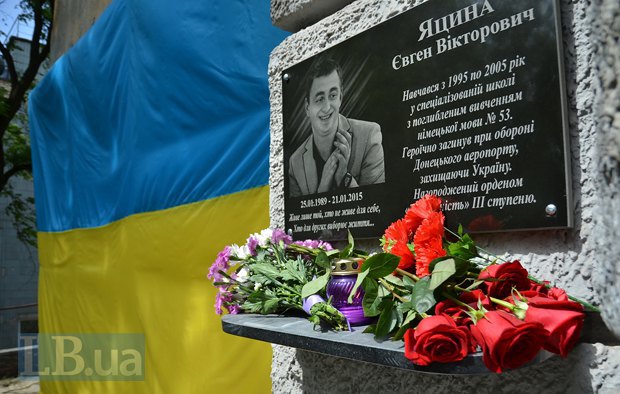
On this day, all the “cyborgs” — the defenders of the airport — are remembered. But in the section “Jews from Ukraine“, it is impossible to overlook the name Yevhen Yatsyna, call sign “Benya” — the youngest cyborg warrior who died in January 2015 in the new terminal of Donetsk Airport.

More about the defense of Donetsk Airport – “People endured, concrete did not”: in Ukraine, January 20 is the Day of Remembrance for the Defenders of Donetsk Airport

Who is Yevhen Yatsyna and why his call sign is especially resonant

Yevhen was born on January 25, 1989. A native of Kyiv, Pechersk. He studied at the Kyiv National Linguistic University, in the Faculty of Economics. Friends remembered him as a star of the university KVN and a “one-man band” — bright, lively, very sociable.

The nickname “Benya” was part of his life even before the front, and later became his call sign. And in this detail, there is an important intonation for the Jewish community: Yevhen greeted friends with the word “shalom”, responded to “Benya”, and this manner of communication was remembered by many more strongly than any official biographies. It was later reported that Yevhen’s mother was Jewish, and he himself had visited Israel and been to Jerusalem.

These strokes are important not for “origin for the sake of origin”. They show that the Jewish line in Yevhen’s history is not a decorative signature at the end, but part of his living language, habits, and connections.

The Defense of Donetsk Airport: Why It Became a Symbol

The defense of the airport lasted for months. The new terminal was turning into ruins right during the battles — under shelling, assaults, explosions. There, the war was fought not on a map, but on stairs, corridors, breaches in walls. People held positions in conditions where every day could be the last.

The word “cyborgs” appeared as an attempt to explain what seemed impossible: Ukrainian soldiers held on so persistently that even the enemy called them “not human”. And this is an important point for understanding the modern war: the Russian side from the very beginning acted on the logic of destruction, not “negotiations” or “disputes”.

Then, in 2015, the terminal was blown up, and part of the defenders ended up under the rubble. Today, in the years of full-scale war, the same principle works throughout the country: strikes on cities, energy, residential buildings — to destroy not only the defense but also the ability of society to live.

The Last Connection and Days That Ended in the Terminal

The last time Yevhen, a soldier of the 81st Brigade of the 90th Separate Airmobile Battalion, made contact was on January 18, 2015. He was definitely in the new terminal of Donetsk Airport that day.

According to his comrades, on January 19, he was wounded (a torn wound on the cheek) and concussed.
On the evening of January 20, Yevhen was caught under the collapse of the airport building after an explosion. His comrades pulled him out from under the rubble. According to them, he had fractures in both legs and a severe spinal injury — he could no longer move. He had a tag with his surname and individual code.

He did not live to see his 26th birthday — January 25 was just a few days away.

Different testimonies record different dates of death — January 19, 20, or 21. But the meaning is the same: Yevhen died in the last days of the defense of the new terminal, at the very point where the war led to the literal collapse of the building on people.

“To Georgiy Borisovich, shalom…”: Words of Georgiy Tuka

Volunteer Georgiy Tuka remembered Yevhen briefly and as one speaks of a close person — without unnecessary “literature”:

“Zhenya. Zhenya Yatsyna. Call sign ‘Benya’. A native of Kyiv. Pechersk. 25 years old. I met Zhenya back when the battalion was stationed in Zhytomyr. Zhenya had the opportunity to ‘dodge’ the draft, but as a man, as a citizen, he did not do this, and honestly went to fulfill his duty. Zhenya was the youngest fighter in the battalion. Without exaggeration, everyone’s favorite. The funniest, most sociable, most contactable. Every time our phone conversation started with the words: To Georgiy Borisovich, shalom!… Still a lump in the throat…”

This quote holds what is often lacking in official memory: voice, habit, life. Not a “hero’s portrait”, but a person who is truly missed.

“Jerusalem Thread”: A Story from His Mother

Yevhen’s mother, Svetlana, said that her son died due to closed fractures of the legs. And she recalled a detail that really brings a lump to many throats:

Once she brought a Jerusalem thread from Israel. When Zhenya came from Zhytomyr, she secretly sewed this thread into his uniform — into pockets, cuffs, “everywhere”. She did it quietly because her son considered such things “nonsense”.

But before leaving for Vodiane, Yevhen put on Pavlo Tuka’s pants — his own were dirty. And later, when the mother found out about this, she said: “Well, now it’s clear why it was the legs — there were no mother’s threads on the pants.”

This story is not about mysticism or “amulets”. It’s about a mother’s attempt to keep her son alive by any means, even the most inconspicuous. And about how war breaks such attempts mercilessly and routinely.

Help from Friends and What They Didn’t Have Time to Deliver

After Yevhen went to the army, friends collected over 40,000 hryvnias on social networks for a thermal imager, thermal underwear, and protective equipment. But they didn’t have time to deliver it to him.

This detail very accurately shows how Ukraine lived in the early years of the war: the front was held not only on orders and headquarters but also on horizontal support — when people collected money “from the world by a thread” to protect a specific fighter. Sometimes they made it. Sometimes — not.

Kyiv Bids Farewell to “Benya”: Funeral, Community Memory, “Wall of Memory” and State Award

After the death of Yevhen Yatsyna (“Benya”), his body was delivered to Dnipropetrovsk and then transported to Kyiv. The funeral took place on February 20, 2015 at Berkovets Cemetery — in the part associated with the relocation of burials from the destroyed Lukyanivka Jewish Cemetery. This place itself became symbolic: Kyiv buried its defender where the city had once tried to preserve Jewish memory, which was being destroyed.

The farewell took place at the Pechersk Military Hospital, followed by a military ceremony and burial. It was reported that the Chief Rabbi of Kyiv and Ukraine Moshe-Reuven Asman participated in the ceremony — an important detail for understanding how the Jewish community perceived this loss: not as a “foreign war”, but as their personal pain.

In the same 2015, at the Central Brodsky Synagogue in Kyiv, Yevhen’s mother was awarded the “Pride of the Community” award — “for the hero son”. For the section “Jews from Ukraine”, this is not a formality or a “religious touch”. It is a marker that the community recognized Yevhen as one of their own — and saw him off as they would their sons.

Memory That Doesn’t End with the Funeral: University and School

The memory of “Benya” was also preserved in the places where he lived before the war — in educational institutions.

On October 11, 2015, at the Kyiv National Linguistic University, a memorial plaque was unveiled in memory of graduate Yevhen Yatsyna by the efforts of students. This is an important moment: the memory was not “imposed from above”, it was made by the young — those who believed that the name should remain within the university walls.

Separately, there is the story with the school. In Kyiv, in the city center, at School No. 53, where Yevhen studied from 1995 to 2005, a memorial plaque was opened for the fallen “cyborg”. His mother said that a “very positive photograph” was chosen for the plaque — the one that best reflected her son’s character: he was cheerful, lively, contactable. The idea came from friends and classmates — the memory was made by people who knew him not by biography, but by school corridors and common conversations.

“Benya” — the youngest “cyborg”: the Jewish story of Yevhen Yatsyna in the memory of Donetsk Airport

“Wall of Memory of Those Who Fell for Ukraine”: Portrait and Exact Location

Another point of Kyiv’s memory is the memorial “Wall of Memory of Those Who Fell for Ukraine”, open to the urban space. This place is arranged so that a person can come and find a specific face — not “in the general list”, but nearby, at arm’s length.

Yevhen Yatsyna’s portrait on the “Wall of Memory” is placed with precise marking: section 5, row 3, place 38. This precision turns memory into action: you can come and stop right at his portrait.

In recent years, the “Wall of Memory” has also become part of the public diplomacy of memory: Volodymyr Zelensky often brings foreign guests there to show the cost of Russian aggression not in the language of statistics, but with the faces of the fallen.

Order “For Courage” III Degree: Fixing the Feat at the State Level

The feat of Yevhen Yatsyna is also enshrined in a state document. He was awarded the Order “For Courage” III Degree (posthumously).

The basis is Presidential Decree of Ukraine No. 270/2015 of May 15, 2015. The decree states that the award is given “for personal courage and high professionalism shown in the defense of the state sovereignty and territorial integrity of Ukraine, loyalty to the military oath”.

Together, these elements — the funeral in Kyiv, community participation, memorial plaques, portrait on the “Wall of Memory”, and state order — form a coherent line: Yevhen Yatsyna did not dissolve in the war as “one of”. He remained a name, a face, and a story — for Ukraine and for the Jewish community, which shared this loss as their own.

Knesset and Words About the Contribution of Jews from Ukraine

On December 23, 2015, during a speech in the Knesset, President of Ukraine Petro Poroshenko said a phrase that still sounds like a political and human testimony:

“In confronting external aggression, our country has revived its army. And in this army, citizens of Ukraine of different nationalities are fighting. And we are proud of the contribution that Jews make to the defense of the country. I cannot but recall the glorious cyborg warrior who died in January this year at Donetsk Airport, Yevhen Yatsyna with the call sign ‘Benya’. We are proud of his feat. Posthumously, he was awarded the state order ‘For Courage’.”

This is not just a “mention of a name”. It is a public acknowledgment that the Jewish community of Ukraine is not an observer and not a “separate topic”, but part of the resistance to Russian aggression.

And this is especially important now, when Russia continues the war and continues to try to blur responsibility, substitute cause-and-effect relationships, and play the card of societal division. Stories of such people break this propaganda because they are very simple and very direct: a citizen of Ukraine went to defend the country, died, and he is remembered — by the state, the university, and the community.

Why the Story of “Benya” Sounds Sharper Today Than Ten Years Ago

Donetsk Airport was one of the first places where the war showed its true face. Back then, many still hoped that “everything would end soon”. Today, after the full-scale invasion, it has become clear: Russian aggression is a long-term project of destruction, exhaustion, terror in the rear, and an attempt to erase identity.

Against this background, the story of Yevhen Yatsyna looks not like an “episode of the past”, but as a point from which much began. It shows that resistance in Ukraine was initially nationwide — including with the participation of the Jewish community, which provided the country with warriors, volunteers, doctors, support for the families of the fallen, and public memory.

And in the end, there remains a simple formula that sounds especially honest in the section “Jews from Ukraine“:

Memory is us with you. As long as we name names and tell stories in living words, the war cannot turn people into impersonal numbers. NAnews — Israel News | Nikk.Agency.

A night of massive terror in Ukraine: Russia struck with “Kinzhal”, “Oreshnik”, and drones: why Russian terror did not break Ukraine again

The night of May 24, 2026, became one of the hardest for Kyiv since the beginning of the full-scale war. Russia launched a massive combined strike on Ukraine — with missiles of various types, ballistics, and hundreds of drones. The main target was once again the capital.

The strikes did not hit military parades or ‘decision-making centers’ from Russian propaganda, but ordinary city life: a dormitory, schools, a business center, a shopping center, a supermarket, residential buildings, water supply facilities, a market. This is what real Russian ‘strength’ looks like today — missiles against apartments, entrances, children’s rooms, and people who were just trying to survive another night.

According to preliminary data, at least 83 people were injured since the beginning of the day. There are fatalities. The scale of the attack was enormous: about 90 missiles of various types, including 36 ballistic ones, and approximately 600 drones. Some targets were shot down, but not all ballistics can be stopped with the available air defense systems.

Kyiv became the main target of the night attack.

The largest number of hits and destructions occurred in Kyiv. Strikes and falling debris were recorded in different areas of the city. Residential high-rises, private houses, public buildings, commercial facilities, and transport infrastructure were damaged.

The strike on the everyday urban environment looks particularly painful. In one area, a dormitory was damaged. In another — a school. Somewhere, floors of a residential building caught fire. Elsewhere, windows and doors were blown out, facades were destroyed, and apartments were buried under debris.

Such a strike cannot be explained by military logic. This is not a strategy for victory. It is an attempt to sow fear, anger, fatigue, and a sense of helplessness.

But in the fifth year of the great war, Putin still hasn’t understood the main thing: strikes on Ukrainian cities do not make people ‘surrender.’ They make society tougher, more collected, and angrier. Every destroyed house becomes another proof that concessions to terror do not stop terror.

What was under attack

According to available data, residential buildings, a business center, a shopping center, a supermarket, schools, a market, infrastructure, and water supply facilities were affected in Kyiv and the region. In several places, rescuers, medics, utility services, police, and emergency crews were working.

It is these people who first bring the city back to life after a night of terror.

They clear the debris, evacuate residents, extinguish fires, help the wounded, cover broken windows, restore movement, check shelters and communications. In such moments, it becomes clear what the state really relies on: not on loud statements, but on people who go to work immediately after the explosions.

Russia once again showed weakness, not strength.

Night of massive terror in Ukraine: Russia struck with 'Daggers', 'Hazel', and drones: why Russian terror did not break Ukraine again
Night of massive terror in Ukraine: Russia struck with ‘Daggers’, ‘Hazel’, and drones: why Russian terror did not break Ukraine again

Moscow tried to present this attack as a demonstration of capabilities. In reality, it once again showed political and military weakness. When a state cannot achieve results on the battlefield, it starts to fight with high-rises, markets, and schools.

This is the essence of the current Russian tactic. Not to defeat the army — but to punish civilians. Not to change the course of the war — but to make the world get used to night attacks. Not to offer peace — but to raise the stakes of blood again.

Ukraine was not only hit in Kyiv. Cherkasy, Kharkiv, Kirovohrad, Odesa, Poltava, Sumy, and Zhytomyr regions were also under attack. There were separate reports of an attack on Bila Tserkva using a missile associated with the Russian ‘Hazel’.

The name of this weapon is used by Moscow as an element of psychological pressure. But behind the beautiful propaganda packaging remains the same reality: missiles fly over cities, not ‘mythical threats’.

For the Israeli audience, this picture is too familiar. Israelis know what it means to live under the threat of rockets, to count minutes to shelter, to check news about hits, and to wait for messages from loved ones. That is why the attack on Kyiv should be perceived not as a distant European news, but as part of the overall picture of the war against civilian life.

In this context, NAnews — Israel News | Nikk.Agency considers such events not only as a Ukrainian tragedy but also as a signal for Israel: a world that gets used to strikes on cities becomes more dangerous for everyone.

Why the silence of international structures seems especially loud

After such nights, it becomes especially noticeable how devalued many international institutions have become. Formally, they exist. They have buildings, budgets, positions, statements, meetings, and the usual diplomatic language.

But when hundreds of drones and dozens of missiles, including ballistics, fly over a European capital, too little real action is heard from them again.

One can talk endlessly about ‘deep concern’, ‘calls for restraint’, and ‘the need for dialogue’. But if the aggressor strikes schools, homes, and life-support facilities again, and the consequences for him remain limited, it means only one thing: the deterrence mechanism does not work as it should.

What should change after this attack

The main conclusion is simple: support for Ukraine needs to be strengthened, not softened. After such strikes, talks about ‘pauses’, ‘fatigue’, and ‘compromises’ look not like diplomacy, but like an invitation to the next attack.

Ukraine needs additional air defense systems, more means to protect against ballistics, sustainable financing of the defense industry, long-range capabilities, and political decisions that will show Moscow the cost of continuing the war.

It’s not just about weapons. It’s about sanctions, using frozen Russian assets, restrictions against Russian military and those who service the military machine. The world has levers of influence. The only question is whether it is ready to use them not after another tragedy, but before the next one.

Israeli perspective

For Israel, this attack is also important because it shows: the Russian war has long gone beyond the Ukrainian front. It is a war against the very idea that civilian cities should be protected from rocket terror.

If such an approach remains without harsh consequences, it will be copied by other regimes and forces. Including those who already threaten Israel, Ukraine, and Jewish communities in different countries.

Iran, which is an enemy of both Ukraine and Israel, has long been embedded in this war through drone technologies and support for the Russian military machine. Therefore, every attack on Kyiv is not only a Russian story. It is part of a broader axis of violence, where different enemies of the free world learn from each other.

Ukraine is now defending not only its cities. It is defending the principle that a missile on a residential building cannot be an ‘argument’ in politics.

And so, after this night, the question should not be: ‘How much more can Ukraine endure?’

The right question is different: how much longer will the world allow Moscow to test the resilience of other people’s cities, other people’s families, and other people’s patience?

How for the first time in the world a fallen IDF soldier was commemorated in the Ukrainian city of Kharkiv

This is the first case in world practice where a street in a city outside of Israel has been named after a fallen IDF soldier.

A street in Kharkiv has been named after Sergeant of the Israel Defense Forces Alexei (Asher) Neikov, who saved dozens of children from death during a terrorist attack on a school bus. This was reported by Israeli journalist Shimon Briman in his article on the website “Ukrainian-Jewish Encounter”.

In September 1996, 17-year-old Alexei independently repatriated to Israel from Kharkiv. He was preparing to study at the Technion — dreaming of the department of astronautics and aerodynamics. But he decided to first serve in the IDF — the Israel Defense Forces.

On October 29, 1998, terrorists directed a car filled with explosives at two school buses carrying Jewish children near the settlement of Kfar Darom.

Israeli soldiers guarding the buses managed to turn their jeep across the road — and took the hit themselves. The children were unharmed, two soldiers were injured. One died. It was Sergeant Alexei (Asher) Neikov.

Sergeant of the Israel Defense Forces Alexei (Asher) Neikov — a hero, writes Shimon Briman, who saved dozens of children from death during an attack by Arab terrorists on a school bus, received the highest posthumous honor in his hometown: a street in Kharkiv — the second-largest metropolis in Ukraine, is named after him. This is the first case in world practice where a street in a city outside of Israel has been named after a fallen IDF soldier.

Kharkiv is located just 30 kilometers from the border with Russia and is subjected to daily rocket attacks from the aggressor country. The city, which had a population of one and a half million people before the full-scale Russian invasion in February 2022, has been defending itself not only on the front lines but also in the sphere of culture and ideology for the third year.

The toponymic commission of the Kharkiv municipal council recently decided to rename 367 street names, alleys, and squares associated with Russia and the USSR. Kharkiv Mayor Igor Terekhov signed this decision, and it came into effect on May 1, 2024.

Among the new street names are the names of 35 fallen defenders of Ukraine who were born in Kharkiv or defended the city; 13 of them were awarded the highest title of Hero of Ukraine.

In addition to the fallen Ukrainian soldiers and officers, the name of one Kharkiv native — Alexei Neikov, an IDF sergeant who died defending Israeli children in 1998, is now eternally glorified on the streets of Kharkiv.

Against the backdrop of anti-Semitic demonstrations and anti-Israel unrest on university campuses in the USA and cities in Western Europe, such a clearly pro-Israel step by the municipal council and mayor of Ukrainian Kharkiv deserves special respect.

As part of the implementation of the Law of Ukraine “On the Condemnation and Prohibition of Propaganda of Russian Imperial Policy and Decolonization of Toponymy,” 510 street names and other toponymic objects have been renamed in Kharkiv since the beginning of Russia’s aggression against Ukraine.

History laughed at Putin: the president of Russia attacked Ukraine using the beacon ideas of “protecting and spreading the Russian World,” but in reality, Putin led to a colossal reduction in the zone of influence of Russian culture and the Russian language.

In Kharkiv, which was previously considered the most Russian-speaking city in Ukraine, almost all names associated with Russia and the USSR, with Russian and Soviet culture, were erased from the map from 2022 to 2024. More and more residents of Kharkiv are demonstratively switching to the Ukrainian language, unwilling to speak the language of the occupiers.

“The author of these lines, writes Shimon Briman, has been following these renamings for almost two years. As a historian and author of the article “Kharkiv” in the Jewish Encyclopedia, in the summer of 2022, I prepared a list of 25 outstanding Jews in the history of Kharkiv at the request of the Jewish community. This list was submitted to the municipal council as options for renaming streets. One of the main names on this list was Alexei Neikov.

The name Neikov was supported by municipal council deputy Irina Goncharova-Bagalei and the chief rabbi of Kharkiv, Moishe Moskovich. Letters in support of this initiative were written by the Israeli ambassador to Ukraine, Michael Brodsky, public organizations “Israeli Friends of Ukraine” and “Orthodox Union Israel.”

Today I can proudly say that three personalities from this list of outstanding Jews have become streets in Kharkiv, where my childhood and youth passed.”

In addition to the name of Alexei Neikov, the names of architects Viktor Estrovich and Alexander Ginzburg, whose masterpieces still adorn Kharkiv, were also approved in the renaming list, despite being endangered by Russian missile and Iranian “shahid” attacks.

Viktor Estrovich was shot by the Nazis in December 1941 in Drobitsky Yar. Putin’s occupiers continued the tragedy of the Holocaust at this place in March 2022, shelling the memorial complex in Drobitsky Yar, where almost 15,000 Jews of Kharkiv, killed by Nazi occupiers, lie in two mass graves.

The outstanding urban planner Alexander Ginzburg led the Jewish community of the city after the liberation of Kharkiv from the Nazis in 1944-1945, under pressure from Stalin’s punitive organs.

The irony of today, writes Shimon Briman, is that some Jewish or quasi-Jewish names were removed from the map of Kharkiv in the spring of 2024 during the liquidation of Russia’s legacy. Thus, four (!) Birobidzhan passages, named after the “Jewish Autonomous Region” of the Russian Federation, were renamed.

The street of Isaac Dunaevsky, a Soviet composer-Jew of the 1920s-1950s, was also renamed. Kharkiv did not forgive Dunaevsky, who studied and began his career in this city, for such pro-communist songs as “My Moscow,” “My Wide Native Land,” “Oh, It’s Good to Live in the Soviet Country,” “Song of Stalin,” “Song of Kakhovka.” Especially in wartime, when this Moscow tries to expand its possessions by barbaric methods at the expense of a neighboring country, and Kakhovka was captured by Russian occupiers who blew up the Kakhovka Reservoir in southern Ukraine.

But, writes Shimon Briman, let’s return to the fate of the Kharkiv Jewish youth Alexei Neikov, which connected Ukraine and Israel.

He studied for several years at Jewish school No. 170 under the leadership of Grigory Shoikhet, then graduated from the senior classes of the religious-Zionist lyceum “Sha’alvim,” which at that time had the highest percentage of graduates repatriating to Israel in the world.

Now, after the renaming of the former Gastello Street, Jewish secondary school No. 170, which has a room in memory of Alexei Neikov, will be located on a street named after its student Neikov.

In September 1996, 17-year-old Alexei arrived in Israel without his parents. He was preparing to study at the Technion — dreaming of the field of astronautics and aerodynamics. But he decided to first serve in the IDF — the Israel Defense Forces.

On the tragic day of October 29 (9th of Heshvan) 1998, at 07:30 am, Arab terrorists directed a car filled with explosives at two school buses carrying 48 Jewish children near the settlement of Kfar Darom in Gush Katif.

Israeli soldiers guarding the buses managed to turn their jeep across the road — and took the hit themselves. The children were unharmed, two soldiers were injured. One died. It was Sergeant Alexei (Asher) Neikov — forever a 19-year-old new repatriate from Kharkiv.

The evening before, Asher called home.

“Tomorrow I have my first combat mission: to escort a bus with children. I’ll be in the first jeep.” “Why necessarily in the first?” — his mother worried. “Because in the first. I decided so.”

Thanks to his feat, in the children he saved, who have grown over 25 years, more than 120 of their own children — young Israelis — were born. So, Asher Neikov preserved lives for them too. Some of them named their children in his honor with the names Asher and Ashrat. They still maintain contact with the soldier’s parents — Klara and Semen Neikov, who live in Haifa.

In memory of Neikov, a Torah scroll was written for the synagogue in the Jewish settlement of Kfar Darom, which was destroyed in 2005 by order of Israeli Prime Minister Ariel Sharon during the so-called “disengagement from the Gaza Strip.” The Jewish settlements destroyed then later became bases for Hamas terrorists, against whom Israel is now waging a heavy war.

The children he saved and who grew up created a touching video clip “Children of the Ninth of Heshvan” in memory of Sergeant Neikov in 2014.

In 2022, Neikov’s parents were presented with a portrait of Alexei, assembled from hundreds of photographs of the saved children, their families, and the children born to them.

“Naming a street after our student Asher Neikov is a huge achievement! At first, I couldn’t believe that in the conditions of war, Kharkiv remembers a person born in the city who became a true hero of Israel. Therefore, I perceive this decision of the municipal council and Mayor Igor Terekhov as a historic event and as an important stage in the context of Ukraine-Israel relations,”

– Israeli rabbi and lawyer Shlomo Asraf, who was the founder and spiritual leader of the “Orthodox Union” Center in Kharkiv and the religious-Zionist lyceum “Sha’alvim” from 1993-2009, told me, writes Shimon Briman.

Kharkiv resident Irina Sherstobitova, Asher Neikov’s English teacher at the “Sha’alvim” lyceum, noted:

“Every year we tell our students about his feat. The lyceum has a memorial board about Asher’s amazing act. A bright and righteous guy, polite and erudite, he spoke French, English, Russian, Ukrainian, and Hebrew, brave and physically fit, with an incredibly attractive smile. We must believe in the bright future that such brave guys as he give us.”

Klara Neikov, Alexei’s mother, received the news from Kharkiv with great gratitude.

“I just have no words. Thank you very much to everyone who supported this initiative. My husband and I would be happy to visit Kharkiv and unveil a memorial plaque on the street named after our son. If only the situation around the city improved, and if the war ended,” — Klara Neikov told me, writes Shimon Briman, in a phone conversation.

In the Israeli organization “Yad Le-Banim”, which coordinates work on commemorating fallen IDF soldiers, in response to my request, writes Shimon Briman, they replied that they are not aware of other cases of naming streets in cities outside of Israel after fallen Israeli soldiers, and that, likely, the decision of the Kharkiv authorities is the first example of this kind in the world.

The Kharkiv street in honor of Alexei Neikov will become another bridge of friendship and interpersonal connections, linking Ukraine and Israel — two countries fighting for the freedom, independence, and physical survival of their citizens.

This bridge works both ways. In the same days when the Kharkiv municipal authorities were deciding on renaming streets, the Kharkiv National University named after Vasyl Karazin was selecting the first laureate of the Mark Azbel Prize in theoretical physics.

We wrote about this — “The Prize of Israeli Scientist and Dissident Mark Azbel Will Help His Alma Mater in Kharkiv, Ukraine”.

This prize was established in the spring of 2024 in memory of the outstanding physicist — Professor of Tel Aviv University Mark Azbel, who began his scientific career at Kharkiv University.

Irina Kolodna from the Israeli city of Ramat HaSharon, the widow of the scientist, allocated $25,000 for five years to support young researchers at Kharkiv National University. The first laureate of the Azbel Prize became 39-year-old Dr. Zakhar Maizelis, a professor of the Department of Theoretical Physics; his award ceremony will take place on May 16, 2024, in honor of Israel’s Independence Day.

In all this, I, writes Shimon Briman, see great symbolism — and timeliness. Precisely now, when Ukraine and Israel are repelling attacks from the global axis of evil.

It was from Kharkiv that the BILU ensemble (1882) came — Jewish students of the University who were the first in the world to begin reviving the Land of Israel with their labor. It was the Kharkiv Zionist Conference (1903) that in an ultimatum demanded the creation of a Jewish state only on the ancient Land of Israel, rejecting the “Uganda Plan.”

It was the Kharkiv industrial giant “Turboatom” that refused in 1997 — at the request of Israeli Prime Minister Benjamin Netanyahu and Minister of Industry and Trade Natan Sharansky — to supply turbines for a nuclear reactor in Iran, which delayed the Iranian nuclear program for many years.

It was in Kharkiv in 2024 that for the first time in the world a street was named after a soldier of the Israel Defense Forces.

And it is precisely to Kharkiv National University that an award named after an Israeli scientist-physicist — a student of Academicians Landau and Lifshitz — comes from Israel.


“Well, shall we go?” – through hiking, the new “Ukrainian” community is discovering Israel – and invites everyone interested

“Well, shall we go?”

In Israel, a new non-profit community for lovers of routes, nature, and live communication is rapidly developing. The initiative “Well, shall we go?”, created in November 2025 by “Ukrainians” in a broad cultural sense, gradually unites various Israelis — from new immigrants to those who grew up here but maintain a connection with the Ukrainian language, as well as people of any origin who feel closer to the Ukrainian cultural atmosphere.

The group is open to everyone. There are no and never have been any nationality restrictions. The only rule is communication takes place in Ukrainian, because the language here is not a “filter” but a cultural center of gravity. It helps to create a comfortable environment but does not exclude anyone who respects the format.

“Do you think there’s only desert and sea here? How about the waterfalls in the Golan, the green forests of Carmel, or the Martian landscapes of the Negev?
We are launching the Ukrainian Hiking Community in Israel!
Who is this channel for:
✅ For those who can’t live without movement.
✅ For beginners who want to start hiking but don’t know the routes.
✅ For those looking for active Ukrainian friends.
We gather groups, share coordinates, organize picnics, and just have a great time.
👇 Your ticket to adventures is here”,  – invite the organizers.

Why now

Relocations, adaptation, new realities — all this creates a need for a space where you can move, communicate, and feel part of something alive. Many “Ukrainians” in Israel have long sought a format where they could combine nature recreation and cultural identity. But it turned out that around this idea, other Israelis easily unite: some are interested in routes, some in communication, and some just in the format of going out into nature together.

The community is built entirely on voluntariness: no commercial elements, no formal structures. Someone suggests routes, someone helps gather a group, someone just comes and goes along. This organic approach makes the initiative lively.

Hiking without complex explanations

In Israel, hiking is not an elite activity or a sport for the prepared. It’s a format where everyone chooses their level — from easy one-day walks to dynamic ascents.

Short routes take about an hour and are suitable for absolutely everyone. Medium ones range from 6 to 12 kilometers, usually 2.5–5 hours, with moderate ascents. Difficult ones can stretch up to 20 kilometers or include steep climbs lasting 5–8 hours.

The group selects hikes so that no one feels “too weak,” “too inexperienced,” or “too prepared.” The balance forms naturally.

What is available for hiking in Israel: a live overview, not a catalog

Israel surprises people who are just beginning to get acquainted with the country’s nature. Several climatic zones fit within a compact distance, and each offers its own routes.

In the north, in Galilee and the Golan, routes usually take three to five hours — about 7–12 kilometers. These are green gorges, waterfalls, terraces, forest areas, and views of the Kinneret. The climate here is milder, the trails vary in level, and many Israelis start their hiking acquaintance from here.

In the Haifa and Krayot area — short walks of 3–5 kilometers that can be completed in an hour or two. The routes are warm, shady, simple in terrain, making them suitable for beginners, families, and those who want to immerse themselves in nature gradually. Carmel is one of the most comfortable regions for calm yet rich hiking.

Further — the Judean Desert. Contrasting, sunny, sharp. Here you can walk 2–3 kilometers to the Ein Gedi waterfalls in just an hour, or choose a three to four-hour route along the Nahal Arugot stream. The ascent to Masada takes about an hour but requires more strength: the elevation change is significant, the terrain rocky.

The southern part of the country — Negev and Makhtesh Ramon — is a completely different experience. Routes here are usually 8–12 kilometers, lasting three to five hours. The ascents are steeper, but this area offers “Martian” landscapes that attract people from all over the country.

There are also gentle options: the Mediterranean coast, where walks of 3–7 kilometers take an hour and a half, maximum three, and are suitable for absolutely everyone. These are the routes you can take even after a workday.

The Eilat Mountains offer routes for all levels: short canyons for an hour, panoramic ascents for two to four hours, and a desert atmosphere that becomes especially comfortable in winter.

Such a range of formats makes Israel an ideal country for people who want to hike regularly and without logistical complexity.

Why the community turned out to be important for “Ukrainians” and Israelis alike

Hikes create a space where boundaries disappear: age, cultural, professional. People walk side by side, exchange experiences, discuss news, share how they are adapting or how long they’ve lived here.

The Ukrainian language has become in the community not a “divider” but a unifying factor: it helps those culturally connected to Ukraine feel safe. And Israelis who find the language interesting or close join as naturally as any other participant.

Participants say: “When you walk the trail and hear Ukrainian speech in Israel, it creates a sense of cultural support. But more importantly, you see people of very different backgrounds next to you.”

This combination explains why the group grows without advertising and formal structures.

The Ukrainian community “Well, shall we go?” has become one of the warmest nature movements in Israel. It unites people of different origins, cities, and biographies — through trails, forests, deserts, coasts, through conversations and support. Israel is ideally suited for such initiatives, and the cultural foundation in the Ukrainian language makes this space special.

NANews will continue to report on projects that strengthen the connection between “Ukrainians” and Israeli society.
NANews — News of Israel | Nikk.Agency

How to join

Everything is organized as simply as possible:
👉 https://t.me/nyshogoo

New routes, landmarks, equipment recommendations, start times, and photos appear in the chat. Any participant can suggest their trail or join a planned hike.

The community is dynamic, open, multicultural — and at the same time retains the Ukrainian language as its foundation.