At the June G7 summit in Evian, France, Ukraine once again brought to the forefront of negotiations an issue directly affecting the life of cities: air defense, additional missiles for Patriot, energy resilience, and new pressure on Russia. For the Israeli audience, this agenda does not sound like distant European diplomacy, but like a familiar language of security, where each interception system can mean saved homes, hospitals, and power plants.
After participating in the G7 leaders’ meeting, Volodymyr Zelensky stated that there are already important results for Ukraine. The main one he mentioned was the additional strengthening of Ukrainian air defense, as well as the readiness of partners to support the country’s defense and its energy resilience.
Why the G7 summit was important for Ukraine
At the negotiations in France, which Zelensky spoke about on June 16 and 17, 2026, specific needs of Kyiv were discussed, not general formulas of support. Among them were energy assistance, strengthening air defense, additional missiles for Patriot systems, and expanding production.
This is an important moment because Ukraine is trying to shift international support from the mode of political statements to the mode of practical solutions. If Russia continues to strike cities, power plants, and civilian infrastructure, the response should not only be sanction formulations but also real defense systems.
Zelensky also emphasized that partners have a common understanding: Russia is not winning the war against Ukraine. Therefore, according to Kyiv’s logic, pressure on Moscow needs to be increased not for the sake of demonstrating toughness, but for the sake of peace — to make Russian aggression too costly both politically and economically.
Air defense and Patriot: not a technical detail, but a matter of survival
For Israel, the topic of air defense is especially understandable. In Tel Aviv, Haifa, Ashdod, Be’er Sheva, in the north and center of the country, people know well that security does not exist only on paper. It is measured by reaction time, the number of interceptor missiles, the quality of intelligence, and the readiness of allies to help at a critical moment.
Ukraine today speaks to partners precisely in this language. It needs missiles for Patriot, more capabilities to protect the sky, and long-term production to not depend on random political moods in individual capitals.
The meeting between Zelensky and Trump changed the atmosphere around Ukraine
One of the main political episodes of the summit was the meeting between Volodymyr Zelensky and Donald Trump. According to reports retold by Ukrainian and Western media, European allies on the sidelines of the G7 tried to bring the positions of the US and Europe closer on the Russian-Ukrainian war, and French President Emmanuel Macron helped organize a direct conversation between the leaders of Ukraine and the US.
Before this meeting, Trump took a tougher stance and believed that Ukraine had few strong cards, and to end the hostilities, Kyiv might have to make territorial concessions. But after the conversation in Evian, his tone became noticeably softer: he stated that Russia should make an agreement, and called the ongoing events senseless.
Kyiv photos as a diplomatic argument
At the meeting, Zelensky showed Trump photos of the destroyed St. Assumption Cathedral in Kyiv. This moment became an important part of the conversation because the Ukrainian side showed not abstract war statistics, but the concrete cost of Russian strikes — destroyed shrines, urban life, memory, and civilian infrastructure.
After this, unscheduled negotiations were added to the American president’s work schedule. For Kyiv, this was not just a protocol victory, but an opportunity to once again explain to Washington: Russia’s war against Ukraine cannot be reduced to territorial bargaining because it is about the security of all of Europe and the right of the country to survive.
In the Israeli context, this plot is read especially acutely. News — News of Israel | Nikk.Agency considers such topics through the connection between Ukraine’s security, the US position, the role of Europe, and the interests of countries that themselves live in a world of missile threats, regional conflicts, and complex allied calculations.
What changes after Evian
After the G7 summit, it became noticeable that the Ukrainian issue remains at the center of international politics, despite war fatigue and different approaches within the Western camp. Zelensky is achieving a simple but tough formula: more air defense, more missiles, more production, more sanction pressure on Russia.
An important signal was also Trump’s willingness to consider increasing pressure on Moscow, including sanctions. Meanwhile, among allies, there is a growing understanding that Russia has not achieved a military victory, and its economy is experiencing the consequences of a long war.
For Ukraine, this is not yet a final result, but a window of opportunity. Now the main question is whether the statements after Evian will be turned into deliveries, new Patriot missiles, expanded defense production, and real solutions against Russia. It is by this that it will be seen whether the G7 summit was a diplomatic episode or a step towards changing the balance of the war.
Conclusion for Israel
For the Israeli audience, the G7 story is important not only as news about Ukraine. It shows how international security works at a time when an aggressor tests allies for fatigue, and democratic countries are forced to prove that their support does not end with statements.
In Evian, Ukraine sought what is well understood by Israel: sky protection, rear resilience, a clear position of partners, and pressure on those who consider war a normal tool of politics. Therefore, the main outcome of the summit will be measured not by the loudness of statements, but by how much concrete protection Ukraine receives after June 17, 2026.
Entering the churchyard of the Basilica of the Annunciation in Nazareth, you immediately notice the beautiful mosaic depicting Ukrainian Zarvanitsky Mother of Godlocated directly opposite the main entrance to the temple.
It is surprising that this image ended up in such an important place, among the mosaics of other countries – as if the Virgin Mary, revered in Ukraine, suddenly found itself among all the great icons of the world.
What is she doing here, how did she appear?
Basilica of the Annunciation— (Hebrew: כנסיית הבשורה, Arabic: كنيسة البشارة, Greek: Εκκλησία του Ευαγγελισμού της Θεοτόκου) – this Catholic church was built over the site of the Annunciation – Christian tradition (Roman Catholic) claims that it was in this place (Joseph’s house) that the Archangel Gabriel informed the Virgin Mary that she would “conceive in her womb and give birth to Jesus Christ.”
Not to be confused with Church of the Annunciation over the source of the Blessed Virgin Mary in Nazareth, also known as the Greek Orthodox Church of the Archangel Gabriel over the Spring of the Blessed Virgin Mary.
The largest Christian church in the Middle East. It has the honorary status of “minor basilica”, awarded to it in 1964 by Pope Paul VI. Place of Christian pilgrimage. The monks of the Franciscan order serve in the basilica.
The construction of the new basilica building, which still exists today, was completed in 1969 and the Basilica was consecrated on March 23, 1969.
The initiative arose after the Basilica of the Annunciation, built in modern style in 1969, opened its doors to mosaic icons from around the world.
The walls of the main hall of the upper part of the temple are decorated with images of the most important temples of the Virgin Mary in the world. But because the internal space of the basilica is obviously limited, we see only 17 images there, illustrating the reading of the Blessed Virgin Mary in the world.
Other (more than 50) images of different peoples and countries create a wonderful wreath in the outer gallery, surrounding the Nazarene Temple in a semicircle.
Noteworthy is the peculiarity of conveying the image of the Virgin Mary as it is perceived by artists of different nations and races.
The idea to create mosaic icon of the Zarvanitsky Mother of God belongs to representatives of the Ukrainian Greek Catholic Church (UGCC).
Every country (Catholic churches – ed.) were invited to present their unique image of the Virgin MaryAnd Ukraine (UGCC), chose the Zarvanitsky Mother of Godwhich is one of the most revered shrines of the Ukrainian people (from Greek Catholics -ed.).
As a result of the pseudo-council in Lviv in March 1946 The Ukrainian Greek Catholic Church was liquidated on the territory of the USSR. A significant part of its property was transferred to the Russian Orthodox Church, and believers and clergy were forcibly forced to renounce their church. The UGCC was legalized in Ukraine in 1989.
Entering the church yard to the main entrance to the Basilica, a beautiful mosaic of the Ukrainian Zarvanytsia Mother of God immediately catches your eye, to the right of the entrance.
We see a copy Zarvanitskaya Mother of Godframed by carefully selected Ukrainian landscapes, among images of two of the greatest Ukrainian churches: Kyiv St. Sophia and Lviv St. George.
Icon of the Zarvanitsa Mother of Godin question, represents an important religious symbol for Ukraine. It is located in Zarvanytsia (Ternopil region), on the territory of the holy complex of the same name, which is one of the main Christian pilgrimage sites in Ukraine. Dates from the middle of the 17th century. According to legend, there was also an image from the 13th century.
On both sides of the icon are two pairs of pilgrims in Poltava and Hutsul folk clothes – representatives of the Eastern and Western lands of Ukraine in bow to the Most Holy Zarvanitskaya Mother of God.
Above the mosaic picture we read the inscription: “For all generations will call me blessed” (Luke 1:48), and under the image there is a pleading call: “Most Holy Mother of God, pray for Your Ukrainian people”. The origin of the icon is explained below in Latin: “Miracle-working Mother of God – Zarvanitsa – Ukraine”.
This one is wonderful The image of the Zarvanitsky Mother of God belongs to creativitysisters (religious institute – ed.) Vasily Chikalo (Vasiliya Chykalo – Ukrainian) (d. 2012), “Servants of the Immaculate Virgin Mary” (auto), natives of Podolia (Ukraine), who then lived in Poland.
The initiator and sponsor of this project, which was completed in the summer of 1976when Vasily Chikalo was in the Main House of the “Servant Sisters” in Rome, there was a father of holy memory (religious institute – ed.)Vasily Turkovid, priest of the Ukrainian Catholic Church in New Ulm in Germany.
He, together with the then “Proto-Archimandrite of the Basilian Order, Fr. Isidore Patril“, CHSVV(The Order of St. Basil the Great (lat. Ordo Sancti Basilii Magni), also ChSVV, the Basilian Order of St. Josaphat, the Basilian Fathers – one of the main monastic orders of the Ukrainian Greek Catholic Church.), made great efforts to obtain this place of honor for Zarvanitsky Mother of God in Nazareth.
According to their instructions, Sister Servant Vasily Chikalo painted the image, and the mosaic itself was executed by a specialized Italian company in Milan under the careful supervision of Fr. Isidora Patrila.
On June 16, 2026, the Federation of Jewish Communities of Ukrainereported on the visit of the chaplain of the FEGU and the 7th Rapid Response Corps of the Air Assault Forces of the Armed Forces of Ukraine, Yakov Sinyakov, to the Air Assault Forces Training Center.
This is not a formal trip “for the record.” In such places, future defenders of Ukraine are being prepared, and alongside them, not only instructors, equipment, and discipline are important, but also a person who can listen, support, pray together, and remind them: even in war, a soldier is not alone.
Visit to the Air Assault Forces Training Center of the Armed Forces of Ukraine
The chaplain of the Federation of Jewish Communities of Ukraine, Yakov Sinyakov, visited the Air Assault Forces Training Center, where servicemen preparing for service in the units of the Armed Forces of Ukraine are trained.
During the visit, humanitarian aid was delivered to the soldiers. For the Israeli audience, it is important to understand the context here: Ukraine has been living under conditions of full-scale Russian aggression for more than four years, and supporting the army is not only about weapons, equipment, or medicine. It is also about the connection between the front and society, between communities and those who take personal risks every day.
Not only help, but also presence nearby
The meeting took place in a warm, human atmosphere. The servicemen were able to participate in joint prayers, talk personally, share thoughts, anxieties, and things that are not always easy to express in formation or during training.
Such conversations often become more important than loud statements. One person asks a question. Another is silent but listens. A third just wants to feel that their concerns are understood and do not appear as weakness. For an army fighting against the Russian invasion, the psychological resilience of the soldiers is part of the overall defense of the country.
Why a military chaplain is important during war
The service of a chaplain in the army is not a replacement for a commander, doctor, or psychologist. It is a separate form of support that combines spiritual support, personal trust, and the ability to be there in moments of internal tension.
The chaplain helps strengthen the morale of the soldiers, maintain internal balance, and restore a sense of meaning to a person where every day is associated with risk, fatigue, and uncertainty.
For Jewish communities of Ukraine, this is of particular importance. The Federation of Jewish Communities of Ukraine continues to participate in the humanitarian and spiritual support of people directly affected by the war: servicemen, families, displaced persons, the elderly, and children. In this context, NANews — Israel News | Nikk.Agency views such events not as a local news story, but as part of a large connection between Ukraine, Jewish communities, and Israelis, for whom the topic of security, the army, and the memory of the cost of defending the country is well understood.
Human support where they prepare for the front
The Air Assault Forces Training Center is a place where soldiers undergo physical, tactical, and moral testing even before going on combat missions. Here, it is important not only to learn to act in a unit but also to withstand internal pressure.
Therefore, the visit of Chaplain Yakov Sinyakov became part of the work that often remains behind the scenes of the news. Without loud slogans, without a political stage, without unnecessary pathos — just help, prayer, conversation, and presence with those preparing to defend Ukraine.
The connection between Ukraine, Jewish communities, and Israel
For the Israeli audience, this story sounds especially close. Israelis know that the army is held together not only by orders and training. It is held together by trust, mutual support, a sense of the rear, and the understanding that society does not turn away from those who stand in defense of the country.
In Ukraine today, this feeling is created by different people and organizations. Among them are military chaplains, volunteers, communities, families, medics, and those who deliver humanitarian aid on the ground.
The visit of the FEGU chaplain to the 7th Corps Air Assault Forces Training Center of the Armed Forces of Ukraine is a small-scale episode of a large war, but it is from such episodes that resilience is built. When a soldier has not only weapons but also words of support, prayer, and live human participation, they gain more strength to endure the trials.
On June 15, 2026, Alexander Lukashenko gave an interview to Al Arabiya and once again did what he does best: tried to cover for Putin where the facts have long diverged from the Kremlin’s legend. This time, in his version, the Russian army did not fail under Kyiv in the spring of 2022, did not encounter Ukrainian resistance, and was not forced to retreat.
No.
It was allegedly ‘deceived.’
And among those who, according to Lukashenko, supposedly participated in this ‘deception,’ unexpectedly appeared the Vatican, the ‘Jewish lobby,’ and ‘Israelis.’ Russian media conveyed his phrase that these forces allegedly spoke on behalf of Volodymyr Zelensky: ‘all right, we are going for peace, we agree.’
For Israel, this is not a trivial detail. This is not just another rudeness of the Minsk dictator and not an ordinary attempt to please Moscow.
This is a dangerous construct: Israel is being dragged into someone else’s war as a convenient scapegoat for the Russian failure.
Lukashenko does not explain the war — he saves Moscow’s version.
In the spring of 2022, Russian troops were standing under Kyiv. This was the first and loudest calculation of the Kremlin: to quickly break Ukraine, take the capital, force the country to capitulate, and show the world that resistance is futile.
But Kyiv did not fall.
Ukraine stood firm. The Russian army retreated. After Bucha, Irpin, Hostomel, and the destroyed cities, it became clear: this is not about a ‘peace operation,’ but about a big war that Russia brought to Ukrainian soil.
This is the fact that Lukashenko is trying to cover up.
He cannot say: ‘Russia could not.’ He cannot say: ‘Ukraine held out.’ He cannot say: ‘Putin made a mistake.’ Therefore, another version appears — not defeat, but ‘deception.’ Not the army’s failure, but ‘intrigue of intermediaries.’ Not Ukrainian resistance, but supposedly someone’s secret game.
And here Israel is inserted into the frame.
Not a specific official. Not an official document. Not a negotiation record. Not a public government decision.
Just — ‘Jewish lobby, Israelis.’
Such a formula does not clarify the story. It obscures it. And it does so exactly as needed for propaganda: the fewer facts, the more room for hints.
Why this sounds especially alarming for Israel
Lukashenko could have said: there were negotiations, there were intermediaries, there were contacts, there were different channels. At the beginning of the big war, there were indeed diplomatic attempts to stop the carnage. Israel then cautiously maintained contact with both Kyiv and Moscow because Israel had its own security issues, Syria, Russian presence in the region, Jewish communities, and the Ukrainian direction.
But diplomatic contact is not ‘deception of Russia.’
Mediation is not a guarantee of Ukraine’s capitulation.
Talks about peace are not proof that Israel or ‘Israelis’ forced Putin to withdraw troops from Kyiv.
Lukashenko substitutes meaning. He takes the complex diplomatic background of 2022 and turns it into a convenient Kremlin myth: Moscow was supposedly ready for peace, but was deceived again.
For the Israeli audience, the vocabulary itself is important here. When a dictator speaks not about a specific prime minister, diplomat, or state decision, but about the ‘Jewish lobby’ and ‘Israelis,’ it is no longer just politics. It is an entry into the old territory of conspiracy theories — where they always look for ‘Jewish influence,’ ‘secret agreements,’ and ‘behind-the-scenes culprits.’
NAnews — Israel News | Nikk.Agency considers this moment key: Israel in Lukashenko’s words is used not as a fact, but as a symbol. A symbol on which it is convenient to cast a shadow without presenting evidence.
From Kyiv to Gaza: Lukashenko connects different wars into one anti-Israeli scheme
In the same interview, Lukashenko sharply spoke about Israel due to the war in the Gaza Strip. He talked about the dead children, accused Israel of destruction, and stated that the country should ‘come to its senses’ and think about its further existence.
This is already another level.
Criticizing the decisions of the Israeli government is possible. Arguing about a military operation is possible. Discussing the humanitarian catastrophe in Gaza is also possible and necessary. But when a person whose regime has depended on Moscow for years starts talking about the ‘further existence’ of Israel, it does not sound like humanitarian concern.
It sounds like a threat wrapped in a political commentary.
Especially if the first part of the interview stands nearby: ‘Israelis’ allegedly deceived Russia in 2022. It turns into one chain. First, Israel is made a participant in the Kremlin’s tale of failure under Kyiv. Then Israel is accused because of Gaza. Then a phrase about the future existence of the Jewish state is heard.
Coincidence? Too convenient for Moscow, Tehran, and everyone who has long been trying to combine the anti-Ukrainian and anti-Israeli agenda into one package.
What Lukashenko is actually selling to his audience
He is not selling the truth. He is selling an excuse.
In his version, Putin is not an aggressor, but a person who was ‘deceived.’ Russia did not attack, but supposedly tried to negotiate. Ukraine did not stand firm, but simply took advantage of someone else’s promises. Belarus is not an accomplice in the attack, although it was from Belarusian territory that Russian troops went to Kyiv in February 2022.
And Israel is not a state with its own complex security interests, but some vague force that can be placed next to the Vatican and blamed for someone else’s defeat.
This is a very convenient scheme.
It removes responsibility from Moscow. It whitewashes Putin. It allows Lukashenko to again appear not as an accomplice in aggression, but as a person who supposedly ‘knew how to negotiate.’
But behind this scheme, the main thing is visible: Lukashenko cannot get out of the role of the Kremlin’s political service staff. He can change his tone, give interviews to an Arab TV channel, talk about peace, apologize to Zelensky — but at the decisive moment, he still repeats what Putin needs.
Apologies to Zelensky do not cancel Belarus’s role
In the same information package on June 15, 2026, Lukashenko stated that Ukraine should not expect military actions from Belarus and apologized to Volodymyr Zelensky for harsh statements. Ukrainian media conveyed this part separately: he tried to show that Minsk supposedly does not want a direct expansion of the war.
But the problem is not in the intonation.
The problem is in memory.
Belarus has already been used as a springboard for an attack on Ukraine. In 2022, it was not a neutral territory. The Russian military machine went through it. Therefore, any words of Lukashenko about peace should be read alongside the actions of his regime, not instead of them.
He can say ‘sorry’ to Zelensky. He can assure that he does not intend to fight. He can tell an Arab TV channel that he wanted peace.
But as long as he repeats the Kremlin’s version of ‘deceived Russia,’ this is not peacemaking. This is an attempt to rewrite history.
Why Israel cannot ignore this phrase
Israel often becomes a convenient target where authoritarian regimes need to explain their own failures. This has happened more than once: if facts interfere, a hint is turned on. If there is no evidence, ‘lobbies,’ ‘behind-the-scenes,’ ‘influence,’ ‘secret forces’ appear.
Lukashenko’s phrase is dangerous precisely because of this.
It does not prove Israel’s involvement in any decision regarding Kyiv. It does not explain who exactly spoke on behalf of Zelensky. It does not show a single document, a single date of negotiations, a single official status.
But it throws a convenient poison into the public space: as if ‘Israelis’ had a hand in the fact that the war in Ukraine did not end as Putin wanted.
For NAnews — Israel News | Nikk.Agency, this is the main Israeli angle of the story. Lukashenko is not just lying about the war. He uses Israel as a political tool to save the myth about Putin.
And he does this at a time when anti-Israeli rhetoric in the world is already intensifying against the backdrop of the war in Gaza.
Conclusion
On June 15, 2026, Lukashenko did not say anything accidental. He gathered several theses needed by Moscow in one interview: Russia supposedly wanted peace, Putin was supposedly deceived, Ukraine supposedly could have ended the war earlier, Belarus supposedly does not want to fight, and Israel should think about its future existence.
This is not an analysis.
This is a political service.
Lukashenko is once again covering for Putin, but now he is doing it through Israel. He tries to turn the Russian failure under Kyiv into a story about the ‘Vatican,’ ‘Jewish lobby,’ and ‘Israelis.’ And then adds Gaza and a phrase about Israel’s existence to this.
This does not look like diplomacy, but a propaganda link.
Russia did not take Kyiv not because someone deceived it. Russia did not take Kyiv because Ukraine resisted. And Israel in this story is needed by Lukashenko for only one thing — so that Putin’s legend has a new external culprit.
In ANU — Museum of the Jewish People in Tel Aviv, a rare exhibit has appeared that is difficult to perceive simply as an old book. It is a handwritten siddur with the kavanot of Ari, created in 1749 in Satanov — a city that is now located in Ukraine. The prayer book was handwritten by the scribe Israel ben Raphael Segal and is now presented as part of the museum’s permanent exhibition.
For the Israeli audience, this story is especially important. It connects several layers of Jewish memory: Safed and the teachings of Ari, the Jewish communities of Podolia, the manuscript tradition of Eastern Europe, the journey of a family heirloom through the USA, and the return of this book to the public Jewish space already in Tel Aviv.
Not an ordinary prayer book: what is a siddur with the kavanot of Ari
Before the museum visitors is not a standard prayer book for everyday reading. It is a siddur with kavanot, that is, with special mystical intentions that should accompany the prayer. In such a tradition, prayer is understood not only as the recitation of text but also as spiritual work: every word, every combination of names, every internal setting has significance.
The siddur is associated with the teachings of Rabbi Isaac Luria, known as Ari.
He lived in the 16th century, became one of the key figures in Jewish mysticism, and had a huge influence on the Kabbalistic tradition. It is important, however, to emphasize: Ari himself did not compile this siddur. His teachings were recorded and transmitted by his disciples, primarily Rabbi Chaim Vital.
In such manuscripts, the text of the prayer is often accompanied by diagrams, tables, highlights, and combinations of divine names. The Times of Israel notes that the prayer book presented in ANU includes detailed instructions for meditative intentions, as well as visual elements — diagrams and tables. Therefore, this book can be considered not only as a religious text but also as a complex spiritual-graphic system.
According to The Jerusalem Post, the prayers in this siddur are structured according to the Kabbalistic concept of worlds — Atzilut, Beriah, Yetzirah, and Assiah. This makes the manuscript part of a special tradition where the order of prayer correlates with the structure of spiritual reality.
Why it was handwritten
At first glance, it may seem strange that in 1749, when print culture had long existed, such a text was still being handwritten. But in Kabbalistic circles, this was not a sign of technical backwardness, but part of internal discipline.
Such siddurs were not widely distributed in printed form for a long time to limit access to esoteric knowledge. The handwritten format helped keep the text within a narrow circle of people who, according to the beliefs of that environment, were prepared to understand and use it.
The material side of the book also speaks of its significance. The siddur is written in ink on paper and bound in a leather cover, decorated with colored leather inserts and gold leaf. It was not a random notebook for personal notes, but an item in which prayer, knowledge, craft, and status were combined.
Satanov: Ukrainian geography of Jewish mysticism
The origin of the siddur from Satanov is one of the strongest details of this story.
Satanov, or Sataniv in Ukrainian, is now located in the Khmelnytskyi region of Ukraine. Until 1793, it belonged to Poland and was part of historical Podolia. The city was located on the left bank of the Zbruch River, which separated Podolia from Galicia.
For Jewish history, this place is far from peripheral. In the 18th century, Satanov was a leading Jewish community in Podolia. Its synagogue was built as a fortress — not only as a house of prayer but also as a means of protection against Tatar and Cossack attacks.
This detail changes the perception of the exhibit. It is not just an old prayer book found somewhere in Eastern Europe. Before us is a trace of Jewish intellectual and spiritual life on the territory of modern Ukraine — the very Ukraine where communities, yeshivas, Hasidic courts, cemeteries, synagogues, and manuscript traditions existed for centuries.
For NAnovosti — Israel News this topic is also important because it helps to see Ukraine not only through the prism of modern war and politics but also as a space of deep Jewish memory. Satanov, Podolia, Safed, Tel Aviv — these are not disparate points, but parts of one historical map.
From Safed of Ari to Podolia
Ari is primarily associated with Safed — one of the main centers of Jewish mysticism.
Britannica indicates that Rabbi Isaac Luria was born in Jerusalem, spent part of his life in Egypt, and in 1570 arrived in Safed, where his teachings received special development.
Through disciples, manuscripts, and Kabbalistic circles, this tradition spread far beyond the borders of Eretz Israel. In the 18th century, its traces were already visible in Eastern Europe, including Podolia. That is why the siddur from Satanov shows not only local history but also the movement of Jewish thought between the lands of Israel and the diaspora.
The Jerusalem Post also notes that siddurs with the kavanot of Ari influenced subsequent traditions, including the siddur of Rashash — Rabbi Shalom Sharabi — and the prayer practices of the Hasidic movement in Eastern Europe. This is especially important for understanding why such a manuscript is valuable not only as a museum rarity but also as evidence of spiritual continuity.
The path of the book: from personal prayer to museum memory
This copy was rewritten for personal use by Israel ben Raphael Segal — a scribe of Kabbalistic manuscripts. The pages of the siddur have preserved numerous notes, annotations, and ownership marks. They indicate that the book did not lie motionless on a shelf but was used, passed from hand to hand, lived within the religious environment.
Among the ownership traces is mentioned the seal of Rabbi Levi Yitzchak Munzon, a descendant of the Hasidic dynasty of Ruzhin. This adds another layer to the story: the siddur turns out to be connected not only with Lurianic Kabbalah but also with the world of Hasidic dynasties of Eastern Europe.
Later, the book ended up in the USA.
It was acquired by the father of Rene Schreiber, and then passed on to his son. Before his death, Rene Schreiber bequeathed to donate the siddur to the museum. Thus, the family heirloom became part of the public exhibition of ANU — Museum of the Jewish People in Tel Aviv.
This route itself resembles the biography of many Jewish items: creation in Eastern Europe, preservation in the family, emigration, life in America, and return to national memory already in Israel. An item that once served one person in prayer now tells the story of an entire people.
Why the exhibit was presented before Lag BaOmer
The appearance of the siddur in the exhibition before Lag BaOmer is not accidental.
This day is traditionally associated with Rabbi Shimon bar Yochai and the world of Jewish mysticism. In 2026, Lag BaOmer began on the evening of May 4, and it was during this period that the museum presented the rare Kabbalistic prayer book to the general public.
Such a choice of time enhances the symbolism. Lag BaOmer in Israeli culture is often perceived through bonfires, family trips, and school traditions, but the holiday also has a deep mystical layer. The siddur with the kavanot of Ari draws attention precisely to this side — to the inner work of prayer, to Kabbalistic thought, and to how Jewish tradition was passed down through generations.
For museum visitors, this is not just an opportunity to see a beautiful old book. It is a meeting with a world where prayer was simultaneously a text, a map, a discipline, and a mystery.
Why this story is important today
The 1749 siddur from Satanov is especially relevant now when the conversation about the Jewish heritage of Ukraine is once again resonating in Israel.
Against the backdrop of war, migration, trauma, and the rethinking of historical memory, such exhibits help to see a longer line: Jewish life on Ukrainian lands was not an episode, but one of the important chapters in the history of the people.
This book reminds us that the territory of modern Ukraine was not only a place of pogroms, catastrophes, and losses. It was also a space of scholarship, trade, craft, prayer, Kabbalah, Hasidism, and family continuity. Without this part, it is impossible to honestly tell the story of the Jewish East of Europe.
For Israel, such a manuscript in ANU is also a return of memory to the center of the national narrative. Not in the form of an abstract museum label, but through a specific item: paper, ink, leather, gold, notes, seals, names of owners, and a city on the map of modern Ukraine.
NAnovosti sees in this story not only a cultural news item but also an important bridge between the past and the present. The siddur from Satanov shows how Jewish tradition survives borders, empires, wars, emigrations, and language changes.
It can be handwritten in Podolia, preserved by a family in America, and almost three centuries later become part of an exhibition in Tel Aviv.
That is why this exhibit should be perceived not as a museum rarity for specialists, but as a living testimony. It speaks of the fact that Jewish memory is not stored only in major political dates. Sometimes it is hidden in the margins of an old manuscript, in the seal of a former owner, in a leather binding, and in a prayer once read with special intention.
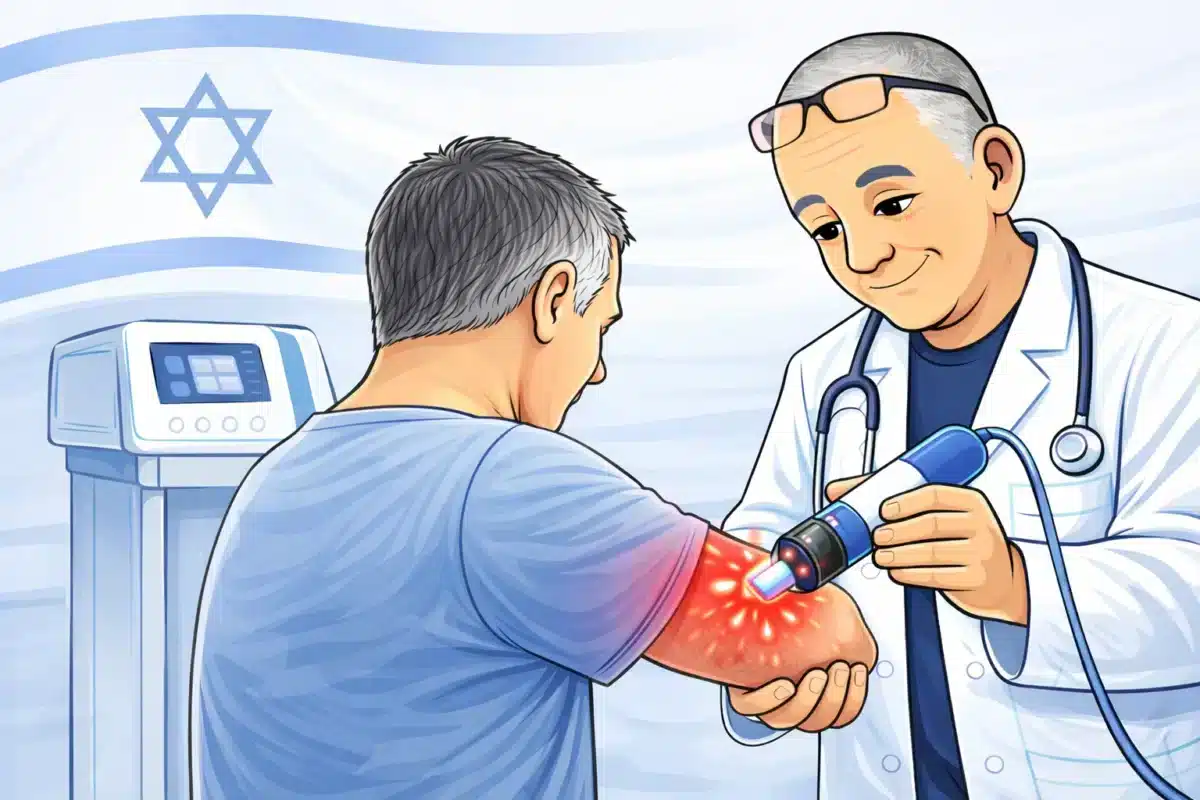
Chronic pain is one of the main reasons people seek medical attention in Israel. Pain in the heel, knee, shoulder, or tendons can last for months or even years, limiting mobility and reducing quality of life. One of the most effective non-drug treatments for such conditions today is shockwave therapy.
In Israel, this method is actively used at the David Sendler Pain Treatment Clinic. Detailed information about the clinic’s approach, treatment directions, and appointment possibilities is available on the official website: https://uvt.nikk.co.il/.
This is where patients can get an initial understanding of the method and therapy possibilities.
Treatment Geography: Where Shockwave Therapy is Conducted in Israel
The David Sendler Pain Treatment Clinic works with patients throughout Israel, providing access to shockwave therapy in different regions of the country. The reception geography is structured so that patients can receive treatment as close to their place of residence as possible, without the need for long trips.
The main region of the clinic’s work is Haifa and the Krayot agglomeration. This area includes Kiryat Ata, Kiryat Bialik, Kiryat Motzkin, Kiryat Yam, and Kiryat Haim. Here, patients with chronic pain in the heel, knee, shoulder, and tendons, who require a regular course of ESWT, are most often treated.
Special attention is given to patients from Nesher and Tirat Carmel. For residents of these cities, treatment is convenient as it does not require long commutes, and the clinic’s work format allows for an individual visit schedule considering the patient’s availability.
The clinic also accepts patients from Acre and Nahariya. In these cities, people often seek help for pain associated with prolonged stress, working on their feet, and the consequences of old injuries. Shockwave therapy in such cases is considered a way to reduce pain and restore mobility without surgery.
Residents of Afula and Yokneam often turn to the clinic with chronic pain syndromes of the musculoskeletal system. For this category of patients, comprehensive treatment is important, where ESWT is combined with recommendations on loads and lifestyle.
In the central regions of Israel, the clinic works with patients from Petah Tikva, Netanya, Hadera, and Kfar Saba. Here, shockwave therapy is often used for prolonged pain that did not yield results with standard medication or physiotherapy.
For patients with limited mobility or severe pain syndrome, a home demonstration of the procedure is possible — by prior arrangement. This format is especially convenient at the stage of initial acquaintance with the method and assessing the body’s reaction to therapy.
Regardless of the city of residence, each patient undergoes an individual assessment of their condition, after which the optimal course of shockwave therapy is selected, taking into account the diagnosis, duration of pain, and overall level of physical activity.
Shockwave Therapy in Israel: What Pains ESWT Treats and How It Works
What is Shockwave Therapy and What is Its Essence
Shockwave therapy (ESWT) is a method of affecting tissues using high-energy acoustic waves. These impulses penetrate deep into the tissues and stimulate natural recovery processes without damaging healthy structures.
A detailed description of the technology, indications, and principles of ESWT devices is presented on the page https://uvt.nikk.co.il/ubt/.
It explains in detail why the shockwave triggers regeneration and reduces chronic inflammation.
A separate material is dedicated to the specific pain syndromes where the method is applied and which areas are treatable.
This information is collected on the page https://uvt.nikk.co.il/gde-udarno/,
where the most common clinical cases are described.
For patients who find it more convenient to receive information in English, a full English version of the site is provided: https://uvt.nikk.co.il/en/.
It is especially useful for new immigrants and foreign patients.
There is also a separate English section that explains in detail where exactly shockwave therapy is applied and in which conditions it is most effective: https://uvt.nikk.co.il/en/where-shockwave/.
Heel Pain and Heel Spur
Heel pain is one of the most common reasons for visiting a pain clinic. Complaints about sharp pain during the first steps in the morning or after prolonged sitting are especially characteristic. Most often, it is about plantar fasciitis or a heel spur.
On the page https://uvt.nikk.co.il/bolit-pjatka/
the causes of heel pain, typical symptoms, and treatment approaches using ESWT are thoroughly analyzed.
The knee joint experiences significant stress daily. Knee pain can be associated with overloads, microtraumas, age-related changes, or the consequences of old injuries.
On the page https://uvt.nikk.co.il/bol-v-kolene/
the main causes of knee pain are thoroughly examined, and it is explained in which cases ESWT can be an effective solution.
The shoulder joint is highly mobile, but for this reason, it often suffers from overloads and inflammatory processes. Chronic shoulder pain can limit movement and interfere with daily activities.
The causes of shoulder pain and treatment options are described on the page https://uvt.nikk.co.il/bolit-plecho/,
where the role of shockwave therapy is separately considered.
The Achilles tendon is one of the most stressed structures of the musculoskeletal system. Chronic pain in this area is often found in people with an active lifestyle.
A detailed analysis of the problem is presented on the page https://uvt.nikk.co.il/bol-v-ahillovom/,
where symptoms and treatment possibilities using ESWT are described.
The David Sendler Pain Treatment Clinic accepts patients in different cities of Israel. Information about treatment in Haifa is available on the page https://uvt.nikk.co.il/klinika-boli-v-hajfe/,
where the reception conditions and therapy possibilities are described.
The clinic pays special attention to protecting patients’ personal data. A detailed privacy policy is published on the page https://uvt.nikk.co.il/privacy-policy/.
Medical and informational materials on the site are published by the clinic’s official team.
Information about the author is available here: https://uvt.nikk.co.il/author/admins56ni9mns4/.
On June 14, 2026, Hamas announced that the day before, on June 13, it had delivered the response of the Palestinian factions to the roadmap for Gaza. The document is related to the implementation of U.S. President Donald Trump’s plan and was prepared by Nikolay Mladenov, the high representative of the Peace Council for Gaza.
Formally, it is about moving to the second stage of the plan: a ceasefire, gradual withdrawal of Israeli troops, the launch of transitional Palestinian governance, and the restoration of the Gaza Strip. But for Israel, the central question remains the same: will Hamas truly be disarmed after October 7, 2023 — or is it again a political formula without real dismantling of the terrorist infrastructure?
Who delivered the response and where was it coordinated
The response was delivered by Hamas on behalf of the Palestinian factions after a series of consultations in Cairo. Representatives of Palestinian groups participated in the negotiations, with Egypt, Qatar, and Turkey acting as mediators.
According to public reports, Nikolay Mladenov’s roadmap became part of an attempt to move the situation in Gaza to the second stage of Trump’s plan. Mladenov himself spoke on this topic at the UN Security Council on May 21, 2026, and by June, the Palestinian factions had formulated a unified response.
What did Hamas write in the response
In Hamas’s statement, it is said that the Palestinian factions approached the roadmap “responsibly and positively.” At the same time, they emphasized that the first stage of Trump’s plan, according to them, is not yet completed.
Among the demands of the Palestinian side are the increase of humanitarian aid supplies to the Gaza Strip, the opening of the Rafah crossing and other checkpoints, the cessation of Israeli military operations, the launch of a recovery program, and the start of work by a Palestinian technocrat committee.
For the Israeli audience, something else is important: in Hamas’s public response, there is no direct agreement to complete disarmament. The organization talks about transitional governance, aid, recovery, and political conditions, but does not pronounce the main formula for Israel — the dismantling of Hamas’s military machine.
NANews — Israel News | Nikk.Agency views this response as an attempt to shift the conversation from security to a humanitarian-political track. But after the massacre on October 7, Israel cannot afford an agreement where the issue of weapons is left “for later.”
Disarmament of Hamas: the point around which everything is stuck
Last week, Arab and international media reported that the disarmament of Hamas and other groups became the main contentious point in the Cairo negotiations. According to Reuters on June 11, 2026, the Palestinian factions agreed on 14 out of 15 points, with the unresolved issue being weapons.
Palestinian sources also reported that Hamas, for the first time since the start of the war in October 2023, allowed the principle of “restricted access to weapons.” But this does not mean complete disarmament. It is about a formula where weapons are supposedly to be controlled by the Palestinian administration or an agreed transitional government.
For Israel, such a construction is too dangerous. If armed structures associated with Hamas, Islamic Jihad, or other groups remain in Gaza, the sector will not become demilitarized. It will simply receive a new sign, and the terrorist infrastructure may partially remain within local security mechanisms.
What conditions does Hamas put forward
Among the conditions that the Palestinian side associates with the issue of weapons are the arrival of sufficient humanitarian aid to Gaza, the opening of Rafah and other checkpoints, the start of the sector’s recovery, the launch of a Palestinian technocratic committee, and the linking of agreements to the timeline for the withdrawal of Israeli troops.
Separately, there is a demand that future agreements do not deprive the Palestinian people of the right to “armed struggle.” For Israel, this effectively means maintaining the ideological justification for terror, even if part of the weapons is formally placed under the control of a future administration.
Another important point is personal firearms. Hamas is trying to make an exception for it, explaining it as “personal protection” and possible licensing by Palestinian authorities. But after October 7, such a scheme cannot be perceived in Israel as a security guarantee.
Israel demands guarantees, the U.S. seeks results
A senior Hamas representative, Taher al-Nunu, stated that controlling access to weapons through the Palestinian administration or an agreed government is supposedly meant to alleviate the concerns of the parties. According to him, no faction will be able to form armed militias, engage in military training, produce weapons, dig tunnels, or smuggle.
But in Israel, such promises are treated with extreme caution. It is too well known how terrorist groups in Gaza have used periods of calm for years to accumulate rockets, build tunnels, and prepare new attacks.
The U.S., judging by the diplomatic logic of Trump’s plan, is interested in a visible result: moving to the second stage, reducing the intensity of the war, restoring Gaza, and creating a manageable political framework. Israel, however, views the situation through a different lens — the security of the country’s south, the return of hostages, the prevention of another October 7, and the elimination of terrorist potential at its borders.
NANews — Israel News | Nikk.Agency notes: the main dispute now is not about the word “disarmament,” but about its content. For Hamas, this may be restriction, licensing, and transferring control to “its” Palestinian structures. For Israel, it is the complete dismantling of military infrastructure, including weapons, tunnels, command networks, production, training, and smuggling.
What does Hamas’s response mean for Israel
Hamas’s response does not close the question of the second stage, but rather shows where the main fault line lies. The Palestinian factions are ready to talk about recovery, governance, and humanitarian mechanisms, but are not ready to publicly and directly renounce armed force as a tool of pressure.
For Israel, this means that any agreement without a strict control mechanism will be perceived as a temporary pause, not a new reality. The recovery of Gaza cannot proceed separately from demilitarization. Otherwise, international money, equipment, building materials, and transitional structures may again become part of a system that once led to the catastrophe of October 7.
Therefore, Hamas’s response to the Peace Council’s roadmap is not a breakthrough. It is a signal of bargaining. Hamas wants to move to the second stage, receive aid, open checkpoints, launch recovery, and maintain political maneuvering around weapons. Israel, on the other hand, will demand not beautiful formulations, but concrete guarantees: who controls Gaza, who holds the weapons, and can a terrorist organization once again turn the sector into a war platform.
Ose Haim – Ticketing Service in Israel, where you can purchase event tickets in English!
Concerts, theater performances, cinema, and educational events – choose and book easily.
Where to Buy Tickets for Concerts and Shows in Israel? Ose Haim Offers Service in English!
Israel is a country where culture unites people of different nationalities. Concerts, theatrical performances, festivals, film screenings, and educational events are available throughout the country. Now, you can easily purchase tickets using the convenient service Ose Haim, which also operates in English.
What is Ose Haim?
Ose Haim is a ticketing service that helps event organizers sell tickets and allows visitors to quickly and easily book their seats.
Main Features of Ose Haim:
✔️ Music Events – concerts of Israeli and international artists.
✔️ Theatrical Performances – shows in Hebrew, Russian, English, and Ukrainian.
✔️ Film Screenings – premieres and retrospectives of popular films.
✔️ Educational Programs – lectures, seminars, and courses.
✔️ Festivals and Cultural Events – large-scale events in various cities of Israel.
Now, all information about upcoming events is available in English, making the ticket booking process even more convenient.
Why Are English-Language Services Important in Israel?
According to Israel’s Ministry of Aliyah and Integration, more than 15,000 immigrants have arrived in Israel since 2022. Additionally, about 14,000 temporary residents from different countries, including Ukraine, actively participate in the country’s cultural life.
The launch of businesses aimed at an English-speaking audience has become a key trend, and Ose Haim is one such service that eliminates language barriers.
“We see a growing demand for cultural events among English-speaking audiences. People need access to information in their native language, and we are happy to provide such a service,” – note the representatives of Ose Haim.
How to Buy Tickets at Ose Haim?
The ticket booking process is extremely simple and takes only a few minutes:
1️⃣ Select an event on the Ose Haim website.
2️⃣ Choose the number of tickets and preferred seats.
3️⃣ Pay online securely.
4️⃣ Receive an e-ticket via email or SMS.
The Ose Haim ticket office is located in Rishon LeZion (Netanya St. 13), but all services are available online, allowing ticket purchases from anywhere in Israel.
NAnews – News of Israel: Supporting Cultural Initiatives
NAnews – News of Israel regularly publishes information about key cultural events in Israel and supports businesses catering to English-speaking audiences.
Cultural events in Israel are not just entertainment but also a crucial way for new immigrants to integrate and communicate. Ose Haim is an example of a business that makes this process more comfortable and accessible.
Conclusion
If you are looking for a **convenient way to buy tickets** for concerts, theater performances, film screenings, or educational events in Israel, Ose Haim offers a service in **English**, making the booking process easy and accessible.
Don’t miss the chance to attend the best cultural events in Israel! Book your tickets with Ose Haim today.
🔹 Address: Rishon LeZion, Netanya St. 13
🔹 Categories: Music | Theater | Cinema | Education
📌 More details and ticket purchases – on the Ose Haim website!
US President Donald Trump will participate in a working session of G7 leaders along with Ukrainian President Volodymyr Zelensky in France. The meeting will take place at the G7 summit in Évian-les-Bains from June 15-17, 2026, and the Ukrainian issue is expected to be one of the central topics at the first working session.
For Israel, this news is important not only as another diplomatic episode of the war in Ukraine. At one summit, two lines of global security will be discussed: support for Ukraine against Russian aggression and the situation in the Middle East, including tensions around the Strait of Hormuz. This is a rare case where the European war and Middle Eastern security are not parallel topics but parts of a single conversation about power, alliances, and the cost of concessions to aggressors.
Why the meeting between Trump and Zelensky is important right now
According to Euractiv, citing a representative of the American administration, Trump will participate in a working session with G7 leaders and Zelensky. Reuters also reports that the summit will take place in Évian, France, where the US, Japan, France, Germany, Italy, Canada, the UK, and EU representatives will discuss key crises in world politics.
The main question is not only whether Trump and Zelensky will be in the same room. More importantly, what position the G7 can formulate on Ukraine: will it be just a diplomatic phrase of support, or a signal that the West is not ready to change Europe’s borders under the pressure of the Russian army.
European leaders, according to publications before the summit, want to achieve a unified message in support of Ukraine. This is especially important against the backdrop of the US under the Trump administration halting bilateral military donations to Ukraine, with the main burden of military and financial assistance falling on Europe.
A separate meeting has not yet been confirmed
In the Ukrainian and international context, it will be closely monitored whether a separate conversation between Trump and Zelensky will take place on the sidelines of the summit. Initial reports allowed for such a possibility, but recent publications clarify: it is definitely about a joint working session, and a formal bilateral meeting between Zelensky and Trump is not yet on the confirmed list.
This is not a minor protocol detail. For Kyiv, a personal conversation with the US president is important as a channel of direct influence on the American position, especially if Washington will promote a negotiation logic with Moscow. For Europe, it is important that any negotiations do not turn into a conversation about Ukraine’s fate without Ukraine and without Europeans.
Europe wants to talk about negotiations, but not about capitulation
The French Élysée Palace, according to Euractiv, outlined one of the key questions of the summit as follows: under what conditions can G7 partners facilitate negotiations between Ukraine and Russia. Special attention should be paid to the parameters of such a dialogue, including the territorial issue.
This is where the main risk appears. The Kremlin has been trying for years to sell the world the idea of ‘peace’ as the consolidation of captured territories. Ukraine, on the contrary, insists that negotiations cannot mean the legalization of Russian aggression. If the G7 wants to maintain its authority, it will have to talk not only about a ceasefire but also about principles: borders cannot be changed with missiles, occupation should not become the norm, and sanctions against Russia cannot be lifted when pressure still needs to be increased.
For the Israeli audience, this sounds familiar. Israel also lives in a reality where terrorist and hostile regimes test the boundaries of what is permissible: with missiles, drones, proxy groups, diplomatic pressure, and information campaigns. Therefore, the Ukrainian issue at the G7 is not a ‘distant European war,’ but part of a broader discussion about whether the aggressor will pay a price or receive a reward for violence.
In this sense, NAnews — Israel News | Nikk.Agency views the summit in Évian as a point where the interests of Ukraine, Europe, the US, and Israel intersect much more strongly than it seems at first glance. If the West weakens its position on Ukraine, it will be noticed not only in Moscow but also in Tehran, Beirut, Gaza, and Sana’a.
Sanctions against Russia remain a test of G7’s seriousness
European leaders, according to preliminary reports, intend to emphasize that now is not the time to lift sanctions on Russia. This is an important signal because sanctions policy remains one of the few tools of long-term pressure that does not require immediate military risk but affects the aggressor’s ability to continue the war.
For Ukraine, sanctions are not a symbol. It is a matter of missile production, access to technology, bypass schemes, banking operations, logistics, and the cost of war for the Russian economy. For Israel, this topic is also not abstract: the same mechanisms for circumventing restrictions are often used by authoritarian regimes and their partners, including players associated with the Iranian axis.
Middle East on the agenda: Hormuz, Arab leaders, and American signal
Ukraine will be important, but not the only topic. The summit will also discuss the situation in the Middle East and security in the Strait of Hormuz. According to Euractiv, leaders of Egypt, Qatar, and the UAE will participate in a working lunch with G7 leaders dedicated to regional security.
For Israel, this is one of the most sensitive blocks of the summit. The Strait of Hormuz is linked to global energy, Iranian influence, maritime security, and the ability of international coalitions to contain Tehran. If the G7 talks about the Middle East separately from Ukraine, the picture will be incomplete. The Iranian axis and Russian aggression exist in different geographies but in one logic: pressure on democratic states, use of proxies, betting on Western fatigue, and testing the boundaries of international reaction.
After the summit, Trump is reportedly set to meet with French President Emmanuel Macron for dinner at the Palace of Versailles on June 17. The Élysée Palace links this gesture to the 250th anniversary of US independence and the history of Franco-American relations, as it was in France that the 1783 treaty was signed, securing the independence of the United States.
What will be the main outcome
The main outcome of Évian will be understood not by photos of Trump and Zelensky, but by the formulations. If the G7 confirms support for Ukraine, the maintenance of sanctions pressure on Russia, and the inadmissibility of negotiations at the expense of Ukrainian territory, it will be a strong signal. If the text of the results is too soft, Moscow will perceive it as a window of opportunity.
For Israel, this language of strength and clarity is important. In a region where threats quickly transition from diplomatic statements to missiles and drone attacks, weak formulations are read by opponents as an invitation to the next step. Therefore, the G7 summit in Évian is not only about Ukraine, Trump, and Zelensky. It is a test of whether the democratic bloc can speak with one voice when both Europe and the Middle East are burning simultaneously.
On the eve of Passover in Jerusalem, one of the most unusual yet most formal ceremonies of the Israeli religious-state calendar took place again. On Tuesday, March 31, 2026, the chief rabbis of Israel formalized the sale of the state’s chametz to Hussein Jabar from Abu Ghosh — the very person who, for many years, becomes, on paper, the owner of the country’s leavened property during the holiday. The official statement emphasizes that this is not only about the state’s chametz as an abstraction, but also about the chametz of ministries, government agencies, and those citizens who have authorized the rabbinate in advance to sell it on their behalf through an online form.
From the outside, this can be taken as a beautiful Israeli tradition with a touch of a joke: a Muslim becomes the “owner of the country’s bread” for a week.
But in reality, this is not folklore, but a working halachic and legal mechanism, without which state institutions, large warehouses, departments, and private owners would find themselves in a much more complicated situation before Passover. That is why this ceremony is conducted not symbolically in a square, but through documents, powers, a deposit, and the formal transfer of rights.
Why does Israel sell chametz before Passover at all
The basic reason is simple, but not always obvious to an outside observer.
The strangest Passover contract: why Israel sells its chametz to an Arab resident of Abu Ghosh every year
According to Jewish law, during Passover, it is forbidden not only to eat chametz but also to keep it in Jewish possession. Moreover, the problem does not disappear if you simply remove the products from sight: rabbinical practice’s specific clarifications directly indicate that chametz that was in Jewish possession during Passover is forbidden even after the holiday ends.
Hence the solution that Israel has brought to a state scale. Chametz is sold to a non-Jew before the prohibition begins, and after Passover, it is usually bought back. For individuals, this could be a home supply, bottles of whiskey, pasta, or flour. For the state, it’s a completely different level: departmental warehouses, supplies in supply systems, food, and other categories of leavened property that cannot simply be massively destroyed without absurdity and direct losses.
Why Hussein Jabar became the buyer again
The story of Hussein Jabar is a separate part of this Israeli construct.
Jabar, a native of Abu Ghosh and a long-time employee of the Ramada Jerusalem hotel, has been performing this role for decades; according to him, it all started in 1995 when the then-chief rabbi Yisrael Meir Lau asked him to take on the purchase of the state’s chametz. Since then, he has regularly become the figure through which the state conducts the Passover sale.
What exactly they sell and what is included in this deal
This is where the confusion usually begins.
They do not sell “Israel as a whole,” not ministerial buildings, and not land as such. They sell exactly chametz — that is, leavened products from five types of grain that fall under the Passover prohibition. Basic clarifications include bread, pastries, dry cereals, pasta, many types of alcohol, and other products made from fermented or leavened grain.
On a state scale, this means not just a box of cookies in some office.
The current official statement refers to the chametz of the state, ministries, government structures, and also the chametz of private individuals who have pre-authorized the rabbinate through the website. In earlier official statements from the Chief Rabbinate, specific objects such as state emergency reserves, police, and prison service were also listed. That is, we are talking about quite real food and warehouse remnants in large volumes.
And another important detail that is often overlooked. They sell not only the “contents of boxes” in the household sense. Classic forms of chametz sale provide that the entire chametz in specified storage locations is included in the deal, even small remnants that no one would buy separately, and to strengthen the legal force of the deal, the buyer is given rights to access the premises where this chametz is located. Traditional formulations refer to the transfer of keys and even temporary rental of the storage premises themselves, so the deal does not look like an empty declaration.
Hence the practical rule that the rabbinate repeats separately: the sold chametz must be placed in a closed and marked place until the end of Passover. This is necessary because after the sale, it should no longer be used by the former owner, even if it physically remains in the same kitchen, the same warehouse, or the same departmental premises.
Otherwise, the whole point of the procedure is blurred.
How the cost of this chametz is calculated and where the “billions” come from
In public retellings, they love the phrase about “chametz worth billions,” sometimes even tens and hundreds of billions. But within the procedure, the assessment is not arranged like a newspaper headline. Official statements from the rabbinate indicated that during the ceremony, the buyer makes a deposit — in recent years, it was about 20,000 shekels — and already after Passover, the cost of the state’s chametz is assessed by three appraisers.
Only after this can a final settlement theoretically be made.
So the figure “billions” is not a random metaphor, but also not always the final account to the last shekel right on the day of the ceremony. Halachic texts, on which the logic of the sale is built, separately explain that the benchmark is the fair market value. If necessary, it is clarified after measuring or weighing the goods.
In one of the classic examples of sale, it is directly stated that the price is actually understood as the value that could be obtained on the local market, and the mechanism itself is equivalent to an assessment by “three people.”
That is why this deal should not be just theater. In the same texts, the buyer is given the right to enter storage places, receive keys, and even resell chametz to other non-Jews during Passover if he wishes. In practice, this almost never happens in the dramatic form that the mass press loves, but the legal logic is important: the sale must be formalized as real, not as a joke, otherwise, it loses both religious and legal force.
This is the Israeli paradox, which from the outside looks almost like a national ritual surrealism. But NAnovosti — News of Israel | Nikk.Agency sees here not exoticism for the sake of a picture, but a point where an ancient prohibition, a modern state, digital services, and live Israeli bureaucracy unexpectedly work together — quite clearly, without unnecessary romance, and with a very specific practical meaning.
Where did this scheme come from and why hasn’t it disappeared
The roots of chametz sale are much older than the State of Israel.
One of the earliest mentions of such a practice is already found in the Tosefta: it describes a case with a Jew who went on a long journey and sold chametz to a non-Jew with the expectation that he could later buy back the remainder. Otherwise, after Passover, he risked being left without supplies.
On a small household level, this could still be solved simply — burn, throw away, eat in advance.
But as people acquired large stocks of grain, alcohol, flour, warehouse remnants, and commercial volumes, the complete destruction of goods began to mean serious economic damage. That is why the mechanism evolved: first as a private solution for merchants and stock owners, then as a standard procedure for communities, and in Israel — already as a formalized state practice.
Hence the answer to the main question that Israelis ask every year, especially those far from religious life: “Why not just throw it all away?” Because in reality, we are talking about a gigantic array of food and goods, partly state-owned, partly private, partly institutional.
The sale allows not to violate the Passover prohibition, not to destroy stocks unnecessarily, and not to turn holiday preparation into economic nonsense. That is why this strange-looking ceremony has such a stable status in Israel — and that is why it made the news again on March 31, 2026.
What is chametz, what exactly is included in it, and why is it treated so strictly on Passover
Chametz is not just “something flour-based,” but a very specific category according to Jewish law.
It refers to products from five types of grains — wheat, barley, rye, oats, and spelt — if they have come into contact with water and have fermented or started to leaven. In modern household examples, this is bread, rolls, cookies, grain-based alcohol (such as “Whiskey”), pasta, dry cereals, pizza, beer, and many other products that contain such grains or their derivatives.
Yes — ordinary vodka often falls into chametz, if it is made from grain: wheat, rye, barley, oats, or spelt. For Passover, this is considered a problem not because of the alcohol itself, but because of the raw material: if the alcohol is made from these grains, it is considered chametz.
But not all vodka is the same. Potato vodka is not chametz by itself, and vodka from corn or rice is not considered chametz, although for Ashkenazim, this may already touch on a separate custom regarding kitniyot. In any case, on Passover, such a bottle is taken only with a clear label Kosher for Passover, because additives, equipment, and the entire production process are also important.
Therefore, when in Israel they talk about selling chametz, it may not only be about a loaf of bread or a pack of spaghetti.
This category also includes larger stocks: flour from these grains, mixes, semi-finished products, warehouse remnants, grain-based alcohol, and industrial products where such components are present. It is important not to confuse chametz with kitniyot: rice, corn, legumes, lentils, and similar products are not considered chametz by themselves, although in Ashkenazi tradition many of them are also not eaten on Passover due to a separate custom, not because they are equated to chametz by the Torah.
In the Torah itself, the prohibition is directly and repeatedly prescribed. In the book of Exodus, it is said that before the holiday, leaven must be removed from homes, and during the seven days, chametz should not be in Jewish possession; it also says that chametz should not “be seen” and “be found” with you. In the book of Deuteronomy, the explanation of the meaning of matzah is added: it is the “bread of affliction,” eaten in memory of the hasty exodus from Egypt when the dough did not have time to rise.
This is where the answer to the question “why” comes from. On Passover, matzah becomes not just a permitted food, but a reminder of the Exodus and the fact that Jews left Egypt in haste. The prohibition of chametz is therefore connected not only with the kitchen but also with the memory of the event itself: Passover is arranged so that a person not only reads about liberation but literally experiences it through what is in their home and on their table.
Later halachic tradition has detailed what exactly to do with chametz before the holiday. Already the Mishnah in the tractate Pesachim begins the discussion with checking the house for chametz on the eve of the 14th of Nisan.
Then the Talmud develops these rules, Rambam in “Mishneh Torah” formulates the obligation to remove chametz before the prohibition moment, and the “Shulchan Aruch” establishes the practical order of checking and removing chametz from places where it can usually be found. So this is not only a biblical commandment but also a long, very specific legal tradition.
In practice, four main actions have grown out of this, familiar to religious and traditional Israel: chametz is searched for, removed, destroyed, or taken out of Jewish possession through sale to a non-Jew. That is why the state sale of chametz in Israel looks unusual only from the outside. Within Jewish legal logic, it is a continuation of an old norm: if chametz cannot be kept during Passover, it must either be destroyed or truly transferred to another owner.