New York primaries showed a worrying signal for Israel

On June 23, 2026, the Democratic primaries concluded in New York, and their outcome proved more significant than the usual intra-party struggle.

This is no longer just a story about local districts, New York activists, and the fight for seats in the U.S. Congress.

For Israel, these elections signaled how quickly attitudes toward the Jewish state are changing within the American Democratic Party — especially in its urban, young, and left-wing factions.

New York Mayor Zohran Mamdani, one of the most prominent representatives of the progressive camp, supported three candidates for the U.S. House of Representatives: Darializa Avila Chevalier, Brad Lander, and Claire Valdez.

All three won.

According to the Associated Press, Mamdani’s list effectively achieved a “clean sweep” in the New York primaries: his candidates won their races and ousted two incumbent congressmen.

For American politics, this means strengthening the left wing of the Democrats.

For Israel, it means the emergence of a new generation of politicians who increasingly view U.S.-Israel relations through the lens of pressure, sanctions, aid reduction, and accusations against Jerusalem.

Mamdani’s three victories: who won and why it matters

The most notable victory was the race in New York’s 13th district, NY-13.

There, Darializa Avila Chevalier defeated incumbent Congressman Adriano Espaillat — an influential Democrat who held strong positions in the party structure and chaired the Congressional Hispanic Caucus.

NY-13 covers Harlem, Upper Manhattan, and part of the Bronx. It is a district with a large Latino, African American, and immigrant audience. Avila Chevalier’s victory was not just a personal success for the candidate but a blow to the old Democratic establishment of New York.

The second key result was Brad Lander’s victory in New York’s 10th district, NY-10.

Lander defeated incumbent Congressman Dan Goldman, who was considered one of the prominent pro-Israel Democrats. Goldman represented Lower Manhattan and part of Brooklyn — areas where the issue of Israel, Jewish security, and anti-Semitism has not symbolic but direct political significance.

The third victory was Claire Valdez in New York’s 7th district, NY-7, which includes parts of Queens and Brooklyn. She defeated Antonio Reynoso, the Brooklyn Borough President, and became another example of how candidates connected to left-wing activist networks are surpassing more traditional representatives of the party system.

The Guardian also notes: all three candidates supported by Mamdani won, strengthening his status as one of the leading figures of the left wing of the Democrats in New York.

Israel became one of the lines of division

At first glance, these were local primaries.

But in reality, the issue of Israel ran through these races as one of the main lines of conflict.

Zohran Mamdani has long been known for his harsh criticism of Israel and the pro-Israel lobby in the U.S. In June 2026, he publicly defended his statement in which he called AIPAC “monsters.” Al Jazeera reported that Mamdani explained this wording as criticism of AIPAC’s role in American politics and in supporting Israel.

AIPAC — American Israel Public Affairs Committee — has been one of the key organizations influencing support for Israel in Washington for decades.

When the mayor of the largest city in the U.S. uses such rhetoric against AIPAC, it is no longer a marginal campus dispute.

It is part of a major political shift.

The case of Darializa Avila Chevalier is particularly indicative.

City & State NY wrote that she participated in a pro-Palestinian rally on October 8, 2023 — the day after the Hamas attack on Israel on October 7. This was a date when Israel was still burying the dead, searching for the kidnapped, and trying to understand the scale of the massacre.

Times of Israel also reported that Avila Chevalier later defended her participation in this rally, explaining it as her long-standing support for Palestinian rights.

For the Israeli audience, the timing is important, not just the fact of the rally.

October 8, 2023, was not yet a time of a long war in Gaza, international campaigns, student camps, and months-long political mobilization against Israel.

It was the day after the largest massacre of Jews since the Holocaust.

And the candidate who later won the primaries in New York was part of a political wave supported by the city’s mayor.

NAnews — Israel News notes: such details show that this is not just about “criticism of Netanyahu’s government” or a debate about humanitarian policy. In part of the American left camp, the framework of the conversation about Israel, its security, and its right to self-defense is changing.

Brad Lander: a Jewish candidate against aid to Israel

Brad Lander deserves special attention.

He is Jewish, has been a prominent figure in New York’s progressive politics for many years, and previously held the position of New York City Comptroller.

But in the race against Dan Goldman, the issue of Israel became one of the main differences between the candidates.

Forward wrote in April 2026 that Lander opposed further funding for Israel’s Iron Dome — a system that protects Israeli citizens from rocket attacks.

This is a principled point.

The “Iron Dome” is not an offensive weapon.

It is a system that saves lives in Sderot, Ashkelon, Tel Aviv, Jerusalem, Haifa, and other cities in Israel.

When an American politician talks about stopping funding for such a system, for Israelis it does not sound like an abstract budget discussion.

It is a question of whether Washington will continue to help Israel protect its citizens from rockets.

Dan Goldman, whom Lander defeated, was considered a more traditional pro-Israel Democrat. Therefore, his defeat in NY-10 became symbolic: even in Jewish New York politics, the line of support for Israel no longer guarantees victory in Democratic primaries.

Where the left wave stopped: NY-12

At the same time, New York showed not only a left turn but also its boundaries.

In the 12th district, NY-12, Micah Lasher — a Jewish centrist and more moderate candidate — won.

This district is particularly important: NY-12 is considered the district with the largest share of Jewish voters among U.S. House districts. Times of Israel called Lasher a Jewish centrist and reported on his victory in the primaries for the seat vacated by Jerry Nadler.

It is here that Mamdani did not bet on his candidate.

This is an important detail.

Where the Jewish community has particularly significant political weight, a moderate and more pro-Israel line was able to hold.

But in other districts — NY-7, NY-10, and NY-13 — candidates associated with the left wave, criticism of Israel, and an anti-establishment agenda won.

Therefore, the conclusion should not be simplified.

It cannot be said that “all New York Democrats have become anti-Israel.”

But it can be said otherwise: in New York, there is already a political model where harsh criticism of Israel does not prevent winning, and in some districts even helps mobilize the active part of the Democratic electorate.

Why this matters for Israel

Israel is used to looking at Washington through the White House, the Senate, the Pentagon, and traditional support groups.

But future U.S. policy is formed not only in the administration’s offices.

It is formed in the primaries.

In the districts.

In urban party organizations.

In the university environment.

In activist networks that first bring candidates to the city council or state assembly, and then to Congress.

Today, these candidates are coming from New York.

In a few years, they may be voting on military aid packages, sanctions resolutions, missile defense funding, investigations against Israel, and pressure on the American administration.

NAnews — Israel News emphasizes: for Jerusalem, this is not a local New York news, but an early indicator of the Democratic Party Israel may have to deal with in the future.

Polls show: it’s not just New York

The political shift is also confirmed by public sentiment.

A Quinnipiac University poll published on June 24, 2026, showed that 48% of registered U.S. voters believe that America “supports Israel too much.” Another 38% consider the level of support appropriate, and only 7% say that the U.S. supports Israel insufficiently. Quinnipiac separately noted that this is the highest percentage of the response “the U.S. supports Israel too much” since 2017, when the university first began asking this question.

For Israel, this is an alarming figure.

Almost half of American voters already perceive American support for Israel as excessive.

This does not mean an automatic break in the alliance.

But it means that any future U.S. administration will take into account the growing pressure within American society.

Especially if this pressure comes from young voters, the left wing of the Democrats, the university environment, and urban districts where primaries often effectively decide the outcome of elections.

Main conclusion

The New York primaries on June 23, 2026, served as a warning.

Zohran Mamdani demonstrated that his political machine is capable of translating a left-wing, anti-establishment, and sharply critical of Israel agenda into real victories.

Darializa Avila Chevalier won in NY-13 after the scandal surrounding her participation in the rally on October 8, 2023.

Brad Lander defeated Dan Goldman in NY-10, despite his position against further funding for the “Iron Dome.”

Claire Valdez won in NY-7 as part of the same progressive wave.

Micah Lasher maintained a more moderate line in NY-12 — but precisely in a district with a particularly strong Jewish electorate.

The picture becomes clear: in the U.S. Democratic Party, the struggle around Israel is no longer a secondary issue.

It is becoming a marker of political identity.

And if Israel wants to understand what Washington might look like in a few years, it needs to pay close attention not only to the White House.

It needs to look at New York.

Нужно смотреть на Нью-Йорк.
Israel prepares for traffic jam: where it’s better not to go today due to the Haredim protest

Today, Wednesday, June 24, 2026, a large-scale protest by the Haredim is expected in Israel, which may significantly affect traffic in several areas of the country. According to preliminary data, about 2,000 vehicles are expected to depart from 19 different points and move in organized columns towards the Beit Lid area, near Kfar Yona.

The main reason for the protest is the detention of Haredim who evade military service. In recent weeks, similar actions have already taken place near prison No. 10, but the current situation differs in the composition of participants. Previously, the more radical ‘Jerusalem flank’ was at the forefront, but now large Hasidic communities, considered more numerous and moderate, are joining the protest.

This means two things simultaneously. On one hand, there may be significantly more participants. On the other hand, the organizers state that they do not plan widespread roadblocks or violent actions.

Where the columns are departing from

According to the plan, the columns will start moving around 16:00. Cars are expected to depart from about 19 points across the country: from Safed and Haifa in the north, through Bnei Brak, Jerusalem, and Modi’in Illit, to Kiryat Gat and Arad in the south.

The organizers claim that the movement is coordinated with the police. Each column should travel in the right lane at a constant speed of about 50 km/h. Participants were also reminded that stopping on the highway and intentionally blocking traffic could lead to fines from the police.

Where to expect traffic jams and which roads to avoid

Although the final routes are still being coordinated with the police, the general direction is clear: all columns will move towards the Kfar Yona area. Therefore, major traffic jams are expected not in one city, but on several key highways in Israel.

Special attention should be paid to Highway No. 1 near the Ben Gurion interchange, Highway No. 4 in the Geha, Ganot, Aluf Sade, and Em HaMoshavot areas, as well as Highway No. 6 near the Ben Shemen, Kesem, and Nahshonim interchanges. Additionally, congestion is possible on Ayalon, Highway No. 20, Highway No. 40, and Highway No. 440.

The most difficult situation is expected closer to the evening. From approximately 18:00 to 19:00, the main flow may shift to Highway No. 57 and the Netanya-Kfar Yona interchange area.

For the Israeli audience, this topic is important not only as news about the protest but also as a practical issue: how to get home today without getting stuck on the highway and avoiding the conflict zone between demonstrators, police, and local residents. This is why such materials are important to read in the context of real life in the country, where NAnews — Israel News | Nikk.Agency pays attention not only to the political background but also to the consequences for ordinary people.

When it’s better not to travel

The most problematic period is from 16:00 to 20:00. During this time, it is better not to plan trips on central highways if possible, especially if the route passes through Gush Dan, the Ben Shemen area, Kesem, Netanya, or Kfar Yona.

In the morning and late evening, according to preliminary estimates, no serious unusual traffic jams are expected. The exception is the Kfar Yona area and its approaches, where tension may persist longer.

The Israel Police recommend postponing all non-essential trips in areas where the protest will take place. This is especially relevant for those who need to travel from the center of the country to the north or vice versa.

Is there an alternative and what could go wrong

The most obvious alternative today is the train. No blockages are expected on ‘Rakevet Israel’, and the railway is expected to operate as usual, without special reinforcements.

But there is also a nuance here. Many drivers may choose to forgo their cars in advance, so increased load is possible at railway stations and on the trains themselves. Those who choose the train should allow extra time for the journey to the station and boarding.

Main risks of the evening

Organizers describe the protest as an action of ‘order, responsibility, and sanctification of the name’. However, with such a number of people and vehicles, it is impossible to completely rule out disruptions.

Problems may arise if individual columns start moving slower than the agreed speed, if someone decides to stop on the highway, or if clashes occur with local residents and police. Organizers have already warned: if one of the columns is hindered, roadblocks may be the response.

There is also a separate point of tension — Kfar Yona. After the city was effectively isolated last week due to the protest, local residents do not intend to silently wait for events to unfold again. The mayor has already announced plans to block entry to the city and prevent the car action from entering.

Because of this, the police, according to the current position, require that the protesters do not reach prison No. 10 directly and remain outside the city. This section may become the main source of unpredictability.

The bottom line is simple: from 16:00 to 20:00, serious traffic jams are possible on central highways in Israel, and in the evening, the main risk will shift to the Kfar Yona area. Those who do not need to travel should postpone their trip. Those who must be on the road should check the route in advance, avoid major interchanges, and consider the train as a calmer alternative.

Russian propaganda urged to learn from Iran amid fuel problems in the Russian Federation

The Russian propaganda TV channel ‘Tsargrad’, amid fuel problems in the Russian Federation, called for learning from Iran how to provide the population with gasoline even during wartime.

At first glance, the thesis seems simple: fuel prices are rising in Russia, reports of ‘dry’ gas stations and sales restrictions are appearing, while in Iran gasoline is allegedly the cheapest in the world due to strict state control, limits, and subsidies.

But if you look at the dates, figures, and military context, the comparison becomes much less favorable for Moscow. The Iranian model is not based on an economic miracle, but on forced regulation, huge subsidies, limits, combating smuggling, and social fear of a new fuel explosion within the country.

Most importantly, Russia is facing not just a market problem. The Ukrainian army is methodically attacking precisely the oil refining, oil depots, logistics, and energy infrastructure, that is, the nodes without which no administrative prices turn into real gasoline at gas stations.

What ‘Tsargrad’ wrote

The ‘Tsargrad’ article was published on June 22, 2026, under a characteristic headline about the ‘gasoline fig’, empty gas stations in Russia, and gasoline in Iran ‘for 2 rubles per liter’.

The text claims that the shutdown of the Moscow Oil Refinery should not be a reason for price increases but should be a signal to the state. The authors explicitly state that during wartime, fuel prices should be frozen because gasoline, diesel, and gas are embedded in the cost of almost all goods — from essentials to medicines.

According to ‘Tsargrad’, there are already enough ‘dry’ gas stations in Russia: somewhere there is no AI-92, somewhere there is no AI-95, and at some gas stations, a liter of high-octane gasoline can cost up to 100 rubles.

Separately, the TV channel refers to the period from June 9 to 15: during this week, as stated in the article, gasoline prices rose in 78 regions of Russia. Among the leaders are Tuva with a growth of 9.4% and Chechnya with a growth of 8%. It is also mentioned that sales restrictions were introduced in more than 50 regions.

After this, ‘Tsargrad’ draws the main propaganda thesis: if in Iran gasoline costs about 2.5 rubles per liter, then Russia should also follow the path of strict price limits, quotas, and direct state intervention.

How the Iranian scheme actually works

Iran has indeed kept gasoline at an artificially low price for decades. But the low price at the pump is not proof of economic stability. It is the result of subsidies, a card system, limits, and a political decision to hold back social discontent.

In December 2025, an updated three-tier system was introduced in Iran. Ordinary drivers can buy up to 60 liters of gasoline per month at 15,000 rials per liter. Another 100 liters are available at 30,000 rials per liter. After the 160-liter mark, an increased rate of 50,000 rials per liter applies.

It is these 160 liters that became the basis for the Russian propaganda comparison. ‘Tsargrad’ claims that about 80% of Iranian drivers fit into the basic monthly quota. But in such a presentation, the main thing is lost: the Iranian system was created not because there are no fuel problems in the country, but because the problems are too sensitive for the authorities.

Iran is an oil country, but the domestic fuel market there has long been associated with several painful factors: high consumption, an outdated vehicle fleet, gasoline smuggling to neighboring countries, budget strain, and fear of protests. In 2019, the rise in fuel prices was one of the reasons for mass protests, which were harshly suppressed.

Therefore, cheap gasoline in Iran is not a free market and not a ‘management victory’. It is a political insurance of the regime.

Why the Iranian example does not work for Russia

The main problem with the Russian comparison is that Moscow is trying to present the fuel crisis as a matter of prices and speculation. But in 2026, it’s not just about prices anymore.

Ukraine is delivering long-range strikes on Russian oil infrastructure precisely because oil and petroleum products remain one of the key sources of war funding. Strikes on refineries, oil depots, pipeline nodes, and logistics hit not the ‘abstract economy’, but Russia’s ability to process raw materials, supply the army, maintain the domestic market, and simultaneously earn from exports.

In June 2026, reports emerged of new strikes on facilities in Crimea, including an oil storage facility near the Kerch TPP and infrastructure related to the supply of the occupied peninsula. Russian occupation authorities in Crimea imposed restrictions, including a ban on fuel sales to non-state users. This is no longer ordinary market volatility, but military pressure on the supply system.

Russian authorities also discussed the possibility of additional restrictions on diesel fuel exports to protect the domestic market. This is an important detail: if an oil power is forced to limit fuel exports, then the problem already goes beyond the propaganda explanation about ‘speculators’ and the ‘buckwheat effect’.

The Iranian experience shows not strength, but the vulnerability of an oil country

For the Russian audience, ‘Tsargrad’ tries to make Iran an example of resilience. But for Israel, Ukraine, and the entire region, this example is read differently.

Iran can keep cheap gasoline as long as it maintains control over production, distribution, and internal limits. But as soon as the oil infrastructure becomes a military target, the picture changes.

On the night of March 7-8, 2026, Israeli strikes hit fuel depots and oil refining facilities in the Tehran area and the neighboring Alborz province. Massive fires broke out, toxic emissions rose into the air, and authorities warned residents of health risks.

This is an important clarification to the widespread thesis that Iranian oil infrastructure was not hit at all. It was. But the difference is in another: against Iran, such strikes did not look like a prolonged, systematic campaign to completely disable all oil refining and internal fuel logistics.

In the case of Russia, the Ukrainian strategy looks precisely like methodical pressure. The goal is not a one-time fire, but constant vulnerability: so that each new strike forces Moscow to choose between the front, exports, the domestic market, and social stability.

Why this is important for Israel

For Israel, this story is important not only as a Russian internal problem. Here, three directions intersect: the Russian war against Ukraine, the Iranian model of a military economy, and Middle East security.

Iran has long become not just an ‘example’ in propaganda texts for Russia. Tehran helps Moscow with military technologies, drones, experience in circumventing sanctions, and the logic of a besieged fortress economy. Therefore, when a Russian propaganda channel calls for learning from Iran, it is not a random economic remark. It is a recognition of the political kinship of the two regimes.

Both regimes try to explain to citizens that war requires patience, control, restrictions, and submission. Both talk about an external enemy. Both want to maintain the military machine, even if it means suppressing the domestic market and lowering the quality of life for the population.

But there is a difference. Iran has lived in a sanctions model for decades and is used to distributing shortages. Russia has long sold its citizens the image of an ‘energy superpower’ that cannot have fuel problems. Now this picture is beginning to crack.

NAnews — Israel News considers it important to view such signals not as separate economic news, but as signs of a change in the entire war. When Russia’s oil infrastructure becomes a weak point, it affects not only prices within the Russian Federation but also Moscow’s ability to continue aggression against Ukraine.

Conclusions

‘Tsargrad’ wanted to show Iran as an example for Russia, but in fact showed something else: even an oil country during war can come to limits, card logic, manual price management, and fear of social irritation.

Russian propaganda talks about 2.5 rubles per liter in Iran but does not talk about the cost of this system for society. It talks about a quota of 160 liters but does not say that quotas appear not from abundance, but from the need to control shortages and consumption.

It proposes freezing prices in Russia but cannot answer the main question: what to do if refineries, oil depots, bridges, energy facilities, and logistics are under attack?

That is why the Iranian example for Russia is not saving, but alarming. It shows where a state is heading that tries to wage a long war, keep the population with cheap promises, and simultaneously hide the real cost of aggression.

For Ukraine, strikes on Russia’s oil infrastructure have become one of the ways to bring the war back to where it started. For Israel, it is a reminder: the Russian-Iranian connection is not only military but also political. It is about regimes learning from each other not development, but survival under the pressure of war, sanctions, and their own aggressive policies.

NAnews — Israel News will continue to monitor how Russian propaganda explains the internal consequences of the war and why Moscow increasingly looks to Iran not as an exception, but as a model for the future.

“We ask you for salvation”: May 16 – 3 years since the appeal of a Jewish Azov fighter to the Israeli government: “On the ruins of the Azovstal plant, there are Jews like you and me”

The defense of Azovstal lasted from March 18 to May 16, 2022, on the territory of the Mariupol Metallurgical Plant “Azovstal”. It took place as part of the battle for Mariupol during the Russian invasion of Ukraine. Russian forces besieged the plant for a long time, and on May 16, 2022, the Ukrainian garrison surrendered by order of the country’s top leadership.

In March and April, the world learned about the civilians and soldiers trapped at Azovstal. While the evacuation of Mariupol civilians was successful, Ukraine was unable to liberate the military by force, and Russia refused any proposals except surrender. The soldiers had no choice but to continue fighting and hold their positions until the end.

The defenders of Mariupol held back 20,000 Russian troops, destroyed around 6,000 of them, approximately 78 tanks, and more than 100 armored vehicles. They helped the Ukrainian Armed Forces better prepare the defense of Donbas by delaying significant Russian forces for nearly three months.

As of early May, there were no civilians left at Azovstal.

On the evening of May 16, the commander of the Azov Regiment, Denys Prokopenko, delivered a statement:

“The defenders of Mariupol fulfilled their order. Despite all the difficulties, for 82 days they held back superior enemy forces and gave the Ukrainian army time to regroup, train more personnel, and receive a large amount of weapons from partner countries.”

A few days earlier, one of the defenders of Mariupol, Azov fighter Vitalii Barabash, recorded a video message on behalf of the Ukrainian Jews at Azovstal, appealing to the Israeli government for help in evacuating all remaining service members from the plant.

Barabash was seriously wounded and suffered a concussion. Another soldier helped him read the appeal on behalf of all Ukrainian Jews at Azovstal.

Full text of the appeal:

“I am Vitalii Oleksandrovych Barabash, call sign Benya. It is hard for me to speak due to serious injuries, concussions, and illnesses, so my brothers in arms will speak for me and on behalf of all Ukrainian Jews here at Azovstal.

Everyone needs a peaceful sky above.

I begin this appeal to Prime Minister Naftali Bennett, the Knesset, the people of Israel, journalists, the ‘Bein Stern Shulman’ synagogue in Kryvyi Rih, and Rabbi Liron Ederi.

I hope our plea will also reach Yuli Edelstein, Yulia Malinovska, Yevgeny Sova, and Alex Kushnir.

Here, in Ukrainian Mariupol, on the ruins of the Azovstal plant, are Jews just like me and you. We all remember how our Ukrainian ancestors suffered from Stalin’s genocide, and how our Jewish ancestors suffered from Hitler.

Today, we face a new threat — in the form of putin — who unites and revives the actions of those two tyrants of the past.

I speak on behalf of all Jews at besieged Azovstal. I am wounded, which is why I can record this video. The rest of my comrades are on the battlefield, defending every inch of land the Ukrainian people have always shared with our ancestors.

For the third consecutive month, Russians have been destroying everything connected to our shared roots and our history. Our peoples have endured terrible tragedies in the past, but today we must fight for our land and our country. Ukraine has never turned its back on Jews, and we believe that Israel will not turn its back on Ukrainians but will stand with us against the Russian occupiers who have brought a new tragedy to our land.

We need help from Israel to extract the Mariupol military garrison. We are asking you to save us.

You, more than anyone, have the power to do this. We, more than anyone, place our hopes in you. We are waiting for you. We are already writing history.”

At the time, Bennett asked putin “to consider various options for evacuation from the Azovstal plant in Mariupol.”

“President putin promised to allow the evacuation of civilians, including the wounded, through UN and Red Cross humanitarian corridors,” said Bennett’s office.

On that day, May 16, 2022, the withdrawal of Ukrainian defenders began from the underground shelters of Azovstal. Those who had endured hell during the defense of Ukraine’s last stronghold in destroyed Mariupol were ordered to lay down their arms to save lives.

The heroic defense of Mariupol and Azovstal lasted 86 days. The defenders, including Azov Regiment fighters, sacrificed themselves to hold back large Russian forces and delay their advance in southern Ukraine during the most difficult stage of the full-scale war. And they succeeded in that mission.

Hundreds of Azovstal defenders, including Azov fighters, are still held in Russian prison camps, subjected to inhumane torture.

More stories about the defenders of Azovstal:

Ukraine: In Uman, an Azov fighter with the call sign “Ravvin” embraces his Jewish pilgrim friend during Rosh Hashanah 5784

Azov Regiment delegation visits Israel: “Mariupol is our Masada”

From the Holocaust to Russian Bombings: The story of Elvira Borts and her grandson — an Azovstal defender — how a Jewish family in Mariupol survived two genocides + video

“Here, in Ukrainian Mariupol, on the ruins of the Azovstal plant, there are Jews just like you and me” — Azov fighters of Jewish descent appeal to the Israeli government

40 “Jewish heroes” are fighting at Mariupol’s Azovstal — says Davyd Arakhamia

NAnews — Israel — Ukraine believes:

  • The defense of Azovstal became a symbol of resilience and self-sacrifice that changed the course of the war.
  • The appeal of Jewish fighters to Israel was a historic cry for help that should not have been ignored.
  • Israel must acknowledge the role of Jews in Ukraine’s defense and push for the release of prisoners.
  • Silence in response to such pleas is a denial of historical memory.
  • We must remember: among the heroes of Mariupol were Jews. And they believed in Israel.

Screening of ‘The Price of Truth’ in Tel Aviv: the memory of the Holodomor that cannot be silenced

In Tel Aviv, a screening of the film “Ціна правди” / Mr. Jones took place — a historical drama by director Agnieszka Holland about the Welsh journalist Gareth Jones, one of the first Western reporters who in 1933 tried to tell the world the truth about the Holodomor in Ukraine. The screening was organized by the Embassy of Poland in Tel Aviv in cooperation with the Embassy of Ukraine in the State of Israel, reported Israeli Friends of Ukraine on June 24, 2026.

Why this film is important today

“Ціна правди” is not just a film about the past. It is a story about how truth can become dangerous when it is opposed by the state machine, diplomatic pressure, censorship, and fear.

The screenplay was written by American journalist of Ukrainian descent Andrea Chalupa, and directed by Agnieszka Holland. At the center of the plot is Gareth Jones, a journalist from Wales who in the early 1930s went to the Soviet Union and saw what the Soviet authorities tried to hide: mass famine, destroyed Ukrainian villages, death, silence, and the forced destruction of millions of people.

For the Israeli audience, this topic resonates particularly sharply. Israel understands well that historical memory is not an archival formality, but a part of national security, social resilience, and the people’s right to their own voice. When crimes are silenced, they do not disappear. They return in new forms — through propaganda, denial, cynicism, and attempts to rewrite history.

Gareth Jones and the price of testimony

A journalist who went against convenient lies

In 1933, Gareth Jones became one of those who dared to speak about the famine in Ukraine under his own name. His testimonies were especially important because they were not about rumors or political declarations, but about personal reporting experience: he saw the famine with his own eyes and tried to convey this truth to the Western press.

The Holodomor of 1932–1933 is considered an artificially created famine that claimed millions of lives in Ukraine. Britannica describes it as a man-made famine in Soviet Ukraine, and research and educational materials on the Holodomor emphasize that it was one of the greatest tragedies of the 20th century.

Holland’s film shows not only the tragedy itself but also the mechanism of its concealment. The world could have learned more and earlier, but the truth faced convenient political calculations, career interests, and the desire not to irritate Moscow. In this sense, “Ціна правди” speaks not only about Ukraine in the 1930s but about any era where journalism becomes a struggle for the right to call a crime a crime.

That is why such cultural events in Israel are significant not only for the Ukrainian community. They are important for everyone who understands: memory of the past is a way to recognize lies in the present. In this context, НАновости — News of Israel | Nikk.Agency views such initiatives as part of a broader connection between Israel, Ukraine, and those communities for whom truth, testimony, and historical responsibility remain not abstract words, but personal experience.

Tel Aviv as a place for conversation about memory

Ukrainian history in the Israeli space

The screening of the film in Tel Aviv was a gesture of solidarity and memory. The participation of Polish and Ukrainian diplomatic missions emphasizes that the conversation about the Holodomor has long gone beyond just Ukrainian history. It is a European, Jewish, Israeli, and international topic — about totalitarianism, silence in the face of crime, and the price of indifference.

Today, as Ukraine once again defends its right to freedom and existence, the story of Gareth Jones sounds particularly contemporary. It poses a question that concerns every society: what to do when the truth is inconvenient, but silence becomes complicity?

The film “Ціна правди” reminds us that dignity begins with the refusal to close our eyes.

Gareth Jones could not stop the tragedy, but his testimony became part of the historical memory that the Soviet system tried to destroy. And decades later, this memory continues to speak — in Kyiv, Warsaw, London, Tel Aviv, and in every place where people are ready to listen not to propaganda, but to the truth.

For Israel, such events are also important because people with different family memories live here: from Ukraine, Poland, the countries of the former USSR, Europe, and the Middle East. When a film about the Holodomor is shown in Tel Aviv, it is not just a Ukrainian evening. It is a conversation about how society maintains a human face in the face of evil, which always first demands silence.


Uri Geller, Trump, and ‘low-frequency weapons’: how a strange version made it into Israeli news

In Israel, from June 18–21, 2026, an unusual story at the intersection of politics, war, television, and conspiracy theories gained widespread attention. At the center was Uri Geller — an Israeli illusionist and mentalist, known for many years for his claims of supernatural abilities, telepathy, and work with intelligence agencies.

This time, Geller linked the behavior of US President Donald Trump with Iran and claimed that the sharp changes in the American leader’s position could be the result of exposure to “low-frequency electromagnetic waves.”

The main thing here is accuracy. This is not an official statement from the Israeli government and not confirmed information from intelligence services. This is Uri Geller’s public version, voiced in the Israeli media space and then published by Channel 14 as a broadcast story.

What happened on June 18, 2026

On June 18, 2026, Israeli TV host Sharon Gal posted a video on Instagram with a caption in Hebrew: “אורי גלר במסר חד לנשיא טראמפ” — “Uri Geller with a sharp message to President Trump.” In this video, Geller addressed Trump and discussed his position on Iran.

The context was a sharp debate in Israel around the American line on Iran. In June 2026, the international press discussed US-Iran negotiations, a memorandum of understanding, and the controversy over how Washington tries to present the agreement: as a strategic victory for the US or as a concession to Tehran. The Soufan Center wrote on June 15, 2026, that the US and Iran are competing to shape the public perception of the agreement, with sanctions, assets, and the Strait of Hormuz remaining key issues.

For Israel, this was not abstract diplomacy. Any rapprochement between Washington and Tehran is directly perceived through the lens of security, the Iranian nuclear program, missile threats, Hezbollah, and Israel’s future freedom of action.

What was written on June 19, 2026

On June 19, 2026, the Israeli site “בחדרי חרדים” published an article with the headline: “נשמע הזוי לגמרי” — “Sounds completely insane.” The author of the article, Hani Levin, noted the publication time: 19.06.26.

The article stated that Uri Geller, in an interview with Sharon Gal on חדשות 24, offered a conspiratorial explanation for Trump’s behavior. According to Geller, the change in the US president’s position was not accidental and could be related to ELF — Extremely Low Frequency technology, meaning the impact of extremely low frequencies.

Geller claimed that with such technology, it is possible to “bombard the brains of leaders with low frequencies.” He also stated that he knows about this because, in the past, according to him, the American intelligence agency CIA asked him to perform various tasks. Host Sharon Gal reacted skeptically and said it “sounds completely insane.”

In the same retelling, it was noted that Geller suggested Trump might have been subjected to such exposure during visits to China or in Washington. After Sharon Gal’s question about whether the situation could be “reversed” with another signal, Geller stated that he is personally trying to act in this direction.

What Channel 14 published on June 21, 2026

On June 21, 2026, Channel 14 / C14 posted an article under the headline: “אורי גלר טוען: זה מה שקרה לנשיא — ‘הוא לא טראמפ האמיתי’”, which can be translated as: “Uri Geller claims: this is what happened to the president — ‘he is not the real Trump’.” The publication date on the C14 page is indicated as 21.06.26.

The C14 publication directly stated that Geller, on the program “ישראל הבוקר” with Tal Meir, put forward an “unusual theory” about changes in Donald Trump’s positions. According to Geller, hostile elements are using technology based on very low-frequency electromagnetic waves, which allegedly can influence the functioning of the human brain, behavior, and decision-making.

Channel 14 also cited Geller’s claim about the E-1000 technology. He stated that countries like Russia, North Korea, and Iran possess it. According to him, Trump could have been affected by such “emissions” during foreign visits or even through weapons operating from embassies.

Separately, Geller recalled a story from the past where he allegedly helped the US convince Russian representative Yulia Vorontsova to sign a nuclear disarmament agreement using a combination of telepathy and ELF weapons. This was also retold in the C14 material.

Why this story became notable

This story is important not because Geller’s version is proven. There is no evidence in the published materials that Iran is affecting Trump’s brain with low-frequency weapons.

It is important for another reason.

By June 18–21, 2026, part of the Israeli right-wing media space was clearly looking for an explanation as to why Trump, whom many in Israel considered the toughest ally on the Iran issue, began acting not as his supporters expected. When the behavior of the American president no longer fits into the usual political picture, not only analysis and criticism emerge, but also versions on the verge of fantasy.

That is why Sharon Gal’s phrase “sounds completely insane” became almost key in this story. The host did not present Geller’s words as a proven fact. He directly expressed doubt. But the very fact of such a conversation appearing in the Israeli broadcast shows the level of nervousness around American policy on Iran.

What is important for the Israeli audience to understand

For Israel, the main question is not whether “waves against Trump’s brain” exist. The main question is different: how reliable American policy remains if White House decisions on Iran can change quickly, sharply, and without a clear explanation for allies.

In June 2026, the American line on Iran was discussed against the backdrop of reports of a possible memorandum, sanctions, the Strait of Hormuz, and Washington’s attempt to present the diplomatic process as control over the Iranian threat. Meanwhile, in the Israeli discussion itself, the feeling was growing that US agreements with Iran might not align with Israel’s security interests.

NAnews — Israel News draws attention to this part of the story: behind the loud and strange wording about “electromagnetic weapons” lies real political anxiety. Israeli society is trying to understand whether it can continue to fully rely on the personal promises of the American president if his position on Iran can change within a few days.

Conclusion

The fact is: June 18, 2026, a video with Uri Geller and a message to Trump appeared with Sharon Gal; June 19, 2026, the site “בחדרי חרדים” retold this as an unusual and conspiratorial version; June 21, 2026, Channel 14 published material about Geller’s statement on the program “ישראל הבוקר.”

The claim that Iran is affecting Trump with low-frequency electromagnetic weapons remains precisely Uri Geller’s claim. There is no confirmation of this.

But the story itself became a symptom of a more serious issue: in Israel, there is growing concern that US policy on Iran may be determined not only by Israel’s security interests but also by the internal logic of the American administration, negotiations with Tehran, and Donald Trump’s personal style.

And when real politics becomes too unpredictable, versions that would have seemed like a joke yesterday begin to appear in the broadcast. Today they are already becoming part of the news agenda.

Qumran and the Dead Sea Scrolls: How Desert Caves Changed the Perception of Ancient Judaism

The material is prepared based on the interview with “Hromadske Radio” (published on January 15, 2026 (Ukr.)). Interviewees: journalist Yelyzaveta Tsaregradska and the president of the Ukrainian Association of Judaic Studies, senior research fellow of the Judaic Foundation of the Vernadsky National Library of Ukraine, Vitaliy Chernoivanenko.

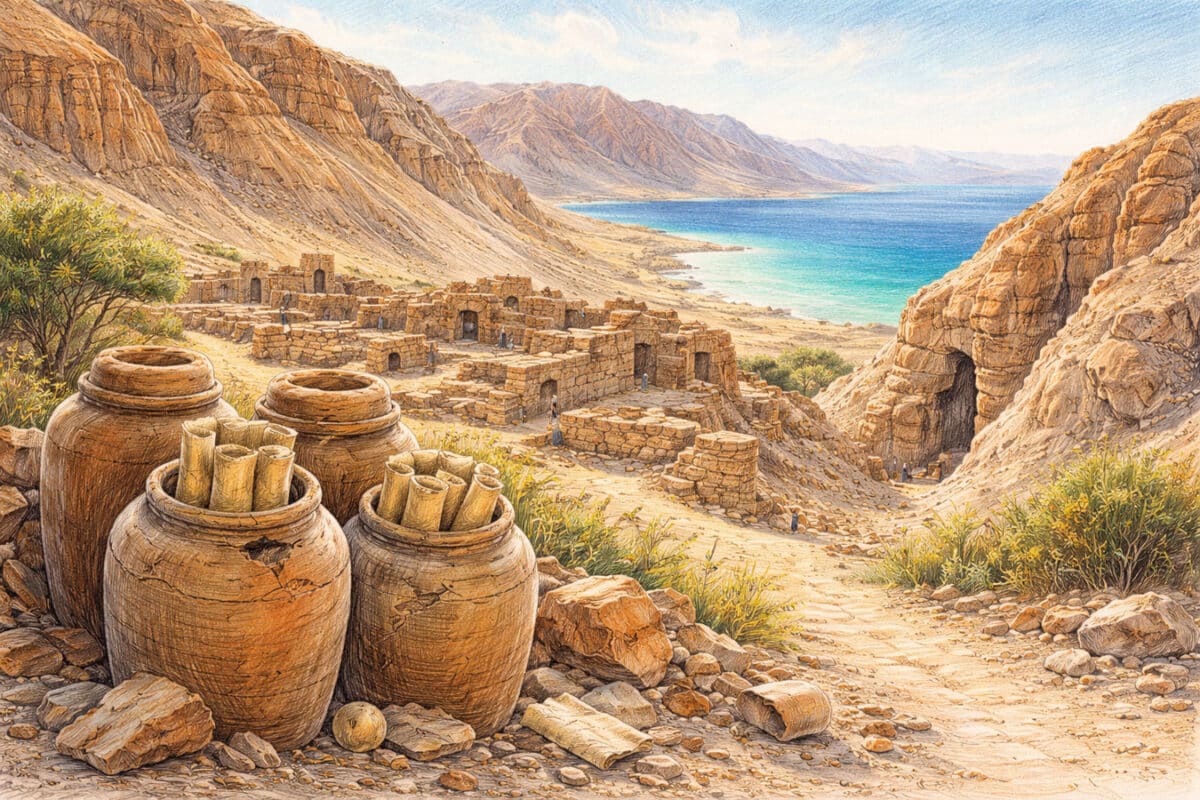
Qumran and the Dead Sea Scrolls are one of those topics where a successful name immediately sets both geography and intrigue. On one hand, it is a real point on the map near the Dead Sea in the Judean Desert, not far from Jerusalem. On the other hand, it is a huge corpus of texts found in caves and surroundings that changes the understanding of the religious and intellectual life of Judea at the turn of our era. That is why the question “what is Qumran” almost always leads to the next: “who wrote these scrolls and why did they end up in the caves.”

Why they are called “Dead Sea Scrolls”

Qumran and the Dead Sea Scrolls: how desert caves changed the understanding of ancient Judaism

In the interview, Chernoivanenko begins with a mundane but illustrative story: when he defended his dissertation on this topic (2012), one of the council members was surprised by the very phrase “manuscripts of the sea” — like, “how can there be manuscripts of some sea.” But the name “Dead Sea Scrolls” (as well as “Qumran Scrolls”) is an established term in different languages, including Ukrainian, English, French, and Hebrew.

The term is also important because it fixes the difference between “Dead Sea Scrolls” in a broad sense and “Qumran Scrolls” in a narrow sense. The Dead Sea Scrolls are finds from various locations near the Dead Sea, while “Qumran” refers to those found specifically in the Qumran area. At the same time, the largest array of finds is indeed associated with Qumran, so in the public consciousness, everything often “collapses” into one point.

Where is Qumran and what is this place

Qumran is not a city in the usual sense. Chernoivanenko emphasizes: debates about what exactly Qumran was (a settlement, the center of some group, an economic object, something else) continue to this day. But as a geographical location, it is described quite clearly.

We are talking about a territory that today belongs to the State of Israel. In ancient times, these lands were called differently in different eras: the Kingdom of Israel, the Kingdom of Judah, and in Roman times — Palestine (at the same time, the term “Palestine,” as the expert reminds, was not the original name of these lands but was fixed later and “stretched” to modern political lexicon).

Geographically, Qumran is located on the northwest of the Dead Sea, in the Judean Desert, near Jerusalem. In literature, the names Khirbet Qumran and Wadi Qumran are encountered. “Wadi” is an Arabic word for a dry riverbed of a seasonal desert river: in the region, rains occur mainly in winter, water appears, but then quickly disappears, the land dries up and cracks. “Khirbet” means “ruins” — that is, the name itself refers to something destroyed, to the remnants of a former structure.

What dates are associated with the scrolls and why is it important

If we “reduce” the finds to a historical range, Chernoivanenko names the period from the 2nd century BCE to the 1st century CE. At the same time, according to him, there are relatively few finds from the 2nd century BCE, the main array relates to the 1st century BCE and the 1st century CE.

This is a key point for explaining why the Dead Sea Scrolls became a global scientific “magnet.” We are talking about a time when different religious and political movements existed in Judea, complex internal processes were taking place, and in a broader context, an environment was forming from which early Christianity later emerged. The scrolls become an additional source, not reducible only to the texts of the New Testament or later retellings.

What languages are the scrolls written in

According to Chernoivanenko, three languages are recorded among the finds: ancient Hebrew, Aramaic, and a little ancient Greek. The appearance of Greek is associated with the post-Hellenistic era when Greek culture spread to the Middle East and became part of the regional reality.

This is not just a “detail for reference.” Multilingualism helps explain how heterogeneous the intellectual environment was and how different audiences could be involved in the production, reading, and copying of texts.

How and when were the scrolls discovered

The first discovery of the scrolls Chernoivanenko dates to 1947. He mentions the “legendary” story of a Bedouin who supposedly stumbled upon jars and found the first scrolls. Further interest in the finds grew: in the 1950s-60s, archaeologists and researchers became active, excavations and research continued then with interruptions, not only in Qumran but also in other points around the Dead Sea — finds “accumulated” over time.

Another important point: access to the scrolls was long restricted — almost until the 1990s. At the same time, the volume of scientific reaction was colossal. The expert says that in the first decade of Qumran studies, research on this topic in scale was second only to biblical studies (Bible research): it was about thousands of works, and he provides a benchmark — about six thousand studies in the first decade.

How many scrolls exist and in what form have they survived

Speaking of manuscript material, not everything has survived intact. Many texts have been preserved in fragments, sometimes very small. But in general, according to Chernoivanenko, more than a thousand “manuscript units” have been found.

This immediately affects how a researcher’s work looks: reconstruction, comparison of handwriting, materials, text variants, attempts to understand which fragments relate to what, and what exactly was in the hands of people two thousand years ago.

What’s inside: it’s not a “chronicle,” but a motley library

One of the most common mistakes is to expect that the Dead Sea Scrolls will be something like a coherent chronicle of events, a “diary of the era,” or systematic annals. Chernoivanenko speaks directly: there are no chronicles in this corpus. Yes, in the biblical tradition there are chronicle books or books of kings, where reigns and events are described, but there is almost none of this in the Dead Sea Scrolls.

But there is something else: extraordinary genre diversity and multilayeredness. The expert emphasizes that the corpus is heterogeneous not only in languages. There are many different handwritings — that is, a significant number of people were involved in the creation/copying of texts. There are also texts of an eschatological, apocalyptic, messianic nature, which, in his assessment, shows how society of that time lived with expectations of “end times.” This, in particular, helps to better understand the context in which early Christianity emerged: initially, it looked like one of the movements within Judaism of that era, and the scrolls demonstrate the diversity of such movements.

In addition, among the scrolls, there are very different types of documents: from actual biblical books (for example, prophetic) to texts that can be called non-canonical, as well as commentaries on biblical books (exegesis). Chernoivanenko mentions unexpected genres — for example, horoscopes. And another important feature: many texts work through allusions, so researchers sometimes tried to “read” historical events and characters of the era indirectly, through hints and images.

What editions are available and why translations are a separate problem

Chernoivanenko notes that today there are several editions of the entire corpus of the Dead Sea Scrolls. There are practically no Ukrainian translations (he says he translated a small volume in an appendix to his own book). In Russian, there were separate attempts back in Soviet times and later — in the post-Soviet period, publications with the most famous texts were released, but not the entire corpus.

The full corpus is published, according to him, in English and Hebrew, there are also bilingual versions, where the original and translation are side by side. He separately mentions the digital format: when high-quality scans of the scrolls are available, and the user can hover over a word and see a hint with reading, meaning, and translation. Importantly, this changes the accessibility of the material compared to the era when the scrolls were “closed” to most researchers.

Main debates: who are the authors and what is Qumran

The interview outlines the basic framework of the discussion, with which, according to Chernoivanenko, almost any serious conversation about the scrolls begins: there are two big questions.

The first is what Qumran was as a place.

The second is who wrote the Dead Sea Scrolls (and, in particular, the Qumran Scrolls).

Chernoivanenko explains that he systematically analyzed these questions in his book “Qumran and the Dead Sea Scrolls: Authorship, Identification, Historiography,” where he collected and analyzed different theories and hypotheses.

The most famous version: the “Qumran-Essene” theory and its logic

The first, most popular in mass perception version arose very early — almost immediately after the 1947 finds. A group of researchers formed, and then an international team, where not everyone was admitted. Chernoivanenko separately emphasizes a characteristic detail: among this team, there was not a single Jew; key roles were played by Christians, including Catholic monks. The central figure of this early wave was the priest and researcher Roland de Vaux.

Their picture looked like this: Qumran was presented as something like an “ancient monastery” with a scriptorium — a place where scribes sat and copied/wrote scrolls. The image is clear: an ascetic group, discipline, text production, storage.

At the same time, Qumran as an archaeological point was known since the 19th century — Chernoivanenko mentions the French archaeologist Clermont-Ganneau, who paid attention to the place long before the discovery of the scrolls. And the “attachment” to a specific group early researchers tried to support with ancient authors: Josephus Flavius, Philo of Alexandria, and Pliny the Elder. In their texts, a group of Essenes is described — mysterious, marginal, ascetic, living in anticipation of the end times.

And then a logical “glue” occurs: ancient sources talk about Essenes in the area of the northwest Dead Sea; in this area, there is Qumran; therefore, Qumran is the place of the Essenes; therefore, they could be the authors/keepers of the scrolls.

Chernoivanenko, however, shows why this version raises questions. One of the sharp points: in ancient descriptions, it is said that the Essenes did not marry, which for Judaism looks marginal against the backdrop of the biblical commandment “be fruitful and multiply.” It can be assumed that a small ascetic group existed — but it can also be argued how accurate and “non-mythological” this image is.

Alternative: “Jerusalem theory” and arguments against the idea of a “small community of scribes”

Then Chernoivanenko moves to a position he considers an important alternative and without which the conversation would be incomplete. He associates it with the works of his scientific mentor — University of Chicago professor Norman Golb. Golb published a key article in 1980, and then developed ideas in subsequent works and in the book “Who Wrote the Dead Sea Scrolls?” in the 1990s.

The essence of the “Jerusalem theory” is that many features of the corpus point not to a small isolated community in Qumran, but to a large urban center — Jerusalem.

The arguments in the interview are presented step by step.

First, different content and different genre: within the corpus, there are texts that are sometimes simply incompatible with each other in spirit and ideas. This poorly fits the image of a “single community” with a single charter and uniform practice.

Second, the number of different handwritings and the scale of manuscript work. Chernoivanenko explains in detail who a professional scribe is in the Jewish tradition. This is not “a person who sat down and copied.” This is a trained specialist, a calligrapher, a profession with discipline and training. In Judaism, this practice has been preserved for centuries, and the profession of sofer — a scribe of sacred texts — still exists. He provides understandable examples from modern life: Torah scrolls in a synagogue, mezuzahs on doors, where inside lies a handwritten text — all this must be written professionally and according to the rules.

From here, the conclusion: it is hard to imagine a small community where there would be “incredibly many” qualified scribes — this would look like a statistically and socially unrealistic model. But in Jerusalem, the capital of Judea at that time, the existence of many groups, schools, traditions, and scribes looks much more plausible.

Then the next question arises: if “all roads lead to Jerusalem,” how did the scrolls end up in the caves near the Dead Sea, including the Qumran area?

The answer in the interview is tied to the historical context of the Jewish War of 66–73 CE. In 70, the Romans took Jerusalem. In Golb’s logic, this triggers a scenario of saving values: people flee the city, take out what they consider important, including scrolls. Chernoivanenko mentions that Josephus Flavius describes the directions of the movement of refugees from Jerusalem, and one of the directions was the area of the Dead Sea.

Then a simple human mechanism comes into play: life is more important than things. If a person understands that they may not escape pursuit, they may hide valuable things “for better times.” The caves near the Dead Sea could become such hiding places. In this model, the scrolls lay for almost two thousand years and “returned” in the 20th century as an archaeological sensation.

Why the topic is important today, including the Ukrainian context

Chernoivanenko emphasizes several times that the Dead Sea Scrolls are not “exotic for narrow specialists,” but a source that expands knowledge about what Jewish society of that time was like, what ideas circulated, what expectations and disputes looked like within the religious environment. This corpus provides material “from the side” of the New Testament and allows us to see that era differently, when messianic and apocalyptic motifs were part of everyday intellectual life.

A separate line in the original source states that the project (within which the conversation took place) was prepared with the support of the Canadian non-governmental organization “Ukrainian-Jewish Encounter” (UJE). This emphasizes that the conversation about Qumran and the scrolls is not only an “Israeli” topic: it exists in both the academic and cultural agenda of Ukraine, where Judaic studies are developing as an independent direction, connected with libraries, universities, translations, and scientific discussions.

In a practical sense, the main outcome of the interview is this: Qumran is geography, and the Dead Sea Scrolls are a corpus that is too diverse to be “closed” forever with one convenient version. The more texts, technologies, and parallel studies are opened, the more noticeable it becomes that the answers here will be refined for a long time. That is why Qumran studies remain a living discipline — not museum-like, but working, arguing, and reassembling details anew.

And for the Israeli audience, it is also a reminder: the Judean Desert, Jerusalem, and the Dead Sea are not only tourist spots but also places where texts literally lay that defined the language of conversations about the Bible, Judaism, and early Christianity for two thousand years ahead — and these texts continue to influence how the world reads the region today. NAnovosti — News of Israel | Nikk.Agency

“Bright Summer” in Tel Aviv: Ukrainian children’s camp for children aged 7–12 will take place in July 2026

A new Ukrainian space for children will appear in Tel Aviv this summer. Ukrainian Meetings in Israel are launching a children’s summer camp “Bright Summer” for the first time — a series of three thematic meetings for children 7–12 years old.

The camp will be held on Fridays — July 10, 17, and 24, 2026 — at the Ukrainian Cultural Center in Tel Aviv, located at Yirmeyahu / ירמיהו 22, Tel Aviv-Yafo. Each meeting will last from 11:00 to 14:00.

For Ukrainian families in Israel, this is not just another summer activity for the child. It is an opportunity to spend part of the holidays in a warm environment where children can meet, play, create, communicate, and feel connected to two important worlds at once — Ukraine and Israel.

What is “Bright Summer”

'Bright Summer' in Tel Aviv: Ukrainian children's camp for children 7–12 years old will be held in July 2026
‘Bright Summer’ in Tel Aviv: Ukrainian children’s camp for children 7–12 years old will be held in July 2026

Organizers describe the camp as a series of thematic meetings during the summer holidays. The idea of the project is to create a safe, friendly, and lively space for children where they can find new friends from the community, try their hand at creativity, participate in team games, and simply have a good time among peers.

Participants can expect creative workshops, active and team games, activities for acquaintance and interaction, a light snack, and an atmosphere where the child feels comfortable being themselves.

It is particularly important that the organizers consciously make a small group — about 12–15 children. This format allows attention to be given to each child, without turning the camp into a noisy mass platform where someone quickly gets lost or stays on the sidelines.

For parents, this is especially important: in the summer in Israel, many families are looking not just for “where to take the child for a few hours,” but a place that is warm, calm, understandable in terms of values, and close in cultural environment.

When and where the camp will take place

The Ukrainian children’s camp “Bright Summer” will be held in Tel Aviv on three Fridays in July:

July 10, 2026
July 17, 2026
July 24, 2026

Time of each meeting: 11:00–14:00.

Venue — Ukrainian Cultural Center in Tel Aviv, ירמיהו 22 / Yirmeyahu 22, Tel Aviv-Yafo.

The event organizer is Ukrainian Meetings in Israel, a community that has long been creating a space for Ukrainian families in Israel. Now special attention is being paid to children — those who especially need communication, movement, creativity, and a sense of belonging during the summer holidays.

Why this is important for Ukrainian families in Israel

After moving, war, adaptation, and living between languages, children often lack their understandable circle. Israel provides safety and new opportunities, but it is important for children to maintain the Ukrainian part of their identity — not through heavy conversations, but through friendship, games, creativity, songs, shared memories, and simple summer meetings.

That is why the format of “Bright Summer” seems especially relevant. It is not a school lesson or an official event. It is a light summer program where a child can communicate, get to know other children, participate in activities, and feel that the Ukrainian community in Israel is not only adult meetings, news, and help, but also children’s joy.

For NAnews — News of Israel, such events are also important because they show the lively side of the Ukrainian-Israeli community. Behind big topics — war, politics, repatriation, security — there is the ordinary life of families, children, parents, and local initiatives.

The summer camp in Tel Aviv is just such a story: small in scale, but very human in meaning.

What will be in the program

Organizers promise participants:

  • creative workshops;
  • active and team games;
  • activities for acquaintance and interaction;
  • a light snack;
  • a safe and friendly atmosphere;
  • a space for communication for children 7–12 years old.

Details about the program of each meeting, the daily schedule, the team, participation conditions, frequently asked questions, and the registration form are published on the camp’s website. Parents can view the information and register their child on the project page: https://sites.google.com/view/bright-summer-camp

The number of places is limited, as the group is small. Organizers advise not to delay registration if the family plans to participate.

Event poster

Event: Ukrainian children’s summer camp “Bright Summer”

City: Tel Aviv

Dates: July 10, 17, and 24, 2026

Time: 11:00–14:00

Venue: Ukrainian Cultural Center in Tel Aviv

Address: Yirmeyahu / ירמיהו 22, Tel Aviv-Yafo

Age: children 7–12 years old

Group: up to 12–15 children

Organizer: Ukrainian Meetings in Israel

Registration and details: https://sites.google.com/view/bright-summer-camp

Summer for children should not only be a time without school, but also a time of new acquaintances, discoveries, movement, and joy. In July 2026, Ukrainian families in Israel will have another opportunity to give children just such a summer — bright, warm, friendly, and connected with Ukraine.

For readers of NAnews — News of Israel, this event can be seen as part of a broader picture: the Ukrainian community in Israel not only preserves memory and responds to the events of the war but also builds everyday life in which children have their place, their circle, and their summer stories.

Odessa awarded the title of Honorary Citizen to Roman Shvartsman, a Holocaust witness, head of the Association of Jewish Prisoners of Ghettoes and Concentration Camps

On September 2, 2025, Odessa Mayor Gennady Trukhanov, on behalf of the entire city, presented Roman Shvartsman with the title of “Honorary Citizen of the City of Odessa”.

They congratulate him warmly and in a homely way, calling him “our Romochka”. They emphasize that he truly deserves this award.

As is customary in Jewish tradition, they wish him “Mazal Tov” and long life – “up to 120”.

It is noted that Roman Markovich managed to survive Nazism and the Soviet system, and there is confidence that he will cope with modern challenges, including Rashism.


Roman Markovich Shvartsman, born on November 7, 1936, in Bershad, Vinnytsia region, at the age of five, ended up in the Bershad ghetto, where he spent 3.5 years in inhumane conditions. This experience left an indelible mark on his fate and became the foundation of his struggle for truth and memory.

According to Odessa portal “Dumskaya”, the city council plans to confer this title on him in the near future.

Roman Shvartsman himself confirmed this information to a “Dumskaya” correspondent and shared his emotions.

“For me, it is a great honor and deep excitement to be presented for the title of Honorary Citizen of Odessa,” Shvartsman noted.

He added that this is the highest award from the city where he has lived his entire life after the war, and which has become for him a “source of revival and strength.”

“This is recognition not only of my work but of everyone whose memory I try to preserve. All those who passed through ghettos and concentration camps. All who gave their lives fighting Nazism. All who today fight for Ukraine’s independence… The title of ‘Honorary Citizen of Odessa’ is not just for me. It is for everyone who survived, who remembers, who passes the truth on. It is for Odessa, which has always been a multicultural, free, and strong-spirited city. I am grateful to everyone who supports this initiative. For me, this is not the end, but a new obligation: to work even harder, speak even louder, and remember even deeper,” said Roman Shvartsman.

After the war ended in 1955, he moved to Odessa, where he studied at Vocational School No. 2 as a “mechanic-assembler.” Later, he graduated from the Odessa Institute of Marine Engineers, becoming a mechanical engineer. His entire working life was connected to the “Poligraphmash” factory, where he worked for over 30 years, showing the highest professionalism and dedication.

Decades of community work

Since 1990, Roman Shvartsman has been actively involved in public life as the head of the Odessa Regional Association of Jews – former prisoners of ghettos and concentration camps. In 1992, he became a member of the international organization of former prisoners of ghettos and concentration camps, founded in Odessa. He remains an active member, uniting those who remember the tragic pages of history.

Shvartsman also serves as the Vice President of the All-Ukrainian Association of Jews – former prisoners of ghettos and concentration camps, led by Boris Zabarko. He is also Deputy Chairman of the Council of the Odessa Society of Jewish Culture and Head of the socio-cultural center.

The Holocaust Museum and monuments – a lifetime’s work

Shvartsman played a huge role in creating the Holocaust Museum in Odessa, which opened on June 22, 2009. In his words:

“This museum should become a school, a university for the young, so that they understand what the Holocaust was.”

Today, the museum has over 4,000 exhibits and, over the years, has been visited by about 20,000 people – diplomats, students, schoolchildren, tourists, and Israelis, for whom the memory of the Holocaust is inseparable from their identity.

Thanks to Shvartsman’s persistence, over 30 monuments and memorials have been established in Odessa, Odessa region, and Mykolaiv region. Among them is the Memorial Complex on Lustdorf Road, the site where 25,000 Jews were killed. In 2015, in the village of Hvozdivka2, a mass grave containing the remains of 3,500 Jews was discovered, above which a memorial was erected at Shvartsman’s initiative.

“Wherever you dig, you’ll find bones – teeth and skulls. It’s horrible.”

Speech in the Bundestag and international recognition

On January 30, 2025, Roman Shvartsman spoke at the German Bundestag during a session dedicated to the memory of the victims of National Socialism. His words to the deputies became a symbol of the parallel between the horrors of the Holocaust and the modern aggression of putin against Ukraine:

“At that time, Hitler tried to kill me because I was a Jew. Now putin is trying to kill me because I am Ukrainian,” he declared, speaking in the German parliament on January 29, 2025, during the session dedicated to the memory of the victims of Nazism.

Shvartsman also called on Germany to actively support Ukraine and increase arms supplies:

“I appeal to you: arm us so that putin ends this war of annihilation.”

He especially emphasized Ukraine’s need for long-range missiles.

Shvartsman reminded everyone that it is the duty of current generations to prevent new catastrophes and protect civilians from violence.

His speech received a standing ovation and the support of German President Frank-Walter Steinmeier. He urged Germany to increase support for Ukraine and stressed the moral duty of everyone – to stop new barbarism.

Awards and recognition

For decades of work and service to society, Roman Shvartsman has received numerous awards:

  • Order of Merit III degree (2006) – for personal courage and the fight against fascism.
  • Order of Merit II degree (2013) – for the development of the veteran movement and patriotic education of the youth.
  • Order of Merit I degree (2018) – for outstanding contributions to the development of Ukraine and high professionalism.
  • Title of “Honored Machine Builder of the Ukrainian SSR” (1989).
  • Medals “For Labor Distinction” (1977) and “Veteran of Labor” (1985).
  • Honorary award of the Odessa mayor “Labor Glory.”
  • German Cross of Merit (2003).
  • Jubilee medals for national and international merits.

Memories of the Holocaust

Recalling his childhood, Roman Shvartsman shared that in early July 1941, his mother tried to evacuate with eight children. However, due to the advance of German and Romanian troops, the evacuation attempt failed. In August 1941, the occupiers entered Bershad and created two ghettos, one of which housed Shvartsman’s family.

25,000 Jews from Bessarabia and Vinnytsia region were deported to the ghetto. During the years of occupation, the Nazis murdered 13,871 Jews.

In 1942, while Roman’s older brother was working on repairing a bridge over the Dokhno River, he was shot by Romanian guards. This tragedy formed the basis for one of the films by Israeli director Boris Mavtzer. Shvartsman recalls the unbearable living conditions, constant hunger, and fear. On March 29, 1944, the town of Bershad was liberated.

Odessa honors its hero

Today, the Odessa City Council is preparing to confer the title of Honorary Citizen on Roman Shvartsman. For Shvartsman himself, this is not just an honor, but a new challenge and responsibility:

“This is recognition not only of my efforts but of all those who survived the Holocaust and continue to fight for Ukraine’s freedom.”

The site NAnews – Israel News emphasizes: Shvartsman’s fate is an important example of the unity of the Jewish and Ukrainian peoples, who together oppose hatred and aggression.

The story of Roman Shvartsman is a reminder that the Jewish people and Ukrainians, despite all trials, continue to fight for truth and freedom. The site NAnews – Israel News is confident: such heroes help us remember the lessons of the past and build a peaceful future.

Iran has strengthened amid a weakened Russia: why this is important for Ukraine and Israel

Inside the ‘axis of evil’, where Russia, Iran, and North Korea have tried for years to appear as a unified anti-Western bloc, noticeable reshuffles have begun. And the most unpleasant for the Kremlin is that Russia no longer appears as the main center of power in this structure.

After another round of conflict with the US, it is Tehran that emerges from the situation more confidently than Moscow. For Ukraine, this may seem unexpected, but the weakening of Russia’s role within this group works to our advantage: the less influence the Kremlin has among its own allies, the harder it is for it to turn the war against Ukraine into a common agenda for the anti-Western camp.

Iran looks stronger than Moscow — and this changes the balance

Iran turned out to be the only capital in this bloc that withstood direct military-diplomatic pressure from the US and did not appear weaker afterward. Against the backdrop of Russia, bogged down in the war against Ukraine, Tehran, on the contrary, demonstrates resilience and tries to raise its political price.

Moscow, on the other hand, increasingly looks not like a leader, but like a state forced to cling to old threats, nuclear blackmail, propaganda, and dependence on partners it once tried to lecture.

This is an important shift. For years, Russia has sold itself as the main center of power for anyone who wants to oppose the West. But today, it itself needs Iranian technologies, North Korean ammunition, bypass schemes, and foreign political loyalty.

Why this might be beneficial for Ukraine

For Ukraine, any loss of Russian monopoly within such a bloc matters.

If the Kremlin is no longer perceived as the main player, it is harder for it to impose its agenda on partners. Moscow wants the war against Ukraine to appear as part of a large global confrontation. But when Iran begins to play more independently and confidently, the Russian war no longer appears to all of the Kremlin’s allies as the only topic.

This does not make Iran safe. Quite the opposite. But within the camp hostile to Ukraine and Israel, competition, jealousy, and a struggle for first place emerge.

For Kyiv, this is a window of opportunity. The less unconditional authority Russia has, the harder it is for it to gather weapons, technologies, money, diplomatic gestures, and silent consent around its aggression.

Israel faced a more dangerous regional reality

For Israel, this same situation looks much more alarming.

If Iran emerges from the conflict with the feeling that it withstood the pressure and did not lose, it may strengthen its positions in the Middle East. Tehran can perceive what is happening as proof of its own resilience, and therefore act more harshly through allied structures, political pressure, and proxy groups.

Therefore, it is important for the Israeli audience to look at this topic more broadly. This is not only the Ukrainian war and not only Russian weakness. It is a chain of crises where Ukraine, Israel, the US, Iran, and Russia are much more closely connected than it seems at first glance.

In this context, NAnews — Israel News | Nikk.Agency views what is happening as a signal of a redistribution of forces: Moscow is weakening, Tehran is trying to take a higher place, and Israel and Ukraine are forced to assess the new reality without illusions.

Why this is unpleasant for the Kremlin

For many years, Russia built the image of a power supposedly capable of dictating terms to both the West and its own partners. But the full-scale war against Ukraine gradually destroyed this image.

The Kremlin spends enormous resources, suffers military and economic losses, depends on supplies of Iranian drones, North Korean shells, and gray schemes. Such dependence poorly matches the claim to the role of leader.

In this situation, Iran may already look at Russia not as a senior partner, but as a weakened ally that itself needs help.

The Kazan Declaration showed the limits of Putin’s influence

A telling example is the final Kazan Declaration after the ASEAN summit. Despite Putin’s personal attempts to achieve a clear position on Ukraine from the participants, the final document did not contain formulations that could be called support for the Kremlin’s version of the war.

Instead of Russian narratives, there remained standard references to the UN Charter and international law. The only thing that can be loosely linked to the Russian-Ukrainian war is a general phrase about the desire to resolve conflicts diplomatically.

For Moscow, this is a weak result.

The Kremlin wanted to get a political symbol and show that a significant part of the world is ready to accept its explanation of aggression against Ukraine. But instead, it received a cautious document without direct support for Russian demands.

Russia’s economy is entering a risk zone

Russia is losing even temporary economic advantages that previously helped the Kremlin maintain the situation.

For the Russian system to receive a serious financial respite, world oil prices would have to rise to about $200 per barrel and stay at that level not for a few days, but at least a year. Such a scenario now looks extremely unlikely.

That is why nervous movements within the Russian financial system become especially indicative. The decision of the Central Bank of Russia on June 19 to lower the key rate by 0.25% looks not like a sign of confidence, but as an attempt to respond to an approaching economic storm.

For Ukraine, this is important because Russia’s war is held not only on missiles, mobilization, and propaganda.

It is held on money. If the financial base begins to crack, it becomes harder for the Kremlin to simultaneously wage war, buy the loyalty of elites, maintain a repressive apparatus, and portray stability to the population.

What this means for us

We see a situation where Russia no longer appears as an unconditional leader even among its own allies. Iran is strengthening, North Korea is bargaining, and the countries of the global South are in no hurry to sign up for the Kremlin’s version of the war against Ukraine.

For Israel, this is an alarming signal due to the strengthening of Iran.

For Ukraine, it is an opportunity. Not an automatic victory and not a quick breakthrough, but an important strategic shift. The more contradictions within the hostile bloc, the weaker Russia’s ability to turn the war against Ukraine into a ‘common war’ of all anti-Western forces.

That is why the current reshuffles need to be read carefully. Behind diplomatic formulations, economic decisions, and changes in balance within this group lies a simple reality: the Kremlin is losing room for maneuver.

And this already works against Russia — and in favor of Ukraine.